


EN 61192-3:2003
(Main)Workmanship requirements for soldered electronic assemblies - Part 3: Through-hole mount assemblies
General Information
- Abstract
Specifies general requirements for workmanship in through-hole mount soldered assemblies on organic substrates, on printed boards, and on similar laminates attached to the surface(s) of inorganic substrates. It applies to assemblies that are totally through-hole or mixed assemblies that include surface-mounting or other related assembly technologies, for example, terminals, wires.
- Status
- Withdrawn
- Publication Date
- 19-Feb-2003
- Technical Committee
- CLC/SR 91 - Electronics assembly technology
- Drafting Committee
- IEC/TC 91 - IEC_TC_91
- Parallel Committee
- IEC/TC 91 - IEC_TC_91
- Current Stage
- 9960 - Withdrawal effective - Withdrawal
- Start Date
- 03-Apr-2019
- Completion Date
- 25-Aug-2026

Relations
- Effective Date
- 10-Feb-2026
- Effective Date
- 09-Feb-2026
- Effective Date
- 03-Feb-2026
- Effective Date
- 03-Feb-2026
- Effective Date
- 03-Feb-2026
- Effective Date
- 03-Feb-2026
- Effective Date
- 03-Feb-2026
- Effective Date
- 03-Feb-2026
- Referred By
EN 61192-1:2003 - Workmanship requirements for soldered electronic assemblies - Part 1: General - Effective Date
- 03-Feb-2026
- Effective Date
- 03-Feb-2026
- Effective Date
- 03-Feb-2026
- Effective Date
- 03-Feb-2026
- Effective Date
- 03-Feb-2026
Frequently Asked Questions
EN 61192-3:2003 is a standard published by CLC. Its full title is "Workmanship requirements for soldered electronic assemblies - Part 3: Through-hole mount assemblies". This standard covers: Specifies general requirements for workmanship in through-hole mount soldered assemblies on organic substrates, on printed boards, and on similar laminates attached to the surface(s) of inorganic substrates. It applies to assemblies that are totally through-hole or mixed assemblies that include surface-mounting or other related assembly technologies, for example, terminals, wires.
Specifies general requirements for workmanship in through-hole mount soldered assemblies on organic substrates, on printed boards, and on similar laminates attached to the surface(s) of inorganic substrates. It applies to assemblies that are totally through-hole or mixed assemblies that include surface-mounting or other related assembly technologies, for example, terminals, wires.
EN 61192-3:2003 is classified under the following ICS (International Classification for Standards) categories: 31.190 - Electronic component assemblies. The ICS classification helps identify the subject area and facilitates finding related standards.
EN 61192-3:2003 has the following relationships with other standards: It is inter standard links to IEC 60194:1999, EN 1171:2002, EN 61191-1:1998, EN 61191-2:1998, EN 61191-4:1998, EN 61191-3:1998, EN 61192-5:2007, EN 61192-4:2003, EN 61192-1:2003, EN 60068-2-82:2007, EN 61193-1:2002, EN 61192-2:2003, EN IEC 60068-2-82:2019. Understanding these relationships helps ensure you are using the most current and applicable version of the standard.
EN 61192-3:2003 is available in PDF format for immediate download after purchase. The document can be added to your cart and obtained through the secure checkout process. Digital delivery ensures instant access to the complete standard document.
Standards Content (Sample)
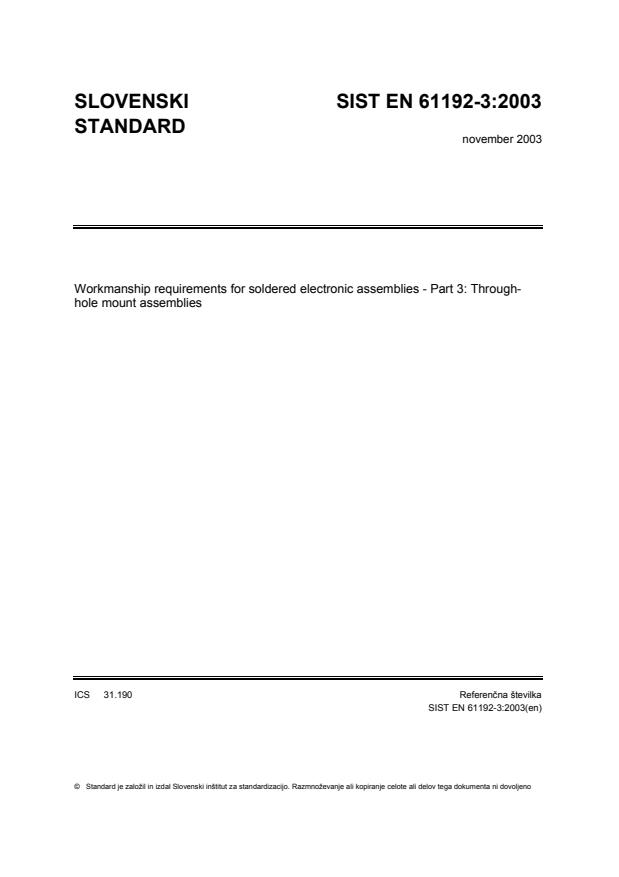
SLOVENSKI SIST EN 61192-3:2003
STANDARD
november 2003
Workmanship requirements for soldered electronic assemblies - Part 3: Through-
hole mount assemblies
ICS 31.190 Referenčna številka
© Standard je založil in izdal Slovenski inštitut za standardizacijo. Razmnoževanje ali kopiranje celote ali delov tega dokumenta ni dovoljeno
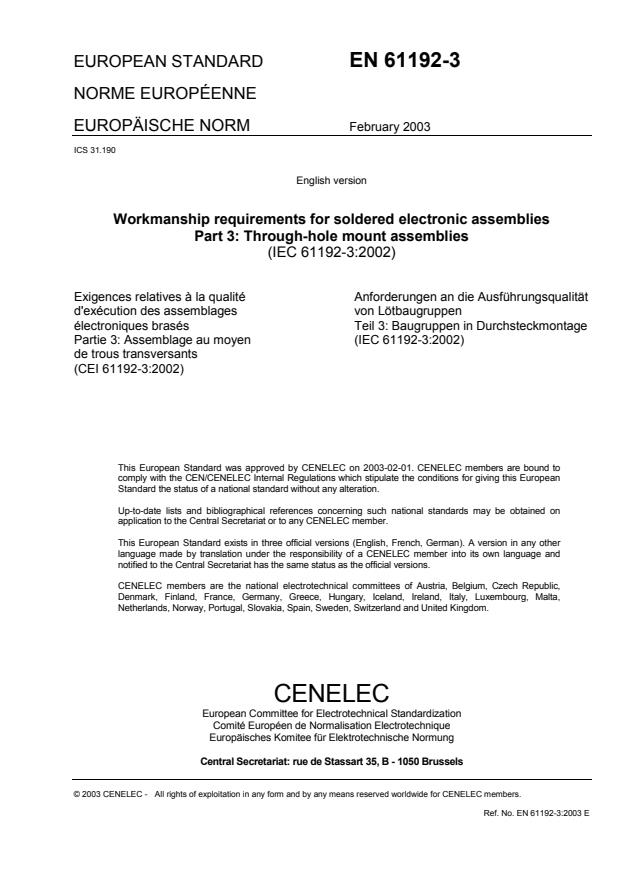
EUROPEAN STANDARD EN 61192-3
NORME EUROPÉENNE
EUROPÄISCHE NORM February 2003
ICS 31.190
English version
Workmanship requirements for soldered electronic assemblies
Part 3: Through-hole mount assemblies
(IEC 61192-3:2002)
Exigences relatives à la qualité Anforderungen an die Ausführungsqualität
d'exécution des assemblages von Lötbaugruppen
électroniques brasés Teil 3: Baugruppen in Durchsteckmontage
Partie 3: Assemblage au moyen (IEC 61192-3:2002)
de trous transversants
(CEI 61192-3:2002)
This European Standard was approved by CENELEC on 2003-02-01. CENELEC members are bound to
comply with the CEN/CENELEC Internal Regulations which stipulate the conditions for giving this European
Standard the status of a national standard without any alteration.
Up-to-date lists and bibliographical references concerning such national standards may be obtained on
application to the Central Secretariat or to any CENELEC member.
This European Standard exists in three official versions (English, French, German). A version in any other
language made by translation under the responsibility of a CENELEC member into its own language and
notified to the Central Secretariat has the same status as the official versions.
CENELEC members are the national electrotechnical committees of Austria, Belgium, Czech Republic,
Denmark, Finland, France, Germany, Greece, Hungary, Iceland, Ireland, Italy, Luxembourg, Malta,
Netherlands, Norway, Portugal, Slovakia, Spain, Sweden, Switzerland and United Kingdom.
CENELEC
European Committee for Electrotechnical Standardization
Comité Européen de Normalisation Electrotechnique
Europäisches Komitee für Elektrotechnische Normung
Central Secretariat: rue de Stassart 35, B - 1050 Brussels
© 2003 CENELEC - All rights of exploitation in any form and by any means reserved worldwide for CENELEC members.
Ref. No. EN 61192-3:2003 E
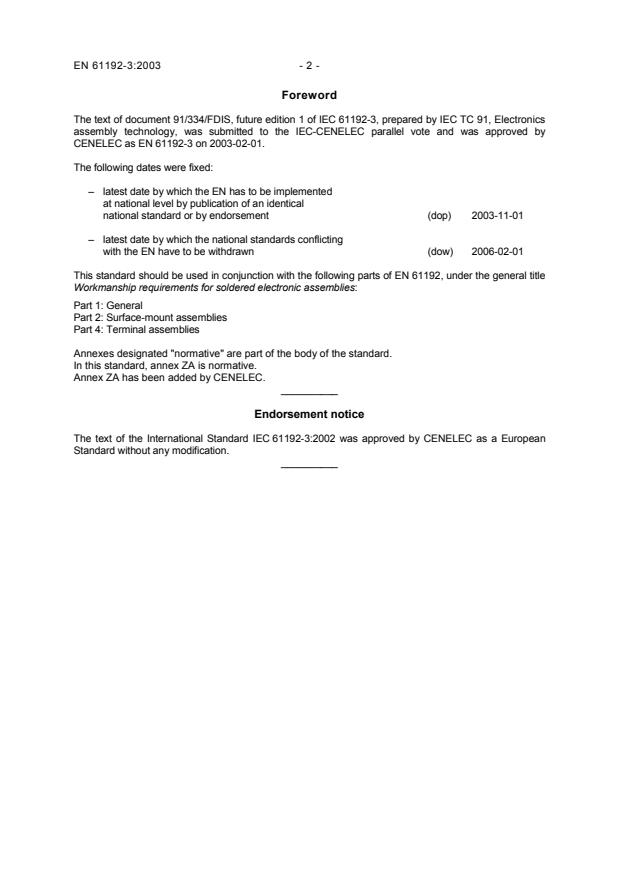
Foreword
The text of document 91/334/FDIS, future edition 1 of IEC 61192-3, prepared by IEC TC 91, Electronics
assembly technology, was submitted to the IEC-CENELEC parallel vote and was approved by
CENELEC as EN 61192-3 on 2003-02-01.
The following dates were fixed:
– latest date by which the EN has to be implemented
at national level by publication of an identical
national standard or by endorsement (dop) 2003-11-01
– latest date by which the national standards conflicting
with the EN have to be withdrawn (dow) 2006-02-01
This standard should be used in conjunction with the following parts of EN 61192, under the general title
Workmanship requirements for soldered electronic assemblies:
Part 1: General
Part 2: Surface-mount assemblies
Part 4: Terminal assemblies
Annexes designated "normative" are part of the body of the standard.
In this standard, annex ZA is normative.
Annex ZA has been added by CENELEC.
__________
Endorsement notice
The text of the International Standard IEC 61192-3:2002 was approved by CENELEC as a European
Standard without any modification.
__________
- 3 - EN 61192-3:2003
Annex ZA
(normative)
Normative references to international publications
with their corresponding European publications
This European Standard incorporates by dated or undated reference, provisions from other
publications. These normative references are cited at the appropriate places in the text and the
publications are listed hereafter. For dated references, subsequent amendments to or revisions of any
of these publications apply to this European Standard only when incorporated in it by amendment or
revision. For undated references the latest edition of the publication referred to applies (including
amendments).
NOTE When an international publication has been modified by common modifications, indicated by (mod), the relevant
EN/HD applies.
Publication Year Title EN/HD Year
1)
IEC 60194 - Printed board design, manufacture and - -
assembly - Terms and definitions
1)
2)
IEC 61191-1 - Printed board assemblies EN 61191-1 1998
Part 1: Generic specification -
Requirements for soldered electrical
and electronic assemblies using surface
mount and related assembly
technologies
1) 2)
IEC 61191-2 - Part 2: Sectional specification - EN 61191-2 1998
Requirements for surface mount
soldered assemblies
1) 2)
IEC 61191-3 - Part 3: Sectional specification - EN 61191-3 1998
Requirements for through-hole mount
soldered assemblies
1) 2)
IEC 61191-4 - Part 4: Sectional specification - EN 61191-4 1998
Requirements for terminal soldered
assemblies
1)
3)
IEC 61192-1 - Workmanship requirements for soldered EN 61192-1 -
electronic assemblies
Part 1: General
1) 3)
IEC 61192-2 - Part 2: Surface-mount assemblies EN 61192-2 -
1) 3)
IEC 61192-4 - Part 4: Terminal assemblies EN 61192-4 -
1)
Undated reference.
2)
Valid edition at date of issue.
3)
To be published.
NORME
CEI
INTERNATIONALE IEC
61192-3
INTERNATIONAL
Première édition
STANDARD
First edition
2002-12
Exigences relatives à la qualité d'exécution
des assemblages électroniques brasés –
Partie 3:
Assemblage au moyen de trous traversants
Workmanship requirements for
soldered electronic assemblies –
Part 3:
Through-hole mount assemblies
© IEC 2002 Droits de reproduction réservés ⎯ Copyright - all rights reserved
Aucune partie de cette publication ne peut être reproduite ni No part of this publication may be reproduced or utilized in any
utilisée sous quelque forme que ce soit et par aucun procédé, form or by any means, electronic or mechanical, including
électronique ou mécanique, y compris la photocopie et les photocopying and microfilm, without permission in writing from
microfilms, sans l'accord écrit de l'éditeur. the publisher.
International Electrotechnical Commission, 3, rue de Varembé, PO Box 131, CH-1211 Geneva 20, Switzerland
Telephone: +41 22 919 02 11 Telefax: +41 22 919 03 00 E-mail: inmail@iec.ch Web: www.iec.ch
CODE PRIX
X
Commission Electrotechnique Internationale PRICE CODE
International Electrotechnical Commission
ɆɟɠɞɭɧɚɪɨɞɧɚɹɗɥɟɤɬɪɨɬɟɯɧɢɱɟɫɤɚɹɄɨɦɢɫɫɢɹ
Pour prix, voir catalogue en vigueur
For price, see current catalogue
61192-3 © IEC:2002 – 3 –
CONTENTS
FOREWORD . 9
INTRODUCTION .13
1 Scope .15
2 Normative references.15
3 Terms and definitions.17
4 General requirements.17
4.1 Classification .17
4.2 Conflict .17
4.3 Inspection techniques .17
4.4 Interpretation of requirements .17
5 Component preparation processes .19
5.1 Lead forming.19
5.2 Lead protrusion and clinching.21
5.3 Lead cutting/cropping.25
5.4 Pre-tinning .27
6 Masking attributes.27
6.1 Misalignment .27
6.2 Improper adhesion .27
6.3 Thermal capability.31
7 Insertion of through-hole components.33
7.1 General requirements .33
7.2 Orientation and mounting criteria.35
7.3 Missing component .55
7.4 Wrong component.55
7.5 Damaged component .55
8 Soldering process attributes .63
8.1 General requirements .63
8.2 Misalignment .69
8.3 Damaged components .69
8.4 Solder joint characteristics .69
9 Cleaning attributes .81
9.1 Flux residues .83
9.2 Other residues .85
10 Rework/replacement attributes .93
Figure 1 – Lead forming, lead extension .19
Figure 2 – Lead forming, bend radius.19
Figure 3 – Straight and partially clinched leads .21
Figure 4 – Lead protrusion.21
Figure 5 – Lead protrusion, clinched .23
Figure 6 – Lead protrusion, partially clinched .23
Figure 7 – Clinched lead – Nonconforming.25
Figure 8 – Lead cutting, target .25
61192-3 © IEC:2002 – 5 –
Figure 9 – Lead cutting – Acceptable .25
Figure 10 – Lead cutting – Nonconforming.27
Figure 11 – Acceptable solder mask .29
Figure 12 – Solder mask – Cracking or blistered .29
Figure 13 – Solder mask – Loose particles.29
Figure 14 – Permanent solder-mask blisters or wrinkling.31
Figure 15 – Permanent solder-mask failure.31
Figure 16 – Solder-mask degradation .33
Figure 17 – Component orientation – Target .35
Figure 18 – Component orientation – Acceptable .35
Figure 19 – Component orientation – Nonconforming.37
Figure 20 – Radial lead component, horizontal installation – Target.37
Figure 21 – Radial lead component, horizontal installation – Acceptable.37
Figure 22 – Radial lead component, horizontal installation – Nonconforming .39
Figure 23 – Axial lead component, vertical installation – Target.39
Figure 24 – Axial lead component, vertical installation – Acceptable.39
Figure 25 – Axial lead component, vertical installation – Nonconforming .41
Figure 26 – Radial lead component, vertical mounting – Target.41
Figure 27 – Radial lead component, vertical mounting – Acceptable.41
Figure 28 – Radial lead component, vertical mounting – Nonconforming .43
Figure 29 – Axial lead component, horizontal mounting – Target/Acceptable .43
Figure 30 – Axial leaded component, horizontal mounting – Nonconforming .43
Figure 31 – Dual in-line packs (DIPs) – Target.45
Figure 32 – Dual in-line packs (DIPs) – Acceptable.45
Figure 33 – Dual in-line packs (DIPs) – Nonconforming.45
Figure 34 – Axial lead component, vertical mounting – Target .47
Figure 35 – Axial lead component, vertical mounting – Acceptable .47
Figure 36 – Axial lead component, vertical mounting – Nonconforming.49
Figure 37 – Coating meniscus in hole – Target .49
Figure 38 – Coating meniscus in hole – Acceptable .51
Figure 39 – Coating meniscus in hole – Nonconforming .51
Figure 40 – Leads crossing conductors – Acceptable .51
Figure 41 – Leads crossing conductors – Nonconforming.53
Figure 42 – Stress-relief axial leaded components .53
Figure 43 – Stress-relief radial leaded components.55
Figure 44 – Axial component lead damage – Acceptable.55
Figure 45 – Axial component lead damage – Nonconforming.57
Figure 46 – Damage to axial component body.57
Figure 47 – Axial lead component damage – Nonconforming.57
Figure 48 – Damage to axial component with glass body.59
Figure 49 – Damage to radial component body – Target.59
Figure 50 – Damage to radial component body – Acceptable.59
Figure 51 – Active area structural integrity – Nonconforming .61
Figure 52 – Dual in-line component – Target.61
Figure 53 – Dual in-line component – Acceptable.63
Figure 54 – Dual in-line component – Nonconforming .63
Figure 55 – Through-hole solder joints – Acceptable .65
61192-3 © IEC:2002 – 7 –
Figure 56 – Poor solder wetting – Nonconforming .65
Figure 57 – Excess solder, bridging – Nonconforming .65
Figure 58 – Excess solder − Mounting hole – Nonconforming.67
Figure 59 – Solder balls and splashes – Nonconforming .67
Figure 60 – Solder webs – Nonconforming.67
Figure 61 – Solder wetting – Target .69
Figure 62 – Solder wetting – Acceptable .69
Figure 63 – Hole fill and lead configuration – Acceptable.71
Figure 64 – Hole solder fill – Thermal plane .71
Figure 65 – Solder fillet – Target.73
Figure 66 – Solder fillet – Acceptable.73
Figure 67 – Solder fillet – Nonconforming .73
Figure 68 – Solder pin holes and voids – Acceptable.75
Figure 69 – Solder joints – Nonconforming.75
Figure 70 – Clinched leads − Non-plated through holes – Acceptable .77
Figure 71 – Clinched leads − Plated through holes – Acceptable .77
Figure 72 – Exposed basis metal – Acceptable .79
Figure 73 – Exposed basis metal – Nonconforming.79
Figure 74 – Trimmed leads – Acceptable .81
Figure 75 – Fractured leads – Nonconforming.81
Figure 76 – Cleaning – Acceptable .83
Figure 77 – Flux residue – Nonconforming.83
Figure 78 – Particulate matter.85
Figure 79 – Particulate residues .85
Figure 80 – Residue-free surface.87
Figure 81 – White residue.87
Figure 82 – Residue-free surface – Corrosion.89
Figure 83 – Corrosion residues – Acceptable .89
Figure 84 – Nonconforming residues .91
Figure 85 – Corrosion residues.91
Figure 86 – Embedded residues .93
Table 1 – Lead bend requirements.19
Table 2 – Lead protrusion requirements.21
Table 3 – Component to board space .43
Table 4 – Component-to-board spacing .47
Table 5 – Minimum component lead acceptance conditions.71
61192-3 © IEC:2002 – 9 –
INTERNATIONAL ELECTROTECHNICAL COMMISSION
____________
WORKMANSHIP REQUIREMENTS FOR
SOLDERED ELECTRONIC ASSEMBLIES –
Part 3: Through-hole mount assemblies
FOREWORD
1) The IEC (International Electrotechnical Commission) is a worldwide organization for standardization comprising
all national electrotechnical committees (IEC National Committees). The object of the IEC is to promote
international co-operation on all questions concerning standardization in the electrical and electronic fields. To
this end and in addition to other activities, the IEC publishes International Standards. Their preparation is
entrusted to technical committees; any IEC National Committee interested in the subject dealt with may
participate in this preparatory work. International, governmental and non-governmental organizations liaising
with the IEC also participate in this preparation. The IEC collaborates closely with the International Organization
for Standardization (ISO) in accordance with conditions determined by agreement between the two
organizations.
2) The formal decisions or agreements of the IEC on technical matters express, as nearly as possible, an
international consensus of opinion on the relevant subjects since each technical committee has representation
from all interested National Committees.
3) The documents produced have the form of recommendations for international use and are published in the form
of standards, technical specifications, technical reports or guides and they are accepted by the National
Committees in that sense.
4) In order to promote international unification, IEC National Committees undertake to apply IEC International
Standards transparently to the maximum extent possible in their national and regional standards. Any
divergence between the IEC Standard and the corresponding national or regional standard shall be clearly
indicated in the latter.
5) The IEC provides no marking procedure to indicate its approval and cannot be rendered responsible for any
equipment declared to be in conformity with one of its standards.
6) Attention is drawn to the possibility that some of the elements of this International Standard may be the subject
of patent rights. The IEC shall not be held responsible for identifying any or all such patent rights.
International Standard IEC 61192-3 has been prepared by IEC technical committee 91:
Electronics assembly technology.
The text of this standard is based on the following documents:
FDIS Report on voting
91/334/FDIS 91/351/RVD
Full information on the voting for the approval of this standard can be found in the report on
voting indicated in the above table.
This publication has been drafted in accordance with the ISO/IEC Directives, Part 2.
This standard should be used in conjunction with the following parts of IEC 61192, under the
general title Workmanship requirements for soldered electronic assemblies:
Part 1: General
Part 2: Surface-mount assemblies
Part 4: Terminal assemblies
61192-3 © IEC:2002 – 11 –
The committee has decided that the contents of this publication will remain unchanged until
2008. At this date, the publication will be
• reconfirmed;
• withdrawn;
• replaced by a revised edition, or
• amended.
61192-3 © IEC:2002 – 13 –
INTRODUCTION
This part of IEC 61192, combined with IEC 61192-1, is used to meet the end-product
requirements defined in IEC 61191-1 and IEC 61191-3.
This standard may be used to enable the suppliers and users of through-hole electronic
assemblies to specify good manufacturing practices as part of a contract.
The respective requirements and guidelines for surface-mount and terminal assemblies are
included in separate but related standard.
61192-3 © IEC:2002 – 15 –
WORKMANSHIP REQUIREMENTS FOR
SOLDERED ELECTRONIC ASSEMBLIES –
Part 3: Through-hole mount assemblies
1 Scope
This part of IEC 61192 specifies general requirements for workmanship in through-hole mount
soldered assemblies on organic substrates, on printed boards, and on similar laminates
attached to the surface(s) of inorganic substrates.
It applies to assemblies that are totally through-hole or mixed assemblies that include surface-
mounting or other related assembly technologies, for example, terminals, wires.
2 Normative references
The following referenced documents are indispensable for the application of this document. For
dated references, only the edition cited applies. For undated references, the latest edition of
the referenced document (including any amendments) applies.
IEC 60194, Printed board design, manufacture and assembly – Terms and definitions
IEC 61191-1, Printed board assemblies – Part 1: Generic specification – Requirements for
soldered electrical and electronic assemblies using surface mount and related assembly
technologies
IEC 61191-2, Printed board assemblies – Part 2: Sectional specification – Requirements for
surface mount soldered assemblies
IEC 61191-3, Printed board assemblies – Part 3: Sectional specification – Requirements for
through-hole mount soldered assemblies
IEC 61191-4, Printed board assemblies – Part 4: Sectional specification – Requirements for
terminal soldered assemblies
IEC 61192-1, Workmanship requirements for soldered electronic assemblies – Part 1: General
IEC 61192-2, Workmanship requirements for soldered electronic assemblies – Part 2: Surface-
mount assemblies
IEC 61192-4, Workmanship requirements for soldered electronic assemblies – Part 4: Terminal
assemblies
61192-3 © IEC:2002 – 17 –
3 Terms and definitions
For the purposes of this part of IEC 61192, the definitions of IEC 60194 apply.
4 General requirements
The requirements of IEC 61192-1 are mandatory for this standard.
4.1 Classification
The classification of assemblies is divided into three levels, that is, levels A, B, and C.
Definitions of the classification categories and the status of product for each level are given in
IEC 61192-1. In general, status is divided into three workmanship conditions, as follows:
a) target;
b) acceptable;
c) nonconforming.
4.2 Conflict
Accept and/or reject decisions shall be based on applicable documentation such as contracts,
drawings, specifications and reference documents.
In the event of conflict, the following order of precedence shall apply:
a) procurement documents as agreed between user and supplier;
b) master assembly drawing;
c) IEC 61191-1 and IEC 61192-1;
d) this standard;
e) other documents to the extent that they are specified in this standard.
4.3 Inspection techniques
For visual inspection, individual specifications may call for magnification aids for examining
printed-board assemblies.
Binocular vision should be used, and may be accomplished with a single large field magnifier.
Magnification of at least 3× shall be used for conventional inserted printed-board assemblies.
Magnification higher than 10× will not be found practicable for routine high speed scanning
inspection, but will be needed sometimes for detailed diagnosis or referee purposes.
4.4 Interpretation of requirements
Unless otherwise specified by the user , the word "shall" signifies that the requirement is
mandatory. Deviation from any "shall" requirement requires written acceptance by the user, for
example, via assembly drawing, specification or contract provision.
The words "should" and "may" reflect recommendations and guidance, respectively, and are
used whenever it is intended to express non-mandatory provisions.
61192-3 © IEC:2002 – 19 –
5 Component preparation processes
Component preparation processes shall be carried out in accordance with the requirements of
clause 6 of IEC 61192-1, using the methods described therein.
5.1 Lead forming
L
Acceptable – Level A, B, C
L
The straight portion of the lead L shall extend
by at least one lead diameter or thickness, but
not less than 0,8 mm from the body or weld
Solder before the start of the bend radius.
bead
L
Weld
IEC 2832/02
Figure 1 – Lead forming, lead extension
R
Acceptable – Level A, B, C
Lead is not kinked or cracked.
∅D
Rectangular leads shall use
R
the thickness T as the lead
diameter D.
T
IEC 2833/02
Figure 2 – Lead forming, bend radius
Table 1 – Lead bend requirements
D or T Level A, B and C
mm Min. R
1 D
≤0,8
0,8 to 1,2
1,5 D
2 D
≥1,2
61192-3 © IEC:2002 – 21 –
5.2 Lead protrusion and clinching
This subclause applies to wires and component leads installation in printed boards in a straight
through or clinched configuration.
5.2.1 Printed-board protrusion – Straight-through and partial clinching
Target – Level A, B, C
The protrusion of leads and wires beyond the
land is L or as specified on the specification or
L
L
drawing.
L = 1,0 mm nom.
IEC 2834/02
Figure 3 – Straight and partially clinched leads
Acceptable – Level A, B, C
1 The leads protrude beyond the land within
the specified minimum and maximum L,
provided there is no danger of violating
electrical spacing.
L
2 For single-sided boards, lead or wire
L
protrusion L shall be at least 0,5 mm for all
L min.
levels.
IEC 2835/02
3 For plated through-hole boards thicker
than 2,3 mm, components with pre-
established lead lengths (DIPs, sockets),
lead protrusion may not be visible.
Figure 4 – Lead protrusion
Table 2 – Lead protrusion requirements
Level B Level C
L min.
End is visible in the solder
mm
L max.
2,5 1,5
mm
61192-3 © IEC:2002 – 23 –
5.2.2 Printed-board protrusion – Clinched leads
This subclause applies to terminations with a clinching requirement. Other requirements may
be specified on relevant specifications or drawings.
Target – Level A, B, C
1 The lead end is parallel to the board and
the direction of the clinch is along the
connecting conductor.
NOTE Multilead DIP packages may have two
leads on opposite corners bent for retention
before soldering.
IEC 2836/02
Figure 5 – Lead protrusion, clinched
Acceptable – Level A, B, C
1 Partially clinched leads shall be bent
sufficiently to provide the necessary
H
mechanical restraint during the soldering
process. Alternate bend directions may be
used. Diagonally opposite corner leads on
DIPs may be partially clinched to retain
parts during soldering operations. DIP
leads should be bent outward away from
the longitudinal axis of the body.
2 The height of the protrusion beyond the
board is not greater than the similar length L
allowed for straight-through leads
(see 5.2.1).
H
3 The clinched lead does not reduce the
IEC 2837/02
separation between electrically non-
common conductors (H1).
Figure 6 – Lead protrusion, partially clinched
61192-3 © IEC:2002 – 25 –
Nonconforming – Level A, B, C
1 The height of the end of the clinched lead
extending beyond the board is less than L
in Figure 3.
2 The clinched lead extends more than L in
Figure 3, the maximum height allowed for
straight-through leads.
3 The lead is clinched toward an electrically
non-common conductor, reducing the
Non-common separation so that shorting is likely.
conductor
IEC 2838/02
4 Partial clinching of leads for part retention
shall be considered as unclinched leads
and shall meet the requirement of 5.2.1.
Figure 7 – Clinched lead – Nonconforming
5.3 Lead cutting/cropping
This subclause applies to component leads and wires which have been cut or cropped to
defined lengths before or after insertion.
Target – Level A, B, C
1 Lead is not distorted.
2 Little cut remnant.
3 No evidence of wire debris.
IEC 2839/02
Figure 8 – Lead cutting, target
<¼ diameter
Acceptable – Level A, B, C
1 Lead distortion is less than half of the lead
diameter.
2 The length of the cut remnant is less than
one quarter of the lead diameter.
3 No evidence of wire debris.
<½ diameter
<½ diameter
IEC 2840/02
Figure 9 – Lead cutting – Acceptable
61192-3 © IEC:2002 – 27 –
>¼diameter
Nonconforming – Level A, B, C
1 Lead distortion is more than half of the
lead diameter.
2 Cut remnant is longer than one quarter of
the lead diameter.
3 Evidence of loose wire debris.
>½ diameter >½ diameter
IEC 2841/02
Figure 10 – Lead cutting – Nonconforming
5.4 Pre-tinning
Component leads, terminations, and printed boards not meeting the designated solderability
requirements may be prepared or reworked by hot solder dip tinning or other suitable methods
prior to soldering. Tinned areas of wires shall not conceal the wire strand(s) with solder.
Wicking of solder under wire insulation shall be minimized. When required, heat sinks shall be
applied to leads of heat-sensitive parts during the tinning operation.
6 Masking attributes
When used, permanent and temporary solder masking shall preclude solder flow or wetting to
the masked areas during all soldering processes.
The substrate and conductor materials shall not have been degraded by masking materials.
Temporary masks shall be readily removable without creating damage or leaving residues
which are harmful to the integrity of the circuit wiring, conformal coating or assembly
connectors, etc.
6.1 Misalignment
The solder mask shall not encroach onto lands, plated holes or other conductor surfaces
intended to be wetted or coated with solder.
The solder mask shall cover all substrate conductor areas not intended to be wetted or coated
with solder.
6.2 Improper adhesion
Some permanent solder-mask films may soften and wrinkle at soldering temperature,
particularly where they cover a tin-lead finish on conductors. This is acceptable provided the
following conditions are met.
61192-3 © IEC:2002 – 29 –
6.2.1 Permanent solder mask – Cracking and wrinkling
Acceptable – Level A, B, C
There should be no evidence of cracking of the
solder mask after the soldering and cleaning
operations. Wrinkling of the solder-mask film
over the area of reflowed solder is acceptable
provided there is no evidence of breaking,
lifting or degradation of the film. Adhesion of
wrinkled areas shall be verified using a tape
pull test.
IEC 2842/02
Figure 11 – Acceptable solder mask
Acceptable – Level A, B
Nonconforming – Level C
1 Cracking of the mask film is acceptable for
levels A and B provided that any loose
particles will not affect other functions of
the assembly. Rework to remove loose
particles is acceptable.
2 Excessive blisters or wrinkling evident after
cleaning operations.
IEC 2843/02
Figure 12 – Solder mask – Cracking or blistered
Nonconforming – Level A, B, C
Loose particles cannot be completely removed
and will affect the operation of the assembly.
IEC 2844/02
Figure 13 – Solder mask – Loose particles
61192-3 © IEC:2002 – 31 –
6.3 Thermal capability
Acceptable – Level A, B, C
No blisters or wrinkling evident under solder
mask after soldering and cleaning operations.
Acceptable – Level A, B
Nonconforming – Level C
1 Blisters do not bridge adjacent circuits.
2 Blisters do not expose base copper
conductor surfaces.
3 Blisters create a hazardous condition
which would allow loose mask particles to
become enmeshed in moving parts or
lodge between two electrically conductive
mating surfaces.
4 Solder flux, oil or cleaning agents are not
trapped under blistered areas.
IEC 2845/02
Figure 14 – Permanent solder-mask blisters or wrinkling
Acceptable – Level A
Nonconforming – Level B, C
During the solder assembly operation, the
mask prevents solder bridging. Blistering and
loose particles are acceptable after the
completion of the assembly provided loose
particles will not affect other functions in the
assembly.
1 Blisters bridge adjacent circuits.
2 Blisters expose bare copper.
3 Blisters allow film to flake in critical
assemblies after a tape test.
4 Solder fluxes, oils or cleaning agents are
trapped under film.
IEC 2846/02
Figure 15 – Permanent solder-mask failure
61192-3 © IEC:2002 – 33 –
Nonconforming – Level A, B, C
1 Loose particles cannot be removed and
may affect the operations of the assembly.
Blisters have permitted solder bridges.
2 Solder mask has powdery whitish
appearance with possible inclusions of
solder metal. Flux entrapment on solder
mask that has peeled from tin-lead
covered conductors should also be
checked.
3 Degradation of the mask film that permits
solder bridging or exposed basis metal.
IEC 2847/02
Figure 16 – Solder-mask degradation
7 Insertion of through-hole components
7.1 General requirements
This subclause covers acceptability requirements for the installation, location, and orientation
of components and wires mounted onto printed boards, including both direct mounting to lands
and mounting to stand-off terminals.
Criteria are given for only the actual mounting or placement of components or wires on
electronic assemblies and to stand-off terminals. Solder is mentioned where it is an integral
part of the placement dimensions, but only as related to those dimensions. The condition and
amount of solder for connection is covered in clause 8.
The criteria in this subclause are grouped together in five main subsections. Not all
combinations of wire/lead types and terminal types can possibly be covered explicitly, so
criteria are typically stated in general terms to apply to all similar combinations.
The sequence of topics listed below follows the general sequence of steps for inspection.
Inspection usually starts with a general overall view of the electronic assembly, then follows
each component/wire to its connection, concentrating on the lead into the connection, the
connection and the tail end of the lead/wire leaving the connection. The wire/lead protrusion
step for all lands should be saved for last so that the board can be flipped over and all
connections checked together.
61192-3 © IEC:2002 – 35 –
7.2 Orientation and mounting criteria
7.2.1 Components orientation – Horizontally mounted components alignment
Target – Level A, B, C
1 Components are centred between their
lands.
2 Component markings are visible.
3 Non-polarized components need to be
oriented so that markings all read the
same way (left to right or top to bottom).
IEC 2848/02
Figure 17 – Component orientation – Target
Acceptable – Level A, B, C
1 Polarized and multi-lead components are
oriented correctly.
2 When hand-formed and hand-inserted
polarization symbols are visible.
3 All components are as specified and
terminate to correct lands.
4 Non-polarized components need not be
oriented so that markings all read the
same way (left to right or top to bottom).
IEC 2849/02
Figure 18 – Component orientation – Acceptable
61192-3 © IEC:2002 – 37 –
Nonconforming – Level A, B, C
1 Component is not as specified.
2 Component not mounted in correct holes.
3 Polarized component mounted backwards.
4 Multileaded component not oriented correctly.
IEC 2850/02
Figure 19 – Component orientation – Nonconforming
7.2.2 Horizontally mounted, radial lead components
Target – Level A, B, C
The component body is in flat contact with the
surface of the board.
IEC 2851/02
Figure 20 – Radial lead component, horizontal installation – Target
Acceptable – Level A, B, C
Component in contact with board on at least
one side and/or surface.
When documented on an approved assembly
drawing, a component may be either side-
mounted or end-mounted. The side or surface
of the body, or at least one point of any
irregularly configured component (such as
certain pocketbook capacitors) shall be in full
contact with the printed board, and the body
shall be bonded or otherwise retained to the
board to prevent damage when vibrational and
IEC 2852/02
shock forces are applied.
Figure 21 – Radial lead component, horizontal installation – Acceptable
61192-3 © IEC:2002 – 39 –
Nonconforming – Level A, B, C
The component body not in contact with
mounting surface.
IEC 2853/02
Figure 22 – Radial lead component, horizontal installation – Nonconforming
7.2.3 Vertically mounted, axial lead components
Target – Level A, B, C
Non-polarized component markings read from
the top down and polarized markings are
located on top.
IEC 2854/02
Figure 23 – Axial lead component, vertical mounting – Target
Acceptable – Level A, B, C
The polarized part is mounted with a long
ground lead.
IEC 2855/02
Figure 24 – Axial lead component, vertical mounting – Acceptable
61192-3 © IEC:2002 – 41 –
Nonconforming – Level A, B, C
Polarized components are mounted backwards.
IEC 2856/02
Figure 25 – Axial lead component, vertical mounting – Nonconforming
7.2.4 Vertically mounted, radial lead components
Target – Level A, B, C
1 The component is perpendicular to and the
base is parallel to the board.
2 The space between the base of the compo-
nent and the board surface is between
0,8 mm and 1,5 mm.
IEC 2857/02
Figure 26 – Radial lead component, vertical mounting – Target
15° max.
Acceptable – Level A, B, C
>0,4 mm
1 Component inclination does not exceed
15° from vertical.
<2 mm 2 The base of the component is parallel to
the board surface within 15°.
3 The space between the base of the compo-
nent and the board surface shall be
between 0,40 mm and 2,0 mm
IEC 2858/02
Figure 27 – Radial lead component, vertical mounting – Acceptable
61192-3 © IEC:2002 – 43 –
Acceptable – Level A
>15°
Component inclination exceeds 15° out of
<0,4 mm
vertical.
Nonconforming – Level B, C
>2 mm
The component base is more than 15° out of
parallel with the board surface.
The space between the component base and
the board surface is less than 0,40 mm or
more than 2,0 mm.
IEC 2859/02
Figure 28 – Radial lead component, vertical mounting – Nonconforming
7.2.5 Horizontally mounted, axial lead components
Target – Level A, B, C
<1 W
1 The space between the entire body length
≤0,25 mm
of the component and the board surface
shall not exceed 0,25 mm from the board
surface provided the component weighs
less than 28 g and provided the component
dissipates less than 1 W.
2 The space between any component that
dissipates 1 W or greater and the board
≥1 W
surface should be at least 1,5 mm above
the board surface.
≥1,5 mm
Acceptable – Level A, B, C
The maximum space between the component
and the board surface shall not exceed the
dimensions in Table 3.
IEC 2860/02
Figure
...