


EN IEC/IEEE 62209-1528:2021/prA1:2025
(Amendment)Measurement procedure for the assessment of specific absorption rate of human exposure to radio frequency fields from hand-held and body-worn wireless communication devices - Human models, instrumentation and procedures (Frequency range of 4 MHz to 10 GHz)
Measurement procedure for the assessment of specific absorption rate of human exposure to radio frequency fields from hand-held and body-worn wireless communication devices - Human models, instrumentation and procedures (Frequency range of 4 MHz to 10 GHz)
Procédure de mesure pour l'évaluation du débit d'absorption spécifique de l'exposition humaine aux champs radiofréquence produits par les dispositifs de communications sans fil tenus à la main ou portés près du corps - Partie 1528: Modèles humains, instrumentation et procédures (plage de fréquences comprise entre 4 MHz et 10 GHz)
Merilni postopki za ocenjevanje stopnje specifične absorpcije pri izpostavljenosti ljudi elektromagnetnim sevanjem brezžičnih komunikacijskih naprav, ki se držijo v roki ali pritrdijo na telo - 1528. del: Človeški modeli, instrumenti in postopki (frekvenčno območje od 4 MHz do 10 GHz) - Dopolnilo A1
General Information
- Status
- Not Published
- Publication Date
- 31-Aug-2026
- Technical Committee
- CLC/TC 106X - Electromagnetic fields in the human environment
- Current Stage
- 4060 - Enquiry results established and sent to TC, SR, BTTF - Enquiry
- Start Date
- 02-May-2025
- Completion Date
- 02-May-2025
Relations
- Effective Date
- 14-Jan-2025
Overview
EN IEC/IEEE 62209-1528:2021/prA1:2025 is an international standard developed by the CLC for assessing the Specific Absorption Rate (SAR) of human exposure to radio frequency (RF) fields originating from hand-held and body-worn wireless communication devices. This amendment covers procedures, instrumentation, and human models applied to devices operating within the frequency range of 4 MHz to 10 GHz. The standard plays a crucial role in safeguarding human health by providing harmonized measurement methods for evaluating RF exposure from modern mobile devices, including smartphones, tablets, wearables, and wireless accessories.
Key Topics
- SAR Measurement Procedures: Details systematic approaches for assessing SAR, considering variables such as device position, frequency band, operational mode, and the use of human body phantoms.
- Device-to-Phantom Positioning: Outlines proper methods for separating the device under test (DUT) from the test phantom, considering regulatory guidelines, manufacturer specifications, and default practices.
- Time-Period Averaged SAR (TPAS): Introduces enhanced procedures for measuring SAR in devices that employ dynamic power control and exposure time averaging algorithms.
- Proximity and Motion Sensor Integration: Describes testing protocols for devices using proximity or motion sensors to adjust RF output and ensure compliance in various real-world scenarios.
- Test Reductions and Minimization: Defines criteria and methods to potentially reduce redundant SAR testing through equivalency demonstration, minimizing overall testing time while maintaining safety.
- Multi-Transmitter and Simultaneous Transmission Assessment: Outlines requirements for evaluating SAR when multiple transmitters operate in parallel.
Applications
The standard is vital for a wide range of stakeholders:
- Device Manufacturers: Assists in demonstrating compliance with international RF exposure guidelines for hand-held and body-worn wireless devices, essential for product certification and global market access.
- Testing Laboratories: Provides harmonized, repeatable procedures for SAR testing, ensuring consistency in measurement outcomes across different facilities.
- Regulatory Bodies: Offers a reference for regulations and helps ensure public health protection from RF exposure.
- R&D Engineers: Supports the design and optimization process for low-RF-emission devices, taking into account the growing use of dynamic power management and sensor-assisted power control.
Key practical applications include:
- Validating compliance for smartphones, tablets, wireless headsets, and various wearable technologies.
- Assessing RF exposure in real use cases, such as devices positioned near the ear during calls or carried in close proximity (pockets, wristbands).
- Providing guidance for leveraging proximity and motion sensor data to dynamically adapt device power for safety.
Related Standards
For comprehensive RF safety assessment and equipment testing, EN IEC/IEEE 62209-1528:2021/prA1:2025 should be considered alongside several related standards, including:
- EN IEC/IEEE 62209-1528:2020 – The original standard for human exposure to RF fields from wireless devices.
- IEC TR 63424-1, which offers further guidance on validating dynamic power control and exposure time averaging algorithms.
- IEC 62209-1/2 – Procedures for SAR assessment in different device and exposure scenarios.
- IEC TC 106 standards – Covering a broad range of electromagnetic field assessment methods.
- International and national RF safety guidelines (e.g., ICNIRP, FCC).
Using this amendment and the related standards, industry professionals can ensure their wireless communication devices meet the latest requirements for RF exposure compliance, supporting both safety and innovation in telecommunications technology.

Get Certified
Connect with accredited certification bodies for this standard

BSMI (Bureau of Standards, Metrology and Inspection)
Taiwan's standards and inspection authority.
Sponsored listings
Frequently Asked Questions
EN IEC/IEEE 62209-1528:2021/prA1:2025 is a draft published by CLC. Its full title is "Measurement procedure for the assessment of specific absorption rate of human exposure to radio frequency fields from hand-held and body-worn wireless communication devices - Human models, instrumentation and procedures (Frequency range of 4 MHz to 10 GHz)". This standard covers: Measurement procedure for the assessment of specific absorption rate of human exposure to radio frequency fields from hand-held and body-worn wireless communication devices - Human models, instrumentation and procedures (Frequency range of 4 MHz to 10 GHz)
Measurement procedure for the assessment of specific absorption rate of human exposure to radio frequency fields from hand-held and body-worn wireless communication devices - Human models, instrumentation and procedures (Frequency range of 4 MHz to 10 GHz)
EN IEC/IEEE 62209-1528:2021/prA1:2025 is classified under the following ICS (International Classification for Standards) categories: 17.220.20 - Measurement of electrical and magnetic quantities. The ICS classification helps identify the subject area and facilitates finding related standards.
EN IEC/IEEE 62209-1528:2021/prA1:2025 has the following relationships with other standards: It is inter standard links to EN IEC/IEEE 62209-1528:2021. Understanding these relationships helps ensure you are using the most current and applicable version of the standard.
EN IEC/IEEE 62209-1528:2021/prA1:2025 is available in PDF format for immediate download after purchase. The document can be added to your cart and obtained through the secure checkout process. Digital delivery ensures instant access to the complete standard document.
Standards Content (Sample)
SLOVENSKI STANDARD
SIST EN IEC/IEEE 62209-
1528:2022/oprA1:2025
01-april-2025
Merilni postopki za ocenjevanje stopnje specifične absorpcije pri izpostavljenosti
ljudi elektromagnetnim sevanjem brezžičnih komunikacijskih naprav, ki se držijo v
roki ali pritrdijo na telo - 1528. del: Človeški modeli, instrumenti in postopki
(frekvenčno območje od 4 MHz do 10 GHz) - Dopolnilo A1
Amendment 1 - Measurement procedure for the assessment of specific absorption rate
of human exposure to radio frequency fields from hand-held and body-worn wireless
communication devices - Human models, instrumentation and procedures (Frequency
range of 4 MHz to 10 GHz)
Procédure de mesure pour l'évaluation du débit d'absorption spécifique de l'exposition
humaine aux champs radiofréquence produits par les dispositifs de communications
sans fil tenus à la main ou portés près du corps - Partie 1528: Modèles humains,
instrumentation et procédures (plage de fréquences comprise entre 4 MHz et 10 GHz)
Ta slovenski standard je istoveten z: EN IEC/IEEE 62209-1528:2021/prA1:2025
ICS:
13.280 Varstvo pred sevanjem Radiation protection
33.050.10 Telefonska oprema Telephone equipment
SIST EN IEC/IEEE 62209- en
1528:2022/oprA1:2025
2003-01.Slovenski inštitut za standardizacijo. Razmnoževanje celote ali delov tega standarda ni dovoljeno.
106/686/CDV
COMMITTEE DRAFT FOR VOTE (CDV)
PROJECT NUMBER:
IEC/IEEE 62209-1528/AMD1 ED1
DATE OF CIRCULATION: CLOSING DATE FOR VOTING:
2025-02-07 2025-05-02
SUPERSEDES DOCUMENTS:
106/629B/RR
IEC TC 106 : METHODS FOR THE ASSESSMENT OF ELECTRIC, MAGNETIC AND ELECTROMAGNETIC FIELDS ASSOCIATED
WITH HUMAN EXPOSURE
SECRETARIAT: SECRETARY:
Germany Mr Alexander Prokop
OF INTEREST TO THE FOLLOWING COMMITTEES: HORIZONTAL FUNCTION(S):
TC 9,TC 27,TC 29,TC 34,SC 62A,SC 62B,TC 69,TC
77,TC 79,TC 96,TC 100,TC 124,CISPR
ASPECTS CONCERNED:
SUBMITTED FOR CENELEC PARALLEL VOTING NOT SUBMITTED FOR CENELEC PARALLEL VOTING
This document is still under study and subject to change. It should not be used for reference purposes.
Recipients of this document are invited to submit, with their comments, notification of any relevant patent rights of
which they are aware and to provide supporting documentation.
Recipients of this document are invited to submit, with their comments, notification of any relevant “In Some
Countries” clauses to be included should this proposal proceed. Recipients are reminded that the CDV stage is
the final stage for submitting ISC clauses. (SEE AC/22/2007 OR NEW GUIDANCE DOC).
TITLE:
Amendment 1 - Measurement procedure for the assessment of specific absorption rate of
human exposure to radio frequency fields from hand-held and body-worn wireless
communication devices - Human models, instrumentation and procedures (Frequency range of
4 MHz to 10 GHz)
PROPOSED STABILITY DATE: 2027
NOTE FROM TC/SC OFFICERS:
electronic file, to make a copy and to print out the content for the sole purpose of preparing National Committee positions.
You may not copy or "mirror" the file or printed version of the document, or any part of it, for any other purpose without
permission in writing from IEC.
IEC/IEEE CDV 62209-1528/AMD1 ED1 © IEC/IEEE 2025 106/686/CD
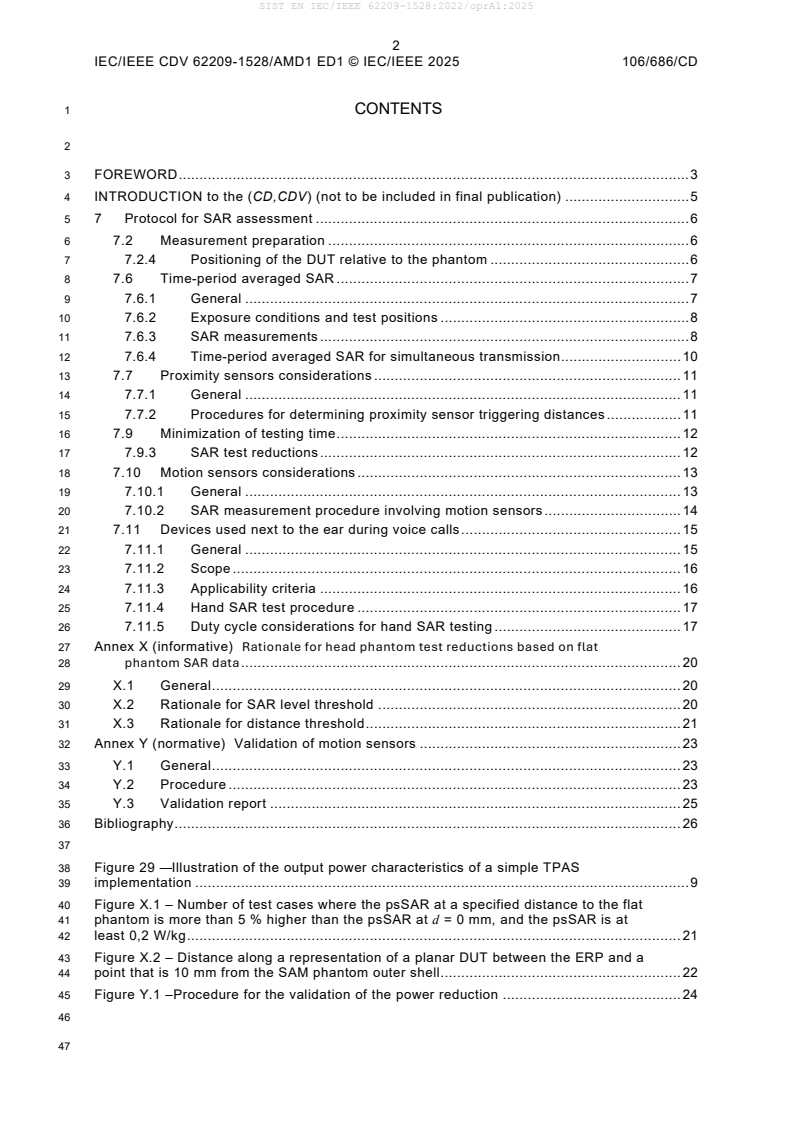
1 CONTENTS
3 FOREWORD . 3
4 INTRODUCTION to the (CD,CDV) (not to be included in final publication) . 5
5 7 Protocol for SAR assessment . 6
6 7.2 Measurement preparation . 6
7 7.2.4 Positioning of the DUT relative to the phantom . 6
8 7.6 Time-period averaged SAR . 7
9 7.6.1 General . 7
10 7.6.2 Exposure conditions and test positions . 8
11 7.6.3 SAR measurements . 8
12 7.6.4 Time-period averaged SAR for simultaneous transmission . 10
13 7.7 Proximity sensors considerations . 11
14 7.7.1 General . 11
15 7.7.2 Procedures for determining proximity sensor triggering distances . 11
16 7.9 Minimization of testing time . 12
17 7.9.3 SAR test reductions . 12
18 7.10 Motion sensors considerations . 13
19 7.10.1 General . 13
20 7.10.2 SAR measurement procedure involving motion sensors . 14
21 7.11 Devices used next to the ear during voice calls . 15
22 7.11.1 General . 15
23 7.11.2 Scope . 16
24 7.11.3 Applicability criteria . 16
25 7.11.4 Hand SAR test procedure . 17
26 7.11.5 Duty cycle considerations for hand SAR testing . 17
27 Annex X (informative) Rationale for head phantom test reductions based on flat
28 phantom SAR data . 20
29 X.1 General . 20
30 X.2 Rationale for SAR level threshold . 20
31 X.3 Rationale for distance threshold . 21
32 Annex Y (normative) Validation of motion sensors . 23
33 Y.1 General . 23
34 Y.2 Procedure . 23
35 Y.3 Validation report . 25
36 Bibliography . 26
38 Figure 29 – Illustration of the output power characteristics of a simple TPAS
39 implementation . 9
40 Figure X.1 – Number of test cases where the psSAR at a specified distance to the flat
41 phantom is more than 5 % higher than the psSAR at d = 0 mm, and the psSAR is at
42 least 0,2 W/kg . 21
43 Figure X.2 – Distance along a representation of a planar DUT between the ERP and a
44 point that is 10 mm from the SAM phantom outer shell. 22
45 Figure Y.1 –Procedure for the validation of the power reduction . 24
IEC/IEEE CDV 62209-1528/AMD1 ED1 © IEC/IEEE 2025 106/686/CD
48 INTERNATIONAL ELECTROTECHNICAL COMMISSION
49 ____________
51 MEASUREMENT PROCEDURE FOR THE ASSESSMENT OF SPECIFIC
52 ABSORPTION RATE OF HUMAN EXPOSURE TO RADIO FREQUENCY
53 FIELDS FROM HAND-HELD AND BODY-MOUNTED WIRELESS
54 COMMUNICATION DEVICES –
56 Part 1528: Human models, instrumentation, and procedures
57 (Frequency range of 4 MHz to 10 GHz)
59 AMENDMENT 1
61 FOREWORD
62 1) The International Electrotechnical Commission (IEC) is a worldwide organization for standardization comprising
63 all national electrotechnical committees (IEC National Committees). The object of IEC is to promote international
64 co-operation on all questions concerning standardization in the electrical and electronic fields. To this end and
65 in addition to other activities, IEC publishes International Standards, Technical Specifications, Technical Reports,
66 Publicly Available Specifications (PAS) and Guides (hereafter referred to as "IEC document(s)"). Their
67 preparation is entrusted to technical committees; any IEC National Committee interested in the subject dealt with
68 may participate in this preparatory work. International, governmental and non-governmental organizations liaising
69 with the IEC also participate in this preparation.
70 IEEE Standards documents are developed within IEEE Societies and Standards Coordinating Committees of the
71 IEEE Standards Association (IEEE SA) Standards Board. IEEE develops its standards through a consensus
72 development process, approved by the American National Standards Institute, which brings together volunteers
73 representing varied viewpoints and interests to achieve the final product. Volunteers are not necessarily members
74 of IEEE and serve without compensation. While IEEE administers the process and establishes rules to promote
75 fairness in the consensus development process, IEEE does not independently evaluate, test, or verify the
76 accuracy of any of the information contained in its standards. Use of IEEE Standards documents is wholly
77 voluntary. IEEE documents are made available for use subject to important notices and legal disclaimers (see
78 https://standards.ieee.org/ipr/disclaimers.html for more information).
79 IEC collaborates closely with IEEE in accordance with conditions determined by agreement between the two
80 organizations. This Dual Logo International Standard was jointly developed by the IEC and IEEE under the terms
81 of that agreement.
82 2) The formal decisions of IEC on technical matters express, as nearly as possible, an international consensus of
83 opinion on the relevant subjects since each technical committee has representation from all interested IEC
84 National Committees. The formal decisions of IEEE on technical matters, once consensus within IEEE Societies
85 and Standards Coordinating Committees has been reached, is determined by a balanced ballot of materially
86 interested parties who indicate interest in reviewing the proposed standard. Final approval of the IEEE standards
87 document is given by the IEEE Standards Association (IEEE SA) Standards Board.
88 3) IEC/IEEE Publications have the form of recommendations for international use and are accepted by IEC National
89 Committees/IEEE Societies in that sense. While all reasonable efforts are made to ensure that the technical
90 content of IEC/IEEE Publications is accurate, IEC or IEEE cannot be held responsible for the way in which they
91 are used or for any misinterpretation by any end user.
92 4) In order to promote international uniformity, IEC National Committees undertake to apply IEC Publications
93 (including IEC/IEEE Publications) transparently to the maximum extent possible in their national and regional
94 publications. Any divergence between any IEC/IEEE Publication and the corresponding national or regional
95 publication shall be clearly indicated in the latter.
96 5) IEC and IEEE do not provide any attestation of conformity. Independent certification bodies provide conformity
97 assessment services and, in some areas, access to IEC marks of conformity. IEC and IEEE are not responsible
98 for any services carried out by independent certification bodies.
99 6) All users should ensure that they have the latest edition of this publication.
100 7) No liability shall attach to IEC or IEEE or their directors, employees, servants or agents including individual
101 experts and members of technical committees and IEC National Committees, or volunteers of IEEE Societies and
102 the Standards Coordinating Committees of the IEEE Standards Association (IEEE SA) Standards Board, for any
103 personal injury, property damage or other damage of any nature whatsoever, whether direct or indirect, or for
104 costs (including legal fees) and expenses arising out of the publication, use of, or reliance upon, this IEC/IEEE
105 Publication or any other IEC or IEEE Publications.
106 8) Attention is drawn to the normative references cited in this publication. Use of the referenced publications is
107 indispensable for the correct application of this publication.
IEC/IEEE CDV 62209-1528/AMD1 ED1 © IEC/IEEE 2025 106/686/CD
108 9) Attention is drawn to the possibility that implementation of this IEC/IEEE Publication may require use of material
109 covered by patent rights. By publication of this standard, no position is taken with respect to the existence or
110 validity of any patent rights in connection therewith. IEC or IEEE shall not be held responsible for identifying
111 Essential Patent Claims for which a license may be required, for conducting inquiries into the legal validity or
112 scope of Patent Claims or determining whether any licensing terms or conditions provided in connection with
113 submission of a Letter of Assurance, if any, or in any licensing agreements are reasonable or non-discriminatory.
114 Users of this standard are expressly advised that determination of the validity of any patent rights, and the risk
115 of infringement of such rights, is entirely their own responsibility.
117 Amendment 1 to IEC/IEEE 62209-1528:2020 has been prepared by IEC technical committee
118 106: Methods for the assessment of electric, magnetic and electromagnetic fields associated
119 with human exposure, in cooperation with the International Committee on Electromagnetic
120 Safety of the IEEE Standards Association.
121 This document is published as an IEC/IEEE Dual Logo standard.
122 The text of this amendment is based on the following IEC documents:
Draft Report on voting
XX/XX/FDIS XX/XX/RVD
124 Full information on the voting for its approval can be found in the report on voting indicated in
125 the above table.
126 The language used for the development of this amendment is English.
127 This document was drafted in accordance with the rules given in the ISO/IEC Directives, Part 2,
128 available at www.iec.ch/members_experts/refdocs. The main document types developed by IEC
129 are described in greater detail at www.iec.ch/publications/.
130 The IEC Technical Committee and IEEE Technical Committee have decided that the contents
131 of this document will remain unchanged until the stability date indicated on the IEC website
132 under webstore.iec.ch in the data related to the specific document. At this date, the document
133 will be
134 • reconfirmed,
135 • withdrawn, or
136 • revised.
IEC/IEEE CDV 62209-1528/AMD1 ED1 © IEC/IEEE 2025 106/686/CD
140 INTRODUCTION to the (CD,CDV)
141 (not to be included in final publication)
142 Product compliance RF exposure assessment standards need periodic amendments to respond
143 to fast-evolving mobile communication technologies.
144 In accordance with IEC TC 106 plenary decisions and agreement of IEEE/ICES TC34 to amend
145 IEC/IEEE 62209-1528:2020, a revision project was registered by circulation of the review report
146 106/629/RR on 2023-11-24 (informally known as “RR1” in TC 106; also supplemented by
147 editorial updates in 106/629A/RR and 106/629B/RR). The RR1 review report also included draft
148 text from a Canada NC input on hand SAR testing, and draft text following from a Finland NC
149 request on testing of motion sensor-based SAR mitigation. An additional document-for-
150 comment for the amendment project, 106/637/DC (informally known as “RR2”), was circulated
151 on 2024-02-23 dealing with time-period averaged SAR, proximity sensor, separation distance,
152 and SAR test reduction.
153 In summary, this amendment of IEC/IEEE 62209-1528:2020, based on the preceding RR1 and
154 RR2 documents, addresses the following items:
155 1) Hand SAR: New subclauses with a) applicability check, b) test procedure
156 2) Motion sensors: a) new section with a SAR measurement procedure, and b) annex on sensor
157 validations
158 3) Amendment of proximity sensor subclause
159 4) Time-period averaged SAR measurement procedure revised and updated.
160 5) Flat phantom separation distance, and test reductions for SAM phantom test configurations
161 based on flat phantom SAR test data
Subdivision numbering in Subdivision numbering in
106/629/RR or 106/637/DC this draft
6.3 (RR) 7.11.1 – renumbered and merged
7.2.4.1.1 (RR) n/a – next-to-ear hand SAR now in 7.11 not 7.2
7.2.4.1.2 (DC Annex 2) 7.2.4.1.2
7.2.4.1.13 7.11
7.6 (DC Annex 1) 7.6
7.7 (DC Annex 3) 7.7
7.9.3.1
7.9.3.7 (DC Annex 2) 7.9.3.7 and Annex X
7.10 (RR) 7.10
7.11 – renumber of RR 7.2.4.1.13
Annex X (RR) Annex Y – renumber of RR Annex X
Annex X – associated with 7.9.3.7
166 ____________
IEC/IEEE CDV 62209-1528/AMD1 ED1 © IEC/IEEE 2025 106/686/CD
169 MEASUREMENT PROCEDURE FOR THE ASSESSMENT OF SPECIFIC
170 ABSORPTION RATE OF HUMAN EXPOSURE TO RADIO FREQUENCY
171 FIELDS FROM HAND-HELD AND BODY-MOUNTED WIRELESS
172 COMMUNICATION DEVICES –
174 Part 1528: Human models, instrumentation, and procedures
175 (Frequency range of 4 MHz to 10 GHz)
177 AMENDMENT 1
180 7 Protocol for SAR assessment
182 7.2 Measurement preparation
183 7.2.4 Positioning of the DUT relative to the phantom
185 Replace the existing entire 7.2.4.1.2 using the following:
186 7.2.4.1.2 DUT-to-phantom separation distance
187 When measuring against the flat phantom, the DUT-to-phantom separation distance may be set
188 according to the following hierarchy.
189 a) Regulatory requirements: If there are national regulatory requirements that specify the DUT
190 separation distance to the phantom, the DUT shall be positioned according to these
191 requirements.
192 b) “Intended use distance” specified by device manufacturer: If there are no regulatory
193 requirements, the intended use condition or distance specified by the manufacturer shall be
194 used. This information shall be aligned with the user documentation of the DUT.
195 c) Default separation distance: If there are neither regulatory requirements nor a manufacturer
196 specification of an intended use distance, the DUT shall be measured with each accessible
197 face at a distance of d = 0 mm from the surface of the phantom according to 7.11.
min
198 NOTE A more detailed rationale for a separation distance of 0 mm is under consideration for future maintenance of
199 this standard.
200 The applicable separation distance may be determined with the carry accessory attached to the
201 DUT, when such condition is tested; see 7.2.4.1.5.
202 Care should be taken to ensure precise positioning at the applicable separation distances, for
203 example by using calibrated gauge blocks or similar means to ensure repeatability.
IEC/IEEE CDV 62209-1528/AMD1 ED1 © IEC/IEEE 2025 106/686/CD
206 Replace the existing entire 7.6 using the following:
207 7.6 Time-period averaged SAR
208 7.6.1 General
209 Subclause 7.6 specifies the test procedures for assessing the time-period averaged SAR
210 (TPAS) when the DUT uses time-period averaged power control algorithms, i.e. dynamic power
211 control and exposure time averaging (DPC-ETA) algorithms (see 7.6.3; also [143]). The
212 applicable time-averaging period is specified in various international guidelines. This test
213 procedure differs from the general SAR test procedures specified in 7.4 that are applicable for
214 DUTs that do not have time-period averaged power control algorithms. Requirements and a
215 procedure for assessing the TPAS are provided in 7.6.2 to 7.6.4. The procedure can be applied
216 if the following requirements are met:
217 a) The power control algorithms in the DUT shall not be alterable or accessible by the user.
218 b) The DUT manufacturer shall provide sufficient documentation about the power control
219 algorithms and their implementation.
220 c) The DUT manufacturer shall validate that the time-averaged power of each test condition
221 set by the algorithm results in conservative SAR assessments.
222 If the preceding requirements are not met, the SAR shall be assessed at the maximum output
223 power level, in accordance with 7.4.
224 NOTE 1 The procedures described in 7.6.2 to 7.6.4 are used for testing devices with dynamic power control. In
225 other words, their output power is dynamically controlled based on changes in the network and transmission
226 conditions and use conditions: instantaneous and time-averaged output power, frequency band, currently active
227 transmission antenna, device position (head or body), etc.
228 NOTE 2 In addition, IEC TR 63424-1 [143] provides detailed guidance on the validation of DPC-ETA algorithms
229 through conducted power measurement, radiated power measurement, or SAR measurement.
230 NOTE 3 It is possible that the applicable regulations include published detailed guidance and requirements to
231 validate DPC-ETA algorithms. It is also possible that the applicable regulations specify testing at the maximum
232 available output power; or some devices, maximum power is based on hardware-implemented time-averaged output
233 power control algorithms. and is used in testing.
___________
While not used in IEC TR 63424-1:2024 [143], the term, definition, and abbreviation TPAS are retained in this
document for consistency with IEC/IEEE 62209-1528:2020, but is subject to change in the next revision.
NOTE 4 Time-period averaged SAR procedures are no longer based on the evaluation of a TX factor, as done in
IEC/IEEE 62209-1528:2020. The approach of this document is more versatile than applying a scaling factor, for
example when evaluating simultaneous transmission or multiple inputs from proximity or motion sensors.
IEC/IEEE CDV 62209-1528/AMD1 ED1 © IEC/IEEE 2025 106/686/CD
237 7.6.2 Exposure conditions and test positions
238 The TPAS shall be assessed separately for each frequency band and operating mode. Two
239 approaches are considered, depending on whether the device is capable of detecting and
240 distinguishing its usage position (e.g. by detecting head and body-worn positions according to
241 audio routing to the earpiece of a device during an audio call).
242 a) If the different usage positions are not detected and not distinguished by the device, the
243 maximum time-averaged power setting and corresponding TPAS among all applicable
244 test/use positions and conditions, including all head, body-worn, and other positions, shall
245 be used to determine compliance. This is the most conservative and simple approach that
246 applies to all use conditions.
247 b) Otherwise, the SAR test positions may be grouped as follows:
248 1) Head test positions: The maximum time-averaged power setting and corresponding
249 TPAS among all head test positions (left cheek, left tilt, right cheek, and right tilt),
250 corresponding to audio calls, is used to determine head exposure SAR compliance.
251 2) Other test positions: The maximum time-averaged power setting and corresponding
252 TPAS among all other applicable test positions, when there is no audio call, is used to
253 determine non-head exposure SAR compliance.
255 7.6.3 SAR measurements
256 SAR shall be measured for all required test positions and conditions as specified in 7.2.4, and
257 for each test condition set by the TPAS algorithm, resulting in different SAR levels. The output
258 power shall be set to the time-averaged power level P of the DPC-ETA algorithm. The time-
limit
259 averaged power levels used shall be reported for all test conditions. These TPAS results are
260 compared directly against the applicable SAR limit to determine compliance. See Figure 29 for
261 illustration of P , other relevant DPC-ETA algorithm parameters, and the output power
limit
262 characteristics.
263 During SAR measurements, the DPC-ETA power control algorithms in the DUT can be disabled.
264 Disabling the power control algorithms typically requires a specific radio configuration on the
265 DUT, using specific test samples or specific test methods.
266 If the power control algorithm cannot be disabled at the maximum output power level, the SAR
267 shall be measured at a lower output power where the power control algorithm does not limit or
268 change the power during measurement, and the measured psSAR shall be scaled to correspond
269 to P .
limit
270 Similarly, setting the output transmit power to the time-averaged power level P typically
limit
271 requires specific test samples where this power is set as maximum instantaneous power, to
272 support repeatable power level-setting during SAR testing, especially when transmission is
273 controlled by a base station simulator.
IEC/IEEE CDV 62209-1528/AMD1 ED1 © IEC/IEEE 2025 106/686/CD
277 P instantaneous power recorded by the RF modem or measured during algorithm validation
instant
278 P time-averaged power calculated within a time-averaging window
average
279 P maximum time-averaged power allowed for continuous exposure
limit
280 P maximum instantaneous output power that a transmitter supports for the intended operations
max
281 Figure 29 – Illustration of the output power characteristics
282 of a simple TPAS implementation
IEC/IEEE CDV 62209-1528/AMD1 ED1 © IEC/IEEE 2025 106/686/CD
285 7.6.4 Time-period averaged SAR for simultaneous transmission
286 In this document, TPAS assessment for simultaneous transmission is limited to cases where
287 1) multiple DPC-ETA algorithms, or 2) DPC-ETA algorithm(s) transmitter(s) and regular (i.e.
288 non-DPC-ETA) transmitter(s), operate independently of each other. This means the DPC-ETA
289 algorithms operate asynchronously with each other, or with regular transmitters, or both. A fixed
290 SAR threshold (margin) is reserved for each transmitter of a DUT, regardless of the temporal
291 time-averaged power or SAR value of the other transmitters (DPC-ETA controlled transmitters
292 or regular transmitters).
293 It is possible though that DPC-ETA algorithms detect if other transmitters are operating
294 simultaneously or not (active or inactive), thereby having different SAR thresholds reserved for
295 each case, or for a combination of these cases when more than two transmitters are operating
296 simultaneously. Fixed SAR threshold(s) to other active transmitter(s) shall be reserved such
297 that the spatial sum of the of the co-located SAR and TPAS (see 7.4.4.) values does not exceed
298 the applicable SAR limit.
299 In other words, the combined exposure ratio (total exposure ratio) of SAR and TPAS, along with
300 the exposure ratio from any DUT transmitters operating between 100 kHz and 4 MHz (field
301 strength metric), and any DUT transmitters operating above 10 GHz (power density metric),
302 shall be less than or equal to 1.
303 The following requirements apply to determine the highest combined psSAR:
304 a) TPAS assessment in 7.6.3 shall be applied to all of the simultaneous transmissions utilizing
305 DPC-ETA;
306 b) simultaneous transmissions other than those under a) shall be assessed according to 7.2.4;
307 c) the combined SAR of all simultaneous transmitters in a) and b) shall be assessed according
308 to 7.4.4.
309 When switching from a non-DPC-ETA transmitter to a DPC-ETA transmitter, or vice versa,
310 temporal non-compliance can occur during the transition phases if output power(s) is (are)
311 above the time-averaged power level P just before, after, or both before and after, the
limit
312 transition instance, i.e. when the sliding time-averaging window covers the transition instance.
313 For devices with multiple transmitters controlled by independent DPC-ETA algorithms, temporal
314 non-compliance can also occur during the transition phases. Therefore, testing shall address
315 the potential for temporal non-compliance. Various approaches can be implemented to preclude
316 temporal non-compliance, such as: providing additional margins, avoiding antenna co-location
317 and co-transmission, etc. Other procedures covering the TPAS during transitions between
318 multiple transmitters will be considered in future maintenance of this document.
IEC/IEEE CDV 62209-1528/AMD1 ED1 © IEC/IEEE 2025 106/686/CD
321 7.7 Proximity sensors considerations
323 7.7.1 General
324 Add the following new paragraph after the existing NOTE 4 in 7.7.1:
325 If the proximity sensor triggers time-averaged power control, as done by the DUT RF
326 chipset/modem circuitry or within the proximity sensor circuitry itself (see also Annex E and
327 F.4.2 of IEC 63424-1:2024 [143]), in addition to the TPAS procedure in 7.6, the proximity sensor
328 procedure in this subclause shall be applied with time-averaging deactivated (i.e. immediate
329 power control active, otherwise power changes could also occur due to the DPC-ETA algorithm
330 and not only due to proximity sensor triggering).
332 7.7.2 Procedures for determining proximity sensor trigg
...
Questions, Comments and Discussion
Ask us and Technical Secretary will try to provide an answer. You can facilitate discussion about the standard in here.
Loading comments...