

EN 50059:2025
(Main)Hand-held electrostatic application equipment for non-ignitable liquid coating materials - Safety requirements
General Information
- Abstract
1.1 This document specifies the electrical requirements for hand-held or hand-operated electrostatic application equipment for non-ignitable liquid coating materials which — do not generate an explosive atmosphere inside the spraying area, — are used to process coating materials with a conductivity of the complete system up to 2 000 µS/cm, — operate with direct current having a d.c. sinusoidal ripple of not more than 10 % of the r.m.s. value and — are used within a temperature range from 5 °C to 40 °C. 1.2 This document specifies — requirements for an interface to machinery according to EN 16985:2018, — additional requirements for machinery according to EN 1953:— and EN 12621:— . 1.3 This document also specifies requirements for a safe operation of electrostatic application equipment, including the electrical installation. The requirements consider both the processing of coating materials and the cleaning and purge processes. 1.4 For electrostatic application equipment used in food and pharmaceutical industry, additional requirements can apply. 1.5 This document does not apply to — electrostatic hand-held spraying equipment for ignitable materials, see EN 50050:2013, Parts 1 to 3; — cleaning systems for spraying devices; — quality assurance systems for electrostatic spraying equipment (see EN ISO/IEC 80079-34:2020, Annex ZB 11).
- Status
- Published
- Publication Date
- 13-Feb-2025
- Technical Committee
- CLC/TC 204 - Safety of electrostatic painting and finishing equipment
- Drafting Committee
- CLC/TC 204 - Safety of electrostatic painting and finishing equipment
- Current Stage
- 6060 - Document made available - Publishing
- Start Date
- 14-Feb-2025
- Due Date
- 01-May-2022
- Completion Date
- 14-Feb-2025
- Directive
- 2006/42/EC - Directive 2006/42/EC of the European Parliament and of the Council of 17 May 2006 on machinery, and amending Directive 95/16/EC (recast)OJ Ref: 2025/1740, OJ L, OJ L, 2025/1740 OJ Date: 14-Aug-2025

Overview
EN 50059:2025 - published by CLC/CENELEC - specifies safety and electrical requirements for hand‑held electrostatic application equipment for non‑ignitable liquid coating materials. The standard applies to handheld or hand‑operated electrostatic spraying devices that do not create an explosive atmosphere, process coatings with system conductivity up to 2 000 µS/cm, operate on direct current with a d.c. sinusoidal ripple ≤ 10% of the r.m.s. value, and are used in ambient temperatures 5 °C to 40 °C. It covers safe operation, electrical installation, cleaning and purge processes, and interfaces to related machinery.
Key topics and technical requirements
- Electric hazards & prevention of electric shock - requirements for electrical insulation, limiting parts and protective measures.
- Bonding to earth potential - measures and tests to ensure safe earthing of applicator and system.
- High‑voltage components - requirements for cables, hoses and other insulating parts operating under high voltage.
- Applicator mechanical requirements - resistance to impact and dropping, handle and trigger safety, reliability tests.
- Coating material supply system - insulation and conductive/dissipative parts for hoses and feed systems.
- Control system & interfaces - IP protection, machine interface requirements (reference to EN 16985:2018) and integration with related machinery.
- Type tests and verification - procedures for electrical safety, bonding, high‑voltage component testing, impact/drop testing and protection class checks.
- Information for use & marking - required user instructions, installation and maintenance guidance, periodic inspection and marking of applicator and control units.
- Special considerations - notes that additional requirements may apply for food and pharmaceutical industry use.
Practical applications
EN 50059:2025 is intended for manufacturers, safety assessors and plant engineers involved with:
- Design and manufacture of hand‑held electrostatic spray guns for industrial finishing.
- Machine builders integrating handheld applicators with spray booths or circulation systems.
- Safety and compliance teams preparing technical documentation, operating instructions and type test evidence.
- Maintenance personnel implementing safe cleaning, purge and inspection procedures.
This standard helps reduce electrical risk during electrostatic spraying, improve operator safety, and ensure compatible integration with machinery and coating supply systems.
Related standards
- EN 16985:2018 - spray booths (interface requirements)
- EN 1953:2025 and EN 12621:2025 - additional machinery requirements
- EN 50050:2013 - electrostatic equipment for ignitable materials (excluded)
- EN ISO/IEC 80079‑34:2020 - quality assurance for explosive atmospheres (not applicable here)
Keywords: EN 50059:2025, hand-held electrostatic application equipment, safety requirements, electrostatic spraying, coating material conductivity, bonding to earth, high-voltage hoses.
Relations
- Effective Date
- 22-Oct-2019
- Effective Date
- 09-Feb-2026
- Refers
EN ISO 20344:2021 - Personal protective equipment - Test methods for footwear (ISO 20344:2021) - Effective Date
- 09-Feb-2026
- Effective Date
- 09-Feb-2026
- Effective Date
- 09-Feb-2026
- Effective Date
- 09-Feb-2026
- Effective Date
- 03-Feb-2026
- Effective Date
- 03-Feb-2026
- Effective Date
- 03-Feb-2026
- Effective Date
- 03-Feb-2026
- Effective Date
- 09-Feb-2026
- Effective Date
- 09-Feb-2026
- Referred By
EN 1953:2013 - Atomising and spraying equipment for coating materials - Safety requirements - Effective Date
- 09-Feb-2026
Frequently Asked Questions
EN 50059:2025 is a standard published by CLC. Its full title is "Hand-held electrostatic application equipment for non-ignitable liquid coating materials - Safety requirements". This standard covers: 1.1 This document specifies the electrical requirements for hand-held or hand-operated electrostatic application equipment for non-ignitable liquid coating materials which — do not generate an explosive atmosphere inside the spraying area, — are used to process coating materials with a conductivity of the complete system up to 2 000 µS/cm, — operate with direct current having a d.c. sinusoidal ripple of not more than 10 % of the r.m.s. value and — are used within a temperature range from 5 °C to 40 °C. 1.2 This document specifies — requirements for an interface to machinery according to EN 16985:2018, — additional requirements for machinery according to EN 1953:— and EN 12621:— . 1.3 This document also specifies requirements for a safe operation of electrostatic application equipment, including the electrical installation. The requirements consider both the processing of coating materials and the cleaning and purge processes. 1.4 For electrostatic application equipment used in food and pharmaceutical industry, additional requirements can apply. 1.5 This document does not apply to — electrostatic hand-held spraying equipment for ignitable materials, see EN 50050:2013, Parts 1 to 3; — cleaning systems for spraying devices; — quality assurance systems for electrostatic spraying equipment (see EN ISO/IEC 80079-34:2020, Annex ZB 11).
1.1 This document specifies the electrical requirements for hand-held or hand-operated electrostatic application equipment for non-ignitable liquid coating materials which — do not generate an explosive atmosphere inside the spraying area, — are used to process coating materials with a conductivity of the complete system up to 2 000 µS/cm, — operate with direct current having a d.c. sinusoidal ripple of not more than 10 % of the r.m.s. value and — are used within a temperature range from 5 °C to 40 °C. 1.2 This document specifies — requirements for an interface to machinery according to EN 16985:2018, — additional requirements for machinery according to EN 1953:— and EN 12621:— . 1.3 This document also specifies requirements for a safe operation of electrostatic application equipment, including the electrical installation. The requirements consider both the processing of coating materials and the cleaning and purge processes. 1.4 For electrostatic application equipment used in food and pharmaceutical industry, additional requirements can apply. 1.5 This document does not apply to — electrostatic hand-held spraying equipment for ignitable materials, see EN 50050:2013, Parts 1 to 3; — cleaning systems for spraying devices; — quality assurance systems for electrostatic spraying equipment (see EN ISO/IEC 80079-34:2020, Annex ZB 11).
EN 50059:2025 is classified under the following ICS (International Classification for Standards) categories: 87.100 - Paint coating equipment. The ICS classification helps identify the subject area and facilitates finding related standards.
EN 50059:2025 has the following relationships with other standards: It is inter standard links to EN 50059:2018, EN ISO 13849-1:2023, EN ISO 20344:2021, EN 1149-5:2018, EN ISO 12100:2010, EN 16985:2018, EN 50176:2025, EN 60529:1991, EN 61340-4-1:2004, EN 60204-1:2018, EN 12621:2025, EN 1953:2025, EN 1953:2013. Understanding these relationships helps ensure you are using the most current and applicable version of the standard.
EN 50059:2025 is associated with the following European legislation: EU Directives/Regulations: 2006/42/EC; Standardization Mandates: M/396. When a standard is cited in the Official Journal of the European Union, products manufactured in conformity with it benefit from a presumption of conformity with the essential requirements of the corresponding EU directive or regulation.
EN 50059:2025 is available in PDF format for immediate download after purchase. The document can be added to your cart and obtained through the secure checkout process. Digital delivery ensures instant access to the complete standard document.
Standards Content (Sample)
SLOVENSKI STANDARD
01-april-2025
Ročna elektrostatična oprema za brizganje nevnetljivih tekočih premazov -
Varnostne zahteve
Hand-held electrostatic application equipment for non-ignitable liquid coating materials -
Safety requirements
Elektrostatische Handsprüheinrichtungen - Sicherheitsanforderungen -
Handsprüheinrichtungen für nichtentzündbare Beschichtungsstoffe
Équipement manuel d’application électrostatique de produits de revêtement liquides non-
inflammables - Exigences de sécurité
Ta slovenski standard je istoveten z: EN 50059:2025
ICS:
87.100 Oprema za nanašanje Paint coating equipment
premazov
2003-01.Slovenski inštitut za standardizacijo. Razmnoževanje celote ali delov tega standarda ni dovoljeno.
EUROPEAN STANDARD EN 50059
NORME EUROPÉENNE
EUROPÄISCHE NORM February 2025
ICS 87.100 Supersedes EN 50059:2018
English Version
Hand-held electrostatic application equipment for non-ignitable
liquid coating materials - Safety requirements
Équipement manuel d'application électrostatique de Elektrostatische Handsprüheinrichtungen -
produits de revêtement liquides non-inflammables - Sicherheitsanforderungen - Handsprüheinrichtungen für
Exigences de sécurité nichtentzündbare Beschichtungsstoffe
This European Standard was approved by CENELEC on 2024-12-30. CENELEC members are bound to comply with the CEN/CENELEC
Internal Regulations which stipulate the conditions for giving this European Standard the status of a national standard without any alteration.
Up-to-date lists and bibliographical references concerning such national standards may be obtained on application to the CEN-CENELEC
Management Centre or to any CENELEC member.
This European Standard exists in three official versions (English, French, German). A version in any other language made by translation
under the responsibility of a CENELEC member into its own language and notified to the CEN-CENELEC Management Centre has the
same status as the official versions.
CENELEC members are the national electrotechnical committees of Austria, Belgium, Bulgaria, Croatia, Cyprus, the Czech Republic,
Denmark, Estonia, Finland, France, Germany, Greece, Hungary, Iceland, Ireland, Italy, Latvia, Lithuania, Luxembourg, Malta, the
Netherlands, Norway, Poland, Portugal, Republic of North Macedonia, Romania, Serbia, Slovakia, Slovenia, Spain, Sweden, Switzerland,
Türkiye and the United Kingdom.
European Committee for Electrotechnical Standardization
Comité Européen de Normalisation Electrotechnique
Europäisches Komitee für Elektrotechnische Normung
CEN-CENELEC Management Centre: Rue de la Science 23, B-1040 Brussels
© 2025 CENELEC All rights of exploitation in any form and by any means reserved worldwide for CENELEC Members.
Ref. No. EN 50059:2025 E
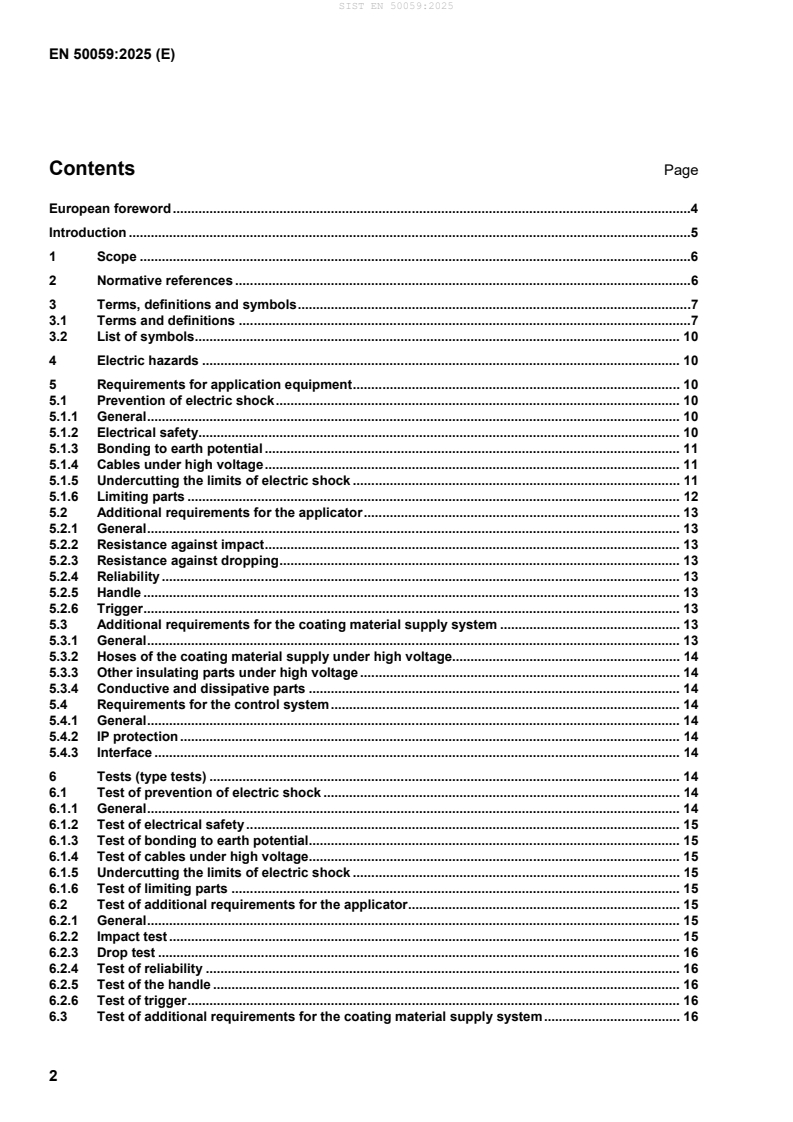
Contents Page
European foreword .4
Introduction .5
1 Scope .6
2 Normative references .6
3 Terms, definitions and symbols .7
3.1 Terms and definitions .7
3.2 List of symbols . 10
4 Electric hazards . 10
5 Requirements for application equipment . 10
5.1 Prevention of electric shock . 10
5.1.1 General . 10
5.1.2 Electrical safety. 10
5.1.3 Bonding to earth potential . 11
5.1.4 Cables under high voltage . 11
5.1.5 Undercutting the limits of electric shock . 11
5.1.6 Limiting parts . 12
5.2 Additional requirements for the applicator . 13
5.2.1 General . 13
5.2.2 Resistance against impact . 13
5.2.3 Resistance against dropping . 13
5.2.4 Reliability . 13
5.2.5 Handle . 13
5.2.6 Trigger . 13
5.3 Additional requirements for the coating material supply system . 13
5.3.1 General . 13
5.3.2 Hoses of the coating material supply under high voltage. 14
5.3.3 Other insulating parts under high voltage . 14
5.3.4 Conductive and dissipative parts . 14
5.4 Requirements for the control system . 14
5.4.1 General . 14
5.4.2 IP protection . 14
5.4.3 Interface . 14
6 Tests (type tests) . 14
6.1 Test of prevention of electric shock . 14
6.1.1 General . 14
6.1.2 Test of electrical safety . 15
6.1.3 Test of bonding to earth potential . 15
6.1.4 Test of cables under high voltage . 15
6.1.5 Undercutting the limits of electric shock . 15
6.1.6 Test of limiting parts . 15
6.2 Test of additional requirements for the applicator . 15
6.2.1 General . 15
6.2.2 Impact test . 15
6.2.3 Drop test . 16
6.2.4 Test of reliability . 16
6.2.5 Test of the handle . 16
6.2.6 Test of trigger . 16
6.3 Test of additional requirements for the coating material supply system . 16
6.3.1 General . 16
6.3.2 Test of the coating material supply hose under high voltage . 16
6.3.3 Test of other insulating parts under high voltage. 17
6.3.4 Test of conductive and dissipative parts . 17
6.4 Test of additional requirements for the control system . 17
6.4.1 General . 17
6.4.2 Test of the degree of protection . 17
6.4.3 Interface . 17
7 Information for use . 17
7.1 General . 17
7.2 Instruction for use . 17
7.2.1 General . 17
7.2.2 Information on installation . 18
7.2.3 Information on operation . 18
7.2.4 Cleaning, maintenance, and corrective maintenance . 19
7.2.5 Periodic inspections . 19
7.3 Marking of application equipment . 19
7.3.1 Marking of applicators . 19
7.3.2 Marking of the control system . 20
7.3.3 Multiple marking of the control system . 20
Annex A (normative) Compliance with area I for application equipment including parts of the
coating material supply system . 21
Annex B (informative) Example for discharge measurement . 27
Annex C (informative) Ignitability of liquid coating materials . 29
Annex ZZ (informative) Relationship between this European Standard and the essential
requirements of Directive 2006/42/EC aimed to be covered . 30
Bibliography . 32
European foreword
This document (EN 50059:2025) has been prepared by CLC/TC 204 “Safety of electrostatic painting and
finishing equipment”.
The following dates are fixed:
• latest date by which this document has to be (dop) 2026-02-28
implemented at national level by publication of
an identical national standard or by
endorsement
• latest date by which the national standards (dow) 2028-02-29
conflicting with this document have to be
withdrawn
This document supersedes EN 50059:2018 and all of its amendments and corrigenda (if any).
EN 50059:2024 includes the following significant technical changes with respect to EN 50059:2018:
— new structure of the entire document,
— update of Clause 2,
— complete revision of Clauses 1, 3 to 7,
— revision of Annex A (normative),
— revision of Annex C (informative).
Attention is drawn to the possibility that some of the elements of this document may be the subject of patent
rights. CENELEC shall not be held responsible for identifying any or all such patent rights.
This document has been prepared under a standardization request addressed to CENELEC by the European
Commission. The Standing Committee of the EFTA States subsequently approves these requests for its
Member States.
For the relationship with EU Legislation, see informative Annex ZZ, which is an integral part of this document.
Any feedback and questions on this document should be directed to the users’ national committee. A complete
listing of these bodies can be found on the CENELEC website.
Introduction
During the electrostatic coating process, the non-ignitable liquid coating material is transported to a spraying
device where it is atomized by mechanical forces and/or by the influence of an electric field. The generated
spray cloud is charged by high voltage of some 10 kV, is attracted by, and is applied to the earthed workpiece.
Spray clouds which are not applied to the workpiece (overspray) are removed by a suction device or by other
means.
The coating material is cured at room temperature or by heating.
1 Scope
1.1 This document specifies the electrical requirements for hand-held or hand-operated electrostatic
application equipment for non-ignitable liquid coating materials which
— do not generate an explosive atmosphere inside the spraying area,
— are used to process coating materials with a conductivity of the complete system up to 2 000 µS/cm,
— operate with direct current having a d.c. sinusoidal ripple of not more than 10 % of the r.m.s. value, and
— are used within a temperature range from 5 °C to 40 °C.
1.2 This document specifies
— requirements for an interface to machinery according to EN 16985:2018,
— additional requirements for machinery according to EN 1953:2025 and EN 12621:2025.
1.3 This document also specifies requirements for a safe operation of electrostatic application equipment,
including the electrical installation. The requirements consider both the processing of coating materials and the
cleaning and purge processes.
1.4 For electrostatic application equipment used in food and pharmaceutical industry, additional requirements
can apply.
1.5 This document does not apply to
— electrostatic hand-held spraying equipment for ignitable materials, see EN 50050:2013, Parts 1 to 3,
— cleaning systems for spraying devices,
— quality assurance systems for electrostatic spraying equipment (see EN ISO/IEC 80079-34:2020,
Clause ZB.11).
2 Normative references
The following documents are referred to in the text in such a way that some or all of their content constitutes
requirements of this document. For dated references, only the edition cited applies. For undated references, the
latest edition of the referenced document (including any amendments) applies.
EN 1149-5:2018, Protective clothing - Electrostatic properties - Part 5: Material performance and design
requirements
EN 1953:2025, Application equipment for coating materials — Safety requirements
EN 12621:2025, Machinery for supply and circulation of liquid coating materials — Safety requirements
EN 16985:2018, Spray booths for organic coating material - Safety requirements
EN 50176:2025, Automatic electrostatic application systems for ignitable liquid coating materials - Safety
requirements
EN 60204-1:2018, Safety of machinery - Electrical equipment of machines - Part 1: General requirements
(IEC 60204-1:2016, modified)
EN 60529:1991, Degrees of protection provided by enclosures (IP Code) (IEC 60529:1989)
EN 61340-4-1:2004, Electrostatics - Part 4-1: Standard test methods for specific applications - Electrical
resistance of floor coverings and installed floors (IEC 61340-4-1:2003)
EN ISO 12100:2010, Safety of machinery - General principles for design - Risk assessment and risk reduction
(ISO 12100:2010)
EN ISO 13849-1:2023, Safety of machinery - Safety-related parts of control systems - Part 1: General principles
for design (ISO 13849-1:2023)
EN ISO 20344:2021, Personal protective equipment - Test methods for footwear (ISO 20344:2021)
IEC 60479-1:2018, Effects of current on human beings and livestock — Part 1: General aspects
3 Terms, definitions and symbols
3.1 Terms and definitions
For the purposes of this document, the following terms and definitions apply.
ISO and IEC maintain terminology databases for use in standardization at the following addresses:
— ISO Online browsing platform: available at https://www.iso.org/obp/
— IEC Electropedia: available at https://www.electropedia.org/
3.1.1
application equipment
hand-held or hand-operated equipment for electrostatic coating which in general comprises the following:
— applicator,
— high voltage supply system,
— control system, and
— coating material supply system
3.1.2
applicator
device for application of coating material by means of electrostatic charge which in general comprises the
following:
— spraying device,
— high voltage electrode, if applicable,
— high voltage supply system (if integrated into the applicator),
— housing,
As impacted by EN 60529:1991/A1:2000 and EN 60529:1991/A2:2013.
As impacted by EN 61340-4-1:2004/A1:2015.
— exchangeable attachment parts, and
— battery unit (integrated fixedly, or attached), if applicable
3.1.3
spraying device
device with outlet opening of coating material for atomising, high-voltage electrode for charging the coating
material and, if applicable, supplying atomising air and horn/shaping air
Note 1 to entry: Typical designs are nozzles or rotating discs, or bell-shaped devices.
Note 2 to entry: The high-voltage electrode can be a needle or a solid part which is on high-voltage potential.
3.1.4
high voltage supply system
system which in general comprises the following:
— low-voltage section with devices for switching on and off the application equipment and for adjustment,
control, regulation, limitation and monitoring of current and voltage, as well as the required connecting
cables,
— high-voltage generator,
— high-voltage switching device,
— high-voltage cable,
— high-voltage plug-and-socket connector
3.1.5
control system
device generally having the following functions for adjustment, control, regulating, limitation and monitoring of,
for instance, the applicator, high voltage supply system, coating material supply and the control air
Note 1 to entry: A combination of the control system and the high voltage supply system according to 3.1.4 is possible.
3.1.6
connecting cable
electric cable connected to the applicator or charging device for coating material
3.1.7
high voltage electrode
conductive part in the form of a needle or a solid part, which is under high voltage and serves for direct or
indirect charging of the coating material
3.1.8
coating material supply system
system for supplying the applicator with coating material which in general comprises the following:
— pressurized or depressurised containers,
— pumps,
— controllers and valves,
— dosing and mixing devices for coating materials,
— ducts and hoses, and
— charging device for liquid coating material
3.1.9
earthing system
system for earthing the application equipment permanently
3.1.10
hazardous discharge
discharge which generates the hazard of electric shock
3.1.11
workpiece
article to which the coating material is applied
3.1.12
non-ignitable liquid coating materials
substances, especially liquids and varnishes, which cannot be ignited in sprayed state
Note 1 to entry: A formula for the estimation of ignitability on the basis of the composition of the liquid coating material
is given in Annex C.
3.1.13
ignitable liquid coating materials
sprayed materials, especially varnishes which can be ignited in sprayed state and react in the form of an
explosion
Note 1 to entry: A formula for the estimation of ignitability on the basis of the composition of the coating material is given
in Annex C.
3.1.14
dissipative footwear
footwear that has a resistance to earth via its sole which is low enough to prevent the build-up of electrostatic
charges capable to produce a hazardous discharge
Note 1 to entry: See EN ISO 20344:2021.
Note 2 to entry: A required electric insulating resistance to prevent electric shocks is not contradictory to this definition.
3.1.15
protective clothing
clothing that has a resistance to earth which is low enough to prevent the build-up of electrostatic charges
capable to produce a hazardous discharge
Note 1 to entry: See EN 1149-5:2018.
Note 2 to entry: A required electric insulating resistance to prevent electric shocks is not contradictory to this definition.
3.1.16
dissipative floor
floor that has a resistance to earth which is low enough to prevent the build-up of electrostatic charges capable
to produce a hazardous discharge
3.1.17
exchangeable attachment parts
nozzles, bells/discs, extensions, angular pieces, electron and ion absorber and discharge electrodes if
applicable
3.2 List of symbols
U Maximum outlet high voltage of the high-voltage generator
max
I Maximum outlet current of the high-voltage generator
max
I Body current (r.m.s.) flowing from the hand to both feet
B rms
I Peak-current value generated by a discharge provoked from the application equipment
C (p)
U Peak-voltage value of a discharge measured from the oscilloscope
C (p)
t Pulse duration in which the peak current value I is dropped to 5 % of its value
i C (p)
R Resistance of the shunt in Ω
Shunt
F Factor of the current transformer in V/A
CT
F Factor of the attenuator
AT
4 Electric hazards
Electric shock (by direct or indirect contact) may be generated, for instance, by contact with
— live parts, which are not insulated for operational reasons,
— conductive parts, which are not under hazardous voltage during normal operation, but in case of failure,
— insulated live parts, whose insulation is insufficient or has been damaged due to mechanical, thermal,
chemical, or other influences.
Inadequate earthing may occur, for instance, due to:
— faulty connections to the protective earthing system,
— a too high resistance to earth (e.g. due to contamination by coating materials).
Electrical hazards may occur, for instance, if hazardous malfunctions (e.g. shortcut of electronic safety circuits,
of access guards to hazardous areas or of warning devices) occur due to interferences of the high-voltage
supply system and the components of control and safety systems.
Hazardous electrostatic discharges may be generated, for instance, by non-earthed conductive components or
by large insulating surfaces, especially if they are backed with conductive material.
5 Requirements for application equipment
5.1 Prevention of electric shock
5.1.1 General
The values of the maximum high voltage and the maximum short-circuit current of the application equipment
shall be defined by the manufacturer.
Insulating materials of parts under high voltage shall be designed in compliance with the conditions for operation,
transport, and storage.
5.1.2 Electrical safety
The electrical equipment of the application equipment not related to the high voltage supply system shall comply
with EN 60204-1:2018.
5.1.3 Bonding to earth potential
Application equipment shall have an earth connection. The connection shall be designed in mechanically
secured way that prevents loosening. Detachable earth connections shall be marked clearly.
All conductive and dissipative parts of the application equipment which are not at high voltage potential shall be
bonded to earth potential with a resistance of ≤ 1 MΩ. Bonding to earth potential of conductive and dissipative
parts inside the application equipment can be neglected if hazardous discharges have been prevented by
design. Conductive and dissipative parts connected to measuring and control circuits shall be bonded to earth
potential with a resistance of ≤ 100 MΩ. This does not apply to the high-voltage path, which may be bonded to
earth potential via a high-voltage resistor in order to measure and / or permanently discharge the high voltage.
NOTE High-voltage resistors used in this field typically have a resistance from 1 GΩ to 10 GΩ.
5.1.4 Cables under high voltage
Electrical connecting cables under high voltage shall be mechanically secured to the applicator or associated
equipment, e.g. screwed on or secured with bayonet fitting or similar device.
High voltage cable shall
— have an earthed shielding,
— be designed to avoid a breakdown.
5.1.5 Undercutting the limits of electric shock
For undercutting the limits of electric shock, application equipment shall be designed such that
— in case of long-time contact (>1 s) of the user with live parts or charged passive parts, the current flowing
through the user does not exceed the value of 25 mA d.c., and
— in the case of a discharge to the user with a pulse duration t shorter than 10 ms from live parts or charged
i
passive parts, the body current I and the pulse duration t of the discharge are within area I of Figure 1.
B rms i
NOTE 1 Discharges between 10 ms and 1 s do not occur at application equipment.
Key
Area Effect on human body
I no risk of strong muscular reactions (safety limit)
II no risk of ventricular fibrillation
III increasing risk of ventricular fibrillation
NOTE 1 Analysis of electrical accidents led to the result that the risk of ventricular fibrillation is especially present for
long-term longitudinal flow (from the hands to the feet). These findings are considered for the calculation of the effective
value of the current.
NOTE 2 Areas I to III are based on the areas DC-2 to DC-4 defined in IEC 60479-1:2018 and extrapolated to shorter
pulse durations.
Figure 1 — Pulse duration - body current, risk of muscular reactions and ventricular fibrillation
5.1.6 Limiting parts
In order to fulfil 5.1.5 a proven hardware solution may be considered: electric limiting parts shall consist of at
least two zener diodes, resistors or equivalent parts (e.g. power semiconductors). These parts shall be loaded
to no more than two-thirds of the maximum valued rates. To ensure the required reliability of all electrical limiting
parts, the applicator shall
— withstand a short-circuit between the high voltage electrode and earth for 5 min. and the degree of
protection given in 5.2.1 and 5.4.2 shall be maintained, or
— be switched off automatically in case of a short-circuit in no more than 1 second.
5.2 Additional requirements for the applicator
5.2.1 General
Applicators shall fulfil the respective requirements of EN 1953:2025.
All electrical components of the applicator, other than the spraying device shall comply with the degree of
protection IP 54 of EN 60529:1991 .
5.2.2 Resistance against impact
Applicators shall be designed and constructed in order to fulfil the impact test.
5.2.3 Resistance against dropping
Applicators shall be designed and constructed in order to fulfil the drop test.
5.2.4 Reliability
Components determining the safety shall be constructed, located, and built-in, that the safety of the applicator
is not affected.
NOTE Examples of components determining the safety are spraying devices, earthing cables, resistors, and other
electronic components.
Insulating materials of parts under high voltage shall be designed in compliance with the conditions for operation,
transport, and storage.
The live parts of the applicator shall be designed in such a way to prevent occurrence of hazardous discharges
within 90 min. under maximum high voltage.
5.2.5 Handle
The handle of the applicator shall have a contact surface area of conductive material of at least 20 cm . This
contact surface area shall be bonded to earth potential, and the resistance to earth shall not exceed 1 MΩ.
Information on the properties of protective gloves shall be given in the instruction manual, see 7.2.3.
5.2.6 Trigger
Operating trigger of the applicator shall be biased to the OFF-position.
5.3 Additional requirements for the coating material supply system
5.3.1 General
The coating material supply system shall
— fulfil the respective requirements of EN 12621:2025;
— fulfil the applicable requirements of 5.1.5. Alternatively, protective measures shall be taken to avoid any
contact with parts under high voltage potential during normal operation;
— enable the complete discharging of the coating material within 2 min. after turning off the main switch of the
application equipment.
5.3.2 Hoses of the coating material supply under high voltage
Hoses of the coating material supply shall
— be made of insulating material with a volume resistivity of ≥ 1 GΩ m;
— be mechanically secured to the applicator or associated equipment, e.g. screwed on or secured with
bayonet fitting or similar;
— have an earthed shielding;
— be designed to avoid a breakdown.
5.3.3 Other insulating parts under high voltage
Other insulating parts under high voltage (e.g. vessels, housing) shall withstand a voltage of 1,5 Umax by design
(e.g. avoidance of breakdown).
5.3.4 Conductive and dissipative parts
If conductive or dissipative parts are used for the coating material supply system, these parts shall be bonded
to earth potential according to 5.1.3 or shall be connected to the high voltage supply in such a way that their
potential is permanently identical with that of the applicator. The equipotential bonding shall be done by means
of a discrete electrical conductor.
5.4 Requirements for the control system
5.4.1 General
The high-voltage supply and the application equipment shall be safeguarded against an unauthorised
modification of safety relevant parameters (e.g. maximum operating voltage).
NOTE Safety against unauthorised modification of safety relevant parameters is ensured by, for instance, safeguarded
control cabinets or software authorisations.
5.4.2 IP protection
Control systems to be used in spraying areas shall at least comply with the requirements of degree of protection
IP54 according to EN 60529:1991 .
5.4.3 Interface
Application equipment shall be equipped with an interface for the exchange of safety related signals (e.g. for
interlocking with the forced ventilation of the spray booth), which shall meet the requirements of PL d according
to EN ISO 13849-1:2023.
6 Tests (type tests)
6.1 Test of prevention of electric shock
6.1.1 General
All tests shall be carried out by a temperature of (22 ± 5) °C.
Tests according 6.1.2, 6.1.5, 6.1.6 and 6.2.1 shall be passed after the tests according to 6.2.2, 6.2.3 and 6.2.4.
Tests according 6.1.2, 6.1.5, 6.1.6 and 6.2.1 also before tests according to 6.2.2, 6.2.3 and 6.2.4 are
recommended.
The measurement of U shall be carried out off-load at the end of the high voltage electrode or at the nozzle
max
or at the bell/disc of the applicator.
The measurement of I shall be carried out with a μ-ampere/m-ampere meter, at the end of the high voltage
max
electrode or at the nozzle or at the bell/disc of the applicator against earth potential.
6.1.2 Test of electrical safety
Measures of the electrical safety shall be checked by measurement and documentation.
6.1.3 Test of bonding to earth potential
Bonding to earth potential shall be proven by measurement and verified by visual inspection and check of the
documentation. The resistance shall be measured using a Megohmmeter/Insulation Resistance Tester with a
measurement voltage up to 1 000 V.
6.1.4 Test of cables under high voltage
The fixing of each electrical connecting cable under high voltage of the applicator shall be tested with a load of
75 N for 60 s. The test is passed, if
— the connection is maintained without any visual slippage;
— the values of U and I (see 6.1.1) are unchanged;
max max
— the shielding is maintained on earth potential.
The avoidance of a breakdown shall be tested by the following procedure: A sample of the high voltage cable
of at least 2,5 m shall be raised to a voltage of 1,2 U for a duration of 24 h, the electrically conductive
max
shielding of the cable being earthed. 80 cm ± 5 cm of the shielding shall be removed at each end of the cable.
The duration of 24 h shall alternatively be replaced by 4 sessions with a duration of 7 h each and a break of
less than 24 h in between. The test is passed, if the voltage of 1,2 U is maintained after this procedure.
max
6.1.5 Undercutting the limits of electric shock
The current shall be measured with a μ-ampere meter/m-ampere meter, from the end of the high-voltage
electrode or of the nozzle or of the bell/disc or of conductive and dissipative parts of the coating material supply
system of the application equipment against earth potential.
and the time
Compliance with the area I of Figure 1 shall be tested by measuring the peak current value I
C (p)
period of the discharge and evaluation of the body current I and the pulse duration t according to Annex A.
B rms i
6.1.6 Test of limiting parts
Requirements on limiting parts shall be verified by measurement and check of the documentation.
If the switch-off function is enabled, the switch-off time shall be measured in accordance with 5.1.6.
6.2 Test of additional requirements for the applicator
6.2.1 General
Compliance with EN 1953:2025 shall be evaluated by the test procedures described in that standard.
Compliance with the degree of protection IP 54 shall be tested according to EN 60529:1991 .
Tests described in 6.2.2, 6.2.3 and 6.2.4 shall be carried out with the same two samples of applicators.
6.2.2 Impact test
The test shall be carried out on two applicators which are ready for operation, one test without and one with
exchangeable attachment parts. The test shall be carried out once at four different positions. The impact points
shall be those points which are considered to be the weakest ones, and they shall be located on the outer side
of those parts which could be exposed to impacts.
The test samples shall be exposed to a test mass of 1 kg falling perpendicularly from a height of 0,7 m. The test
mass shall be equipped with a hemispherical impact load of 25 mm in diameter made of hardened steel. The
samples shall be positioned on a steel plate in such way that the direction of impact is perpendicular to the
surface to be tested. The steel plate shall have a minimum mass of 20 kg, or shall be fixed rigidly, or shall be
embedded in the floor, e.g. in concrete.
The test is passed, if no damage occurs that leads to failure in the tests according 6.1.2, 6.1.5, 6.1.6 and 6.2.1.
6.2.3 Drop test
The test shall be carried out on two applicators which are ready for operation, one test without and one with
exchangeable attachment parts. The applicators are dropped four times from a height of 1 m on to a horizontal
concrete surface. The position considered to be the most unfavourable one shall be selected for the sample
during the drop test.
The test is passed, if no damage occurs that leads to failure in the tests according 6.1.2, 6.1.5, 6.1.6 and 6.2.1.
6.2.4 Test of reliability
The test shall be carried out for 90 min. at Umax. During the test corona current at the high-voltage electrode
shall be suppressed, e.g. by means of an insulating moulding material. All parts of the application equipment at
earth potential during normal operation shall be earthed during the test.
The test is passed, if no electrical breakdown occurs that leads to failure in the tests according 6.1.2, 6.1.5,
6.1.6 and 6.2.1.
6.2.5 Test of the handle
The contact surface area and the resistance to earth shall be proven by measurement and verified by check of
the documentation. If measured, the resistance shall be measured using a Megohmmeter/Insulation Resistance
Tester with a measurement voltage up to 1 000 V.
6.2.6 Test of trigger
The OFF-position of the trigger shall be checked by functional test.
6.3 Test of additional requirements for the coating material supply system
6.3.1 General
Compliance with EN 12621:2025 shall be evaluated by test procedures described in that standard.
The coating material supply system shall be tested according 6.1.5. Alternative protective measures avoiding
contact with parts under high voltage shall be verified by check of the documentation.
The complete discharging of the coating material shall be tested according to Annex A; after the time given in
5.3.1 no spark shall be detected.
6.3.2 Test of the coating material supply hose under high voltage
The volume resistivity of the insulating material shall be verified by check of the documentation.
The fixing of the coating material supply hose under high voltage shall be tested with a load of 75 N for 60 s.
The test is passed, if
— the value of U (see 6.1.1) is unchanged;
max
— the connection is maintained without any visible slippage;
— the connection shows no leakage at maximum hydraulic working pressure of the applicator;
— the shielding is maintained on earth potential.
The avoidance of a breakdown shall be tested by the following procedure: A sample of the material supply hose
of at least 2,5 m shall be filled with tap water or another conductor at ambient temperature. The tap water or the
conductor inside the hose shall be raised to a voltage of 1,2 U for a duration of 24 h; the electrically
max
conductive shield of the hose shall be earthed. 80 cm ± 5 cm of the shielding shall be removed at each end of
the hose. The duration of 24 h shall alternatively be replaced by 4 sessions with a duration of 7 h each and a
break of less than 24 h in between. The test is passed, if the voltage of 1,2 U is maintained after this
max
procedure.
6.3.3 Test of other insulating parts under high voltage
The properties of other insulating parts under high voltage shall be verified by check of design and
documentation.
6.3.4 Test of conductive and dissipative parts
Bonding to earth potential shall be tested according to 6.1.3.
Equipotential bonding between high voltage supply and applicator shall be verified by measurement. A discrete
electrical conductor shall be verified by visual inspection, measurement and check of documentation.
6.4 Test of additional requirements for the control system
6.4.1 General
The safeguard against modification of safety relevant parameters shall be checked by functional test and
documentation.
6.4.2 Test of the degree of protection
Compliance with degree of protection IP 54 according to EN 60529:1991 shall be tested on control systems to
be used in spraying areas.
6.4.3 Interface
The compliance of the interface with PL d according to EN ISO 13849-1:2023 shall be verified by functional test
and check of documentation.
7 Information for use
7.1 General
In addition to the requirements of EN 1953:2025, Clause 6 and EN 12621:2025, Clause 6, the manufacturer
shall provide information for use for all application equipment.
The information for use shall comply with the requirements in EN ISO 12100:2010, Clause 6, especially 6.4.5
“Accompanying documents (in particular — instruction handbook)” and 6.4.4 “Marking, signs (pictograms) and
written warnings”.
7.2 Instruction for use
7.2.1 General
Every application equipment shall be accompanied by an instruction manual according to EN ISO 12100:2010.
In addition, the instruction manual shall also contain the information given in Table 1.
NOTE The instruction manual can be written in a generally comprehensible, illustrated or symbolic language.
The manufacturer shall provide information for use for all application systems given in EN 1953:2025, Clause 6
and EN 12621:2025, Clause 6.
The instruction manual shall contain the admissible combinations of devices, including the indication of the
admissible exchangeable attachment parts.
The instruction manual shall contain a list of safety relevant spare and wear parts (e.g. exchangeable attachment
parts).
7.2.2 Information on installation
The following information shall be given:
— application equi
...