

EN 1149-5:2018
(Main)Protective clothing - Electrostatic properties - Part 5: Material performance and design requirements
- Abstract
This European Standard specifies material and design requirements for electrostatic dissipative protective clothing, including hoods and caps, used as part of a total earthed system, to avoid incendiary discharges, where the minimum ignition energy of an explosive atmosphere is not less than 0,016 mJ.
In the context of this European Standard, a total earthed system is one in which personnel and other conductors are connected to earth via a resistance of less than 108 Ω.
The material and design requirements do not presume adequate earthing of additional equipment worn or carried in contact with clothing, e.g. breathing apparatus, etc. If such additional equipment is required to be earthed, other requirements beyond the scope of this European Standard may be necessary.
The scope of this standard does not include electrostatic dissipative protective gloves or footwear that are separate and not integral parts of garments.
The material and design requirements may not provide sufficient protection in oxygen enriched flammable atmospheres.
NOTE Additional information about oxygen enriched flammable atmospheres can be found in CEN/CLC/TR 16832:2015 [1].
This European Standard is not applicable for protection against mains voltages.
- Status
- Published
- Publication Date
- 11-Sep-2018
- Withdrawal Date
- 30-Mar-2019
- Technical Committee
- CEN/TC 162 - Protective clothing including hand and arm protection and lifejackets
- Drafting Committee
- CEN/TC 162/WG 1 - General requirements for protective clothing
- Current Stage
- 9093 - Decision to confirm - Review Enquiry
- Start Date
- 10-Oct-2024
- Completion Date
- 07-Oct-2026
- Directive
- 2016/425 - Regulation (EU) 2016/425 of the European Parliament and of the Council of 9 March 2016 on personal protective equipment and repealing Council Directive 89/686/EECOJ Ref: L, L 077 OJ Date: 05-Mar-2021


Overview
EN 1149-5:2018 (CEN) - "Protective clothing - Electrostatic properties - Part 5: Material performance and design requirements" sets the material and design requirements for electrostatic dissipative protective clothing used as part of a total earthed system. It aims to reduce the risk of incendiary electrostatic discharges in atmospheres where the minimum ignition energy is ≥ 0.016 mJ. The standard complements test-method parts of the EN 1149 series and is intended for garments (including hoods and caps), not for separate gloves or footwear.
Key topics and technical requirements
- Scope limits
- Applies when personnel and conductors are earthed via resistance < 10^8 Ω (total earthed system).
- Not intended for protection against mains voltages or for oxygen-enriched atmospheres (see CEN/CLC/TR 16832).
- Excludes separate electrostatic-dissipative gloves and footwear.
- Material performance (choose at least one)
- Half decay time (t50) geometric mean < 4 s (EN 1149-3 test method 2, induction charging).
- Shielding factor S (arithmetic mean) > 0.2 (EN 1149-3 test method 2).
- Surface resistance (geometric mean) ≤ 2.5 × 10^9 Ω on at least one surface (EN 1149-1).
- Design requirements
- Dissipative materials must permanently cover non-compliant materials during normal movement.
- If composite outer layers: either all layers meet material requirements or the composite surface must meet them; non-dissipative outer layers combined thickness ≤ 2 mm.
- Attachments (labels, reflective strips): width ≤ 50 mm (no length limit); if wider, max area 10 000 mm²; combined thickness limits apply.
- Exposed conductive parts are permitted only if covered by dissipative material or have capacitance < 3 pF (EN 60079-32-2 measurement).
- Hoods with exposed non-dissipative material must be removable/stowable within the garment.
- Maintenance and testing
- Materials/garments must be tested after cleaning in accordance with manufacturer instructions; if unspecified, test after five wash/dry cycles.
- Marking & information
- Must follow EN ISO 13688 marking plus electrostatic protection symbols and manufacturer warnings (e.g., wearer must be earthed, not to open/remove garment in explosive atmospheres, intended Zones 1/2/20/21/22).
Applications - who uses EN 1149-5:2018
- PPE designers and manufacturers of electrostatic dissipative garments (coveralls, hoods, caps)
- Safety engineers, procurement and compliance teams specifying PPE for hazardous environments
- Testing laboratories verifying electrostatic performance and design compliance
- Industries working with flammable/explosive atmospheres (petrochemical, chemical, pharmaceutical, grain handling, electronics assembly) where ignition energies are above 0.016 mJ
Related standards
- EN 1149-1:2006 - surface resistivity test method
- EN 1149-3:2004 - charge decay test methods
- EN ISO 13688:2013 - general requirements for protective clothing
- EN 60079-32-2:2015 - electrostatics tests for explosive atmospheres
- CEN/CLC/TR 16832:2015 - guidance on selection, use and testing of electrostatic-dissipative clothing
Keywords: EN 1149-5:2018, electrostatic dissipative protective clothing, electrostatic properties, material performance, design requirements, total earthed system, minimum ignition energy.
Relations
- Effective Date
- 19-Sep-2018
- Effective Date
- 09-Feb-2026
- Effective Date
- 28-Jan-2026
- Effective Date
- 28-Jan-2026
- Effective Date
- 28-Jan-2026
- Effective Date
- 09-Feb-2026
- Effective Date
- 09-Feb-2026
- Referred By
CLC/TR 60079-32-1:2015 - Explosive atmospheres - Part 32-1: Electrostatic Hazards - Guidance - Effective Date
- 09-Feb-2026
- Effective Date
- 09-Feb-2026
- Referred By
CLC/TR 60079-32-1:2018 - Explosive atmospheres - Part 32-1: Electrostatic hazards, guidance - Effective Date
- 09-Feb-2026
- Effective Date
- 28-Jan-2026
- Effective Date
- 28-Jan-2026
- Effective Date
- 28-Jan-2026
- Effective Date
- 28-Jan-2026
- Effective Date
- 28-Jan-2026
Get Certified
Connect with accredited certification bodies for this standard

CIS Institut d.o.o.
Personal Protective Equipment (PPE) certification body. Notified Body NB-2890 for EU Regulation 2016/425 PPE.

Kiwa BDA Testing
Building and construction product certification.
Kmetijski inštitut Slovenije
Agricultural Institute of Slovenia. Soil testing, plant health, agricultural product analysis.
Sponsored listings
Frequently Asked Questions
EN 1149-5:2018 is a standard published by the European Committee for Standardization (CEN). Its full title is "Protective clothing - Electrostatic properties - Part 5: Material performance and design requirements". This standard covers: This European Standard specifies material and design requirements for electrostatic dissipative protective clothing, including hoods and caps, used as part of a total earthed system, to avoid incendiary discharges, where the minimum ignition energy of an explosive atmosphere is not less than 0,016 mJ. In the context of this European Standard, a total earthed system is one in which personnel and other conductors are connected to earth via a resistance of less than 108 Ω. The material and design requirements do not presume adequate earthing of additional equipment worn or carried in contact with clothing, e.g. breathing apparatus, etc. If such additional equipment is required to be earthed, other requirements beyond the scope of this European Standard may be necessary. The scope of this standard does not include electrostatic dissipative protective gloves or footwear that are separate and not integral parts of garments. The material and design requirements may not provide sufficient protection in oxygen enriched flammable atmospheres. NOTE Additional information about oxygen enriched flammable atmospheres can be found in CEN/CLC/TR 16832:2015 [1]. This European Standard is not applicable for protection against mains voltages.
This European Standard specifies material and design requirements for electrostatic dissipative protective clothing, including hoods and caps, used as part of a total earthed system, to avoid incendiary discharges, where the minimum ignition energy of an explosive atmosphere is not less than 0,016 mJ. In the context of this European Standard, a total earthed system is one in which personnel and other conductors are connected to earth via a resistance of less than 108 Ω. The material and design requirements do not presume adequate earthing of additional equipment worn or carried in contact with clothing, e.g. breathing apparatus, etc. If such additional equipment is required to be earthed, other requirements beyond the scope of this European Standard may be necessary. The scope of this standard does not include electrostatic dissipative protective gloves or footwear that are separate and not integral parts of garments. The material and design requirements may not provide sufficient protection in oxygen enriched flammable atmospheres. NOTE Additional information about oxygen enriched flammable atmospheres can be found in CEN/CLC/TR 16832:2015 [1]. This European Standard is not applicable for protection against mains voltages.
EN 1149-5:2018 is classified under the following ICS (International Classification for Standards) categories: 13.340.10 - Protective clothing. The ICS classification helps identify the subject area and facilitates finding related standards.
EN 1149-5:2018 has the following relationships with other standards: It is inter standard links to EN 1149-5:2008, EN 60079-32-2:2015, EN ISO 13688:2013, EN 1149-3:2004, EN 1149-1:2006, EN 50059:2018, EN 50059:2025, CLC/TR 60079-32-1:2015, EN 50176:2025, CLC/TR 60079-32-1:2018, EN 1755:2024, EN 17673:2022, CEN/CLC/TR 16832:2015, EN 1755:2015, EN 16689:2017. Understanding these relationships helps ensure you are using the most current and applicable version of the standard.
EN 1149-5:2018 is associated with the following European legislation: EU Directives/Regulations: 2016/425, 89/686/EEC; Standardization Mandates: M/031, M/571, M/571 AMD 1. When a standard is cited in the Official Journal of the European Union, products manufactured in conformity with it benefit from a presumption of conformity with the essential requirements of the corresponding EU directive or regulation.
EN 1149-5:2018 is available in PDF format for immediate download after purchase. The document can be added to your cart and obtained through the secure checkout process. Digital delivery ensures instant access to the complete standard document.
Standards Content (Sample)
2003-01.Slovenski inštitut za standardizacijo. Razmnoževanje celote ali delov tega standarda ni dovoljeno.Schutzkleidung - Elektrostatische Eigenschaften - Teil 5: Leistungsanforderungen an Material und KonstruktionsanforderungVêtements de protection - Propriétés électrostatiques - Partie 5 : Exigences de performance des matériaux et de conceptionProtective clothing - Electrostatic properties - Part 5: Material performance and design requirements13.340.10Varovalna oblekaProtective clothingICS:Ta slovenski standard je istoveten z:EN 1149-5:2018SIST EN 1149-5:2018en,fr,de01-december-2018SIST EN 1149-5:2018SLOVENSKI
STANDARDSIST EN 1149-5:20081DGRPHãþD
EUROPEAN STANDARD NORME EUROPÉENNE EUROPÄISCHE NORM
EN 1149-5
September
t r s z ICS
s uä u v rä s r Supersedes EN
s s v {æ wã t r r zEnglish Version
Protective clothing æ Electrostatic properties æ Part
wã Material performance and design requirements Vêtements de protection æ Propriétés électrostatiques æPartie
w ã Exigences de performance des matériaux et de conception
Schutzkleidung æ Elektrostatische Eigenschaften æ Teil
wã Leistungsanforderungen an Material und Konstruktionsanforderungen This European Standard was approved by CEN on
u r April
t r s zä
egulations which stipulate the conditions for giving this European Standard the status of a national standard without any alterationä Upætoædate lists and bibliographical references concerning such national standards may be obtained on application to the CENæCENELEC Management Centre or to any CEN memberä
translation under the responsibility of a CEN member into its own language and notified to the CENæCENELEC Management Centre has the same status as the official versionsä
CEN members are the national standards bodies of Austriaá Belgiumá Bulgariaá Croatiaá Cyprusá Czech Republicá Denmarká Estoniaá Finlandá Former Yugoslav Republic of Macedoniaá Franceá Germanyá Greeceá Hungaryá Icelandá Irelandá Italyá Latviaá Lithuaniaá Luxembourgá Maltaá Netherlandsá Norwayá Polandá Portugalá Romaniaá Serbiaá Slovakiaá Sloveniaá Spainá Swedená Switzerlandá Turkey and United Kingdomä
EUROPEAN COMMITTEE FOR STANDARDIZATION COMITÉ EUROPÉEN DE NORMALISATION EUROPÄISCHES KOMITEE FÜR NORMUNG
CEN-CENELEC Management Centre:
Rue de la Science 23,
B-1040 Brussels
t r s z CEN All rights of exploitation in any form and by any means reserved worldwide for CEN national Membersä Refä Noä EN
s s v {æ wã t r s z ESIST EN 1149-5:2018
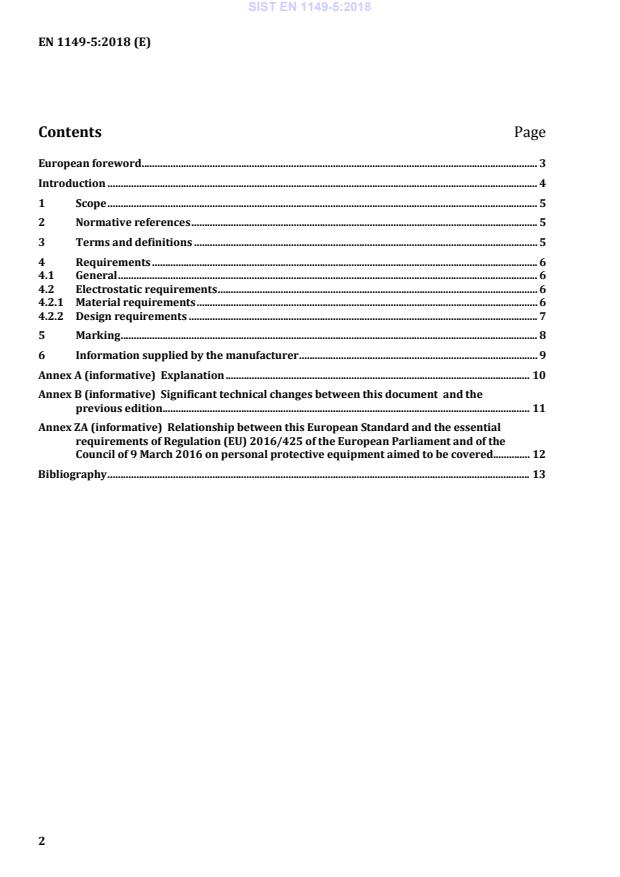
Explanation . 10 Annex B (informative)
Significant technical changes between this document
and the previous edition . 11 Annex ZA (informative)
Relationship between this European Standard and the essential requirements of Regulation (EU) 2016/425 of the European Parliament and of the Council of 9 March 2016 on personal protective equipment aimed to be covered. 12 Bibliography . 13
1) Numbers in square brackets refer to the bibliography. SIST EN 1149-5:2018
The material and design requirements do not presume adequate earthing of additional equipment worn or carried in contact with clothing, e.g. breathing apparatus, etc. If such additional equipment is required to be earthed, other requirements beyond the scope of this European Standard may be necessary. The scope of this standard does not include electrostatic dissipative protective gloves or footwear that are separate and not integral parts of garments. The material and design requirements may not provide sufficient protection in oxygen enriched flammable atmospheres. NOTE Additional information about oxygen enriched flammable atmospheres can be found in CEN/CLC/TR 16832:2015 [1]. This European Standard is not applicable for protection against mains voltages. 2 Normative references The following documents are referred to in the text in such a way that some or all of their content constitutes requirements of this document. For dated references, only the edition cited applies. For undated references, the latest edition of the referenced document (including any amendments) applies. EN 1149-1:2006, Protective clothing — Electrostatic properties — Part 1: Test method for measurement of surface resistivity EN 1149-3:2004, Protective clothing — Electrostatic properties — Part 3: Test methods for measurement of charge decay EN 60079-32-2:2015, Explosive atmospheres — Part 32-2: Electrostatics hazards — Tests (IEC 60079-32-2:2015) EN ISO 13688:2013, Protective clothing — General requirements (ISO 13688:2013) 3 Terms and definitions For the purposes of this document, the terms and definitions given in EN ISO 13688:2013, EN 1149-1:2006, EN 1149-3:2004 and the following apply. ISO and IEC maintain terminological databases for use in standardization at the following addresses:
IEC Electropedia: available at http://www.electropedia.org/
ISO Online browsing platform: available at http://www.iso.org/obp 3.1 attachment item that is not an integral part of material, but is permanently or temporarily attached to clothing, e.g. fastener, detachable pocket, label, high visibility tape, etc. SIST EN 1149-5:2018
...