

EN 50289-4-7:2008
(Main)Communication cables - Specifications for test methods - Part 4-7: Environmental test methods - Damp heat, steady state
General Information
- Abstract
This Part 4-7 of EN 50289 details the method of test to determine the stability of transmission performance of a finished cable used in analogue and digital communication systems when submitted to damp heat steady state which may occur during use. It is to be read in conjunction with Part 4-1 of EN 50289, which contains essential provisions for its application.
- Status
- Published
- Publication Date
- 30-Jan-2008
- Withdrawal Date
- 31-Aug-2010
- Technical Committee
- CLC/TC 46X - Communication cables
- Drafting Committee
- IEC/TC 46 - IEC_TC_46
- Parallel Committee
- IEC/TC 46 - IEC_TC_46
- Current Stage
- 9093 - Decision to confirm - Review Enquiry
- Start Date
- 24-Sep-2025
- Completion Date
- 25-Aug-2026

Overview
EN 50289-4-7:2008 is a key European standard that specifies test methods for communication cables, focusing on environmental testing under damp heat, steady state conditions. Issued by CLC, this standard outlines procedures to evaluate the stability of transmission performance for finished cables used in analog and digital communication systems when exposed to sustained humid heat environments. This test method ensures reliable cable performance despite environmental stressors that may be encountered during typical use.
The standard complements Part 4-1 of EN 50289, which covers general environmental testing requirements, and is integral for manufacturers and testers aiming to validate cable durability and performance under challenging climate conditions.
Key Topics
Scope and Purpose
The test verifies the transmission stability of communication cables subjected to steady-state damp heat, typically at 60 °C and over 95% relative humidity for an extended period (commonly 96 hours), reflecting real-world environmental stresses.Test Equipment and Conditions
Testing requires a climatic chamber capable of controlling temperature within ±3 K and maintaining high humidity by admitting or generating water vapor. Transmission measuring equipment suitable for detecting changes in cable performance is essential.Sample Preparation
Cable samples must have adequate length per cable specifications and are typically tested as loose coils or on cushioned reels to prevent tension that could impact results. The winding diameter should allow for differential thermal expansion without restriction to mimic actual cable deployment conditions.Testing Procedure
The testing method involves:- Initial visual inspection and baseline transmission measurement at ambient temperature
- Gradual heating of the climatic chamber to test temperature
- Steady exposure to high humidity and temperature for a specified duration
- Controlled cooling back to ambient temperature and ensuring temperature stability before removal
- Optional recovery phase at standard atmospheric conditions to assess permanent effects
Measurement and Acceptance
Transmission parameters such as attenuation or electrical length are monitored before, during, and after testing. Acceptance criteria depend on relevant cable specifications to determine pass/fail status.Reporting Requirements
Test reports must detail inspection schedules, sample configuration (winding type, diameter, tension), equipment used, temperature cycling protocols, transmission parameter variations, and compliance results.
Applications
EN 50289-4-7:2008 is essential for cable manufacturers, testing laboratories, and quality assurance teams involved in analogue and digital communication infrastructure. Its implementation ensures that communication cables maintain reliable transmission quality despite prolonged exposure to damp heat environments commonly found in indoor, outdoor, and industrial settings.
Typical applications include:
- Telecommunications networks with cables exposed to humid climates
- Data centers requiring environmental robustness testing of internal cabling
- Industrial automation systems where cables face fluctuating temperature and moisture
- Outdoor communication installations subject to steady high humidity and heat cycles
Using this standard helps reduce failure risks, increase network uptime, and comply with regulatory requirements for cable environmental performance.
Related Standards
- EN 50289-4-1 - Environmental test methods – General requirements
- EN 50290-1-2 - Communication cables – Definitions and terminology
- EN 60068-2-14 - Environmental testing – Change of temperature test methods
- IEC 60068 Series - International standards covering various environmental testing procedures
These standards collectively provide a comprehensive framework for testing communication cables against environmental stresses, ensuring consistent and reliable performance across diverse applications.
Keywords: EN 50289-4-7, communication cables, damp heat test, environmental test methods, transmission performance, cable testing, climatic chamber, humidity testing, cable standards, digital communication cables, analogue cables, steady-state heat, CLC standard, cable durability, communication infrastructure testing.
Relations
- Refers
EN IEC 60068-2-14:2023 - Environmental testing - Part 2-14: Tests - Test N: Change of temperature - Effective Date
- 03-Feb-2026
- Effective Date
- 03-Feb-2026
- Effective Date
- 03-Feb-2026
- Effective Date
- 03-Feb-2026
- Effective Date
- 03-Feb-2026
- Effective Date
- 03-Feb-2026
Get Certified
Connect with accredited certification bodies for this standard

ANCE
Mexican certification and testing association.

Intertek Slovenia
Intertek testing, inspection, and certification services in Slovenia.

LNE (Laboratoire National de Métrologie et d'Essais)
French national laboratory for metrology and testing.
Sponsored listings
Frequently Asked Questions
EN 50289-4-7:2008 is a standard published by CLC. Its full title is "Communication cables - Specifications for test methods - Part 4-7: Environmental test methods - Damp heat, steady state". This standard covers: This Part 4-7 of EN 50289 details the method of test to determine the stability of transmission performance of a finished cable used in analogue and digital communication systems when submitted to damp heat steady state which may occur during use. It is to be read in conjunction with Part 4-1 of EN 50289, which contains essential provisions for its application.
This Part 4-7 of EN 50289 details the method of test to determine the stability of transmission performance of a finished cable used in analogue and digital communication systems when submitted to damp heat steady state which may occur during use. It is to be read in conjunction with Part 4-1 of EN 50289, which contains essential provisions for its application.
EN 50289-4-7:2008 is classified under the following ICS (International Classification for Standards) categories: 33.120.10 - Coaxial cables. Waveguides. The ICS classification helps identify the subject area and facilitates finding related standards.
EN 50289-4-7:2008 has the following relationships with other standards: It is inter standard links to EN IEC 60068-2-14:2023, EN 50289-4-1:2001, EN 50290-1-2:2004, EN 50117-1:2019, EN 50290-4-1:2014, EN 50602:2014. Understanding these relationships helps ensure you are using the most current and applicable version of the standard.
EN 50289-4-7:2008 is associated with the following European legislation: Standardization Mandates: M/212. When a standard is cited in the Official Journal of the European Union, products manufactured in conformity with it benefit from a presumption of conformity with the essential requirements of the corresponding EU directive or regulation.
EN 50289-4-7:2008 is available in PDF format for immediate download after purchase. The document can be added to your cart and obtained through the secure checkout process. Digital delivery ensures instant access to the complete standard document.
Standards Content (Sample)
2003-01.Slovenski inštitut za standardizacijo. Razmnoževanje celote ali delov tega standarda ni dovoljeno.Communication cables - Specifications for test methods - Part 4-7: Environmental test methods - Damp heat, steady stateCâbles de communication - Spécifications des méthodes d'essais - Partie 4-7: Méthodes d'essais d’environnement - Chaleur humide, essai continuKommunikationskabel - Spezifikationen für Prüfverfahren - Teil 4-7: Umweltprüfverfahren - Feuchte Wärme, konstantTa slovenski standard je istoveten z:EN 50289-4-7:2008SIST EN 50289-4-7:2008en,de33.120.10ICS:SLOVENSKI
STANDARDSIST EN 50289-4-7:200801-april-2008
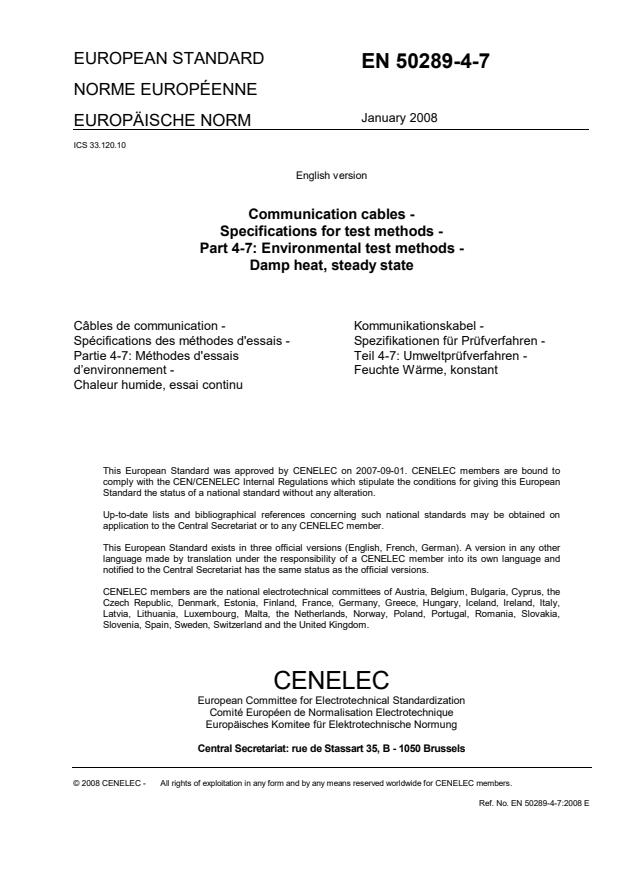
EUROPEAN STANDARD EN 50289-4-7 NORME EUROPÉENNE
EUROPÄISCHE NORM January 2008
CENELEC European Committee for Electrotechnical Standardization Comité Européen de Normalisation Electrotechnique Europäisches Komitee für Elektrotechnische Normung
Central Secretariat: rue de Stassart 35, B - 1050 Brussels
© 2008 CENELEC -
All rights of exploitation in any form and by any means reserved worldwide for CENELEC members.
Ref. No. EN 50289-4-7:2008 E
ICS 33.120.10
English version
Communication cables -
Specifications for test methods -
Part 4-7: Environmental test methods -
Damp heat, steady state
Câbles de communication -
Spécifications des méthodes d'essais -
Partie 4-7: Méthodes d'essais d’environnement -
Chaleur humide, essai continu
Kommunikationskabel -
Spezifikationen für Prüfverfahren -
Teil 4-7: Umweltprüfverfahren -
Feuchte Wärme, konstant
This European Standard was approved by CENELEC on 2007-09-01. CENELEC members are bound to comply with the CEN/CENELEC Internal Regulations which stipulate the conditions for giving this European Standard the status of a national standard without any alteration.
Up-to-date lists and bibliographical references concerning such national standards may be obtained on application to the Central Secretariat or to any CENELEC member.
This European Standard exists in three official versions (English, French, German). A version in any other language made by translation under the responsibility of a CENELEC member into its own language and notified to the Central Secretariat has the same status as the official versions.
CENELEC members are the national electrotechnical committees of Austria, Belgium, Bulgaria, Cyprus, the Czech Republic, Denmark, Estonia, Finland, France, Germany, Greece, Hungary, Iceland, Ireland, Italy, Latvia, Lithuania, Luxembourg, Malta, the Netherlands, Norway, Poland, Portugal, Romania, Slovakia, Slovenia, Spain, Sweden, Switzerland and the United Kingdom.
The text of the draft was submitted to the Unique Acceptance Procedure and was approved by CENELEC as EN 50289-4-7 on 2007-09-01. The following dates were fixed:
- latest date by which the EN has to be implemented
at national level by publication of an identical
national standard or by endorsement
(dop) 2008-09-01
- latest date by which the national standards conflicting
with the EN have to be withdrawn
(dow) 2010-09-01 This European Standard has been prepared under the European Mandate M/212 given to CENELEC by the European Commission and the European Free Trade Association. __________
- 3 - EN 50289-4-7:2008 Contents 1 Scope.4 2 Normative references.4 3 Definitions.4 4 Test methods.4 4.1 Equipment.4 4.2 Test sample.4 4.3 Procedure.5 4.4 Requirements.6 4.5 Details to be specified.6 5 Test report.6
1 Scope This Part 4-7 of EN 50289 details the method of test to determine the stability of transmission performance of a finished cable used in analogue and digital communication systems when submitted to damp heat steady state which may oc
...