


EN 45544-1:2015
(Main)Workplace atmospheres - Electrical apparatus used for the direct detection and direct concentration measurement of toxic gases and vapours - Part 1: General requirements and test methods
General Information
- Abstract
This European Standard specifies general requirements and test methods for the determination of the performance characteristics of personal, portable, transportable and fixed, continuous duty electrical apparatus used for the direct detection and direct concentration measurement of toxic gases and vapours in workplace atmospheres.
- Status
- Withdrawn
- Publication Date
- 15-Jan-2015
- Withdrawal Date
- 23-Nov-2017
- Current Stage
- 9960 - Withdrawal effective - Withdrawal
- Start Date
- 27-Aug-2025
- Completion Date
- 27-Aug-2025

Relations
- Effective Date
- 11-Feb-2026
- Effective Date
- 23-Aug-2022
- Refers
ISO/IEC 17025:2005 - General requirements for the competence of testing and calibration laboratories - Effective Date
- 10-Feb-2026
- Effective Date
- 10-Feb-2026
- Effective Date
- 03-Feb-2026
- Effective Date
- 03-Feb-2026
- Effective Date
- 03-Feb-2026
- Effective Date
- 03-Feb-2026
Get Certified
Connect with accredited certification bodies for this standard

CIS Institut d.o.o.
Personal Protective Equipment (PPE) certification body. Notified Body NB-2890 for EU Regulation 2016/425 PPE.

Kiwa BDA Testing
Building and construction product certification.
Kmetijski inštitut Slovenije
Agricultural Institute of Slovenia. Soil testing, plant health, agricultural product analysis.
Sponsored listings
Frequently Asked Questions
EN 45544-1:2015 is a standard published by CLC. Its full title is "Workplace atmospheres - Electrical apparatus used for the direct detection and direct concentration measurement of toxic gases and vapours - Part 1: General requirements and test methods". This standard covers: This European Standard specifies general requirements and test methods for the determination of the performance characteristics of personal, portable, transportable and fixed, continuous duty electrical apparatus used for the direct detection and direct concentration measurement of toxic gases and vapours in workplace atmospheres.
This European Standard specifies general requirements and test methods for the determination of the performance characteristics of personal, portable, transportable and fixed, continuous duty electrical apparatus used for the direct detection and direct concentration measurement of toxic gases and vapours in workplace atmospheres.
EN 45544-1:2015 is classified under the following ICS (International Classification for Standards) categories: 13.040.30 - Workplace atmospheres; 13.320 - Alarm and warning systems. The ICS classification helps identify the subject area and facilitates finding related standards.
EN 45544-1:2015 has the following relationships with other standards: It is inter standard links to EN 45544-1:1999, EN IEC 62990-1:2022, ISO/IEC 17025:2005, EN 482:2021, EN IEC 60079-0:2018, EN 50270:2015, EN 60068-2-6:2008, EN 50271:2018. Understanding these relationships helps ensure you are using the most current and applicable version of the standard.
EN 45544-1:2015 is available in PDF format for immediate download after purchase. The document can be added to your cart and obtained through the secure checkout process. Digital delivery ensures instant access to the complete standard document.
Standards Content (Sample)
2003-01.Slovenski inštitut za standardizacijo. Razmnoževanje celote ali delov tega standarda ni dovoljeno.Arbeitsplatzatmosphäre - Elektrische Geräte für die direkte Detektion und direkte Konzentrationsmessung toxischer Gase und Dämpfe - Teil 1: Allgemeine Anforderungen und PrüfverfahrenAtmosphères des lieux de travail - Appareillage électrique utilisé pour la détection directe des vapeurs et gaz toxiques et le mesurage direct de leur concentration - Partie 1: Exigences générales et méthodes d'essaiWorkplace atmospheres - Electrical apparatus used for the direct detection and direct concentration measurement of toxic gases and vapours - Part 1: General requirements and test methods13.320Alarmni in opozorilni sistemiAlarm and warning systems13.040.30Kakovost zraka na delovnem mestuWorkplace atmospheresICS:Ta slovenski standard je istoveten z:EN 45544-1:2015SIST EN 45544-1:2015en,fr,de01-september-2015SIST EN 45544-1:2015SLOVENSKI
STANDARDoSIST prEN 45544-1:20131DGRPHãþD
EUROPEAN STANDARD NORME EUROPÉENNE EUROPÄISCHE NORM
EN 45544-1
January 2015 ICS 13.320; 13.040.30
Supersedes
EN 45544-1:1999
English Version
Workplace atmospheres - Electrical apparatus used for the direct detection and direct concentration measurement of toxic gases and vapours - Part 1: General requirements and test methods
Atmosphères des lieux de travail - Appareillage électrique utilisé pour la détection directe des vapeurs et gaz toxiques et le mesurage direct de leur concentration - Partie 1: Exigences générales et méthodes d'essai
Arbeitsplatzatmosphäre - Elektrische Geräte für die direkte Detektion und direkte Konzentrationsmessung toxischer Gase und Dämpfe - Teil 1: Allgemeine Anforderungen und Prüfverfahren This European Standard was approved by CENELEC on 24 November 2014. CEN and CENELEC members are bound to comply with the CEN/CENELEC Internal Regulations which stipulate the conditions for giving this European Standard the status of a national standard without any alteration. Up-to-date lists and bibliographical references concerning such national standards may be obtained on application to the CEN-CENELEC Management Centre or to any CEN and CENELEC member.
This European Standard exists in three official versions (English, French, German). A version in any other language made by translation under the responsibility of a CEN and CENELEC member into its own language and notified to the CEN-CENELEC Management Centre has the same status as the official versions. CEN and CENELEC members are the national standards bodies and national electrotechnical committees of Austria, Belgium, Bulgaria, Croatia, Cyprus, Czech Republic, Denmark, Estonia, Finland, Former Yugoslav Republic of Macedonia, France, Germany, Greece, Hungary, Iceland, Ireland, Italy, Latvia, Lithuania, Luxembourg, Malta, Netherlands, Norway, Poland, Portugal, Romania, Slovakia, Slovenia, Spain, Sweden, Switzerland, Turkey and United Kingdom European Committee for Electrotechnical Standardization
Comité Européen de Normalisation Electrotechnique Europäisches Komitee für Elektrotechnische Normung CEN-CENELEC Management Centre: Avenue Marnix 17,
B-1000 Brussels © 2015 CEN/CENELEC All rights of exploitation in any form and by any means reserved worldwide for CEN national Members and for CENELEC Members.
Ref. No. EN 45544-1:2015 E SIST EN 45544-1:2015
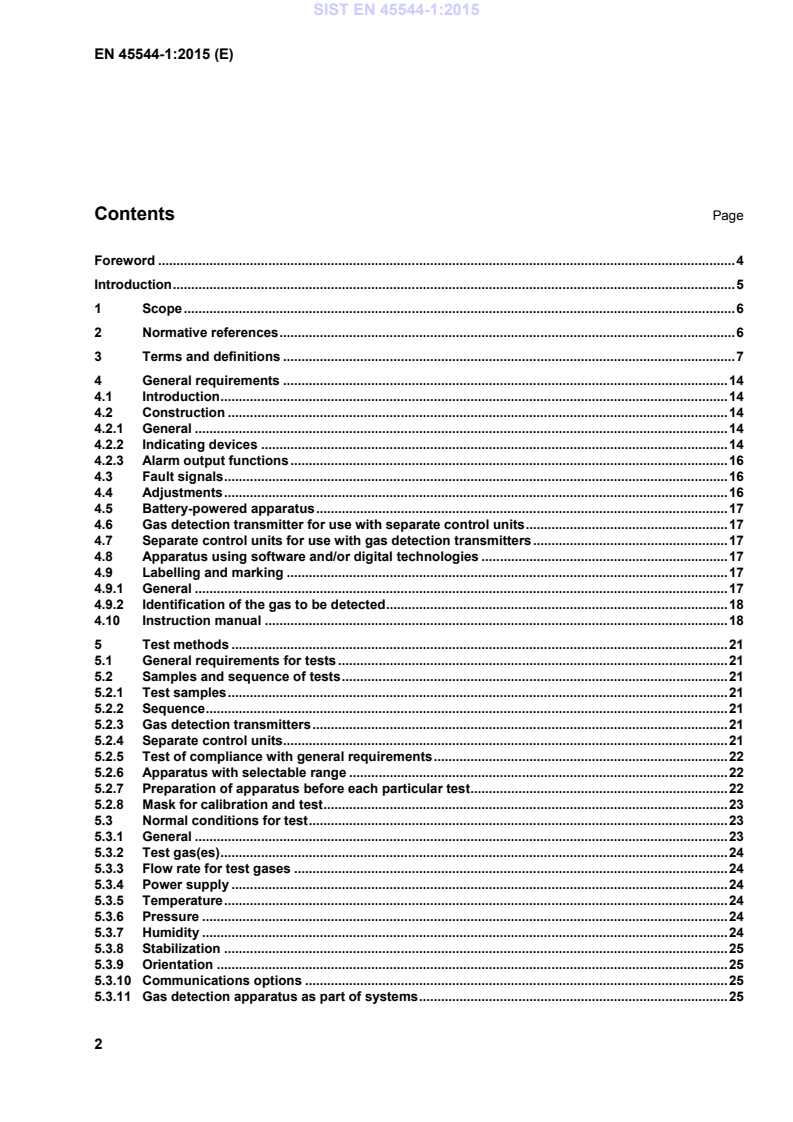
Contents Page Foreword . 4 Introduction . 5 1 Scope . 6 2 Normative references . 6 3 Terms and definitions . 7 4 General requirements . 14 4.1 Introduction . 14 4.2 Construction . 14 4.2.1 General . 14 4.2.2 Indicating devices . 14 4.2.3 Alarm output functions . 16 4.3 Fault signals . 16 4.4 Adjustments . 16 4.5 Battery-powered apparatus . 17 4.6 Gas detection transmitter for use with separate control units . 17 4.7 Separate control units for use with gas detection transmitters . 17 4.8 Apparatus using software and/or digital technologies . 17 4.9 Labelling and marking . 17 4.9.1 General . 17 4.9.2 Identification of the gas to be detected . 18 4.10 Instruction manual . 18 5 Test methods . 21 5.1 General requirements for tests . 21 5.2 Samples and sequence of tests . 21 5.2.1 Test samples . 21 5.2.2 Sequence . 21 5.2.3 Gas detection transmitters . 21 5.2.4 Separate control units. 21 5.2.5 Test of compliance with general requirements . 22 5.2.6 Apparatus with selectable range . 22 5.2.7 Preparation of apparatus before each particular test . 22 5.2.8 Mask for calibration and test . 23 5.3 Normal conditions for test . 23 5.3.1 General . 23 5.3.2 Test gas(es) . 24 5.3.3 Flow rate for test gases . 24 5.3.4 Power supply . 24 5.3.5 Temperature . 24 5.3.6 Pressure . 24 5.3.7 Humidity . 24 5.3.8 Stabilization . 25 5.3.9 Orientation . 25 5.3.10 Communications options . 25 5.3.11 Gas detection apparatus as part of systems . 25 SIST EN 45544-1:2015
5.4 Tests . 25 5.4.1 General . 25 5.4.2 Unpowered storage . 26 5.4.3 Measurement of deviations . 26 5.4.4 Mechanical tests . 27 5.4.5 Environmental tests . 28 5.4.6 Performance tests . 30 5.4.7 Electrical tests . 34 5.4.8 Stability . 35 5.4.9 Verification of software and digital components . 35 6 Uncertainty of measurement and lower limit of measurement. 35 6.1 General . 35 6.2 Method of calculation of uncertainty of measurement . 36 6.2.1 General . 36 6.2.2 Sources of uncertainty. 37 6.2.3 Calculation of relative expanded uncertainty . 42 6.3 Method of calculation of lower limit of measurement . 42 7 Test report . 44 Annex A (normative)
Standard test gas volume fractions for EN 45544-2 apparatus . 45 Annex B (informative)
Sequence of tests . 47 Annex C (informative)
Example of a test chamber . 48 Annex D (informative)
Table of significant changes in comparison to EN 45544-1:1999 . 49
Foreword This document (EN 45544-1:2015) has been prepared by CEN/CENELEC Joint Working Group Continuous Measuring Instruments (JWG CMI). The following dates are fixed: • latest date by which this document has to be implemented at national level by publication of an identical national standard or by endorsement (dop) 2015-11-24 • latest date by which the national standards conflicting with this document have to be withdrawn (dow) 2017-11-24 This document supersedes EN 45544-1:1999. SIST EN 45544-1:2015
Introduction National laws and regulations based on European Directives require the assessment of the potential exposure of a worker to chemical agents in workplace atmospheres. EN 45544, Workplace atmospheres – Electrical apparatus used for the direct detection and direct concentration measurement of toxic gases and vapours, consists of the following parts: — Part 1: General requirements and test methods; — Part 2: Performance requirements for apparatus used for exposure measurement; — Part 3: Performance requirements for apparatus used for general gas detection; — Part 4: Guide for selection, installation, use and maintenance. EN 45544 series is based on EN 482 which specifies general performance requirements for procedures for measuring the concentration of chemical agents in workplace atmospheres. These performance requirements are intended to apply under environmental conditions present at the workplace. However, because a wide range of environmental conditions are encountered in practice, this document specifies requirements that have to be fulfilled by measuring procedures when tested under prescribed laboratory conditions. EN 45544-2 details the performance requirements outlined in EN 482 specifically for electrical apparatus used for the direct detection and direct concentration measurement of toxic gases and vapours intended for exposure measurement. EN 45544-3 details the performance requirements for general gas detection apparatus, e.g. safety warning, leak detection. The measuring range will be defined by the manufacturer. In general, the requirements for accuracy will be higher for EN 45544-2 apparatus than for EN 45544-3 apparatus. The same apparatus may be used for applications covered by EN 45544-2 and EN 45544-3. EN 45544 series will help manufacturers, test laboratories and users of apparatus to adopt a consistent approach to, and provide a framework for, the assessment of performance criteria. It is the manufacturer’s primary responsibility to ensure that the apparatus meets the requirements laid down in this European Standard, including environmental influences, which can be expected to affect performance. For a given measurement task, the range over which the requirements for the relative expanded uncertainty have to be met depends on the limit value. However, for most chemical agents the limit values have not been harmonized at the European level. Therefore, it was decided to use a reference value (standard test gas concentration) instead of the limit value for the performance tests. The list of standard test gas volume fractions is given in Annex A. The values chosen are equal to or close to the limit values used in different European countries but are intended to be used only for type testing apparatus without any legal implications. Electrical apparatus used for the direct detection and direct concentration measurement of toxic gases and vapours generate readings in clean air (zero readings), which vary with environmental conditions and time. This standard therefore includes test methods and requirements for acceptable variations in zero readings which are additional to the general requirements of EN 482. SIST EN 45544-1:2015
1 Scope This European Standard specifies general requirements and test methods for the determination of the performance characteristics of personal, portable, transportable and fixed, continuous duty electrical apparatus used for the direct detection and direct concentration measurement of toxic gases and vapours in workplace atmospheres. This European Standard is applicable to apparatus whose primary purpose is to provide an indication, alarm and/or other output function to give a warning of the presence of a toxic gas or vapour in the atmosphere and, in some cases, to initiate automatic or manual protective actions. It is applicable to apparatus in which the sensor automatically generates an electrical signal when gas is present. This European Standard is not applicable to apparatus: − used for the measurement of oxygen; − used only in laboratories for analysis or measurement; − used only for process measurement purposes; − used in car parks or tunnels; − used in the domestic environment; − used in environmental air pollution monitoring; − used for the measurement of combustible gases and vapours related to the risk of explosion. It also does not apply to open-path (line of sight) area monitors. For apparatus used for sensing the presence of multiple gases this standard applies only to the detection of toxic gas or vapour. 2 Normative references The following documents, in whole or in part, are normatively referenced in this document and are indispensable for its application. For dated references, only the edition cited applies. For undated references, the latest edition of the referenced document (including any amendments) applies. EN 482, Workplace exposure - General requirements for the performance of procedures for the measurement of chemical agents EN 45544-2:2015, Workplace atmospheres - Electrical apparatus used for the direct detection and direct concentration measurement of toxic gases and vapours - Part 2: Performance requirements for apparatus used for exposure measurement EN 45544-3:2015, Workplace atmospheres - Electrical apparatus used for the direct detection and direct concentration measurement of toxic gases and vapours - Part 3: Performance requirements for apparatus used for general gas detection EN 50270, Electromagnetic compatibility - Electrical apparatus for the detection and measurement of combustible gases, toxic gases or oxygen SIST EN 45544-1:2015
EN 50271, Electrical apparatus for the detection and measurement of combustible gases, toxic gases or oxygen - Requirements and tests for apparatus using software and/or digital technologies EN 60068-2-6, Environmental testing - Part 2-6: Tests - Test Fc: Vibration (sinusoidal) (IEC 60068-2-6) EN 60079-0, Explosive atmospheres - Equipment - General requirements (IEC 60079-0) EN ISO/IEC 17025, General requirements for the competence of testing and calibration laboratories (ISO/IEC 17025) 3 Terms and definitions For the purposes of this document, the following terms and definitions apply. 3.1 toxic gas general term for any gas or vapour that can be harmful to human health toxic. The term “gas” is used for both gases and vapours 3.2 clean air air that is free of gases or vapours which the sensor is sensitive to or which influence the performance of the sensor 3.3 ambient air normal atmosphere surrounding the apparatus 3.4 poisons substances that lead to temporary or permanent change of performance, particularly loss of sensitivity, of the sensing element 3.5 standard test gas test gas with a composition specified for each apparatus and gas to be used for all tests unless otherwise stated 3.6 mask for calibration and test device that can be attached to the apparatus to present a test gas to the sensor in a reproducible manner 3.7 volume fraction (V/V)
quotient of the volume of a specified component and the sum of the volumes of all components of a gas mixture before mixing Note 1 to entry The volume fraction and volume concentration take the same value if, at the same state conditions, the sum of the component volumes before mixing and the volume of the mixture are equal. However, because the mixing of two or more gases at the same state conditions is usually accompanied by a slight contraction or, less frequently, a slight expansion, this is not generally the case. SIST EN 45544-1:2015
3.8 limit value occupational exposure limit of the time-weighted average of the concentration of a chemical agent in the air within the breathing zone of a worker in relation to a specified reference period [SOURCE: Council Directive 98/24/EC Art. 2(d) [1]] Note 1 to entry Limit values are mostly set for reference periods of 8 h, but can also be set for shorter periods or concentration excursions, e.g. short-term exposure limit (STEL). Limit values for gases and vapours are stated in terms independent of temperature and air pressure variables in ml/m3 and in terms dependent on those variables in mg/m3 for a temperature of 20 °C and a pressure of 101,3 kPa. 3.9 time weighted average (TWA) concentration concentration of gas in air integrated over time and divided by the specified reference period 3.10 fixed apparatus apparatus which is intended to have all parts permanently installed 3.11 transportable apparatus apparatus not intended to be a portable apparatus, but which can readily be moved from one place to another 3.12 portable apparatus apparatus that has been designed to be readily carried from place to place and to be used whilst being carried Note 1 to entry Portable apparatus is generally battery powered. 3.13 personal apparatus portable apparatus attached to a person, that monitors the atmosphere in their breathing zone so that their exposure to toxic gases or vapours can be determined Note 1 to entry Also known as a personal monitor. 3.14 continuous duty apparatus apparatus that is powered for long periods of time, but may have either continuous or intermittent sensing 3.15 gas detection transmitter fixed gas detection apparatus that provides a conditioned electronic signal or output indication to a generally accepted industry standard, intended to be utilized with seperate control units, or signal processing data acquisition, central monitoring and similar systems which typically process information from various locations and sources including, but not limited to, gas detection apparatus EXAMPLE An example of a generally accepted industry standard for an electronic signal or output indication is 4–20 mA. 3.16 control unit apparatus intended to provide display indication, alarm functions, output contacts and/or alarm signal outputs when operated with remote sensor(s) SIST EN 45544-1:2015
3.17 separate control unit
control unit intended to be utilized with gas detection transmitter(s) 3.18 apparatus with integral sensor(s) apparatus intended to provide display indication, alarm functions, output contacts and/or alarm signal outputs where the sensor is an integral part of the apparatus 3.19 diffusion apparatus apparatus in which the transfer of gas from the atmosphere to the gas sensor takes place without aspirated flow 3.20 aspirated apparatus apparatus which samples the atmosphere by drawing it to the sensor EXAMPLE A hand operated or electric pump can draw gas to the sensor 3.21 automatically aspirated apparatus aspirated apparatus with an integral pump 3.22 alarm-only apparatus apparatus having an alarm but not having a display or other device to indicate the measured gas concentration 3.23 sensing element part of the sensor which is sensitive to the gas/vapour to be measured 3.24 sensor assembly in which the sensing element is housed and which can also contain associated circuit components 3.25 measuring principle type of physical or physico-chemical detection principle and the measurement procedure to determine the measured value 3.26 remote sensor sensor which is not an integral part of the apparatus. A remote sensor is connected to a control unit or to a gas detection transmitter 3.27 alarm set point setting of the apparatus at which the measured concentration will cause the apparatus to initiate an indication, alarm or other output function SIST EN 45544-1:2015
3.28 TWA alarm set point setting of the apparatus at which the measured time weighted average concentration will cause the apparatus to initiate an indication, alarm or other output function 3.29 latching alarm alarm that, once activated, requires deliberate action for deactivation 3.30 fault signal audible, visible or other type of output, different from the alarm signal which permits, directly or indirectly, a warning or indication that the apparatus is not working satisfactorily 3.31 sample line means by which the gas being sampled is conveyed to the sensor including accessories EXAMPLE (of accessories) Filter, water trap 3.32 sampling probe separate sample line which is attached to the apparatus as required Note 1 to entry It can be supplied with or without the apparatus. It is usually short (e.g. of the order of 1 m) and rigid, although it can be telescopic. It can also be connected by a flexible tube to the apparatus. 3.33 field calibration kit means of calibrating or adjusting the apparatus EXAMPLE This can be a mask for calibration and test (see 3.6). Note 1 to entry The field calibration kit can also be used for verifying the operation of the apparatus. 3.34 special tool tool required to gain access to or to adjust the apparatus controls Note 1 to entry The design of the tool is intended to discourage unauthorized interference with the apparatus. 3.35 stabilization state when three successive observations taken at 1 min intervals in clean air or test gas under constant conditions indicate no changes greater than ± lower limit of measurement for EN 45544-2 apparatus or ± 1 % of the specified measuring range for EN 45544-3 apparatus 3.36 final indication indication given by the apparatus after stabilization 3.37 indication range range of measured values of gas concentration over which the apparatus is capable of indicating Note 1 to entry See Figure 1. SIST EN 45544-1:2015
3.38 zero scale indication smallest value of the measured quantity within the indication range Note 1 to entry This is typically zero. Note 2 to entry See Figure 1. 3.39 full scale indication largest value of the measured quantity within the indication range Note 1 to entry See Figure 1. 3.40 measuring range range of measured values of gas concentration over which the accuracy of the apparatus lies within specified limits Note 1 to entry For apparatus conforming to EN 45544–2, the requirements for expanded uncertainty in Table 1 of EN 482 are met. For apparatus conforming to EN 45544–3, the requirements for accuracy in EN 45544–3 are met. The measuring range is a subset of the indication range. Note 2 to entry See Figure 1. 3.41 lower limit of measurement smallest value of the measured quantity within the measuring range Note 1 to entry See Figure 1. 3.42 upper limit of measurement largest value of the measured quantity within the measuring range Note 1 to entry Indications below the lower limit of measurement or above the upper limit of measurement will not necessarily meet the uncertainty requirements of this standard. Note 2 to entry See Figure 1.
Figure 1 — Instrument scale showing ranges, indications and limits SIST EN 45544-1:2015
3.43 expanded uncertainty quantity defining an interval around a result of a measurement, expected to encompass a large fraction of the distribution of values that could reasonably be attributed to the measurand 3.44 coverage factor (k) numerical factor used as a multiplier of the combined standard uncertainty in order to obtain an expanded uncertainty Note 1 to entry EN 482:2012 specifies k = 2. 3.45 non-random uncertainty uncertainty associated with non-random errors 3.46 random uncertainty uncertainty associated with random errors 3.47 zero uncertainty quantity defining an interval about the zero that might be expected to encompass a large fraction of the distribution of values that could reasonably be attributed to the measurement in clean air In Figure 2, the mean value of the measured values in clean air is not equal to the zero scale indication to illustrate that there can be an offset due to drift. The mean value can be above or below the zero scale indication
Figure 2 — Example of zero uncertainty SIST EN 45544-1:2015
3.48 drift variation in the apparatus indication with time at any fixed gas volume fraction under constant ambient conditions 3.49 time of recovery (tx) time interval, with the apparatus in a warmed-up condition, between the time when an instantaneous decrease in volume fraction is produced at the apparatus inlet and the time when the response reaches a stated indication of x % of the initial indication Note 1 to entry For alarm only apparatus the stated indication can be represented by the de-activation of the alarm set at a stated value. 3.50 time of response (tx) time interval, with the apparatus in a warmed-up condition between the time when an instantaneous increase in volume fraction is produced at the apparatus inlet and the time when the response reaches a stated indication of x % of the final indication Note 1 to entry For alarm only apparatus the stated indication can be represented by the activation of the alarm set at a stated value. 3.51 warm-up time time interval, with the apparatus in a stated atmosphere, between the time when the apparatus is switched on and the time when the indication reaches and remains within the stated tolerances Note 1 to entry See Figure 3.
Figure 3 — Example of warm-up time in clean air SIST EN 45544-1:2015
3.52 calibration procedure which establishes the relationship between a measured value and the volume fraction of a test gas 3.53 adjustment procedure carried out to minimize the deviation of the measured value from the test gas volume fraction Note 1 to entry When the apparatus is adjusted to give an indication of zero in clean air, the procedure is called ’zero adjustment’. 3.54 special state all states of the apparatus other than those in which monitoring of gas concentration and/or alarming takes place, for example warm-up, calibration mode or fault condition 4 General requirements 4.1 Introduction Electrical assemblies and components shall conform to the construction requirements of 4.2, where applicable. In addition, parts of the gas detection apparatus intended for use in potentially explosive atmospheres shall employ materials, and comply with the construction and explosion protection as specified in the EN 60079 series of standards. 4.2 Construction 4.2.1 General Each apparatus shall be constructed in such a manner that regular functional checks can be easily undertaken by the user and that it can be equipped with suitable devices for application of test gas (field calibration kit). Gas detection apparatus or parts thereof (e.g. remote sensors) specifically intended for use in the presence of corrosive vapours or gases, or which can produce corrosive by-products as a result of the detection process (e.g. catalytic oxidation or other chemical process), shall be constructed of materials known to be resistant to corrosion by such substances. All materials and components used in the construction of the apparatus shall be used within the manufacturer’s ratings or limitations unless otherwise specified by appropriate safety standards. For aspirated apparatus, inlet and outlet ports shall be unambiguously marked to ensure the correct connection of any sample and exhaust lines. 4.2.2 Indicating devices 4.2.2.1 General Readily distinguishable indications shall be provided to show that the apparatus is energized, in alarm or in a special state. SIST EN 45544-1:2015
Portable apparatus shall provide visual and audible indications for both faults and alarms. If audible indications are provided for transportable or fixed apparatus, alarms shall be indicated as a minimum requirement. For fixed apparatus the indications may be shown at the control unit. Within the measuring range, the resolution of the display and all other devices for indication of the measured value shall be at least 1 % of the upper limit of the measuring range. For EN 45544-2 apparatus the resolution shall be 10 % of the volume fraction of the standard test gas or better. NOTE See also 5.2.7. Measured values on the display and all other devices for indication of the measured value shall be identical within their tolerances. Any measurements under or over the indication range shall be clearly indicated. If the apparatus has more than one indication range, the range selected shall be clearly identified. If only one indicating light is provided for signalling alarms and special states, it shall be coloured red. If separate indicating lights are used or if a multi-coloured indicating light is provided, the colours shall be used in the following order of priority ((a) being highest priority): a) alarm indicators shall be coloured RED; b) special state indicators shall be coloured YELLOW; c) power supply indicators shall be coloured GREEN. In addition to the colour requirements, the indicator lights shall be adequately labelled to show their functions. 4.2.2.2 Dead bands Measured values within the measuring range shall be indicated. Measured values below the lower limit of measurement may be indicated as: a) zero; b) another indication that the measured value is below the lower limit of measurement; or c) the measured value. For personal, portable and transportable apparatus, the following additional requirement applies: if the measured value is below −5 % of the upper limit of measurement, the apparatus shall indicate the measured value or shall provide a fault signal. All apparatus shall provide a fault signal at measured values below −10 % of the upper limit of measurement. It shall be possible for the user to configure the apparatus such that any dead band is permanently disabled when in measuring mode. In calibration mode, any dead band shall be automatically disabled. SIST EN 45544-1:2015
4.2.3 Alarm output functions Alarm set points and TWA alarm set points shall not be adjustable outside the indication range. If more than one alarm set point is provided the alarm with the highest set point shall be latching and require a deliberate manual action to reset. All other alarms and TWA alarms shall be configurable to be latching or non-latching. Alarms shall remain in operation while the alarm condition is still present. An audible alarm may be silenced if this audible alarm is not the only alarm signal. If it is possible to temporarily de-activate alarm devices, output contacts or alarm signal outputs, this deactivation shall be indicated by a signal. For fixed apparatus, this shall include a contact or other transmittable output signal. The output signal or contacts are not required if the alarms are automatically re-enabled within 15 min. EXAMPLE It might be necessary to de-activate alarm devices for calibration purposes. For personal and portable apparatus, the sound output of audible alarms shall not be less than 70 dB(A) at 0,3 m from the apparatus. 4.3 Fault signals For fixed and transportable apparatus a transmittable fault signal shall be provided in the following cases: – failure of power; – open circuit or short circuit (i.e. loop failure) in one or more of the wires to any remote sensor. It shall be distinguishable from any alarm signal. Under-range values (e.g. caused by drift) shall be indicated by a fault signal in accordance with 4.2.2.2. Automatically aspirated apparatus shall be provided with an integral flow-indicating device that produces a fault signal in the event of low flow. For apparatus where the sensor can be disconnected without opening the housing, the apparatus shall provide a fault signal in the event of a disconnection of the sensor. 4.4 Adjustments All adjustment devices shall be designed so as to discourage unauthorised or inadvertent interference with the apparatus. EXAMPLE Examples would include procedural devices, in the case of a keyboard instrument, or mechanical devices such as a cover requiring the use of a special tool. Fixed apparatus housed in explosion-protected enclosures shall be designed so that any facilities for field adjustments, resetting or similar functions shall not degrade the explosion protection of the apparatus. The adjustments of the zero and signal amplification shall be so designed that adjustments of one will not affect the other. If this is not possible, an appropriate adjustment sequence shall be defined and described in the instruction manual. SIST EN 45544-1:2015
NOTE See 4.10v. The equipment shall not perform an automatic zero adjustment during start-up. If equipment prompts the user for zero adjustment during start-up and the user makes no selection, the ‘No’ option shall be automatically selected after a maximum period of 15 s. 4.5 Battery-powered apparatus Apparatus powered with integral batteries shall be provided with an indication of low battery condition. 4.6 Gas detection transmitter for use with separate control units A specification shall be supplied with the apparatus that describes the relationship that the gas concentration, detected by the apparatus, has with the corresponding output signal or indication (transfer function). The specification shall be detailed to the extent that the accuracy of this transfer function can be verified. As a minimum, the specification shall include data showing the relationship between the output signal and the gas concentrations corresponding to 0 %, 10 %, 30 %, 50 %, 70 %, 90 % and 100 % of the indicating range. Full-scale output and status signals shall also be included in the specification. EXAMPLE Fault and inhibit are examples of status signals. Where necessary, equipment shall be provided with the apparatus to interpret the output signal or indication, which will enable the accuracy of the transfer function to be verified. 4.7 Separate control units for use with gas detection transmitters A specification shall be supplied with the apparatus that describes the relationship the input signal has with the calculated gas concentration (transfer function). Such specification shall be detailed to the extent that the accuracy of this transfer function can be verified. As a minimum, the specification shall include data showing the relationship between the input signal and the gas concentrations corresponding to 0 %, 10 %, 30 %, 50 %, 70 %, 90 % and 100 % of the indicating range. Required inputs for full-scale indication and status signals shall also be included in the specification. EXAMPLE Fault and inhibit are examples of status signals. Where necessary, equipment shall be provided by the manufacturer to provide the input signals, which will enable the accuracy of the transfer function to be verified. 4.8 Apparatus using software and/or digital technologies The apparatus shall conform to EN 50271. 4.9 Labelling and marking 4.9.1 General The apparatus shall be marked legibly and indelibly with a minimum of the following: a) name and address of the manufacturer; b) designation of series or type; c) serial number; SIST EN 45544-1:2015
d) year of manufacture (may be encoded within the serial number); e) “EN 45544-2” and/or “EN 45544-3” (to represent conformity with one or both of these standards). If due to size constraints this information cannot be put onto the apparatus, it shall be included in the instruction manual; f) If applicable, the marking shall conform to the additional marking requirements of EN 60079-0. 4.9.2 Identification of the gas to be detected Personal, portable and transportable apparatus shall be labelled with the gas(es) to be detected or the gas(es) shall be indicated on a display. 4.10 Instruction manual At least one instruction manual shall be provided with the gas detection apparatus that contains complete, clear and accurate instructions. It shall include, at least, the following information: a) complete instructions, drawings and diagrams for safe and proper operation, installation and servicing of the apparatus; b) adjustment procedures; c) recommendations for: 1) the procedure for initial and routine calibration; 2) the calibration gas, including warning notes concerning the hazards associated with the calibration gases; 3) humidity and application time(s) of the calibration gas(es). 4) the calibration period. If the calibration period is longer than 6 months it shall also be stated that conformity to this standard is only given for a 6 months period; 5) methods for verification of the response time; NOTE This could be instructions for use of a field calibration kit. d) for personal and portable apparatus, the requirement and method for performing a functional check with gas before each day of use; e) instructions for the use of the field calibration kit including sample flow rate limits, if provided; f) operational details including, where applicable, the following: 1) intended use; 2) whether the apparatus is intended to be used in potentially explosive atmospheres; 3) measuring principles and description of the apparatus functions; 4) times of response t90 and t50; times of recovery t10 and t50 and information on how they vary with temperature and humidity; SIST EN 45544-1:2015
5) for instruments measuring TWA concentration, the reference period(s); 6) temperature limits; 7) humidity limits and transient effects from humidity changes, if any; 8) pressure limits and, if appropriate, correction factor for pressure dependence; 9) supply voltage limits; 10) maximum power consumption; 11) relevant characteristics and construction details of required interconnecting cables; 12) for battery operated apparatus, battery type(s) and operating time(s) until low battery condition; 13) nominal orientation and orientation limits; 14) safety-related significance of the measuring sequence in non-continuous operation and possibilities of adapting the measuring sequence to the monitoring tasks; 15) warm-up time; 16) stabilization time; 17) gas mixtures expressly prohibited by the manufacturer; 18) ingress protection (IP), if claimed; 19) response factors, where appropriate, of the gases for which the apparatus is suitable; 20) information on apparatus drift; 21) the gases for which the apparatus is suitable, and its specified indication and measuring range(s), including, in particular, the lower limit of measurement; 22) measurement accuracy under operating conditions outside the specification of this standard, if applicable (see 5.1); 23) description of any dead band and method for its activation/deactivation g) details of storage life and limitations for the apparatus, replacement parts and accessories, including, where applicable, the following limits: 1) temperature; 2) humidity; 3) pressure; 4) time; h) information on the adverse effects of poisons and interfering gases or substances and oxygen-enriched or deficient atmospheres on the proper performance (and, in the case of oxygen-enriched atmospheres, SIST EN 45544-1:2015
on electrical safety) of the apparatus; it shall be stated, if known, whether the stated interfering gases in the presence of the gas to be measured are additive, subtractive or synergistic; i) for aspirated apparatus, the minimum and maximum flow rates and pressure, or, for automatically aspirated apparatus, the nominal flow rate and th
...