


EN 60300-3-12:2004
(Main)Dependability management - Part 3-12: Application guide - Integrated logistic support
General Information
- Abstract
Application guide intended for use by a wide range of suppliers wishing to offer a competitive and quality product which is optimized for the purchaser and supplier for the complete product life cycle.
- Status
- Withdrawn
- Publication Date
- 15-Mar-2004
- Withdrawal Date
- 28-Feb-2007
- Technical Committee
- CLC/SR 56 - Dependability
- Drafting Committee
- IEC/TC 56 - IEC_TC_56
- Parallel Committee
- IEC/TC 56 - IEC_TC_56
- Current Stage
- 9960 - Withdrawal effective - Withdrawal
- Start Date
- 24-Mar-2014
- Completion Date
- 24-Mar-2014

Relations
- Effective Date
- 29-Jan-2023
- Effective Date
- 09-Feb-2026
- Effective Date
- 03-Feb-2026
- Referred By
EN 60300-3-3:2004 - Dependability management - Part 3-3: Application guide - Life cycle costing - Effective Date
- 03-Feb-2026
- Effective Date
- 03-Feb-2026
- Effective Date
- 03-Feb-2026
- Effective Date
- 03-Feb-2026
- Effective Date
- 03-Feb-2026
- Effective Date
- 03-Feb-2026
- Effective Date
- 03-Feb-2026
- Effective Date
- 03-Feb-2026
Get Certified
Connect with accredited certification bodies for this standard

BSI Group
BSI (British Standards Institution) is the business standards company that helps organizations make excellence a habit.

Bureau Veritas
Bureau Veritas is a world leader in laboratory testing, inspection and certification services.

DNV
DNV is an independent assurance and risk management provider.
Sponsored listings
Frequently Asked Questions
EN 60300-3-12:2004 is a standard published by CLC. Its full title is "Dependability management - Part 3-12: Application guide - Integrated logistic support". This standard covers: Application guide intended for use by a wide range of suppliers wishing to offer a competitive and quality product which is optimized for the purchaser and supplier for the complete product life cycle.
Application guide intended for use by a wide range of suppliers wishing to offer a competitive and quality product which is optimized for the purchaser and supplier for the complete product life cycle.
EN 60300-3-12:2004 is classified under the following ICS (International Classification for Standards) categories: 03.120.30 - Application of statistical methods; 21.020 - Characteristics and design of machines, apparatus, equipment. The ICS classification helps identify the subject area and facilitates finding related standards.
EN 60300-3-12:2004 has the following relationships with other standards: It is inter standard links to EN 60300-3-12:2011, EN ISO 14935:1998, HD 485 S1:1987, EN 60300-3-3:2004, EN 60300-3-11:2009, EN 60706-2:2006, EN 60300-3-4:2008, EN 62308:2006, EN 60706-3:2006, EN 60300-3-14:2004, EN 60300-3-16:2008. Understanding these relationships helps ensure you are using the most current and applicable version of the standard.
EN 60300-3-12:2004 is available in PDF format for immediate download after purchase. The document can be added to your cart and obtained through the secure checkout process. Digital delivery ensures instant access to the complete standard document.
Standards Content (Sample)
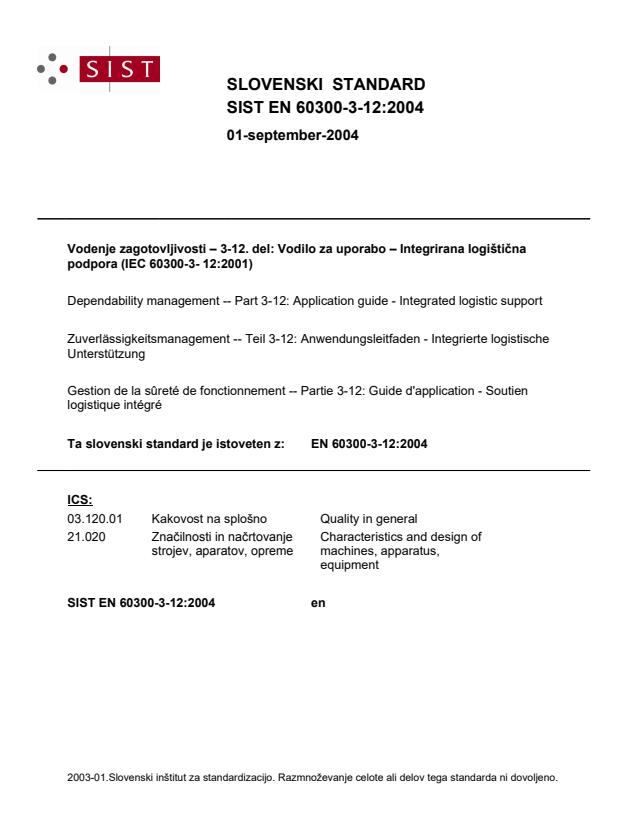
2003-01.Slovenski inštitut za standardizacijo. Razmnoževanje celote ali delov tega standarda ni dovoljeno.Zuverlässigkeitsmanagement -- Teil 3-12: Anwendungsleitfaden - Integrierte logistische UnterstützungGestion de la sûreté de fonctionnement -- Partie 3-12: Guide d'application - Soutien logistique intégréDependability management -- Part 3-12: Application guide - Integrated logistic support21.020Characteristics and design of machines, apparatus, equipment03.120.01Kakovost na splošnoQuality in generalICS:Ta slovenski standard je istoveten z:EN 60300-3-12:2004SIST EN 60300-3-12:2004en01-september-2004SIST EN 60300-3-12:2004SLOVENSKI
STANDARD
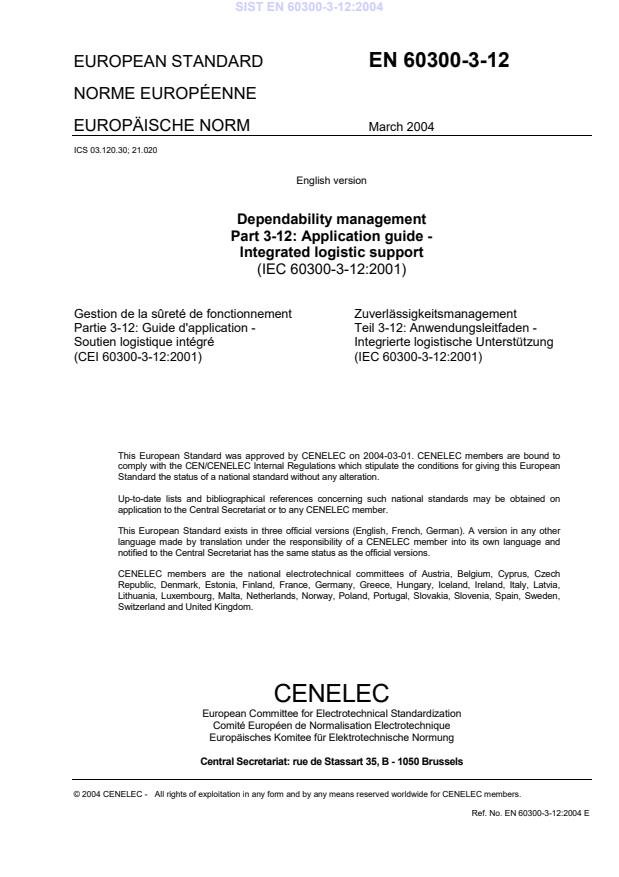
EUROPEAN STANDARD
EN 60300-3-12 NORME EUROPÉENNE EUROPÄISCHE NORM
March 2004 CENELEC European Committee for Electrotechnical Standardization Comité Européen de Normalisation Electrotechnique Europäisches Komitee für Elektrotechnische Normung
Central Secretariat: rue de Stassart 35, B - 1050 Brussels
© 2004 CENELEC - All rights of exploitation in any form and by any means reserved worldwide for CENELEC members.
Ref. No. EN 60300-3-12:2004 E
ICS 03.120.30; 21.020
English version
Dependability management Part 3-12: Application guide -
Integrated logistic support (IEC 60300-3-12:2001)
Gestion de la sûreté de fonctionnement Partie 3-12: Guide d'application -
Soutien logistique intégré (CEI 60300-3-12:2001)
Zuverlässigkeitsmanagement Teil 3-12: Anwendungsleitfaden - Integrierte logistische Unterstützung (IEC 60300-3-12:2001)
This European Standard was approved by CENELEC on 2004-03-01. CENELEC members are bound to comply with the CEN/CENELEC Internal Regulations which stipulate the conditions for giving this European Standard the status of a national standard without any alteration.
Up-to-date lists and bibliographical references concerning such national standards may be obtained on application to the Central Secretariat or to any CENELEC member.
This European Standard exists in three official versions (English, French, German). A version in any other language made by translation under the responsibility of a CENELEC member into its own language and notified to the Central Secretariat has the same status as the official versions.
CENELEC members are the national electrotechnical committees of Austria, Belgium, Cyprus, Czech Republic, Denmark, Estonia, Finland, France, Germany, Greece, Hungary, Iceland, Ireland, Italy, Latvia, Lithuania, Luxembourg, Malta, Netherlands, Norway, Poland, Portugal, Slovakia, Slovenia, Spain, Sweden, Switzerland and United Kingdom.
The text of document 56/769/FDIS, future edition 1 of IEC 60300-3-12, prepared by IEC TC 56, Dependability, was submitted to the IEC-CENELEC parallel vote and was approved by CENELEC as EN 60300-3-12 on 2004-03-01.
The following dates were fixed:
– latest date by which the EN has to be implemented
at national level by publication of an identical
national standard or by endorsement
(dop) 2004-12-01
– latest date by which the national standards conflicting
with the EN have to be withdrawn
(dow) 2007-03-01
Annex ZA has been added by CENELEC. __________
Endorsement notice
The text of the International Standard IEC 60300-3-12:2001 was approved by CENELEC as a European Standard without any modification. __________ SIST EN 60300-3-12:2004
- 3 - EN 60300-3-12:2004 Annex ZA
(normative)
Normative references to international publications
with their corresponding European publications The following referenced documents are indispensable for the application of this document. For dated references, only the edition cited applies. For undated references, the latest edition of the referenced document (including any amendments) applies. NOTE When an international publication has been modified by common modifications, indicated by (mod), the relevant EN/HD applies. Publication Year Title EN/HD Year IEC 60050-191 - 1) International Electrotechnical Vocabulary (IEV) Chapter 191: Dependability and quality of service
- - IEC 60300-3-3 - 1) Dependability management Part 3-3: Application guide - Life cycle costing
- - IEC 60300-3-11 - 1) Part 3-11: Application guide - reliability centered maintenance
- - IEC 60706-2 - 1) Guide on maintainability of equipment Part 2 - Section 5: Maintainability studies during the design phase
- - IEC 60812 - 1) Analysis techniques for system reliability - Procedure for failure mode and effects analysis (FMEA)
HD 485 S1 1987 2) IEC 61160 - 1) Formal design review
- -
1) Undated reference.
2) Valid edition at date of issue.
NORMEINTERNATIONALECEIIECINTERNATIONALSTANDARD60300-3-12Première éditionFirst edition2001-12Gestion de la sûreté de fonctionnement –Partie 3-12:Guide d'application –Soutien logistique intégréDependability management –Part 3-12:Application guide –Integrated logistic support Commission Electrotechnique Internationale International Electrotechnical CommissionPour prix, voir catalogue en vigueurFor price, see current catalogue© IEC 2001
Droits de reproduction réservés
⎯
Copyright - all rights reservedAucune partie de cette publication ne peut être reproduite niutilisée sous quelque forme que ce soit et par aucun procédé,électronique ou mécanique, y compris la photocopie et lesmicrofilms, sans l'accord écrit de l'éditeur.No part of this publication may be reproduced or utilized inany form or by any means, electronic or mechanical,including photocopying and microfilm, without permission inwriting from the publisher.International Electrotechnical Commission3, rue de Varembé
Geneva, SwitzerlandTelefax: +41 22 919 0300e-mail: inmail@iec.ch IEC web site
http://www.iec.chCODE PRIXPRICE CODEXSIST EN 60300-3-12:2004
60300-3-12 © IEC:2001– 3 –CONTENTSFOREWORD.7INTRODUCTION.111Scope.152Normativereferences.153Definitions.154Acronyms.175Principles of Integrated Logistic Support (ILS).195.1ILS objectives.195.2Application of ILS.195.3Elements of ILS.215.4Structure of ILS.235.5Logistic Support Analysis (LSA).255.6LSA database.276Planning and management of ILS.276.1General.276.2Management structure and responsibilities.276.3Controlling documentation and review processes.297Customer profile.317.1Customer profile constraints.317.2Supportability factors.337.3Supportability factors report.378Evaluation of design and support options.378.1Overview.398.2Functional analysis during design.418.3Design and logistic support options and trade-offs.438.4Trade-off study reports.459Determination of logistic support resource requirements.479.1Maintenance Support Analysis (MSA).499.2Potential Impact upon existing support.539.3Post-Production Support (PPS).5510Verification of logistic supportability.5710.1Logistic support acceptance strategy.5710.2Monitoring of field data.6111LSA database.6311.1General.6311.2Co-operation with other databases.6311.3Tailoring of the database.6311.4Format of data.6512ILS outputs.6512.1General.6512.2Outputs used to influence the design process.6512.3Outputs used to identify or provide the logistic support elements.65SIST EN 60300-3-12:2004
60300-3-12 © IEC:2001– 5 –Annex A (informative)
Illustrative examples of LSA tasks.75Annex B (informative)
Illustrative example of trade-off analysis emanating fromthe evaluation of design and support options series of tasks.83Annex C (informative)Examples of LSA database.87Figure 1 – Interrelationship of LSA analyses and other design activities.23Figure 2 – Applicability of LSA tasks by product phase.25Figure 3 – Design and logistic support options.39Figure 4 – Maintenance Support Analysis.49Figure 5 – Test and evaluation procedure.59Figure B.1 – Illustrative example of trade-off analysis.85Table A.1 – Illustrative example of customer profile – Constraints data.75Table A.2 – Illustrative example of logistic standardization analysis.75Table A.3 – Illustrative example of logistic improvement analysis (photocopier testcable – H1 as replacement for G1).77Table A-4 – Illustrative example of logistic technological opportunity analysis toimprove or reduce logistic requirements.79Table A.5 – Illustrative example of logistic support characteristics calculated fromsupportability factors analysis.79Table A.6 – Illustrative example of initial supportability and logistic supportrequirements emanating from the customer profile – Constraints and supportabilityfactors series of tasks.81Table C.1 – Selected data element definitions.89SIST EN 60300-3-12:2004
60300-3-12 © IEC:2001– 7 –INTERNATIONAL ELECTROTECHNICAL COMMISSION____________DEPENDABILITY MANAGEMENT –Part 3-12: Application guide –Integrated logistic supportFOREWORD1)The IEC (International Electrotechnical Commission) is a worldwide organization for standardization comprisingall national electrotechnical committees (IEC National Committees). The object of the IEC is to promoteinternational co-operation on all questions concerning standardization in the electrical and electronic fields. Tothis end and in addition to other activities, the IEC publishes International Standards. Their preparation isentrusted to technical committees; any IEC National Committee interested in the subject dealt with mayparticipate in this preparatory work. International, governmental and non-governmental organizations liaisingwith the IEC also participate in this preparation. The IEC collaborates closely with the InternationalOrganization for Standardization (ISO) in accordance with conditions determined by agreement between thetwo organizations.2)The formal decisions or agreements of the IEC on technical matters express, as nearly as possible, aninternational consensus of opinion on the relevant subjects since each technical committee has representationfrom all interested National Committees.3)The documents produced have the form of recommendations for international use and are published in the formof standards, technical specifications, technical reports or guides and they are accepted by the NationalCommittees in that sense.4)
In order to promote international unification, IEC National Committees undertake to apply IEC InternationalStandards transparently to the maximum extent possible in their national and regional standards. Anydivergence between the IEC Standard and the corresponding national or regional standard shall be clearlyindicated in the latter.5)
The IEC provides no marking procedure to indicate its approval and cannot be rendered responsible for anyequipment declared to be in conformity with one of its standards.6)
Attention is drawn to the possibility that some of the elements of this International Standard may be the subjectof patent rights. The IEC shall not be held responsible for identifying any or all such patent rights.International Standard IEC 60300-3-12 has been prepared by IEC technical committee 56:Dependability.The text of this standard is based on the following documents:FDISReport on voting56/769/FDIS56/778/RVDFull information on the voting for the approval of this standard can be found in the report onvoting indicated in the above table.This publication has been drafted in accordance with the ISO/IEC Directives, Part 3.IEC 60300 consists of the following parts, under the general title, Dependability managementPart 1:Dependability programme managementPart 2:Dependability programme elements and tasksPart 3:Application guideAnnexes A, B and C are for information only.SIST EN 60300-3-12:2004
60300-3-12 © IEC:2001– 9 –The committee has decided that the contents of this publication will remain unchangeduntil 2006. At this date, the publication will be•reconfirmed;•withdrawn;•replaced by a revised edition, or•amended.SIST EN 60300-3-12:2004
60300-3-12 © IEC:2001– 11 –INTRODUCTIONThe successful operation of a product in service depends to a large extent upon the effectiveprovision of logistic support in order to achieve and maintain the required levels of per-formance and customer satisfaction.Logistic support encompasses the activities and resources required to operate and maintain aproduct (hardware and software) in service. Logistic support covers maintenance, manpowerand personnel, training, spares, technical documentation and packaging handling, storageand transportation, support resources and disposal.The cost of logistic support is a major contributor to the life cycle cost (LCC) of a product andincreasingly customers are making purchase decisions based on life cycle cost rather thaninitial purchase price alone. Logistic support considerations may therefore have a majorimpact on product sales by ensuring that the product can be operated and supported at anaffordable cost and that all the necessary resources have been provided to fully support theproduct so that it meets the customer requirements.Quantification of support costs allows the manufacturer to define the support cost elementsand evaluate the warranty implications. This provides the opportunity to reduce risk andallows support costs to be set at competitive rates.Integrated logistic support (ILS) is a management method by which all the logistic supportservices required by a customer can be brought together in a structured way and in harmonywith a product. In essence, the application of ILS– ensures that supportability considerations influence the concept and design of a product;– develops logistic support arrangements that are consistently related to the design and toeach other;– provides the necessary logistic support at the beginning and during customer use anddisposal at optimum cost;– allows improvements in the support of a product throughout its life.The method by which ILS achieves much of the above is through the application of LogisticSupport Analysis (LSA). This is a series of support analysis tasks that are performediteratively throughout the design process in order to ensure that the product can be supportedefficiently in accordance with the requirements of the customer.The successful application of ILS will result in a number of customer and supplier benefits.These should include, but will not be limited to, some or all of the following:– meeting customer requirements;– increased overall customer satisfaction;– better visibility of support costs;– lower customer support costs;– greater product availability;– fewer product modifications due to supportability deficiencies and hence less supplierrework;SIST EN 60300-3-12:2004
60300-3-12 © IEC:2001– 13 –– better adherence to production schedules in process plants through reduced maintenanceand better support;– reduced product LCC;– lower supplier product costs;– a better and more saleable product leading to increased product purchases;– potential for purchase or upgrade of the product sooner through customer savings onsupport of current product;– improved safety;– reduced support costs providing more likelihood of repeat sales.ILS should be an integral part of the total product design and management process with anon-going improvement activity using monitoring of achieved performance to tailor existingsupport and influence future design activities.For many years, ILS was predominantly applied to military procurement, primarily usingMilitary Standard 1388, generated by the US Department of Defense (DoD). Other countrieshave also produced their own military standards that refer to specialized governmentinfrastructures and these may be unnecessarily complex for commercial application. Themethods and benefits of ILS, however, have potential for much wider application incommercial and civilian use.The idea of ILS is simple and depends on a structured procedure which ensures that theappropriate logistic aspects are considered fully throughout the design and developmentphases of a product, in close co-operation with the designers. Under an ILS approach theability to support the product effectively is given equal weight to performance and is fullyconsidered in relation to its cost.The application of ILS provides improvements in availability, maintenance support and long-term logistic cost savings. Logistic costs are significant through the life of a system and canoften amount to many times the initial purchase cost of the system.This standard is one of a series of application guides that describe various tools in the field ofmaintenance support under the generic heading of Dependability management. ILS is amanagement technique that can effectively be used to determine the support requirements ofa product.This standard provides guidance on the minimum activities necessary to implement effectiveILS for a wide range of commercial suppliers. The standard supplements IEC 60706-4 1),which emphasizes the maintenance aspects of the support requirements and refers to otherexisting standards where appropriate. The use of Reliability and Maintainability (R&M) studiesis also mentioned in this standard, as R&M analysis is an important contributor to the ILSprocess. However, R&M techniques are not described in any detail in this standard and theappropriate IEC standards should be consulted.________1)IEC 60706-4, Guide on maintainability of equipment – Part 4: Section 8: Maintenance and maintenance supportplanningSIST EN 60300-3-12:2004
60300-3-12 © IEC:2001– 15 –DEPENDABILITY MANAGEMENT –Part 3-12: Application guide –Integrated logistic support1 ScopeThis part of IEC 60300-3 is an application guide intended for use by a wide range of suppliersincluding large and small companies wishing to offer a competitive and quality product whichis optimized for the purchaser and supplier for the complete product life cycle. This standardcan be applied to both commercial and military products. It describes the process of ILS, andthe various minimal common practices and logistic data analyses that should be undertakento meet this objective.2 NormativereferencesThe following normative documents contain provisions which, through reference in this text,constitute provisions of this part of IEC 60300. For dated references, subsequent amend-ments to, or revisions of, any of these publications do not apply. However, parties toagreements based on this part of IEC 60300 are encouraged to investigate the possibility ofapplying the most recent editions of the normative documents indicated below. For undatedreferences, the latest edition of the normative document referred to applies. Members ofIEC and ISO maintain registers of currently valid International Standards.IEC 60050-191, International Electrotechnical Vocabulary (IEV) – Chapter 191: Dependabilityand quality of serviceIEC 60300-3-3, Dependability management – Part 3: Application guide – Section 3: Life cyclecostingIEC 60300-3-11, Dependability management – Part 3-11: Application guide – Reliabilitycentred maintenanceIEC 60706-2, Guide on maintainability of equipment – Part 2 – Section 5: Maintainabilitystudies during the design phaseIEC 60812, Analysis techniques for system reliability – Procedure for failure mode and effectsanalysis (FMEA)IEC 61160, Formal design review3 DefinitionsFor the purposes of this part of IEC 60300 the definitions given in IEC 60050-191 apply,together with the following.3.1design lifeperiod that the item is expected to meet its performance specification in an agreedenvironment and level of utilization with the recommended supportSIST EN 60300-3-12:2004
60300-3-12 © IEC:2001– 17 –3.2integrated logistic support (ILS)management method by which all the logistic support services required by a customer can bebrought together in a structured way and in harmony with a product3.3line replaceable unit (LRU)lowest level of assembly, subassembly or component which is recommended to be exchangedduring maintenance to effect a repair at a specified repair level3.4logistic supportall material and resources required for the operation and maintenance of a product includingboth hardware and software3.5logistic support analysis (LSA)selective application of a range of tasks undertaken to assist in complying with supportabilityand other ILS objectives3.6provisioningprocess of determining and acquiring the range and quantity of spares required to operateand maintain the product3.7supportabilitydegree to which product design characteristics and planned logistic support resources meetproduct operational utilization requirements3.8trade-offdetermination of the optimum balance between product characteristics (cost, performance,and supportability)3.9support conceptrecommended support policy and procedure for a particular product specific to a particularuser or application4 AcronymsA,R&MAvailability, Reliability and MaintainabilityBITEBuilt-In Test EquipmentCP&SCustomer Profile and SupportabilityEDIElectronic Data InterchangeFMEAFault Mode and Effects AnalysisFMECAFault Mode, Effects and Criticality AnalysisFRIFunctional Requirement IdentificationILSIntegrated Logistic SupportSIST EN 60300-3-12:2004
60300-3-12 © IEC:2001– 19 –LCCLife Cycle CostLORALevel Of Repair AnalysisLRULine Replaceable UnitLSALogistic Support AnalysisLSILogistic Support ImprovementMSAMaintenance Support AnalysisMTTRMean Time To RestorationPHS&TPackaging, Handling, Storage and TransportationPPSPost Production SupportR&MReliability and MaintainabilityRCMReliability Centred MaintenanceSTTESpecial Tools and Test EquipmentT&ETest and Evaluation5 Principles of Integrated Logistic Support (ILS)5.1 ILS objectivesThe objectives of ILS are toa)permit support considerations to be integrated into product design;b)develop support arrangements that are consistently related to design and to each other;c)provide the necessary logistic support at the beginning and during customer use anddisposal at optimum cost;d)allow improvements to be made in the support of a product throughout its life.Meeting these objectives should result in an improved product and support system thatminimizes the through-life cost while meeting the needs of the customer and business.5.2 Application of ILSThe application of ILS to the design and development of a product aims to ensure that all thelogistic implications of introducing the product have been properly considered so that it can besupported in the most cost-effective way. The application of ILS is also applicable to largesystems, such as a power plant or a paper mill, and provides a methodology for theidentification and optimization of the support requirements for the individual products thatconstitute the plant.Logistic Support Analysis (LSA) is an analytical process that is a part of ILS and comprises aseries of analysis tasks to influence the design to improve its supportability and to ensuresupport requirements are adequately identified and provided.The degree of application of ILS and the associated LSA will vary accordingly with the degreeof design freedom, technical complexity, cost of the product and other factors.SIST EN 60300-3-12:2004
60300-3-12 © IEC:2001– 21 –In applying the principles of ILS it is necessary that the logistic support concept be tailored tomeet the specific product development and customer needs. Therefore if a product is acompletely new development it may be necessary to apply most of the LSA tasks, but where aproduct is identified as an existing item, it will not be necessary to apply all of the tasks. Thisis referred to as tailoring and should address the depth of analysis to a cost-effective levelbased on maturity and the type of product.5.3 Elements of ILSThe following elements of support are covered by ILS, and may include, but are not limited to:– maintenance planning;– support equipment (including tools and test equipment);– technical documentation;– training;– manpower and personnel;– spares/materials;– packaging, handling, storage and transportation;– software support;– facilities;– environmental aspects;– disposal.Key areas that interface with ILS are:– systems and design engineering;– reliability analysis (IEC 60812);– maintainability analysis (IEC 60706-2);– Life Cycle Cost (LCC) analysis (IEC 60300-3-3);– reliability centred maintenance (IEC 60300-3-11).In addition ILS interfaces with:– project management;– risk management;– safety and hazard analysis;– human factors analysis;– trials and acceptance;– configuration management;– quality;– environmental requirements;and will reflect and contribute to the approach in these areas.The tasks and procedures for these interface areas are covered in other IEC standards.SIST EN 60300-3-12:2004
60300-3-12 © IEC:2001– 23 –5.4 Structure of ILSThe structure of ILS is shown in figure 1, which illustrates at a high level how the LSAactivities interrelate with each other and with the design activities.3. LSA2.
Design and performance studies (including R&M and FMEA)1.
Support conceptCustomer profileconstraints (7)Preparation andevaluation (8)Determination oflogistic supportresource requirements (9)Support equipmentTechnical documentsManpower and trainingSpares and materialsPackaging, handlingLSA database4. Trials and logistic support5. L C CMaintenance planSoftware supportIEC
2514/01NOTENumbers in brackets refer to the relevant clauses of the standard.Figure 1 – Interrelationship of LSA analyses and other design activitiesThe support concept, box 1 of figure 1, is a basic description of the maintenance supportexpected to apply to the product. It is usually defined within the customer profile and shouldbe provided to both the design and support team to ensure that the product will besupportable in its intended environment. As the design progresses the initial support conceptwill be confirmed and expanded.Box 2 of figure 1 provides basic design and performance information. The design information isprogressively analysed in terms of its support implications under the LSA in clauses 7 and 8.Reliability and maintainability characteristics and Fault Mode and Effects Analysis (FMEA) area fundamental input to these analyses. The R&M characteristics indicate the likelihood ofproduct failure and time to restore and hence the maintenance and support effort andresources required.The FMEA indicates the likely causes of failure of the product and provides feedback toimprove the design. The FMEA for the final design and support concept provides the input forthe systematic identification of all the maintenance and support resources required for theproduct through the use of maintenance support analysis described in clause 9.Proving trials will normally be conducted on new products to demonstrate stated performanceor fitness for purpose and the trials should include the logistic support arrangements. Thetesting of the design and proving of the support arrangements are covered under trials andlogistic support (see clause 10). This ensures that the recommended support is sufficient tomeet the required performance.SIST EN 60300-3-12:2004
60300-3-12 © IEC:2001– 25 –5.5 Logistic Support Analysis (LSA)LSA comprises a series of analysis tasks that are selected, or tailored, as necessary to meetthe requirements of the product. Many of the analyses are iterative and are updated duringthe product design process. Figure 2 shows the typical applicability of the LSA tasks byproduct phase.ActivityEarly DesignDetailed DesignProductionIn-usePlanning and managementProduct monitoringCustomer profile constraintsSupportability factorsFunctional analysisDesign and logistic support
options and trade-offsMaintenance support analysisPotential impact on existing supportPost-production supportVerification of logistic supportabilityLSA databaseILS task outputsUpdate as necessaryUpdate as necessaryOutlineDetailUpdate as necessaryOutlineDetailUpdate as necessaryUpdate as necessaryFigure 2 – Applicability of LSA tasks by product phaseThe starting point of the analysis is to identify the Customer Profile and Supportability (CP&S)constraints (clause 7 in figure 1). The CP&S constraint is the framework of how the productshould be supported: for example, customer or supplier repair capability, the skill level oftechnicians, available facilities. These all have a bearing on the complexity of anymaintenance tasks that can be performed.In clause 7, use is made of support experience and data on previous products in early designphases to understand and build up a picture of where the support drivers may be for the newproduct and to prompt changes to improve availability and reduce life cycle cost. Design andsupport options that are not favourable are discounted and favourable options areprogressively detailed and subject to a more detailed analysis (clause 8). Life cycle costinganalysis (box 5 of figure 1) and Level Of Repair Analysis (LORA) are used as quantitativetechniques to compare options and may also be used to provide predictions of long-termcosts to assist customers with future financial planning or the identification of warranty costsand decide on the optimum level of repair in a given application. The results in terms ofrecommendations and requirements for the best support solution are fed back into the designstudies (box 2 of figure 1) and reflected in design documentation. In some circumstances, theresults of the LSA may cause the support concept to be modified.The various LSA studies are described in subsequent clauses of this standard.IEC
2515/01SIST EN 60300-3-12:2004
60300-3-12 © IEC:2001– 27 –5.6 LSA databaseThe LSA database provides the mechanism and repository for the LSA and documents thedetailed support to be provided as a result of the clause 9 tasks. To maximize the benefit, theoutputs and results of the LSA should be recorded in a controlled and structured LSAdatabase. The creation of an electronic LSA database is recommended as the most viablemeans to store and control the information obtained. This is discussed further in clause 11.6 Planning and management of ILS6.1 GeneralThe planning and management of ILS addresses the programme of work required to carry outthe ILS tasks. For a complex product this is a major factor in the success of the ILSprogramme. The planning of ILS should ensure that all ILS and LSA tasks, responsibilitiesand internal and external interfaces at each phase of the design are clearly defined. The ILSmanagement and planning tasks are listed below.– Determine and agree on ILS responsibilities, including logistic information, and interfaceswith the customer and the product design team.– Define programme of LSA tasks to be undertaken (see clauses 7, 9 and 11).– Determine method for providing design guidance.– Define logistic support resource outputs.– Plan and put in place review processes, both informal and formal, to audit the design andthe ILS programme.– Produce and maintain ILS planning documentation to control the ILS programme.– Monitor and control the ILS programme of work.– Identify risks associated with the ILS programme and propose actions to reduce theserisks.6.2 Management structure and responsibilitiesA single person, usually referred to as the ILS manager, should be appointed withresponsibility for the overall programme of ILS tasks. The responsibilities of the ILS managerare the ILS management and planning tasks defined in 6.1 and other detailed tasks asallocated. The principal tasks of the ILS manager are to:– meet the requirements of the ILS/LSA plans;– develop the support-related technical characteristics of the product;– co-ordinate and integrate inputs from the specialist disciplines;– co-ordinate logistic support provided by contractors and subcontractors.The ILS manager, who may have other tasks, should report directly to the product or projectmanager and have the same level of authority as the design and manufacturing managers.This is to ensure that support issues are given equal weight in the design process.SIST EN 60300-3-12:2004
60300-3-12 © IEC:2001– 29 –For projects involving lower tier subcontractors and/or suppliers, a similar management struc-ture should apply. The subcontractor and, where applicable, supplier ILS managers shouldreport to the overall product contractor ILS manager in a management tier structure. Whenapplicable the ILS manager should have authority to maintain effective liaison with thecustomer and with any subcontractors.Clear terms of reference and methods of operation need to be identified and agreed betweenthe ILS manager and the designers to ensure that supportability considerations resulting fromthe LSA studies can fully influence the design. The ILS manager needs to understand thedesign process, objectives and programme and relate the ILS programme to it. A concurrentengineering approach is recommended with the design and logistic personnel working closelytogether to evolve the design and support arrangements in parallel.The ILS manager may have a team of specialists in LSA, R&M, LCC and logistic supporttechniques. The number of specialists required will depend upon the size of the project andprogramme of work and they would assist the ILS manager by performing detailed tasks asdirected in the ILS/LSA plan.6.3 Controlling documentation and review processes6.3.1 Planning documentationIt is recommended that a product ILS plan be produced which will be updated for each phase.This should define the ILS programme tasks to be completed, as selected in the tailoringprocess, and the management controls to be put in place for the success of the programme.The ILS plan should be sufficiently detailed to ensure a clear understanding of the variousmanagement responsibilities, objectives and aims of the programme, the LSA studies to becompleted and supportability outputs to be produced. The ILS plan may be supported by anumber of element planning documents, for example, R&M plan or LSA plan. These can beissued separately or, more beneficially, annexed to the ILS plan to provide improved visibilityof the total set of planning requirements. The number and content of plans should be limitedto those required to adequately control the ILS programme.6.3.2 Review proceduresReviews are a fundamental part of ILS management.At all major design reviews ILS should be identified as an agenda item, in which the ILSmanager should summarize the current findings and results of the ILS programme tasks. Thepresentation of the design should also discuss any impact on supportability and logisticsupport provision from the design studies and trade-offs which have been performed.ILS reviews should also be held at key stages in the programme to discuss and review thedetailed results and progress of the various activities, for example, LSA, R&M, LCC. Theseshould be timed to occur a few weeks before the scheduled design reviews. Furtherinformation on design reviews is given in IEC 61160.SIST EN 60300-3-12:2004
60300-3-12 © IEC:2001– 31 –6.3.3 Identification of supportability issuesSupportability is the degree to which product design characteristics and planned logisticsupport resources meet product operational utilization requirements. To provide a furthermanagement tool for ensuring that supportability and any other design related issues arehighlighted in a project, it is recommended that a procedure be introduced to document issuesand risks. These would be monitored by the product team through actions to investigate andmitigate the issues/risks.7 Customer profile constraints and supportability factorsThe purpose of the customer profile constraints and supportability factors LSA tasks is toidentify the customer’s constraints and goals for logistic support. Annex A contains illustrativeexamples of LSA tasks.7.1 Customer profile constraintsThe application of ILS will vary to some extent with each type of product, depending on theway it is operated and maintained, and the relationship of the manufacturer to the customer.There are a number of different scenarios where ILS may be applied, ranging from a productdeveloped specially for a customer to meet a particular requirement, to a domestic product wherethe ultimate customers are the public at large who have no direct link with the productmanufacturers. In all cases, the ILS process will be largely similar but it is important that a fullunderstanding is established of how the product is intended to be used and the variousconstraints under which it is likely to be operated and maintained.In each case, it is the manufacturer who initiates the ILS activities and who has to apply theresults of the analysis to produce a recommended support policy and infrastructure tomaintain the product in the condition that will enable it to carry out its function. The customermay play an active part in establishing the support structure where the product is a uniquedevelopment to a particular requirement. At the other end of the scale, the customer mayhave no input to that process, as in the case of the domestic product which is serviced andmaintained by a separate repair organization. Here, the LSA will enable the maintenanceprocedures to be established and the necessary tools and test equipment to be provided tothe repair agents.Ideally, a full understanding of how the product is intended to be used and the variousconstraints under which it is likely to be operated and maintained needs to be established or ageneral set of assumptions defined. The information may be derived from suppliers' customerrecords and/or market research, or by visits to existing or potential customer’s operation andmaintenance facilities.Studies need to be made on the use and application of the proposed product to obtaininformation such as:– operating cycle, including number of operating days or cycles per unit of time;– safety requirements;– number of products to be supported;– number of customer sites and maintenance levels;SIST EN 60300-3-12:2004
60300-3-12 © IEC:2001– 33 –– availability and/or repair/resupply time requirements;– allowable periods for undertaking maintenance;– commonality with other customer systems and equipment:– effect of product use on the environment;– definition of the product operational and storage environment;– likely numbers, competence and skill of operators and maintenance personnel;– transportation considerations, for example, mode, type, quantity to be transported,destinations, transport time and schedule;– service and design life;– any other relevant use-related constraints.Some of this information may not be available but will be determined in the analysis process.For example, where the product will be on sale to the public through retail outlets, themanufacturer will need to consider setting up a servicing organization, if it does not alreadyexist, to provide a repair facility to the customers. For this it is necessary to establish thelocations and levels of support required and it is therefore important that the information is asaccurate as possible, as the output of the LSA will provide the scale of the supportorganization required, the cost of which could be a significant factor in the financial viability ofthe product.The data collected would be used as a common reference for design, reliability and maintain-ability analysis, performance assessment, and definition of the environmental envelopetoensure consistency of analysis. An example is shown in table A.1.The customer profile constraints report is produced to define how a product is, or will be, usedand supported. It provides the basic information to the design team about the existing supportorganization. The report may be provided by the customer to describe his own supportorganization, or may be generated as part of a market survey to detail what will be available,or expected to be provided, within a particular market area. If applicable, for example, forprocurement of large systems or plant, the report should be checked by the customer andshould also be provided to subcontractors and/or suppliers for information and agreement.7.2 Supportability factors7.2.1 Logistic support standardizationLogistic support standardization refers to the use of existing and planned supplier andcustomer support resources, the re-use of existing hardware and software modules in the newproducts, and the development of common design and support solutions for different elementsof a new product. Appropriate standardization may– substantially reduce life cycle cost;– minimize the need to introduce new support resources;– or minimize the need to modify existing ar
...