

EN 50626-2:2023
(Main)Conduit systems buried underground for the protection and management of insulated electrical cables or communication cables - Part 2: Polyethylene (PE), Polypropylene (PP) or Unplasticized poly(vinyl chloride) (PVC-U) conduit systems - Requirements for solid wall conduits, fittings and the system used in special applications
General Information
- Abstract
This European Standard specifies particular requirements and tests for conduit systems buried underground for the protection and management of insulated conductors and/or power cables or communication cables that are installed by different techniques, for example, blowing (including floating), pulling or pushing directly after installation of the conduit or during its expected performance time. This standard is applicable to all conduits with circular cross section manufactured individually or manufactured as a part of an assembly NOTE Reference is made to other documents for additional material requirements where applicable.
- Status
- Published
- Publication Date
- 20-Jul-2023
- Technical Committee
- CLC/TC 213 - Cable management systems
- Drafting Committee
- CLC/TC 213/WG 04 - Conduit systems buried underground
- Current Stage
- 6060 - Document made available - Publishing
- Start Date
- 21-Jul-2023
- Due Date
- 18-Jul-2018
- Completion Date
- 21-Jul-2023
2014/35/EU - Directive 2014/35/EU of the European Parliament and of the Council of 26 February 2014 on the harmonisation of the laws of the Member States relating to the making available on the market of electrical equipment designed for use within certain voltage limitsOJ Ref: 2024/1198, OJ L, OJ L, 2024/1198 OJ Date: 23-Apr-2024

Overview
EN 50626-2:2023 (CLC) is the CENELEC European standard that specifies requirements and tests for leak‑tight solid wall conduit systems manufactured from Polyethylene (PE), Polypropylene (PP) or Unplasticized poly(vinyl chloride) (PVC‑U). It applies to circular‑cross‑section conduits and fittings buried underground (up to 6 m depth) for the protection and management of insulated electrical conductors, power cables and communication cables. Typical installation techniques covered include blowing, floating, trenchless installation, and conventional pulling/pushing of cables.
Key topics and technical requirements
- Material requirements: specifications and tests for PE, PP and PVC‑U materials, including rules for use of non‑virgin (reprocessed/recycled) materials (Annexes A–C).
- Geometrical and dimensional characteristics: tolerances and dimensional verification for conduits, sockets and fittings.
- Mechanical characteristics: tensile properties, ring stiffness, resistance to external blows and longitudinal reversion.
- Physical characteristics and performance: resistance to internal/external loads, long‑term performance time (declared performance time), and leak‑tightness for elastomeric sealed joints.
- Sealing rings and joints: requirements and test methods for elastomeric seals to ensure conduit system leak‑tightness.
- Fire hazard and electromagnetic compatibility (EMC): assessment and marking requirements where applicable.
- Marking and documentation: product identification, performance declarations and user documentation for safe installation and maintenance.
- Normative references: cross‑references to relevant EN and ISO test methods (e.g., EN ISO 3126, EN ISO 9969, EN 50626‑1).
Practical applications
- Protecting and routing power and communication cables in buried installations for utilities, telecom operators, transport infrastructure and construction projects.
- Systems designed specifically for cable installation by blowing or floating, and for trenchless techniques (e.g., HDD, microtunnelling).
- Specifying conduit products for projects that require declared service/performance time and leak‑tight systems.
Who should use this standard
- Manufacturers of PE, PP and PVC‑U conduits and fittings (design, testing, quality control).
- Engineers and specifiers selecting conduit systems for underground cable projects.
- Contractors and installers performing cable blowing, floating or trenchless installations.
- Procurement teams, utilities and certifying bodies verifying compliance and product documentation.
Related standards
- EN 50626-1:2023 (general requirements for buried conduit systems)
- Relevant EN/ISO test standards listed in EN 50626‑2 (e.g., EN ISO 3126, EN ISO 9969, EN ISO 6259)
Keywords: EN 50626-2:2023, conduit systems, underground conduit, PE conduit, PP conduit, PVC‑U conduit, leak‑tight conduit, cable protection, cable management, trenchless installation, cable blowing.
Relations
- Effective Date
- 20-Feb-2026
- Effective Date
- 10-Feb-2026
- Effective Date
- 09-Feb-2026
- Effective Date
- 09-Feb-2026
- Effective Date
- 09-Feb-2026
- Effective Date
- 09-Feb-2026
- Effective Date
- 09-Feb-2026
- Refers
EN ISO 3451-1:2019 - Plastics - Determination of ash - Part 1: General methods (ISO 3451-1:2019) - Effective Date
- 09-Feb-2026
- Effective Date
- 09-Feb-2026
- Effective Date
- 09-Feb-2026
- Effective Date
- 09-Feb-2026
- Effective Date
- 09-Feb-2026
- Effective Date
- 09-Feb-2026
- Effective Date
- 09-Feb-2026
- Effective Date
- 09-Feb-2026
Get Certified
Connect with accredited certification bodies for this standard

IMQ S.p.A. (Certification)
Italian electrical product certification.

SLG Prüf- und Zertifizierungs GmbH
German testing and certification body.

UL Solutions
Global safety science company with testing, inspection and certification.
Sponsored listings
Frequently Asked Questions
EN 50626-2:2023 is a standard published by CLC. Its full title is "Conduit systems buried underground for the protection and management of insulated electrical cables or communication cables - Part 2: Polyethylene (PE), Polypropylene (PP) or Unplasticized poly(vinyl chloride) (PVC-U) conduit systems - Requirements for solid wall conduits, fittings and the system used in special applications". This standard covers: This European Standard specifies particular requirements and tests for conduit systems buried underground for the protection and management of insulated conductors and/or power cables or communication cables that are installed by different techniques, for example, blowing (including floating), pulling or pushing directly after installation of the conduit or during its expected performance time. This standard is applicable to all conduits with circular cross section manufactured individually or manufactured as a part of an assembly NOTE Reference is made to other documents for additional material requirements where applicable.
This European Standard specifies particular requirements and tests for conduit systems buried underground for the protection and management of insulated conductors and/or power cables or communication cables that are installed by different techniques, for example, blowing (including floating), pulling or pushing directly after installation of the conduit or during its expected performance time. This standard is applicable to all conduits with circular cross section manufactured individually or manufactured as a part of an assembly NOTE Reference is made to other documents for additional material requirements where applicable.
EN 50626-2:2023 is classified under the following ICS (International Classification for Standards) categories: 29.120.10 - Conduits for electrical purposes. The ICS classification helps identify the subject area and facilitates finding related standards.
EN 50626-2:2023 has the following relationships with other standards: It is inter standard links to ISO 18373-1:2007, ISO 5893:2019, EN 681-1:1996, EN 15346:2014, EN ISO 9852:2017, EN ISO 1167-1:2006, EN 12099:1997, EN ISO 3451-1:2019, EN ISO 6259-1:2015, EN ISO 1167-2:2006, EN ISO 1183-2:2019, EN ISO 2505:2005, EN ISO 1133-1:2022, EN ISO 11357-6:2018, FprCEN ISO/TS 20443. Understanding these relationships helps ensure you are using the most current and applicable version of the standard.
EN 50626-2:2023 is associated with the following European legislation: EU Directives/Regulations: 2006/95/EC, 2014/35/EU; Standardization Mandates: M/511. When a standard is cited in the Official Journal of the European Union, products manufactured in conformity with it benefit from a presumption of conformity with the essential requirements of the corresponding EU directive or regulation.
EN 50626-2:2023 is available in PDF format for immediate download after purchase. The document can be added to your cart and obtained through the secure checkout process. Digital delivery ensures instant access to the complete standard document.
Standards Content (Sample)
SLOVENSKI STANDARD
01-september-2023
Podzemni kanalski sistem za zaščito in upravljanje izoliranih električnih ali
komunikacijskih kablov - 2. del: Polietilenski (PE), polipropilenski (PP) ali
neplastificirani polivinilkloridni (PVC-U) vodovodni sistemi - Zahteve za masivne
stenske vodnike, armature in sistem, ki se uporablja v posebnih aplikacijah
Conduit systems buried underground for the protection and management of insulated
electrical cables or communication cables - Part 2: Polyethylene (PE), Polypropylene
(PP) or Unplasticized poly(vinyl chloride) (PVC-U) conduit systems - Requirements for
solid wall conduits, fittings and the system used in special applications
Erdverlegte Elektroinstallationsrohrsysteme für den Schutz und die Führung isolierter
elektrischer Kabel oder Fernmeldekabel - Teil 2: Elektroinstallationsrohrsysteme aus
Polyethylen (PE), Polypropylen (PP) oder weichmacherfreiem Poly(vinylchlorid) (PVC-U)
- Anforderungen an Vollwandrohre, Rohrzubehörteile und spezielle Anwendungen
Systèmes de conduits enterrés dans le sol pour la protection et la gestion des câbles
électriques isolés ou des câbles de communication - Partie 2: Systèmes de conduits en
polyéthylène (PE), en polypropylène (PP) ou en poly(chlorure de vinyle) non plastifié
(PVC-U) - Exigences pour les conduits à paroi pleine, les accessoires et le système
utilisé dans les applications spéciales
Ta slovenski standard je istoveten z: EN 50626-2:2023
ICS:
29.120.10 Inštalacijske cevi za Conduits for electrical
električne namene purposes
2003-01.Slovenski inštitut za standardizacijo. Razmnoževanje celote ali delov tega standarda ni dovoljeno.
EUROPEAN STANDARD EN 50626-2
NORME EUROPÉENNE
EUROPÄISCHE NORM July 2023
ICS 29.120.10
English Version
Conduit systems buried underground for the protection and
management of insulated electrical cables or communication
cables - Part 2: Polyethylene (PE), Polypropylene (PP) or
Unplasticized poly(vinyl chloride) (PVC-U) conduit systems -
Requirements for solid wall conduits, fittings and the system
used in special applications
Systèmes de conduits enterrés dans le sol pour la Erdverlegte Elektroinstallationsrohrsysteme für den Schutz
protection et la gestion des câbles électriques isolés ou des und die Führung isolierter elektrischer Kabel oder
câbles de communication - Partie 2: Systèmes de conduits Fernmeldekabel - Teil 2: Elektroinstallationsrohrsysteme
en polyéthylène (PE), en polypropylène (PP) ou en aus Polyethylen (PE), Polypropylen (PP) oder
poly(chlorure de vinyle) non plastifié (PVC-U) - Exigences weichmacherfreiem Poly(vinylchlorid) (PVC-U) -
pour les conduits à paroi pleine, les accessoires et le Anforderungen an Vollwandrohre, Rohrzubehörteile und
système utilisé dans les applications spéciales spezielle Anwendungen
This European Standard was approved by CENELEC on 2023-06-19. CENELEC members are bound to comply with the CEN/CENELEC
Internal Regulations which stipulate the conditions for giving this European Standard the status of a national standard without any alteration.
Up-to-date lists and bibliographical references concerning such national standards may be obtained on application to the CEN-CENELEC
Management Centre or to any CENELEC member.
This European Standard exists in three official versions (English, French, German). A version in any other language made by translation
under the responsibility of a CENELEC member into its own language and notified to the CEN-CENELEC Management Centre has the
same status as the official versions.
CENELEC members are the national electrotechnical committees of Austria, Belgium, Bulgaria, Croatia, Cyprus, the Czech Republic,
Denmark, Estonia, Finland, France, Germany, Greece, Hungary, Iceland, Ireland, Italy, Latvia, Lithuania, Luxembourg, Malta, the
Netherlands, Norway, Poland, Portugal, Republic of North Macedonia, Romania, Serbia, Slovakia, Slovenia, Spain, Sweden, Switzerland,
Türkiye and the United Kingdom.
European Committee for Electrotechnical Standardization
Comité Européen de Normalisation Electrotechnique
Europäisches Komitee für Elektrotechnische Normung
CEN-CENELEC Management Centre: Rue de la Science 23, B-1040 Brussels
© 2023 CENELEC All rights of exploitation in any form and by any means reserved worldwide for CENELEC Members.
Ref. No. EN 50626-2:2023 E
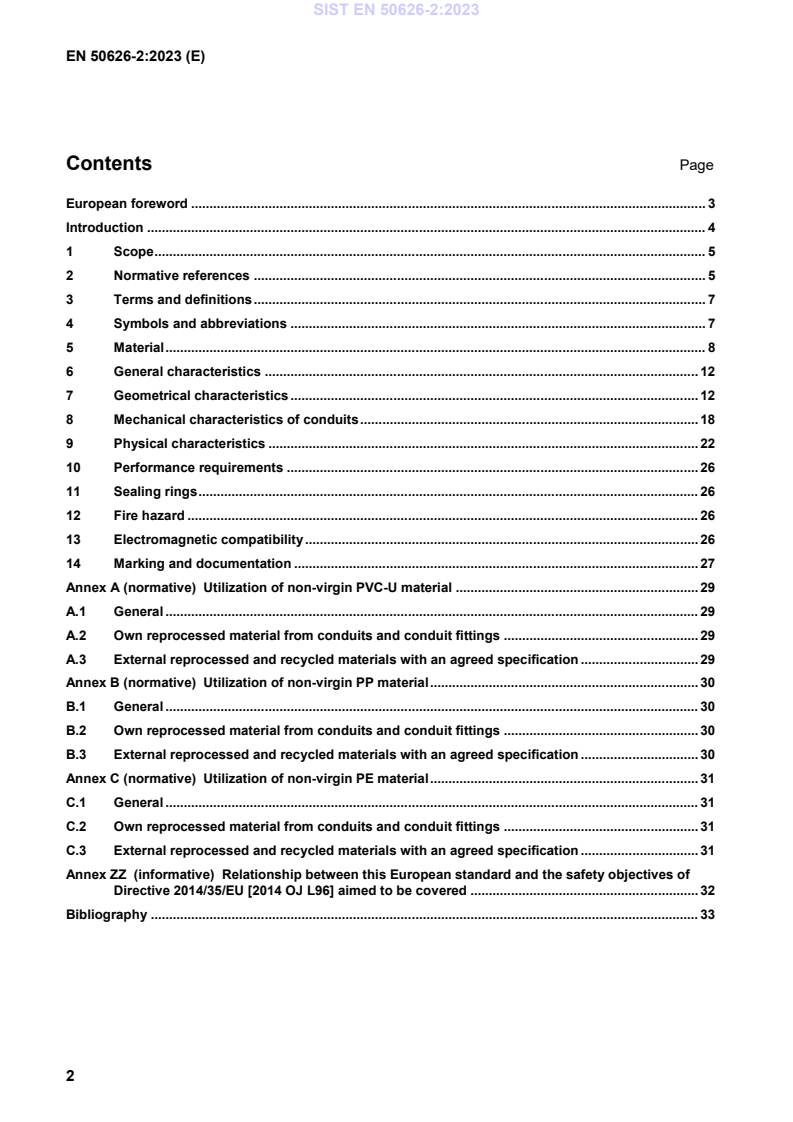
Contents Page
European foreword . 3
Introduction . 4
1 Scope . 5
2 Normative references . 5
3 Terms and definitions . 7
4 Symbols and abbreviations . 7
5 Material . 8
6 General characteristics . 12
7 Geometrical characteristics . 12
8 Mechanical characteristics of conduits . 18
9 Physical characteristics . 22
10 Performance requirements . 26
11 Sealing rings . 26
12 Fire hazard . 26
13 Electromagnetic compatibility . 26
14 Marking and documentation . 27
Annex A (normative) Utilization of non-virgin PVC-U material . 29
A.1 General . 29
A.2 Own reprocessed material from conduits and conduit fittings . 29
A.3 External reprocessed and recycled materials with an agreed specification . 29
Annex B (normative) Utilization of non-virgin PP material . 30
B.1 General . 30
B.2 Own reprocessed material from conduits and conduit fittings . 30
B.3 External reprocessed and recycled materials with an agreed specification . 30
Annex C (normative) Utilization of non-virgin PE material . 31
C.1 General . 31
C.2 Own reprocessed material from conduits and conduit fittings . 31
C.3 External reprocessed and recycled materials with an agreed specification . 31
Annex ZZ (informative) Relationship between this European standard and the safety objectives of
Directive 2014/35/EU [2014 OJ L96] aimed to be covered . 32
Bibliography . 33
European foreword
This document (EN 50626-2:2023) has been prepared by CLC/TC 213, “Cable management systems”.
The following dates are fixed:
• latest date by which this document has to be (dop) 2024-06-19
implemented at national level by publication of
an identical national standard or by
endorsement
• latest date by which the national standards (dow) 2026-06-19
conflicting with this document have to be
withdrawn
Attention is drawn to the possibility that some of the elements of this document may be the subject of patent rights.
CENELEC shall not be held responsible for identifying any or all such patent rights.
This document has been prepared under a Standardization Request given to CENELEC by the European
Commission and the European Free Trade Association, and supports essential requirements of EU Directive(s) /
Regulation(s).
For relationship with EU Directive(s) / Regulation(s), see informative Annex ZZ, which is an integral part of this
document.
Any feedback and questions on this document should be directed to the users’ national committee. A complete
listing of these bodies can be found on the CENELEC website.
Introduction
CENELEC TC 213 is responsible for the development of the EN 50626 series, which consists of two separate
parts, each covering different products/applications.
This document covers requirements and tests for conduit systems buried underground for the protection and
management of insulated conductors and/or power cables or communication cables having a specified
performance time and which are leak-tight solid wall conduit systems and manufactured in PE, PP and PVC-U.
EN 50626-1 covers requirements and tests for conduit systems buried underground for the protection and
management of insulated conductors and/or power cables or communication cables.
For on-site storage, CEN/TS 1046 can be used as a guidance.
A conduit system buried underground that conforms to this document is deemed to be safe for use.
This is a European Standard for cable management products used for electro-technical purposes. It relates to the
Council Directives on the approximation of laws, regulations and administrative provisions of the Member States
relating to Low Voltage Directive 2014/35/EU through consideration of the essential requirements of this Directive.
This document is supported by separate standards to which references are made.
1 Scope
This document specifies requirements and tests for PE, PP and PVC-U leak-tight solid wall conduit systems with
circular cross section, manufactured individually or as part of an assembly having a specified performance time
and buried underground to a maximum depth of 6 m for the protection and management of insulated conductors
and/or power cables or communication cables.
Applications that require leak-tight solid wall conduit systems are:
— installation of cables in conduits by blowing;
— installation of cables in conduits by floating;
— trenchless installation of conduits.
This document is applicable to conduits with or without integral socket and fittings.
NOTE 1 Conduits in which cables are installed by blowing or floating can also be installed by conventional methods.
NOTE 2 Installation of cables can also be done by pulling and pushing.
NOTE 3 Within a thermoplastic conduit system, fittings made of other materials can be used but they are not specified in
this document.
NOTE 4 It is the responsibility of the purchaser or specifier to take into account any relevant national regulations and
installation practices or codes when selecting the products to be installed, based on the characteristics specified in this
document.
NOTE 5 Microducts are covered by the relevant part of the EN 60794 series.
2 Normative references
The following documents are referred to in the text in such a way that some or all of their content constitutes
requirements of this document. For dated references, only the edition cited applies. For undated references, the
latest edition of the referenced document (including any amendments) applies.
EN 681-1:1996, Elastomeric seals - Materials requirements for pipe joint seals used in water and drainage
applications - Part 1: Vulcanized rubber
EN 681-2:2000, Elastomeric Seals - Materials requirements for pipe joint seals used in water and drainage
applications - Part 2: Thermoplastic elastomers
EN 1905:1998, Plastics piping systems - Unplasticized poly(vinyl chloride) (PVC-U) pipes, fittings and material -
Method for assessment of the PVC content based on total chlorine content
EN 12099:1997, Plastics piping systems - Polyethylene piping materials and components - Determination of
volatile content
EN 15346:2014, Plastics - Recycled plastics - Characterization of poly(vinyl chloride) (PVC) recyclates
EN 50626-1:2023, Conduit systems buried underground for the protection and management of insulated electrical
cables or communication cables - Part 1: General requirements
EN ISO 472:2013, Plastics - Vocabulary (ISO 472:2013)
EN ISO 580:2005, Plastics piping and ducting systems - Injection-moulded thermoplastics fittings - Methods for
visually assessing the effects of heating (ISO 580:2005)
EN ISO 1043-1:2011, Plastics - Symbols and abbreviated terms - Part 1: Basic polymers and their special
characteristics (ISO 1043-1:2001)
EN ISO 1133-1:2022, Plastics - Determination of the melt mass-flow rate (MFR) and melt volume-flow rate (MVR)
of thermoplastics - Part 1: Standard method (ISO 1133-1:2022)
EN ISO 1167-1:2006, Thermoplastics pipes, fittings and assemblies for the conveyance of fluids - Determination
of the resistance to internal pressure - Part 1: General method (ISO 1167-1:2006)
EN ISO 1167-2:2006, Thermoplastics pipes, fittings and assemblies for the conveyance of fluids - Determination
of the resistance to internal pressure - Part 2: Preparation of pipe test pieces (ISO 1167-2:2006)
EN ISO 1183-1:2019, Plastics - Methods for determining the density of non-cellular plastics - Part 1: Immersion
method, liquid pycnometer method and titration method (ISO 1183-1:2019, Corrected version 2019-05)
EN ISO 1183-2:2019, Plastics - Methods for determining the density of non-cellular plastics - Part 2: Density
gradient column method (ISO 1183-2:2019)
EN ISO 2505:2005, Thermoplastics pipes - Longitudinal reversion - Test method and parameters (ISO
2505:2005)
EN ISO 2507-1:2017, Thermoplastics pipes and fittings - Vicat softening temperature - Part 1: General test
method (ISO 2507-1:1995)
EN ISO 3126:2005, Plastics piping systems - Plastics components - Determination of dimensions (ISO
3126:2005)
EN ISO 3451-1:2019, Plastics - Determination of ash - Part 1: General methods (ISO 3451-1:2019)
EN ISO 3451-5:2002, Plastics - Determination of ash - Part 5: Poly(vinyl chloride) (ISO 3451-5:2002)
EN ISO 6259-1:2015, Thermoplastics pipes - Determination of tensile properties - Part 1: General test method
(ISO 6259-1:2015)
EN ISO 6259-2:2020, Thermoplastics pipes - Determination of tensile properties - Part 2: Pipes made of
unplasticized poly(vinyl chloride) (PVC-U), oriented unplasticized poly(vinyl chloride (PVC-O), chlorinated poly
(vinyl chloride) (PVC-C) and high-impact poly (vinyl chloride) (PVC-HI) (ISO 6259-2:2020)
EN ISO 9852:2017, Unplasticized poly(vinyl chloride) (PVC-U) pipes - Dichloromethane resistance at specified
temperature (DCMT) - Test method (ISO 9852:2007)
EN ISO 9969:2016, Thermoplastics pipes - Determination of ring stiffness (ISO 9969:2016)
EN ISO 11173:2017, Thermoplastics pipes - Determination of resistance to external blows - Staircase method
(ISO 11173:1994)
EN ISO 11357-6:2018, Plastics - Differential scanning calorimetry (DSC) - Part 6: Determination of oxidation
induction time (isothermal OIT) and oxidation induction temperature (dynamic OIT) (ISO 11357-6:2018)
EN ISO 13259:2020, Thermoplastics piping systems for underground non-pressure applications - Test method
for leaktightness of elastomeric sealing ring type joints (ISO 13259:2020)
ISO 5893:2019, Rubber and plastics test equipment — Tensile, flexural and compression types (constant rate of
traverse) — Specification
As impacted by EN ISO 1043-1:2011/A1:2016.
ISO 18373-1:2007, Rigid PVC pipes — Differential scanning calorimetry (DSC) method — Part 1: Measurement
of the processing temperature
3 Terms and definitions
For the purposes of this document, the terms and definitions given in EN ISO 472:2013 and EN ISO 1043-1:2011
and the following apply.
ISO and IEC maintain terminology databases for use in standardization at the following addresses:
— ISO Online browsing platform: available at https://www.iso.org/obp/https://www.iso.org/obp
— IEC Electropedia: available at https://www.electropedia.org/
3.1
performance time
predicted service time of the installed conduit
Note 1 to entry: The service time considers continuous external loads and occasional internal loads. Both types of loads
are to be considered when the predicted service time is declared.
3.2
solid wall conduit
conduit with smooth external surface and where the internal surface may be smooth or with longitudinal grooves
3.3
non-virgin material
own or external reprocessed material or recycled material
3.4
own reprocessed material
material prepared from rejected unused conduits and conduit fittings, including trimmings from the production,
that will be reprocessed in a manufacturer’s plant after having been previously processed by the same
manufacturer by a process such as moulding or extrusion and for which the complete formulation is known
3.5
external reprocessed material
material prepared from unused thermoplastics products regardless of where those products were manufactured
3.6
recycled material
material prepared from used thermoplastic products which have been cleaned and crushed or ground
3.7
agreed specification
specification of the relevant material characteristics agreed between the supplier of the non-virgin material and
the conduits and/or conduit fittings manufacturer
4 Symbols and abbreviations
4.1 Symbols
A minimum length of engagement
min
d mean outside diameter
em
d nominal outside diameter
n
d mean inside diameter of a socket
sm
e minimum wall thickness
min
e wall thickness of a socket
e wall thickness in the groove area
L length of spigot
1min
4.2 Abbreviations
DN nominal size
DN/OD nominal size, outside diameter related
OIT oxidation induction time
PE polyethylene
PP polypropylene
PVC-U unplasticized poly(vinyl chloride)
SDR standard dimension ratio
SN nominal ring stiffness
TIR true impact rate
5 Material
5.1 Unplasticized poly(vinyl chloride) (PVC-U)
The material shall be a mixture of PVC-U to which are added additives, and if applicable non-virgin material, that
shall allow the final product to comply with the requirements of this document.
When tested in accordance with the test methods as specified in Table 1 using the indicated parameters, the
formulation shall have characteristics conforming to the requirements given in Table 1, for the chosen
performance time 25, 50 or 100 years.
NOTE If the 100-year test is passed, the requirements for 25 and 50 year are deemed to be fulfilled. If the 50-year test
is passed, the requirements for 25 year is deemed to be fulfilled.
Table 1 — Formulation characteristics of PVC-U conduits
Characteristic Requirements Test parameters Test method
Performance time minimum 25 year
Resistance to No failure during EN ISO 1167-1:2006
End caps Type A or Type B
internal pressure the test period and
EN ISO 1167-2:2006
Orientation Free
Number of test pieces 3
Test temperature 60 °C
Circumferential stress 2,0 MPa
Conditioning period Shall conform to
EN ISO 1167-1:2006
Type of test Water-in-water
Test period 165 h
Vicat (VST) ≥ 76 °C EN ISO 2507-1:2017
Performance time minimum 50 year
Resistance to No failure during EN ISO 1167-1:2006
End caps Type A or Type B
internal pressure the test period and
Orientation Free
EN ISO 1167-2:2006
Number of test pieces 3
Test temperature 60 °C
Circumferential stress 8,0 MPa
Conditioning period Shall conform to
EN ISO 1167-1:2006
Type of test Water-in-water
Test period 165 h
Vicat (VST) ≥ 79 °C EN ISO 2507-1:2017
Performance time minimum 100 year
Resistance to No failure during EN ISO 1167-1:2006
End caps Type A or Type B
internal pressure the test period and
Orientation Free
EN ISO 1167-2:2006
Number of test pieces 3
Test temperature 60 °C
Circumferential stress 10 MPa
Conditioning period Shall conform to
EN ISO 1167-1:2006
Type of test Water-in-water
Test period 1000 h
Vicat (VST) ≥ 79 °C EN ISO 2507-1:2017
5.2 Polypropylene (PP)
The material shall be a mixture of PP to which are added additives, and if applicable non-virgin material, that shall
allow the final product to comply with the requirements of this document.
When tested in accordance with the test methods as specified in Table 2 using the indicated parameters, the
compound shall have characteristics conforming to the requirements given in Table 2, for the chosen performance
time 25, 50 or 100 years.
NOTE If the 100-year test is passed, the requirements for 25 and 50 year are deemed to be fulfilled. If the 50-year test
is passed, the requirements for 25 year is deemed to be fulfilled.
Table 2 — Compound characteristics of PP conduits
Characteristic Requirements Test parameters Test method
Performance time minimum 25 year
Resistance to No failure during End caps Type A or Type B EN ISO 1167-1:2006
internal pressure the test period and
Test temperature 80 °C
EN ISO 1167-2:2006
Orientation Free
Number of test pieces 3
Circumferential stress 1,0 MPa
Conditioning period Shall conform to
EN ISO 1167-1:2006
Type of test Water-in-water
Test period 140 h
Melt mass-flow ≤ 2,5 g/10 min Temperature 230 °C EN ISO 1133-1:2022
rate Loading mass 2,16 kg
Thermal stability, ≥ 8 min Temperature 200 °C EN ISO 11357-6:2018
OIT
Performance time minimum 50 year
Resistance to No failure during End caps Type A or Type B EN ISO 1167-1:2006
internal pressure the test period and
Test temperature 80 °C
EN ISO 1167-2:2006
Orientation Free
Number of test pieces 3
Circumferential stress 3,7 MPa
Conditioning period Shall conform to
EN ISO 1167-1:2006
Type of test Water-in-water
Test period 165 h
Melt mass-flow ≤ 1,5 g/10 min Temperature 230 °C EN ISO 1133-1:2022
Loading mass 2,16 kg
Thermal stability, ≥ 8 min Temperature 200 °C EN ISO 11357-6:2018
OIT
Performance time minimum 100 year
Resistance to No failure during End caps Type A or Type B EN ISO 1167-1:2006
internal pressure the test period and
Test temperature 95 °C
EN ISO 1167-2:2006
Orientation Free
Number of test pieces 3
Circumferential stress 2,5 MPa
Conditioning period Shall conform to
EN ISO 1167-1:2006
Type of test
Water-in-water
Test period
1000 h
Characteristic Requirements Test parameters Test method
Melt mass-flow ≤ 1,5 g/10 min Temperature 230 °C EN ISO 1133-1:2022
rate Loading mass 2,16 kg
Thermal stability, ≥ 8 min Temperature 200 °C EN ISO 11357-6:2018
OIT
5.3 Polyethylene (PE)
The material shall be a mixture of PE to which are added additives, and if applicable non-virgin material, that shall
allow the final product to comply with the requirements of this document.
When tested in accordance with the test method as specified in Table 3 using the indicated parameters, the
compound shall have characteristics conforming to the requirements given in Table 3, for the chosen performance
time 25, 50 or 100 years.
NOTE If the 100-year test is passed, the requirements for 25 and 50 year are deemed to be fulfilled. If the 50-year test
is passed, the requirements for 25 year is deemed to be fulfilled.
Table 3 — Compound characteristics of PE conduits
Characteristic Requirements Test parameters Test method
Performance time minimum 25 year
Resistance to No failure during End caps Type A or Type B EN ISO 1167-1:2006
internal pressure the test period and
Test temperature 80 °C
EN ISO 1167-2:2006
Orientation Free
Number of test pieces 3
Circumferential stress 1,2 MPa
Conditioning period Shall conform to
EN ISO 1167-1:2006
Type of test Water-in-water
Test period 165 h
Melt mass-flow ≤ 2,6 g/10 min Temperature 190 °C EN ISO 1133-1:2022
rate Loading mass 5 kg
Thermal stability, ≥ 20 min Temperature 200 °C EN ISO 11357-6:2018
OIT
Performance time minimum 50 year
Resistance to No failure during End caps Type A or Type B EN ISO 1167-1:2006
internal pressure the test period and
Test temperature 80 °C
EN ISO 1167-2:2006
Orientation Free
Number of test pieces 3
Circumferential stress 4,0 MPa
Conditioning period Shall conform to
EN ISO 1167-1:2006
Type of test Water-in-water
Test period 165 h
Melt mass-flow ≤ 1,7 g/10 min Temperature 190 °C EN ISO 1133-1:2022
Loading mass 5 kg
Thermal stability, ≥ 20 min Temperature 200 °C EN ISO 11357-6:2018
OIT
Characteristic Requirements Test parameters Test method
Performance time minimum 100 year
Resistance to No failure during End caps Type A or Type B EN ISO 1167-1:2006
internal pressure the test period and
Test temperature 80 °C
EN ISO 1167-2:2006
Orientation Free
Number of test pieces 3
Circumferential stress 4,0 MPa
Conditioning period Shall conform to
EN ISO 1167-1:2006
Type of test
Water-in-water
Test period
1000 h
Melt mass-flow ≤ 1,4 g/10 min Temperature 190 °C EN ISO 1133-1:2022
rate Loading mass 5 kg
Thermal stability, ≥ 20 min Temperature 200 °C EN ISO 11357-6:2018
OIT
5.4 Utilization of non-virgin materials
For the utilization of non-virgin PVC-U materials, additional conditions and requirements are given in Annex A.
For the utilization of non-virgin PP materials, additional conditions and requirements are given in Annex B.
For the utilization of non-virgin PE materials, additional conditions and requirements are given in Annex C.
6 General characteristics
6.1 General
Conduit and conduit fittings shall be so designed and constructed that in normal use their performance is reliable
and they provide protection to the user or surroundings.
6.2 Appearance
When viewed without magnification, the following requirements apply:
The internal and the external surfaces of conduits and fittings shall be smooth, clean and free from edges,
grooving, blistering, impurities and pores and any other surface irregularities likely to prevent their conformity to
this document.
Internal longitudinal grooves existing by design, are not considered as surface irregularities. The conduit end shall
be cleanly cut and the ends of conduits and fittings shall be square to their axis.
6.3 Colour
The colour should be agreed with the customer.
NOTE National regulations could apply.
The colour of the outer layer shall be constant along the length of the conduit or fitting.
7 Geometrical characteristics
7.1 General
Dimensions shall be measured in accordance with EN ISO 3126:2005.
7.2 Dimensions of conduits
7.2.1 Outside diameters
The mean outside diameter, d , shall conform to Table 4.
em
Table 4 — Mean outside diameters
Dimensions in millimetres
Nominal Nominal Mean outside diameter
size outside
diameter
d d d PVC d PP d PE
DN/OD
n em,min em,max. em,max. em,max.
16 16 16,0 16,2 16,3 16,3
20 20 20,0 20,2 20,3 20,3
25 25 25,0 25,2 25,3 25,3
32 32 32,0 32,2 32,3 32,3
40 40 40,0 40,2 40,3 40,4
50 50 50,0 50,2 50,3 50,5
63 63 63,0 63,2 63,3 63,6
75 75 75,0 75,3 75,4 75,7
90 90 90,0 90,3 90,4 90,9
110 110 110,0 110,3 110,4 111,0
125 125 125,0 125,3 125,4 126,2
140 140 140,0 140,4 140,5 141,3
160 160 160,0 160,4 160,5 161,5
200 200 200,0 200,5 200,6 201,8
250 250 250,0 250,5 250,8 252,3
Other nominal sizes are permitted. They should preferably be selected from the Renard
series R 40, ISO 3, or traditional national dimensions.
7.2.2 Wall thicknesses
The wall thickness, e , shall conform to Table 5, and the tolerances shall conform to Table 6. Values in Table 6
min
are positive (+) tolerances.
Table 5 — Minimum wall thicknesses of pipes and spigots
Dimensions in millimetres
Wall thicknesses e for a
min
PVC PP PE
SN2 SN4 SN8 SN16 SN32 SN2 SN4 SN8 SN16 SN32 SN2 SN4 SN8 SN16 SN32 SN64
b
16 16 - - – 1,8 1,8 - - - 1,8 1,8 - - - 1,8 1,8 1,8
b
20 20 - - - 1,8 1,8 - - - 1,8 1,8 - - - 1,8 1,8 1,9
b
25 25 - - 1,8 1,8 - - - 1,8 1,8 - - - 1,8 1,9 2,3
b
32 32 - - - 1,8 1,8 - - - 1,8 1,9 - - 1,8 1,9 2,4 3,0
b
40 40 - - - 1,8 1,9 - - 1,8 1,9 2,4 - 1,8 1,9 2,4 3,0 3,7
b
50 50 - - 1,8 2,0 2,3 - 1,8 2,0 2,3 3,0 1,8 2,0 2,4 3,0 3,7 4,6
b
63 63 - 1,8 1,9 2,5 2,9 1,8 2,0 2,5 2,9 3,8 2,0 2,5 3,0 3,8 4,7 5,8
75 75 1,8 1,9 2,2 2,9 3,5 1,9 2,3 2,9 3,5 4,5 2,3 2,9 3,6 4,5 5,6 6,8
90 90 1,8 2,2 2,7 3,5 4,1 2,2 2,8 3,5 4,1 5,4 2,8 3,5 4,3 5,4 6,7 8,2
110 110 2,2 2,7 3,2 4,2 5,0 2,7 3,4 4,2 5,0 6,6 3,4 4,2 5,3 6,6 8,1 10,0
125 125 2,5 3,1 3,7 4,8 5,7 3,1 3,9 4,8 5,7 7,4 3,9 4,8 6,0 7,4 9,2 11,4
140 140 2,8 3,5 4,1 5,4 6,4 3,5 4,3 5,4 6,4 8,3 4,3 5,4 6,7 8,3 10,3 12,7
160 160 3,2 4,0 4,7 6,2 7,3 4,0 4,9 6,2 7,3 9,5 4,9 6,2 7,7 9,5 11,8 14,6
200 200 3,9 4,9 5,9 7,7 9,1 4,9 6,2 7,7 9,1 11,9 6,2 7,7 9,6 11,9 14,7 18,2
250 250 4,9 6,2 7,3 9,6 11,4 6,2 7,7 9,6 11,4 14,8 7,7 9,6 11,9 14,8 18,4 22,7
a The minimum required wall-thicknesses are based on the following SDR series for the various materials:
SN PVC PP PE
2 SDR 51 SDR 41 SDR 33
4 SDR 41 SDR 33 SDR 26
8 SDR 34,4 SDR 26 SDR 21
16 SDR 26 SDR 22 SDR 17
32 SDR 22 SDR 17 SDR 13,6
64 – – SDR 11
For outside diameters not covered by this table, wall thickness shall be calculated based on the SDR. If the pipe is made of non-virgin
material and does not fulfil the SN classes stated in this Table, the lower nominal stiffness as defined in this table shall be declared.
b
The wall thickness of pipes with internal gro
...