


EN 60071-1:2006
(Main)Insulation co-ordination - Part 1: Definitions, principles and rules
General Information
- Abstract
IEC 60071-1:2006 applies to three-phase a.c. systems having a highest voltage for equipment above 1 kV. It specifies the procedure for the selection of the rated withstand voltages for the phase-to-earth, phase-to-phase and longitudinal insulation of the equipment and the installations of these systems. It also gives the lists of the standard withstand voltages from which the rated withstand voltages should be selected. This standard recommends that the selected withstand voltages should be associated with the highest voltage for equipment. This association is for insulation co-ordination purposes only. The requirements for human safety are not covered by this standard. Although the principles of this standard also apply to transmission line insulation, the values of their withstand voltages may be different from the standard rated withstand voltages. The apparatus committees are responsible for specifying the rated withstand voltages and the test procedures suitable for the relevant equipment taking into consideration the recommendations of this standard. NOTE: In IEC 60071-2, Application Guide, all rules for insulation co ordination given in this standard are justified in detail, in particular the association of the standard rated withstand voltages with the highest voltage for equipment. When more than one set of standard rated withstand voltages is associated with the same highest voltage for equipment, guidance is provided for the selection of the most suitable set. The main changes from the previous edition are as follows: - in the definitions (3.26, 3.28 and 3.29) and in the environmental conditions (5.9) taken into account clarification of the atmospheric and altitude corrections involved in the insulation co-ordination process; - in the list of standard rated short-duration power frequency withstand voltages reported in 5.6 addition of 115 kV; - in the list of standard rated impulse withstand voltages reported in 5.7, addition of 200 kV and 380 kV; - in the standard insulation levels for range I (1kV < Um 245 kV) (Table 2) addition of the highest voltage for equipment Um = 100 kV; - in the standard insulation levels for range II (Um 245 kV) (Table 3) replacement of 525 kV by 550 kV and of 765 kV by 800 kV; - in order to remove that part in the next revision of IEC 60071-2, addition of Annex A dealing with clearances in air to assure a specified impulse withstand voltage in installation; - in Annex B, limitation at two Um values for the values of rated insulation levels for 1kV < Um 245 kV for highest voltages for equipment Um not standardized by IEC based on current practice in some countries. It has the status of a horizontal standard in accordance with IEC Guide 108.
- Status
- Withdrawn
- Publication Date
- 11-May-2006
- Technical Committee
- CLC/TC 99X - Power installations exceeding 1 kV a.c. (1,5 kV d.c.)
- Drafting Committee
- IEC/TC 99 - IEC_TC_99
- Parallel Committee
- IEC/TC 28 - IEC_TC_28
- Current Stage
- 9960 - Withdrawal effective - Withdrawal
- Start Date
- 12-Sep-2022
- Completion Date
- 12-Sep-2022
Buy Documents



Relations
- Effective Date
- 28-Jan-2023
- Replaced By
EN IEC 60071-1:2019 - Insulation co-ordination - Part 1: Definitions, principles and rules - Effective Date
- 07-Jun-2022
- Effective Date
- 03-Feb-2026
- Refers
EN 60507:1993 - Artificial pollution tests on high-voltage insulators to be used on a.c. systems - Effective Date
- 03-Feb-2026
- Refers
HD 588.1 S1:1991 - High-voltage test techniques - Part 1: General definitions and test requirements - Effective Date
- 03-Feb-2026
- Effective Date
- 03-Feb-2026
- Effective Date
- 03-Feb-2026
- Effective Date
- 03-Feb-2026
- Effective Date
- 03-Feb-2026
- Effective Date
- 03-Feb-2026
- Effective Date
- 03-Feb-2026
- Effective Date
- 03-Feb-2026
- Effective Date
- 03-Feb-2026
- Effective Date
- 03-Feb-2026
- Effective Date
- 03-Feb-2026
Buy Documents
Get Certified
Connect with accredited certification bodies for this standard

IMQ S.p.A. (Certification)
Italian electrical product certification.

SLG Prüf- und Zertifizierungs GmbH
German testing and certification body.

UL Solutions
Global safety science company with testing, inspection and certification.
Sponsored listings
Frequently Asked Questions
EN 60071-1:2006 is a standard published by CLC. Its full title is "Insulation co-ordination - Part 1: Definitions, principles and rules". This standard covers: IEC 60071-1:2006 applies to three-phase a.c. systems having a highest voltage for equipment above 1 kV. It specifies the procedure for the selection of the rated withstand voltages for the phase-to-earth, phase-to-phase and longitudinal insulation of the equipment and the installations of these systems. It also gives the lists of the standard withstand voltages from which the rated withstand voltages should be selected. This standard recommends that the selected withstand voltages should be associated with the highest voltage for equipment. This association is for insulation co-ordination purposes only. The requirements for human safety are not covered by this standard. Although the principles of this standard also apply to transmission line insulation, the values of their withstand voltages may be different from the standard rated withstand voltages. The apparatus committees are responsible for specifying the rated withstand voltages and the test procedures suitable for the relevant equipment taking into consideration the recommendations of this standard. NOTE: In IEC 60071-2, Application Guide, all rules for insulation co ordination given in this standard are justified in detail, in particular the association of the standard rated withstand voltages with the highest voltage for equipment. When more than one set of standard rated withstand voltages is associated with the same highest voltage for equipment, guidance is provided for the selection of the most suitable set. The main changes from the previous edition are as follows: - in the definitions (3.26, 3.28 and 3.29) and in the environmental conditions (5.9) taken into account clarification of the atmospheric and altitude corrections involved in the insulation co-ordination process; - in the list of standard rated short-duration power frequency withstand voltages reported in 5.6 addition of 115 kV; - in the list of standard rated impulse withstand voltages reported in 5.7, addition of 200 kV and 380 kV; - in the standard insulation levels for range I (1kV < Um 245 kV) (Table 2) addition of the highest voltage for equipment Um = 100 kV; - in the standard insulation levels for range II (Um 245 kV) (Table 3) replacement of 525 kV by 550 kV and of 765 kV by 800 kV; - in order to remove that part in the next revision of IEC 60071-2, addition of Annex A dealing with clearances in air to assure a specified impulse withstand voltage in installation; - in Annex B, limitation at two Um values for the values of rated insulation levels for 1kV < Um 245 kV for highest voltages for equipment Um not standardized by IEC based on current practice in some countries. It has the status of a horizontal standard in accordance with IEC Guide 108.
IEC 60071-1:2006 applies to three-phase a.c. systems having a highest voltage for equipment above 1 kV. It specifies the procedure for the selection of the rated withstand voltages for the phase-to-earth, phase-to-phase and longitudinal insulation of the equipment and the installations of these systems. It also gives the lists of the standard withstand voltages from which the rated withstand voltages should be selected. This standard recommends that the selected withstand voltages should be associated with the highest voltage for equipment. This association is for insulation co-ordination purposes only. The requirements for human safety are not covered by this standard. Although the principles of this standard also apply to transmission line insulation, the values of their withstand voltages may be different from the standard rated withstand voltages. The apparatus committees are responsible for specifying the rated withstand voltages and the test procedures suitable for the relevant equipment taking into consideration the recommendations of this standard. NOTE: In IEC 60071-2, Application Guide, all rules for insulation co ordination given in this standard are justified in detail, in particular the association of the standard rated withstand voltages with the highest voltage for equipment. When more than one set of standard rated withstand voltages is associated with the same highest voltage for equipment, guidance is provided for the selection of the most suitable set. The main changes from the previous edition are as follows: - in the definitions (3.26, 3.28 and 3.29) and in the environmental conditions (5.9) taken into account clarification of the atmospheric and altitude corrections involved in the insulation co-ordination process; - in the list of standard rated short-duration power frequency withstand voltages reported in 5.6 addition of 115 kV; - in the list of standard rated impulse withstand voltages reported in 5.7, addition of 200 kV and 380 kV; - in the standard insulation levels for range I (1kV < Um 245 kV) (Table 2) addition of the highest voltage for equipment Um = 100 kV; - in the standard insulation levels for range II (Um 245 kV) (Table 3) replacement of 525 kV by 550 kV and of 765 kV by 800 kV; - in order to remove that part in the next revision of IEC 60071-2, addition of Annex A dealing with clearances in air to assure a specified impulse withstand voltage in installation; - in Annex B, limitation at two Um values for the values of rated insulation levels for 1kV < Um 245 kV for highest voltages for equipment Um not standardized by IEC based on current practice in some countries. It has the status of a horizontal standard in accordance with IEC Guide 108.
EN 60071-1:2006 is classified under the following ICS (International Classification for Standards) categories: 29.080 - Insulation; 29.080.30 - Insulation systems. The ICS classification helps identify the subject area and facilitates finding related standards.
EN 60071-1:2006 has the following relationships with other standards: It is inter standard links to EN 60071-1:1995, EN IEC 60071-1:2019, EN 60071-2:1997, EN 60507:1993, HD 588.1 S1:1991, HD 472 S1:1989, EN 60633:1999, EN 60099-4:2004, EN IEC 60519-1:2020, EN 61954:2011/A2:2017, EN 60143-1:2015, EN 60871-1:2014, EN 60137:2008, EN 61788-14:2010, EN 62501:2009/A1:2014. Understanding these relationships helps ensure you are using the most current and applicable version of the standard.
EN 60071-1:2006 is available in PDF format for immediate download after purchase. The document can be added to your cart and obtained through the secure checkout process. Digital delivery ensures instant access to the complete standard document.
Standards Content (Sample)
2003-01.Slovenski inštitut za standardizacijo. Razmnoževanje celote ali delov tega standarda ni dovoljeno.Insulation co-ordination - Part 1: Definitions, principles and rulesCoordination de l'isolement - Partie 1: Definitions, principes et reglesIsolationskoordination - Teil 1: Begriffe, Grundsätze und AnforderungenTa slovenski standard je istoveten z:EN 60071-1:2006SIST EN 60071-1:2006en29.080.0101.040.29ICS:SIST EN 60071-1:20011DGRPHãþDSLOVENSKI
STANDARDSIST EN 60071-1:200601-november-2006
EUROPEAN STANDARD EN 60071-1 NORME EUROPÉENNE
EUROPÄISCHE NORM May 2006
CENELEC European Committee for Electrotechnical Standardization Comité Européen de Normalisation Electrotechnique Europäisches Komitee für Elektrotechnische Normung
Central Secretariat: rue de Stassart 35, B - 1050 Brussels
© 2006 CENELEC -
All rights of exploitation in any form and by any means reserved worldwide for CENELEC members.
Ref. No. EN 60071-1:2006 E
ICS 29.080.30 Supersedes EN 60071-1:1995
English version
Insulation co-ordination Part 1: Definitions, principles and rules (IEC 60071-1:2006)
Coordination de l'isolement Partie 1: Définitions, principes et règles (CEI 60071-1:2006)
Isolationskoordination Teil 1: Begriffe, Grundsätze
und Anforderungen (IEC 60071-1:2006)
This European Standard was approved by CENELEC on 2006-03-01. CENELEC members are bound to comply with the CEN/CENELEC Internal Regulations which stipulate the conditions for giving this European Standard the status of a national standard without any alteration.
Up-to-date lists and bibliographical references concerning such national standards may be obtained on application to the Central Secretariat or to any CENELEC member.
This European Standard exists in three official versions (English, French, German). A version in any other language made by translation under the responsibility of a CENELEC member into its own language and notified to the Central Secretariat has the same status as the official versions.
CENELEC members are the national electrotechnical committees of Austria, Belgium, Cyprus, the Czech Republic, Denmark, Estonia, Finland, France, Germany, Greece, Hungary, Iceland, Ireland, Italy, Latvia, Lithuania, Luxembourg, Malta, the Netherlands, Norway, Poland, Portugal, Romania, Slovakia, Slovenia, Spain, Sweden, Switzerland and the United Kingdom.
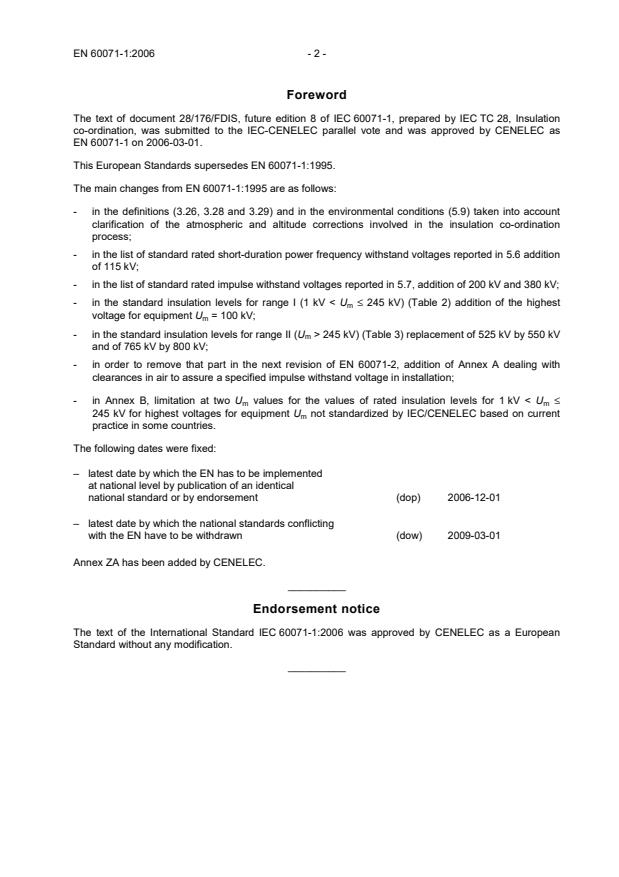
- 2 - Foreword The text of document 28/176/FDIS, future edition 8 of IEC 60071-1, prepared by IEC TC 28, Insulation co-ordination, was submitted to the IEC-CENELEC parallel vote and was approved by CENELEC as EN 60071-1 on 2006-03-01. This European Standards supersedes EN 60071-1:1995. The main changes from EN 60071-1:1995 are as follows: - in the definitions (3.26, 3.28 and 3.29) and in the environmental conditions (5.9) taken into account clarification of the atmospheric and altitude corrections involved in the insulation co-ordination process; - in the list of standard rated short-duration power frequency withstand voltages reported in 5.6 addition of 115 kV; - in the list of standard rated impulse withstand voltages reported in 5.7, addition of 200 kV and 380 kV; - in the standard insulation levels for range I (1 kV < Um ≤ 245 kV) (Table 2) addition of the highest voltage for equipment Um = 100 kV; - in the standard insulation levels for range II (Um > 245 kV) (Table 3) replacement of 525 kV by 550 kV and of 765 kV by 800 kV; - in order to remove that part in the next revision of EN 60071-2, addition of Annex A dealing with
clearances in air to assure a specified impulse withstand voltage in installation; - in Annex B, limitation at two Um values for the values of rated insulation levels for 1 kV < Um ≤
245 kV for highest voltages for equipment Um not standardized by IEC/CENELEC based on current
practice in some countries. The following dates were fixed: – latest date by which the EN has to be implemented
at national level by publication of an identical
national standard or by endorsement
(dop)
2006-12-01 – latest date by which the national standards conflicting
with the EN have to be withdrawn
(dow)
2009-03-01 Annex ZA has been added by CENELEC. __________ Endorsement notice The text of the International Standard IEC 60071-1:2006 was approved by CENELEC as a European Standard without any modification. __________
- 3 - EN 60071-1:2006
Annex ZA
(normative)
Normative references to international publications with their corresponding European publications
The following referenced documents are indispensable for the application of this document. For dated references, only the edition cited applies. For undated references, the latest edition of the referenced document (including any amendments) applies.
NOTE
When an international publication has been modified by common modifications, indicated by (mod), the relevant EN/HD applies.
Publication Year Title EN/HD Year IEC 60038 (mod) + A1 + A2 1983 1994 1997 IEC standard voltages 1) HD 472 S1 + corr. February
1989 2002
IEC 60060-1 + corr. March
1989 1990
HD 588.1 S1
IEC 60071-2 - 2) Insulation co-ordination Part 2: Application guide EN 60071-2 1997 3)
IEC 60099-4 (mod) - 2) Surge arresters Part 4: Metal-oxide surge arresters without gaps for a.c. systems EN 60099-4 2004 3)
IEC 60507 - 2) Artificial pollution tests on high-voltage insulators to be used on a.c. systems EN 60507 1993 3)
IEC 60633 - 2) Terminology for high-voltage direct current (HVDC) transmission EN 60633 1999 3)
1) The title of HD 472 S1 is: Nominal voltages for low voltage public electricity supply systems.
2) Undated reference.
3) Valid edition at date of issue.
NORME INTERNATIONALECEIIEC INTERNATIONAL STANDARD 60071-1Huitième éditionEighth edition2006-01 Coordination de l'isolement – Partie 1: Définitions, principes et règles
Insulation co-ordination – Part 1: Definitions, principles and rules
Pour prix, voir catalogue en vigueur For price, see current catalogue IEC 2006
Droits de reproduction réservés
Copyright - all rights reserved Aucune partie de cette publication ne peut être reproduite ni utilisée sous quelque forme que ce soit et par aucun procédé, électronique ou mécanique, y compris la photocopie et les microfilms, sans l'accord écrit de l'éditeur. No part of this publication may be reproduced or utilized in any form or by any means, electronic or mechanical, including photocopying and microfilm, without permission in writing from the publisher. International Electrotechnical Commission,
3, rue de Varembé, PO Box 131, CH-1211 Geneva 20, SwitzerlandTelephone: +41 22 919 02 11 Telefax: +41 22 919 03 00 E-mail: inmail@iec.ch
Web: www.iec.ch CODE PRIX PRICE CODE V Commission Electrotechnique InternationaleInternational Electrotechnical Commission
60071-1 IEC:2006 – 3 –
CONTENTS FOREWORD.7
1 Scope.11 2 Normative references.11 3 Terms and definitions.13 4 Symbols and abbreviations.27 4.1 General.27 4.2 Subscripts.27 4.3 Letter symbols.27 4.4 Abbreviations.29 5 Procedure for insulation co-ordination.29 5.1 General outline of the procedure.29 5.2 Determination of the representative voltages and overvoltages (Urp).33 5.3 Determination of the co-ordination withstand voltages (Ucw).35 5.4 Determination of the required withstand voltage (Urw).37 5.5 Selection of the rated insulation level.37 5.6 List of standard rated short-duration power frequency withstand voltages.39 5.7 List of standard rated impulse withstand voltages.39 5.8 Ranges for highest voltage for equipment.39 5.9 Environmental conditions.41 5.10 Selection of the standard insulation level.41 5.11 Background of the standard insulation levels.49 6 Requirements for standard withstand voltage tests.51 6.1 General requirements.51 6.2 Standard short-duration power-frequency withstand voltage tests.53 6.3 Standard impulse withstand voltage tests.53 6.4 Alternative test situation.55 6.5 Phase-to-phase and longitudinal insulation standard withstand voltage tests for equipment in range I.55 6.6 Phase-to-phase and longitudinal insulation standard withstand voltage tests for equipment in range II.57
Annex A (normative)
Clearances in air to assure a specified impulse withstand voltage installation.59 Annex B (informative)
Values of rated insulation levels for 1kV < Um ≤ 245 kV for highest voltages for equipment Um not standardized by IEC based on current practice in some countries.67
Bibliography.69
Figure 1 – Flow chart for the determination of rated or standard insulation level.31
60071-1 IEC:2006 – 5 –
Table 1 – Classes and shapes of overvoltages, Standard voltage shapes and Standard withstand voltage tests.33 Table 2 – Standard insulation levels for range I (1kV < Um ≤ 245 kV).45 Table 3 – Standard insulation levels for range II (Um > 245 kV).47 Table A.1 – Correlation between standard rated lightning impulse withstand voltages and minimum air clearances.61 Table A.2 – Correlation between standard rated switching impulse withstand voltages and minimum phase-to-earth air clearances.63 Table A.3 – Correlation between standard rated switching impulse withstand voltages and minimum phase-to-phase air clearances.65 Table B.1- Values of rated insulation levels for 1kV < Um ≤ 245 kV for highest voltages for equipment Um not standardized by IEC based on current practice in some countries.67
60071-1 IEC:2006 – 7 –
INTERNATIONAL ELECTROTECHNICAL COMMISSION ___________
INSULATION CO-ORDINATION –
Part 1: Definitions, principles and rules
FOREWORD 1) The International Electrotechnical Commission (IEC) is a worldwide organization for standardization comprising all national electrotechnical committees (IEC National Committees). The object of IEC is to promote international co-operation on all questions concerning standardization in the electrical and electronic fields. To this end and in addition to other activities, IEC publishes International Standards, Technical Specifications, Technical Reports, Publicly Available Specifications (PAS) and Guides (hereafter referred to as “IEC Publication(s)”). Their preparation is entrusted to technical committees; any IEC National Committee interested in the subject dealt with may participate in this preparatory work. International, governmental and non-governmental organizations liaising with the IEC also participate in this preparation. IEC collaborates closely with the International Organization for Standardization (ISO) in accordance with conditions determined by agreement between the two organizations. 2) The formal decisions or agreements of IEC on technical matters express, as nearly as possible, an international consensus of opinion on the relevant subjects since each technical committee has representation from all interested IEC National Committees.
3) IEC Publications have the form of recommendations for international use and are accepted by IEC National Committees in that sense. While all reasonable efforts are made to ensure that the technical content of IEC Publications is accurate, IEC cannot be held responsible for the way in which they are used or for any misinterpretation by any end user. 4) In order to promote international uniformity, IEC National Committees undertake to apply IEC Publications transparently to the maximum extent possible in their national and regional publications. Any divergence between any IEC Publication and the corresponding national or regional publication shall be clearly indicated in the latter. 5) IEC provides no marking procedure to indicate its approval and cannot be rendered responsible for any equipment declared to be in conformity with an IEC Publication. 6) All users should ensure that they have the latest edition of this publication. 7) No liability shall attach to IEC or its directors, employees, servants or agents including individual experts and members of its technical committees and IEC National Committees for any personal injury, property damage or other damage of any nature whatsoever, whether direct or indirect, or for costs (including legal fees) and expenses arising out of the publication, use of, or reliance upon, this IEC Publication or any other IEC Publications.
8) Attention is drawn to the Normative references cited in this publication. Use of the referenced publications is indispensable for the correct application of this publication. 9) Attention is drawn to the possibility that some of the elements of this IEC Publication may be the subject of patent rights. IEC shall not be held responsible for identifying any or all such patent rights. International Standard IEC 60071-1 has been prepared by IEC technical committee 28: Insulation co-ordination. This eighth edition cancels and replaces the seventh edition published in 1993 and constitutes a technical revision. The main changes from the previous edition are as follows:
– in the definitions (3.26, 3.28 and 3.29) and in the environmental conditions (5.9) taken into account clarification of the atmospheric and altitude corrections involved in the insulation co-ordination process;
– in the list of standard rated short-duration power frequency withstand voltages reported in 5.6 addition of 115 kV;
60071-1 IEC:2006 – 9 –
– in the list of standard rated impulse withstand voltages reported in 5.7, addition of 200 kV and 380 kV; – in the standard insulation levels for range I (1kV < Um ≤ 245 kV) (Table 2) addition of the highest voltage for equipment Um = 100 kV; – in the standard insulation levels for range II (Um > 245 kV) (Table 3) replacement of 525 kV by 550 kV and of 765 kV by 800 kV; – in order to remove that part in the next revision of IEC 60071-2, addition of Annex A dealing with clearances in air to assure a specified impulse withstand voltage in installation; – in Annex B, limitation at two Um values for the values of rated insulation levels for 1kV < Um ≤ 245 kV for highest voltages for equipment Um not standardized by IEC based on current practice in some countries. The text of this standard is based on the following documents: FDIS Report on voting 28/176/FDIS 28/177/RVC
Full information on the voting for the approval of this standard can be found in the report on voting indicated in the above table. This publication has been drafted in accordance with the ISO/IEC Directives, Part 2. The IEC 60071 comprises the following parts under the general title Insulation co-ordination: Part 1:
Definitions, principles and rules Part 2:
Application guide Part 4:
Computational guide to insulation co-ordination and modelling of electrical networks Part 5:
Procedures for high-voltage direct current (HVDC) converter stations The committee has decided that the contents of this publication will remain unchanged until the maintenance result date indicated on the IEC web site under "http://webstore.iec.ch" in the data related to the specific publication. At this date, the publication will be
• reconfirmed; • withdrawn; • replaced by a revised edition, or • amended.
60071-1 IEC:2006 – 11 –
INSULATION CO-ORDINATION –
Part 1: Definitions, principles and rules
1 Scope This part of IEC 60071 applies to three-phase a.c. systems having a highest voltage for equipment above 1 kV. It specifies the procedure for the selection of the rated withstand voltages for the phase-to-earth, phase-to-phase and longitudinal insulation of the equipment and the installations of these systems. It also gives the lists of the standard withstand voltages from which the rated withstand voltages should be selected. This standard recommends that the selected withstand voltages should be associated with the highest voltage for equipment. This association is for insulation co-ordination purposes only. The requirements for human safety are not covered by this standard. Although the principles of this standard also apply to transmission line insulation, the values of their withstand voltages may be different from the standard rated withstand voltages. The apparatus committees are responsible for specifying the rated withstand voltages and the test procedures suitable for the relevant equipment taking into consideration the recommendations of this standard.
NOTE In IEC 60071-2, Application Guide, all rules for insulation co-ordination given in this standard are justified in detail, in particular the association of the standard rated withstand voltages with the highest voltage for equipment. When more than one set of standard rated withstand voltages is associated with the same highest voltage for equipment, guidance is provided for the selection of the most suitable set. 2 Normative references The following referenced documents are indispensable for the application of this document. For dated references, only the edition cited applies. For undated references, the latest edition of the referenced document (including any amendments) applies. IEC 60038:2002, IEC standard voltages
IEC 60060-1:1989, High-voltage test techniques – Part 1: General definitions and test requirements IEC 60071-2, Insulation co-ordination – Part 2: Application guide IEC 60099-4, Surge arresters – Part 4: Metal-oxide surge arresters without gaps for a.c. systems IEC 60507, Artificial pollution tests on high-voltage insulators to be used on a.c. systems IEC 60633, Terminology for high-voltage direct current (HVDC) transmission
60071-1 IEC:2006 – 13 –
3 Terms and definitions For the purposes of this document, the following terms and definitions apply. 3.1
insulation co-ordination selection of the dielectric strength of equipment in relation to the operating voltages and overvoltages which can appear on the system for which the equipment is intended and taking into account the service environment and the characteristics of the available preventing and protective devices [IEC 604-03-08:1987, modified] NOTE By "dielectric strength" of the equipment, is meant here its rated or its standard insulation level as defined in 3.35 and 3.36 respectively. 3.2
external insulation distances in atmospheric air, and the surfaces in contact with atmospheric air of solid insulation of the equipment which are subject to dielectric stresses and to the effects of atmospheric and other environmental conditions from the site, such as pollution, humidity, vermin, etc.
[IEC 604-03-02:1987, modified] NOTE External insulation is either weather protected or non-weather protected, designed to operate inside or outside closed shelters respectively. 3.3
internal insulation internal distances of the solid, liquid, or gaseous insulation of equipment which are protected from the effects of atmospheric and other external conditions [IEC 604-03-03:1987] 3.4
self-restoring insulation insulation which, after a short time, completely recovers its insulating properties after a disruptive discharge during test [IEC 604-03-04:1987, modified] NOTE Insulation of this kind is generally, but not necessary, external insulation 3.5
non self-restoring insulation insulation which loses its insulating properties, or does not recover them completely, after a disruptive discharge during test [IEC 604-03-05:1987, modified] NOTE The definitions of 3.4 and 3.5 apply only when the discharge is caused by the application of a test voltage during a dielectric test. However, discharges occurring in service may cause a self-restoring insulation to lose partially or completely its original insulating properties. 3.6
insulation configuration terminal any of the terminals between any two of which a voltage that stresses the insulation can be applied. The types of terminal are: (a)
phase terminal, between which and the neutral is applied in service the phase-to-neutral voltage of the system; (b)
neutral terminal, representing, or connected to, the neutral point of the system (neutral terminal of transformers, etc.); (c)
earth terminal, always solidly connected to earth in service (tank of transformers, base of disconnectors, structures of towers, ground plane, etc.).
60071-1 IEC:2006 – 15 –
3.7
insulation configuration complete geometric configuration of the insulation in service, consisting of the insulation and of all terminals. It includes all elements (insulating and conducting) which influence its dielectric behaviour. The following insulation configurations are identified: 3.7.1 three-phase insulation configuration configuration having three phase terminals, one neutral terminal and one earth terminal 3.7.2 phase-to-earth (p-e) insulation configuration three-phase insulation configuration where two phase terminals are disregarded and, except in particular cases, the neutral terminal is earthed 3.7.3 phase-to-phase(p-p) insulation configuration three-phase insulation configuration where one phase terminal is disregarded. In particular cases, the neutral and the earth terminals are also disregarded 3.7.4 longitudinal(t-t) insulation configuration insulation configuration having two phase terminals and one earth terminal. The phase terminals belong to the same phase of a three-phase system temporarily separated into two independently energized parts (e.g. open switching devices). The four terminals belonging to the other two phases are disregarded or earthed. In particular cases one of the two phase terminals considered is earthed 3.8
nominal voltage of a system
Un suitable approximate value of voltage used to designate or identify a system [IEC 601-01-21:1985] 3.9
highest voltage of a system
Us highest value of the phase-to-phase operating voltage (r.m.s. value) which occurs under normal operating conditions at any time and at any point in the system [IEC 601-01-23:1985, modified] 3.10
highest voltage for equipment Um highest value of phase-to-phase voltage (r.m.s. value) for which the equipment is designed in respect of its insulation as well as other characteristics which relate to this voltage in the relevant equipment Standards. Under normal service conditions specified by the relevant apparatus committee this voltage can be applied continuously to the equipment [IEC 604-03-01:1987, modified]
60071-1 IEC:2006 – 17 –
3.11
isolated neutral system system where the neutral point is not intentionally connected to earth, except for high impedance connections for protection or measurement purposes [IEC 601-02-24:1985] 3.12
solidly earthed neutral system system whose neutral point(s) is(are) earthed directly [IEC 601-02-25:1985] 3.13
impedance earthed (neutral) system system whose neutral point(s) is(are) earthed through impedances to limit earth fault currents [IEC 601-02-26:1985] 3.14
resonant earthed (neutral) system system in which one or more neutral points are connected to earth through reactances which approximately compensate the capacitive component of a single-phase-to-earth fault current [IEC 601-02-27:1985] NOTE With resonant earthing of a system, the residual current in the fault is limited to such an extent that an arcing fault in air is usually self-extinguishing. 3.15
earth fault factor
k at a given location of a three-phase system, and for a given system configuration, the ratio of the highest r.m.s. phase-to-earth power frequency voltage on a healthy phase during a fault to earth affecting one or more phases at any point on the system to the r.m.s. phase-to-earth power frequency voltage which would be obtained at the given location in the absence of any such fault [IEC 604-03-06:1987] 3.16
overvoltage any voltage: – between one phase conductor and earth or across a longitudinal insulation having a peak value exceeding the peak of the highest voltage of the system divided by 3;
[IEC 604-03-09, modified] or – between phase conductors having a peak value exceeding the amplitude of the highest voltage of the system
[IEC 604-03-09:1987, modified] NOTE Unless otherwise clearly indicated, such as for surge arresters, overvoltage values expressed in p.u.
refer to Us × 32
60071-1 IEC:2006 – 19 –
3.17
classification of voltages and overvoltages according to their shape and duration, voltages and overvoltages are divided in the following classes NOTE More details on the following six first voltages and overvoltages are also given in Table 1. 3.17.1 continuous (power frequency) voltage power-frequency voltage, considered having constant r.m.s. value, continuously applied to any pair of terminals of an insulation configuration 3.17.2 temporary overvoltage
TOV power frequency overvoltage of relatively long duration [IEC 604-03-12:1987, modified] NOTE The overvoltage may be undamped or weakly damped. In some cases its frequency may be several times smaller or higher than power frequency. 3.17.3 transient overvoltage short-duration overvoltage of few milliseconds or less, oscillatory or non-oscillatory, usually highly damped [IEC 604-03-13:1987] NOTE Transient overvoltages may be immediately followed by temporary overvoltages. In such cases the two overvoltages are considered as separate events. Transient overvoltages are divided into: 3.17.3.1 slow-front overvoltage
SFO transient overvoltage, usually unidirectional, with time to peak 20 µs < Tp ≤ 5 000 µs, and tail duration T2 ≤ 20 ms 3.17.3.2 fast-front overvoltage
FFO transient overvoltage, usually unidirectional, with time to peak 0,1 µs < T1 ≤ 20 µs, and tail duration T2 < 300 µs 3.17.3.3 very-fast-front overvoltage
VFFO transient overvoltage, usually unidirectional with time to peak Tf ≤ 0,1 µs, and with or without superimposed oscillations at frequency 30 kHz < f < 100 MHz 3.17.4 combined overvoltage consisting of two voltage components simultaneously applied between each of the two phase terminals of a phase-to-phase (or longitudinal) insulation and earth. It is classified by the component of higher peak value (temporary, slow-front, fast-front or very-fast-front)
60071-1 IEC:2006 – 21 –
3.18
standard voltage shapes for test the following voltage shapes are standardized: NOTE More details on the following three first standard voltage shapes are given in IEC 60060-1 and also in Table 1. 3.18.1 standard short-duration power-frequency voltage sinusoidal voltage with frequency between 48 Hz and 62 Hz, and duration of 60 s 3.18.2 standard switching impulse impulse voltage having a time to peak of 250 µs and a time to half-value of 2 500 µs 3.18.3 standard lightning impulse impulse voltage having a front time of 1,2 µs and a time to half-value of 50 µs 3.18.4 standard combined switching impulse for phase-to-phase insulation, a combined impulse voltage having two components of equal peak value and opposite polarity.
The positive component is a standard switching impulse and the negative one is a switching impulse whose times to peak and half value should not be less than those of the positive impulse. Both impulses should reach their peak value at the same instant. The peak value of the combined voltage is, therefore, the sum of the peak values of the components 3.18.5 standard combined voltage for longitudinal insulation, a combined voltage having a standard impulse on one terminal and a power frequency voltage on the other terminal. The impulse component is applied at the peak of the power frequency voltage of opposite polarity 3.19
representative overvoltages
Urp overvoltages assumed to produce the same dielectric effect on the insulation as overvoltages of a given class occurring in service due to various origins. They consist of voltages with the standard shape of the class, and may be defined by one value or a set of values or a frequency distribution of values that characterize the service conditions NOTE This definition also applies to the continuous power frequency voltage representing the effect of the service voltage on the insulation. 3.20
overvoltage limiting device device which limits the peak values of the overvoltages or their durations or both. They are classified as preventing devices (e.g., a preinsertion resistor), or as protective devices (e.g., a surge arrester)
60071-1 IEC:2006 – 23 –
3.21
lightning [or switching] impulse protective level
Upl [or Ups] maximum permissible peak voltage value on the terminals of a protective device subjected to lightning [or switching] impulses under specific conditions [IEC 604-03-56:1987 and IEC 604-03-57:1987] 3.22
performance criterion basis on which the insulation is selected so as to reduce to an economically and operationally acceptable level the probability that the resulting voltage stresses imposed on the equipment will cause damage to equipment insulation or affect continuity of service. This criterion is usually expressed in terms of an acceptable failure rate (number of failures per year, years between failures, risk of failure, etc.) of the insulation configuration 3.23
withstand voltage value of the test voltage to be applied under specified conditions in a withstand voltage test, during which a specified number of disruptive discharges is tolerated. The withstand voltage is designated as: a) conventional assumed withstand voltage, when the number of disruptive discharges tolerated is zero. It is deemed to correspond to a withstand probability Pw = 100 %; b) statistical withstand voltage, when the number of disruptive discharges tolerated is related to a specified withstand probability. In this standard, the specified probability is Pw = 90 %. NOTE In this standard, for non-self-restoring insulation are specified conventional assumed withstand voltages, and for self-restoring insulation are specified statistical withstand voltages. 3.24
co-ordination withstand voltage
Ucw for each class of voltage, the value of the withstand voltage of the insulation configuration in actual service conditions, that meets the performance criterion 3.25
co-ordination factor
Kc factor by which the value of the representative overvoltage must be multiplied in order to obtain the value of the co-ordination withstand voltage 3.26
standard reference atmospheric conditions atmospheric conditions to which the standardized withstand voltages apply (see 5.9) 3.27
required withstand voltage
Urw test voltage that the insulation must withstand in a standard withstand voltage test to ensure that the insulation will meet the performance criterion when subjected to a given class of overvoltages in actual service conditions and for the whole service duration. The required withstand voltage has the shape of the co-ordination withstand voltage, and is specified with reference to all the conditions of the standard withstand voltage test selected to verify it
60071-1 IEC:2006 – 25 –
3.28
atmospheric correction factor
Kt factor to be applied to the co-ordination withstand voltage to account for the difference in dielectric strength between the average atmospheric conditions in service and the standard reference atmospheric conditions It applies to external insulation only, for all altitudes NOTE 1 The factor Kt allows the correction of test voltages taking into account the difference between the actual atmospheric conditions during test and the standard reference atmospheric conditions. For the factor Kt, the atmospheric conditions taken into account are air pressure, temperature and humidity. NOTE 2 For insulation co-ordination purposes usually only the air pressure correction needs to be taken into account. 3.29
altitude correction factor
Ka factor to be applied to the co-ordination withstand voltage to account for the difference in dielectric strength between the average pressure corresponding to the altitude in service and the standard reference pressure NOTE The altitude correction factor Ka is part of the atmospheric correction factor Kt. 3.30
safety factor
Ks overall factor to be applied to the co-ordination withstand voltage, after the application of the atmospheric correction factor (if required), to obtain the required withstand voltage, accounting for all other differences in dielectric strength between the conditions in service during life time and those in the standard withstand voltage test 3.31
actual withstand voltage of an equipment or insulation configuration
Uaw highest possible value of the test voltage that can be applied to an equipment or insulation configuration in a standard withstand voltage test 3.32
test conversion factor
Ktc for a given equipment or insulation configuration, the factor to be applied to the required withstand voltage of a given overvoltage class, in the case where the standard withstand shape of the selected withstand voltage test is that of a different overvoltage class NOTE For a given equipment or insulation configuration: the test conversion factor of the standard voltage shape (a) to the standard voltage shape (b) must be higher than or equal to the ratio between the actual withstand voltage for the standard voltage shape (a) and the actual withstand voltage of the standard voltage shape (b). 3.33
rated withstand voltage value of the test voltage, applied in a standard withstand voltage test that proves that the insulation complies with one or more required withstand voltages. It is a rated value of the insulation of an equipment 3.34
standard rated withstand voltage Uw standard value of the rated withstand voltage as specified in this standard (see 5.6 and 5.7)
60071-1 IEC:2006 – 27 –
3.35
rated insulation level set of rated withstand voltages which characterize the dielectric strength of the insulation 3.36
standard insulation level set of standard rated withstand voltages which are associated to Um as specified in this standard (see Table 2 and Table 3) 3.37
standard withstand voltage test dielectric test performed in specified conditions to prove that the insulation complies with a standard rated withstand voltage NOTE 1 This standard covers: – short-duration power-frequency voltage tests; – switching impulse tests; – lightning impulse tests; – combined switching impulse tests; – combined voltage tests. NOTE 2 More detailed information on the standard withstand voltage tests are given in IEC 60060-1 (see also Table 1 for the test voltage shapes). NOTE 3 The very-fast-front impulse standard withstand voltage tests should be specified by the relevant apparatus committees, if required. 4 Symbols and abbreviations 4.1 General The list covers only the most frequently used symbols and abbreviations which are useful for insulation co-ordination. 4.2 Subscripts p-e related to phase to earth t-t related to longitudinal max maximum (IEC 60633) p-p related to phase to phase
4.3 Letter symbols f frequency k earth fault factor Kt
atmospheric correction factor Ka
altitude correction factor Kc co-ordination factor Ks safety factor Ktc test conversion factor Pw withstand probability T1 front time
T2 time to half value of a decreasing voltage
60071-1 IEC:2006 – 29 –
Tp time to peak value Tt total overvoltage duration Uaw the actual withstand voltage of an equipment or insulation configuration Ucw co-ordination withstand voltage Um
highest voltage for equipment Un
nominal voltage of a system Upl lightning impulse protective level of a surge arrester Ups switching impulse protective level of a surge arrester Urp representative overvoltage Urw required withstand voltage Us highest voltage of a system Uw
standard rated withstand voltage
4.4 Abbreviations FFO fast-front overvoltage ACWV standard rated short-duration power frequency withstand voltage of an equipment or insulation configuration LIPL lightning impulse protective level of a surge arrester SIPL switching impulse protective level of a surge arrester LIWV standard rated lightning impulse withstand voltage of an equipment or insulation configuration SFO slow-front overvoltage SIWV standard rated switching impulse withstand voltage of an equipment or insulation configuration TOV temporary overvoltage VFFO very-fast-front overvoltage
5 Procedure for insulation co-ordination 5.1 General outline of the procedure The procedure for insulation co-ordination consists of the selection of the highest voltage for the equipment together with a corresponding set of standard rated withstand voltages which characterize the insulation of the equipment needed for the application. This procedure is outlined in Figure 1 and its steps are described in 5.1 to 5.5. The optimization of the selected set of Uw may require reconsideration of some input data and repetition of part of the procedure. The rated withstand voltages shall be selected from the lists of standard rated withstand voltages given in 5.6 and 5.7. The set of selected standard voltages constitutes a rated insulation level. If the standard rated withstand voltages are also associated with the same Um according to 5.10, this set constitutes a standard insulation level.
60071-1 IEC:2006 – 31 –
Origin and classification of stressing voltages
(see 3.16 and 3.17) System analysis (see 5.2) Protective level of overvoltage limiting devices
(see 3.21) Insulation characteristics Representative voltages and overvoltages Urp Insulation characteristics (see 3.19 ) Performance criterion
(see 3.22) Statistical distribution (+) Selection of the insulation meetingthe performance criterion Inaccuracy of input data (+) (see 5.3) (+) Effects combined in a co-ordination factor Kc
(see 3.25) Altitude correction factors Ka (or atmospheric correction factors Kt Co-ordination withstand voltages Ucw
(see 3.28 and 3.29) (see 3.24) Equipment test assembly *) Dispersion in production *) Quality of installation *)Application of factors to account for the differences between type test conditions and actual service conditions Ageing in service *) (see 5.4) Other unknown factors *) *) Effects combined in a safety factor Ks (see 3.30) Required withstand voltages Urw Test conditions
(see 6) Test conversion factor Ktc (see 3.32) Standard withstand voltages
(see 5.6 and 5.7) Selection of rated withstand voltages (see 3.33) or standard rated withstand voltages Uw (see 3.34) from the lists in 5.6 and 5.7 Ranges of Um (see 5.8) Rated or standard insulation level : set of Uw (see 3.35 and 3.36) NOTE
In brackets the subclauses reporting the definition of the term or the description of the action. Sided boxes refer to required input Sided boxes refer to performed actionsSided boxes refer to obtained results
(see 3.27) IEC
2781/05
Figure 1 – Flow chart for the determination of rated or standard insulation level
60071-1 IEC:2006 – 33 –
5.2 Determination of the representative voltages and overvoltages (Urp) The voltages and the overvoltages that stress the insulation shall be determined in amplitude, shape and duration by means of a system analysis which includes the selection and location of the overvoltage preventing and limiting devices. For each class of voltages and overvoltages, this analysis shall then determine a representative voltage and overvoltage, taking into account the characteristics of the insulation with respect to the different behaviour at the voltage or overvoltage shapes in the system and at the standard voltage shapes applied in a standard withstand voltage test as outlined in Table 1. Table 1 – Classes and shapes of overvoltages, Standard voltage shapes and Standard withstand voltage tests Class Low frequency Transient
Continuous Temporary Slow-front Fast-front Very-fast-front Voltage or over-voltage shapes Tt 1/f
1/f Tt
T2Tp T2T1
1/f1 Tf 1/f2 Range of voltage or over-voltage shapes f = 50 Hz or 60 Hz Tt ≥3 600s 10 Hz < f < 500 Hz
0,02 s ≤ Tt
≤3 600 s 20 µs < Tp
≤ 5 000 µs T2 ≤ 20 ms 0,1 µs < T1 ≤ 20 µs T2 ≤ 300 µs Tf
≤ 100 ns 0,3 MHz < f1 < 100 MHz 30 kHz < f2 < 300 kHz
Standard voltage shapes Tt 1/f
Tt 1/f
T2Tp seT2T1
a
f = 50 Hz or 60 Hz Tt a 48 Hz ≤ f ≤ 62 Hz Tt = 60 s Tp = 250 µs T2 = 2 500 µs T1 = 1,2 µs T2 = 50 µs
Standard withstand voltage test a Short-duration power frequency testSwitching impulse test Lightning impulse test a
a To be specified by the relevant apparatus committees.
The representative voltages and overvoltages may be characterized either by: – an assumed maximum, or – a set of peak values, or – a complete statistical distribution of peak values. NOTE In the last case additional characteristics of the overvoltage shapes may have to be considered.
60071-1 IEC:2006 – 35 –
When the adoption of an assumed maximum is considered adequate, the representative overvoltage of the various classes shall be: – For the continuous power-frequency voltage: a power-frequency voltage with r.m.s. value equal to the highest voltage of the system, and with duration corresponding to the lifetime of the equipment. – For the temporary overvoltage: a standard power-frequency short-duration voltage with an r.m.s. value equal to the assumed maximum of the temporary overvoltages divided by 2. – For the slow-front overvoltage: a standard switching impulse with peak value equal to the peak value of the assumed maximum of the slow-front overvoltages. – For the fast-front overvoltage: a standard lightning impulse with peak value equal to the peak value of the assumed maximum of the fast-front overvoltages phase to earth. NOTE For GIS or GIL with three-phase enclosure and insulation levels chosen among the lowest ones for a given Um, the phase-to-phase overvoltages may need consideration. – For the very-fast-front overvoltage: the characteristics for this class of overvoltage are specified by the relevant apparatus committees. – For the slow-front phase-to-phase overvoltage: a standard combined switching impulse with peak value equal to the peak value of the assumed maximum of the slow-front phase-to-phase overvoltages. – For the slow-front [or fast-front] longitudinal overvoltage: a combined voltage consisting of a standard switching [or lightning] impulse and of a power-frequency voltage, each with peak value equal to the two relevant assumed maximum peak values, and with the instant of impulse peak coinciding with the peak of the power-frequency of opposite polarity. 5.3 Determination of the co-ordination withstand voltages (Ucw) The determination of the co-ordination withstand voltages consists of determining the lowest values of the withstand voltages of the insulation meeting the performance criterion when subjected to the representative overvoltages under service conditions. The co-ordination withstand voltages of the insula
...
2003-01.Slovenski inštitut za standardizacijo. Razmnoževanje celote ali delov tega standarda ni dovoljeno.Isolationskoordination -- Teil 1: Begriffe, Grundsätze und AnforderungenCoordination de l'isolement -- Partie 1: Définitions, principes et règlesInsulation co-ordination -- Part 1: Definitions, principles and rules29.080.01VSORãQRElectrical insulation in general01.040.29Elektrotehnika (Slovarji)Electrical engineering (Vocabularies)ICS:Ta slovenski standard je istoveten z:EN 60071-1:2006SIST EN 60071-1:2006en,fr01-november-2006SIST EN 60071-1:2006SLOVENSKI
STANDARDSIST EN 60071-1:20011DGRPHãþD
NORME EUROPÉENNE EN 60071-1 EUROPÄISCHE NORM
EUROPEAN STANDARD Mai 2006
CENELEC Comité Européen de Normalisation Electrotechnique Europäisches Komitee für Elektrotechnische Normung European Committee for Electrotechnical Standardization
Secrétariat Central: rue de Stassart 35, B - 1050 Bruxelles
© 2006 CENELEC -
Tous droits d'exploitation sous quelque forme et de quelque manière que ce soit réservés dans le monde entier aux membres du CENELEC.
Ref. n° EN 60071-1:2006 F
ICS 29.080.30 Remplace EN 60071-1:1995
Version française
Coordination de l'isolement Partie 1: Définitions, principes et règles (CEI 60071-1:2006)
Isolationskoordination Teil 1: Begriffe, Grundsätze
und Anforderungen (IEC 60071-1:2006)
Insulation co-ordination Part 1: Definitions, principles and rules (IEC 60071-1:2006)
La présente Norme Européenne a été adoptée par le CENELEC le 2006-03-01. Les membres du CENELEC sont tenus de se soumettre au Règlement Intérieur du CEN/CENELEC qui définit les conditions dans lesquelles doit être attribué, sans modification, le statut de norme nationale à la Norme Européenne.
Les listes mises à jour et les références bibliographiques relatives à ces normes nationales peuvent être obtenues auprès du Secrétariat Central ou auprès des membres du CENELEC.
La présente Norme Européenne existe en trois versions officielles (allemand, anglais, français). Une version dans une autre langue faite par traduction sous la responsabilité d'un membre du CENELEC dans sa langue nationale, et notifiée au Secrétariat Central, a le même statut que les versions officielles.
Les membres du CENELEC sont les comités électrotechniques nationaux des pays suivants: Allemagne, Autriche, Belgique, Chypre, Danemark, Espagne, Estonie, Finlande, France, Grèce, Hongrie, Irlande, Islande, Italie, Lettonie, Lituanie, Luxembourg, Malte, Norvège, Pays-Bas, Pologne, Portugal, République Tchèque, Roumanie, Royaume-Uni, Slovaquie, Slovénie, Suède et Suisse.
- 2 - Avant-propos Le texte du document 28/176/FDIS, future édition 8 de la CEI 60071-1, préparé par le CE 28 de la CEI, Coordination de l'isolement, a été soumis au vote parallèle CEI-CENELEC et a été approuvé par le CENELEC comme EN 60071-1 le 2006-03-01. Cette Norme Européenne remplace la EN 60071-1:1995. Les principaux changements par rapport à la EN 60071-1:1995 sont ceux qui suivent: – dans les définitions (3.26, 3.28 et 3.29) et dans les conditions environnementales (5.9) prises en
compte, clarification des corrections atmosphérique et d'altitude impliquées dans le processus de
coordination de l'isolement; – dans la liste des tensions de tenue assignées normalisées de courte durée à fréquence industrielle
mentionnées en 5.6, introduction de 115 kV; – dans la liste des tensions de tenue assignées normalisées aux chocs indiquées en 5.7, introduction
de 200 kV et 380 kV; – dans les niveaux de tenue normalisés pour la gamme I (1 kV < Um ≤ 245 kV) (Tableau 2),
introduction de la tension la plus élevée pour le matériel Um = 100 kV; – dans les niveaux de tenue normalisés pour la gamme II (Um > 245 kV) (Tableau 3) remplacement de
525 kV par 550 kV et de 765 kV par 800 kV; – afin de supprimer cette partie de la révision prochaine de la EN 60071-2, introduction de l'Annexe A
relative aux distances dans l'air pour installation avec tension de tenue aux chocs spécifiée;
– dans l'Annexe B, limitation à deux valeurs de Um pour les valeurs de niveaux d'isolement assignés
pour 1 kV < Um ≤ 245 kV pour des tensions les plus élevées pour le matériel Um non normalisées par
la CEI / le CENELEC, fondées sur la pratique existant dans certains pays. Les dates suivantes ont été fixées: – date limite à laquelle la EN doit être mise en application
au niveau national par publication d'une norme
nationale identique ou par entérinement
(dop)
2006-12-01 – date limite à laquelle les normes nationales
conflictuelles doivent être annulées
(dow)
2009-03-01 L'Annexe ZA a été ajoutée par le CENELEC. __________ Notice d’entérinement Le texte de la Norme internationale CEI 60071-1:2006 a été approuvé par le CENELEC comme Norme Européenne sans aucune modification. __________ SIST EN 60071-1:2006
- 3 - EN 60071-1:2006
Annexe ZA (normative)
Références normatives à d'autres publications internationales avec les publications européennes correspondantes
Les documents de référence suivants sont indispensables pour l'application du présent document. Pour les références datées, seule l'édition citée s'applique. Pour les références non datées, la dernière édition du document de référence s'applique (y compris les éventuels amendements).
NOTE
Dans le cas où une publication internationale est modifiée par des modifications communes, indiqué par (mod), l'EN / le HD correspondant(e) s'applique.
Publication Année Titre EN/HD Année IEC 60038 (mod) + A1 + A2 1983 1994 1997 Tensions normales de la CEI 1) HD 472 S1 + corr. février
1989 2002
IEC 60060-1 + corr. mars
1989 1990 Techniques des essais à haute tension Partie 1: Définitions et prescriptions générales relatives aux essais
HD 588.1 S1
IEC 60071-2 - 2) Coordination de l'isolement Partie 2: Guide d'application EN 60071-2 1997 3)
IEC 60099-4 (mod) - 2) Parafoudres Partie 4: Parafoudres à oxyde métallique sans éclateurs pour réseaux à courant alternatif EN 60099-4 2004 3)
IEC 60507 - 2) Essais sous pollution artificielle des isolateurs pour haute tension destinés aux réseaux à courant alternatif EN 60507 1993 3)
IEC 60633 - 2) Terminologie pour le transport d'énergie en courant continu à haute tension (CCHT) EN 60633 1999 3)
1) Le HD 472 S1 a comme titre: Tensions nominales des réseaux électriques de distribution publique basse tension.
2) Référence non datée.
3) Edition valide à ce jour.
NORME INTERNATIONALECEIIEC INTERNATIONAL STANDARD 60071-1Huitième éditionEighth edition2006-01 Coordination de l'isolement – Partie 1: Définitions, principes et règles
Insulation co-ordination – Part 1: Definitions, principles and rules
Pour prix, voir catalogue en vigueur For price, see current catalogue IEC 2006
Droits de reproduction réservés
Copyright - all rights reserved Aucune partie de cette publication ne peut être reproduite ni utilisée sous quelque forme que ce soit et par aucun procédé, électronique ou mécanique, y compris la photocopie et les microfilms, sans l'accord écrit de l'éditeur. No part of this publication may be reproduced or utilized in any form or by any means, electronic or mechanical, including photocopying and microfilm, without permission in writing from the publisher. International Electrotechnical Commission,
3, rue de Varembé, PO Box 131, CH-1211 Geneva 20, SwitzerlandTelephone: +41 22 919 02 11 Telefax: +41 22 919 03 00 E-mail: inmail@iec.ch
Web: www.iec.ch CODE PRIX PRICE CODE V Commission Electrotechnique InternationaleInternational Electrotechnical CommissionSIST EN 60071-1:2006
– 2 – 60071-1 CEI:2006 SOMMAIRE AVANT-PROPOS.6
1 Domaine d’application.10 2 Références normatives.10 3 Termes et définitions.12 4 Symboles et abréviations.26 4.1 Généralités.26 4.2 Indices.26 4.3 Symboles littéraux.26 4.4 Abréviations.28 5 Procédure pour la coordination de l'isolement.28 5.1 Généralités sur la procédure.28 5.2 Détermination des tensions et surtensions représentatives (Urp).32 5.3 Détermination des tensions de tenue de coordination (Ucw).34 5.4 Détermination des tensions de tenue requises (Urw).36 5.5 Choix du niveau d'isolement assigné.36 5.6 Liste des tensions de tenue assignées normalisées de courte durée à fréquence industrielle.38 5.7 Liste des tensions de tenue assignées normalisées aux chocs.38 5.8 Gammes de la tension la plus élevée pour le matériel.38 5.9 Conditions environnementales.40 5.10 Choix du niveau d'isolement normalisé.40 5.11 Origine des niveaux d'isolement normalisés.48 6 Exigences pour les essais de tension de tenue normalisée.50 6.1 Exigences générales.50 6.2 Essais de tension de tenue normalisée de courte durée à fréquence industrielle.52 6.3 Essais de tension de tenue normalisée aux chocs.52 6.4 Situation d'essai alternative.54 6.5 Essais de tension de tenue normalisée de l'isolation entre phases et de l'isolation longitudinale pour le matériel de la gamme I.54 6.6 Essais de tension de tenue normalisée de l'isolation entre phases et de l'isolation longitudinale pour le matériel de la gamme II.56
Annexe A (normative)
Distances dans l'air pour installation garantissant
une tension de tenue aux chocs spécifiée.58 Annexe B (informative)
Valeurs de niveaux d'isolement assignés pour 1 kV < Um ≤ 245 kV pour des tensions les plus élevées pour le matériel Um non normalisées par la CEI, fondées sur la pratique existant dans certains pays.66
Bibliographie.68
Figure 1 – Organigramme de détermination du niveau d'isolement assigné ou normalisé 30
– 4 – 60071-1 CEI:2006 Table 1 – Classes et formes des surtensions, des formes de tension normalisées
et des essais de tension de tenue normalisée.32 Tableau 2 – Niveaux d'isolement normalisés pour la gamme I (1 kV < Um ≤ 245 kV).44 Tableau 3 – Niveaux d'isolement normalisés pour la gamme II (Um > 245 kV).46 Tableau A.1 – Correspondance entre les tensions de tenue assignées normalisées au choc de foudre et les distances dans l'air minimales.60 Tableau A.2 – Correspondance entre les tensions de tenue assignées normalisées au choc de manœuvre et les distances dans l'air minimales phase-terre.62 Tableau A.3 – Correspondance entre les tensions de tenue assignées normalisées au choc de manœuvre et les distances dans l'air minimales phase-phase.64 Tableau B.1 – Valeurs de niveaux d'isolement assignés pour 1 kV < Um ≤ 245 kV pour des tensions les plus élevées pour le matériel Um non normalisées par la CEI, fondées sur la pratique existant dans certains pays.66
– 6 – 60071-1 CEI:2006 COMMISSION ÉLECTROTECHNIQUE INTERNATIONALE __________
COORDINATION DE L'ISOLEMENT –
Partie 1: Définitions, principes et règles
AVANT-PROPOS 1) La Commission Electrotechnique Internationale (CEI) est une organisation mondiale de normalisation composée de l'ensemble des comités électrotechniques nationaux (Comités nationaux de la CEI). La CEI a pour objet de favoriser la coopération internationale pour toutes les questions de normalisation dans les domaines de l'électricité et de l'électronique. A cet effet, la CEI – entre autres activités – publie des Normes internationales, des Spécifications techniques, des Rapports techniques, des Spécifications accessibles au public (PAS) et des Guides (ci-après dénommés "Publication(s) de la CEI"). Leur élaboration est confiée à des comités d'études, aux travaux desquels tout Comité national intéressé par le sujet traité peut participer. Les organisations internationales, gouvernementales et non gouvernementales, en liaison avec la CEI, participent également aux travaux. La CEI collabore étroitement avec l'Organisation Internationale de Normalisation (ISO), selon des conditions fixées par accord entre les deux organisations. 2) Les décisions ou accords officiels de la CEI concernant les questions techniques représentent, dans la mesure du possible, un accord international sur les sujets étudiés, étant donné que les Comités nationaux de la CEI intéressés sont représentés dans chaque comité d’études. 3) Les Publications de la CEI se présentent sous la forme de recommandations internationales et sont agréées comme telles par les Comités nationaux de la CEI. Tous les efforts raisonnables sont entrepris afin que la CEI s'assure de l'exactitude du contenu technique de ses publications; la CEI ne peut pas être tenue responsable de l'éventuelle mauvaise utilisation ou interprétation qui en est faite par un quelconque utilisateur final. 4) Dans le but d'encourager l'uniformité internationale, les Comités nationaux de la CEI s'engagent, dans toute la mesure possible, à appliquer de façon transparente les Publications de la CEI dans leurs publications nationales et régionales. Toutes divergences entre toutes Publications de la CEI et toutes publications nationales ou régionales correspondantes doivent être indiquées en termes clairs dans ces dernières. 5) La CEI n’a prévu aucune procédure de marquage valant indication d’approbation et n'engage pas sa responsabilité pour les équipements déclarés conformes à une de ses Publications. 6) Tous les utilisateurs doivent s'assurer qu'ils sont en possession de la dernière édition de cette publication. 7) Aucune responsabilité ne doit être imputée à la CEI, à ses administrateurs, employés, auxiliaires ou mandataires, y compris ses experts particuliers et les membres de ses comités d'études et des Comités nationaux de la CEI, pour tout préjudice causé en cas de dommages corporels et matériels, ou de tout autre dommage de quelque nature que ce soit, directe ou indirecte, ou pour supporter les coûts (y compris les frais de justice) et les dépenses découlant de la publication ou de l'utilisation de cette Publication de la CEI ou de toute autre Publication de la CEI, ou au crédit qui lui est accordé. 8) L'attention est attirée sur les références normatives citées dans cette publication. L'utilisation de publications référencées est obligatoire pour une application correcte de la présente publication.
9) L’attention est attirée sur le fait que certains des éléments de la présente Publication de la CEI peuvent faire l’objet de droits de propriété intellectuelle ou de droits analogues. La CEI ne saurait être tenue pour responsable de ne pas avoir identifié de tels droits de propriété et de ne pas avoir signalé leur existence. La Norme internationale CEI 60071-1 a été établie par le comité d'études 28 de la CEI: Coordination de l'isolement. Cette huitième édition annule et remplace la septième édition publiée en 1993 et constitue une révision technique. Les principaux changements par rapport à l'édition précédente sont ceux qui suivent: – dans les définitions (3.26, 3.28 et 3.29) et dans les conditions environnementales (5.9) prises en compte, clarification des corrections atmosphérique et d'altitude impliquées dans le processus de coordination de l'isolement; – dans la liste des tensions de tenue assignées normalisées de courte durée à fréquence industrielle mentionnées en 5.6, introduction de 115 kV; SIST EN 60071-1:2006
– 8 – 60071-1 CEI:2006 – dans la liste des tensions de tenue assignées normalisées aux chocs indiquées en 5.7, introduction de 200 kV et 380 kV; – dans les niveaux de tenue normalisés pour la gamme I (1kV < Um ≤ 245 kV) (Tableau 2), introduction de la tension la plus élevée pour le matériel Um = 100 kV; – dans les niveaux de tenue normalisés pour la gamme II (Um > 245 kV) (Tableau 3) remplacement de 525 kV par 550 kV et de 765 kV par 800 kV; – afin de supprimer cette partie dans la révision prochaine de la CEI 60071-2, introduction de l'Annexe A relative aux distances dans l'air pour installation avec tension de tenue aux chocs spécifiée; – dans l'Annexe B, limitation à deux valeurs de Um pour les valeurs de niveaux d'isolement assignés pour 1 kV < Um ≤ 245 kV pour des tensions les plus élevées pour le matériel Um non normalisées par la CEI, fondées sur la pratique existant dans certains pays. Le texte de cette norme est issu des documents suivants: FDIS Rapport de vote 28/176/FDIS 28/177/RVC
Le rapport de vote indiqué dans le tableau ci-dessus donne toute information sur le vote ayant abouti à l'approbation de cette norme. Cette publication a été rédigée selon les Directives ISO/CEI, Partie 2. La CEI 60071 comprend les parties suivantes, sous le titre général Coordination de l'isolement: Partie 1:
Définitions, principes et règles Partie 2:
Guide d'application Partie 4: Guide de calcul de coordination de l'isolement et de modélisations des réseaux électriques Partie 5:
Procédures pour les stations de conversion à courant continu haute tension (CCHT) Le comité a décidé que le contenu de cette publication ne sera pas modifié avant la date de maintenance indiquée sur le site web de la CEI sous «http://webstore.iec.ch» dans les données relatives à la publication recherchée. A cette date, la publication sera • reconduite; • supprimée; • remplacée par une édition révisée, ou • amendée.
– 10 – 60071-1 CEI:2006 COORDINATION DE L'ISOLEMENT –
Partie 1: Définitions, principes et règles
1 Domaine d’application La présente partie de la CEI 60071 s'applique aux réseaux à tension alternative triphasée dont la tension la plus élevée pour le matériel est supérieure à 1 kV. Elle spécifie la procédure pour le choix des tensions de tenue assignées normalisées pour l'isolation phase-terre, l'isolation entre phases et l'isolation longitudinale du matériel et des installations de ces réseaux. Elle donne également les listes des valeurs normalisées parmi lesquelles il convient de choisir les tensions de tenue assignées normalisées. Cette norme recommande que les tensions de tenue choisies soient associées aux tensions les plus élevées pour le matériel. Cette association est destinée aux seules fins de la coordination de l'isolement. Les exigences concernant la sécurité des personnes ne sont pas couvertes par cette norme. Bien que les principes de cette norme s'appliquent également à l'isolation des lignes de transport d'énergie, les valeurs des tensions de tenue peuvent être différentes des tensions de tenue assignées normalisées. Il appartient aux comités de produits de spécifier les tensions de tenue et les procédures d'essai appropriées aux matériels correspondants, en prenant les recommandations de cette norme en considération.
NOTE Toutes les règles pour la coordination de l'isolement données dans cette norme sont justifiées en détail dans la CEI 60071-2, en particulier en ce qui concerne l'association des tensions de tenue assignées normalisées avec les tensions les plus élevées pour le matériel. Lorsque plusieurs séries de tensions de tenue assignées normalisées sont associées à la même valeur de la tension la plus élevée pour le matériel, une ligne directrice est donnée pour le choix de la série la plus appropriée. 2 Références normatives Les documents de référence suivants sont indispensables pour l'application du présent document. Pour les références datées, seule l'édition citée s'applique. Pour les références non datées, la dernière édition du document de référence s'applique (y compris les éventuels amendements). CEI 60038:2002, Tensions normales de la CEI CEI 60060-1:1989, Techniques des essais à haute tension – Partie 1: Définitions et prescriptions générales relatives aux essais CEI 60071-2, Coordination de l’isolement – Partie 2: Guide d’application CEI 60099-4, Parafoudres – Partie 4: Parafoudres à oxyde métallique sans éclateurs pour réseaux à courant alternatif
CEI 60507, Essais sous pollution artificielle des isolateurs pour haute tension destinés aux réseaux à courant alternatif CEI 60633, Terminologie pour le transport d’énergie en courant continu à haute tension (CCHT) SIST EN 60071-1:2006
– 12 – 60071-1 CEI:2006 3 Termes et définitions Pour les besoins du présent document, les termes et définitions suivants s'appliquent. 3.1
coordination de l'isolement sélection de la rigidité diélectrique des matériels, en fonction des tensions de service et des surtensions qui peuvent apparaître dans le réseau auquel ces matériels sont destinés et compte tenu de l'environnement en service et des caractéristiques des dispositifs de prévention et de protection disponibles [VEI 604-03-08:1987, modifiée] NOTE La «rigidité diélectrique» des matériels est prise ici au sens de niveau d'isolement assigné ou de niveau d'isolement normalisé tels que définis respectivement en 3.35 et en 3.36. 3.2
isolation externe distances dans l'air atmosphérique et sur les surfaces des isolations solides d'un matériel en contact avec l'air atmosphérique, qui sont soumises aux contraintes diélectriques et à l'influence des conditions atmosphériques ou d'autres conditions environnementales provenant du site comme la pollution, l'humidité, les animaux, etc.
[VEI 604-03-02:1987, modifiée] NOTE L'isolation externe est soit protégée, soit exposée, selon qu'elle est conçue pour être utilisée à l'intérieur ou à l'extérieur d'abris fermés. 3.3
isolation interne distances internes dans l’isolation solide, liquide ou gazeuse des matériels qui sont à l'abri de l'influence des conditions atmosphériques ou d'autres agents externes [VEI 604-03-03:1987] 3.4
isolation autorégénératrice isolation qui, en peu de temps, retrouve intégralement ses propriétés isolantes après une décharge disruptive au cours d'un essai [VEI 604-03-04:1987, modifiée] NOTE Une isolation de ce type est généralement, mais pas nécessairement, une isolation externe. 3.5
isolation non autorégénératrice isolation qui perd ses propriétés isolantes, ou ne les retrouve pas intégralement, après une décharge disruptive au cours d'un essai [VEI 604-03-05:1987, modifiée] NOTE Les définitions 3.4 et 3.5 s'appliquent uniquement quand la décharge est provoquée par l'application d'une tension d'essai lors d'un essai diélectrique. Cependant, des décharges apparaissant en service peuvent conduire une isolation autorégénératrice à perdre partiellement ou complètement ses propriétés isolantes d'origine. 3.6
borne de la configuration de l'isolation l'une ou l'autre des deux bornes entre lesquelles peut être appliquée une tension qui soumet l'isolation à une contrainte. Les types de borne sont: (a)
borne de phase, en service, la tension phase-neutre du réseau est appliquée entre cette borne et le neutre; (b)
borne de neutre, représentant le point neutre du réseau, ou y étant connectée (borne de neutre de transformateur, etc.); (c)
borne de terre, toujours mise directement à la terre en service (cuve de transformateur, socle de sectionneur, structure de pylône, plaque de mise à la terre, etc.) SIST EN 60071-1:2006
– 14 – 60071-1 CEI:2006 3.7
configuration de l'isolation configuration géométrique complète de l'isolation en service comprenant l'isolation et toutes ses bornes. Elle inclut tous les éléments (isolants et conducteurs) qui influencent son comporte-ment diélectrique. On distingue les configurations de l'isolation suivantes: 3.7.1 configuration de l’isolation triphasée configuration ayant trois bornes de phase, une borne de neutre et une borne de terre 3.7.2 configuration de l’isolation phase-terre
p-e configuration d'isolation triphasée dans laquelle on ne tient pas compte des bornes de deux phases et, sauf cas particuliers, dans laquelle la borne de neutre est mise à la terre 3.7.3 configuration de l’isolation phase-phase p-p configuration d'isolation triphasée dans laquelle on ne tient pas compte d'une borne de phase. Dans des cas particuliers, les bornes de neutre et de terre ne sont également pas prises en compte 3.7.4 configuration de l’isolation longitudinale
t-t configuration de l’isolation ayant deux bornes de phase et une borne de terre. Les bornes de phase appartiennent à la même phase d'un réseau triphasé, séparée temporairement en deux parties indépendantes sous tension (par exemple, appareils de connexion ouverts). Les quatre bornes appartenant aux deux autres phases ne sont pas prises en compte ou sont mises à la terre. Dans des cas particuliers, l'une des deux bornes de phase considérées est mise à la terre 3.8
tension nominale d'un réseau
Un valeur arrondie appropriée de la tension utilisée pour dénommer ou identifier un réseau [VEI 601-01-21:1985] 3.9
tension la plus élevée d'un réseau
Us valeur la plus élevée de la tension de service entre phases (valeur efficace) qui se présente à un instant et en un point quelconque du réseau dans des conditions d'exploitation normales [VEI 601-01-23:1985, modifiée] 3.10
tension la plus élevée pour le matériel
Um valeur la plus élevée de la tension entre phases (valeur efficace) pour laquelle le matériel est spécifié en ce qui concerne son isolement ainsi que certaines autres caractéristiques qui sont rattachées à cette tension dans les normes proposées pour chaque matériel. Dans les conditions normales de service spécifiées par le comité de produit correspondant, cette tension peut être appliquée au matériel en permanence [VEI 604-03-01:1987, modifiée] SIST EN 60071-1:2006
– 16 – 60071-1 CEI:2006 3.11
réseau à neutre isolé réseau dont aucun point neutre n'a de connexion intentionnelle avec la terre, à l'exception des liaisons à haute impédance destinées à des dispositifs de protection ou de mesure [VEI 601-02-24:1985] 3.12
réseau à neutre directement à la terre réseau dont le ou les points neutres sont reliés directement à la terre [VEI 601-02-25:1985] 3.13
réseau à neutre non directement à la terre réseau dont le ou les points neutres sont reliés à la terre par l'intermédiaire d'impédances destinées à limiter les courants de défaut à la terre [VEI 601-02-26:1985] 3.14
réseau compensé par bobine d'extinction réseau dont un ou plusieurs points neutres sont reliés à la terre par des réactances compensant approximativement la composante capacitive du courant de défaut monophasé à la terre [VEI 601-02-27:1985] NOTE Pour un réseau compensé par bobine d'extinction, le courant résiduel dans le défaut est limité à tel point qu'un arc de défaut dans l'air est généralement auto-extinguible. 3.15
facteur de défaut à la terre
k en un emplacement donné d'un réseau triphasé, et pour un schéma d'exploitation donné de ce réseau, rapport entre, d'une part, la tension efficace la plus élevée, à la fréquence du réseau, entre une phase saine et la terre pendant un défaut à la terre affectant une phase quelconque ou plusieurs phases en un point quelconque du réseau, et d'autre part la valeur efficace de la tension entre phase et terre à la fréquence du réseau qui serait obtenue à l'emplacement considéré en l'absence du défaut [VEI 604-03-06:1987] 3.16
surtension
toute tension: – entre un conducteur de phase et la terre ou à travers une isolation longitudinale dont la valeur de crête dépasse la valeur de crête correspondant à la tension la plus élevée du réseau divisée par 3 [VEI 604-03-09:1987, modifiée] ou
– entre conducteurs de phase dont la valeur de crête dépasse l'amplitude de la tension le plus élevée du réseau [VEI 604-03-09:1987, modifiée] NOTE Sauf indication contraire clairement stipulée, comme pour les parafoudres, les valeurs de surtension exprimées en p.u. renvoient à Us × 32. SIST EN 60071-1:2006
– 18 – 60071-1 CEI:2006 3.17
classification des tensions et des surtensions tensions et surtensions réparties selon les catégories suivantes d'après leur forme et leur durée NOTE Plus de détails sur les six premières tensions et surtensions suivantes sont aussi donnés au Tableau 1. 3.17.1 tension permanente (à fréquence industrielle) tension à la fréquence du réseau, considérée comme ayant une valeur efficace constante, appliquée en permanence à toute paire de bornes d'une configuration d'isolation 3.17.2 surtension temporaire
TOV surtension à fréquence industrielle de durée relativement longue [VEI 604-03-12:1987, modifiée] NOTE La surtension peut être non amortie ou faiblement amortie. Dans certains cas, sa fréquence peut être inférieure ou supérieure à la fréquence industrielle dans un rapport de plusieurs unités. 3.17.3 surtension transitoire
surtension de courte durée, ne dépassant pas quelques millisecondes, oscillatoire ou non, généralement fortement amortie [VEI 604-03-13:1987] NOTE Les surtensions transitoires peuvent être immédiatement suivies par des surtensions temporaires. S'il en est ainsi, les deux types de surtensions sont considérés comme des événements séparés. Les surtensions transitoires sont divisées en: 3.17.3.1 surtension à front lent
SFO surtension transitoire, généralement unidirectionnelle, de durée Tp jusqu'à la valeur de crête telle que 20 µs < Tp ≤ 5 000 µs et de durée de queue T2 ≤ 20 ms 3.17.3.2 surtension à front rapide
SFO surtension transitoire, généralement unidirectionnelle, de durée Tp jusqu'à la valeur de crête telle que 0,1 µs < T1 ≤ 20 µs et de durée de queue T2 < 300 µs 3.17.3.3 surtension à front très rapide
VFFO surtension transitoire, généralement unidirectionnelle, de durée jusqu'à la valeur de crête Tf ≤ 0,1 µs et avec ou sans oscillations superposées de fréquence 30 kHz < f < 100 MHz 3.17.4 surtension combinée consistant en deux composantes de tension appliquées simultanément entre chacune des deux bornes de phase d'une isolation entre phases (ou longitudinale) et la terre. Elle est classée selon la composante de la valeur de crête la plus élevée (temporaire, à front lent, à front rapide ou à front très rapide) SIST EN 60071-1:2006
– 20 – 60071-1 CEI:2006 3.18
formes de tension normalisées pour essai les formes de tension suivantes sont normalisées: NOTE Plus de détails sur les trois premières formes de tension normalisées suivantes sont donnés dans la CEI 60060-1 ainsi qu’au Tableau 1. 3.18.1 tension normalisée de courte durée à fréquence industrielle tension sinusoïdale de fréquence comprise entre 48 Hz et 62 Hz et de durée égale à 60 s 3.18.2 tension normalisée de choc de manœuvre tension de choc ayant une durée jusqu'à la crête de 250 µs et une durée jusqu'à la mi-valeur de 2 500 µs 3.18.3 tension normalisée de choc de foudre tension de choc ayant une durée de front de 1,2 µs et une durée jusqu'à la mi-valeur de 50 µs 3.18.4 tension normalisée de choc de manœuvre combinée pour l'isolation entre phases, une tension de choc combinée ayant deux composantes de valeurs de crête égales et de polarités opposées. La composante positive est une tension de choc de manœuvre normalisée et la composante négative est une tension de choc de manœuvre dont les durées jusqu'à la crête et jusqu'à la mi-valeur ne sont pas inférieures à celles de la composante positive. Il convient que les deux tensions de choc atteignent leur valeur de crête au même instant. Par conséquent, la valeur de crête de la tension combinée est la somme des valeurs de crête de leurs composantes 3.18.5 tension normalisée combinée pour l'isolation longitudinale, une tension combinée ayant un choc normalisé sur une borne et une tension à fréquence industrielle sur l'autre borne. La composante de choc est appliquée à la valeur de crête de la tension à fréquence industrielle de polarité opposée 3.19
surtensions représentatives
Urp surtensions supposées produire le même effet diélectrique sur l'isolation que les surtensions d'une catégorie donnée apparaissant en service dues à diverses origines. Elles sont constituées de tensions ayant la forme normalisée de la catégorie en question et peuvent être définies par une valeur, un ensemble de valeurs ou une distribution statistique des valeurs qui caractérisent les conditions de service NOTE Cette définition s'applique également à la tension permanente à fréquence industrielle qui représente l'effet de la tension de service sur l'isolation. 3.20
dispositif de limitation des surtensions dispositif qui limite les valeurs de crête des surtensions ou leurs durées ou les deux. Ces dispositifs sont classés en dispositifs de prévention (tel que résistance de préinsertion) ou en dispositifs de protection (tel que parafoudre) SIST EN 60071-1:2006
– 22 – 60071-1 CEI:2006 3.21
niveau de protection au choc de foudre [ou de manœuvre]
Upl [ou Ups] valeur de crête maximale de la tension admissible aux bornes d'un dispositif de protection soumis, dans des conditions spécifiées, à des chocs de foudre [ou de manœuvre] [VEI 604-03-56:1987 et VEI 604-03-57:1987] 3.22
critère de performance base sur laquelle est choisie l'isolation de façon à réduire à un niveau acceptable, du point de vue de l'économie et de celui de l'exploitation, la probabilité que les contraintes diélectriques résultantes imposées aux matériels causent des dommages aux isolations des matériels ou affectent la continuité du service. Ce critère est habituellement exprimé en termes d'un taux de défaillance acceptable (nombre de défaillances par année, nombre d'années entre défaillances, risque de défaillance, etc.) de la configuration de l'isolation 3.23
tension de tenue valeur de la tension d'essai à appliquer, dans des conditions spécifiées, lors d'un essai de tension de tenue pendant lequel un nombre spécifié de décharges disruptives est toléré. La tension de tenue est désignée par: a) tension de tenue présumée conventionnelle, lorsque le nombre de décharges disruptives toléré est nul. Cela est supposé correspondre à une probabilité de tenue Pw = 100 %; b) tension de tenue statistique, lorsque le nombre de décharges disruptives toléré est relatif à une probabilité de tenue spécifiée. Dans cette norme, la probabilité spécifiée est Pw = 90 %. NOTE Dans cette norme, les tensions de tenue présumées conventionnelles sont spécifiées pour l'isolation non autorégénératrice et les tensions de tenue statistiques le sont pour l'isolation autorégénératrice. 3.24
tension de tenue de coordination
Ucw pour chaque catégorie de tension, valeur de la tension de tenue de la configuration de l'isolation, dans les conditions réelles de service, qui satisfait au critère de performance 3.25
facteur de coordination
Kc facteur par lequel il faut que la valeur de la surtension représentative soit multipliée pour obtenir la valeur de la tension de tenue de coordination 3.26
conditions atmosphériques normalisées de référence conditions atmosphériques auxquelles les tensions de tenue assignées normalisées s'appliquent (voir 5.9) 3.27
tension de tenue requise
Urw tension d'essai qu’il faut que l'isolation tienne dans un essai de tension de tenue normalisée pour s'assurer que l'isolation satisfera au critère de performance lorsqu'elle sera soumise à une catégorie donnée de surtensions dans les conditions réelles de service et pendant toute la durée de service. La tension de tenue requise a la forme de la tension de tenue de coordination et elle est spécifiée en se référant à toutes les conditions de l'essai de tension de tenue normalisée choisi pour vérifier cette tenue SIST EN 60071-1:2006
– 24 – 60071-1 CEI:2006 3.28
facteur de correction atmosphérique
Kt facteur à appliquer à la tension de tenue de coordination pour tenir compte de la différence de tenue diélectrique entre les conditions atmosphériques moyennes en service et les conditions atmosphériques normalisées de référence. Ce facteur ne s'applique qu'à l'isolation externe, pour toutes les altitudes NOTE 1 Le facteur Kt permet de corriger les tensions d'essai en tenant compte de la différence entre les conditions atmosphériques réelles pendant les essais et les conditions atmosphériques normalisées de référence. Pour ce facteur, les conditions atmosphériques prises en compte sont la pression de l’air, la température et l’humidité. NOTE 2 En général, pour les besoins de coordination de l’isolement, seule la correction de pression de l’air a besoin d’être prise en compte. 3.29
facteur de correction de l'altitude Ka facteur à appliquer à la tension de tenue de coordination pour tenir compte de la différence de tenue diélectrique entre la pression moyenne correspondant à l'altitude en service et la pression normalisée de référence NOTE
Le facteur de correction de l'altitude Ka fait partie du facteur de correction atmosphérique Kt. 3.30
facteur de sécurité
Ks facteur global à appliquer à la tension de tenue de coordination, après application du facteur de correction atmosphérique (si nécessaire), pour obtenir la tension de tenue requise en tenant compte de toutes les autres différences de tenue diélectrique entre les conditions en service au cours de la durée de vie et celles de l'essai de tension de tenue normalisée 3.31
tension de tenue réelle d'un matériel ou d'une configuration de l'isolation
Uaw valeur la plus élevée possible de la tension d'essai qui peut être appliquée à un matériel ou à une configuration d'isolation dans un essai de tension de tenue normalisée 3.32
facteur de conversion d'essai
Ktc pour un matériel ou une configuration d'isolation donné, facteur à appliquer à la tension de tenue requise d'une catégorie de surtension donnée, dans le cas où la forme de la tension de tenue normalisée de l'essai de tension de tenue choisi est celle d'une catégorie de surtension différente NOTE Pour une configuration de matériel ou d'isolation donnée: il faut que le facteur de conversion d'essai de la forme de la tension normalisée (a) en forme de tension normalisée (b) soit supérieur ou égal au rapport entre la tension de tenue réelle pour la forme de tension normalisée (a) et la tension de tenue réelle de la forme de tension normalisée (b). 3.33
tension de tenue assignée valeur de la tension d'essai, appliquée dans un essai de tension de tenue normalisée, qui permet de vérifier que l'isolation satisfait à une ou plusieurs des tensions de tenue requises. C'est une valeur assignée d’isolation d'un matériel 3.34
tension de tenue assignée normalisée
Uw valeur normalisée de la tension de tenue assignée telle que recommandée dans cette norme (voir 5.6 et 5.7) SIST EN 60071-1:2006
– 26 – 60071-1 CEI:2006 3.35
niveau d’isolement assigné ensemble de tensions de tenue assignées qui caractérisent la rigidité diélectrique de l'isolation 3.36
niveau d'isolement normalisé ensemble de tensions de tenue assignées normalisées associées à Um comme il est recommandé dans cette norme (voir Tableau 2 et Tableau 3) 3.37
essai de tension de tenue normalisée essai diélectrique effectué dans des conditions spécifiées pour démontrer que l'isolation satisfait à une tension de tenue assignée normalisée. NOTE 1 Cette norme couvre: – les essais à la tension de courte durée à fréquence industrielle; – les essais au choc de manœuvre; – les essais au choc de foudre; – les essais au choc de manœuvre combinés; – les essais à la tension combinée. NOTE 2 Des informations détaillées complémentaires sur les essais de tension de tenue normalisée sont données dans la CEI 60060-1 (voir également le Tableau 1 pour les formes de la tension d'essai). NOTE 3 Il convient que les essais de tension de tenue normalisée au choc à front très rapides soient spécifiés par les comités de produit concernés, si nécessaire. 4 Symboles et abréviations 4.1 Généralités Cette liste ne couvre que les symboles et les abréviations utilisés le plus fréquemment et qui sont utiles pour la coordination de l'isolement. 4.2 Indices p-e phase à terre t-t longitudinal max maximum (CEI 60633) p-p entre phases
4.3 Symboles littéraux f fréquence k facteur de défaut à la terre Kt
facteur de correction atmosphérique Ka
facteur de correction d'altitude Kc facteur de coordination Ks facteur de sécurité Ktc facteur de conversion d'essai Pw probabilité de tenue T1 durée de front T2 durée jusqu'à la mi-valeur d'une tension décroissante SIST EN 60071-1:2006
– 28 – 60071-1 CEI:2006
Tp durée jusqu'à la valeur de crête Tt durée totale de surtension Uaw tension de tenue réelle d'un matériel ou d'une configuration de l'isolation Ucw tension de tenue de coordination Um
tension la plus élevée pour le matériel Un
tension nominale d'un réseau Upl niveau de protection au choc de foudre d'un parafoudre Ups niveau de protection au choc de manœuvre d'un parafoudre Urp surtension représentative Urw tension de tenue requise Us tension la plus élevée d'un réseau Uw
tension de tenue assignée normalisée
4.4 Abréviations FFO surtension à front rapide (fast-front overvoltage) ACWV tension de tenue assignée normalisée de courte durée à fréquence industrielle d'un matériel ou d'une configuration de l'isolation (power frequency withstand voltage ) LIPL niveau de protection au choc de foudre d'un parafoudre (lightning impulse protective level) SIPL niveau de protection au choc de manœuvre d'un parafoudre (switching impulse protective level) LIWV tension de tenue assignée normalisée au choc de foudre d'un matériel ou d'une configuration de l'isolation (lightning impulse withstand voltage) SFO surtension à front lent (slow-front overvoltage) SIWV tension de tenue assignée normalisée au choc de manœuvre d'un matériel ou d'une configuration de l'isolation (switching impulse withstand voltage) TOV surtension temporaire (temporary overvoltage) VFFO surtension à front très rapide (very-fast-front overvoltage)
5 Procédure pour la coordination de l'isolement 5.1 Généralités sur la procédure La procédure pour la coordination de l'isolement consiste à choisir la tension la plus élevée pour le matériel avec un ensemble de tensions de tenue assignées normalisées qui caractérisent l'isolation du matériel nécessaire à l'application. Cette procédure est représentée à la Figure 1 et ses étapes sont décrites de 5.1 à 5.5. L'optimisation de l'ensemble choisi de Uw peut nécessiter la reprise de quelques données d'entrée et la répétition d'une partie de cette procédure. Les tensions de tenue assignées normalisées doivent être choisies dans les listes de 5.6 et de 5.7. L'ensemble des tensions normalisées choisies constitue un niveau d'isolement assigné. Si les tensions de tenue assignées normalisées sont également associées à la même valeur de Um conformément à 5.10, cet ensemble constitue un niveau d'isolement normalisé. SIST EN 60071-1:2006
– 30 – 60071-1 CEI:2006
Origine et classification des contraintes de tension
(voir 3.16 et 3.17) Analyse du réseau(voir 5.2) Niveau de protection des dispositifs limiteurs de surtension
(voir 3.21) Caratéristique de l’isolation Tensions et surtensions représentatives Urp (voir3.19 ) Critère de performace
(voir 3.22) Distribution statistique (+) Choix de l’isolement satisfaisant lecritère de performance Imprécision des données de départ (+) (voir 5.3) (+) Effets combinés en un facteur de coordination Kc
(voir
...
ba
SLOVENSKI SIST EN 60071-1
STANDARD november 2006
Koordinacija izolacije – 1. del: Definicije, načela in pravila
(IEC 60071-1:2006)
Insulation co-ordination – Part 1: Definitions, principles and rules
Coordination de l'isolement – Partie 1: Définitions, principes et règles
Isolationskoordination – Teil 1: Begriffe, Grundsätze und Anforderungen
Referenčna oznaka
ICS 01.040.29; 29.080.01 SIST EN 60071-1:2006 (sl)
Nadaljevanje na straneh II do III in od 1 do 36
© 2019-02. Slovenski inštitut za standardizacijo. Razmnoževanje ali kopiranje celote ali delov tega standarda ni dovoljeno.
SIST EN 60071-1 : 2006
NACIONALNI UVOD
Standard SIST EN 60071-1 (sl), Koordinacija izolacije – 1. del: Definicije, načela in pravila, 2006, ima
status slovenskega standarda in je istoveten evropskemu standardu EN 60071-1 (en), Insulation co-
ordination – Part 1: Definitions, principles and rules, 2006.
Ta standard nadomešča SIST EN 60071-1:2001.
NACIONALNI PREDGOVOR
Mednarodni standard IEC 60071-1:2006 je pripravil tehnični odbor Mednarodne elektrotehniške
komisije IEC/TC 28 Koordinacija izolacije, potrdil pa tehnični odbor Evropskega komiteja za
standardizacijo v elektrotehniki CLC/SR 28 Koordinacija izolacije. Slovenski standard SIST EN 60071-
1:2006 je prevod evropskega standarda EN 60071-1:2006. V primeru spora glede besedila slovenskega
prevoda v tem standardu je odločilen izvirni evropski standard v angleškem jeziku.
Odločitev za privzem tega standarda je v novembru 2006 sprejel Strokovni svet SIST za področja
elektrotehnike, informacijske tehnologije in telekomunikacij.
ZVEZA Z NACIONALNIMI STANDARDI
S privzemom tega evropskega standarda veljajo za omejeni namen referenčnih standardov vsi
standardi, navedeni v izvirniku, razen tistih, ki so že sprejeti v nacionalno standardizacijo:
SIST HD 472 S1:1996 Nazivne napetosti za javna nizkonapetostna električna omrežja
SIST HD 588.1 S1:1998 Visokonapetostne preskusne tehnike – 1. del: Splošne definicije in
preskusne zahteve
SIST EN 60071-2:2001 Koordinacija izolacije – 2. del: Vodilo za uporabo
SIST EN 60099-4:2005 Prenapetostni odvodniki – 4. del: Kovinskooksidni prenapetostni odvodniki
brez iskrišč za sisteme z izmenično napetostjo
SIST EN 60507:1997 Preskusi z umetnim onesnaženjem visokonapetostnih keramičnih
izolatorjev, namenjenih za sisteme z izmenično napetostjo
SIST EN 60633:2001 Terminologija za visokonapetostni enosmerni prenos (HVDC)
OSNOVA ZA IZDAJO STANDARDA
– privzem standarda EN 60071-1:2006
PREDHODNA IZDAJA
– SIST EN 60071-1:2001, Koordinacija izolacije – 1. del: Definicije, načela in pravila
II
SIST EN 60071-1 : 2006
OPOMBE
– Povsod, kjer se v besedilu standarda uporablja izraz "evropski standard" ali "mednarodni standard",
v SIST EN 60071-1:2006 to pomeni "slovenski standard".
– Nacionalni uvod in nacionalni predgovor nista sestavni del standarda.
– Ta nacionalni dokument je istoveten EN 60071-1:2006 in je objavljen z dovoljenjem
CEN/CENELEC
Upravni center
Rue de la Science 23
B-1000 Bruselj
This national document is identical with EN 60071-1:2006 and is published with the permission of
CEN-CENELEC
Management Centre
Rue de la Science 23
B-1000 Brussels
III
SIST EN 60071-1 : 2006
(prazna stran)
IV
EVROPSKI STANDARD EN 60071-1
EUROPEAN STANDARD
NORME EUROPÉENNE
maj 2006
EUROPÄISCHE NORM
ICS 29.080.30 Nadomešča EN 60071-1:1995
Slovenska izdaja
Koordinacija izolacije – 1. del: Definicije, načela in pravila
(IEC 60071-1:2006)
Insulation co-ordination – Part 1: Coordination de l'isolement – Isolationskoordination –
Definitions, principles and rules Partie 1: Définitions, principes et Teil 1: Begriffe, Grundsätze und
règles Anforderungen
Ta evropski standard je CENELEC sprejel dne 1. marca 2006. Člani CENELEC morajo izpolnjevati
določila poslovnika CEN/CENELEC, s katerim je predpisano, da mora biti ta standard brez kakršnihkoli
sprememb sprejet kot nacionalni standard.
Seznami najnovejših izdaj teh nacionalnih standardov in njihovi bibliografski podatki so na voljo pri
centralnem sekretariatu ali članih CENELEC.
Evropski standardi obstajajo v treh izvirnih izdajah (nemški, angleški in francoski). Izdaje v drugih jezikih,
ki jih člani CENELEC na lastno odgovornost prevedejo in izdajo ter prijavijo pri centralnem sekretariatu,
veljajo kot uradne izdaje.
Člani CENELEC so nacionalni elektrotehniški komiteji Avstrije, Belgije, Cipra, Češke republike, Danske,
Estonije, Finske, Francije, Grčije, Irske, Islandije, Italije, Latvije, Litve, Luksemburga, Madžarske, Malte,
Nemčije, Nizozemske, Norveške, Poljske, Portugalske, Romunije, Slovaške, Slovenije, Španije,
Švedske, Švice in Združenega kraljestva.
.
CENELEC
Evropski komite za standardizacijo v elektrotehniki
European Committee for Electrotechnical Standardization
Comité Européen de Normalisation Electrotechnique
Europäisches Komitee für Elektrotechnische Normung
Centralni sekretariat: rue de Stassart 35 - 1050 Bruselj
© 2006 CENELEC Lastnice vseh oblik avtorskih pravic so vse države članice CENELEC. Ref. oznaka EN 60071-1:2006 E
SIST EN 60071-1 : 2006
VSEBINA Stran
Evropski predgovor . 4
Dodatek ZA: Normativna sklicevanja na mednarodne publikacije z njihovimi ustreznimi
evropskimi publikacijami . 5
Predgovor k mednarodnemu standardu . 6
1 Področje uporabe . 8
2 Zveze s standardi . 8
3 Izrazi in definicije . 8
4 Simboli in okrajšave . 16
4.1 Splošno . 16
4.2 Spodnji indeksi . 16
4.3 Črkovni simboli . 16
4.4 Okrajšave . 17
5 Postopek koordinacije izolacije . 17
5.1 Splošni oris postopka . 17
5.2 Določanje reprezentativnih napetosti in prenapetosti (U ) . 18
rp
5.3 Določanje usklajenih vzdržnih napetosti (U ) . 20
cw
5.4 Določanje zahtevane vzdržne napetosti (U ) . 20
rw
5.5 Izbiranje naznačenega izolacijskega nivoja . 21
5.6 Seznam standardnih naznačenih kratkotrajnih vzdržnih napetosti omrežne frekvence . 22
5.7 Seznam standardnih naznačenih vzdržnih udarnih napetosti . 22
5.8 Območja najvišjih napetosti opreme . 22
5.9 Okoljski pogoji . 22
5.10 Izbiranje standardnega izolacijskega nivoja . 23
5.11 Ozadje standardnih izolacijskih nivojev . 26
6 Zahteve za preskuse s standardno vzdržno napetostjo . 27
6.1 Splošne zahteve . 27
6.2 Preskusi s standardno kratkotrajno vzdržno napetostjo omrežne frekvence . 27
6.3 Preskusi s standardno vzdržno udarno napetostjo . 28
6.4 Alternativne razmere pri preskusu . 28
6.5 Preskusi medfazne in vzdolžne izolacije opreme I. območja s standardno vzdržno
napetostjo . 29
6.6 Preskusi medfazne in vzdolžne izolacije opreme II. območja s standardno vzdržno
napetostjo . 29
Dodatek A (normativni): Izolacijske razdalje v zraku, ki zagotavljajo določeno vzdržno
udarno napetost inštalacije . 31
Dodatek B (informativni): Vrednosti naznačenih izolacijskih nivojev za 1 kV < U ≤ 245 kV
m
za najvišje napetosti opreme U , ki jih IEC ni standardiziral in temeljijo na sedanji rabi
m
v nekaterih deželah. . 35
Literatura. 36
SIST EN 60071-1 : 2006
Slika 1: Diagram poteka za določanje naznačenega ali standardnega izolacijskega nivoja . 18
Preglednica 1: Razredi in oblike prenapetosti, standardne oblike napetosti in
preskusi s standardno vzdržno napetostjo . 19
Preglednica 2: Standardni izolacijski nivoji I. območja (1 kV < U ≤ 245 kV) . 24
m
Preglednica 3: Standardni izolacijski nivoji II. območja (U > 245 kV) . 25
m
Preglednica A.1: Povezava med standardnimi naznačenimi vzdržnimi napetostmi udara strele in
najkrajšimi izolacijskimi razdaljami v zraku . 32
Preglednica A.2: Povezava med standardnimi naznačenimi stikalnimi vzdržnimi udarnimi
napetostmi in najkrajšimi faznimi (dozemnimi) izolacijskimi zračnimi razdaljami . 33
Preglednica A.3: Povezava med standardnimi naznačenimi stikalnimi vzdržnimi udarnimi
napetostmi in najkrajšimi medfaznimi izolacijskimi zračnimi razdaljami . 34
Preglednica B.1: Vrednosti naznačenih izolacijskih nivojev za 1 kV < U ≤ 245 kV za najvišje
m
napetosti opreme U , ki jih IEC ni standardiziral in temeljijo na sedanji rabi v nekaterih deželah. 35
m
SIST EN 60071-1 : 2006
Evropski predgovor
Besedilo dokumenta 28/176/FDIS, prihodnje 8. izdaje IEC 60071-1, ki ga je pripravil IEC/TC 28
Koordinacija izolacije, je bilo predloženo IEC-CENELEC v vzporedno glasovanje in ga je CENELEC
sprejel 1. marca 2006 kot EN 60071-1.
Ta evropski standard nadomešča EN 60071-1:1995
Glavne spremembe glede na EN 60071-1:1995 so naslednje:
‒ v definicijah (3.26, 3.28 in 3.29) in v okoljskih pogojih (5.9) je upoštevana obrazložitev popravkov
zaradi atmosfere in višine, ki vplivajo na proces koordinacije izolacije;
‒ v seznam standardnih naznačenih kratkotrajnih vzdržnih napetosti omrežne frekvence, navedenih
v 5.6, je dodana napetost 115 kV;
‒ v seznam standardnih naznačenih vzdržnih udarnih napetosti, navedenih v 5.7, sta dodani
napetosti 200 kV in 380 kV;
‒ standardnim izolacijskim nivojem I. območja (1 kV < U ≤ 245 kV) (preglednica 2) je dodana
m
najvišja napetost opreme U = 100 kV;
m
‒ pri standardnih izolacijskih nivojih II. območja (U > 245 kV) (preglednica 3) je napetost 525 kV
m
zamenjana s 550 kV in 765 KV z 800 kV;
‒ zaradi predvidene odstranitve tega dela pri naslednji reviziji EN 60071-2 je dodan dodatek A z
navedbo izolacijskih zračnih razdalj, ki zagotavljajo določeno vzdržno udarno napetost v inštalaciji;
‒ v dodatku B sta navedeni dve mejni vrednosti U za vrednosti naznačenih izolacijskih nivojev za
m
1 kV < U ≤ 245 kV za najvišje napetosti opreme U , ki niso standardizirane v IEC in temeljijo na
m m
sedanji uporabi v nekaterih deželah.
Določena sta bila naslednja roka:
– zadnji datum, do katerega mora dokument dobiti status
nacionalnega standarda bodisi z objavo istovetnega besedila
ali z razglasitvijo (dop) 2006-12-01
– zadnji datum, do katerega je treba razveljaviti nacionalne standarde,
ki so z EN v nasprotju (dow) 2009-03-01
Dodatek ZA je dodal CENELEC.
Razglasitvena objava
Besedilo mednarodnega standarda IEC 60071-1:2006 je CENELEC odobril kot evropski standard brez
kakršnekoli spremembe.
SIST EN 60071-1 : 2006
Dodatek ZA
(normativni)
Normativna sklicevanja na mednarodne publikacije z njihovimi ustreznimi
evropskimi publikacijami
Za uporabo tega standarda so nujno potrebni spodaj navedeni dokumenti. Pri datiranih dokumentih velja
samo navedena izdaja. Pri nedatiranih dokumentih velja najnovejša izdaja dokumenta (vključno z
morebitnimi spremembami).
OPOMBA: Kadar je bila mednarodna publikacija spremenjena s skupnimi spremembami, označenimi z (mod), se uporablja
ustrezni EN/HD.
Publikacija Leto Naslov EN/HD Leto
1)
IEC 60038 (mod) 1983 Standardne napetosti IEC HD 472 S1 1989
+A1 1994 + corr., februar 2002
+A2 1997
IEC 60060-1 1989
+ corr. marec 1990 HD 588.1 S1 1991
2) 3)
IEC 60071-2 – Koordinacija izolacije – EN 60071-2 1997
2. del: Vodilo za uporabo
2) 3)
IEC 60099-4 (mod) – Prenapetostni odvodniki – EN 60099-4 2004
4. del: Kovinskooksidni prenapetostni
odvodniki brez iskrišč za sisteme z
izmenično napetostjo
2) 3)
IEC 60507 – Preskusi z umetnim onesnaženjem EN 60507 1993
visokonapetostnih keramičnih
izolatorjev, namenjenih za sisteme z
izmenično napetostjo
2) 3)
IEC 60633 – Terminologija za visokonapetostni EN 60633 1999
enosmerni prenos (HVDC)
1)
Naslov HD 472 S1 je: Nazivne napetosti za javna nizkonapetostna električna omrežja.
2)
Nedatirano sklicevanje.
3)
Izdaja, veljavna na datum izdaje tega standarda.
SIST EN 60071-1 : 2006
MEDNARODNA ELEKTROTEHNIŠKA KOMISIJA
KOORDINACIJA IZOLACIJE –
1. del: Definicije, načela in pravila
Predgovor
1. Mednarodna elektrotehniška komisija (IEC) je svetovna organizacija za standardizacijo, ki združuje vse nacionalne
elektrotehnične komiteje (nacionalni komiteji IEC). Cilj IEC je pospeševati mednarodno sodelovanje v vseh vprašanjih
standardizacije s področja elektrotehnike in elektronike. V ta namen poleg drugih aktivnosti izdaja mednarodne standarde,
tehnične specifikacije, tehnična poročila, javno dostopne specifikacije (PAS) in vodila (v nadaljevanju: publikacije IEC). Za
njihovo pripravo so odgovorni tehnični odbori; vsak nacionalni komite IEC, ki ga zanima obravnavana tema, lahko sodeluje
v tem pripravljalnem delu. Prav tako lahko v pripravi sodelujejo mednarodne organizacije ter vladne in nevladne ustanove,
ki so povezane z IEC. IEC deluje v tesni povezavi z mednarodno organizacijo za standardizacijo ISO skladno s pogoji,
določenimi v soglasju med obema organizacijama.
2. Uradne odločitve ali sporazumi IEC o tehničnih vprašanjih, pripravljeni v tehničnih odborih, kjer so prisotni vsi nacionalni
komiteji, ki jih tema zanima, izražajo, kolikor je mogoče, mednarodno soglasje o obravnavani temi.
3. Publikacije IEC imajo obliko priporočil za mednarodno uporabo ter jih kot takšne sprejmejo nacionalni komiteji IEC. Čeprav
IEC skuša zagotavljati natančnost tehničnih vsebin v publikacijah IEC. IEC ni odgovoren za način uporabe ali za možne
napačne interpretacije končnih uporabnikov.
4. Da bi se pospeševalo mednarodno poenotenje, so nacionalni komiteji IEC v svojih nacionalnih in regionalnih standardih
dolžni čim pregledneje uporabljati mednarodne standarde. Vsako odstopanje med standardom IEC in ustreznim nacionalnim
ali regionalnim standardom je treba v slednjem jasno označiti.
5. IEC sam ne izvaja potrjevanja skladnosti. Storitve ugotavljanja skladnosti in na nekaterih območjih tudi dostop do znakov
skladnosti IEC izvajajo neodvisni certifikacijski organi. IEC ni določil nobenega postopka v zvezi z označevanjem kot znakom
strinjanja in ne prevzema nikakršne odgovornosti za storitve, ki jih izvajajo neodvisni certifikacijski organi. opremo, ki je
deklarirana, da ustreza kateremu od publikacij IEC.
6. Vsi uporabniki naj bi si zagotovili zadnjo izdajo teh publikacij.
7. IEC ali njegovi direktorji, zaposleni, uslužbenci ali agenti, vključno s samostojnimi strokovnjaki ter člani tehničnih odborov in
nacionalnih komitejev IEC, ne prevzemajo nobene odgovornosti za kakršnokoli osebno poškodbo, škodo na premoženju ali
katerokoli drugo škodo kakršnekoli vrste, bodisi posredne ali neposredne, ali za stroške (vključno z zakonitim lastništvom) in
izdatke, povezane s publikacijo, njeno uporabo ali zanašanjem na to publikacijo IEC ali katerokoli drugo publikacijo IEC.
8. Posebno pozornost je treba posvetiti normativnim virom, na katere se sklicuje ta publikacija. Uporaba navedenih publikacij
je nujna za pravilno uporabo te publikacije.
9. Opozoriti je treba na možnost, da bi lahko bil kateri od elementov tega mednarodnega standarda predmet patentnih pravic.
IEC ne odgovarja za identifikacijo nobene od teh patentnih pravic.
Mednarodni standard IEC 60071-1 je pripravil tehnični odbor IEC 28 Koordinacija izolacije.
Ta osma izdaja razveljavlja in nadomešča sedmo izdajo, objavljeno leta 1993, ter pomeni tehnično
revizijo.
Glavne spremembe glede na prejšnjo izdajo so naslednje:
‒ v definicijah (3.26, 3.28 in 3.29) in v okoljskih pogojih (5.9) je upoštevana obrazložitev popravkov
zaradi atmosfere in višine, ki vplivajo na proces koordinacije izolacije;
‒ v seznam standardnih naznačenih kratkotrajnih vzdržnih napetosti omrežne frekvence, navedenih
v 5.6, je dodana napetost 115 kV;
‒ v seznam standardnih naznačenih vzdržnih udarnih napetosti, navedenih v 5.7, sta dodani
napetosti 200 kV in 380 kV;
‒ standardnim izolacijskim nivojem I. območja (1 kV < U ≤ 245 kV) (preglednica 2) je dodana
m
najvišja napetost opreme U = 100 kV;
m
SIST EN 60071-1 : 2006
‒ pri standardnih izolacijskih nivojih II. območja (U > 245 kV) (preglednica 3) je napetost 525 kV
m
zamenjana s 550 kV in 765 KV z 800 kV;
‒ zaradi predvidene odstranitve tega dela pri naslednji reviziji EN 60071-2 je dodan dodatek A z
navedbo izolacijskih zračnih razdalj, ki zagotavljajo določeno vzdržno udarno napetost v inštalaciji;
‒ v dodatku B sta navedeni dve mejni vrednosti U za vrednosti naznačenih izolacijskih nivojev za
m
1 kV < U ≤ 245 kV za najvišje napetosti opreme U , ki niso standardizirane v IEC in temeljijo na
m m
sedanji uporabi v nekaterih deželah.
Besedilo tega standarda temelji na naslednjih dokumentih:
FDIS Poročilo o glasovanju
28/176/FDIS 28/177/RVC
Celotna informacija o glasovanju za sprejetje tega standarda je na voljo v poročilu o glasovanju,
navedenem v gornji preglednici.
Ta publikacija je bila pripravljena v skladu z Direktivami ISO/IEC, 2. del.
Standard IEC 60071 pod splošnim naslovom Koordinacija izolacije sestavljajo naslednji deli:
1. del: Definicije, načela in pravila
2. del: Vodilo za uporabo
4. del: Vodilo za računalniško koordinacijo izolacije in modeliranje električnih omrežij
5. del: Postopki za visokonapetostne enosmerne presmerniške postaje
Tehnični odbor je sklenil, da bo vsebina te publikacije ostala nespremenjena do datuma, določenega za
zaključek periodičnega pregleda, ki je določen na spletni strani IEC "http://webstore.iec.ch" pri podatkih
za to publikacijo. Po tem datumu bo publikacija:
– ponovno potrjena,
– razveljavljena,
– zamenjana z novo izdajo ali
‒ dopolnjena.
SIST EN 60071-1 : 2006
Koordinacija izolacije – 1. del: Definicije, načela in pravila
1 Področje uporabe
Ta del IEC 60071 se uporablja za trifazna izmenična omrežja z najvišjo napetostjo opreme nad 1 kV.
Določa postopek za izbiro naznačenih vzdržnih napetosti za fazno (dozemno), medfazno in vzdolžno
izolacijo opreme in postavitve teh omrežij. Prav tako podaja sezname standardnih vzdržnih napetosti,
iz katerih naj se izberejo naznačene vzdržne napetosti.
Ta standard priporoča, da naj se izbrane vzdržne napetosti povežejo z najvišjo napetostjo opreme. Ta
povezava je namenjena samo za koordinacijo izolacije. Zahtev za varnost ljudi ta standard ne
obravnava.
Čeprav se načela tega standarda uporabljajo tudi za izolacijo prenosnih vodov, se lahko vrednosti
njihove vzdržne napetosti razlikujejo od standardnih naznačenih vzdržnih napetosti.
Tehnični odbori za proizvode so odgovorni za določitev naznačenih vzdržnih napetosti in preskusnih
postopkov, primernih za ustrezno opremo ob upoštevanju priporočil tega standarda.
OPOMBA: V IEC 60071-2, Vodilo za uporabo, so podrobno urejena vsa pravila za koordinacijo izolacije, podana v tem
standardu, posebej povezava standardnih naznačenih vzdržnih napetosti z najvišjo napetostjo opreme. Če je več
kot en niz standardnih naznačenih vzdržnih napetosti povezan z isto najvišjo napetostjo opreme, je podano
navodilo za izbiro najprimernejšega niza.
2 Zveza s standardi
Za uporabo tega dokumenta so, delno ali v celoti, nujno potrebni spodaj navedeni referenčni dokumenti.
Pri datiranih sklicevanjih se uporablja le navedena izdaja. Pri nedatiranih sklicevanjih se uporablja
zadnja izdaja dokumenta (vključno z dopolnili).
IEC 60038:2002 Standardne napetosti IEC
IEC 60060-1:1989 Visokonapetostne preskusne tehnike – 1. del: Splošne definicije in preskusne
zahteve
IEC 60071-2 Koordinacija izolacije – 2. del: Vodilo za uporabo
IEC 60099-4 Prenapetostni odvodniki – 4. del: Kovinskooksidni prenapetostni odvodniki
brez iskrišč za sisteme z izmenično napetostjo
IEC 60507 Preskusi z umetnim onesnaženjem visokonapetostnih keramičnih izolatorjev,
namenjenih za sisteme z izmenično napetostjo
IEC 60633 Terminologija za visokonapetostni enosmerni prenos (HVDC)
3 Izrazi in definicije
V tem dokumentu so uporabljeni naslednji izrazi in definicije.
3.1
koordinacija izolacije
izbira dielektrične trdnosti opreme glede na obratovalne napetosti in prenapetosti, ki se lahko pojavijo v
omrežju, za katerega je oprema predvidena, ter ob upoštevanju obratovalnega okolja in lastnosti
razpoložljivih preprečevalnih in zaščitnih naprav
[IEC 604-03-08:1987, spremenjen]
OPOMBA: Z izrazom "dielektrična trdnost" opreme je mišljen njen naznačeni ali standardni izolacijski nivo, kot je določen v
3.35 oziroma 3.36.
SIST EN 60071-1 : 2006
3.2
zunanja izolacija
razdalje v atmosferskem zraku in po površinah trdne izolacije opreme v stiku z atmosferskim zrakom, ki
so dielektrično obremenjene in pod vplivom atmosferskih in drugih okoljskih pogojev kraja, kot so
onesnaženje, vlažnost, mrčes itd.
[IEC 604-03-02:1987, spremenjen]
OPOMBA: Zunanja izolacija je lahko zaščitena ali nezaščitena pred vremenom, zasnovana za obratovanje zunaj ali znotraj
zaprtih prostorov.
3.3
notranja izolacija
notranje razdalje trdne, tekoče ali plinaste izolacije opreme, ki so zaščitene pred vplivi atmosferskih in
drugih zunanjih pogojev
[IEC 604-03-03:1987]
3.4
samoobnovljiva izolacija
izolacija, ki v kratkem času po porušni razelektritvi med preskusom popolnoma obnovi svoje izolacijske
lastnosti
[IEC 604-03-04:1987, spremenjen]
OPOMBA: Tovrstna izolacija je v splošnem, ne pa nujno, zunanja izolacija.
3.5
nesamoobnovljiva izolacija
izolacija, ki po porušni razelektritvi med preskusom izgubi svoje izolacijske lastnosti ali jih ne obnovi v
celoti
[IEC 604-03-05:1987, spremenjen]
OPOMBA: Definiciji 3.4 in 3.5 veljata samo v primeru, ko razelektritev povzroči uporaba preskusne napetosti med
dielektričnim preskusom. Vendar, razelektritve med obratovanjem lahko povzročijo, da samoobnovljiva izolacija
izgubi originalne izolacijske lastnosti delno ali v celoti.
3.6
priključki, sponke glede na konfiguracijo izolacije
vsak(-a) priključek (sponka), med katerima se lahko priključi napetost, ki obremenjuje izolacijo. Vrste
priključkov (sponk) so:
a) fazni priključek: med njim in nevtralnim priključkom je med obratovanjem priključena fazna napetost
omrežja;
b) nevtralni priključek: predstavlja nevtralno točko omrežja ali pa je povezan z njo (nevtralni
priključek/sponka transformatorjev itd.);
c) ozemljitveni priključek: vedno togo povezan z zemljo (kotel transformatorja, temelj ločilnika,
konstrukcija stebra, ozemljitvena talna ploskev itd.)
3.7
konfiguracija izolacije
celotna geometrijska oblika izolacije med obratovanjem, ki zajema izolacijo in vse priključke. Vključuje
vse dele (izolacijske in prevodne), ki vplivajo na dielektrično obnašanje. Razpoznavne so naslednje
konfiguracije izolacije:
SIST EN 60071-1 : 2006
3.7.1
konfiguracija trifazne izolacije
oblika s tremi faznimi priključki, enim nevtralnim priključkom in enim ozemljitvenim priključkom
3.7.2
konfiguracija fazne (dozemne) izolacije (p-e)
konfiguracija trifazne izolacije, pri kateri se dva fazna priključka ne upoštevata in je, razen v posebnih
primerih, nevtralni priključek ozemljen
3.7.3
konfiguracija medfazne izolacije, konfiguracija izolacije faza-faza (p-p)
konfiguracija trifazne izolacije, pri kateri se en fazni priključek ne upošteva. V posebnih primerih se tudi
nevtralni in ozemljitveni priključek ne upoštevata
3.7.4
konfiguracija vzdolžne izolacije (t-t)
konfiguracija izolacije z dvema faznima priključkoma in enim ozemljitvenim priključkom. Fazna priključka
pripadata isti fazi trifaznega omrežja, ki sta občasno ločena v dva neodvisno napajana dela (npr. odprte
sponke stikalne naprave). Preostali štirje priključki, ki pripadajo drugima fazama, se ne upoštevajo ali
pa so ozemljeni. V posebnih primerih je eden od obravnavanih faznih priključkov ozemljen
3.8
nazivna napetost omrežja
U
n
primerno zaokrožena vrednost napetosti za poimenovanje ali identificiranje omrežja
[IEC 601-01-21:1985]
3.9
najvišja napetost omrežja
Us
največja vrednost medfazne obratovalne napetosti (efektivna vrednost), ki se pojavi med normalnimi
obratovalnimi pogoji ob kateremkoli času in v katerikoli točki omrežja
[IEC 601-01-23:1985, spremenjen]
3.10
najvišja napetost opreme
Um
največja vrednost medfazne napetosti (efektivna vrednost), za katero je oprema zasnovana, ob
upoštevanju tako njene izolacijske sposobnosti kot tudi drugih karakteristik, ki se nanašajo na to
napetost v ustreznih standardih za to opremo. V normalnih obratovalnih pogojih, ki jih je določil ustrezni
tehnični odbor za aparate, je lahko ta napetost trajno priključena na to opremo
[IEC 604-03-01:1987, spremenjen]
3.11
omrežje z izolirano nevtralno točko
omrežje, v katerem nevtralna točka ni namerno povezana z zemljo, razen z visokoimpedančnimi
povezavami za zaščito ali meritve
[IEC 601-02-24:1985]
3.12
omrežje s togo ozemljeno nevtralno točko
omrežje, katerega nevtralna(-e) točka(-e) je (so) ozemljena(-e) neposredno
[IEC 601-02-25:1985]
SIST EN 60071-1 : 2006
3.13
omrežje z impedančno ozemljeno nevtralno točko
omrežje, katerega nevtralna(-e) točka(-e) je (so) ozemljena(-e) z impedanco za omejevanje
zemeljskostičnih tokov
[IEC 601-02-26:1985]
3.14
omrežje z resonančno ozemljeno nevtralno točko
omrežje, v katerem je ena ali več nevtralnih točk povezanih z zemljo z reaktancami, ki približno
kompenzirajo kapacitivno komponento toka enofaznega zemeljskega stika
[IEC 601-02-27:1985]
OPOMBA: Pri resonančni ozemljitvi omrežja je preostali tok okvare toliko znižan, da je okvarni oblok v zraku navadno
samougasen.
3.15
faktor zemeljskega stika
k
na danem mestu v trifaznem omrežju in za dano obliko omrežja je faktor k razmerje med največjo
efektivno vrednostjo fazne napetosti omrežne frekvence na zdravi fazi med trajanjem zemeljskega stika,
ki prizadene eno ali več faz v katerikoli točki omrežja, in efektivno vrednostjo fazne napetosti omrežne
frekvence na danem mestu, ko bi ne bilo nobene takšne okvare
[IEC 604-03-06:1987]
3.16
prenapetost
vsaka napetost:
— med faznim vodnikom in zemljo ali po vzdolžni izolaciji z največjo vrednostjo, ki presega temensko
vrednost najvišje napetosti omrežja, deljeno s 3;
√
[IEC 604-03-09, spremenjen] ali
— med faznima vodnikoma s temensko vrednostjo, ki presega amplitudo najvišje napetosti omrežja
[IEC 604-03-09:1987, spremenjen]
OPOMBA: Če ni jasno naznačeno drugače, npr. za prenapetostne odvodnike, se prenapetosti na enoto nanašajo na
𝑈 � 2 / 3.
√ √
�
3.17
razvrstitev napetosti in prenapetosti
skladno z njihovo obliko in trajanjem so napetosti in prenapetosti razvrščene v naslednje razrede:
OPOMBA: Več podrobnosti o naslednjih šestih napetostih in prenapetostih je podanih v preglednici 1.
3.17.1
trajna napetost (omrežne frekvence)
napetost omrežne frekvence, ki ima konstantno efektivno vrednost in je trajno pritisnjena na vse pare
priključkov konfiguracije izolacije
3.17.2
časna prenapetost
TOV
sorazmerno dolgotrajna prenapetost omrežne frekvence
[IEC 604-03-12:1987, spremenjen]
SIST EN 60071-1 : 2006
OPOMBA: Prenapetost je lahko nedušena ali slabo dušena. V nekaterih primerih je njena frekvenca lahko nekajkrat nižja ali
višja od omrežne frekvence.
3.17.3
prehodna prenapetost; napetost prehodnega pojava
kratkotrajna prenapetost, dolga nekaj milisekund ali manj, nihajoča ali nenihajoča, navadno zelo dušena
[IEC 604-03-13:1987]
OPOMBA: Prehodnim prenapetostim lahko takoj sledijo časne prenapetosti. V takih primerih se obe prenapetosti upoštevata
kot ločena dogodka.
Prehodne prenapetosti se delijo v:
3.17.3.1
prenapetost s položnim čelom
SFO
prehodna prenapetost, navadno enosmerna, s časom porasta do temena 20 μs < T ≤ 5 000 μs in časom
p
hrbta T ≤ 20 ms
3.17.3.2
prenapetost s strmim čelom
FFO
prehodna prenapetost, navadno enosmerna, s časom porasta do temena 0,1 μs < T ≤ 20 μs in časom
hrbta T ≤ 300 μs
3.17.3.3
prenapetost z zelo strmim čelom
VFFO
prehodna prenapetost, navadno enosmerna, s časom porasta do temena T ≤ 0,1 μs in s
f
superponiranimi nihanji ali brez njih s frekvenco 30 kHz < f < 100 MHz
3.17.4
sestavljena prenapetost
sestavljena je iz dveh napetostnih komponent, ki sta hkrati pritisnjeni med vsakim od dveh faznih
priključkov medfazne (ali vzdolžne) izolacije in zemljo. Opredeljena je s komponento z višjo temensko
vrednostjo (časna, s položnim čelom, strmim čelom ali zelo strmim čelom)
3.18
standardne oblike preskusne napetosti
standardizirane so naslednje oblike napetosti:
OPOMBA: Več podrobnosti o naslednjih treh prvih standardnih oblikah napetosti je podanih v IEC 60060-1 in tudi v
preglednici 1.
3.18.1
standardna kratkotrajna napetost omrežne frekvence
sinusna napetost s frekvenco med 48 Hz in 62 Hz ter trajanjem 60 s
3.18.2
standardni stikalni napetostni udar
napetostni udar s časom 250 μs do temena in časom 2 500 μs do upada na polovico temenske vrednosti
3.18.3
standardni napetostni udar strele
napetostni udar s časom čela 1,2 μs in časom 50 μs do upada na polovico temenske vrednosti
SIST EN 60071-1 : 2006
3.18.4
standardni sestavljeni stikalni napetostni udar
za medfazno izolacijo ima sestavljeni napetostni udar dve komponenti z enako temensko vrednostjo in
nasprotno polariteto
Pozitivna komponenta je standardni stikalni napetostni udar in negativna komponenta je stikalni
napetostni udar, katerega čas do temena in razpolovni čas naj ne bi bila krajša kot ustrezna časa
pozitivnega udara. Oba udara naj dosežeta temensko vrednost v istem trenutku. Temenska vrednost
sestavljene napetosti je tako vsota temenskih vrednosti obeh komponent.
3.18.5
standardna sestavljena napetost
za vzdolžno izolacijo ima sestavljena napetost na en priključek pritisnjen standardni udar in na drugi
priključek napetost omrežne frekvence. Komponenta napetostnega udara je pritisnjena pri temenski
vrednosti napetosti omrežne frekvence z nasprotno polariteto
3.19
reprezentativne prenapetosti
Urp
prenapetosti, za katere se šteje, da povzročijo enak dielektrični učinek na izolaciji kakor prenapetosti
danega razreda, ki se pojavljajo med obratovanjem iz različnih vzrokov
Sestavljene so iz napetosti standardnih oblik zadevnega razreda in so lahko določene z eno vrednostjo,
s skupkom vrednosti ali statistično porazdelitvijo vrednosti, ki opredeljujejo obratovalne pogoje.
OPOMBA: Ta definicija velja tudi za trajno napetost omrežne frekvence, ki predstavlja učinek obratovalne napetosti na
izolacijo.
3.20
prenapetostna omejilna naprava, naprava za omejevanje prenapetosti
naprava, ki omejuje temenske vrednosti prenapetosti ali trajanje prenapetosti ali oboje. Uvrščena je med
naprave za preprečevanje (npr. omejilni upori) ali med naprave za zaščito (npr. prenapetostni odvodniki)
3.21
zaščitni nivo napetostnega udara strele [ali stikalnega napetostnega udara]
Upl [ali Ups]
največja dopustna temenska vrednost napetosti na priključkih zaščitne naprave, ki je pri določenih
pogojih izpostavljena napetostnim udarom strele [ali stikalnim napetostnim udarom]
[IEC 604-03-56:1987 in IEC 604-03-57:1987]
3.22
merilo zmogljivosti
podlaga, na kateri se izolacija izbira tako, da se zniža na sprejemljivo raven tako z gospodarnega kot
tudi obratovalnega vidika, je verjetnost, da bo napetostno obremenjevanje opreme posledično
povzročilo poškodovanje izolacije opreme ali prizadelo neprekinjenost obratovanja. To merilo je
navadno izraženo s pojmom sprejemljive pogostosti odpovedi (število odpovedi na leto; število let med
odpovedma, tveganje odpovedi itd.) konfiguracije izolacije
3.23
vzdržna napetost
vrednost preskusne napetosti, ki se pod posebnimi pogoji uporabi pri preskušanju vzdržne napetosti,
med katerim je sprejemljivo določeno število porušnih razelektritev. Vzdržna napetost je opredeljena
kot:
a) običajna privzeta vzdržna napetost, če je dopustno število porušnih razelektritev nič. Šteje se, da
ustreza verjetnosti vzdržnosti P = 100 %,
w
SIST EN 60071-1 : 2006
b) statistična vzdržna napetost, če dopustno število porušnih razelektritev ustreza določeni verjetnosti
vzdržnosti. V tem standardu je določena verjetnost P = 90 %
w
OPOMBA: V tem standardu so za nesamoobnovljivo izolacijo določene običajne privzete vzdržne napetosti, za
samoobnovljivo izolacijo pa statistične vzdržne napetosti.
3.24
usklajena vzdržna napetost
U
cw
za vsak napetostni razred in konfiguracijo izolacije vrednost vzdržne napetosti v dejanskih obratovalnih
pogojih, ki zadovoljuje merilo zmogljivosti
3.25
uskladitveni faktor
K
c
faktor, s katerim se pomnoži reprezentativna prenapetost, da se dobi vrednost usklajene vzdržne
napetosti
3.26
standardni referenčni atmosferski pogoji
atmosferski pogoji, pri katerih velja standardizirana vzdržna napetost (glej 5.9)
3.27
zahtevana vzdržna napetost
U
rw
preskusna napetost, ki jo mora izolacija vzdržati v preskusu s standardno vzdržno napetostjo, da se
zagotovi, da bo izolacija ves čas obratovanja izpolnjevala merilo zmogljivosti, ko bo izpostavljena
danemu prenapetostnemu razredu v dejanskih obratovalnih pogojih. Zahtevana vzdržna napetost ima
obliko usklajene vzdržne napetosti in je določena glede na vse pogoje preskusa s standardno vzdržno
napetostjo, izbrano za potrditev vzdržnosti
3.28
atmosferski korekcijski faktor
Kt
faktor, s katerim se pomnoži usklajena vzdržna napetost za izračun razlike med dielektrično trdnostjo
pri povprečnih atmosferskih obratovalnih pogojih in med dielektrično trdnostjo pri standardnih
referenčnih atmosferskih pogojih
Velja samo za zunanjo izolacijo na vseh višinah.
OPOMBA 1: Faktor K dopušča popravek preskusnih napetosti ob upoštevanju razlike med dejanskimi atmosferskimi pogoji v
t
času preskusa in standardnimi referenčnimi atmosferskimi pogoji. Za faktor K se upoštevajo atmosferski pogoji
t
zračni tlak, temperatura in vlažnost.
OPOMBA 2: Za potrebe koordinacije izolacije je navadno treba upoštevati samo popravek zračnega tlaka.
3.29
višinski korekcijski faktor
Ka
faktor, s katerim se pomnoži usklajena vzdržna napetost za izračun razlike med dielektrično trdnostjo
pri povprečnem atmosferskem tlaku, ki ustreza višini pri obratovanju, in med dielektrično trdnostjo pri
standardnem referenčnem tlaku
OPOMBA: Višinski korekcijski faktor K je del atmosferskega korekcijskega faktorja K
a t
SIST EN 60071-1 : 2006
3.30
varnostni faktor
KS
celoten faktor, ki se pri usklajeni vzdržni napetosti uporabi po uporabi atmosferskega korekcijskega
faktorja (če je zahtevano), da se dobi zahtevana vzdržna napetost, ob upoštevanju vseh drugih razlik
med dielektrično trdnostjo med obratovalnimi pogoji v življenjski dobi in dielektrično trdnostjo pri
preskusu s standardno vzdržno napetostjo
3.31
dejanska vzdržna napetost opreme ali konfiguracije izolacije
Uaw
največja možna vrednost preskusne napetosti, ki jo je mogoče pri preskusu s standardno vzdržno
napetostjo uporabiti na opremi ali konfiguraciji izolacije
3.32
preskusni faktor pretvorbe
Ktc
faktor za dano opremo ali konfiguracijo izolacije, ki se uporabi za zahtevano vzdržno napetost danega
prenapetostnega razreda, če je za standardno vzdržno obliko izbranega preskusa vzdržne napetosti
uporabljena napetost drugega prenapetostnega razreda
OPOMBA: Za dano opremo ali konfiguracijo izolacije mora biti preskusni faktor pretvorbe standardne oblike napetosti (a) v
primerjavi s standardno obliko napetosti (b) večji ali enak razmerju med dejansko vzdržno napetostjo za
standardno obliko napetosti (a) in dejansko vzdržno napetostjo za standardno obliko napetosti (b).
3.33
naznačena vzdržna napetost
vrednost preskusne napetosti, ki se uporabi pri preskusu s standardno vzdržno napetostjo za
dokazovanje, da izolacija ustreza eni ali več zahtevanim vzdržnim napetostim. To je naznačena
vrednost izolacije ali opreme
3.34
standardna naznačena vzdržna napetost
U
W
standardna vrednost naznačene vzdržne napetosti, kot je določena v tem standardu (glej 5.6 in 5.7)
3.35
naznačeni izolacijski nivo
niz naznačenih vzdržnih napetosti, ki opredeljujejo dielektrično trdnost izolacije
3.36
standardni izolacijski nivo
niz standardnih naznačenih vzdržnih napetosti, ki so združene v U , kot je določeno v tem standardu
m
(glej preglednici 2 in 3)
3.37
preskus s standardno vzdržno napetostjo
dielektrični preskus, ki se izvaja v določenih pogojih zaradi dokazovanja, da izolacija ustreza standardni
naznačeni vzdržni napetosti
OPOMBA 1: Ta standard obsega:
‒ kratkotrajne preskuse z napetostjo omrežne frekvence,
‒ preskuse s stikalnim napetostnim udarom,
‒ preskuse z napetostnim udarom strele,
‒ preskuse s sestavljenim stikalnim napetostnim udarom,
‒ preskuse s sestavljeno napetostjo.
SIST EN 60071-1 : 2006
OPOMBA 2: Več podrobnejših informacij o preskusih s standardno vzdržno napetostjo je v IEC 60060-1 (glej še preglednico
1 za oblike preskusne napetosti).
OPOMBA 3: Če se zahteva, morajo preskuse s standardno vzdržno napetostjo z zelo strmim čelom določiti ustrezni tehnični
odbori za zadevne proizvode.
4 Simboli in okrajšave
4.1 Splošno
Seznam zajema samo najpogosteje rabljene simbole in okrajšave, ki so uporabni za koordinacijo
izolacije.
4.2 Spodnji indeksi
p-e fazno (dozemno)
t-t vzdolžno
max največja vrednost (IEC 60633)
p-p medfazno
4.3 Črkovni simboli
f frekvenca
k faktor zemeljskega stika
K atmosferski korekcijski faktor
t
K višinski korekcijski faktor
a
K uskladitveni faktor
c
K varnostni faktor
S
K preskusni faktor pretvorbe
tc
P verjetnost vzdržnosti
w
T1 čas čela napetostnega udara, čas porasta do temena napetosti
T čas do upada na polovico temenske vrednosti
T čas do temenske vrednosti
p
T skupno trajanje prenapetosti
t
U dejanska vzdržna napetost opreme ali konfiguracije izolacije
aw
U usklajena vzdržna napetost
cw
U najvišja napetost opreme
m
U nazivna napetost omrežja
n
U zaščitni nivo prenapetostnega odvodnika za napetostni udar strele
pl
U zaščitni nivo prenapetostnega odvodnika za stikalni napetostni udar
ps
U reprezentativna prenapetost
rp
U zahtevana vzdržna napetost
rw
U najvišja napetost omrežja
s
U standardna naznačena vzdržna napetost
w
SIST EN 60071-1 : 2006
4.4 Okrajšave
FFO prenapetost s strmim čelom
ACWV standardna naznačena kratkotrajna vzdržna napetost omrežne frekvence za opremo ali
konfiguracijo izolacije
LIPL zaščitni nivo prenapetostnega odvodnika za napetostni udar strele
SIPL zaščitni nivo prenapetostnega odvodnika za stikalni napetostni udar
LIWV standardna naznačena vzdržna napetost udara strele opreme ali konfiguracije izolacije
SFO prenapetost s položnim čelom
SIWV standardna naznačena stikalna vzdržna udarna napetost opreme ali konfiguracije izolacije
TOV časna prenapetost
VFFO prenapetost z zelo strmim čelom
5 Postopek koordinacije izolacije
5.1 Splošni oris postopka
Postopek koordinacije izolacije vključuje izbiranje najvišje napetosti opreme skupaj z ustreznim nizom
standardnih naznačenih vzdržnih napetosti, ki označujejo izolacijo opreme, potrebne za uporabo. Ta
postopek je predstavljen na sliki 1, njegovi koraki pa so opisani v 5.1 do 5.5. Optimizacija izbranega niza
standardnih naznačenih vzdržnih napetosti U lahko zahteva ponovno obravnavo nekaterih vhodnih
W
podatkov in ponovitev dela postopka.
Naznačene vzdržne napetosti je treba izbrati s seznamov standardnih naznačenih vzdržnih napetosti,
ki so podane v 5.6 in 5.7. Niz izbranih standardnih napetosti določa naznačeni izolacijski nivo. Če so
standardne naznačene vzdržne napetosti poleg tega povezane še z enako najvišjo napetostjo opreme
U v skladu s 5.10, ta niz določa standardni izolacijski nivo.
m
...