


EN 60601-1-6:2004
(Main)Medical electrical equipment - Part 1-6: General requirements for safety - Collateral standard: Usability
Medical electrical equipment - Part 1-6: General requirements for safety - Collateral standard: Usability
Medical practice is increasingly using medical electrical equipment for observation and treatment of patients. use errors caused by inadequate medical electrical equipment usability have become an increasing cause for concern. The usability engineering process is intended to achieve reasonable usability, which in turn is intended to minimise use errors and to minimise use associated risks. Some, but not all, forms of incorrect use are amenable to control by the manufacturer. The usability engineering process is part of the process of risk control. This Collateral Standard describes a usability engineering process, and provides guidance on how to implement and execute the process to provide medical electrical equipment safety. It addresses normal use and use errors but excludes abnormal use.
Medizinische elektrische Geräte - Teil 1-6: Allgemeine Festlegungen für die Sicherheit - Ergänzungsnorm: Gebrauchstauglichkeit
Appareils électromédicaux - Partie 1-6: Règles générales de sécurité - Norme collatérale: Aptitude à l'utilisation
Les appareils électromédicaux sont de plus en plus utilisés en pratique médicale pour l'observation et le traitement des patients. Les erreurs d'utilisation dues à une aptitude à l'utilisation inadéquate des appareils électromédicaux sont devenues une préoccupation majeure. Le processus d'ingénierie de l'aptitude à l'utilisation est destiné à obtenir une aptitude à l'utilisation raisonnable qui, a son tour, est destinée à minimiser les erreurs d'utilisation et à minimiser les risques associés à l'utilisation. Certaines formes d'utilisation incorrecte, mais pas toutes, sont maîtrisables par le constructeur. Le processus d'ingénierie de l'aptitude à l'utilisation fait partie du processus de maîtrise du risque. La présente norme collatérale décrit un processus d'ingénierie de l'aptitude à l'utilisation et fournit des lignes directrices pour la mise en oeuvre et l'exécution de ce processus pour contribuer à la sécurité des appareils électromédicaux. Elle traite de l'utilisation normale et des erreurs d'utilisation mais exclut l'utilisation anormale.
Medicinska električna oprema – 1-6. del: Splošne varnostne zahteve – Kolateralni standard: Uporabnost
General Information
- Status
- Withdrawn
- Publication Date
- 04-Nov-2004
- Withdrawal Date
- 31-Aug-2007
- Technical Committee
- CLC/TC 62 - Electrical equipment in medical practice
- Drafting Committee
- IEC/SC 62A - IEC_SC_62A
- Parallel Committee
- IEC/SC 62A - IEC_SC_62A
- Current Stage
- 9960 - Withdrawal effective - Withdrawal
- Start Date
- 01-Jun-2012
- Completion Date
- 01-Jun-2012
- Directive
- Not Harmonized93/42/EEC - Medical devicesOJ Ref: C 173/2, C 293/39, C 293/39, C 293/39, C 293/39, C OJ Date: 27-Apr-2012
Relations
- Effective Date
- 28-Jan-2023
- Effective Date
- 10-Feb-2026
- Effective Date
- 09-Feb-2026
- Effective Date
- 03-Feb-2026
- Refers
EN 60601-1:1990/A1:1993 - Medical electrical equipment - Part 1: General requirements for safety - Effective Date
- 03-Feb-2026
- Refers
EN 60601-1:1990/A2:1995 - Medical electrical equipment - Part 1: General requirements for safety - Effective Date
- 03-Feb-2026
- Effective Date
- 03-Feb-2026
- Effective Date
- 03-Feb-2026

Get Certified
Connect with accredited certification bodies for this standard

BSI Group
BSI (British Standards Institution) is the business standards company that helps organizations make excellence a habit.

TÜV Rheinland
TÜV Rheinland is a leading international provider of technical services.

TÜV SÜD
TÜV SÜD is a trusted partner of choice for safety, security and sustainability solutions.
Sponsored listings
Frequently Asked Questions
EN 60601-1-6:2004 is a standard published by CLC. Its full title is "Medical electrical equipment - Part 1-6: General requirements for safety - Collateral standard: Usability". This standard covers: Medical practice is increasingly using medical electrical equipment for observation and treatment of patients. use errors caused by inadequate medical electrical equipment usability have become an increasing cause for concern. The usability engineering process is intended to achieve reasonable usability, which in turn is intended to minimise use errors and to minimise use associated risks. Some, but not all, forms of incorrect use are amenable to control by the manufacturer. The usability engineering process is part of the process of risk control. This Collateral Standard describes a usability engineering process, and provides guidance on how to implement and execute the process to provide medical electrical equipment safety. It addresses normal use and use errors but excludes abnormal use.
Medical practice is increasingly using medical electrical equipment for observation and treatment of patients. use errors caused by inadequate medical electrical equipment usability have become an increasing cause for concern. The usability engineering process is intended to achieve reasonable usability, which in turn is intended to minimise use errors and to minimise use associated risks. Some, but not all, forms of incorrect use are amenable to control by the manufacturer. The usability engineering process is part of the process of risk control. This Collateral Standard describes a usability engineering process, and provides guidance on how to implement and execute the process to provide medical electrical equipment safety. It addresses normal use and use errors but excludes abnormal use.
EN 60601-1-6:2004 is classified under the following ICS (International Classification for Standards) categories: 11.040 - Medical equipment. The ICS classification helps identify the subject area and facilitates finding related standards.
EN 60601-1-6:2004 has the following relationships with other standards: It is inter standard links to EN 60601-1-6:2007, ISO 14971:2000/AMD1:2003, EN ISO 182-2:1999, EN 60601-1:1990, EN 60601-1:1990/A1:1993, EN 60601-1:1990/A2:1995, EN 60601-1-8:2004, EN 60601-1:2006. Understanding these relationships helps ensure you are using the most current and applicable version of the standard.
EN 60601-1-6:2004 is associated with the following European legislation: EU Directives/Regulations: 93/42/EEC; Standardization Mandates: M/432. When a standard is cited in the Official Journal of the European Union, products manufactured in conformity with it benefit from a presumption of conformity with the essential requirements of the corresponding EU directive or regulation.
EN 60601-1-6:2004 is available in PDF format for immediate download after purchase. The document can be added to your cart and obtained through the secure checkout process. Digital delivery ensures instant access to the complete standard document.
Standards Content (Sample)
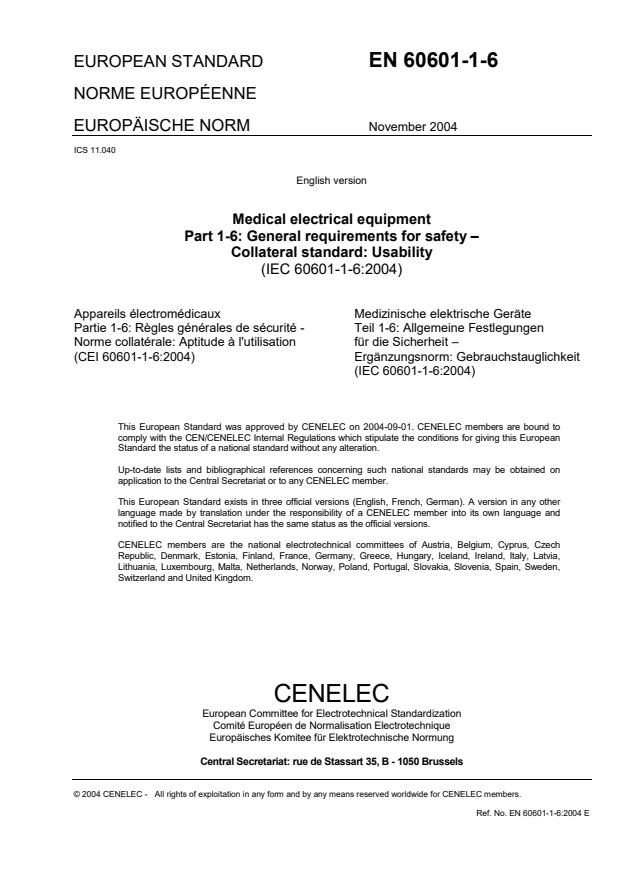
EUROPEAN STANDARD EN 60601-1-6
NORME EUROPÉENNE
EUROPÄISCHE NORM November 2004
ICS 11.040
English version
Medical electrical equipment
Part 1-6: General requirements for safety –
Collateral standard: Usability
(IEC 60601-1-6:2004)
Appareils électromédicaux Medizinische elektrische Geräte
Partie 1-6: Règles générales de sécurité - Teil 1-6: Allgemeine Festlegungen
Norme collatérale: Aptitude à l'utilisation für die Sicherheit –
(CEI 60601-1-6:2004) Ergänzungsnorm: Gebrauchstauglichkeit
(IEC 60601-1-6:2004)
This European Standard was approved by CENELEC on 2004-09-01. CENELEC members are bound to
comply with the CEN/CENELEC Internal Regulations which stipulate the conditions for giving this European
Standard the status of a national standard without any alteration.
Up-to-date lists and bibliographical references concerning such national standards may be obtained on
application to the Central Secretariat or to any CENELEC member.
This European Standard exists in three official versions (English, French, German). A version in any other
language made by translation under the responsibility of a CENELEC member into its own language and
notified to the Central Secretariat has the same status as the official versions.
CENELEC members are the national electrotechnical committees of Austria, Belgium, Cyprus, Czech
Republic, Denmark, Estonia, Finland, France, Germany, Greece, Hungary, Iceland, Ireland, Italy, Latvia,
Lithuania, Luxembourg, Malta, Netherlands, Norway, Poland, Portugal, Slovakia, Slovenia, Spain, Sweden,
Switzerland and United Kingdom.
CENELEC
European Committee for Electrotechnical Standardization
Comité Européen de Normalisation Electrotechnique
Europäisches Komitee für Elektrotechnische Normung
Central Secretariat: rue de Stassart 35, B - 1050 Brussels
© 2004 CENELEC - All rights of exploitation in any form and by any means reserved worldwide for CENELEC members.
Ref. No. EN 60601-1-6:2004 E
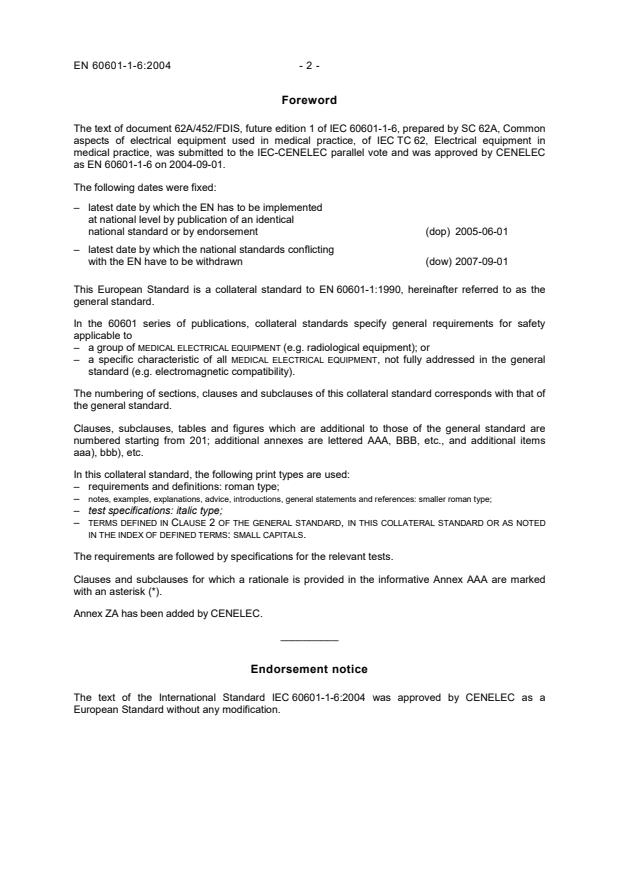
Foreword
The text of document 62A/452/FDIS, future edition 1 of IEC 60601-1-6, prepared by SC 62A, Common
aspects of electrical equipment used in medical practice, of IEC TC 62, Electrical equipment in
medical practice, was submitted to the IEC-CENELEC parallel vote and was approved by CENELEC
as EN 60601-1-6 on 2004-09-01.
The following dates were fixed:
– latest date by which the EN has to be implemented
at national level by publication of an identical
national standard or by endorsement (dop) 2005-06-01
– latest date by which the national standards conflicting
with the EN have to be withdrawn (dow) 2007-09-01
This European Standard is a collateral standard to EN 60601-1:1990, hereinafter referred to as the
general standard.
In the 60601 series of publications, collateral standards specify general requirements for safety
applicable to
– a group of MEDICAL ELECTRICAL EQUIPMENT (e.g. radiological equipment); or
– a specific characteristic of all MEDICAL ELECTRICAL EQUIPMENT, not fully addressed in the general
standard (e.g. electromagnetic compatibility).
The numbering of sections, clauses and subclauses of this collateral standard corresponds with that of
the general standard.
Clauses, subclauses, tables and figures which are additional to those of the general standard are
numbered starting from 201; additional annexes are lettered AAA, BBB, etc., and additional items
aaa), bbb), etc.
In this collateral standard, the following print types are used:
– requirements and definitions: roman type;
– notes, examples, explanations, advice, introductions, general statements and references: smaller roman type;
– test specifications: italic type;
– TERMS DEFINED IN CLAUSE 2 OF THE GENERAL STANDARD, IN THIS COLLATERAL STANDARD OR AS NOTED
IN THE INDEX OF DEFINED TERMS: SMALL CAPITALS.
The requirements are followed by specifications for the relevant tests.
Clauses and subclauses for which a rationale is provided in the informative Annex AAA are marked
with an asterisk (*).
Annex ZA has been added by CENELEC.
__________
Endorsement notice
The text of the International Standard IEC 60601-1-6:2004 was approved by CENELEC as a
European Standard without any modification.
- 3 - EN 60601-1-6:2004
In the official version, for Bibliography, the following notes have to be added for the standard indicated:
ISO 9000 NOTE Harmonized as EN ISO 9000:2000 (not modified)
ISO 9001 NOTE Harmonized as EN ISO 9001:2000 (not modified)
ISO 9241-11 NOTE Harmonized as EN ISO 9241-11:1998 (not modified)
ISO 13485 NOTE Harmonized as EN ISO 13485:2003 (not modified)
__________
Annex ZA
(normative)
Normative references to international publications
with their corresponding European publications
The following referenced documents are indispensable for the application of this document. For dated
references, only the edition cited applies. For undated references, the latest edition of the referenced
document (including any amendments) applies.
NOTE Where an international publication has been modified by common modifications, indicated by (mod), the relevant
EN/HD applies.
Publication Year Title EN/HD Year
IEC 60601-1 1988 Medical electrical equipment EN 60601-1 1990
Part 1: General requirements for safety + Corr. Juli 1994
A1 1991 A1 1993
+ Corr. Juli 1994
A2 1995
+ corr. June 1995 A2 1995
A13 1996
IEC 60601-1-8 2003 Medical electrical equipment EN 60601-1-8 2004
Part 1-8: General requirements for safety
- Collateral standard: General
requirements, tests and guidance for
alarm systems in medical electrical
equipment and medical electrical systems
ISO 14971 2000 Medical devices - Application of risk EN ISO 14971 2000
management to medical devices + corr. February 2002
A1 2003 A1 2003
NORME CEI
INTERNATIONALE
IEC
60601-1-6
INTERNATIONAL
Première édition
STANDARD
First edition
2004-06
Appareils électromédicaux –
Partie 1-6:
Règles générales de sécurité –
Norme collatérale: Aptitude à l'utilisation
Medical electrical equipment –
Part 1-6:
General requirements for safety –
Collateral Standard: Usability
IEC 2004 Droits de reproduction réservés Copyright - all rights reserved
Aucune partie de cette publication ne peut être reproduite ni No part of this publication may be reproduced or utilized in any
utilisée sous quelque forme que ce soit et par aucun procédé, form or by any means, electronic or mechanical, including
électronique ou mécanique, y compris la photocopie et les photocopying and microfilm, without permission in writing from
microfilms, sans l'accord écrit de l'éditeur. the publisher.
International Electrotechnical Commission, 3, rue de Varembé, PO Box 131, CH-1211 Geneva 20, Switzerland
Telephone: +41 22 919 02 11 Telefax: +41 22 919 03 00 E-mail: inmail@iec.ch Web: www.iec.ch
CODE PRIX
XB
PRICE CODE
Commission Electrotechnique Internationale
International Electrotechnical Commission
МеждународнаяЭлектротехническаяКомиссия
Pour prix, voir catalogue en vigueur
For price, see current catalogue
60601-1-6 IEC:2004 – 3 –
CONTENTS
FOREWORD.7
INTRODUCTION.11
SECTION ONE – GENERAL
1 Scope and object.13
1.201 Scope.13
1.202 Relationship to other standards.13
1.202.1 IEC 60601-1 .13
1.202.2 Particular Standards .13
1.202.3 Normative references.13
2 Terminology and definitions.15
3 General requirements .19
6 Identification, markings and documents .19
6.8 ACCOMPANYING DOCUMENTS .19
6.8.1 General .19
6.8.2 Instructions for use .19
6.8.201 TRAINING and materials for TRAINING .19
SECTIONS TWO TO SIX – NOT USED
SECTION SEVEN – PROTECTION AGAINST EXCESSIVE TEMPERATURES AND
OTHER SAFETY HAZARDS
46* USE ERROR and USABILITY.21
46.201 SAFETY for the PATIENT, OPERATOR and other persons .21
46.202 USABILITY ENGINEERING PROCESS.21
46.202.1 General.21
46.202.2 Input for the USABILITY ENGINEERING PROCESS.23
46.202.3 USABILITY SPECIFICATION .25
46.202.4 USABILITY VERIFICATION .27
46.202.5 USABILITY VALIDATION plan .27
46.202.6 USABILITY VALIDATION.27
SECTION EIGHT TO TEN – NOT USED
Annex AAA (informative) General guidance and rationale .29
Annex BBB (informative) A Taxonomy of OPERATOR action.41
Annex CCC (informative) Examples of USE ERRORS, ABNORMAL USE and design flaws
potentially leading to USE ERRORS .43
Annex DDD (informative) Guidance on the USABILITY ENGINEERING PROCESS .49
Annex EEE (informative) Sample USABILITY SPECIFICATION.107
Annex FFF (informative) Reference documents .125
60601-1-6 IEC:2004 – 5 –
Bibliography.143
Terminology – Index of defined terms .147
Figure BBB.1 – Summary of the taxonomy of OPERATOR action .41
Figure DDD.1 – An OPERATOR-EQUIPMENT INTERFACE design cycle.55
Figure DDD.2 – Bubble diagram of the conceptual model of a physiological monitor .85
Figure EEE.1 – Example of a USABILITY SPECIFICATION for a hypothetical device .107
Table DDD.1 – Sample of design flaws and associated USE ERRORS .53
Table DDD.2 – Mapping of Figure DDD.1 to the subclauses of this standard .55
Table DDD.3 – Examples of OPERATOR-EQUIPMENT INTERFACE requirements .63
Table DDD.4 – Typical deliverables .75
Table DDD.5 – Examples of objective and subjective USABILITY goals .83
Table DDD.6 – Examples of OPERATOR-EQUIPMENT INTERFACE modelling techniques .87
Table DDD.7 – Characteristics of a typical USABILITY testing effort .87
60601-1-6 IEC:2004 – 7 –
INTERNATIONAL ELECTROTECHNICAL COMMISSION
___________
MEDICAL ELECTRICAL EQUIPMENT –
Part 1-6: General requirements for safety –
Collateral Standard: Usability
FOREWORD
1) The International Electrotechnical Commission (IEC) is a worldwide organization for standardization comprising
all national electrotechnical committees (IEC National Committees). The object of IEC is to promote
international co-operation on all questions concerning standardization in the electrical and electronic fields. To
this end and in addition to other activities, IEC publishes International Standards, Technical Specifications,
Technical Reports, Publicly Available Specifications (PAS) and Guides (hereafter referred to as “IEC
Publication(s)”). Their preparation is entrusted to technical committees; any IEC National Committee interested
in the subject dealt with may participate in this preparatory work. International, governmental and non-
governmental organizations liaising with the IEC also participate in this preparation. IEC collaborates closely
with the International Organization for Standardization (ISO) in accordance with conditions determined by
agreement between the two organizations.
2) The formal decisions or agreements of IEC on technical matters express, as nearly as possible, an international
consensus of opinion on the relevant subjects since each technical committee has representation from all
interested IEC National Committees.
3) IEC Publications have the form of recommendations for international use and are accepted by IEC National
Committees in that sense. While all reasonable efforts are made to ensure that the technical content of IEC
Publications is accurate, IEC cannot be held responsible for the way in which they are used or for any
misinterpretation by any end user.
4) In order to promote international uniformity, IEC National Committees undertake to apply IEC Publications
transparently to the maximum extent possible in their national and regional publications. Any divergence
between any IEC Publication and the corresponding national or regional publication shall be clearly indicated in
the latter.
5) IEC provides no marking procedure to indicate its approval and cannot be rendered responsible for any
equipment declared to be in conformity with an IEC Publication.
6) All users should ensure that they have the latest edition of this publication.
7) No liability shall attach to IEC or its directors, employees, servants or agents including individual experts and
members of its technical committees and IEC National Committees for any personal injury, property damage or
other damage of any nature whatsoever, whether direct or indirect, or for costs (including legal fees) and
expenses arising out of the publication, use of, or reliance upon, this IEC Publication or any other IEC
Publications.
8) Attention is drawn to the Normative references cited in this publication. Use of the referenced publications is
indispensable for the correct application of this publication.
9) Attention is drawn to the possibility that some of the elements of this IEC Publication may be the subject of
patent rights. IEC shall not be held responsible for identifying any or all such patent rights.
International Standard IEC 60601-1-6 has been prepared by subcommittee 62A: Common
aspects of electrical equipment used in medical practice, of IEC technical committee 62:
Electrical equipment in medical practice.
This first edition constitutes a Collateral Standard to IEC 60601-1:1998, Medical electrical
equipment – Part 1: General requirements for safety, hereinafter referred to as the General
Standard.
60601-1-6 IEC:2004 – 9 –
The text of this Collateral Standard is based on the following documents:
FDIS Report of voting
62A/452/FDIS 62A/458/RVD
Full information on the voting for the approval of this Collateral Standard can be found in the
report on voting indicated in the above table.
In the 60601 series of publications, Collateral Standards specify general requirements for
safety applicable to:
– a subgroup of MEDICAL ELECTRICAL EQUIPMENT (e.g. radiological equipment); or
– a specific characteristic of all MEDICAL ELECTRICAL EQUIPMENT, not fully addressed in the
General Standard (e.g. electromagnetic compatibility).
The numbering of sections, clauses and subclauses of this Collateral Standard corresponds
with that of the General Standard.
Clauses, subclauses, tables and figures which are additional to those of the General Standard
are numbered starting from 201; additional annexes are lettered AAA, BBB, etc., and
additional items aaa), bbb), etc.
In this Collateral Standard, the following print types are used:
– requirements and definitions: roman type;
– notes, examples, explanations, advice, general statements and references: smaller roman type;
– test specifications: italic type; and
– TERMS DEFINED IN CLAUSE 2 OF THE GENERAL STANDARD OR IN THIS COLLATERAL STANDARD OR
AS NOTED IN THE INDEX OF DEFINED TERMS: SMALL CAPITALS.
The requirements are followed by specifications for the relevant tests.
Clause and subclauses for which a rationale is provided in informative Annex AAA are marked
with an asterisk (*).
The committee has decided that the contents of this publication will remain unchanged until
the maintenance result date indicated on the IEC web site under "http://webstore.iec.ch" in
the data related to the specific publication. At this date, the publication will be
• reconfirmed;
• withdrawn;
• replaced by a revised edition, or
• amended.
60601-1-6 IEC:2004 – 11 –
INTRODUCTION
Medical practice is increasingly using MEDICAL ELECTRICAL EQUIPMENT for observation and
treatment of PATIENTS. USE ERRORS caused by inadequate MEDICAL ELECTRICAL EQUIPMENT
USABILITY have become an increasing cause for concern. The USABILITY ENGINEERING PROCESS
is intended to achieve reasonable USABILITY, which in turn is intended to minimise USE ERRORS
and to minimise use associated RISKS. Some, but not all, forms of incorrect use are amenable
to control by the manufacturer. The USABILITY ENGINEERING PROCESS is part of the PROCESS of
RISK CONTROL.
This Collateral Standard describes a USABILITY ENGINEERING PROCESS, and provides guidance
on how to implement and execute the PROCESS to provide MEDICAL ELECTRICAL EQUIPMENT
SAFETY. It is intended to be useful not only for manufacturers of MEDICAL ELECTRICAL
EQUIPMENT, but also for technical committees responsible for the preparation of particular
standards.
60601-1-6 IEC:2004 – 13 –
MEDICAL ELECTRICAL EQUIPMENT –
Part 1-6: General requirements for safety –
Collateral Standard: Usability
SECTION ONE – GENERAL
1 Scope and object
1.201 Scope
This Collateral Standard specifies requirements for a PROCESS to analyse, design, verify and
validate the USABILITY, as it relates to SAFETY of MEDICAL ELECTRICAL EQUIPMENT, hereinafter
referred to as EQUIPMENT. This standard addresses NORMAL USE and USE ERRORS but excludes
ABNORMAL USE.
1.202 Relationship to other standards
1.202.1 IEC 60601-1
This Collateral Standard complements IEC 60601-1.
When referring to IEC 60601-1 or to this Collateral Standard, either individually or in
combination, the following conventions are used:
– “the General Standard” designates IEC 60601-1 alone;
– “this Collateral Standard” designates IEC 60601-1-6 alone;
– “this Standard” designates the combination of the General Standard and this Collateral
Standard.
1.202.2 Particular Standards
A requirement in a Particular Standard takes priority over the corresponding requirement in
this Collateral Standard.
1.202.3 Normative references
The following referenced documents are indispensable for the application of this document.
For dated references, only the edition cited applies. For undated references, the latest edition
of the referenced document (including any amendments) applies.
IEC 60601-1:1988, Medical electrical equipment – Part 1: General requirements for safety
Amendment 1 (1991)
Amendment 2 (1995)
IEC 60601-1-8:2003, Medical electrical equipment – Part 1-8: General requirements for safety
– Collateral standard: General requirements, tests and guidance for alarm systems in medical
electrical equipment and medical electrical systems
ISO 14971:2000, Medical devices – Application of risk management to medical devices
Amendment 1 (2003)
60601-1-6 IEC:2004 – 15 –
2 Terminology and definitions
For the purpose of this collateral standard, the terms and definitions given in Clause 2 of
IEC 60601-1:1988, as amended by the other collateral standards, Clause 3 of
ISO 14971:2000 and the following apply.
NOTE An Index of all defined terms used in this collateral standard is found at the end of the document.
2.201
ABNORMAL USE
intended act or intended omission of an act by the USER or OPERATOR of EQUIPMENT as a result
of conduct that is beyond any reasonable means of RISK CONTROL by the manufacturer
NOTE 1 See also Annex BBB. Examples are given in Annex CCC.
NOTE 2 It is possible for the PATIENT to be the OPERATOR, e.g. when EQUIPMENT is used in the PATIENT’S home.
NOTE 3 ABNORMAL USE is not considered REASONABLY FORESEABLE MISUSE.
2.202
EFFECTIVENESS
accuracy and completeness with which OPERATORS achieve specified goals
[ISO 9241-11:1998, definition 3.2, modified]
2.203
EFFICIENCY
resources expended in relation to the accuracy and completeness with which OPERATORS
achieve goals
[ISO 9241-11:1998, definition 3.3 modified]
2.204
* OPERATOR-EQUIPMENT INTERFACE
means by which the OPERATOR and the EQUIPMENT communicate
[ANSI/AAMI/HE 74:2001, definition 3.24 modified]
NOTE The ACCOMPANYING DOCUMENTS are considered part of the EQUIPMENT and the OPERATOR-EQUIPMENT
INTERFACE.
2.205
OPERATOR PROFILE
summary of the mental, physical and demographic traits of the intended OPERATOR population,
as well as any special characteristics that can have a bearing on design decisions, such as
occupational skills and job requirements
2.206
* PRIMARY OPERATING FUNCTION
function that involves OPERATOR interaction that is either frequently used or related to the
SAFETY of the EQUIPMENT in NORMAL USE
2.207
* REASONABLY FORESEEABLE MISUSE
use by the OPERATOR in a way not intended by the manufacturer but which can result from
readily predictable human behaviour
[ISO/IEC Guide 51:1999, definition 3.14, modified]
NOTE 1 REASONABLY FORESEEABLE MISUSE is an intended action.
60601-1-6 IEC:2004 – 17 –
NOTE 2 Use refers to a product, PROCESS or service.
NOTE 3 Slips, lapses, mistakes and ABNORMAL USE can also be reasonably foreseeable, but are not considered
REASONABLY FORESEEABLE MISUSE.
NOTE 4 See also Annex BBB.
2.208
TRAINING
application-specific OPERATOR-oriented instruction or exercises required for the safe and
effective use of the EQUIPMENT
2.209
USE ERROR
act or omission of an act that has a different EQUIPMENT response than intended by the
manufacturer or expected by the OPERATOR
NOTE 1 USE ERROR includes slips, lapses, mistakes, and REASONABLY FORESEEABLE MISUSE.
NOTE 2 See also Annex BBB and DDD.1.3.
NOTE 3 The physiological response of the PATIENT is not considered part of USE ERROR.
2.210
USE SCENARIO
sequence of events and tasks used to specify and test the USABILITY of the EQUIPMENT
2.211
* USABILITY
Characteristic that establishes EFFECTIVENESS, EFFICIENCY and OPERATOR learnability and
satisfaction
2.212
USABILITY ENGINEERING
application of knowledge about human behaviour, abilities, limitations, and other
characteristics to the design of tools, machines, EQUIPMENT, devices, systems, tasks, jobs,
and environments to achieve adequate USABILITY
2.213
USABILITY ENGINEERING FILE
*
set of RECORDS and other documents that are produced by USABILITY ENGINEERING activities
2.214
USABILITY SPECIFICATION
documentation defining the OPERATOR-EQUIPMENT INTERFACE requirements related to USABILITY
2.215
VALIDATION
confirmation, through the provision of objective evidence, that the requirements for a specific
intended use or application have been fulfilled
NOTE 1 The term “validated” is used to designate the corresponding status.
NOTE 2 The use conditions for VALIDATION can be real or simulated.
[ISO 9000:2000, definition 3.8.5]
60601-1-6 IEC:2004 – 19 –
3 General requirements
3.1 Addition:
* The EQUIPMENT shall provide adequate USABILITY such that the RISKS resulting from NORMAL
USE and USE ERRORS are acceptable.
6 Identification, markings and documents
6.8 ACCOMPANYING DOCUMENTS
6.8.1 * General
Addition:
A brief description of the EQUIPMENT, its physical operating principles and significant physical
and performance characteristics relevant to its USABILITY, shall be included in the instructions
for use. The same information shall also be included in the technical description, if this is
provided as a separate document.
ACCOMPANYING DOCUMENTS for EQUIPMENT may be provided electronically, e.g. by electronic
file format or CD-ROM. If the ACCOMPANYING DOCUMENTS are provided electronically, the
USABILITY ENGINEERING PROCESS shall include consideration of which information also needs to
be provided as hard copy or as markings on the EQUIPMENT, e.g. to cover emergency
operation.
The ACCOMPANYING DOCUMENTS shall include a description of the OPERATOR PROFILE. The
ACCOMPANYING DOCUMENTS shall be written at a level consistent with the intended OPERATOR
PROFILE.
Compliance is checked by inspection of the ACCOMPANYING DOCUMENTS and the USABILITY
ENGINEERING FILE.
6.8.2 Instructions for use
Addition:
6.8.201 * TRAINING and materials for TRAINING
If EQUIPMENT specific TRAINING is required for the PRIMARY OPERATING FUNCTIONS of the
EQUIPMENT, the manufacturer shall:
– provide the necessary materials for TRAINING;
– ensure that these materials are available; or
– provide the TRAINING.
NOTE 1 EQUIPMENT-specific TRAINING provides the knowledge and skills required for safe and effective use of
EQUIPMENT in addition to the OPERATOR PROFILE.
The INTENDED USE/INTENDED PURPOSE shall be the basis for TRAINING and TRAINING material.
The instructions for use shall indicate whether specific TRAINING for this EQUIPMENT is required
and shall indicate the available TRAINING options.
1)
NOTE 2 See IEC 61258 [1] .
———————
) Figures in brackets refer to the Bibliography.
60601-1-6 IEC:2004 – 21 –
SECTIONS TWO TO SIX – NOT USED
SECTION SEVEN – PROTECTION AGAINST EXCESSIVE TEMPERATURES
AND OTHER SAFETY HAZARDS
Replacement (title):
46 * USE ERROR and USABILITY
46.201 * SAFETY for the PATIENT, OPERATOR and other persons
A USABILITY ENGINEERING PROCESS shall be conducted to provide SAFETY for the PATIENT,
OPERATOR and other persons related to USABILITY of the OPERATOR-EQUIPMENT INTERFACE.
NOTE 1 To guide the application of USABILITY ENGINEERING principles, the HAZARDS to PATIENTS, OPERATORS and
other persons as listed in ISO 14971 should be considered.
NOTE 2 The following are examples of HAZARDS for the PATIENT:
– unintentional setting of the diagnostic or therapeutic EQUIPMENT, e.g. inappropriate X-ray exposure setting
requiring an additional exposure;
– unintentional interruption of delivery of therapy;
– misinterpretation of displayed values followed by an inappropriate treatment;
– confusing data presentation contributing to mental fatigue resulting in increased USE ERROR.
NOTE 3 The following are examples of HAZARDS for the OPERATOR:
– poor anthropometric design leading to musculoskeletal injury;
– repetitive-motion resulting in nerve/tendon injuries;
– poor display contrast resulting in eye fatigue;
– loud noise emanating from the EQUIPMENT resulting in hearing impairment.
Compliance with this subclause is considered to exist when compliance with the other clauses
and subclauses is demonstrated.
46.202 USABILITY ENGINEERING PROCESS
46.202.1 General
The results of the USABILITY ENGINEERING PROCESS shall be recorded in the USABILITY
ENGINEERING FILE. The USABILITY ENGINEERING PROCESS may vary in form and extent based on
the nature of the EQUIPMENT, its intended OPERATOR and its INTENDED USE/INTENDED PURPOSE
(see DDD.3.2). The records and other documents that make up the USABILITY ENGINEERING
FILE may form part of other documents and files, e.g. a manufacturer’s product file or RISK
MANAGEMENT FILE.
In the case of the modification of existing EQUIPMENT design, the USABILITY ENGINEERING
PROCESS may be scaled based on the significance of the modification depending on the
results of the RISK ANALYSIS (see DDD.3.2.2).
NOTE 1 The manufacturer should conduct iterative design and development. USABILITY ENGINEERING should begin
early and continue through the EQUIPMENT design and development lifecycle.
NOTE 2 Due to the iterative nature of the USABILITY ENGINEERING PROCESS, the activities described in the following
subclauses may be carried out in any convenient order (see DDD.2).
Compliance is checked by inspection of the USABILITY ENGINEERING FILE.
60601-1-6 IEC:2004 – 23 –
46.202.2 Input for the USABILITY ENGINEERING PROCESS
46.202.2.1 * EQUIPMENT application specification
The manufacturer shall specify the application of the EQUIPMENT in the USABILITY ENGINEERING
FILE.
This specification shall include:
– medical purpose (e.g. conditions(s) or disease(s) to be screened, monitored, treated, or
diagnosed);
– PATIENT population (e.g. age, weight, region of body, health, condition);
– part of the body or type of tissue applied to or interacted with;
– * intended OPERATOR PROFILE; and
– application (e.g. environment, frequency of use, location, mobility).
NOTE This specification contains elements of the INTENDED USE/INTENDED PURPOSE.
A summary of the EQUIPMENT application specification shall be included in the instructions for
use.
Compliance is checked by inspection of the USABILITY ENGINEERING FILE and the instructions
for use.
46.202.2.2 PRIMARY OPERATING FUNCTIONS
The manufacturer shall determine the PRIMARY OPERATING FUNCTIONS and record them in the
USABILITY ENGINEERING FILE.
NOTE 1 See also DDD.5.2, DDD.5.4, DDD.5.8, DDD.5.9 and DDD.5.13 for a discussion of methods that might be
useful in determining PRIMARY OPERATING FUNCTIONS.
NOTE 2 PRIMARY OPERATING FUNCTIONS should be easily recognizable and self-explanatory to the OPERATOR.
NOTE 3 See element 1.2 of Figure EEE.1 for an example of PRIMARY OPERATING FUNCTIONS for a hypothetical
EQUIPMENT.
Compliance is checked by inspection of the USABILITY ENGINEERING FILE.
46.202.2.3 * RISK ANALYSIS
A RISK ANALYSIS or part of a RISK ANALYSIS that focuses on USABILITY shall be performed
according to Clause 4 of ISO 14971:2000. The term and definition of “medical device” in
ISO 14971:2000 shall be replaced by the defined term EQUIPMENT. During the RISK ANALYSIS
the following shall be considered:
– application specification (see 46.202.2.1);
– OPERATOR PROFILE;
– predictable USE ERRORS (see Annex CCC for a list of predictable USE ERRORS);
– * task related requirements;
– * context of use;
– information on HAZARDS known for existing OPERATOR-EQUIPMENT INTERFACES for
EQUIPMENT of a similar type, if available;
OPERATOR-EQUIPMENT INTERFACE (see DDD.2.2 in this
– results of the review of the
document and D.7 of ISO 14971:2000).
60601-1-6 IEC:2004 – 25 –
For RISK CONTROL related to USABILITY, the manufacturer shall decide what information is
required for SAFETY, e.g. warnings or limitation of use in the ACCOMPANYING DOCUMENTS,
marking, etc. Any such information shall be subject to the USABILITY ENGINEERING PROCESS.
Disregarding this information shall be considered ABNORMAL USE. See also Annex BBB.
NOTE 1 RISK CONTROL consists of an integrated approach in which the manufacturer uses one or more of the
following in the priority listed:
a) inherent SAFETY by design;
b) protective measures in the EQUIPMENT itself or in the manufacturing PROCESS, e.g. ALARM SYSTEMS;
c) information for SAFETY, e.g. warnings in the instructions for use, display of a monitored variable.
The results of this RISK ANALYSIS or a reference to the location of the results of this RISK
ANALYSIS shall be recorded in the USABILITY ENGINEERING FILE.
NOTE 2 The RISK ANALYSIS for the EQUIPMENT or for the corresponding generic device type is an input for the
USABILITY SPECIFICATION as required for the USABILITY ENGINEERING PROCESS. Any RESIDUAL RISK evaluation should
consider the results of the USABILITY VALIDATION.
NOTE 3 The evaluation of post-production information (post-market surveillance) should include USABILITY (see
ISO 14971:2000, Clause 9).
Compliance is checked by inspection of the USABILITY ENGINEERING FILE.
46.202.3 USABILITY SPECIFICATION
As part of the USABILITY ENGINEERING PROCESS, the manufacturer shall develop a USABILITY
SPECIFICATION. The USABILITY SPECIFICATION shall be recorded in USABILITY ENGINEERING FILE.
The USABILITY SPECIFICATION may be integrated into other specifications.
The USABILITY SPECIFICATION shall be based on the following:
– application specification (see 46.202.2.1);
– HAZARDS related to the use of the EQUIPMENT (results from RISK ANALYSIS as described in
46.202.2.3); and
– predictable USE ERRORS associated with the EQUIPMENT.
The USABILITY SPECIFICATION shall describe at least:
– * USE SCENARIOS for the EQUIPMENT;
– OPERATOR actions related to the PRIMARY OPERATING FUNCTIONS;
– OPERATOR-EQUIPMENT INTERFACE requirements for the PRIMARY OPERATING FUNCTIONS; and
– requirements for determining whether PRIMARY OPERATING FUNCTIONS are easily
recognizable by the OPERATOR.
NOTE 1 The USABILITY SPECIFICATION should include references to context of use (see AAA.46.202.2.3 and
DDD.4.1.2.4).
NOTE 2 For guidance, see DDD.2.6.
NOTE 3 See Annex EEE for an example of a USABILITY SPECIFICATION for hypothetical EQUIPMENT.
Compliance is checked by inspection of the USABILITY ENGINEERING FILE.
60601-1-6 IEC:2004 – 27 –
46.202.4 * USABILITY VERIFICATION
As part of the EQUIPMENT design VERIFICATION PROCESS, the manufacturer shall verify the
OPERATOR-EQUIPMENT interface design according to the USABILITY SPECIFICATION. The results of
the VERIFICATION shall be recorded in USABILITY ENGINEERING FILE.
Compliance is checked by inspection of the USABILITY ENGINEERING FILE.
46.202.5 USABILITY VALIDATION plan
The manufacturer shall develop and maintain a USABILITY VALIDATION plan. The USABILITY
VALIDATION plan shall specify:
– any method used for VALIDATION of the USABILITY of the PRIMARY OPERATING FUNCTIONS;
– the criteria for determining successful VALIDATION of the USABILITY of the PRIMARY
OPERATING FUNCTIONS (see Table DDD.5); and
– the involvement of representative intended OPERATORS (see DDD.4.3.2).
USABILITY VALIDATION methods may be quantitative or qualitative. USABILITY VALIDATION may be
performed in a laboratory setting, in a simulated use environment or in the actual use
environment.
NOTE 1 The manufacturer should apply one or more methods for the USABILITY VALIDATION of PRIMARY OPERATING
FUNCTIONS of the EQUIPMENT depending on the INTENDED USE/INTENDED PURPOSE. Examples of these methods are
found in Clause DDD.5.
NOTE 2 Findings based on any single method can be insufficient, e.g. in a clinical evaluation it might not be
possible to explore some high-RISK situations.
The USABILITY VALIDATION plan shall address:
– worst case USE SCENARIOS derived from:
• the application specification (see 46.202.2.1),
• predictable USE ERRORS, and
• the results of the RISK ANALYSIS; and
– USE SCENARIOS representing frequent application situations identified in the USABILITY
SPECIFICATION.
The USABILITY VALIDATION plan shall be recorded in the USABILITY ENGINEERING FILE.
Compliance is checked by inspection of the USABILITY ENGINEERING FILE.
46.202.6 * USABILITY VALIDATION
The manufacturer shall validate OPERATOR-EQUIPMENT INTERFACE design according to the
USABILITY VALIDATION plan. The results shall be recorded, including any required design
modification needed to satisfy the criteria as defined in the USABILITY VALIDATION plan.
NOTE 1 The ACCOMPANYING DOCUMENTS are part of the EQUIPMENT and are also subject to activities for validating
USABILITY.
NOTE 2 Individuals that were not directly involved in the OPERATOR-EQUIPMENT INTERFACE design should be
involved in the USABILITY VALIDATION.
Compliance is checked by inspection of the USABILITY ENGINEERING FILE.
SECTIONS EIGHT TO TEN – NOT USED
60601-1-6 IEC:2004 – 29 –
Annex AAA
(informative)
General guidance and rationale
AAA.0 General
This annex provides a concise rationale for the important requirements of this Collateral
Standard. Its purpose is to promote effective application of the standard by explaining the
reasons for the requirements and provide additional guidance where appropriate.
AAA.2.204 OPERATOR-EQUIPMENT INTERFACE
The OPERATOR-EQUIPMENT INTERFACE includes all means of communication between the
EQUIPMENT to the OPERATOR and the OPERATOR to the EQUIPMENT. These means include, but
are not limited to:
– markings and ACCOMPANYING DOCUMENTS;
– lights;
– video displays;
– push buttons;
– touch screens;
– auditory and visual INFORMATION SIGNALS;
– ALARM SIGNALS;
– vibratory signals;
– keyboard and mouse; and
– haptic controls.
AAA.2.206 PRIMARY OPERATING FUNCTION
For the purposes of this Collateral Standard, a PRIMARY OPERATING FUNCTION is a function that
is directly related to the SAFETY of the EQUIPMENT in NORMAL USE or a function that is
frequently used. Examples of PRIMARY OPERATING FUNCTION that directly relate to SAFETY
include:
– inactivating an ALARM SIGNAL (temporarily or indefinitely);
– setting ALARM LIMITS;
– setting X-ray exposure parameters (e.g. kV , mA);
p
– setting infusion parameters (e.g. flow rate);
– setting gas flow rates and anaesthetic vaporizer concentration.
Frequently used functions are included in the PRIMARY OPERATING FUNCTIONS because
inadequate USABILITY of the frequently used functions adds to OPERATORS’ workloads and can
increase the probability of USE ERRORS affecting SAFETY-related functions. A collection of
relatively minor shortcomings in the design of OPERATOR-EQUIPMENT INTERFACES can raise the
probability of USE ERRORS and their consequences, particularly when they involve frequently
used functions. Examples of such shortcomings include poor labelling, ambiguous control-
display relationships, difficult to read indicators, connectors that lack the proper shape coding,
60601-1-6 IEC:2004 – 31 –
inconsistent software navigation methods, etc. At a minimum, these shortcomings can
increase the time required to learn to use the EQUIPMENT and increase the time required to
perform frequent tasks due to an overall increase in mental and physical workload. At worse,
these shortcomings can induce USE ERROR because OPERATORS have to focus more attention
on operational mechanics, taking attention away from higher-level considerations directly
related to PATIENT SAFETY. As workload increases, there is generally an increased chance of
errors of various types. There is less time to check one's work, less time to consider all
variables and a greater chance of imprecision and blundering due to rushing. Accordingly, it
makes sense to review all functions, particularly the most frequent ones, and determine if
there could be a problem due to the cumulative effect of USABILITY ENGINEERING deficiencies
that could have a negative impact on SAFETY.
AAA.2.207 REASONABLY FORESEEABLE MISUSE
There is often a thin line between ABNORMAL USE and REASONABLY FORESEEABLE MISUSE. What
might look to be a case of ABNORMAL USE can later turn out to be REASONABLY FORESEEABLE
MISUSE after investigation and closer examination by experts trained in the USABILITY
ENGINEERING PROCESS and the science of human error. The RISK MANAGEMENT PROCESS of
EQUIPMENT defines within the context of that particular EQUIPMENT what is REASONABLY
FORESEEABLE MISUSE and what is ABNORMAL USE, and documents what RISK CONTROL measures
have been taken to mitigate the REASONABLY FORESEEABLE MISUSE.
A manufacturer needs to exercise judgement in selecting the appropriate RISK CONTROL
measure to avoid unnecessarily limiting the practice of medicine. EQUIPMENT should not
arbitrarily prevent off-label use that does not present a SAFETY HAZARD, e.g. preventing the
use of EQUIPMENT for a PATIENT population because efficacy data does not exist. In such a
case, using a protective measure in the EQUIPMENT is more appropriate, e.g. a warning
message or pop-up window on the display.
The USABILITY ENGINEERING PROCESS helps discover which actions are “readily predictable.”
AAA.2.211 USABILITY
The time needed to become acquainted with the EQUIPMENT and its operation is called
“learnability” (ISO 9241-11:1998, Table B.2). Freedom from discomfort, and positive attitude
towards the use of the EQUIPMENT is called “satisfaction” (ISO 9241-11:1998, definition 3.4).
NOTE HOW easy it is to remember the operational details of EQUIPMENT can be thought of as
“memorizability” [10].
USABILITY is a measure of the EFFECTIVENESS, EFFICIENCY, and satisfaction with which
specified OPERATORS achieve specified goals in particular environments, within the scope of
the INTENDED USE/INTENDED PURPOSE of the EQUIPMENT. Many of these factors can influence
SAFETY to various extents.
To gauge if EQUIPMENT exhibits adequate USABILITY, specifications for the following influencing
factors are required:
– OPERATOR;
– task/goals; and
– conditions and setting in which the OPERATOR interacts with the EQUIPMENT.
60601-1-6 IEC:2004 – 33 –
This is because a change in a single factor could change the USABILITY significantly.
EXAMPLE An AC/battery-powered ECG monitor that works perfectly well in the relatively protected environment
of an ICU ward could exhibit severe drawbacks in USABILITY if it were to be used outside at night. This is a change
in the conditions and setting. In the new location of use, the influencing factors vary for:
– power up/pre-check needs;
– ambient light (night, bright sunlight), reflections; or
– requirements for handling, transportation, weight.
Some OPERATOR-EQUIPMENT INTERFACES contribute to USE ERROR because they employ non-
intuitive or counter-intuitive displays or controls. The consequences of such design flaws
often only become apparent when the OPERATOR is using the EQUIPMENT in an emergency or
stressful situation, is fatigued, or uses the EQUIPMENT only rarely.
AAA.2.213 USABILITY ENGINEERING FILE
The USABILITY ENGINEERING FILE can be part of the RISK MANAGEMENT FILE. There is no
requirement for the USABILITY ENGINEERING FILE to be independently stored from the RISK
MANAGEMENT FILE. The USABILITY ENGINEERING FILE need not physically contain all the records
and other documents produced by USABILITY ENGINEERING activities. However, it should
contain at least references or pointers to all required documentation.
AAA.3.1
This Collateral Standard specifies requirements addressing particular RISKS associated with
USABI
...
Questions, Comments and Discussion
Ask us and Technical Secretary will try to provide an answer. You can facilitate discussion about the standard in here.
Loading comments...