

EN 60601-1:2006/A13:2024
(Amendment)Medical electrical equipment - Part 1: General requirements for safety
General Information
- Abstract
Contains requirements concerning basic safety and essential performance that are generally applicable to medical electrical equipment. For certain types of medical electrical equipment, these requirements are either supplemented or modified by the special requirements of a collateral or particular standard. Where particular standards exist, this standard should not be used alone. The contents of the corrigenda of December 2006, of July 2007, the interpretation sheet 1 of April 2008, the interpretation sheet 2 of January 2009 and the interpretation sheet 2 of May 2013 have been included in this copy.
- Status
- Published
- Publication Date
- 18-Apr-2024
- Technical Committee
- CLC/TC 62 - Electrical equipment in medical practice
- Current Stage
- 6060 - Document made available - Publishing
- Start Date
- 19-Apr-2024
- Due Date
- 01-Jun-2025
- Completion Date
- 19-Apr-2024

Overview
EN 60601-1:2006/A13:2024 is a CENELEC amendment to the European adoption of IEC 60601‑1 that updates the general safety and essential performance requirements for medical electrical equipment. Approved 28 Feb 2024, this amendment A13 modifies EN 60601‑1:2006 and earlier amendments (A1:2013, A2:2021) and incorporates earlier corrigenda and interpretation sheets. It is normative for national implementation (dop 2025‑02‑28) and aligns with EU regulatory expectations (see Annex ZZ relating to Regulation (EU) 2017/745).
Key topics and technical requirements
This amendment focuses on topics that are generally applicable across medical electrical equipment rather than device‑specific provisions. Key areas include:
- Basic safety and essential performance expectations that form the baseline for device design and testing.
- Integration with risk management processes and normative references that shape testing and evaluation.
- Updated normative references (Annex ZA) linking EN 60601‑1 to collateral standards such as:
- EMC and immunity testing (EN 60601‑1‑2)
- Usability/ergonomics (EN 60601‑1‑6)
- Radiation protection for X‑ray equipment (EN 60601‑1‑3)
- Alarm system requirements (EN 60601‑1‑8)
- Biological evaluation and materials (ISO/EN ISO 10993 series)
- Battery and electrical component safety (IEC 62133, IEC 60065, etc.)
- Replacement and clarification of European annexes (ZA, ZZA, ZZB) to reflect current harmonisation and regulatory mapping.
Note: where particular (collateral or particular) standards exist for a specific device type, EN 60601‑1/A13 is to be used together with those standards rather than alone.
Practical applications and who uses it
EN 60601‑1:2006/A13:2024 is essential for:
- Medical device manufacturers designing, developing or updating electrical medical devices to meet European market requirements.
- Regulatory and compliance teams preparing technical documentation and conformity assessments for CE marking under the EU MDR.
- Test laboratories and certification bodies conducting safety, EMC and performance assessments.
- Notified Bodies and auditors assessing compliance with General Safety and Performance Requirements (GSPRs).
- Hospital biomedical engineers and procurement teams who evaluate device safety and suitability.
Using this amendment helps demonstrate alignment with European harmonised standards and supports regulatory conformity, product safety, and market access.
Related standards
EN 60601‑1:2006/A13 references many collateral and international standards (see Annex ZA) including EN 60601‑1‑2, EN 60601‑1‑6, EN ISO 10993 series, IEC 62133, IEC 60320‑1 and others that address EMC, usability, biocompatibility, batteries and component safety. These related standards should be consulted together with EN 60601‑1/A13 for full compliance.
Relations
- Effective Date
- 09-Feb-2026
- Effective Date
- 09-Feb-2026
- Effective Date
- 09-Feb-2026
- Effective Date
- 14-Feb-2023
Get Certified
Connect with accredited certification bodies for this standard

BSI Group
BSI (British Standards Institution) is the business standards company that helps organizations make excellence a habit.

TÜV Rheinland
TÜV Rheinland is a leading international provider of technical services.

TÜV SÜD
TÜV SÜD is a trusted partner of choice for safety, security and sustainability solutions.
Sponsored listings
Frequently Asked Questions
EN 60601-1:2006/A13:2024 is a amendment published by CLC. Its full title is "Medical electrical equipment - Part 1: General requirements for safety". This standard covers: Contains requirements concerning basic safety and essential performance that are generally applicable to medical electrical equipment. For certain types of medical electrical equipment, these requirements are either supplemented or modified by the special requirements of a collateral or particular standard. Where particular standards exist, this standard should not be used alone. The contents of the corrigenda of December 2006, of July 2007, the interpretation sheet 1 of April 2008, the interpretation sheet 2 of January 2009 and the interpretation sheet 2 of May 2013 have been included in this copy.
Contains requirements concerning basic safety and essential performance that are generally applicable to medical electrical equipment. For certain types of medical electrical equipment, these requirements are either supplemented or modified by the special requirements of a collateral or particular standard. Where particular standards exist, this standard should not be used alone. The contents of the corrigenda of December 2006, of July 2007, the interpretation sheet 1 of April 2008, the interpretation sheet 2 of January 2009 and the interpretation sheet 2 of May 2013 have been included in this copy.
EN 60601-1:2006/A13:2024 is classified under the following ICS (International Classification for Standards) categories: 11.040 - Medical equipment. The ICS classification helps identify the subject area and facilitates finding related standards.
EN 60601-1:2006/A13:2024 has the following relationships with other standards: It is inter standard links to EN 1789:2007+A1:2010, EN 13718-1:2014, EN 13718-1:2008, EN 60601-1:2006. Understanding these relationships helps ensure you are using the most current and applicable version of the standard.
EN 60601-1:2006/A13:2024 is associated with the following European legislation: EU Directives/Regulations: 2017/745; Standardization Mandates: M/575, M/575 Amd 1, M/575 Amd 1, M/575 Amd 2, M/575 Amd 2. When a standard is cited in the Official Journal of the European Union, products manufactured in conformity with it benefit from a presumption of conformity with the essential requirements of the corresponding EU directive or regulation.
EN 60601-1:2006/A13:2024 is available in PDF format for immediate download after purchase. The document can be added to your cart and obtained through the secure checkout process. Digital delivery ensures instant access to the complete standard document.
Standards Content (Sample)
SLOVENSKI STANDARD
01-junij-2024
Medicinska električna oprema - 1. del: Splošne zahteve za varnost - Dopolnilo A13
Medical electrical equipment - Part 1: General requirements for safety
Medizinische elektrische Geräte - Teil 1: Allgemeine Festlegungen für die Sicherheit
einschließlich der wesentlichen Leistungsmerkmale
Appareils électromédicaux - Partie 1: Exigences générales pour la sécurité de base et
les performances essentielles
Ta slovenski standard je istoveten z: EN 60601-1:2006/A13:2024
ICS:
11.040.01 Medicinska oprema na Medical equipment in general
splošno
2003-01.Slovenski inštitut za standardizacijo. Razmnoževanje celote ali delov tega standarda ni dovoljeno.
EUROPEAN STANDARD EN 60601-1:2006/A13
NORME EUROPÉENNE
EUROPÄISCHE NORM April 2024
ICS 11.040
English Version
Medical electrical equipment - Part 1: General requirements for
safety
Appareils électromédicaux - Partie 1: Exigences générales Medizinische elektrische Geräte - Teil 1: Allgemeine
pour la sécurité de base et les performances essentielles Festlegungen für die Sicherheit einschließlich der
wesentlichen Leistungsmerkmale
This amendment A13 modifies the European Standard EN 60601-1:2006; it was approved by CENELEC on 2024-02-28. CENELEC
members are bound to comply with the CEN/CENELEC Internal Regulations which stipulate the conditions for giving this amendment the
status of a national standard without any alteration.
Up-to-date lists and bibliographical references concerning such national standards may be obtained on application to the CEN-CENELEC
Management Centre or to any CENELEC member.
This amendment exists in three official versions (English, French, German). A version in any other language made by translation under the
responsibility of a CENELEC member into its own language and notified to the CEN-CENELEC Management Centre has the same status as
the official versions.
CENELEC members are the national electrotechnical committees of Austria, Belgium, Bulgaria, Croatia, Cyprus, the Czech Republic,
Denmark, Estonia, Finland, France, Germany, Greece, Hungary, Iceland, Ireland, Italy, Latvia, Lithuania, Luxembourg, Malta, the
Netherlands, Norway, Poland, Portugal, Republic of North Macedonia, Romania, Serbia, Slovakia, Slovenia, Spain, Sweden, Switzerland,
Türkiye and the United Kingdom.
European Committee for Electrotechnical Standardization
Comité Européen de Normalisation Electrotechnique
Europäisches Komitee für Elektrotechnische Normung
CEN-CENELEC Management Centre: Rue de la Science 23, B-1040 Brussels
© 2024 CENELEC All rights of exploitation in any form and by any means reserved worldwide for CENELEC Members.
Ref. No. EN 60601-1:2006/A13:2024 E
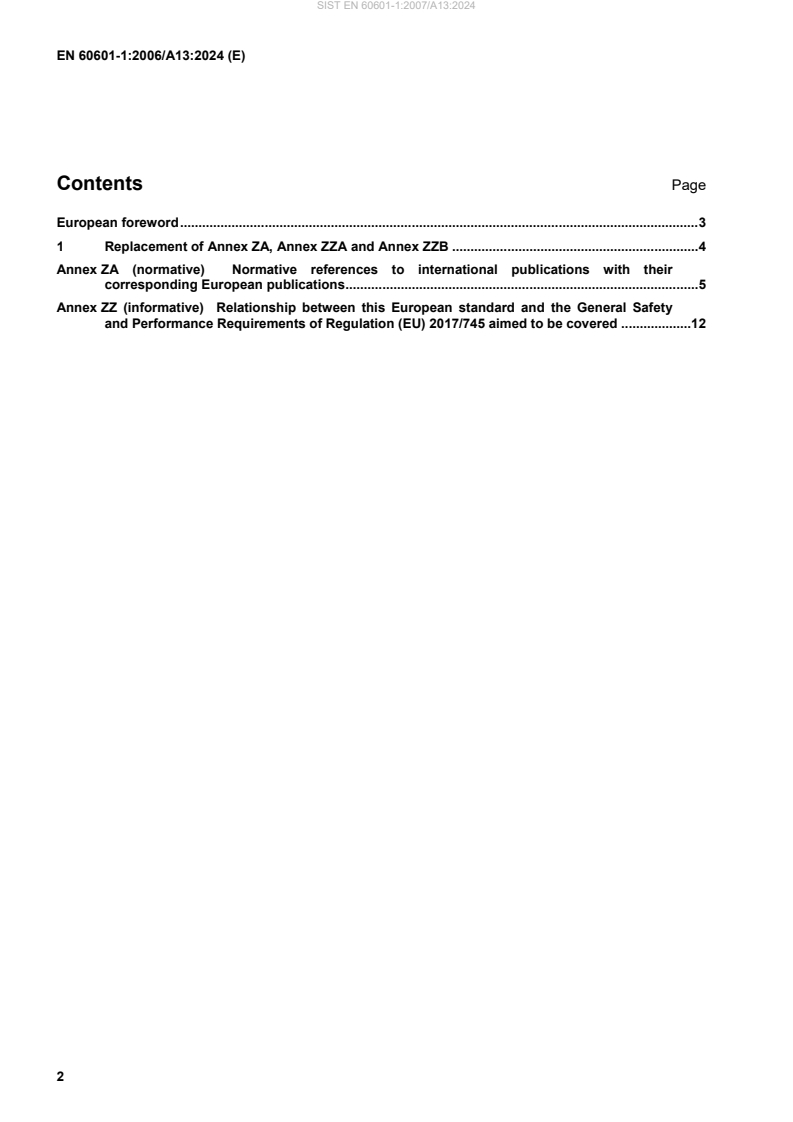
Contents Page
European foreword . 3
1 Replacement of Annex ZA, Annex ZZA and Annex ZZB . 4
Annex ZA (normative) Normative references to international publications with their
corresponding European publications . 5
Annex ZZ (informative) Relationship between this European standard and the General Safety
and Performance Requirements of Regulation (EU) 2017/745 aimed to be covered . 12
European foreword
This document (EN 60601-1:2006/A13:2024) has been prepared by CLC/TC 62 "Electrical Equipment in
medical practice".
The following dates are fixed:
• latest date by which this document has to be (dop) 2025-02-28
implemented at national level by publication of
an identical national standard or by
endorsement
• latest date by which the national standards (dow) 2027-02-28
conflicting with this document have to be
withdrawn
This amendment A13 modifies EN 60601-1:2006, and EN 60601-1:2006/A1:2013 and
EN 60601-1:2006/A2:2021.
Attention is drawn to the possibility that some of the elements of this document may be the subject of patent
rights. CENELEC shall not be held responsible for identifying any or all such patent rights.
This document has been prepared under a standardization request addressed to CENELEC by the European
Commission. The Standing Committee of the EFTA States subsequently approves these requests for its
Member States.
For the relationship with EU Legislation, see informative Annex ZZ, which is an integral part of this document.
Any feedback and questions on this document should be directed to the users’ national committee. A
complete listing of these bodies can be found on the CENELEC website.
1 Replacement of Annex ZA, Annex ZZA and Annex ZZB
Replace Annex ZA, Annex ZZA and Annex ZZB with the following:
Annex ZA
(normative)
Normative references to international publications
with their corresponding European publications
The following documents are referred to in the text in such a way that some or all of their content constitutes
requirements of this document. For dated references, only the edition cited applies. For undated references,
the latest edition of the referenced document (including any amendments) applies.
NOTE 1 Where an International Publication has been modified by common modifications, indicated by (mod), the
relevant EN/HD applies.
NOTE 2 Up-to-date information on the latest versions of the European Standards listed in this annex is available here:
www.cencenelec.eu.
Publication Year Title EN/HD Year
IEC 60065 (mod) 2001 Audio, video and similar electronic apparatus - EN 60065 2002
Safety requirements
Cor. March 2006
+ A1 (mod) 2005 + A1 2006
Cor. August 2007
+ A11 2008
+ A2 (mod) 2010 + A2 2010
+ A12 2011
IEC 60068-2-2 2007 Environmental testing Part 2-2: Tests - Test B: EN 60068-2-2 2007
Dry heat
IEC 60079-0 - Explosive atmospheres - Part 0: Equipment - EN IEC 60079-0 2018
General requirements
(mod)
+ AC 2020
IEC 60079-2 - Explosive atmospheres - Part 2: Equipment EN 60079-2 2014
protection by pressurized enclosure "p"
+ AC 2015
IEC 60079-5 - Explosive atmospheres - Part 5: Equipment EN 60079-5 2015
protection by powder filling "q"
IEC 60079-6 - Explosive atmospheres - Part 6: Equipment EN 60079-6 2015
protection by liquid immersion "o"
IEC/TR 60083 2015 Plugs and socket-outlets for domestic and - -
similar general use standardized in member
countries of IEC
IEC 60085 - Electrical insulation - Thermal evaluation and EN 60085 2008
designation
Dated as no European equivalent exists.
IEC 60086-4 - Primary batteries Part 4: Safety of lithium EN IEC 60086-4 2019
batteries
+ AC 2019
+ AC 2020
IEC 60112 - Method for the determination of the proof and EN IEC 60112 2020
the comparative tracking indices of solid
insulating materials
IEC 60127-1 - Miniature fuses Part 1: Definitions for miniature EN 60127-1 2006
fuses and general requirements for miniature
+ A1 2011
fuse-links
+ A2 2015
IEC 60227-1 2007 Polyvinyl chloride insulated cables of rated EN 50525-1 2011
voltages up to and including 450/750 V Part 1:
General requirements
IEC 60245-1 2003 Rubber insulated cables - Rated voltages up to EN 50525-1 2011
and including 450/750 V Part 1: General
+ A1 2007
requirements
IEC 60252-1 - + AC motor capacitors Part 1: General - EN 60252-1 2011
Performance, testing and rating - Safety
+ A1 2013
requirements - Guidance for installation and
operation
IEC 60320-1 - Appliance couplers for household and similar EN IEC 60320-1 2021
general purposes Part 1: General
requirements
IEC 60335-1 (mod) 2010 Household and similar electrical appliances - EN 60335-1 2012
Safety Part 1: General requirements
+ AC 2014
+ A11 2014
+ A12 2017
IEC 60364-4-41 - Low-voltage electrical installations Part 4-41: HD 60364-4-41 2017
(mod) Protection for safety - Protection against
+ A11 2017
electric shock
+ A12 2019
IEC 60384-14 2005 Fixed capacitors for use in electronic EN 60384-14 2005
equipment Part 14: Sectional specification -
Fixed capacitors for electromagnetic
interference suppression and connection to the
supply mains
IEC 60417 Data Graphical symbols for use on equipment - -
base available from http://www.graphical-
symbols.info/equipment
IEC 60445 - Basic and safety principles for man-machine EN IEC 60445 2021
interface, marking and identification -
Identification of equipment terminals,
conductor terminations and conductors
IEC 60447 - Basic and safety principles for man-machine EN 60447 2004
interface, marking and identification - Actuating
principles
EN 50525-1:2011, Electric cables - Low voltage energy cables of rated voltages up to and including 450/750
V (U0/U) - Part 1: General requirements, which is related to, but not directly equivalent with, IEC 60227-1 and
IEC 60245-1, applies instead.
IEC 60447 - Basic and safety principles for man-machine EN 60447 2004
interface, marking and identification - Actuating
principles
IEC 60529 1989 Degrees of protection provided by enclosures EN 60529 1991
(IP Code)
+ A1 1999 Cor. May 1993
+ A1 2000
IEC 60601-1-2 2014 Medical electrical equipment Part 1-2: General EN 60601-1-2 2015
requirements for basic safety and essential
+ A1 2020 + A1 2021
performance - Collateral standard:
Electromagnetic disturbances- Requirements
and tests
IEC 60601-1-3 2008 Medical electrical equipment - Part 1-3: EN 60601-1-3 2008
General requirements for basic safety and
2013 Cor. March 2010
essential performance - Collateral Standard:
+ A1 + A1 2013
Radiation protection in diagnostic X-ray
+ AC 2014
equipment
+ A11 2016
IEC 60601-1-3 2008 Medical electrical equipment - Part 1-3: EN 60601-1-3 2008
General requirements for basic safety and
2013 Cor. March 2010
essential performance - Collateral Standard:
+ A1 + A1 2013
Radiation protection in diagnostic X-ray
+ AC 2014
equipment
+ A11 2016
IEC 60601-1-6 2010 Medical electrical equipment Part 1-6: General EN 60601-1-6 2010
requirements for basic safety and essential
+ A1 2013 + A1 2015
performance - Collateral standard: Usability
+ A2 2020 + A2 2021
IEC 60601-1-8 2006 Medical electrical equipment Part 1-8: General EN 60601-1-8 2007
requirements for basic safety and essential
Cor. March 2010
performance - Collateral Standard: General
+ A1 2012 + A1 2013
requirements, tests and guidance for alarm
+ AC 2014
systems in medical electrical equipment and
medical electrical systems + A11 2017
+ A2 2020 + A2 2021
IEC 60664-1 2007 Insulation coordination for equipment within EN 60664-1 2007
low-voltage systems Part 1: Principles,
requirements and tests
IEC 60695-11-10 - Fire hazard testing - Part 11-10: Test flames - EN 60695-11-10 2013
50 W horizontal and vertical flame test
+ AC 2014
methods
IEC 60730-1 2010 Automatic electrical controls for household and EN 60730-1 2011
similar use Part 1: General requirements
(mod)
IEC 60747-5-5 2007 Semiconductor devices - Discrete devices - EN 60747-5-5 2011
Part 5-5: Optoelectronic devices -
Photocouplers
IEC 60825-1 2014 Safety of laser products - Part 1: Equipment EN 60825-1 2014
classification and requirements
+ AC 2017
+ A11 2021
+ AC 2022
IEC 60851-3 2009 Winding wires - Test methods - Part 3: EN 60851-3 2009
Mechanical properties
IEC 60851-5 2008 Winding wires - Test methods - Part 5: EN 60851-5 2008
Electrical properties
IEC 60851-6 1996 Winding wires - Test methods - Part 6: EN 60851-6 1996
Thermal properties
+ A1 1997 + A1 1997
IEC 60851-6 1996 Winding wires - Test methods EN 60851-6 1996
Part 6: Thermal properties
+ A1 1997 + A1 1997
IEC 60884-1 - Plugs and socket-outlets for household and IEC 60884-1 2022
similar purposes - Part 1: General
requirements
IEC 60950-1 2005 Information technology equipment - Safety - EN 60950-1 2006
Part 1: General requirements
(mod) + A11 2009
+ A1 2009 + A1 2010
2013 + A12 2011
+ AC 2011
+ A2 + A2 2013
IEC 61058-1 2000 Switches for appliances - Part 1: General EN 61058-1 2002
requirements
(mod) + A2 2008
+ A1 2001
+ A2 2007
IEC 61558-2-1 - Safety of power transformers, power supplies, EN 61558-2-1 2007
reactors and similar products - Part 2-1:
Particular requirements and tests for
separating transformers and power supplies
incorporating separating transformers for
general applications
IEC 61672-1 - Electroacoustics - Sound level meters EN 61672-1 2013
Part 1: Specifications
IEC 61672-2 - Electroacoustics - Sound level meters EN 61672-2 2013
Part 2: Pattern evaluation tests
+ A1 2017
IEC 61965 - Mechanical safety of cathode ray tubes EN 61965 2003
IEC 62133 - Secondary cells and batteries containing EN 62133 2013
alkaline or other non-acid electrolytes – Safety
requirements for portable sealed secondary
cells, and for batteries made from them, for
use in portable applications
IEC 62133-2 - Secondary cells and batteries containing EN 62133-2 2017
alkaline or other non-acid electrolytes - Safety
+ A1 2021
requirements for portable sealed secondary
+ AC 2022
cells, and for batteries made from them, for
use in portable applications - Part 2: Lithium
systems
IEC 62304 2006 Medical device software – Software lifecycle EN 62304 2006
processes
Cor. Nov. 2008
+ A1 2015 + A1 2015
IEC 62368-1 2018 Audio/video, information and communication EN IEC 62368-1 2020
technology equipment - Part 1: Safety
+ A11 2020
requirements
+ AC 2020
ISO 780 - Packaging - Distribution packaging - Graphical EN ISO 780 2015
symbols for handling and storage of packages
ISO 1853 2018 Conducting and dissipative rubbers, - -
vulcanized or thermoplastic - Measurement of
resistivity
ISO 2878 2017 Rubber, vulcanized - Antistatic and conductive - -
products - Determination of electrical
resistance
ISO 2882 1979 Rubber, vulcanized - Antistatic and conductive - -
products for hospital use - Electrical resistance
limits
ISO 3746 - Acoustics - Determination of sound power EN ISO 3746 2010
levels of noise sources using sound pressure -
Survey method using an enveloping
measurement surface over a reflecting plane
ISO 3864-1 2011 Graphical symbols - Safety colours and safety - -
signs - Part 1: Design principles for safety
signs in workplaces and public areas
ISO 5349-1 - Mechanical vibration - Measurement and EN ISO 5349-1 2001
evaluation of human exposure to hand-
transmitted vibration - Part 1: General
requirements
ISO 7000 2004 Graphical symbols for use on equipment – - -
Collection of symbols
ISO 7010 2019 Graphical symbols – Safety colours and safety EN ISO 7010 2012
signs – Registered safety signs
+ A1 2014
+ A2 2014
+ A3 2014
+ A4 2014
+ A5 2015
+ A6 2016
+ A7 2017
ISO 9614-1 - Acoustics – Determination of sound power EN ISO 9614-1 2009
levels of noise sources using sound intensity –
Measurement at discrete points
ISO 10993 series Biological evaluation of medical devices
Biological evaluation of medical devices - Part EN ISO 10993-1 2020
1: Evaluation and testing within a risk
management process
Biological evaluation of medical devices - Part EN ISO 10993-2 2006
2: Animal welfare requirements
Biological evaluation of medical devices - Part EN ISO 10993-3 2014
3: Tests for genotoxicity, carcinogenicity and
reproductive toxicity
Biological evaluation of medical devices - Part EN ISO 10993-4 2017
4: Selection of tests for interactions with blood
Dated as no European equivalent exists.
Dated as no European equivalent exists.
Dated as no European equivalent exists.
Biological evaluation of medical devices - Part EN ISO 10993-5 2009
5: Tests for in vitro cytotoxicity
Biological evaluation of medical devices - Part 6: EN ISO 10993-6 2016
Tests for local effects after implantation
Biological evaluation of medical devices - Part 7: EN ISO 10993-7 2008
Ethylene oxide sterilization residuals
+ AC 2009
+ A1 2020
Biological evaluation of medical devices - Part 9: EN ISO 10993-9 2009
Framework for identification and quantification of
potential degradation products
Biological evaluation of medical devices - Part EN ISO 10993-10 2013
10: Tests for irritation and skin sensitization
Biological evaluation of medical devices - Part EN ISO 10993-11 2018
11: Tests for systemic toxicity
Biological evaluation of medical devices - Part EN ISO 10993-12 2012
12: Sample preparation and reference materials
Biological evaluation of medical devices - Part EN ISO 10993-13 2010
13: Identification and quantification of
degradation products from polymeric medical
devices
Biological evaluation of medical devices - Part EN ISO 10993-14 2009
14: Identification and quantification of
degradation products from ceramics
Biological evaluation of medical devices - Part EN ISO 10993-15 2020
15: Identification and quantification of
degradation products from metals and alloys
Biological evaluation of medical devices - Part EN ISO 10993-16 2017
16: Toxicokinetic study design for degradation
products and leachables
Biological evaluation of medical devices - Part EN ISO 10993-17 2009
17: Establishment of allowable limits for
leachable substances
Biological evaluation of medical devices - Part EN ISO 10993-18 2020
18: Chemical characterization of materials
Biological evaluation of medical devices - Part ISO/TS 10993-19 2006
19: Physico-chemical, morphological and
topographical characterization of materials
Biological evaluation of medical devices - Part ISO/TS 10993-20 2006
20: Principles and methods for immunotoxicology
testing of medical devices
ISO 18562-1 2017 Biocompatibility evaluation of breathing gas EN ISO 18562-1 2020
pathways in healthcare applications -- Part 1:
Evaluation and testing within a risk management
process
ISO 18562-2 2017 Biocompatibility evaluation of breathing gas EN ISO 18562-2 2020
pathways in healthcare applications -- Part 2:
Tests for emissions of particulate matter
ISO 18562-3 2017 Biocompatibility evaluation of breathing gas EN ISO 18562-3 2020
pathways in healthcare applications -- Part 3:
Tests for emissions of volatile organic
compounds (VOCs)
ISO 18562-4 2017 Biocompatibility evaluation of breathing gas EN ISO 18562-4 2020
pathways in healthcare applications -- Part 4:
Tests for leachables in condensate
ISO 11135-1 2007 Sterilization of health care products – Ethylene EN ISO 11135-1 2007
oxide – Part 1: Requirements for development,
validation and routine control of a sterilization
process for medical devices
ISO 11137-1 2006 Sterilization of health care products – Radiation – EN ISO 11137-1 2006
Part 1: Requirements for development, validation
and routine control of a sterilization process for
medical devices
ISO 13857 2008 Safety of machinery – Safety distances to EN ISO 13857 2008
prevent hazard zones being reached by the
upper and lower limbs
ISO 14971 2019 Medical devices – Application of risk EN ISO 14971 2019
management to medical devices
ISO 15223-1 2016 ISO 15223-1:2012, Medical devices – Symbols to EN ISO 15223-1 2016
be used with medical device labels, labelling and
information to be supplied – Part 1: General
requirements
ISO 17665-1 2006 Sterilization of health care products – Moist heat EN ISO 17665-1 2006
– Part 1: Requirements for the development,
validation and routine control of a sterilization
process for medical devices
ISO 23529 2016 Rubber – General procedures for preparing and - -
conditioning test pieces for physical test methods
ISO 80000-1 2009 Quantities and units – Part 1: General EN ISO 80000-1 2013
Dated as no European equivalent exists.
Annex ZZ
(informative)
Relationship between this European standard and the General Safety
and Performance Requirements of Regulation (EU) 2017/745 aimed to be
covered
This European standard has been prepared under M/575 to provide one voluntary means of conforming to the
General Safety and Performance Requirements of Regulation (EU) 2017/745 of 5 April 2017 concerning
medical devices [OJ L 117] and to system or process requirements including those relating to quality
management systems, risk management, post-market surveillance systems, clinical investigations, clinical
evaluation or post-market clinical follow-up.
Once this standard is cited in the Official Journal of the European Union under that Regulation, compliance
with the normative clauses of this standard given in Table ZZ.1 confers, within the limits of the scope of this
standard, a presumption of conformity with the corresponding General Safety and Performance Requirements
of that Regulation, and associated EFTA regulations.
Where a definition in this standard differs from a definition of the same term set out in Regulation (EU)
2017/745, the differences shall be indicated in this Annex Z. For the purpose of using this standard in support
of the requirements set out in Regulation (EU) 2017/745, the definitions set out in this Regulation prevail.
Where the European standard is an adoption of an International Standard, the scope of this standard can
differ from the scope of the European Regulation that it supports. As the scope of the applicable regulatory
requirements differ from nation to nation and region to region, the standard can only support European
regulatory requirements to the extent of the scope of the European regulation for medical devices (EU)
2017/745.
For application of this European standard under Regulation (EU) 2017/745, its scope is limited to medical
devices for use with human patients. This affects all clauses of this European standard.
NOTE 1 Where a reference from a clause of this standard to the risk management process is made, the risk
management process needs to be in compliance with Regulation (EU) 2017/745. This means that risks have to be
‘reduced as far as possible’, ‘reduced to the lowest possible level’, ‘reduced as far as possible and appropriate’, ‘removed
or reduced as far as possible’, ‘eliminated or reduced as far as possible’, ’removed or minimized as far as possible’, or
‘minimized’, according to the wording of the corresponding General Safety and Performance Requirement.
NOTE 2 The manufacturer’s policy for determining acceptable risk must be in compliance with General Safety and
Performance Requirements 1, 2, 3, 4, 5, 8, 9, 10, 11, 14, 16, 17, 18, 19, 20, 21 and 22 of the Regulation.
NOTE 3 When a General Safety and Performance Requirement does not appear in Table ZZ.1, it means that it is not
addressed by this European Standard.
Table ZZ.1 — Correspondence between this European standard and Annex I of Regulation (EU)
2017/745 [OJ L 117] and to system or process requirements including those relating to quality
management systems, risk management, post-market surveillance systems, clinical investigations,
clinical evaluation or post-market clinical follow-up
General Safety and Performance Clause(s) / sub-
Remarks / Notes
Requirements of Regulation (EU) 2017/745 clause(s) of this EN
ANNEX I GENERAL SAFETY AND
PERFORMANCE REQUIREMENTS
CHAPTER I GENERAL REQUIREMENTS
1. Devices shall achieve the performance 4 to 17 Covered with regard to basic
intended by their manufacturer and shall be safety and essential performance
designed and manufactured in such a way in relation to the clinical condition
that, during normal conditions of use, they are and the safety of patients, the
suitable for their intended purpose. They shall safety and health of users and,
be safe and effective and shall not where applicable, other persons.
compromise the clinical condition or the
safety of patients, or the safety and health of
users or, where applicable, other persons,
provided that any risks which may be
associated with their use constitute
acceptable risks when weighed against the
benefits to the patient and are compatible
with a high level of protection of health and
safety, taking into account the generally
acknowledged state of the art.
2. The requirement in this Annex to reduce 4 to 17 Considered in respect of the risks
risks as far as possible means the reduction identified in this EN.
of risks as far as possible without adversely
affecting the benefit-risk ratio.
3. Manufacturers shall establish, implement, 4.2 Partially covered by the
document and maintain a risk management requirement to implement to
system. Risk management shall be EN ISO 14971, except
understood as a continuous iterative process maintenance and regular
throughout the entire lifecycle of a device, systematic updating.
requiring regular systematic updating.
See rows for GSPR 3.(a) to 3.(f).
In carrying out risk management
manufacturers shall:
3.(a) establish and document a risk Not covered.
management plan for each device;
3.(b) identify and analyse the known and 4 to 17 Covered in respect of hazards and
foreseeable hazards associated with each risks related to basic safety and
device; essential performance within the
scope of this EN.
3.(c) estimate and evaluate the risks 4 to 17 Covered in respect of hazards and
associated with, and occurring during, the risks related to basic safety and
intended use and during reasonably essential performance within the
foreseeable misuse; scope of this EN.
3.(d) eliminate or control the risks referred to 4 to 17 Covered in respect of hazards and
in point (c) in accordance with the risks related to basic safety and
requirements of Section 4; essential performance within the
scope of this EN.
General Safety and Performance Clause(s) / sub-
Remarks / Notes
Requirements of Regulation (EU) 2017/745 clause(s) of this EN
3.(e) evaluate the impact of information from Not covered.
the production phase and, in particular, from
the post-market surveillance system, on
hazards and the frequency of occurrence
thereof, on estimates of their associated
risks, as well as on the overall risk, benefit-
risk ratio and risk acceptability; and
3.(f) based on the evaluation of the impact of Not covered.
the information referred to in point (e), if
necessary amend control measures in line
with the requirements of Section 4.
4. Risk control measures adopted by 4 to 17 Covered in respect of hazards and
manufacturers for the design and risks related to basic safety and
manufacture of the devices shall conform to essential performance within the
safety principles, taking account of the scope of this EN.
generally acknowledged state of the art. To
reduce risks, Manufacturers shall manage
See rows for GSPR 4.(a) to 4.(c).
risks so that the residual risk associated with
each hazard as well as the overall residual
risk is judged acceptable.
In selecting the most appropriate solutions,
manufacturers shall, in the following order of
priority:
4.(a) eliminate or reduce risks as far as 4 to 17 Covered in respect of hazards and
possible through safe design and risks related to basic safety and
manufacture; essential performance within the
scope of this EN.
4.(b) where appropriate, take adequate 4 to 17 Covered in respect of hazards and
protection measures, including alarms if risks related to basic safety and
necessary, in relation to risks that cannot be essential performance within the
eliminated; and scope of this EN.
4.(c) provide information for safety (warnings 7, 8.4.4, 8.6.7, 8.11.1, Covered in respect of hazards and
/ precautions / contra-indications) and, where 8.11.4.1, 9.2.1, 9.2.4, risks related to basic safety and
appropriate, training to users. 9.4.2, 9.7.2, 9.8.3.1, essential performance within the
9.8.4.3, 11.6.2, 16.2, scope of this EN.
16.9.2.1
4. (continued) Manufacturers shall inform 9.4.2.2 Covered for instability and
users of any residual risks. overbalancing risks.
5. In eliminating or reducing risks related to
use error, the manufacturer shall:
See rows for GSPR 5.(a) to 5.(b).
5.(a) reduce as far as possible the risks 5.3, 5.4, 5.5, 7, 11, 12, Covered in respect of hazards and
related to the ergonomic features of the 14, 15, 15.4, 16 risks related to basic safety and
device and the environment in which the essential performance within the
device is intended to be used (design for scope of this EN.
patient safety), and
General Safety and Performance Clause(s) / sub-
Remarks / Notes
Requirements of Regulation (EU) 2017/745 clause(s) of this EN
5.(b) give consideration to the technical 7, 11, 12, 14, 15, 16 Covered in respect of hazards and
knowledge, experience, education, training risks related to basic safety and
and use environment, where applicable, and essential performance within the
the medical and physical conditions of scope of this EN.
intended users (design for lay, professional,
disabled or other users).
6. The characteristics and performance of a 4.7, 5.6, 7.9, 11.6, 13.2, Covered in respect of hazards and
device shall not be adversely affected to such 14.12, 15.2, 15.4 risks related to basic safety and
a degree that the health or safety of the essential performance within the
patient or the user and, where applicable, of scope of this EN.
other persons are compromised during the
lifetime of the device, as indicated by the
manufacturer, when the device is subjected
to the stresses which can occur during
normal conditions of use and has been
properly maintained in accordance with the
manufacturer's instructions.
7. Devices shall be designed, manufactured i. Design and i. Covered in respect of hazards
and packaged in such a way that their manufacturing and risks related to basic safety
characteristics and performance during their 5.3, 5.4, 5.5, 7.2.21, and essential performance within
intended use are not adversely affected 7.9.2.8, 7.9.2.9, the scope of this EN.
during transport and storage, for example, 7.9.2.12, 7.9.2.13,
ii. Covered in respect of hazards
through fluctuations of temperature and 7.9.2.18, 7.9.3, 9.4,
related to handling and
humidity, taking account of the instructions 9.8.3, 11.1, 11.2.1,
environmental conditions during
and information provided by the 11.6.5, 11.6.6, 11.6.7,
transport/storage.
manufacturer. 11.8, 15.2, 15.3,
15.4.7.3
ii. Packaging
7.2.17
8. All known and foreseeable risks, and any 4 to 17 Covered in respect of hazards and
undesirable side-effects, shall be minimised risks related to basic safety and
and be acceptable when weighed against the essential performance within the
evaluated benefits to the patient and/or user scope of this EN.
arising from the achieved performance of the
device during normal conditions of use.
9. For the devices referred to in Annex XVI, Not covered.
the general safety requirements set out in
Sections 1 and 8 shall be understood to
mean that the device, when used under the
conditions and for the purposes intended,
does not present a risk at all or presents a
risk that is no more than the maximum
acceptable risk related to the product's use
which is consistent with a high level of
protection for the safety and health of
persons.
General Safety and Performance Clause(s) / sub-
Remarks / Notes
Requirements of Regulation (EU) 2017/745 clause(s) of this EN
CHAPTER II REQUIREMENTS REGARDING
DESIGN AND MANUFACTURE
10. Chemical, physical and biological
properties
10.1. Devices shall be designed and 6.4, 7.1, 9.3, 9.8, 11.2 Covered as listed for sections
manufactured in such a way as to ensure that to 11.6, 13.1, 15.3 10.1.(a) to 10.1.(h).
the characteristics and performance
requirements referred to in Chapter I are
fulfilled. Particular attention shall be paid to:
10.1.(a) the choice of materials and 11.2, 11.3, 11.4, 11.5, Partly covered. Not covered for
substances used, particularly as regards 13.1.2 biocompatibility because clause
toxicity and, where relevant, flammability; 11.7 only references to a series of
other standards and does not
include more detailed
specifications as regards the legal
requirements of section 10.1.(a).
10.1.(b) the compatibility between the Not covered, because the aspects
materials and substances used and biological are only addressed by reference to
tissues, cells and body fluids, taking account other standards and clause 11.6.8
of the intended purpose of the device and, does not include more detailed
where relevant, absorption, distribution, specifications as regards the legal
metabolism and excretion; requirements of section 10.1.(b).
10.1.(c) the compatibility between the Not covered.
different parts of a device which consists of
more than one implantable part;
10.1.(d) the impact of processes on material 6.4, 7.9.2.12, 11.6.6, Covered for cleaning, disinfection
properties; 11.6.7 & sterilization.
10.1.(e) where appropriate, the results of Not covered.
biophysical or modelling research the validity
of which has been demonstrated beforehand;
10.1.(f) the mechanical properties of the 7.1.3, 9.8, 15.3 Covered.
materials used, reflecting, where appropriate,
matters such as strength, ductility, fracture
resistance, wear resistance and fatigue
resistance;
10.1.(g) surface properties; and 7.1.3, 9.3, 11.6 Covered.
10.1.(h) the confirmation that the device Not covered.
meets any defined chemical and/or physical
specifications.
10.2. Devices shall be designed, i. Design and i. Covered for cleaning, disinfection
manufactured and packaged in such a way Manufacturing and sterilization.
as to minimise the risk posed by
7.9.2.12, 16.2.c), ii. Not covered.
contaminants and residues to patients, taking
16.2.d)
account of the intended purpose of the
ii. Packaging
device, and to the persons involved in the
transport, storage and use of the devices.
Particular attention shall be paid to tissues
exposed to those contaminants and residues
and to the duration and frequency of
exposure.
General Safety and Performance Clause(s) / sub-
Remarks / Notes
Requirements of Regulation (EU) 2017/745 clause(s) of this EN
10.3. Devices shall be designed and 6.4, 7.9.2.12, 9.7, 11.4, Partly covered: Covered for
manufactured in such a way that they can be 11.5, 11.6.2, 11.6.3, general purpose MEDICAL
used safely with the materials and 11.6.6, 11.6.7, 13.2.6 ELECTRICAL EQUIPMENT and/or
substances, including gases, with which they MEDICAL ELECTRICAL SYSTEMS.
enter into contact during their intended use;
Not covered for product group
specific safety aspects.
10.3. (continued) If the devices are intended 11.6.8 with 4.2 Partly covered by addressing in
to administer medicinal products they shall be the risk management process.
designed and manufactured in such a way as
to be compatible with the medicinal products
concerned in accordance with the provisions
and restrictions governing those medicinal
products and that the performance of both the
medicinal products and of the devices is
maintained in accordance with their
respective indications and intended use.
10.4. Substances
10.4.1. Design and manufacture of devices Not covered, because the aspects
shall be designed and manufactured in such are only addressed by reference to
a way as to reduce as far as possible the other standards and clauses 6.4,
risks posed by substances or particles, 11.6.6, 11.6.7, 11.6.8 and 11.7 do
including wear debris, degradation products not include more detailed
and processing residues that may be specifications as regards the legal
released from the device. Devices, or those requirements of section 10.4.1.
parts thereof or those materials used therein
that:
— are invasive and come into direct contact
with the human body,
— (re)administer medicines, body liquids or
other substances, including gases, to/from
the body, or
— transport or store such medicines, body
fluids or substances, including gases, to be
(re)administered to the body
shall only contain the following substances in
a concentration that is above 0,1 % weight by
weight (w/w) where justified pursuant to
Section 10.4.2:
10.4.1.(a) substances which are See remark to GSPR #10.4.1.
carcinogenic, mutagenic or toxic to
reproduction (‘CMR’), of category 1A or 1B, in
accordance with Part 3 of Annex VI to
Regulation (EC) No 1272/2008 of the
European Parliament and of the Council (1),
or
General Safety and Performance Clause(s) / sub-
Remarks / Notes
Requirements of Regulation (EU) 2017/745 clause(s) of this EN
10.4.1.(b) substances having endocrine- See remark to GSPR #10.4.1.
disrupting properties for which there is
scientific evidence of probable serious effects
to human health and which are identified
either in accordance with the procedure set
out in Article 59 of Regulation (EC) No
1907/2006 of the European Parliament and of
the Council (2) or, once a delegated act has
been adopted by the Commission pursuant to
the first subparagraph of Article 5(3) of
Regulation (EU) No 528/2012 of the
European Parliament and the Council (3), in
accordance with the criteria that are relevant
to human health amongst the criteria
established therein.
10.4.2. Justification regarding the presence of Not covered.
CMR and/or endocrine-disrupting
substances.
The justification for the presence of such
substances shall be based upon:
10.4.2.(a) an analysis and estimation of Not covered.
potential patient or user exposure to the
substance;
10.4.2.(b) an analysis of possible alternative Not covered.
substances, materials or designs, including,
where available, information about
independent research, peer-reviewed studies,
scientific opinions from relevant scientific
committees and an analysis of the availability
of such alternatives;
10.4.2.(c) argumentation as to why possible Not covered.
substance and/ or material substitutes, if
available, or design changes, if feasible, are
inappropriate in relation to maintaining the
functionality, performance and the benefit-risk
ratios of the product; including taking into
account if the intended use of such devices
includes treatment of children or treatment of
pregnant or breastfeeding women or
treatment of other patient groups considered
particularly vulnerable to such substances
and/or materials; and
10.4.2.(d) where applicable and available, the Not covered.
latest relevant scientific committee guidelines
in accordance with Sections 10.4.3. and
10.4.4.
General Safety and Performance Clause(s) / sub-
Remarks / Notes
Requirements of Regulation (EU) 2017/745 clause(s) of this EN
10.4.3. Guidelines on phthalates Not covered.
For the purposes of Section 10.4., the
Commission shall, as soon as possible and
by 26 May 2018, provide the relevant
scientific committee with a mandate to
prepare guidelines that shall be ready before
26 May 2020. The mandate for the committee
shall encompass at least a benefit-risk
assessment of the presence of phthalates
which belong to either of the groups of
substances referred to in points (a) and (b) of
Section 10.4.1. The benefit-risk assessment
shall take into account the intended purpose
and context of the use of the device, as well
as any available alternative substances and
alternative materials, designs or medical
treatments. When deemed appropriate on the
basis of the latest scientific evidence, but at
least every five years, the guidelines shall be
updated.
10.4.4. Guidelines on other CMR and Not covered.
endocrine-disrupting substances
Subsequently, the Commission shall mandate
the relevant scientific committee to prepare
guidelines as referred to in Section 10.4.3.
also for other substances referred to in points
(a) and (b) of Section 10.4.1., where
appropriate.
10.4.5. Labelling Not covered.
Where devices, parts thereof or materials
used therein as referred to in Section 10.4.1.
contain substances referred to in points (a) or
(b) of Section 10.4.1. in a concentration
above 0,1 % weight by weight (w/w), the
presence of those substances shall be
labelled on the device itself and/or on the
packaging for each unit or, where
appropriate, on the sales packaging, with the
list of such substances. If the intended use of
such devices includes treatment of children or
treatment of pregnant or breastfeeding
women or treatment of other patient groups
considered particularly vulnerable to such
substances and/or materials, information on
residual risks for those patient groups and, if
applicable, on appropriate precautionary
measures shall be given in the instructions for
use.
General Safety and Performance Clause(s) / sub-
Remarks / Notes
Requirements of Regulation (EU) 2017/745 clause(s) of this EN
10.5. Devices shall be designed and 5.9.2, 6.3, 7.2.9, 7.2.17, Covered.
manufactured in such a way as to reduce as 11.6.3, 11.6.5, 13.2.6,
far as possible the risks posed by the 15.4.7.3
unintentional ingress of substances into the
device taking into account the device and the
nature of the environment in which it is
intended to be used.
10.6. Devices shall be designed and Not covered, because
manufactured in such a way as to reduce as biocompatibility in clause 11.7 is
far as possible the risks linked to the size and only addressed by reference to a
the properties of particles which are or can be series of other standards and does
released into the patient's or user's body, not include more detailed
unless they come into contact with intact skin specifications as regards the legal
only. Special attention shall be given to requirements of section 10.6.
nanomaterials.
11. Infection and microbial contamination
11.1. Devices and their manufacturing 6.4, 7.2.17, 7.9.2.12, Covered.
processes shall be designed in such a way as 11.6.6, 11.6.7
to eliminate or to reduce as far as possible
the risk of infection to patients, users and,
where applicable, other persons. The design
shall:
11.1.(a) reduce as far as possible and 7.2.17, 9.2, 9.3, 9.5, 9.8 Covered for general purpose
appropriate the risks from unintended cuts MEDICAL ELECTRICAL EQUIPMENT
and pricks, such as needle stick injuries, and/or MEDICAL ELECTRICAL
SYSTEMS.
Not covered for product group
specific safety aspects.
11.1.(b) all
...