


EN 60601-1-8:2004
(Main)Medical electrical equipment - Part 1-8: General requirements for safety - Collateral standard: General requirements, tests and guidance for alarm systems in medical electrical equipment and medical electrical systems
General Information
- Abstract
The object of this collateral standard is to specify basic safety and essential performance requirements and tests for alarm systems in medical electrical equipment and medical electrical systems and to provide guidance for their application. This is accomplished by defining alarm categories (priorities) by degree of urgency, consistent alarm signals and consistent control states and their marking for all alarm systems.
- Status
- Withdrawn
- Publication Date
- 29-Jan-2004
- Withdrawal Date
- 30-Nov-2006
- Technical Committee
- CLC/TC 62 - Electrical equipment in medical practice
- Drafting Committee
- IEC/SC 62A - IEC_SC_62A
- Parallel Committee
- IEC/SC 62A - IEC_SC_62A
- Current Stage
- 9960 - Withdrawal effective - Withdrawal
- Start Date
- 01-Jun-2012
- Completion Date
- 01-Jun-2012
- Directive
- Not Harmonized93/42/EEC - Medical devicesOJ Ref: C 293/39, C 123/02 OJ Date: 27-Apr-2012


Relations
- Effective Date
- 28-Jan-2023
- Effective Date
- 20-Feb-2026
- Effective Date
- 09-Feb-2026
- Refers
EN 60601-1:1990/A1:1993 - Medical electrical equipment - Part 1: General requirements for safety - Effective Date
- 03-Feb-2026
- Effective Date
- 03-Feb-2026
- Refers
EN 60601-1:1990/A2:1995 - Medical electrical equipment - Part 1: General requirements for safety - Effective Date
- 03-Feb-2026
- Effective Date
- 03-Feb-2026
- Effective Date
- 03-Feb-2026
- Effective Date
- 03-Feb-2026
- Effective Date
- 03-Feb-2026
- Effective Date
- 03-Feb-2026
- Effective Date
- 03-Feb-2026
- Effective Date
- 03-Feb-2026
- Effective Date
- 28-Jan-2023
Get Certified
Connect with accredited certification bodies for this standard

BSI Group
BSI (British Standards Institution) is the business standards company that helps organizations make excellence a habit.

TÜV Rheinland
TÜV Rheinland is a leading international provider of technical services.

TÜV SÜD
TÜV SÜD is a trusted partner of choice for safety, security and sustainability solutions.
Sponsored listings
Frequently Asked Questions
EN 60601-1-8:2004 is a standard published by CLC. Its full title is "Medical electrical equipment - Part 1-8: General requirements for safety - Collateral standard: General requirements, tests and guidance for alarm systems in medical electrical equipment and medical electrical systems". This standard covers: The object of this collateral standard is to specify basic safety and essential performance requirements and tests for alarm systems in medical electrical equipment and medical electrical systems and to provide guidance for their application. This is accomplished by defining alarm categories (priorities) by degree of urgency, consistent alarm signals and consistent control states and their marking for all alarm systems.
The object of this collateral standard is to specify basic safety and essential performance requirements and tests for alarm systems in medical electrical equipment and medical electrical systems and to provide guidance for their application. This is accomplished by defining alarm categories (priorities) by degree of urgency, consistent alarm signals and consistent control states and their marking for all alarm systems.
EN 60601-1-8:2004 is classified under the following ICS (International Classification for Standards) categories: 11.040.01 - Medical equipment in general. The ICS classification helps identify the subject area and facilitates finding related standards.
EN 60601-1-8:2004 has the following relationships with other standards: It is inter standard links to EN 60601-1-8:2007, ISO 7000:1989, EN ISO 3744:2009, EN 60601-1:1990/A1:1993, EN 60651:1994/A2:2001, EN 60601-1:1990/A2:1995, EN 60651:1994/A1:1994, EN 60601-1-6:2004, EN 60601-1-1:2001, EN 60601-1:1990, R009-005:2001, EN 60651:1994, EN 60601-1:2006, EN 60601-1-8:2004/A1:2006. Understanding these relationships helps ensure you are using the most current and applicable version of the standard.
EN 60601-1-8:2004 is associated with the following European legislation: EU Directives/Regulations: 93/42/EEC; Standardization Mandates: M/023, M/432. When a standard is cited in the Official Journal of the European Union, products manufactured in conformity with it benefit from a presumption of conformity with the essential requirements of the corresponding EU directive or regulation.
EN 60601-1-8:2004 is available in PDF format for immediate download after purchase. The document can be added to your cart and obtained through the secure checkout process. Digital delivery ensures instant access to the complete standard document.
Standards Content (Sample)
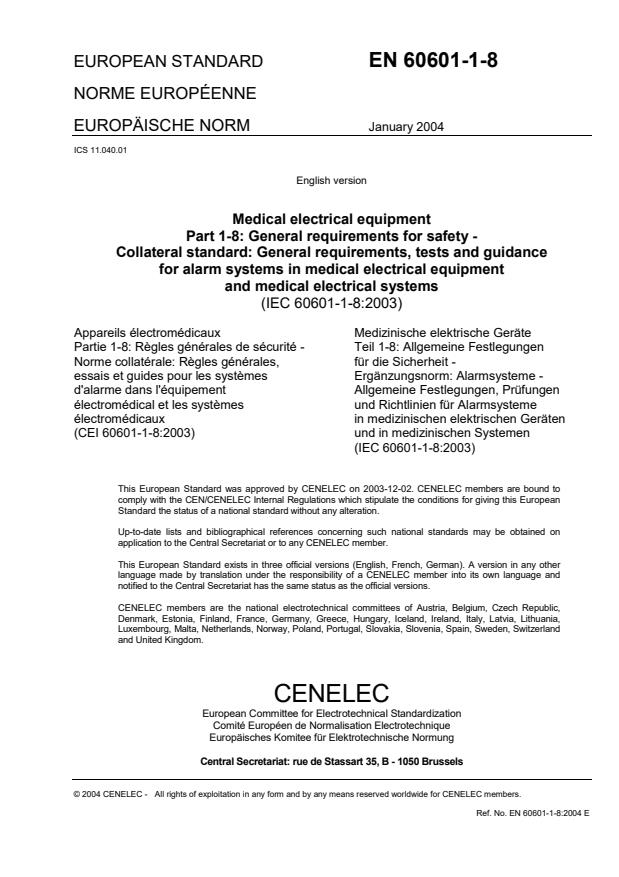
EUROPEAN STANDARD EN 60601-1-8
NORME EUROPÉENNE
EUROPÄISCHE NORM January 2004
ICS 11.040.01
English version
Medical electrical equipment
Part 1-8: General requirements for safety -
Collateral standard: General requirements, tests and guidance
for alarm systems in medical electrical equipment
and medical electrical systems
(IEC 60601-1-8:2003)
Appareils électromédicaux Medizinische elektrische Geräte
Partie 1-8: Règles générales de sécurité - Teil 1-8: Allgemeine Festlegungen
Norme collatérale: Règles générales, für die Sicherheit -
essais et guides pour les systèmes Ergänzungsnorm: Alarmsysteme -
d'alarme dans l'équipement Allgemeine Festlegungen, Prüfungen
électromédical et les systèmes und Richtlinien für Alarmsysteme
électromédicaux in medizinischen elektrischen Geräten
(CEI 60601-1-8:2003) und in medizinischen Systemen
(IEC 60601-1-8:2003)
This European Standard was approved by CENELEC on 2003-12-02. CENELEC members are bound to
comply with the CEN/CENELEC Internal Regulations which stipulate the conditions for giving this European
Standard the status of a national standard without any alteration.
Up-to-date lists and bibliographical references concerning such national standards may be obtained on
application to the Central Secretariat or to any CENELEC member.
This European Standard exists in three official versions (English, French, German). A version in any other
language made by translation under the responsibility of a CENELEC member into its own language and
notified to the Central Secretariat has the same status as the official versions.
CENELEC members are the national electrotechnical committees of Austria, Belgium, Czech Republic,
Denmark, Estonia, Finland, France, Germany, Greece, Hungary, Iceland, Ireland, Italy, Latvia, Lithuania,
Luxembourg, Malta, Netherlands, Norway, Poland, Portugal, Slovakia, Slovenia, Spain, Sweden, Switzerland
and United Kingdom.
CENELEC
European Committee for Electrotechnical Standardization
Comité Européen de Normalisation Electrotechnique
Europäisches Komitee für Elektrotechnische Normung
Central Secretariat: rue de Stassart 35, B - 1050 Brussels
© 2004 CENELEC - All rights of exploitation in any form and by any means reserved worldwide for CENELEC members.
Ref. No. EN 60601-1-8:2004 E
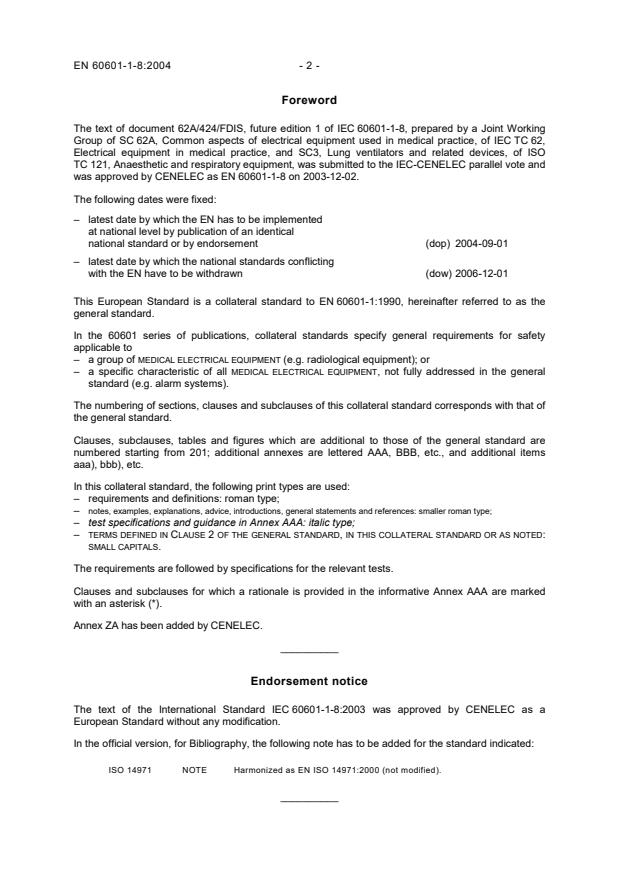
Foreword
The text of document 62A/424/FDIS, future edition 1 of IEC 60601-1-8, prepared by a Joint Working
Group of SC 62A, Common aspects of electrical equipment used in medical practice, of IEC TC 62,
Electrical equipment in medical practice, and SC3, Lung ventilators and related devices, of ISO
TC 121, Anaesthetic and respiratory equipment, was submitted to the IEC-CENELEC parallel vote and
was approved by CENELEC as EN 60601-1-8 on 2003-12-02.
The following dates were fixed:
– latest date by which the EN has to be implemented
at national level by publication of an identical
national standard or by endorsement (dop) 2004-09-01
– latest date by which the national standards conflicting
(dow) 2006-12-01
with the EN have to be withdrawn
This European Standard is a collateral standard to EN 60601-1:1990, hereinafter referred to as the
general standard.
In the 60601 series of publications, collateral standards specify general requirements for safety
applicable to
– a group of MEDICAL ELECTRICAL EQUIPMENT (e.g. radiological equipment); or
– a specific characteristic of all MEDICAL ELECTRICAL EQUIPMENT, not fully addressed in the general
standard (e.g. alarm systems).
The numbering of sections, clauses and subclauses of this collateral standard corresponds with that of
the general standard.
Clauses, subclauses, tables and figures which are additional to those of the general standard are
numbered starting from 201; additional annexes are lettered AAA, BBB, etc., and additional items
aaa), bbb), etc.
In this collateral standard, the following print types are used:
– requirements and definitions: roman type;
– notes, examples, explanations, advice, introductions, general statements and references: smaller roman type;
– test specifications and guidance in Annex AAA: italic type;
– TERMS DEFINED IN CLAUSE 2 OF THE GENERAL STANDARD, IN THIS COLLATERAL STANDARD OR AS NOTED:
SMALL CAPITALS.
The requirements are followed by specifications for the relevant tests.
Clauses and subclauses for which a rationale is provided in the informative Annex AAA are marked
with an asterisk (*).
Annex ZA has been added by CENELEC.
__________
Endorsement notice
The text of the International Standard IEC 60601-1-8:2003 was approved by CENELEC as a
European Standard without any modification.
In the official version, for Bibliography, the following note has to be added for the standard indicated:
ISO 14971 NOTE Harmonized as EN ISO 14971:2000 (not modified).
__________
- 3 - EN 60601-1-8:2004
Annex ZA
(normative)
Normative references to international publications
with their corresponding European publications
The following referenced documents are indispensable for the application of this document. For dated
references, only the edition cited applies. For undated references, the latest edition of the referenced
document (including any amendments) applies.
NOTE When an international publication has been modified by common modifications, indicated by (mod), the relevant
EN/HD applies.
Publication Year Title EN/HD Year
IEC 60417 database Graphical symbols for use on equipment - -
IEC 60601-1 1988 Medical electrical equipment EN 60601-1 1990
Part 1: General requirements for safety + corr. July 1994
A1 1991 A1 1993
+ corr. July 1994
A2 1995 A2 1995
+ corr. June 1995
A13 1996
IEC 60601-1-1 2000 Medical electrical equipment EN 60601-1-1 2001
Part 1-1: General requirements for
safety - Collateral standard: Safety
requirements for medical electrical
systems
1)
IEC 60601-1-6 - Part 1-6: General requirements for - -
safety - Collateral standard: Usability
IEC 60651 1979 Sound level meters EN 60651 1994
A1 1993 A1 1994
A2 2000 A2 2001
ISO 3744 1994 Acoustics - Determination of sound EN ISO 3744 1999
power levels of noise sources using
sound pressure - Engineering method in
an essentially free field over a reflecting
plane
ISO 7000 1989 Graphical symbols for use on equipment - -
- Index and synopsis
1)
To be published.
NORME CEI
INTERNATIONALE
IEC
60601-1-8
INTERNATIONAL
Première édition
STANDARD
First edition
2003-08
Appareils électromédicaux –
Partie 1-8:
Règles générales de sécurité – Norme collatérale:
Règles générales, essais et recommandations
pour les systèmes d'alarme des appareils et
des systèmes électromédicaux
Medical electrical equipment –
Part 1-8:
General requirements for safety – Collateral
Standard: General requirements, tests and
guidance for alarm systems in medical electrical
equipment and medical electrical systems
IEC 2005 Droits de reproduction réservés Copyright - all rights reserved
Aucune partie de cette publication ne peut être reproduite ni No part of this publication may be reproduced or utilized in any
utilisée sous quelque forme que ce soit et par aucun procédé, form or by any means, electronic or mechanical, including
électronique ou mécanique, y compris la photocopie et les photocopying and microfilm, without permission in writing from
microfilms, sans l'accord écrit de l'éditeur. the publisher.
International Electrotechnical Commission, 3, rue de Varembé, PO Box 131, CH-1211 Geneva 20, Switzerland
Telephone: +41 22 919 02 11 Telefax: +41 22 919 03 00 E-mail: inmail@iec.ch Web: www.iec.ch
CODE PRIX
XC
PRICE CODE
Pour prix, voir catalogue en vigueur
For price, see current catalogue
60601-1-8 IEC:2005 – 3 –
CONTENTS
FOREWORD.7
INTRODUCTION.11
SECTION ONE – GENERAL
1 * Scope and object .13
1.201 Scope .13
1.202 Object .13
1.203 Relationship to other standards.13
1.203.1 IEC 60601-1.13
1.203.2 Particular standards.15
1.203.3 Normative references.15
2 Terminology and definitions.15
6 Identification, marking and documents.23
6.3 Marking of controls and instruments.23
6.7 Indicator lights and push-buttons .23
6.8.1 ACCOMPANYING DOCUMENTS.25
6.8.2 Instructions for use.25
6.8.3 Technical description.25
SECTION TWO TO TEN – NOT USED
201 ALARM SYSTEMS.25
201.1 * ALARM CONDITION .25
201.1.1 * General .25
201.1.2 * ALARM CONDITION priority.27
201.2 * Disclosures for INTELLIGENT ALARM SYSTEM .27
201.3 Generation of ALARM SIGNALS.29
201.3.1 General .29
201.3.2 * Visual ALARM SIGNALS .29
201.3.3 * Auditory ALARM SIGNALS.31
201.3.4 * Characteristics of verbal ALARM SIGNALS.37
201.4 * Disclosure of delays .39
201.4.1 * ALARM SYSTEM delays.39
201.4.2 * Delays to or from a DISTRIBUTED ALARM SYSTEM .39
201.5 ALARM PRESETS .39
201.5.1 General requirements.39
201.5.2 Manufacturer-configured ALARM PRESETS .41
201.5.3 * USER- and OPERATOR-configured ALARM PRESETS .41
201.5.4 DEFAULT ALARM PRESET .43
201.5.5 * Interruptions of less than or equal to 30 s .45
201.6 ALARM LIMIT .45
201.6.1 General requirements.45
201.6.2 * Adjustable ALARM LIMIT .45
201.7 * ALARM SYSTEM security.47
201.8 * ALARM SIGNAL inactivation states .47
201.8.1 * General.47
201.8.2 * Termination of inactivation of ALARM SIGNALS .49
60601-1-8 IEC:2005 – 5 –
201.8.3 * Indication and access.49
201.9 * ALARM RESET.51
201.10 * NON-LATCHING and LATCHING ALARM SIGNALS.51
201.11 * DISTRIBUTED ALARM SYSTEM.51
201.11.1 * Existence OF DISTRIBUTED ALARM SYSTEM .51
201.11.2 Requirements for DISTRIBUTED ALARM SYSTEM communication of
ALARM CONDITIONS.53
201.12 * ALARM CONDITION logging.53
Appendix D (normative) Symbols on marking .55
Annex AAA (informative) Rationale and guidance .65
Annex BBB (informative) Cross-reference of identification, marking, and documents .131
Annex CCC (informative) Guidance for auditory ALARM SIGNALS.139
Annex DDD (informative) Verbal ALARM SIGNALS.141
Annex EEE (normative) Reserved melodies for ALARM SIGNALS.147
Bibliography.149
Index of defined terms .153
Figure 201 – Illustration of temporal characteristics of auditory ALARM SIGNALS .35
Figure AAA.1 – Graphical representation of components of ALARM SYSTEM delay .101
Table 201 – ALARM CONDITION priorities.27
Table 202 – Characteristics of alarm indicator lights .29
Table 203 – Characteristics of the BURST of auditory ALARM SIGNALS.33
Table 204 – Characteristics of the PULSE of auditory ALARM SIGNALS .33
Table 205 – ALARM SIGNAL inactivation states .49
Table D.201 – Graphical symbols for ALARM SYSTEMS .57
Table D.202 – Alternative ALARM SYSTEM related markings .63
Table AAA.1 – Reference interpretation of Table EEE.1.127
Table AAA.2 – Reference interpretation of Table EEE.2.129
Table BBB.1 – Cross-reference of Marking .131
Table BBB.2 – Cross-reference of ACCOMPANYING DOCUMENTS .133
Table BBB.3 – Cross-reference of instructions for use .135
Table BBB.4 – Cross-reference of technical description.137
Table CCC.1 – Attributes of perceived urgency.139
Table EEE.1 – Equipment encoded auditory ALARM SIGNALS categorized by ALARM
CONDITION and priority complying with Tables 203 and 204 .147
Table EEE.2 – Auditory LOW PRIORITY ALARM SIGNAL complying with Tables 203 and 204 .147
60601-1-8 IEC:2005 – 7 –
INTERNATIONAL ELECTROTECHNICAL COMMISSION
___________
MEDICAL ELECTRICAL EQUIPMENT –
Part 1-8: General requirements for safety – Collateral Standard:
General requirements, tests and guidance for alarm systems
in medical electrical equipment and medical electrical systems
FOREWORD
1) The International Electrotechnical Commission (IEC) is a worldwide organization for standardization comprising
all national electrotechnical committees (IEC National Committees). The object of IEC is to promote
international co-operation on all questions concerning standardization in the electrical and electronic fields. To
this end and in addition to other activities, IEC publishes International Standards, Technical Specifications,
Technical Reports, Publicly Available Specifications (PAS) and Guides (hereafter referred to as “IEC
Publication(s)”). Their preparation is entrusted to technical committees; any IEC National Committee interested
in the subject dealt with may participate in this preparatory work. International, governmental and non-
governmental organizations liaising with the IEC also participate in this preparation. IEC collaborates closely
with the International Organization for Standardization (ISO) in accordance with conditions determined by
agreement between the two organizations.
2) The formal decisions or agreements of IEC on technical matters express, as nearly as possible, an international
consensus of opinion on the relevant subjects since each technical committee has representation from all
interested IEC National Committees.
3) IEC Publications have the form of recommendations for international use and are accepted by IEC National
Committees in that sense. While all reasonable efforts are made to ensure that the technical content of IEC
Publications is accurate, IEC cannot be held responsible for the way in which they are used or for any
misinterpretation by any end user.
4) In order to promote international uniformity, IEC National Committees undertake to apply IEC Publications
transparently to the maximum extent possible in their national and regional publications. Any divergence
between any IEC Publication and the corresponding national or regional publication shall be clearly indicated in
the latter.
5) IEC provides no marking procedure to indicate its approval and cannot be rendered responsible for any
equipment declared to be in conformity with an IEC Publication.
6) All users should ensure that they have the latest edition of this publication.
7) No liability shall attach to IEC or its directors, employees, servants or agents including individual experts and
members of its technical committees and IEC National Committees for any personal injury, property damage or
other damage of any nature whatsoever, whether direct or indirect, or for costs (including legal fees) and
expenses arising out of the publication, use of, or reliance upon, this IEC Publication or any other IEC
Publications.
8) Attention is drawn to the Normative references cited in this publication. Use of the referenced publications is
indispensable for the correct application of this publication.
9) Attention is drawn to the possibility that some of the elements of this IEC Publication may be the subject of
patent rights. IEC shall not be held responsible for identifying any or all such patent rights.
International standard IEC 60601-1-8 has been prepared by a Joint Working Group of IEC
subcommittee 62A: Common aspects of electrical equipment used in medical practice, of
IEC technical committee 62: Electrical equipment in medical practice, and ISO subcommittee
SC3: Lung ventilators and related devices of ISO technical committee 121: Anaesthetic and
respiratory equipment.
It is published as double logo standard.
This first edition constitutes a collateral standard to IEC 60601-1: Medical electrical
equipment – Part 1: General requirements for safety, hereinafter referred to as the general
standard.
This bilingual version (2005-08) replaces the English version.
60601-1-8 IEC:2005 – 9 –
This standard replaces the following standards:
ISO 9703-1 Anesthesia and respiratory care alarm signals – Part 1: Visual alarm signals
ISO 9703-2 Anesthesia and respiratory care alarm signals – Part 2: Auditory alarm signals
ISO 9703-3 Anesthesia and respiratory care alarm signals – Part 3: Guidance on
application of alarms
NOTE This standard is intended to replace other national and regional standards, such as EN 475 Medical
devices – Electrically generated alarm signals.
The text of this collateral standard is based on the following documents:
FDIS Report on voting
62A/424/FDIS 62A/432/RVD
Full information on the voting for the approval of this standard can be found in the report on
voting indicated in the above table. In ISO, the standard has been approved by 16 P-members
out of 18 having cast a vote.
The French version of this standard has not been voted upon.
In the 60601 series of publications, collateral standards specify general requirements for
safety applicable to:
– a subgroup of MEDICAL ELECTRICAL EQUIPMENT (e.g. radiological equipment); or
– a specific characteristic of all MEDICAL ELECTRICAL EQUIPMENT, not fully addressed in the
general standard (e.g. alarm systems).
The numbering of sections, clauses and subclauses of this collateral standard corresponds
with that of the general standard.
Clauses, subclauses, tables, and figures which are additional to those of the general standard
are numbered starting from 201; additional annexes are lettered AAA, BBB, etc., and
additional items aaa), bbb), etc.
In this collateral standard, the following print types are used:
– requirements and definitions: roman type;
– notes, examples, explanations, advice, introductions, general statements and references: smaller roman type;
– test specifications and guidance in Annex AAA: italic type; and
– TERMS DEFINED IN CLAUSE 2 OF THE GENERAL STANDARD, IN THIS COLLATERAL STANDARD OR AS
NOTED: SMALL CAPITALS.
The requirements are followed by specifications for the relevant tests.
Clauses and subclauses for which a rationale is provided in informative Annex AAA are
marked with an asterisk (*).
The committee has decided that the contents of this publication will remain unchanged until
the maintenance result date indicated on the IEC web site under "http://webstore.iec.ch" in
the data related to the specific publication. At this date, the publication will be
• reconfirmed;
• withdrawn;
• replaced by a revised edition, or
• amended.
60601-1-8 IEC:2005 – 11 –
INTRODUCTION
MEDICAL ELECTRICAL EQUIPMENT and MEDICAL ELECTRICAL SYSTEMS are increasingly used in
medical practice. ALARM SIGNALS are frequently used to indicate unsatisfactory physiological
PATIENT states, unsatisfactory functional states of the MEDICAL ELECTRICAL EQUIPMENT or
MEDICAL ELECTRICAL SYSTEM or to warn the OPERATOR of potential hazards to the PATIENT or
OPERATOR due to the MEDICAL ELECTRICAL EQUIPMENT or MEDICAL ELECTRICAL SYSTEM.
INFORMATION SIGNALS convey information that is independent of an ALARM CONDITION.
Surveys of healthcare personnel have indicated significant discontent with ALARM SIGNALS.
Problems include difficulty in identifying the source of an ALARM SIGNAL, loud and distracting
)
ALARM SIGNALS, and the high incidence of FALSE POSITIVE or NEGATIVE ALARM CONDITIONS [16] .
Surveys of manufacturers of medical monitors demonstrated a wide variety of DEFAULT ALARM
PRESETS. The leading reason for disabling ALARM SIGNALS is the large number of ALARM
SIGNALS associated with FALSE POSITIVE ALARM CONDITIONS. See also bibliography.
Safety of PATIENTS depends on the ability of the OPERATOR to correctly discern the
characteristics of ALARM SIGNALS. Usability is an important element in the design of ALARM
SIGNALS that are readily discernible without being unnecessarily distracting or disturbing. This
approach is intended to rationalize the current situation, to reduce confusion by limiting
proliferation of ALARM SIGNALS and their control states, and to minimize distraction for other
people. This collateral standard was developed with contributions from clinicians, engineers
and applied psychologists.
The terminology, requirements, general recommendations and guidance of this collateral
standard are intended to be useful for manufacturers of MEDICAL ELECTRICAL EQUIPMENT and
MEDICAL ELECTRICAL SYSTEMS and for technical committees responsible for particular
standards.
The effectiveness of any ALARM SYSTEM depends critically on its implementation by the USER.
It is important that the USER configure the ALARM SYSTEM so that an OPERATOR is not able to
compromise it.
___________
1)
Figures in brackets refer to the bibliography.
60601-1-8 IEC:2005 – 13 –
MEDICAL ELECTRICAL EQUIPMENT –
Part 1-8: General requirements for safety – Collateral Standard:
General requirements, tests and guidance for alarm systems
in medical electrical equipment and medical electrical systems
SECTION ONE – GENERAL
1 * Scope and object
1.201 Scope
This collateral standard specifies requirements for ALARM SYSTEMS and ALARM SIGNALS in
MEDICAL ELECTRICAL EQUIPMENT and MEDICAL ELECTRICAL SYSTEMS.
It also provides guidance for the application of ALARM SYSTEMS.
1.202 Object
The object of this collateral standard is to specify basic safety and essential performance
requirements and tests for ALARM SYSTEMS in MEDICAL ELECTRICAL EQUIPMENT and MEDICAL
ELECTRICAL SYSTEMS and to provide guidance for their application. This is accomplished by
defining alarm categories (priorities) by degree of urgency, consistent ALARM SIGNALS and
consistent control states and their marking for all ALARM SYSTEMS.
NOTE See IEC 60513:1994 [4] for a description of basic safety and essential performance.
This collateral standard does not specify:
– whether any particular MEDICAL ELECTRICAL EQUIPMENT or MEDICAL ELECTRICAL SYSTEM is
required to be provided with ALARM SYSTEMS;
– the particular circumstances which initiate an ALARM CONDITION;
– the allocation of priorities to a particular ALARM CONDITION; or
– the means of generating ALARM SIGNALS.
1.203 Relationship to other standards
1.203.1 IEC 60601-1
For MEDICAL ELECTRICAL EQUIPMENT, this collateral standard complements IEC 60601-1.
When referring to IEC 60601-1 or to this collateral standard, either individually or in
combination, the following conventions are used:
– "the general standard" designates IEC 60601-1 alone;
– "this collateral standard" designates IEC 60601-1-8 alone;
– "this standard" designates the combination of the general standard and this collateral
standard.
60601-1-8 IEC:2005 – 15 –
1.203.2 Particular standards
A requirement in a particular standard takes priority over the corresponding requirement in
this collateral standard.
1.203.3 Normative references
The following referenced documents are indispensable for the application of this document.
For dated references, only the edition cited applies. For undated references, the latest edition
of the referenced document (including any amendments) applies.
2)
IEC 60417-DB:2002 , Graphical symbols for use on equipment
IEC 60601-1:1988 Medical electrical equipment – Part 1: General requirements for safety
Amendment 1 (1991)
Amendment 2 (1995)
IEC 60601-1-1:2000, Medical electrical equipment – Part 1-1: General requirements for safety
– Collateral standard: Safety requirements for medical electrical systems
IEC 60601-1-6, Medical electrical equipment – Part 1-6: General requirements for safety –
Collateral standard: Usability
3)
IEC 60651:1979 , Sound level meters
Amendment 1 (1993)
Amendment 2 (2000)
ISO 3744:1994, Acoustics – Determination of sound power levels of noise sources using
sound pressure – Engineering method in an essentially free field over a reflecting plane
ISO 7000:1989, Graphical symbols for use on equipment – Index and synopsis
2 Terminology and definitions
4)
For the purposes of this collateral standard, the following definitions apply.
NOTE This collateral standard uses the term “equipment” to mean MEDICAL ELECTRICAL EQUIPMENT or non-MEDICAL
ELECTRICAL EQUIPMENT in the context of a MEDICAL ELECTRICAL SYSTEM.
2.201
* ALARM CONDITION
state of the ALARM SYSTEM when it has determined that a potential or actual hazard exists
NOTE 1 An ALARM CONDITION can be invalid, i.e. a FALSE POSTIVE ALARM CONDITION.
NOTE 2 An ALARM CONDITION can be missed, i.e. a FALSE NEGATIVE ALARM CONDITION.
___________
2)
“DB” refers to the IEC on-line database.
3)
A consolidated edition (1.2) exists including IEC 60651 (1979), its Amendment 1 (1993) and its Amendment 2
(2000).
4)
An index of defined terms is found beginning on page 153.
60601-1-8 IEC:2005 – 17 –
2.202
* ALARM CONDITION DELAY
time from the occurrence of a triggering event either in the PATIENT, for PHYSIOLOGICAL ALARM
CONDITIONS, or in the equipment, for TECHNICAL ALARM CONDITIONS, to when the ALARM SYSTEM
determines that an ALARM CONDITION exists
2.203
* ALARM LIMIT
threshold used by an ALARM SYSTEM to determine an ALARM CONDITION
2.204
ALARM OFF
state of indefinite duration in which an ALARM SYSTEM or part of an ALARM SYSTEM does not
generate ALARM SIGNALS
2.205
* ALARM PAUSED
state of limited duration in which the ALARM SYSTEM or part of the ALARM SYSTEM does not
generate ALARM SIGNALS
2.206
ALARM PRESET
set of stored configuration parameters, including selection of algorithms and initial values for
use by algorithms, which affect or modify the performance of the ALARM SYSTEM
2.207
ALARM RESET
OPERATOR action that causes the cessation of an ALARM SIGNAL for which no associated ALARM
CONDITION currently exists
2.208
ALARM SETTINGS
ALARM SYSTEM configuration, including but not limited to:
– ALARM LIMITS;
– the characteristics of any ALARM SIGNAL inactivation states; and
– the values of variables or parameters that determine the function of the ALARM SYSTEM.
NOTE Some algorithmically determined ALARM SETTINGS can require time to be determined or re-determined.
2.209
ALARM SIGNAL
type of signal generated by the ALARM SYSTEM to indicate the presence (or occurrence) of an
ALARM CONDITION
2.210
* ALARM SIGNAL GENERATION DELAY
time from the onset of an ALARM CONDITION to the generation of its ALARM SIGNALS
2.211
ALARM SYSTEM
parts of MEDICAL ELECTRICAL EQUIPMENT or a MEDICAL ELECTRICAL SYSTEM that detect ALARM
CONDITIONS and, as appropriate, generate ALARM SIGNALS
60601-1-8 IEC:2005 – 19 –
2.212
AUDIO OFF
state of indefinite duration in which the ALARM SYSTEM or part of the ALARM SYSTEM does not
generate an auditory ALARM SIGNAL
2.213
AUDIO PAUSED
state of limited duration in which the ALARM SYSTEM or part of the ALARM SYSTEM does not
generate an auditory ALARM SIGNAL
2.214
BURST
group of PULSES with a distinctive rhythm or pattern
2.215
DE-ESCALATION
process by which an ALARM SYSTEM decreases the priority of an ALARM CONDITION or decreases
the sense of urgency of an ALARM SIGNAL
2.216
DEFAULT ALARM PRESET
ALARM PRESET that can be activated by the ALARM SYSTEM without OPERATOR action
NOTE Manufacturer- or USER-configured ALARM PRESETS are possible types of DEFAULT ALARM PRESETS.
2.217
* DISTRIBUTED ALARM SYSTEM
ALARM SYSTEM that involves more than one item of equipment of a MEDICAL ELECTRICAL SYSTEM
NOTE The parts of a DISTRIBUTED ALARM SYSTEM can be widely separated in distance.
2.218
ESCALATION
process by which an ALARM SYSTEM increases the priority of an ALARM CONDITION or increases
the sense of urgency of an ALARM SIGNAL
2.219
FALL TIME
t
f
interval over which the PULSE amplitude decreases from 90 % to 10 % of its maximum (see
Figure 201)
2.220
FALSE NEGATIVE ALARM CONDITION
absence of an ALARM CONDITION when a valid triggering event has occurred in the PATIENT, the
equipment or the ALARM SYSTEM
NOTE An ALARM CONDITION can be rejected or missed because of spurious information produced by the PATIENT,
the PATIENT-equipment interface, other equipment or the equipment itself.
2.221
FALSE POSITIVE ALARM CONDITION
presence of an ALARM CONDITION when no valid triggering event has occurred in the PATIENT,
the equipment or the ALARM SYSTEM
NOTE A FALSE POSITIVE ALARM CONDITION can be caused by spurious information produced by the PATIENT, the
PATIENT-equipment interface, other equipment or the ALARM SYSTEM itself.
60601-1-8 IEC:2005 – 21 –
2.222
HIGH PRIORITY
indicating that immediate OPERATOR response is required
NOTE The priority is assigned through risk analysis.
2.223
* INFORMATION SIGNAL
any signal that is not an ALARM SIGNAL or a REMINDER SIGNAL
EXAMPLE 1 ECG waveform
EXAMPLE 2 SpO tone
EXAMPLE 3 Fluoroscopy beam-on indication
2.224
* INTELLIGENT ALARM SYSTEM
ALARM SYSTEM that makes logical decisions based on monitored information without OPERATOR
intervention
EXAMPLE 1 An ALARM SYSTEM that changes priority based on the rate of change of a monitored variable.
EXAMPLE 2 An ALARM SYSTEM that suppresses an ALARM CONDITION when a related ALARM CONDITION of higher
priority has recently generated an ALARM SIGNAL.
2.225
INTERBURST INTERVAL
t
b
period of time between the end of the last PULSE of a BURST and the start of the first PULSE of
the next BURST of the same ALARM SIGNAL (see Figure 201)
2.226
LATCHING ALARM SIGNAL
ALARM SIGNAL that continues to be generated after its triggering event no longer exists until
stopped by deliberate OPERATOR action
2.227
LOW PRIORITY
indicating that OPERATOR awareness is required
NOTE The priority is assigned through risk analysis.
2.228
MEDIUM PRIORITY
indicating that prompt OPERATOR response is required
NOTE The priority is assigned through risk analysis.
2.229
NON-LATCHING ALARM SIGNAL
ALARM SIGNAL that automatically stops being generated when its associated triggering event
no longer exists
2.230
OPERATOR'S POSITION
intended position of the OPERATOR with respect to the ALARM SIGNAL generating part of the
ALARM SYSTEM
NOTE A DISTRIBUTED ALARM SYSTEM can have multiple OPERATOR’S POSITIONS.
2.231
PHYSIOLOGICAL ALARM CONDITION
ALARM CONDITION arising from a monitored PATIENT-related variable
60601-1-8 IEC:2005 – 23 –
EXAMPLE 1 High exhaled anesthetic agent concentration.
EXAMPLE 2 Low exhaled tidal volume.
EXAMPLE 3 Low oxygen saturation measured by pulse oximetry.
EXAMPLE 4 High arterial pressure.
EXAMPLE 5 High heart rate.
2.232
PULSE
brief continuous sound having a specific spectral content
2.233
PULSE FREQUENCY
f
o
fundamental frequency (first harmonic) of a PULSE
2.234
* REMINDER SIGNAL
periodic signal that reminds the OPERATOR that the ALARM SYSTEM is in an ALARM SIGNAL-
inactivation state
2.235
RISE TIME
t
r
interval over which the PULSE increases from 10% to 90% of its maximum amplitude (see
Figure 201)
2.236
TECHNICAL ALARM CONDITION
ALARM CONDITION arising from a monitored equipment-related or ALARM SYSTEM-related
variable
EXAMPLE 1 An electrical, mechanical or other failure.
EXAMPLE 2 A failure of a sensor or component (unsafe voltage, high impedance, signal impedance, artifact,
noisy signal, disconnection, calibration error, tubing obstruction, etc.).
EXAMPLE 3 An algorithm that cannot classify or resolve the available data.
6 Identification, marking and documents
6.3 Marking of controls and instruments
Addition:
NOTE Additional requirements for the marking on controls and instruments are specified in this collateral
standard, together with the technical requirements, giving rise to requirements on markings. These requirements
are also listed in BBB.1.
6.7 Indicator lights and push-buttons
a) Colors of indicator lights
Addition, after the first sentence:
See also 201.3.2.2.
Addition, after the second sentence:
See also 201.3.2.2.
60601-1-8 IEC:2005 – 25 –
6.8.1 ACCOMPANYING DOCUMENTS
Addition:
NOTE Additional requirements on ACCOMPANYING DOCUMENTS are specified in this collateral standard, together
with the technical requirements, giving rise to requirements on ACCOMPANYING DOCUMENTS. These requirements are
also listed in Table BBB.2.
6.8.2 Instructions for use
Addition:
aaa) ALARM SYSTEMS
Instructions for use shall:
− * provide an overview of the ALARM SYSTEM, including a listing and description of every
possible ALARM CONDITION and, as appropriate for the intended OPERATOR, a summary of
how it is determined;
− indicate any delay inherent in the determination of an ALARM CONDITION;
− disclose the OPERATOR'S POSITION; and
− * include how and when to verify the functionality of the ALARM SYSTEM.
As applicable, the instructions for use shall:
− caution against setting ALARM LIMITS to extreme values that can render the ALARM SYSTEM
useless.
NOTE Additional requirements on instructions for use are specified in this collateral standard, together with the
technical requirements, giving rise to requirements on instructions for use. These requirements are also listed in
Table BBB.3.
6.8.3 Technical description
Addition:
NOTE Additional requirements on technical description are specified in this collateral standard, together with the
technical requirements, giving rise to requirements on technical description. These requirements are also listed in
Table BBB.4.
SECTION TWO TO TEN – NOT USED
Addition:
201 ALARM SYSTEMS
201.1 * ALARM CONDITION
201.1.1 * General
If ALARM CONDITIONS are grouped into PHYSIOLOGICAL ALARM CONDITIONS, TECHNICAL ALARM
CONDITIONS or other ALARM CONDITION groups by the manufacturer, this shall be disclosed in
the instructions for use.
Compliance is checked by inspection of the instructions for use.
60601-1-8 IEC:2005 – 27 –
201.1.2 * ALARM CONDITION priority
ALARM CONDITIONS shall be assigned to one or more of the following priorities: HIGH PRIORITY,
MEDIUM PRIORITY, or LOW PRIORITY. Unless a particular ALARM CONDITION priority is specified in
a relevant particular standard, the assignment of priorities is part of the risk management
process and shall be based on Table 201. The priority of each ALARM CONDITION shall be
disclosed in the instructions for use. Priorities may be identified in groups.
NOTE A risk management process for medical devices is given in ISO 14971.
Compliance is checked by inspection of the instructions for use and risk management file.
Table 201 – ALARM CONDITION priorities
a
Potential result of failure Onset of potential harm
to respond to the cause
b c d
Immediate Prompt Delayed
of ALARM CONDITION
e
Death or irreversible injury HIGH PRIORITY HIGH PRIORITY MEDIUM PRIORITY
Reversible injury HIGH PRIORITY MEDIUM PRIORITY LOW PRIORITY
Minor injury or discomfort MEDIUM PRIORITY LOW PRIORITY LOW PRIORITY
or no ALARM SIGNAL
An INFORMATION SIGNAL may also be used to indicate the potential for delayed minor injury or discomfort.
a
Onset of potential harm refers to when an injury occurs and not to when it is manifested.
b
Having the potential for the event to develop within a period of time not usually sufficient for manual corrective
action.
c
Having the potential for the event to develop within a period of time usually sufficient for manual corrective
action.
d
Having the potential for the event to develop within an unspecified time greater than that given under “prompt”.
e
MEDICAL ELECTRICAL EQUIPMENT with a therapeutic function is usually designed to prevent immediate death or
irreversible injury by automatic safety mechanisms.
201.2 * Disclosures for INTELLIGENT ALARM SYSTEM
If an INTELLIGENT ALARM SYSTEM is provided, the instructions for use shall include, as
applicable, an overview of how the ALARM SYSTEM:
a) determines an ALARM CONDITION on the basis of time, weightings, multiple variables, or
other advanced processing (including, but not limited to, algorithms, neural networks,
fuzzy logic, etc.);
b) generates ALARM SIGNALS for two or more ALARM CONDITIONS of equal priority (including,
but not limited to, internal ranking, effect on generation of ALARM SIGNALS);
c) changes the previously-assigned priority or relative prioritization of a particular ALARM
CONDITION (e.g., ESCALATION or DE-ESCALATION);
d) changes the ALARM SIGNAL GENERATION DELAY or ALARM CONDITION DELAY; and
e) changes the characteristics of the generated ALARM SIGNALS (for example, volume, pitch,
tempo, urgency).
Compliance is checked by inspection of the instructions for use.
60601-1-8 IEC:2005 – 29 –
201.3 Generation of ALARM SIGNALS
201.3.1 General
Each ALARM CONDITION shall cause the generation of visual ALARM SIGNALS as specified in this
collateral standard. If deemed necessary by risk assessment regarding the environment in
which the ALARM SYSTEM is intended to be used, additional ALARM SIGNALS shall be generated.
These additional ALARM SIGNALS may be auditory, verbal, vibratory or produced by other
means.
EXAMPLE ALARM SYSTEMS with HIGH or MEDIUM PRIORITY ALARM CONDITIONS that are intended not to be
continuously attended by an OPERATOR in NORMAL USE should generate additional auditory ALARM SIGNALS.
Compliance is checked by inspection of the ALARM SYSTEM.
201.3.2 * Visual ALARM SIGNALS
201.3.2.1 General
ALARM SYSTEMS shall generate visual ALARM SIGNALS to indicate the presence of ALARM
CONDITIONS, their priority and each specific ALARM CONDITION.
201.3.2.2 * Characteristics of visual ALARM SIGNALS
If a visual indicator is necessary for the OPERATOR to identify the equipment or part of the
equipment that requires OPERATOR response or awareness, at least one visual ALARM SIGNAL
shall be provided that:
a) indicates the priority of the highest priority ALARM CONDITION; and
b) can be perceived correctly at a distance of 4 m from the ALARM SYSTEM.
If an alarm indicator light or graphical simulation of an indicator light is used for these
purposes, it shall comply with the color and flashing requirements given in Table 202.
Alternatively, this indication may be generated by some other type of visual display or device.
ALARM SYSTEMS that do not contain HIGH PRIORITY or MEDIUM PRIORITY ALARM CONDITIONS are
exempt from this requirement if their visual indication cannot be confused with a HIGH PRIORITY
or MEDIUM PRIORITY alarm indicator light complying with Table 202.
NOTE 1 This visual indicator is necessary for ALARM SYSTEMS that are intended to be located in the proximity of
other ALARM SYSTEMS.
NOTE 2 This visual indicator is not necessary for ALARM SYSTEMS that are worn, e.g., a paging receiver.
NOTE 3 An indicator light can be simulated, e.g. by a graphical display.
Table 202 – Characteristics of alarm indicator lights
Alarm Indicator Flashing Duty
category color frequency cycle
HIGH
Red 1,4 Hz to 2,8 Hz 20 % to 60 % on
PRIORITY
MEDIUM
Yellow 0,4 Hz to 0,8 Hz 20 % to 60 % on
PRIORITY
LOW Cyan or
Constant (on) 100 % on
PRIORITY yellow
...