

EN 13611:2007
(Main)Safety and control devices for gas burners and gas burning appliances - General requirements
- Abstract
This European Standard specifies safety, construction, and performance requirements and testing of safety control or regulating devices and sub-assemblies or fittings (hereafter referred to as controls) for burners and gas burning appliances using fuel gases of the first, second or third families and to their testing.
Controls to which this European Standard applies include the following:
- automatic shut-off valves;
- automatic burner control systems;
- flame supervision devices;
- Gas/air ratio controls;
- pressure regulators;
- manual taps;
- mechanical thermostats;
- multifunctional controls;
- pressure sensing devices;
- valve proving systems;
- zero governors.
The methods of test given in this standard are intended for product type testing.
For DC supplied controls Annex H applies.
NOTE 1 When no particular control standard exists, the control can be tested according to this standard and further tests taking into account the intended use.
NOTE 2 This European Standard is to be used in conjunction with the specific control standard (see bibliography) .
- Status
- Withdrawn
- Publication Date
- 13-Nov-2007
- Withdrawal Date
- 11-Oct-2011
- Current Stage
- 9960 - Withdrawal effective - Withdrawal
- Start Date
- 12-Oct-2011
- Completion Date
- 12-Oct-2011
- Directive
- 2009/142/EC - Appliances burning gaseous fuelsOJ Ref: C, C 349 OJ Date: 22-Dec-2010
90/396/EEC - Appliances burning gaseous fuelsOJ Ref: C, C 328 OJ Date: 23-Dec-2008
97/23/EC - Pressure equipmentOJ Ref: C, C 46 OJ Date: 25-Feb-2009

Relations
- Effective Date
- 22-Dec-2008
- Effective Date
- 22-Dec-2008
- Effective Date
- 18-Jan-2023
- Effective Date
- 28-Jan-2026
- Effective Date
- 28-Jan-2026
- Effective Date
- 28-Jan-2026
- Effective Date
- 28-Jan-2026
- Effective Date
- 28-Jan-2026
- Effective Date
- 28-Jan-2026
- Effective Date
- 28-Jan-2026
- Effective Date
- 28-Jan-2026
- Effective Date
- 28-Jan-2026
- Effective Date
- 28-Jan-2026
- Effective Date
- 22-Dec-2008
- Effective Date
- 03-Jul-2010
Get Certified
Connect with accredited certification bodies for this standard

Institut za varilstvo d.o.o. (Welding Institute)
Slovenia's leading welding institute since 1952. ISO 3834, EN 1090, pressure equipment certification, NDT personnel, welder qualification. Only IIW Au
Sponsored listings
Frequently Asked Questions
EN 13611:2007 is a standard published by the European Committee for Standardization (CEN). Its full title is "Safety and control devices for gas burners and gas burning appliances - General requirements". This standard covers: This European Standard specifies safety, construction, and performance requirements and testing of safety control or regulating devices and sub-assemblies or fittings (hereafter referred to as controls) for burners and gas burning appliances using fuel gases of the first, second or third families and to their testing. Controls to which this European Standard applies include the following: - automatic shut-off valves; - automatic burner control systems; - flame supervision devices; - Gas/air ratio controls; - pressure regulators; - manual taps; - mechanical thermostats; - multifunctional controls; - pressure sensing devices; - valve proving systems; - zero governors. The methods of test given in this standard are intended for product type testing. For DC supplied controls Annex H applies. NOTE 1 When no particular control standard exists, the control can be tested according to this standard and further tests taking into account the intended use. NOTE 2 This European Standard is to be used in conjunction with the specific control standard (see bibliography) .
This European Standard specifies safety, construction, and performance requirements and testing of safety control or regulating devices and sub-assemblies or fittings (hereafter referred to as controls) for burners and gas burning appliances using fuel gases of the first, second or third families and to their testing. Controls to which this European Standard applies include the following: - automatic shut-off valves; - automatic burner control systems; - flame supervision devices; - Gas/air ratio controls; - pressure regulators; - manual taps; - mechanical thermostats; - multifunctional controls; - pressure sensing devices; - valve proving systems; - zero governors. The methods of test given in this standard are intended for product type testing. For DC supplied controls Annex H applies. NOTE 1 When no particular control standard exists, the control can be tested according to this standard and further tests taking into account the intended use. NOTE 2 This European Standard is to be used in conjunction with the specific control standard (see bibliography) .
EN 13611:2007 is classified under the following ICS (International Classification for Standards) categories: 23.060.40 - Pressure regulators. The ICS classification helps identify the subject area and facilitates finding related standards.
EN 13611:2007 has the following relationships with other standards: It is inter standard links to EN 13611:2000/A1:2004, EN 13611:2000, EN 13611:2007+A2:2011, EN 1854:2010, EN 257:2010, EN 267:2009+A1:2011, EN 1106:2010, EN 14459:2007, EN 88-2:2007, EN 125:2010, EN 88-1:2011, EN 125:2010+A1:2015, EN 88-1:2011+A1:2016, EN 13611:2007/FprA1, EN 13611:2015. Understanding these relationships helps ensure you are using the most current and applicable version of the standard.
EN 13611:2007 is associated with the following European legislation: EU Directives/Regulations: 2009/142/EC, 90/396/EEC, 97/23/EC; Standardization Mandates: M/BC/CEN/89/6. When a standard is cited in the Official Journal of the European Union, products manufactured in conformity with it benefit from a presumption of conformity with the essential requirements of the corresponding EU directive or regulation.
EN 13611:2007 is available in PDF format for immediate download after purchase. The document can be added to your cart and obtained through the secure checkout process. Digital delivery ensures instant access to the complete standard document.
Standards Content (Sample)
2003-01.Slovenski inštitut za standardizacijo. Razmnoževanje celote ali delov tega standarda ni dovoljeno.Varnostne in nadzorne naprave za plinske gorilnike in plinske aparate - Splošne zahteveSicherheits-, Regel- und Steuereinrichtungen für Gasbrenner und Gasgeräte - Allgemeine AnforderungenEquipements auxiliaires pour bruleurs a gaz et appareils et appareils a gaz - Exigences généralesSafety and control devices for gas burners and gas burning appliances - General requirements27.060.20Plinski gorilnikiGas fuel burners23.060.40Pressure regulatorsICS:Ta slovenski standard je istoveten z:EN 13611:2007SIST EN 13611:2008en,fr,de01-december-2005SIST EN 13611:2008SLOVENSKI
STANDARDSIST EN 13611:2002/A1:2005SIST EN 13611:20021DGRPHãþD
EUROPEAN STANDARDNORME EUROPÉENNEEUROPÄISCHE NORMEN 13611November 2007ICS 23.060.40Supersedes EN 13611:2000
English VersionSafety and control devices for gas burners and gas burningappliances - General requirementsEquipements auxiliaires pour brûleurs à gaz et appareils àgaz - Exigences généralesSicherheits-, Regel- und Steuereinrichtungen fürGasbrenner und Gasgeräte - Allgemeine AnforderungenThis European Standard was approved by CEN on 7 October 2007.CEN members are bound to comply with the CEN/CENELEC Internal Regulations which stipulate the conditions for giving this EuropeanStandard the status of a national standard without any alteration. Up-to-date lists and bibliographical references concerning such nationalstandards may be obtained on application to the CEN Management Centre or to any CEN member.This European Standard exists in three official versions (English, French, German). A version in any other language made by translationunder the responsibility of a CEN member into its own language and notified to the CEN Management Centre has the same status as theofficial versions.CEN members are the national standards bodies of Austria, Belgium, Bulgaria, Cyprus, Czech Republic, Denmark, Estonia, Finland,France, Germany, Greece, Hungary, Iceland, Ireland, Italy, Latvia, Lithuania, Luxembourg, Malta, Netherlands, Norway, Poland, Portugal,Romania, Slovakia, Slovenia, Spain, Sweden, Switzerland and United Kingdom.EUROPEAN COMMITTEE FOR STANDARDIZATIONCOMITÉ EUROPÉEN DE NORMALISATIONEUROPÄISCHES KOMITEE FÜR NORMUNGManagement Centre: rue de Stassart, 36
B-1050 Brussels© 2007 CENAll rights of exploitation in any form and by any means reservedworldwide for CEN national Members.Ref. No. EN 13611:2007: ESIST EN 13611:2008
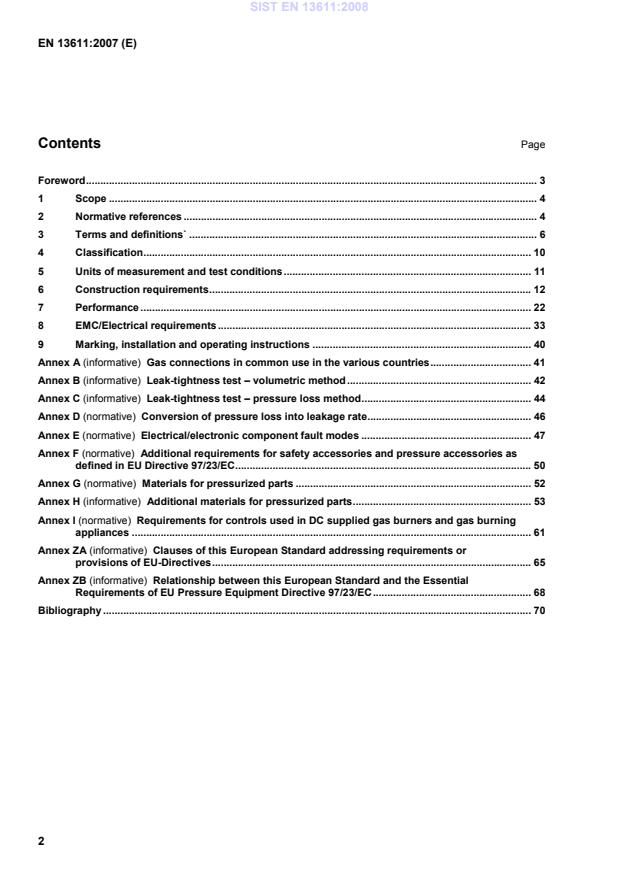
Gas connections in common use in the various countries.41 Annex B (informative)
Leak-tightness test – volumetric method.42 Annex C (informative)
Leak-tightness test – pressure loss method.44 Annex D (normative)
Conversion of pressure loss into leakage rate.46 Annex E (normative)
Electrical/electronic component fault modes.47 Annex F (normative)
Additional requirements for safety accessories and pressure accessories as defined in EU Directive 97/23/EC.50 Annex G (normative)
Materials for pressurized parts.52 Annex H (informative)
Additional materials for pressurized parts.53 Annex I (normative)
Requirements for controls used in DC supplied gas burners and gas burning appliances.61 Annex ZA (informative)
Clauses of this European Standard addressing requirements or provisions of EU-Directives.65 Annex ZB (informative)
Relationship between this European Standard and the Essential Requirements of EU Pressure Equipment Directive 97/23/EC.68 Bibliography.70
This European Standard covers type testing only. Tests intended for production testing are not specifically included. This standard recognizes the safety level specified by CEN/TC 58 and is regarded as a horizontal standard dealing with the safety, construction and performance of controls for gas burners and gas burning appliances and to their testing.
This European Standard should be used in conjunction with the specific standard for a specific type of control, (e. g. EN 88-1, EN 88-2, EN 125, EN 126, EN 161, EN 257, EN 298, EN 1106, EN 1643, EN 1854, EN 12067-1 and EN 12067-2, EN
12078) or for controls for specific applications. This standard may also be applied, so far as reasonable, to controls not mentioned in a specific standard and to controls designed on new principles, in which case additional requirements may be necessary. Other control standards should make use of this standard by adapting this standard and stating "addition“, "modification“ or "replacement“ in their corresponding clauses. This 2nd edition of EN 13611 includes EN 13611:2000/A1:2004 and new 6.5 Electric parts of the control and 6.6. Protection against internal faults for the purpose of functional safety. Annex G contains a list of materials which meet the essential requirements of Pressure Equipment Directive (PED). According to the CEN/CENELEC Internal Regulations, the national standards organizations of the following countries are bound to implement this European Standard: Austria, Belgium, Bulgaria, Cyprus, Czech Republic, Denmark, Estonia, Finland, France, Germany, Greece, Hungary, Iceland, Ireland, Italy, Latvia, Lithuania, Luxembourg, Malta, Netherlands, Norway, Poland, Portugal, Romania, Slovakia, Slovenia, Spain, Sweden, Switzerland and the United Kingdom.
For DC supplied controls Annex H applies. NOTE 1 When no particular control standard exists, the control can be tested according to this standard and further tests taking into account the intended use. NOTE 2 This European Standard should be used in conjunction with the specific control standard (see Bibliography). 2 Normative references The following referenced documents are indispensable for the application of this document. For dated references, only the edition cited applies. For undated references, the latest edition of the referenced document (including any amendments) applies. EN 549, Rubber materials for seals and diaphragms for gas appliances and gas equipment EN 10028-2:2003, Flat products made of steels for pressure purposes — Part 2: Non-alloy and alloy steels with specified elevated temperature properties EN 10028-3:2003, Flat products made of steels for pressure purposes — Part 3: Weldable fine grain steels, normalized EN 10028-4:2003, Flat products made of steels for pressure purposes — Part 4: Nickel alloy steels with specified low temperature properties SIST EN 13611:2008
(sinusoidal) (IEC 60068-2-6:1995 + Corrigendum 1995) EN 60127-1, Miniature fuses — Part 1: Definitions for miniature fuses and general requirements for miniature fuse-links (IEC 60127-1:2006) EN 60335-1:2002, Household and similar electrical appliances — Safety — Part 1: General requirements (IEC 60335-1:2001, modified)
EN 60529, Degrees of protection provided by enclosures (IP code) (IEC 60529:1989) EN 60730-1:2000, Automatic electrical controls for household and similar use — Part 1: General requirements (IEC 60730-1:1999, modified) EN 60947-5-1:2004, Low-voltage switchgear and controlgear - Part 5-1: Control circuit devices and switching elements - Electromechanical control circuit devices (IEC 60947-5- 1:2003) EN 61000-4-2, Electromagnetic compatibility (EMC) — Part 4: Testing and measurement techniques — Section 2: Electrostatic discharge immunity test — Basic EMC publication (IEC 61000-4-2:1995) EN 61000-4-3, Electromagnetic compatibility (EMC) — Part 4-3: Testing and measurement techniques — Radiated, radio-frequency, electromagnetic field immunity test (IEC 61000-4-3:2006) EN 61000-4-4, Electromagnetic compatibility (EMC) — Part 4-4: Testing and measurement techniques — Electrical fast transient/burst immunity test (IEC 61000-4-4:2004) EN 61000-4-5, Electromagnetic compatibility (EMC) — Part 4-5: Testing and measurement techniques — Surge immunity test (IEC 61000-4-5:2005) EN 61000-4-6, Electromagnetic compatibility (EMC) — Part 4-6: Testing and measurement techniques - Immunity to conducted disturbances, induced by radio-frequency fields (IEC 61000-4-6:2003 + A1:2004 + A2:2006) SIST EN 13611:2008
3 Terms and definitions` For the purposes of this document, the following terms and definitions apply. 3.1 control device which directly or indirectly controls the gas flow and/or provides a safety function within a gas burner or gas-burning appliance 3.2 control function function providing safe operation of gas burners and gas burning appliances 3.3 closure member movable part of the control which shuts off the gas flow SIST EN 13611:2008
For physical reasons (e. g. long distances between individual items) it is in many cases not possible to test an installation as a unit. 3.20 fault tolerating time time between the occurrence of a fault and the shut down of the burner, which is tolerated by the application without creating a hazardous situation NOTE Actions other than shut down of a burner are possible if they can show prevention of hazardous situations. 3.21 fault reaction time time for a control function, within the fault tolerating time, to react on a fault and initiate a shut down
3.22 normal operation use of the control or its associated equipment for the purpose for which it was made and in the manner intended by the manufacturer under the conditions as specified 3.23 defined state state of a control with the following characterisation: a) control passively assumes a state in which the output terminals ensure a safe situation under all circumstances. When the cause of the transition to defined state is lifted the application starts up only in accordance with the appropriate requirements or b) control actively executes a protective action, within the time as specified for the specific control standard, causing it to shut down and/or lock-out or c) control remains in operation, continuing to satisfy all safety related functional requirements. 3.24 complex electronics denote assemblies which use electronic components with the following characteristics: a) Component provides more than one functional output. b) It is impractical or impossible to represent the failure mode of such a component by stuck-at and cross-links at the pins or by other failure modes which are described in Annex E. 3.25 reset
action which provides reset from lock-out to allow the system to attempt a restart SIST EN 13611:2008
[161-11-19 of IEC 60050-161:1990] NOTE The term "degradation" can apply to temporary or permanent failure. 3.28 fault state of an item characterised by its inability to perform a required function, excluding the inability during preventive maintenance or other planned actions, or due to lack of external resources
NOTE 1 „Failure“ is an event, as distinguished from „fault“, which is a state. NOTE 2 After failure the item has a fault. NOTE 3 This concept as defined does not apply to items consisting of software only. NOTE 4 A fault is often the result of a failure of the item itself, but may exist without prior failure. [IEC 60191-1] 3.29 harm physical injury and/or damage to health or property
[ISO/IEC Guide 51:1999] 3.30 hazard potential source of harm
[ISO/IEC Guide 51:1999] 3.31 risk probable rate of occurrence of a hazard causing harm and the degree of severity of the harm
[ISO/IEC Guide 51:1999] 3.32 functional safety safety related to the application which depends on the correct functioning of the safety-related control 3.33 program sequence of control operations NOTE It may consist of switching on, starting up, supervising and switching off, safety shut down or lock out. SIST EN 13611:2008
NOTE Examples are: room thermostats, temperature control. Class B: Control functions which are intended to prevent an unsafe state of the appliance. Failure of the control function will not lead directly to a hazardous situation, NOTE Examples are: thermal limiter, pressure limiter. Class C: Control functions which are intended to prevent special hazards such as explosion or whose failure could directly cause a hazard in the appliance. NOTE Examples are: burner control systems, thermal cut-outs for closed water systems (without vent protection). SIST EN 13611:2008
1) 1 mbar = 100 N/m2 = 100 Pa SIST EN 13611:2008
Mechanical parts of the control
6.2.1 Appearance Controls shall be free from sharp edges and corners which could cause damage, injury or incorrect operation. All parts shall be clean internally and externally. 6.2.2 Holes Holes for screws, pins, etc., used for the assembly of parts of the control or for mounting, shall not penetrate gas ways. The wall thickness between these holes and gas ways shall be at least 1 mm. Holes necessary for manufacture which connect gas ways to atmosphere but which do not affect the operation of the control shall be permanently sealed by metallic means. Suitable jointing compounds may additionally be used. 6.2.3 Breather holes Breather holes in controls with diaphragms, which are not provided with a connection for a vent pipe, shall be designed in such a way that when the diaphragm is damaged, air does not escape at a rate of more than 70 dm³/h at the maximum inlet pressure. Conformity shall be verified by the method given in 6.2.4 For maximum inlet pressures below 3 kPa (30 mbar), this requirement is deemed to be met if the diameter of the breather hole does not exceed 0,7 mm. If a leakage rate limiter is used, it shall be able to withstand three times the maximum inlet pressure. If a safety diaphragm is used as a leakage rate limiter, it shall not take the place of the working diaphragm if there is a fault. Breather holes shall be protected against blockage or they shall be located such that they do not easily become blocked. They shall be positioned in such a way that the diaphragm cannot be damaged by a sharp device inserted through the breather hole. 6.2.4 Test for leakage of breather holes Rupture the dynamic part of the working diaphragm. Ensure all closure members of the control, if any, are in the open position. Pressurize all gas-carrying compartments to the maximum inlet pressure and measure the leakage rate. SIST EN 13611:2008
When inside the housing a diaphragm separates the gas-carrying compartment from atmosphere than this is considered to be indirectly separated. 6.3.3 Test for leakage of housing after removal of non-metallic parts Remove all non-metallic parts of the housing which separate a gas-carrying compartment from atmosphere, excluding O-rings, gaskets and sealing part of diaphragms. Pressurize the inlet and outlet(s) of the control to the maximum inlet pressure and measure the leakage rate. 6.3.4 Zinc alloys Zinc alloys shall only be used for gas-carrying parts of controls up to DN 50 with maximum working pressures up to 20 kP (200 mbar) and of quality ZnAl4 that conforms to ISO 301 where the parts do not exceed a temperature of 80 °°°°C. Where the main inlet or outlet threaded connections are made of zinc alloys, threads shall be external and conform to EN ISO 228-1. 6.3.5 Springs providing closing and/or sealing force Closing force and sealing force shall be provided by spring action. Springs providing the sealing and/or closing force for any closure member of the control shall be made of corrosion-resistant materials and shall be designed for static and dynamic loading according to EN 13906-1 or EN 13906-2. Springs with wire diameter up to and including 2,5 mm shall be made from corrosion-resistant materials.
Springs with wire diameter above 2,5 mm shall either be made from corrosion-resistant materials or shall be protected against corrosion. 6.3.6 Resistance to corrosion and surface protection All parts in contact with gas or atmosphere and springs other than those covered by 6.3.5, shall either be made from corrosion-resistant materials or shall be suitably protected. The corrosion protection for springs and other moving parts shall not be impaired by any movement. 6.3.7 Impregnation Where impregnation is part of the manufacturing process, it shall be carried out using an appropriate procedure, (e. g. vacuum or internal pressure, using appropriate sealing materials). 6.3.8 Seals for glands for moving parts Seals for moving parts which pass through the body to atmosphere and seals for closure members shall be made only of solid, mechanically stable material of a type which does not deform permanently. Sealing paste shall not be used. Manually adjustable packing glands shall not be used for sealing moving parts. NOTE An adjustable gland set by the manufacturer and protected against further adjustment is considered to be non-adjustable. Bellows shall not be used as the sole sealing element against atmosphere. SIST EN 13611:2008
Controls above DN 80 shall be flanged to ISO 7005. NOTE In some countries there is a requirement for flanged connections above DN 50. 6.4.3 Threads Inlet and outlet threads shall be according to ISO 7-1 or to EN ISO 228-1 and shall be chosen from the series given in Table 1. NOTE Additional information on the use of these threads is given in Annex A. 6.4.4 Union joints Where connections are made with union joints either the joints shall be included with the control or full details shall be supplied if the threads do not conform to ISO 7-1 or EN ISO 228-1. 6.4.5 Flanges Where flanges are used on controls above DN 50, they shall be suitable for connection to flanges to ISO 7005, PN 6 or PN 16. SIST EN 13611:2008
6.5.3.2 Test An examination of the circuit shall be carried out according to the requirements of 6.6 and Annex E. 6.5.3.3 Sensing element Sensing elements shall remain suitable and reliable during the product's lifetime with respect to its intended purpose (e.g. the surface of a temperature sensing element shall remain suitable and reliable during the product's lifetime with respect to heat transfer). Interchange of wiring and changing of polarity of wiring shall be prevented or the effect shall be controlled whenever interchange can lead to a hazard. Connectors with a polarity key are considered to be a preventative measure. The physical value as detected by the sensing element shall not be influenced significantly by the measurement method compared to the declared deviation according to the specific control standard.
6.6 Protection against internal faults for the purpose of functional safety 6.6.1 Design and construction requirements 6.6.1.1 Fault avoidance and fault tolerance Controls shall be designed in accordance with 6.6 (taking into account the failure modes of Annex E) and in accordance with EN 60730-1:2000, Annex H.11.12 for complex electronics. Failures of complex electronics can be caused by either systematic errors (built into the design) or by random faults (component faults). Therefore, the system shall be designed in such a way that systematic errors are avoided and random faults shall be dealt with by a proper system configuration. The design of the software and hardware shall be based on the functional analysis of the application resulting in a structured design explicitly incorporating the control flow, data flow and time related functions required by the application. In the case of custom-chips special attention is required with regard to measures taken to minimize systematic errors. The result shall be a system configuration which is either inherently fail safe or in which components with direct safety-critical functions (e. g. gas valve drivers, microprocessors with their associated circuits, etc.) are guarded by safeguards (in accordance to EN 60730-1:2000, Annex H, Software class B or C). These safeguards shall be built into hardware (e. g. watch-dog, supply voltage supervision) and can be supplemented by software (e. g. ROM-test, RAM-test, etc.). It is important that these safeguards can cause a completely independent safety-shut-down. Reaction times of these safeguards shall be equal or smaller than the relevant fault tolerating time. If time slot monitoring is used, it shall be sensitive to both an upper and a lower limit of the time interval. Faults resulting in shift of the upper and/or lower limit shall be taken into account. SIST EN 13611:2008
NOTE 2 A component failure could cause a degradation of safety critical insulation. This should be considered when making assessment against this clause. 6.6.1.2 Reset device The system shall be so constructed that a restart attempt following non-volatile lock-out shall only be possible following a manual reset, e. g. with an integrally or remotely mounted reset button. Misuse or tampering with the reset device, whether integrally or remotely mounted (e. g. continuous pressing of the manual reset button or an internal fault of the reset device) or shorting of the connecting cables to the reset device, or between the connecting cables and earth, shall not cause the system to operate outside the requirements of this standard or prevent it from going to shut-down or lock-out. Acceptable means for resetting from lock-out others than a reset button on the appliance shall be described in the specific control standard. 6.6.1.3 Documentation The functional analysis of the control and the safety related programs under its control shall be documented in a clear hierarchical way in accordance with the safety philosophy and the programme requirements. As a minimum the following documentation shall be provided with any system submitted for assessment: a) description of the system philosophy, the control flow, data flow and timings; b) clear description of the safety philosophy of the system with all safeguards and safety functions clearly indicated. Sufficient design information shall be provided to enable the safety functions or safeguards to be assessed; c) Documentation for any software within the system. A documentation of design programming shall be supplied in a programming language declared by the manufacturer. Safety related data and safety related segments of the operating sequence shall be identified and classified according to EN 60730-1:2000, Annex H. There shall be a clear relationship between the various parts of the documentation, for example the interconnections of process, hardware and the labelling used in software documentation. SIST EN 13611:2008
...