

EN 14179-2:2005
(Main)Glass in building - Heat soaked thermally toughened soda lime silicate safety glass - Part 2: Evaluation of conformity/Product standard
- Abstract
This document specifies requirements, the evaluation of conformity and the factory production control of flat heat soaked thermally toughened soda lime silicate safety glass for use in buildings.
NOTE For glass products with electrical wiring or connections for, e.g. alarm or heating purposes, other directives, e.g. Low Voltage Directive, may apply.
- Status
- Published
- Publication Date
- 17-May-2005
- Withdrawal Date
- 29-Nov-2005
- Technical Committee
- CEN/TC 129 - Glass in building
- Drafting Committee
- CEN/TC 129 - Glass in building
- Current Stage
- 9092 - Decision on results of review/2YR ENQ - revise - Review Enquiry
- Start Date
- 03-Dec-2017
- Completion Date
- 07-Oct-2026
- Directive
- 305/2011 - Regulation (eu) No 305/2011 of the European Parliament and of the Council of 9 march 2011 laying down harmonised conditions for the marketing of construction products and repealing council directive 89/106/eecOJ Ref: C, C 259 OJ Date: 08-Aug-2014
89/106/EEC - Construction productsOJ Ref: C, C 319 OJ Date: 14-Dec-2005

Overview
EN 14179-2:2005 - Glass in building: Heat soaked thermally toughened soda lime silicate safety glass - Part 2: Evaluation of conformity / Product standard is a CEN standard that specifies the requirements for conformity assessment and factory production control (FPC) of flat heat‑soaked, thermally toughened soda‑lime silicate safety glass for use in buildings. It is the product/evaluation complement to Part 1 (definition and description) and supports CE/European regulatory requirements (see Annex ZA).
Key topics and requirements
- Product description and product families: Manufacturers must prepare and maintain a normative product description (process conditions, structure, family definitions) that demonstrates how products comply with the standard.
- Conformity with Part 1: Products must meet the definition and requirements for heat‑soaked thermally toughened soda‑lime silicate safety glass given in prEN 14179‑1.
- Characteristics and performance determination:
- Uses properties of the glass substrate (density, Young’s modulus, emissivity, light and solar transmittance, bending strength, thermal properties).
- Identifies which characteristics can be taken from EN 572 series or require testing after thermal toughening/heat soaking (e.g., bending strength, resistance to temperature differentials).
- Addresses coated glass radiometric properties and when re-testing is required (EN 1096 series).
- Evaluation of conformity:
- Initial type testing (test reports, prototype tests).
- Factory production control (FPC) system with specified tests and inspection routines (Annex A and B).
- Initial factory inspection and continuous surveillance; provisions for third‑party involvement (Annex C).
- Durability and dangerous substances: Requirements to ensure long‑term performance and conformity with applicable substance regulations.
- Marking and documentation: Product marking, performance declaration and “characteristics/performance identification paper”.
Practical applications and users
This standard is used by:
- Manufacturers of heat‑soaked thermally toughened safety glass to set up FPC, prepare product descriptions, and demonstrate conformity for market access.
- Product certifiers and notified bodies conducting initial type tests, factory audits and surveillance.
- Test laboratories performing EN‑referenced tests (e.g., EN 12600 pendulum impact, EN 1063 bullet resistance, EN 356 security, EN 13541 explosion resistance, EN 13501 fire classification).
- Architects, specifiers and façade engineers who require certified safety glass meeting declared performances.
- Regulators and compliance officers verifying conformity with EU construction product rules and other directives (note: products with electrical wiring may also fall under the Low Voltage Directive).
Related standards
Key normative references include EN 572 (soda‑lime glass), EN 1096 (coated glass), EN 12600, EN 1063, EN 356, EN 13501, EN 13541, and calculation standards such as EN 673 for U‑values. These referenced ENs define specific test methods and classifications used in conformity evaluation.
Relations
- Effective Date
- 28-Jan-2026
- Effective Date
- 28-Jan-2026
- Effective Date
- 28-Jan-2026
- Effective Date
- 28-Jan-2026
- Refers
EN 572-2:2012 - Glass in building - Basic soda lime silicate glass products - Part 2: Float glass - Effective Date
- 28-Jan-2026
- Effective Date
- 28-Jan-2026
- Effective Date
- 28-Jan-2026
- Effective Date
- 28-Jan-2026
- Effective Date
- 28-Jan-2026
- Effective Date
- 28-Jan-2026
- Refers
EN 410:2011 - Glass in building - Determination of luminous and solar characteristics of glazing - Effective Date
- 28-Jan-2026
- Effective Date
- 28-Jan-2026
- Effective Date
- 28-Jan-2026
- Effective Date
- 28-Jan-2026
- Effective Date
- 28-Jan-2026
Frequently Asked Questions
EN 14179-2:2005 is a standard published by the European Committee for Standardization (CEN). Its full title is "Glass in building - Heat soaked thermally toughened soda lime silicate safety glass - Part 2: Evaluation of conformity/Product standard". This standard covers: This document specifies requirements, the evaluation of conformity and the factory production control of flat heat soaked thermally toughened soda lime silicate safety glass for use in buildings. NOTE For glass products with electrical wiring or connections for, e.g. alarm or heating purposes, other directives, e.g. Low Voltage Directive, may apply.
This document specifies requirements, the evaluation of conformity and the factory production control of flat heat soaked thermally toughened soda lime silicate safety glass for use in buildings. NOTE For glass products with electrical wiring or connections for, e.g. alarm or heating purposes, other directives, e.g. Low Voltage Directive, may apply.
EN 14179-2:2005 is classified under the following ICS (International Classification for Standards) categories: 81.040.20 - Glass in building. The ICS classification helps identify the subject area and facilitates finding related standards.
EN 14179-2:2005 has the following relationships with other standards: It is inter standard links to EN 673:2024, EN 1063:1999, EN 14179-1:2005, EN 13501-1:2018, EN 572-2:2012, EN 1096-3:2012, EN 1288-3:2000, EN 572-5:2012, EN 356:1999, EN 12898:2019, EN 410:2011, EN 1096-2:2012, EN 13501-5:2016, EN 13541:2012, EN 12758:2019+A1:2023. Understanding these relationships helps ensure you are using the most current and applicable version of the standard.
EN 14179-2:2005 is associated with the following European legislation: EU Directives/Regulations: 305/2011, 89/106/EEC; Standardization Mandates: M/135. When a standard is cited in the Official Journal of the European Union, products manufactured in conformity with it benefit from a presumption of conformity with the essential requirements of the corresponding EU directive or regulation.
EN 14179-2:2005 is available in PDF format for immediate download after purchase. The document can be added to your cart and obtained through the secure checkout process. Digital delivery ensures instant access to the complete standard document.
Standards Content (Sample)
2003-01.Slovenski inštitut za standardizacijo. Razmnoževanje celote ali delov tega standarda ni dovoljeno.Steklo v gradbeništvu – HS-preskus kaljenega natrijevega-kalcijevega-silikatnega varnostnega stekla – 2. del: Ovrednotenje skladnosti/standard za izdelekGlas im Bauwesen - Heißgelagertes thermisch vorgespanntes Kalknatron-Einscheibensicherheitsglas - Teil 2: Konformitätsbewertung/ProduktnormVerre dans la construction - Verre de silicate sodo-calcique de sécurité trempé et traité Heat Soak - Partie 2: Evaluation de la conformité/Norme de produitGlass in building - Heat soaked thermally toughened soda lime silicate safety glass - Part 2: Evaluation of conformity/Product standard81.040.20Steklo v gradbeništvuGlass in buildingICS:Ta slovenski standard je istoveten z:EN 14179-2:2005SIST EN 14179-2:2005en01-september-2005SIST EN 14179-2:2005SLOVENSKI
STANDARD
EUROPEAN STANDARDNORME EUROPÉENNEEUROPÄISCHE NORMEN 14179-2May 2005ICS 81.040.20English versionGlass in building - Heat soaked thermally toughened soda limesilicate safety glass - Part 2: Evaluation of conformity/ProductstandardVerre dans la construction - Verre de silicate sodo-calciquede sécurité trempé et traité Heat Soak - Partie 2: Evaluationde la conformité/Norme de produitGlas im Bauwesen - Heißgelagertes thermischvorgespanntes Kalknatron-Einscheibensicherheitsglas -Teil 2: Konformitätsbewertung/ProduktnormThis European Standard was approved by CEN on 24 March 2005.CEN members are bound to comply with the CEN/CENELEC Internal Regulations which stipulate the conditions for giving this EuropeanStandard the status of a national standard without any alteration. Up-to-date lists and bibliographical references concerning such nationalstandards may be obtained on application to the Central Secretariat or to any CEN member.This European Standard exists in three official versions (English, French, German). A version in any other language made by translationunder the responsibility of a CEN member into its own language and notified to the Central Secretariat has the same status as the officialversions.CEN members are the national standards bodies of Austria, Belgium, Cyprus, Czech Republic, Denmark, Estonia, Finland, France,Germany, Greece, Hungary, Iceland, Ireland, Italy, Latvia, Lithuania, Luxembourg, Malta, Netherlands, Norway, Poland, Portugal, Slovakia,Slovenia, Spain, Sweden, Switzerland and United Kingdom.EUROPEAN COMMITTEE FOR STANDARDIZATIONCOMITÉ EUROPÉEN DE NORMALISATIONEUROPÄISCHES KOMITEE FÜR NORMUNGManagement Centre: rue de Stassart, 36
B-1050 Brussels© 2005 CENAll rights of exploitation in any form and by any means reservedworldwide for CEN national Members.Ref. No. EN 14179-2:2005: E
Factory Production Control.17 Annex B (normative)
Tests for factory production control.23 Annex C (informative)
Provisions for voluntary involvement of third party(ies).25 Annex ZA (informative)
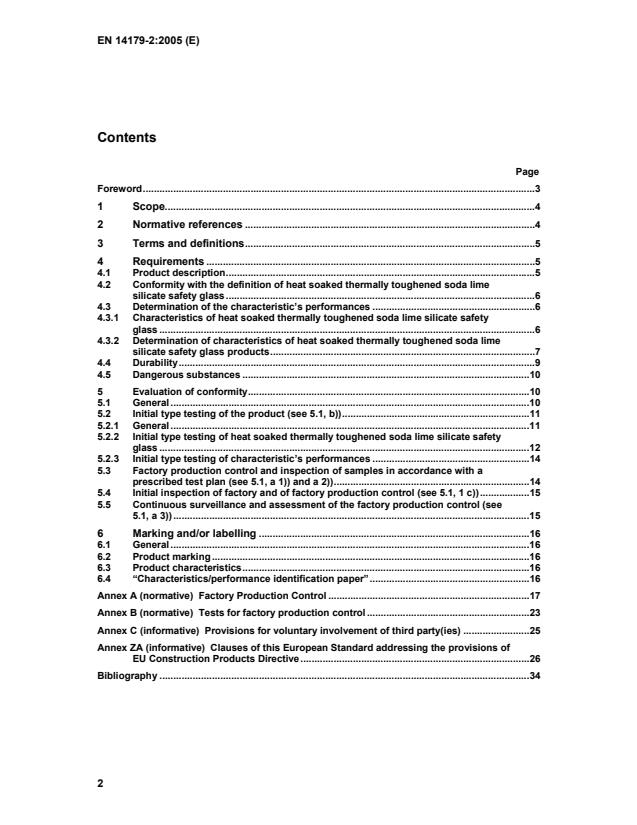
Clauses of this European Standard addressing the provisions of EU Construction Products Directive.26 Bibliography.34
– Basic soda lime silicate glass products – Part 4: Drawn sheet glass EN 572-5, Glass in building – Basic soda lime silicate glass products – Part 5: Patterned glass EN 673, Glass in Building – Determination of thermal transmittance (U value) – Calculation method EN 1063, Glass in Building – Security glazing – Testing and classification of resistance against bullet attack EN 1096-1, Glass in building – Coated glass – Part 1: Definitions and classification EN 1096-2, Glass in building – Coated glass – Part 2: Requirements and test methods for class A, B and S coatings EN 1096-3, Glass in building – Coated glass – Part 3: Requirements and test methods for class C and D coatings EN 1288-3, Glass in building – Determination of bending strength of glass – Part 3: Test with specimen supported at two points (four point bending) EN 12600, Glass in building – Pendulum test – Impact test method and classification for flat glass EN 12758, Glass in building – Glazing and airborne sound insulation – Product descriptions and determination of properties EN 12898, Glass in building – Determination of the emissivity EN 13501-1, Fire classification of construction products and building elements – Part 1: Classification using test data from reaction to fire tests
using data from external fire exposure to roof tests EN 13541, Glass in building – Security glazing – Testing and classification of resistance against explosion pressure prEN 14179-1:2001, Glass in building – Heat soaked thermally toughened soda lime silicate safety glass – Part 1: Definition and description 3 Terms and definitions For the purposes of this European Standard, the terms and definitions given in prEN 14179-1:2001 and the following apply. 3.1
initial type testing determination of the performance of a product (characteristic, durability), on the basis of either actual tests or other procedures (such as conventional, standardised, tabulated or general accepted values, standardised or recognised calculation methods, test reports when made available, …), in accordance with this European Standard that demonstrates compliance with this European Standard 3.2
test report document that covers the results of tests undertaken on a representative sample of the product from production
or on a prototype design of the product 3.3 product description document that details the relevant parameters, e.g. process conditions, structure, etc., for defining a product that complies with the standard. It includes specific reference(s) to characteristics that are modified by the production process 3.4 significant change variation in performance beyond the permitted tolerance for the characteristic 4 Requirements 4.1 Product description For conformity purposes the heat soaked thermally toughened glass manufacturer is responsible for the preparation and maintenance of the product description. This description shall describe the product and/or product families. Disclosure of the product description shall be at the discretion of the heat soaked thermally toughened glass manufacturer or his agent except in the case of regulatory requirements. The description shall contain at least a normative part. The description may also contain an informative part, when the manufacturer foresees further development of the product. The normative part of the description shall contain the following minimum information:
EN 1096-1, EN 1096-2, EN 1096-3, when those properties are changed, intentionally or unintentionally, by the thermal toughening and heat soaking process. The definition of product families shall be consistent with the normative part of the product description. The substitution of materials shall maintain the conformity with the product description. The substituting material can be added to the product family and also the product description when compliance has been demonstrated. 4.2 Conformity with the definition of heat soaked thermally toughened soda lime silicate safety glass Products shall conform to the definition and fulfil the requirements of heat soaked thermally toughened soda lime silicate safety glass as defined in prEN 14179-1. 4.3 Determination of the characteristic’s performances 4.3.1 Characteristics of heat soaked thermally toughened soda lime silicate safety glass 4.3.1.1 General The characteristics of heat soaked thermally toughened soda lime silicate safety glass are in general those of the glass substrate (see 4.3.1.2). 4.3.1.2 Characteristics of the soda lime silicate glass panes used for the production of heat soaked thermally toughened soda lime silicate safety glass Panes shall be made of soda lime silicate glass according to EN 572-1, EN 572-2, EN 572-4, EN 572-5. The panes can be coated according to EN 1096-1, EN 1096-2, EN 1096-3 and/or enamelled according to prEN 14179-1. For the characteristics listed in Table 1, for the soda lime silicate glass panes, generally accepted values or calculated values shall be used. Since the majority of the characteristics of Table 1 are not changed significantly by the thermal toughening process they shall be used for heat soaked thermally toughened soda lime silicate safety glass. The exceptions being the characteristic bending strength fg,k and the resistance against sudden temperature changes and temperature differentials.
Characteristic
Symbol
Unit
- density - hardness - Young's modulus - Poisson's ratio - Characteristic bending strength - Resistance against sudden temperature changes and temperature differentials
- Specific heat capacity - Coefficient of linear expansion - Thermal conductivity (for U-value) - Mean refractive index to visible radiation - Emissivity - Light transmittance - Solar direct transmittance - Total energy transmittance
ρ HK0,1/20 E µ fg,k
c α λ n ε τv τe g
kg/m³ GPa Pa Dimensionless Pa K J/(kg·K) K-1 W/(m·K) Dimensionless Dimensionless Dimensionless Dimensionless Dimensionless
If some coatings, i.e. coated glass conforming with the EN 1096 series, when heat soaked thermally toughened change their radiometric properties the manufacturer shall refer to the following for the determination of the appropriate characteristics, etc.: 4.3.2.12 for the emissivity; 4.3.2.13 for the light transmittance and reflectance; 4.3.2.14 for the solar energy transmittance; EN 1096-2 for the durability of A, B and S coatings; EN 1096-3 for the durability of C and D coatings. 4.3.2 Determination of characteristics of heat soaked thermally toughened soda lime silicate safety glass products 4.3.2.1 General If the heat soaked thermally toughened glass manufacturer wishes to claim that any performance characteristic is independent of the production equipment used then the factory production control system shall be in accordance with this European Standard including his specific process control conditions.
EN 673 with: emissivity ε : the declared value of the glass manufacturer. If the information is not available, the emissivity shall be determined in accordance with EN 12898; nominal thickness of the glass panes. However, the information supplied about the thermal properties of the incoming glass can be used if the thermal toughening and heat soaking process does not alter the values. 4.3.2.13 Energy conservation and heat retention - Radiation properties: Light transmittance and reflectance The light transmittance and reflectance shall be determined in accordance with EN 410. However, the information supplied about the radiation properties of the incoming glass can be used if the thermal toughening and heat soaking process does not alter the values. 4.3.2.14 Energy conservation and heat retention - Radiation properties: Solar energy characteristics The solar energy transmittance and reflectance shall be determined in accordance with EN 410. However, the information supplied about the radiation properties of the incoming glass can be used if the thermal toughening and heat soaking process does not alter the values. 4.4 Durability When products conform to the definition of heat soaked thermally toughened soda lime silicate glass as in 4.2, then the characteristics’ performances in 4.3.2 are ensured during an economically reasonable working life. The durability of glass products, including their characteristics, is ensured by the following: compliance with this standard; compliance with instructions from the glass product manufacturer or supplier.
1 prEN 13474 series is currently being prepared.
2 The terms ‘manufacturer’ and ‘producer’ are understood as being synonyms (see CPD working document NB-CPD/02/019-issued 24 April 2002 – page 1).
EN 572-1 and EN 572-2 in accordance with this European Standard. The ‘simplest’ type of edge work specified in the manufacturers production control documentation shall be used. However, if an arrissed edge is used then all other types of edge working are deemed to satisfy. The number of test specimens are as follows: a) For mechanical strength measurement they are given in Table 2a for float glass, Table 2b for coated float glass and Table 2c for enamelled float glass. b) For fragmentation 5 test specimens per thickness are required. Table 2a - Number of test specimen distributed over the product thickness range
Product thickness range a
Number of test specimen for the mechanical strength measurement
– minimum ≥ 2 – first after minimum ≥ 2 – centre of range ≥ 2 – last before maximum ≥ 2 – maximum ≥ 2 TOTAL ≥ 10 a When the production range consists of: - two thicknesses, the distribution shall be as equal as possible; -
a single thickness, all specimens are of the same thickness.
thickness range
Emissivity εεεε of incoming glass product Product thickness range Number of specimen for the mechanical strength measurement 1 ≥ ε > 0,25 Minimum Middle Maximum ≥ 2 ≥ 2 ≥ 2 Total
(min.10) 0,25 ≥ ε > 0,1 Minimum Middle Maximum ≥ 2 ≥ 2 ≥ 2 Total
(min.10)
0,1 ≥ ε Minimum Middle Maximum ≥ 2 ≥ 2 ≥ 2 Total
(min.10) NOTE 1 Tests according to this table are valid for all coated glasses within the respective emissivity ranges. NOTE 2 Half number of test specimen shall be tested with the coated side in tension and the other half with the uncoated side in tension.
Table 2c - Number of test specimen of enamelled float glass, distributed over the product thickness range Type of surface design Product thickness range Number of specimen for the mechanical strength measurement
Fully enamelled Minimum
≥ 10
NOTE 1 This table covers all enamelled designs and all produced thicknesses. NOTE 2 Mechanical test undertaken with enamelled surface in tension. NOTE Strength measurement outcomes are expressed in force per unit of area and are therefore independent of the thickness. Hence strength measurements may be performed on a collection of test specimens with different thicknesses. 5.2.2.3 Test results a) When the mechanical strength is measured then no measured value shall be below that given in 11.4 of prEN 14179-1:2001. However, if one value falls below then the manufacturer shall ensure that the results relate to a 5 % probability of breakage at the lower limit of the 95 % confidence interval. b) In the fragmentation test, no test specimen shall exhibit a fragmentation assessment that does not meet Clause 10 of prEN 14179-1:2001.
Nr
Characteristic
Interested parameter related to the characteristic
For details, refer to
A
Resistance to fire Reaction to fire External fire behaviour
- checking incoming glass - production control - product control after production - labelling outgoing glass product
Annex A
B
Release of dangerous substances
- checking incoming materials
Annex A
C
Bullet resistance Explosion resistance Burglar resistance Pendulum body impact resistance Resistance against sudden temperature Changes and temperature differentials Wind, snow, permanent and imposed load resistance of the glass unit
- checking incoming glass - production control - product control after production - labelling outgoing glass product
Annex A
D
Direct airborne sound reduction Thermal properties Radiation properties: – light transmittance and reflection – solar energy characteristic
- checking incoming glass - production control - product control after production - labelling outgoing glass product
Annex A 5.5 Continuous surveillance and assessment of the factory production control (see 5.1, 1 c)) The continuous surveillance, assessment and approval of the factory production control shall cover the parameters listed in Table 3. NOTE There may be a need to involve a third party for the purpose of regulatory marking (see Annex ZA). The frequency of production surveillance shall be twice per year for new production facilities or for facilities that do not already have an established factory production control system in accordance with
Factory Production Control A.1 Factory Production Control requirements A.1.1 General The FPC system shall consist of procedures, regular inspections and tests and/or assessments and the use of the results to control [raw and other] incoming materials or components, equipment, the production process and the product. A.1.2 Organisation A.1.2.1 Responsibility and authority The responsibility, authority and the interrelation of all personnel who manage, perform and verify work affecting conformity shall be defined, particularly for personnel who have the organizational freedom and authority to: a) initiate action to prevent the occurrence of product non-conformity; b) identify and record any product non-conformances. A.1.2.2 Management representative for factory production control The manufacturer shall appoint a management representative who, irrespective of other responsibilities, shall have defined authority and responsibility for ensuring that the requirements of this European Standard are implemented and maintained. A.1.2.3 Management review The production control system shall be reviewed by the manufacturer’s management at appropriate intervals in accordance with the manufacturer’s control to ensure its continuing suitability and effectiveness. Records of such reviews shall be maintained for a minimum of 5 years. A.1.3 Control system A.1.3.1 General The manufacturer shall establish and maintain a documented system as a means of ensuring that the product conforms to prEN 14179-1. The following requirements shall be fulfilled. A.1.3.2 Personnel The manufacturer shall use appropriately trained personnel for the operation and inspections of all production and inspection equipment.
Section 1: Incoming material
Ref.
Material, inspection or test Recommended method (decision to be made by manufacturer)
Requirement Recommended minimum frequency (decision to be made by manufacturer)
Record 1.1 Incoming material glass
1.1.1 Identification, including packaging and label Visual See purchase specification Each delivery Yes 1.1.2 Thickness Visual See purchase specificatio
...