


EN 15502-1:2012/FprA1
(Amendment)Gas-fired heating boilers - Part 1: General requirements and tests
General Information
- Abstract
Amendment for the addition of ecodesign requirements (Regulation No 813/2013)
and energy labelling requirements (Regulation No 811/2013)
This European Standard specifies the common requirements and test methods concerning, in particular the construction, safety, fitness for purpose, and rational use of energy, as well as the classification, marking and energy labelling of gas-fired central heating boilers that are fitted with atmospheric burners, fan assisted atmospheric burners or fully premixed burners, and are hereafter referred to as “boilers”.
This European Standard is to be used in conjunction with the specific Parts 2 (Part 2-1 and following ones).
This European Standard applies to boilers of types B and C, according to CEN/TR 1749:2014:
a) that use one or more combustible gases of the three gas families at the pressures stated in EN 437;
b) where the temperature of the heat transfer fluid does not exceed 105 °C during normal operation;
c) where the maximum operating pressure in the water circuit does not exceed 6 bar;
d) which can give rise to condensation under certain circumstances;
e) which are declared in the installation instructions to be either a “condensing” boiler or a "low temperature boiler" or a “standard boiler”. If no declaration is given the boiler is to be considered a “standard boiler”
f) which are intended to be installed inside a building or in a partially protected place;
g) which are intended to produce hot water either by the instantaneous or storage principle, the whole being marketed as a single unit.
This European Standard applies to boilers designed for sealed water systems or for open water systems.
This general standard and the specific standards (see Part 2) provide requirements for boilers with known constructions. For boilers with any alternative constructions, which might not fully be covered by this standard or a specific standard, the risk associated with this alternative construction will need to be assessed.
An example of an assessment methodology, based upon risk assessment, is given in Clause 11.
This European Standard is not intended to cover appliances intended for connection to gas grids where the quality of the distributed gas is likely to vary to a large extent over the lifetime of the appliance.
- Status
- Not Published
- Technical Committee
- CEN/TC 109 - Central heating boilers using gaseous fuels
- Drafting Committee
- CEN/TC 109/WG 1 - Domestic central heating boilers using gaseous fuels
- Current Stage
- 5060 - Closure of Vote - Formal Approval
- Start Date
- 23-Mar-2015
- Due Date
- 24-Mar-2016
- Completion Date
- 23-Mar-2015
- Directive
- Not Harmonized2009/125/EC - Directive 2009/125/EC of the European Parliament and of the Council of 21 October 2009 establishing a framework for the setting of ecodesign requirements for energy-related products
Not Harmonized2009/142/EC - Appliances burning gaseous fuels


Overview
EN 15502-1:2012/FprA1 is a European Standard developed by CEN that outlines the general requirements and testing methods for gas-fired central heating boilers. This amendment integrates critical ecodesign and energy labelling requirements as mandated by European Commission Regulations No 813/2013 and No 811/2013. The standard applies to boilers fitted with various burner types, including atmospheric burners, fan-assisted atmospheric burners, and fully premixed burners.
Primarily targeting boilers with outputs ranging from 4 to 400 kW, this standard covers essential factors such as construction quality, safety protocols, energy efficiency, classification, marking, and comprehensive energy labelling. EN 15502-1 complements more specific guidelines found in Part 2 of the series, thus forming a complete framework for manufacturers, testers, and regulatory bodies.
Key Topics
Scope and Boiler Types
Applies to gas-fired boilers of types B and C operating under specific conditions:- Use of combustible gases covered under EN 437
- Maximum heat transfer fluid temperature of 105 °C
- Maximum water circuit pressure of 6 bar
- Boilers that may condense during operation
- Boilers classified as condensing, low temperature, standard, or other, as per installation documentation
- Intended for indoor or partially protected installation environments
- Boilers producing hot water either instantaneously or stored, marketed as individual units
Compliance with Ecodesign and Energy Labelling Regulations
Ensures boilers meet eco-design requirements (Regulation No 813/2013) for space heaters and combination heaters, focusing on rational use of energy and reductions in harmful emissions. Additionally, mandates energy labelling (Regulation No 811/2013) to provide end-users with transparency regarding energy efficiency and environmental impact.Testing and Performance Metrics
Detailed methodologies for evaluating:- Useful efficiency at nominal and part load
- NOx emissions categorisation, establishing limits for emissions based on gross and net calorific values
- Electrical auxiliary energy consumption excluding circulation pumps
- Sound power levels within indoor environments
- Risk assessments for alternative or innovative boiler constructions
Marking and Product Information
Requirements for data plates, technical instructions, and energy label formats to ensure clarity in product performance, safety, and compliance information.
Applications
EN 15502-1:2012/FprA1 is highly relevant for:
- Manufacturers and Designers designing gas-fired central heating boilers requiring conformity with European ecodesign and energy labelling criteria.
- Test Laboratories and Certification Bodies applying standardized testing methods for evaluating safety, emissions, efficiency, and auxiliary energy consumption.
- Building and HVAC Professionals selecting compliant boilers to meet building regulations, energy efficiency standards, and environmental safety.
- Policy Makers and Regulators ensuring that local market products meet EU mandates for sustainability and consumer information transparency.
By adopting this standard, stakeholders ensure improved product quality, enhanced safety, reduced environmental impact, and increased energy savings.
Related Standards
- EN 437 - Covers the specifications for test gases and their pressures for appliances burning gaseous fuels.
- CEN/TR 1749:2014 - Provides classification guidance for boilers, dividing them into types B and C based on air supply and combustion product evacuation methods.
- EN 15036-1:2006 - Specifies test methods for airborne noise emissions from heat generators, relevant for overall boiler assessment.
- FprEN 13203-2:2014 - Addresses energy consumption assessment specifically for gas-fired domestic hot water appliances.
Integration with these standards ensures consistency and helps manufacturing and testing processes comply comprehensively with European regulations.
By adhering to EN 15502-1:2012/FprA1, industry players can ensure gas-fired heating boilers meet stringent ecological and energy performance criteria, supporting sustainable heating solutions across Europe. This standard plays a critical role in reducing energy consumption and environmental emissions while providing transparent energy labelling for consumer awareness.
Relations
- Merged Into
EN 15502-1:2012+A1:2015 - Gas-fired heating boilers - Part 1: General requirements and tests - Effective Date
- 19-Jan-2023
- Effective Date
- 16-Jul-2014
Get Certified
Connect with accredited certification bodies for this standard

DNV
DNV is an independent assurance and risk management provider.

Lloyd's Register
Lloyd's Register is a global professional services organisation specialising in engineering and technology.

DIBt (Deutsches Institut für Bautechnik)
German Institute for Building Technology.
Sponsored listings
Frequently Asked Questions
EN 15502-1:2012/FprA1 is a draft published by the European Committee for Standardization (CEN). Its full title is "Gas-fired heating boilers - Part 1: General requirements and tests". This standard covers: Amendment for the addition of ecodesign requirements (Regulation No 813/2013) and energy labelling requirements (Regulation No 811/2013) This European Standard specifies the common requirements and test methods concerning, in particular the construction, safety, fitness for purpose, and rational use of energy, as well as the classification, marking and energy labelling of gas-fired central heating boilers that are fitted with atmospheric burners, fan assisted atmospheric burners or fully premixed burners, and are hereafter referred to as “boilers”. This European Standard is to be used in conjunction with the specific Parts 2 (Part 2-1 and following ones). This European Standard applies to boilers of types B and C, according to CEN/TR 1749:2014: a) that use one or more combustible gases of the three gas families at the pressures stated in EN 437; b) where the temperature of the heat transfer fluid does not exceed 105 °C during normal operation; c) where the maximum operating pressure in the water circuit does not exceed 6 bar; d) which can give rise to condensation under certain circumstances; e) which are declared in the installation instructions to be either a “condensing” boiler or a "low temperature boiler" or a “standard boiler”. If no declaration is given the boiler is to be considered a “standard boiler” f) which are intended to be installed inside a building or in a partially protected place; g) which are intended to produce hot water either by the instantaneous or storage principle, the whole being marketed as a single unit. This European Standard applies to boilers designed for sealed water systems or for open water systems. This general standard and the specific standards (see Part 2) provide requirements for boilers with known constructions. For boilers with any alternative constructions, which might not fully be covered by this standard or a specific standard, the risk associated with this alternative construction will need to be assessed. An example of an assessment methodology, based upon risk assessment, is given in Clause 11. This European Standard is not intended to cover appliances intended for connection to gas grids where the quality of the distributed gas is likely to vary to a large extent over the lifetime of the appliance.
Amendment for the addition of ecodesign requirements (Regulation No 813/2013) and energy labelling requirements (Regulation No 811/2013) This European Standard specifies the common requirements and test methods concerning, in particular the construction, safety, fitness for purpose, and rational use of energy, as well as the classification, marking and energy labelling of gas-fired central heating boilers that are fitted with atmospheric burners, fan assisted atmospheric burners or fully premixed burners, and are hereafter referred to as “boilers”. This European Standard is to be used in conjunction with the specific Parts 2 (Part 2-1 and following ones). This European Standard applies to boilers of types B and C, according to CEN/TR 1749:2014: a) that use one or more combustible gases of the three gas families at the pressures stated in EN 437; b) where the temperature of the heat transfer fluid does not exceed 105 °C during normal operation; c) where the maximum operating pressure in the water circuit does not exceed 6 bar; d) which can give rise to condensation under certain circumstances; e) which are declared in the installation instructions to be either a “condensing” boiler or a "low temperature boiler" or a “standard boiler”. If no declaration is given the boiler is to be considered a “standard boiler” f) which are intended to be installed inside a building or in a partially protected place; g) which are intended to produce hot water either by the instantaneous or storage principle, the whole being marketed as a single unit. This European Standard applies to boilers designed for sealed water systems or for open water systems. This general standard and the specific standards (see Part 2) provide requirements for boilers with known constructions. For boilers with any alternative constructions, which might not fully be covered by this standard or a specific standard, the risk associated with this alternative construction will need to be assessed. An example of an assessment methodology, based upon risk assessment, is given in Clause 11. This European Standard is not intended to cover appliances intended for connection to gas grids where the quality of the distributed gas is likely to vary to a large extent over the lifetime of the appliance.
EN 15502-1:2012/FprA1 is classified under the following ICS (International Classification for Standards) categories: 27.060.30 - Boilers and heat exchangers; 91.140.10 - Central heating systems. The ICS classification helps identify the subject area and facilitates finding related standards.
EN 15502-1:2012/FprA1 has the following relationships with other standards: It is inter standard links to EN 15502-1:2012+A1:2015, EN 15502-1:2012. Understanding these relationships helps ensure you are using the most current and applicable version of the standard.
EN 15502-1:2012/FprA1 is associated with the following European legislation: EU Directives/Regulations: 2009/125/EC, 2009/142/EC, 2010/30/EU, 92/13/EEC; Standardization Mandates: M/066, M/495, M/BC/CEN/89/2. When a standard is cited in the Official Journal of the European Union, products manufactured in conformity with it benefit from a presumption of conformity with the essential requirements of the corresponding EU directive or regulation.
EN 15502-1:2012/FprA1 is available in PDF format for immediate download after purchase. The document can be added to your cart and obtained through the secure checkout process. Digital delivery ensures instant access to the complete standard document.
Standards Content (Sample)
SLOVENSKI STANDARD
01-januar-2015
Plinski kotli za gretje - 1. del: Splošne zahteve in preskusi
Gas-fired heating boilers - Part 1: General requirements and tests
Heizkessel fur gasförmige Brennstoffe - Teil 1: Allgemeine Anforderungen und
Prüfungen
Chaudières de chauffage central utilisant les combustibles gazeux - Partie 1: Exigences
générales et essais
Ta slovenski standard je istoveten z: EN 15502-1:2012/FprA1
ICS:
91.140.10 Sistemi centralnega Central heating systems
ogrevanja
97.100.20 Plinski grelniki Gas heaters
2003-01.Slovenski inštitut za standardizacijo. Razmnoževanje celote ali delov tega standarda ni dovoljeno.
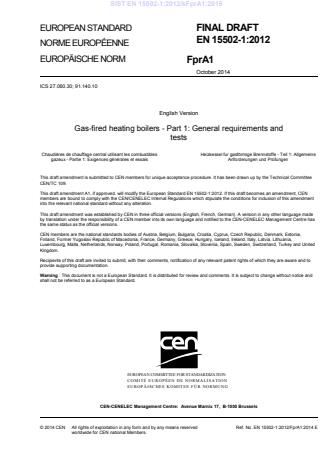
EUROPEAN STANDARD
FINAL DRAFT
EN 15502-1:2012
NORME EUROPÉENNE
EUROPÄISCHE NORM
FprA1
October 2014
ICS 27.060.30; 91.140.10
English Version
Gas-fired heating boilers - Part 1: General requirements and
tests
Chaudières de chauffage central utilisant les combustibles Heizkessel fur gasförmige Brennstoffe - Teil 1: Allgemeine
gazeux - Partie 1: Exigences générales et essais Anforderungen und Prüfungen
This draft amendment is submitted to CEN members for unique acceptance procedure. It has been drawn up by the Technical Committee
CEN/TC 109.
This draft amendment A1, if approved, will modify the European Standard EN 15502-1:2012. If this draft becomes an amendment, CEN
members are bound to comply with the CEN/CENELEC Internal Regulations which stipulate the conditions for inclusion of this amendment
into the relevant national standard without any alteration.
This draft amendment was established by CEN in three official versions (English, French, German). A version in any other language made
by translation under the responsibility of a CEN member into its own language and notified to the CEN-CENELEC Management Centre has
the same status as the official versions.
CEN members are the national standards bodies of Austria, Belgium, Bulgaria, Croatia, Cyprus, Czech Republic, Denmark, Estonia,
Finland, Former Yugoslav Republic of Macedonia, France, Germany, Greece, Hungary, Iceland, Ireland, Italy, Latvia, Lithuania,
Luxembourg, Malta, Netherlands, Norway, Poland, Portugal, Romania, Slovakia, Slovenia, Spain, Sweden, Switzerland, Turkey and United
Kingdom.
Recipients of this draft are invited to submit, with their comments, notification of any relevant patent rights of which they are aware and to
provide supporting documentation.
Warning : This document is not a European Standard. It is distributed for review and comments. It is subject to change without notice and
shall not be referred to as a European Standard.
EUROPEAN COMMITTEE FOR STANDARDIZATION
COMITÉ EUROPÉEN DE NORMALISATION
EUROPÄISCHES KOMITEE FÜR NORMUNG
CEN-CENELEC Management Centre: Avenue Marnix 17, B-1000 Brussels
© 2014 CEN All rights of exploitation in any form and by any means reserved Ref. No. EN 15502-1:2012/FprA1:2014 E
worldwide for CEN national Members.
Contents Page
0 Modifications to the Foreword .5
th
0.1 Addition after the 4 paragraph of the Foreword .5
th
0.2 Modification to the 5 paragraph of the Foreword .5
1 Modifications to Clause 1, Scope .6
st
1.1 Modification to the 1 paragraph of the Scope .6
rd
1.2 Modification to the 3 paragraph of the Scope .6
1.3 Modification to indent e) under the Scope .6
2 Modifications to Clause 2, Normative references .6
3 Modifications to Clause 3, Terms, definitions and symbols .7
3.1 Modifications to 3.1.6 Outputs .7
3.2 Addition of a new subclause 3.1.13 .7
3.3 Modifications to 3.2, Symbols .8
4 Modifications to Clause 4, Classification .9
4.1 Modification to 4.2, Mode of air supply and evacuation of the combustion products .9
5 Construction (existing – no change) .9
6 Electrical safety (existing – no change) .9
7 Controls (existing – no change) .9
8 Modifications to Clause 8, Operational requirements . 10
8.1 Modifications to 8.13, NOx . 10
8.2 Addition of a new subclause 8.17 . 11
9 Modifications to Clause 9, Useful efficiencies . 11
9.1 General (existing – no change) . 11
9.2 Modifications to 9.2, Useful efficiency at the nominal heat input . 11
9.3 Modifications to 9.3, Useful efficiency at part load . 12
9.4 Losses of combination boilers (existing – no change). 14
9.5 Compliance with the eco-design regulation for efficiency . 14
9.6 Compliance with the Labelling delegated regulation for efficiency . 17
10 Modifications to Clause 10, Electric auxiliary energy . 19
10.1 General (existing – no change) . 19
10.2 System boundaries (existing – no change) . 19
10.3 Modifications to 10.3, Auxiliary energy at nominal heat input . 19
10.4 Auxiliary energy at part load (existing – no change) . 19
10.5 Auxiliary energy at stand-by (existing – no change) . 19
10.6 Auxiliary electricity consumption measurements required for eco-design and labelling
regulations . 19
11 Risk assessment (existing – no change) . 20
12 Modifications to Clause 12, Marking and instructions . 21
12.1 Modifications to 12.1.1 Data plate . 21
13 Requirements for Eco-design Regulation (No 813/2013) and Energy Labelling Regulation
(No 811/2013) . 21
13.1 Requirements for product information for the Eco-design Regulation (Annex II,
Regulation No 813/2013) . 21
13.2 Energy label for Energy Labelling Regulation No 811/2013 Energy Label . 21
13.3 Product fiche for Energy Labelling Regulation 811/2013 . 22
14 Modifications to 'Annex J'. 25
14.1 Addition of a new Table J.4 . 25
15 Addition of a new Annex AA . 25
16 Addition of a new Annex BB . 28
17 Addition of a new Annex CC . 32
18 Addition of a new Annex DD . 35
19 Modifications to Annex ZA . 37
20 Modifications to Annex ZB . 39
21 Addition of a new Annex ZC . 39
22 Addition of a new Annex ZD . 41
Foreword
This document (EN 15502-1:2012/FprA1:2014) has been prepared by Technical Committee CEN/TC 109
“Central heating boilers using gaseous fuels”, the secretariat of which is held by NEN.
This document is currently submitted to the Unique Acceptance Procedure.
This document comprises technical changes to:
- Subclause 7.2, Requirements;
- Subclause 10.2, Minimum required marking of fittings.
0 Modifications to the Foreword
th
0.1 Addition after the 4 paragraph of the Foreword
After the paragraph ending on "with an output of 4 – 400 kW.", add the following:
"This document has been prepared under mandate M/495, given to CEN by the European Commission and
the European Free Trade Association to provide a means of conforming to:
- requirements of Commission Regulation (EC) No 813/2013 of 2 August 2013 implementing Directive
2009/125/EC of the European Parliament and of the Council with regard to ecodesign requirements for space
heaters and combination heaters;
- requirements of Commission Delegated Regulation (EC) No 811/2013 of 18 February 2013 supplementing
Directive 2010/30/EC of the European Parliament and of the Council with regard to energy labelling of space
heaters, combination heaters, packages of space heater, temperature control and solar device and packages
of combination heater, temperature control and solar device."
th
0.2 Modification to the 5 paragraph of the Foreword
Replace the existing text of this paragraph:
"For relationship with EU Directive(s), see informative Annex ZA and ZB, which are integral parts of this
document."
with the following:
"For relationship with EU Directive(s) and Commission Regulations, see informative Annexes ZA, ZB, ZC and ZD
which are integral parts of this document."
1 Modifications to Clause 1, Scope
st
1.1 Modification to the 1 paragraph of the Scope
After "marking" add "and energy labelling"
to read:
"This European Standard specifies the common requirements and test methods concerning, in particular the
construction, safety, fitness for purpose, and rational use of energy, as well as the classification, marking and
energy labelling of gas-fired central heating boilers that are fitted with atmospheric burners, fan assisted
atmospheric burners or fully premixed burners, and are hereafter referred to as “boilers”."
rd
1.2 Modification to the 3 paragraph of the Scope
Replace "CEN/TR 1749:2009" with "CEN/TR 1749:2014".
1.3 Modification to indent e) under the Scope
Replace the existing text of the indent e) with the following:
"which are declared in the installation instructions to be either a “condensing” boiler or a "low temperature
boiler" or a “standard boiler” or a "other boiler". If no declaration is given the boiler is to be considered both a
“standard boiler” and an "other boiler"
NOTE The Ecodesign Directive defines "other boilers", "low temperature boilers" and "condensing boilers". The Boiler
Efficiency Directive defines "standard boilers", "low temperature boilers" and "condensing boilers". Depending on the
legislation applied, a boiler can be both "a standard boiler" and an "other boiler"."
2 Modifications to Clause 2, Normative references
Delete the following reference and move it to the Bibliography:
"CR 1404:1994, Determination of emissions from appliances burning gaseous fuels during type-testing".
Replace "CEN/TR 1749:2009" with "CEN/TR 1749:2014".
Add the following references:
"FprEN 13203-2:2014, Gas-fired domestic appliances producing hot water - Part 2: Assessment of energy
consumption"
"EN 15036-1:2006, Heating boilers – Test regulations for airborne noise emissions from heat generators - Part
1: Airborne noise emissions from heat generators"
3 Modifications to Clause 3, Terms, definitions and symbols
3.1 Modifications to 3.1.6 Outputs
Add the following term and definition:
"3.1.6.4
rated heat output
Prated
useful output stated by the manufacturer in kW, corresponding to the operation of the boiler in a nominal
(80 °C/60 °C) water temperature regime"
3.2 Addition of a new subclause 3.1.13
Add the following new subclause 3.1.13 after the existing subclause 3.1.12:
"3.1.13 Relevant eco-design and labelling regulations terms
3.1.13.1
electric auxiliary energy for eco-design and labelling regulations
electric energy consumed by the system components such as fan, valves, heating elements required for the
heat generator‘s designed operation, but no circulation pump
3.1.13.2
seasonal space heating energy efficiency
ratio between the space heating demand for a designated heating season, supplied by the boiler and the
annual energy consumption based on GCV required to meet this demand
— Symbol η
s
— Unit percent (%)
3.1.13.3
water heating energy efficiency
ratio between the useful energy in drinking or sanitary water provided by a combination boiler and the energy
required for its generation based on GCV
— Symbol η
WH
— Unit percent (%)
3.1.13.4
sound power level
A-weighted sound power level, indoors
— Symbol LWA
— Unit dB(A)
3.1.13.5
package
package of boilers or combination boilers, temperature control and solar devices means a package offered to
the end-user containing one or more boilers or combination boilers combined with one or more temperature
controls and/or one or more solar devices
Note 1 to entry: Definition based on Labelling Regulation 811/2013 Article 2 - (19) and (20).
3.1.13.6
maximum load profile
load profile for combination water boilers with the greatest reference energy that a combination boiler is able
to provide while fulfilling the temperature and flow rate conditions of that load profile".
3.3 Modifications to 3.2, Symbols
In Table 1, after the symbol for Nominal heat input (Qn), add the following definition:
"
…. …
Heat input at the arithmetic mean Qa
… …
"
In Table 1, after the symbol for Nominal output (Pn), add the following definition:
"
…. …
Useful output at the arithmetic mean Pa
… …
"
In Table 1, after the symbol for Useful efficiency (η ), add the following definitions:
u
"
Seasonal space heating energy efficiency GCV η
s
Water heating energy efficiency GCV η
WH
Weighted value of the NOx concentration, in NO
x,pond Hs
milligrams per kilowatt-hour (mg/kWh) GCV
Weighted value of the NO concentration, in NO
x x,pond
milligrams per kilowatt-hour (mg/kWh) NCV
The useful efficiency at 30 % of the nominal heat η
input GCV
The useful efficiency at nominal heat input GCV
η
The useful efficiency at 30 % of the nominal heat η
input NCV
The useful efficiency at nominal heat input NCV η
Auxiliary electricity consumption at nominal heat input el
max
[kW]
Auxiliary electricity consumption at 30 % of the el
min
nominal heat input [kW]
Auxiliary electricity consumption at stand-by [kW] P
SB
"
4 Modifications to Clause 4, Classification
4.1 Modification to 4.2, Mode of air supply and evacuation of the combustion products
Replace "CEN/TR 1749:2009" with "CEN/TR 1749:2014".
5 Construction (existing – no change)
6 Electrical safety (existing – no change)
7 Controls (existing – no change)
8 Modifications to Clause 8, Operational requirements
8.1 Modifications to 8.13, NOx
8.1.1 Modifications to 8.13.1, Requirement
Replace the existing text of this subclause with the following:
"The NO class of the boiler is to be stated in the technical instructions according to Table 4. The test and
x
calculation conditions below shall be applied. The permissible NO concentration assigned to this class in the
x
dry, air free products of combustion shall not be exceeded.
Table 4 – NO classes
x
NO -Classes Limit NO concentration Limit NO concentration
x x x
mg/kWh based on NCV mg/kWh based on GCV
1 260
2 200
3 150
4 100
5 70
6 56
"
8.1.2 Modifications to 8.13.2, Test methods
8.1.2.1 Modifications to 8.13.2.1, General
th
In the 4 paragraph before the end of the subclause,
After the definition of the symbols for the second formula in 8.13.2.1 add the following line (please note the
indent):
"Annex J provides the factors to be used for correcting dry flue measurement values to mg/kWh".
8.1.2.2 Modification to 8.13.2.2,Weighting
In the tenth line of the existing text, add "on a NCV basis" to read:
"NO weighted value of the NO concentration, in milligrams per kilowatt-hour (mg/kWh)
x,pond x
on a NCV basis"
8.1.3 Addition of a subclause 8.13.3
Add the following subclause after the existing subclause 8.13.2.6:
"8.13.3 NO requirement for Eco-design regulation
x
Requirement:
As from 26 September 2018, for boilers ≤ 400 kW nominal heat output, NO shall not exceed 56 mg/kWh
x,pond Hs
Heat input, based on GCV. This corresponds to the current NO class 6 (see 8.13.1).
x
Test method:
NO based on NCV is determined in accordance with 8.13.2.
x,pond
NO based on GCV shall be calculated according to the following formula:
x,pond,Hs
H
i
NO = × NO
x,pond,Hs x,pond
H
s
NO the weighted value of the NO concentration, in milligrams per kilowatt-hour (mg/kWh Heat input)
x,pond,Hs x
on a GCV basis;
H
i
= the ratio of the Net to Gross Calorific Value for the appropriate gas family taken from Annex J.".
H
s
8.2 Addition of a new subclause 8.17
Add the following subclause after the existing subclause 8.16:
"8.17 Sound power level
From 26 September 2015 the sound power level of gas boilers and combination boilers ≤ 70 kW nominal heat
output shall be declared on the product label and in the product fiche. The declared value shall not be less
than the value measured according to EN 15036-1, when operating in heating mode, taking into account the
tolerances given in EN 15036-1."
9 Modifications to Clause 9, Useful efficiencies
9.1 General (existing – no change)
9.2 Modifications to 9.2, Useful efficiency at the nominal heat input
9.2.1 Modifications to 9.2.1, Requirements
Replace the existing text of this subclause with the following:
"The requirement below for useful efficiency is valid for:
- boilers with a nominal heat output > 400 kW,
- boilers with a nominal heat output ≤ 400 kW until 26 September 2015.
NOTE 1 For boilers with a nominal heat output ≤ 400 kW, from 26 September 2015, see 9.5.
The useful efficiency, measured according to 9.2.2, at nominal heat input, or the maximum heat input for
range rated boilers, expressed in percent, shall be at least:
84 + 2 log10 P ;
n
87,5 + 1,5 log10 P for low temperature boilers;
n
91 + log10 P for condensing boilers.
n
where
P is the nominal output (maximum output for range rated boilers), expressed in kilowatts (kW).
n
NOTE 2 The value of efficiency is calculated using 400 kW as the maximum nominal output.
In addition, for range rated boilers, the efficiency measured according to 9.2.2, at a rate, corresponding to the
arithmetic mean of the maximum and minimum heat input, expressed in percent, shall be at least:
84 + 2 log10 P ;
a
87,5 + 1,5 log10 P for low temperature boilers;
a
91 + log10 P for condensing boilers.
a
where
P is the arithmetic mean of the maximum and minimum useful heat output as stated in the technical
a
specifications, expressed in kilowatts (kW).
NOTE 3 The limit value of efficiency is calculated using 400 kW as the maximum nominal output. If the minimum useful
heat output is also > 400 kW, then the efficiency will be calculated using 400 kW as P .".
a
9.3 Modifications to 9.3, Useful efficiency at part load
9.3.1 Modifications to 9.3.1, Requirements
Replace the existing text of this subclause with the following:
"The requirement below for useful efficiency is valid for:
- boilers with a nominal heat output > 400 kW,
- boilers with a nominal heat output ≤ 400 kW until 26 September 2015.
NOTE 1 For boilers with a nominal heat output ≤ 400 kW, from 26 September 2015, see 9.5.
The useful efficiency, measured according to 9.3.2, for a load corresponding to 30 % of the nominal heat input
or for range rated boilers to 30 % of the arithmetic mean of the maximum and minimum heat input, expressed
in percent, shall be at least:
80 + 3 log10 P ;
i
87,5 + 1,5 log10 P for low temperature boilers
i
97 + log10 P for condensing boilers
i
where
P is the nominal output P , or the arithmetic mean P of the maximum and minimum useful output
i n a
as stated in the technical instructions for range rated boilers.
NOTE 2 Where Pi is > 400 kW, the value of efficiency is calculated using 400 kW as the maximum nominal output. If the
minimum useful heat output is also > 400 kW, then the efficiency will be calculated using 400 kW as Pi.".
9.3.2 Modifications to 9.3.2 Tests
9.3.2.1 Modifications to 9.3.2.1General
nd rd
Delete the 2 and 3 sentences to read:
"To determine the useful efficiency at a load corresponding to 30 % of the nominal heat input, or for range
rated boilers to 30 % of the arithmetic mean of the maximum and minimum heat input, the manufacturer shall
declare whether the direct method or the indirect method is used.".
9.3.2.2 Modifications to 9.3.2.2.2, Operating mode no 1
nd
Replace the existing text of the 2 paragraph with:
"The boiler return temperature is held constant, for "condensing boilers" at (30 ± 0,5) °C, for "low temperature
boilers" at (37 ± 1) °C, for "standard boilers" at (47 ± 1) °C, and for "other boilers" at (50 ± 1) °C, with a
maximum variation in this temperature of ± 1 K during the measurement period.
NOTE The Ecodesign Directive defines "other boilers", "low temperature boilers" and "condensing boilers". The Boiler
Efficiency Directive defines "standard boilers", "low temperature boilers" and "condensing boilers". Depending on the
legislation applied, a boiler can be both a "standard boiler" and an "other boiler"."
Introduce directly before Table 6 the following text:
"The efficiency for a "standard boiler" can be calculated from the efficiency of an "other boiler" (measured at
50 °C) by adding 0,1 % per degree to the efficiency of the "other boiler". The efficiency of an "other boiler" can
be calculated from the efficiency of a "standard boiler" (measured at 47 °C) by substracting 0,1 % per degree
from the efficiency of a "standard boiler"."
In Table 6 – row 3 reduced rate – column 'cycle time', replace the existing text:
"
180 Q - 600 Q
21 3
t = 2)"
Q - Q
21 3
with the following:
"
180 Q - 600 Q
n 3
t = "
-
Q Q
21 3
9.3.2.3 Modification to 9.3.2.3.1.1, Useful efficiency at the nominal heat input at 50 °C
In the first paragraph of this subclause replace "9.2.1" with "9.2.2" to read:
"The useful efficiency at the nominal heat input (for range rated boilers at the arithmetic mean of the maximum
and the minimum nominal heat input ) is measured according to the test of 9.2.2 with a flow temperature of
(60 ± 2) °C and a return temperature of (40 ± 1) °C.".
9.4 Losses of combination boilers (existing – no change)
Add the following new subclauses 9.5, 9.6 and 9.7 after the existing subclause 9.4:
"
9.5 Compliance with the eco-design regulation for efficiency
9.5.1 Requirements for seasonal space heating energy efficiency
9.5.1.1 Type B1 boilers with rated heat output ≤ 10kW and Type B1 Combination boilers with rated
heat output ≤ 30kW
As from 26 September 2015 the seasonal space heating efficiency calculated according to 9.5.2 shall be at
least 75 %.
9.5.1.2 Boilers and combination boilers with rated heat output ≤ 70 kW, with the exception of type
B1 boilers with rated heat output ≤ 10 kW and type B1 combination boilers with rated heat output ≤ 30
kW
As from 26 September 2015 the seasonal space heating efficiency calculated according to 9.5.2 shall be at
least 86 %.
9.5.2 Calculations for seasonal space heating energy efficiency
9.5.2.1 Conversion to gross calorific efficiency
All efficiencies measured according to 9.2 and 9.3 are converted from net calorific value (NCV) to gross
calorific value (GCV).
Full load useful efficiency at rated heat output
H
i
η =η ×
4 100
H
s
where
η is the useful efficiency at nominal heat input Q or for range rated boilers at the arithmetic mean
100 n
of the maximum and minimum heat input Q and shall be determined according to the test of
a
9.2.2.
H
i
is the ratio of the Net to Gross Calorific Value for the appropriate gas family taken from Annex J.
H
s
Useful efficiency at 30 % heat output
H
i
η =η ×
1 30
H
s
where
η is the useful efficiency at 30 % of the nominal heat input Q or for range rated boilers at 30 % of the
30 n
arithmetic mean of the maximum and minimum heat input Q and shall be determined according to
a
the test of 9.2.2.
9.5.2.2 Calculation of the seasonal space heating energy efficiency
The seasonal space heating energy efficiency η is calculated by means of the following formula:
s
ηη -ΣF(i)
s son
where
η is the seasonal space heating energy efficiency in active mode.
son
η 0,85×+ηη0,15 ×
son 1 4
The correction F(1) accounts for a negative contribution due to absence of temperature controls.
F(1)= 3
The correction F(2) accounts for a negative contribution to the seasonal space heating efficiency by
auxiliary electricity consumption.
F(2)= 2,5× (0,15× el + 0,85 × el +1,3 × P )/(0,15 × P + 0,85 × P ) x 100
max min SB 4 1
where
2,5 = value of the conversion coefficient (CC) means a coefficient reflecting the estimated
40 % average EU generation efficiency;
el shall be determined in accordance with the test of 10.6.3;
max
el shall be determined in accordance with the test of 10.6.4;
min
P shall be determined in accordance with the test of 10.6.5;
SB
P = is the nominal output P (maximum output for range rated boilers) in accordance with the test of
4 n
9.2.2;
P = is the output corresponding to 30 % of the nominal heat input (maximum input for range rated
boilers) in accordance with the test in 9.3.2.
The correction F(3) accounts for a negative contribution to the seasonal space heating efficiency by
standby heat losses and is given as follows:
F(3)= 0,5× P /P× 100
stby 4
where
P = P shall be determined in accordance with 9.3.2.3.1.3;
stby s
=
=
P = is the nominal output P (maximum output for range rated boilers) in accordance with the test of in
4 n
9.2.2.
The correction F(4) accounts for a negative contribution to the seasonal space heating efficiency by
ignition burner power consumption and is given as follows:
F(4)= 1,3× P /P × 100
ign 4
where
P shall be determined in accordance with the test conditions of 8.4.3;
ign
P = is the nominal output P (maximum output for range rated boilers) in accordance with the test of
4 n
9.2.2.
F(4) is only applicable for boilers with a continuous operating pilot flame.
9.5.3 Useful efficiency for nominal heat output > 70kW and ≤ 400kW
Requirement:
The full load useful efficiency η shall be at least 86 % and the useful efficiency at 30 % of the rated heat
output η shall be at least 94%.
9.5.4 Water heating energy efficiency for combined heaters
9.5.4.1 Load profiles
The appropriate load profile shall be declared in the technical instruction and in the user instruction
(see Annex AA). The declared load profile shall be the maximum load profile or the load profile one below the
maximum load profile as measured according to FprEN 13203-2:2014.
NOTE For combination boilers with outputs in excess of 70 kW the water heating efficiency will be determined in
accordance with the procedures of FprEN 13203-2:2014.
9.5.4.2 Requirements for water heating energy efficiency of a combination boiler of nominal heat
output ≤ 400 kW
As from 26 September 2015, the water heating energy efficiency, calculated according to 9.5.4.3, shall be at
least the following values:
Declared load 3XS XXS XS S M L XL XXL 3XL 4XL
profile
Water heating 22% 23% 26% 26% 30% 30% 30% 32% 32% 32%
energy
efficiency
As from 26 September 2017, the water heating energy efficiency, calculated according to 9.5.4.3,
shall be at least the following values:
Declared load 3XS XXS XS S M L XL XXL 3XL 4XL
profile
Water heating 38% 60% 64% 64%
32% 32% 32% 32% 36% 37%
energy
efficiency
9.5.4.3 Calculation of the water heating energy efficiency (η )
WH
The water heating energy efficiency shall be measured and calculated according to FprEN 13203-2:2014.
9.6 Compliance with the Labelling delegated regulation for efficiency
9.6.1 Seasonal space heating energy efficiency classes
Requirement:
The following requirements shall apply as from 26 September 2015 for boilers ≤ 70 kW nominal heat output.
The values of the seasonal space heating energy efficiency shall be taken from 9.5.2.2.
A printed label shall be provided with each boiler stating the seasonal space heating efficiency class
determined in accordance with Table 8.
Table 8 – Seasonal space heating energy efficiency classes of boilers
Seasonal space heating energy efficiency class Seasonal space heating energy efficiency η in %
s
A+++ η ≥ 150
s
A++ 125 ≤ η < 150
s
A+ 98 ≤ η < 125
s
A 90 ≤ η < 98
s
B 82 ≤ η < 90
s
C 75 ≤ η < 82
s
D 36 ≤ η < 75
s
E 34 ≤ η < 36
s
F 30 ≤ η < 34
s
G η < 30
s
9.6.2 Annual energy consumption of space heating
The reference annual energy consumption Q of space heating for average climate condition, expressed in
HE
GJ is calculated according to the formula below:
HP×
3,6
eh design
Q ×
HE
η 1000
s
H is 2066 number of hours per year as equivalent number of hours used for calculation of reference
eh
heating season (A) average.
P is the nominal output P multiplied by 800 and divided by 2066 or the arithmetic mean of the maximum
design n
and minimum useful heat output P multiplied by 800 and divided by 2066, expressed in kilowatts (kW).
a
9.6.3 Water heating energy efficiency classes
Requirement:
The following requirements shall apply as from 26 September 2015 for combination boilers ≤ 70 kW nominal
heat output.
The values of the water heating energy efficiency, shall be taken from 9.5.4.3.
The water heating energy efficiency class of a combination boiler shall be determined on the basis of its water
heating energy efficiency as set out in Table 9.
Table 9 – Water heating energy efficiency classes of combination boilers, categorized by declared
load profiles η in %
WH
3XS XXS XS S M L XL XXL
A+++
η ≥ 62 η ≥ 62 η ≥ 69 η ≥ 90 η ≥ 163 η ≥ 188 η ≥ 200 η ≥ 213
WH WH WH WH WH WH WH WH
A++ 53 ≤ η < 53 ≤ η < 61 ≤ η < 72 ≤ η < 130 ≤ η < 150 ≤ η < 160 ≤ η < 170 ≤ η <
WH WH WH WH WH WH WH WH
62 62 69 90 163 188 200 213
A+ 44 ≤ η < 44 ≤ η < 53 ≤ η < 55 ≤ η < 100 ≤ η 115 ≤ η < 123 ≤ η < 131 ≤ η <
WH WH WH WH WH WH WH WH
53 53 61 72 <130 150 160 170
A 35 ≤ η < 35 ≤ η < 38 ≤ η < 38 ≤ η < 65 ≤ η < 75 ≤ η < 80 ≤ η < 85 ≤ η <
WH WH WH WH WH WH WH WH
44 44 53 55 100 115 123 131
B 32 ≤ η < 32 ≤ η < 35 ≤ η < 35 ≤ η < 39 ≤ η < 50 ≤ η < 55 ≤ η < 60 ≤ η <
WH WH WH WH WH WH WH WH
35 35 38 38 65 75 80 85
C 29 ≤ η < 29 ≤ η < 32 ≤ η < 32 ≤ η < 36 ≤ η < 37 ≤ η < 38 ≤ η < 40 ≤ η <
WH WH WH WH WH WH WH WH
32 32 35 35 39 50 55 60
D 26 ≤ η < 26 ≤ η < 29 ≤ η < 29 ≤ η < 33 ≤ η < 34 ≤ η < 35 ≤ η < 36 ≤ η <
WH WH WH WH WH WH WH WH
29 29 32 32 36 37 38 40
E 22 ≤ η < 23 ≤ η < 26 ≤ η < 26 ≤ η < 30 ≤ η < 30 ≤ η < 30 ≤ η < 32 ≤ η <
WH WH WH WH WH WH WH WH
26 26 29 29 33 34 35 36
F 19 ≤ η < 20 ≤ η < 23 ≤ η < 23 ≤ η < 27 ≤ η < 27 ≤ η < 27 ≤ η < 28 ≤ η <
WH WH WH WH WH WH WH WH
22 23 26 26 30 30 30 32
G η < η < 20 η < 23 η < 23 η < 27 η < 27 η < 27 η < 28
WH WH WH WH WH WH WH WH
=
9.6.4 Annual Fuel consumption of water heating
The annual fuel consumption AFC shall be calculated according to FprEN 13203-2:2014.
9.6.5 Annual electricity consumption
The annual electricity consumption AEC in kWh shall be calculated according to FprEN 13203-2:2014.
"
10 Modifications to Clause 10, Electric auxiliary energy
10.1 General (existing – no change)
10.2 System boundaries (existing – no change)
10.3 Modifications to 10.3, Auxiliary energy at nominal heat input
Replace the existing text of the first paragraph (requirement) with the following:
"Requirement
"Under the test conditions of 9.2.2, the electrical auxiliary energy consumption per hour expressed in kilowatt
(kW) shall be recorded and the average shall be determined."
10.4 Auxiliary energy at part load (existing – no change)
10.5 Auxiliary energy at stand-by (existing – no change)
Add the following new subclause 10.6 after the existing subclause 10.5:
"
10.6 Auxiliary electricity consumption measurements required for eco-design and labelling
regulations
10.6.1 General
The auxiliary energy consumption values declared in the technical documentation shall be determined
according to 10.6.2 to 10.6.5.
10.6.2 System boundaries
The system boundary contains all electrical components between the manual shut-off device (for water and
fuel) and the flue outlet of the combustion circuit, excluding the circulation pump.
Energy consumption for all types of temperature control devices as defined in DD.2 of Annex DD are
excluded.
The following components shall also be covered by measurement provided they are considered to be a
component of the heating boiler required for the design operation:
a) Shut-off valves in the fuel supply;
b) Mechanical supply of combustion air or flue gas removal respectively;
c) Control and monitoring devices (programming units, monitoring device/detector, etc.), if they are
mandatory for the operation of the boiler;
10.6.3 Auxiliary electricity consumption [kW] at nominal heat input
Requirement:
The auxiliary electricity consumption [kW] (el ), shall be recorded and the average shall be determined.
max
Test Conditions:
The test shall be carried out in accordance with 9.2.2.
10.6.4 Auxiliary electricity consumption at part load [kW]
Requirements:
The auxiliary electricity consumption [kW] (el ) for a load corresponding to 30 % of the nominal heat input,
min
shall be recorded and the average shall be determined.
Test conditions:
The test shall be carried out in accordance with 9.3.2.2.2 or 9.3.2.2.
10.6.5 Auxiliary electricity consumption at stand by [kW]
Requirement:
During the measurement in stand-by the auxiliary electricity consumption [kW] (P ), shall be recorded and the
SB
average shall be determined.
Test Conditions:
The power input is measured during stand-by.
"
11 Risk assessment (existing – no change)
12 Modifications to Clause 12, Marking and instructions
12.1 Modifications to 12.1.1 Data plate
Replace in this subclause under i) "CEN/TR 1749:2009" with "CEN/TR 1749:2014";
Add a new Clause 13 after the existing Clause 12:
"
13 Requirements for Eco-design Regulation (No 813/2013) and Energy Labelling
Regulation (No 811/2013)
13.1 Requirements for product information for the Eco-design Regulation (Annex II,
Regulation No 813/2013)
As from 26 September 2015 the following information shall be provided for boilers ≤ 400 kW nominal heat
output.
Product information shall be provided with the boiler in the technical instructions and in the user instructions:
— technical parameters in AA.1 of Annex AA;
— the relevant information for end-of-life disposal;
— for type B1 boilers and type B1 combination boilers, their characteristics and the following standard text:
‘This natural draught boiler is intended to be connected only to a flue shared between multiple dwellings in
existing buildings that evacuates the residues of combustion to the outside of the room containing the boiler. It
draws the combustion air directly from the room and incorporates a draught diverter. Due to lower efficiency,
any other use of this boiler shall be avoided and would result in higher energy consumption and higher
operating costs.’;
13.2 Energy label for Energy Labelling Regulation No 811/2013 Energy Label
13.2.1 Boiler energy label
As from 26 September 2015 a printed label complying with the format and content of information set out
in BB.1 (Boilers) and BB.2 (combination boilers) of Annex BB shall be provided for each boiler and
combination boiler ≤ 70 kW nominal heat output including those integrated in packages.
As from 26 September 2019 a printed label complying with the format and content of information set out
in BB.3 (Boilers) and BB.4 (combination boilers) of Annex BB shall be provided for each boiler and
combination boiler ≤ 70 kW nominal heat output including those integrated in packages.
13.2.2 Additional energy label for boilers intended to be used in a package
As from 26 September 2015 for boilers intended for use in a package, a second label complying with the format
and content of information set out in CC.1 (boiler) and CC.2 (combination boiler) of Annex CC shall be
provided for each boiler or combination boiler ≤ 70 kW nominal heat output (see 13.2.3);
13.2.3 Energy label for a package of space heater and temperature control and/or solar device
As from 26 September 2015 for a package, a second label complying with the format and content of information
set out in CC.1 (boiler) and in CC.2 (combination heaters) of Annex CC shall be provided for each package
containing a boiler or combination boiler ≤ 70 kW nominal heat output;
13.3 Product fiche for Energy Labelling Regulation 811/2013
13.3.1 General
As from 26 September 2015 a product fiche shall be provided for each boiler or combination boiler ≤ 70 kW
nominal heat output.
One fiche may cover a number of appliance types.
The information contained in the fiche may be given in the form of a copy of the label, either in colour or in
black and white. Where this is the case, the information listed in 13.3.2 or 13.3.3 not already displayed on the
label shall also be provided.
13.3.2 Boilers
The information in the product fiche of the boiler shall be provided in the following order and shall be included
in the product brochure or other literature provided with the product:
a) supplier’s name or trademark;
b) supplier’s appliance type;
c) the seasonal space heating energy efficiency class of the appliance type in accordance with 9.6.1;
d) the nominal heat output for space heating, in kW in accordance with 8.4.4;
e) the seasonal space heating energy efficiency in % in accordance with 9.5.2.2;
f) the annual energy consumption in GJ in accordance with 9.6.2;
g) the sound power level L WA , indoors in dB in accordance with 8.17;
h) any specific precautions that shall be taken when the space heater is assembled, installed or maintained;
13.3.3 Combination boilers
The information in the product fiche of the combination boiler shall be provided in the following order and shall
be included in the product brochure or other literature provided with the product:
a) supplier’s name or trademark;
b) supplier’s appliance type;
c) the declared load profile in accordance with 9.5.4.1;
d) the seasonal space heating energy efficiency class in accordance with 9.6.1 e) the nominal heat output for
space heating and for water heating in kW in accordance with 8.4.4;
e) the annual energy consumption in GJ for space heating in accordance with 9.6.2;
f) the seasonal space heating energy efficiency in % in accordance with 9.5.2.2;
g) the water temperature regime for space heating according to 8.11.1;
h) the seasonal space heating energy efficiency class and the water heating energy efficiency class in
accordance with 9.6.3;
i) the sound power level L WA , indoors, in dB in accordance with 8.17;
j) annual fuel co
...