


EN 13892-2:2002
(Main)Methods of test for screed materials - Part 2: Determination of flexural and compressive strength
Methods of test for screed materials - Part 2: Determination of flexural and compressive strength
This European standard specifies a method for determining the flexural and compressive strength of moulded mortar specimens made from cementitious screed-, calcium sulfate screed-, magnesite screed- and synthetic resin material.
Prüfverfahren für Estrichmörtel und Estrichmassen - Teil 2: Bestimmung der Biegezug- und Druckfestigkeit
Diese Europäische Norm legt ein Verfahren zur Bestimmung der Biegezug- und Druckfestigkeit von geformten Prüfkörpern aus Zementestrich-, Calciumsulfatestrich-, Magnesiaestrich- und Kunstharzestrichmörtel fest.
Méthodes d'essai des matériaux pour chapes - Partie 2: Détermination de la résistance à la flexion et à la compression
La présente Norme européenne spécifie une méthode permettant de déterminer la résistance à la flexion et à la compression sur des éprouvettes de mortier moulées, confectionnées avec des matériaux pour chapes à base de ciment, de sulfate de calcium, de magnésie ou de résine synthétique.
Metode preskušanja za mešanice za estrih – 2. del: Določevanje upogibne in tlačne trdnosti
General Information
- Status
- Published
- Publication Date
- 19-Nov-2002
- Technical Committee
- CEN/TC 303 - Floor screeds and in-situ floorings in buildings
- Drafting Committee
- CEN/TC 303/WG 2 - Test methods
- Current Stage
- 9092 - Decision on results of review/2YR ENQ - revise - Review Enquiry
- Start Date
- 11-Dec-2018
- Completion Date
- 14-Apr-2025
- Directive
- 89/106/EEC - Construction products
Overview
EN 13892-2:2002 is a European standard developed by CEN that specifies standardized test methods for determining both the flexural and compressive strength of moulded screed materials. This standard applies to various screed materials including cementitious screeds, calcium sulfate screeds, magnesite screeds, and synthetic resin screeds. Its primary purpose is to provide reliable and reproducible test procedures to evaluate structural performance parameters essential for floor screed applications in construction.
Key Topics
Scope of Testing
EN 13892-2:2002 covers the preparation and testing of mortar specimens shaped according to EN 13892-1, focusing on flexural strength first followed by compressive strength using broken halves from the previous test.Test Principles
The flexural strength test measures the load causing specimen failure under midspan bending. Subsequently, compressive strength is determined by applying loads to the fractured specimen halves, ensuring practical use of materials and consistent results.Apparatus Requirements
Specific equipment includes a testing machine compliant with EN 196-1 standards, steel rollers arranged in a three-point bending configuration for flexural tests, and hardened bearing plates for compression tests to ensure accurate load distribution.Testing Procedure
The standard delineates detailed steps for both flexural and compressive tests-such as specimen dimensions (typically 40 mm x 40 mm x160 mm), loading rates, measurement of specimen dimensions pre-test, and calculation formulas for strength values.Accuracy and Reporting
Test results are recorded with precision (to 0.05 N/mm² for individual tests and 0.1 N/mm² for averages). The standard also specifies comprehensive reporting requirements covering sample identification, preparation conditions, test parameters, and results to ensure traceability and quality control.
Applications
Quality Control in Construction
EN 13892-2 provides concrete testing protocols essential for verifying the strength performance of screeds used as floor substrates, helping manufacturers and contractors comply with structural and safety regulations.Material Certification
The results guide manufacturers in product classification and compliance with performance criteria under EN 13813 (Screed material and floor screeds properties), facilitating market acceptance across European countries.Research and Development
The standard serves as an established benchmark for R&D laboratories developing new screed formulations, enabling comparative analysis of mechanical properties.Conformity Assessment
Compliance with EN 13892-2 allows stakeholders to fulfill national standards obligations and ensures the screed materials meet minimum structural requirements, critical in flooring installations subjected to load-bearing conditions.
Related Standards
EN 13892-1 - Methods for sampling, making, and curing screed specimens; foundational for preparing test samples used in EN 13892-2.
EN 13813 - Defines properties and requirements of screed materials, integrating mechanical strength results into product specifications.
EN 196-1 - Specifies cement strength test methods; referenced for apparatus and testing machine criteria.
EN ISO 6507-1 - Details Vickers hardness test requirements; applies to materials used for compression test bearing plates.
Summary
EN 13892-2:2002 is an authoritative European standard offering detailed methodologies for measuring flexural and compressive strength of screed materials in construction. Designed to ensure accuracy, repeatability, and compliance, it supports construction quality control, product certification, and material innovation. Adopting this standard enhances confidence in screed performance and contributes to safer, durable flooring systems in building projects across Europe.

Frequently Asked Questions
EN 13892-2:2002 is a standard published by the European Committee for Standardization (CEN). Its full title is "Methods of test for screed materials - Part 2: Determination of flexural and compressive strength". This standard covers: This European standard specifies a method for determining the flexural and compressive strength of moulded mortar specimens made from cementitious screed-, calcium sulfate screed-, magnesite screed- and synthetic resin material.
This European standard specifies a method for determining the flexural and compressive strength of moulded mortar specimens made from cementitious screed-, calcium sulfate screed-, magnesite screed- and synthetic resin material.
EN 13892-2:2002 is classified under the following ICS (International Classification for Standards) categories: 91.100.10 - Cement. Gypsum. Lime. Mortar. The ICS classification helps identify the subject area and facilitates finding related standards.
EN 13892-2:2002 is associated with the following European legislation: EU Directives/Regulations: 305/2011, 89/106/EEC; Standardization Mandates: M/132. When a standard is cited in the Official Journal of the European Union, products manufactured in conformity with it benefit from a presumption of conformity with the essential requirements of the corresponding EU directive or regulation.
EN 13892-2:2002 is available in PDF format for immediate download after purchase. The document can be added to your cart and obtained through the secure checkout process. Digital delivery ensures instant access to the complete standard document.
Standards Content (Sample)
2003-01.Slovenski inštitut za standardizacijo. Razmnoževanje celote ali delov tega standarda ni dovoljeno.Methods of test for screed materials - Part 2: Determination of flexural and compressive strengthWUGQRVWLMéthodes d'essai des matériaux pour chapes - Partie 2: Détermination de la résistance a la flexion et a la compressionPrüfverfahren für Estrichmörtel und Estrichmassen - Teil 2: Bestimmung der Biegezug- und Druckfestigkeit91.100.10Cement. Mavec. Apno. MaltaCement. Gypsum. Lime. MortarICS:SIST EN 13892-2:2003enTa slovenski standard je istoveten z:EN 13892-2:200201-september-2003SIST EN 13892-2:2003SLOVENSKI
STANDARD
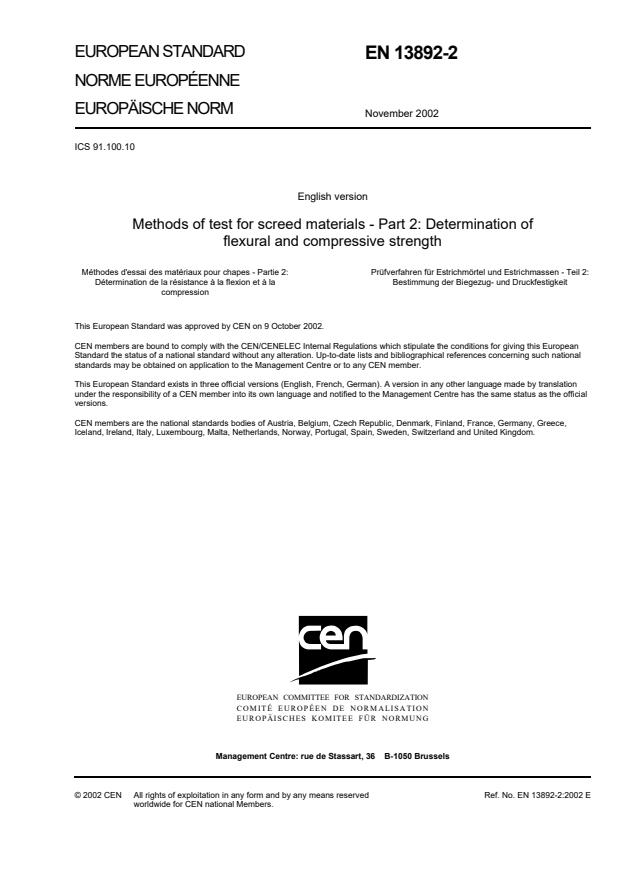
EUROPEAN STANDARDNORME EUROPÉENNEEUROPÄISCHE NORMEN 13892-2November 2002ICS 91.100.10English versionMethods of test for screed materials - Part 2: Determination offlexural and compressive strengthMéthodes d'essai des matériaux pour chapes - Partie 2:Détermination de la résistance à la flexion et à lacompressionPrüfverfahren für Estrichmörtel und Estrichmassen - Teil 2:Bestimmung der Biegezug- und DruckfestigkeitThis European Standard was approved by CEN on 9 October 2002.CEN members are bound to comply with the CEN/CENELEC Internal Regulations which stipulate the conditions for giving this EuropeanStandard the status of a national standard without any alteration. Up-to-date lists and bibliographical references concerning such nationalstandards may be obtained on application to the Management Centre or to any CEN member.This European Standard exists in three official versions (English, French, German). A version in any other language made by translationunder the responsibility of a CEN member into its own language and notified to the Management Centre has the same status as the officialversions.CEN members are the national standards bodies of Austria, Belgium, Czech Republic, Denmark, Finland, France, Germany, Greece,Iceland, Ireland, Italy, Luxembourg, Malta, Netherlands, Norway, Portugal, Spain, Sweden, Switzerland and United Kingdom.EUROPEAN COMMITTEE FOR STANDARDIZATIONCOMITÉ EUROPÉEN DE NORMALISATIONEUROPÄISCHES KOMITEE FÜR NORMUNGManagement Centre: rue de Stassart, 36
B-1050 Brussels© 2002 CENAll rights of exploitation in any form and by any means reservedworldwide for CEN national Members.Ref. No. EN 13892-2:2002 E
...
Questions, Comments and Discussion
Ask us and Technical Secretary will try to provide an answer. You can facilitate discussion about the standard in here.
Loading comments...