


EN 1846-2:2001
(Main)Firefighting and rescue service vehicles - Part 2: Common requirements - Safety and performance
Firefighting and rescue service vehicles - Part 2: Common requirements - Safety and performance
1.1 This part of this European Standard specifies the minimum requirements for safety and performance of firefighting and rescue service vehicles as designated in EN 1846-1:1998.
NOTE 1 Categories and mass classes of these vehicles are given in EN 1846-1:1998.
Firefighting and rescue service vehicles normally use a commercial chassis-cab or vehicle. A special chassis may be used for specialised vehicles to meet particular requirements.
NOTE 2 Both chassis and vehicle are considered to be standard commercially available items when the manufacturer proposes them for sale in all their standard or special versions, on the basis of catalogues distributed via its commercial network, including chassis and vehicles that are manufactured solely for fire service use.
Further requirements for aerial appliances are contained within other European Standards (see prEN 1777:1994 Hydraulic platforms for fire fighting and rescue services - Safety requirements and testing, prEN 14043:2000 Automatic turntable ladders for fire service use - Requirements and test methods and prEN14044:2000 Semi - automatic turntable ladders for fire service use - Requirements and test methods).
NOTE 3 This part of this European Standard should be read in conjunction with any national regulations in force for vehicles using the public roads and with any EC Directives and associated EFTA regulations in force relevant to vehicles and their equipment.
For the purpose of this part of this European Standard, the normal ambient temperature range is - 15 °C to + 35 °C.
NOTE 4 In the case of utilisation outside this temperature range, the particular temperature range should be specified by the customer.
1.2 This part of this European Standard does not apply to:
- personnel carrying vehicles;
- vehicles with a gross laden mass not exceeding 2 t;
- boats;
- aircraft;
- trains;
- ambulances;
- airport vehicles complying with International Civil Aviation Organisation (ICAO) recommendations.
Feuerwehrfahrzeuge - Teil 2: Allgemeine Anforderungen - Sicherheit und Leistung
Dieser Teil dieser Europäischen Norm legt die Mindestanforderungen an Sicherheit und Leistung für die in EN 1846-1 bezeichneten Feuerwehrfahrzeuge fest. ANMERKUNG 1: Kategorien und Gewichtsklassen dieser Fahrzeuge werden in EN 1846-1 angegeben. Für Feuerwehrfahrzeuge werden im Regelfall handelsübliche Fahrgestelle oder Fahrzeuge eingesetzt. Bei Spezialfahrzeugen dürfen spezifische Fahrgestelle verwendet werden, um besonderen Anforderungen zu entsprechen.
Véhicules des services de secours et de lutte contre l'incendie - Partie 2: Prescriptions communes - Sécurité et performances
1.1 La présente partie de la présente Norme européenne spécifie les prescriptions minimales de sécurité et de performances pour les véhicules des services de secours et de lutte contre l'incendie, tels que définis dans l'EN 1846-1:1998.
NOTE 1 Les catégories et les classes de masse de ces véhicules sont définies dans l'EN 1846-1:1998.
Les véhicules des services de secours et de lutte contre l'incendie utilisent normalement des châssis-cabine ou des véhicules de la gamme commerciale. Un châssis spécifique peut être utilisé pour des véhicules spéciaux afin de remplir certaines prescriptions particulières.
NOTE 2 Un châssis et un véhicule sont tous deux considérés comme appartenant à la gamme commerciale lorsque le constructeur les propose à la vente dans toutes ses versions de base ou spéciales, à partir de catalogues distribués à travers son réseau commercial, y compris les châssis et les véhicules fabriqués à l'unité pour les services de secours et de lutte contre l'incendie.
D'autres prescriptions pour les matériels aériens sont contenues dans d'autres normes européennes (voir prEN 1777:1994, Plates-formes hydrauliques pour services d'incendie - Prescriptions de sécurité et essais, prEN 14043:2000 « Echelles pivotantes automatiques pour la lutte contre l'incendie - Prescriptions et méthodes d'essais » et prEN 14044:2000, Échelles pivotantes semi-automatiques pour la lutte contre l'incendie - Prescriptions et méthodes d'essais.
NOTE 3 Il convient d'utiliser la présente partie de la présente norme Européenne conjointement avec tout règlement national en vigueur pour les véhicules utilisant les voies publiques, ainsi que toute Directive CE et toute réglementation de l'AELE qui y est associée, concernant les véhicules et leurs équipements.
Pour les besoins de la présente partie de la présente Norme européenne, la plage de température ambiante normale s'étend de - 15 °C à + 35 °C.
Gasilska in reševalna vozila - 2. del: Splošne zahteve - Varnost in obnašanje pri uporabi
General Information
- Status
- Withdrawn
- Publication Date
- 11-Dec-2001
- Withdrawal Date
- 10-Mar-2009
- Technical Committee
- CEN/TC 192 - Fire service equipment
- Drafting Committee
- CEN/TC 192/WG 3 - Firefighting and rescue service vehicles
- Current Stage
- 9960 - Withdrawal effective - Withdrawal
- Start Date
- 11-Mar-2009
- Completion Date
- 11-Mar-2009
- Directive
- 98/37/EC - Machinery
Relations
- Effective Date
- 19-Jan-2023
- Effective Date
- 08-Aug-2009
- Effective Date
- 28-Jan-2026
- Effective Date
- 28-Jan-2026
- Effective Date
- 28-Jan-2026
- Effective Date
- 08-Jun-2022
- Effective Date
- 08-Jun-2022
- Effective Date
- 08-Jun-2022

Get Certified
Connect with accredited certification bodies for this standard

NSF International
Global independent organization facilitating standards development and certification.

CIS Institut d.o.o.
Personal Protective Equipment (PPE) certification body. Notified Body NB-2890 for EU Regulation 2016/425 PPE.

Kiwa BDA Testing
Building and construction product certification.
Sponsored listings
Frequently Asked Questions
EN 1846-2:2001 is a standard published by the European Committee for Standardization (CEN). Its full title is "Firefighting and rescue service vehicles - Part 2: Common requirements - Safety and performance". This standard covers: 1.1 This part of this European Standard specifies the minimum requirements for safety and performance of firefighting and rescue service vehicles as designated in EN 1846-1:1998. NOTE 1 Categories and mass classes of these vehicles are given in EN 1846-1:1998. Firefighting and rescue service vehicles normally use a commercial chassis-cab or vehicle. A special chassis may be used for specialised vehicles to meet particular requirements. NOTE 2 Both chassis and vehicle are considered to be standard commercially available items when the manufacturer proposes them for sale in all their standard or special versions, on the basis of catalogues distributed via its commercial network, including chassis and vehicles that are manufactured solely for fire service use. Further requirements for aerial appliances are contained within other European Standards (see prEN 1777:1994 Hydraulic platforms for fire fighting and rescue services - Safety requirements and testing, prEN 14043:2000 Automatic turntable ladders for fire service use - Requirements and test methods and prEN14044:2000 Semi - automatic turntable ladders for fire service use - Requirements and test methods). NOTE 3 This part of this European Standard should be read in conjunction with any national regulations in force for vehicles using the public roads and with any EC Directives and associated EFTA regulations in force relevant to vehicles and their equipment. For the purpose of this part of this European Standard, the normal ambient temperature range is - 15 °C to + 35 °C. NOTE 4 In the case of utilisation outside this temperature range, the particular temperature range should be specified by the customer. 1.2 This part of this European Standard does not apply to: - personnel carrying vehicles; - vehicles with a gross laden mass not exceeding 2 t; - boats; - aircraft; - trains; - ambulances; - airport vehicles complying with International Civil Aviation Organisation (ICAO) recommendations.
1.1 This part of this European Standard specifies the minimum requirements for safety and performance of firefighting and rescue service vehicles as designated in EN 1846-1:1998. NOTE 1 Categories and mass classes of these vehicles are given in EN 1846-1:1998. Firefighting and rescue service vehicles normally use a commercial chassis-cab or vehicle. A special chassis may be used for specialised vehicles to meet particular requirements. NOTE 2 Both chassis and vehicle are considered to be standard commercially available items when the manufacturer proposes them for sale in all their standard or special versions, on the basis of catalogues distributed via its commercial network, including chassis and vehicles that are manufactured solely for fire service use. Further requirements for aerial appliances are contained within other European Standards (see prEN 1777:1994 Hydraulic platforms for fire fighting and rescue services - Safety requirements and testing, prEN 14043:2000 Automatic turntable ladders for fire service use - Requirements and test methods and prEN14044:2000 Semi - automatic turntable ladders for fire service use - Requirements and test methods). NOTE 3 This part of this European Standard should be read in conjunction with any national regulations in force for vehicles using the public roads and with any EC Directives and associated EFTA regulations in force relevant to vehicles and their equipment. For the purpose of this part of this European Standard, the normal ambient temperature range is - 15 °C to + 35 °C. NOTE 4 In the case of utilisation outside this temperature range, the particular temperature range should be specified by the customer. 1.2 This part of this European Standard does not apply to: - personnel carrying vehicles; - vehicles with a gross laden mass not exceeding 2 t; - boats; - aircraft; - trains; - ambulances; - airport vehicles complying with International Civil Aviation Organisation (ICAO) recommendations.
EN 1846-2:2001 is classified under the following ICS (International Classification for Standards) categories: 13.220.10 - Fire-fighting. The ICS classification helps identify the subject area and facilitates finding related standards.
EN 1846-2:2001 has the following relationships with other standards: It is inter standard links to EN 1846-2:2001+A3:2009, EN 1846-2:2009, EN 1846-3:2002+A1:2008, EN 14043:2005+A1:2009, EN 14044:2005+A1:2009, EN 1846-2:2001/A2:2006, EN 1846-2:2001/A1:2004, EN 1846-2:2001/AC:2007. Understanding these relationships helps ensure you are using the most current and applicable version of the standard.
EN 1846-2:2001 is associated with the following European legislation: EU Directives/Regulations: 98/37/EC; Standardization Mandates: M/079. When a standard is cited in the Official Journal of the European Union, products manufactured in conformity with it benefit from a presumption of conformity with the essential requirements of the corresponding EU directive or regulation.
EN 1846-2:2001 is available in PDF format for immediate download after purchase. The document can be added to your cart and obtained through the secure checkout process. Digital delivery ensures instant access to the complete standard document.
Standards Content (Sample)
2003-01.Slovenski inštitut za standardizacijo. Razmnoževanje celote ali delov tega standarda ni dovoljeno.Gasilska in reševalna vozila - 2. del: Splošne zahteve - Varnost in obnašanje pri uporabiFeuerwehrfahrzeuge - Teil 2: Allgemeine Anforderungen - Sicherheit und LeistungVéhicules des services de secours et de lutte contre l'incendie - Partie 2: Prescriptions communes - Sécurité et performancesFirefighting and rescue service vehicles - Part 2: Common requirements - Safety and performance43.160Vozila za posebne nameneSpecial purpose vehicles13.220.10Gašenje požaraFire-fightingICS:Ta slovenski standard je istoveten z:EN 1846-2:2001SIST EN 1846-2:2002en01-junij-2002SIST EN 1846-2:2002SLOVENSKI
STANDARD
CEN TC 192EN 1846-2:2001CEN TC 192Secretariat:
BSIFirefighting and rescue service vehicles — Part 2: Common requirements -Safety and performanceFeuerwehrfahrzeuge — Teil 2: Allgemeine Anforderungen - Sicherheit und LeistungVéhicules des services de secours et de luttre contre l'incendie — Partie 2 : Prescriptions communes - Sécurité etperformancesICS:
13.220.10Descriptors:
Document type:
European StandardDocument subtype:
Document stage:
PublicationDocument language:
ED:\rgt\192\standards\EN 1846-2\EN 1846-2 (E)pub.doc
STD Version 1.0SIST EN 1846-2:2002
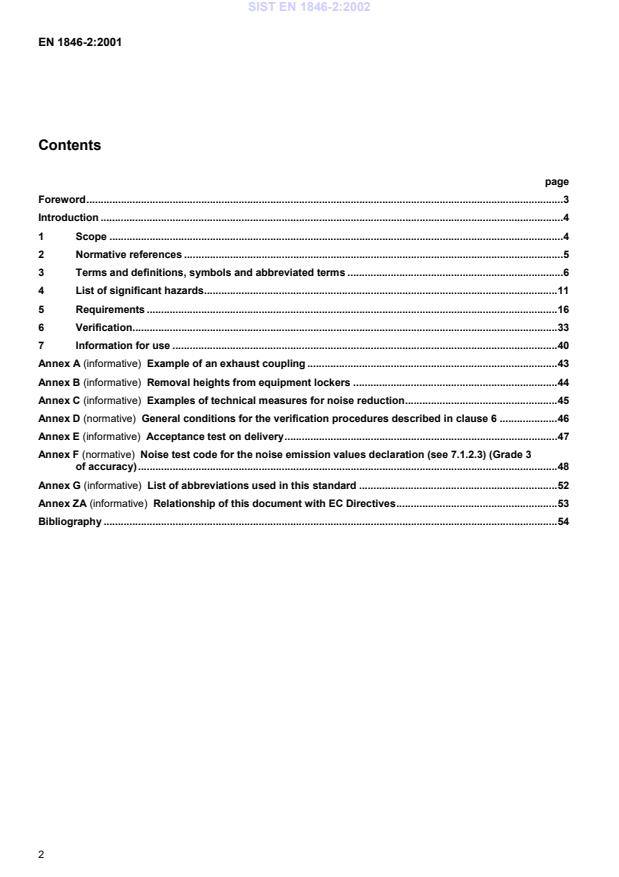
Example of an exhaust coupling.43Annex B (informative)
Removal heights from equipment lockers.44Annex C (informative)
Examples of technical measures for noise reduction.45Annex D (normative)
General conditions for the verification procedures described in clause 6.46Annex E (informative)
Acceptance test on delivery.47Annex F (normative)
Noise test code for the noise emission values declaration (see 7.1.2.3) (Grade 3of accuracy).48Annex G (informative)
List of abbreviations used in this standard.52Annex ZA (informative)
Relationship of this document with EC Directives.53Bibliography.54SIST EN 1846-2:2002
Part 1: Nomenclature and designation;
Part 2: Common requirements - Safety and performance;
Part 3: Permanently installed equipment - Safety and performance.According to the CEN/CENELEC Internal Regulations, the national standards organizations of the followingcountries are bound to implement this European Standard: Austria, Belgium, Czech Republic, Denmark, Finland,France, Germany, Greece, Iceland, Ireland, Italy, Luxembourg, Netherlands, Norway, Portugal, Spain, Sweden,Switzerland and the United KingdomSIST EN 1846-2:2002
personnel carrying vehicles;
vehicles with a gross laden mass not exceeding 2 t;
boats;
aircraft;SIST EN 1846-2:2002
trains;
ambulances;
airport vehicles complying with International Civil Aviation Organisation (ICAO) recommendations.1.3
This part of this European Standard deals with the technical requirements to minimise the hazards listed inclause 4 which can arise during the commissioning, the operational use and the routine checking of firefighting andrescue service vehicles when carried out in accordance with the specifications given by the manufacturer or hisauthorised representative.It does not cover the hazards generated by:
radiation (low frequency, radio frequency, radiation, micro-waves);
errors in the software;
use in potentially explosive atmospheres;
construction, transportation, maintenance and decommissioning;
wind pressure in and out of use;
static electricity problems;
remote control;
electromagnetic compatibility.This part of this European Standard also deals with performance requirements.1.4
This part of this European Standard is not applicable to machines which are manufactured before its date ofpublication.2 Normative referencesThis European Standard incorporates by dated or undated reference, provisions from other publications. Thesenormative references are cited at the appropriate places in the text and the publications are listed hereafter. Fordated references, subsequent amendments to or revisions of any of these publications apply to this EuropeanStandard only when incorporated in it by amendment or revision. For undated references the latest edition of thepublication referred to applies.EN 292-1:1991, Safety of machinery - Basic concepts, general principles for design - Part 1: Basic terminology,methodology.EN 292-2:1991, Safety of machinery - Basic concepts, general principles for design - Part 2: Technical principlesand specifications.EN 292-2/A1:1995, Safety of machinery - Basic concepts, general principles for design - Part 2: Technicalprinciples and specifications.EN 659:1996, Protective gloves for firefighters.EN 1846-1:1998, Firefighting and rescue service vehicles - Part 1: Nomenclature and designation.EN 24165:1991, Road vehicles - Electrical connections - Double pole connector (ISO 4165:1979).EN 60529:1991, Classification of degrees of protection provided by enclosures (IP code).EN 1070:1998, Safety of machinery – Terminology.SIST EN 1846-2:2002
between the horizontal ground contact plane and the plane tangent to the tyres of the front wheels,such that no rigid part ahead of the first axle of the vehicle is located between these planes (see Figure 1).aFigure 13.5departure angle (ß)The angle ß between the horizontal ground contact plane and the plane tangent to the tyres of the rearmost wheelssuch that no rigid part of the vehicle behind the last axle is between these planes (see Figure 2).bFigure 2 SIST EN 1846-2:2002
measured between two planes tangential to the innermost front and rear tyres which intersectat the lowest rigid point or surface of the underside of the vehicle between these tyres (see Figure 3). This angledefines the largest ramp over which the vehicle can pass.Figure 33.7ground clearance (d)The distance d between the horizontal ground contact plane and the lowest fixed point on the vehicle, other thanthe axles, measured when the vehicle is at its gross laden mass (see 3.2 and Figure 4).Multiple axle sets are considered as a single axle.dFigure 4 3.8ground clearance under axle (h)The distance h determined by the highest part of a quadrilateral having its base as the ground contact planebetween the innermost wheels on an axle and its upper plane as the lowest rigid part of the vehicle falling betweenthe wheels and within 0,3 m of both sides of the vehicle centre line (see Figure 5).SIST EN 1846-2:2002
between the horizontal and ground contact planes at which the vehicle, when tilted along itslongitudinal axis, loses stability. Loss of stability being the point at which the final upslope wheel loses contact withthe ground contact plane, at the gross laden mass of the vehicle (see 3.2 and Figure 7).312dFigure 7 3.12cabinThe driver's cab (including the first range of seats) and crew compartment (see Figure 8).12Key1
Driver's cab2
Crew compartment (separate or not)Figure 8 3.13operating positionThe position at which firefighters are located to operate firefighting or rescue equipment permanently installed onthe vehicle.3.14gradient capability (P)The ability of a vehicle at its gross laden mass (GLM) to start and stop on and to ascend or descend a slope.Key1
Loss of contact2
Ground contact plane3
Horizontal planeSIST EN 1846-2:2002
Mechanical hazards1.1
CrushingUnintended movement of thevehicle5.1.1.3.1Falling of tipping cabin5.1.2.2.1Reversing of vehicle5.1.1.8Rolling over of vehicle5.1.1.1Forward movement of load/bodywork5.1.2.2.25.1.2.2.31.2
ShearingInjury from horizontally movingload carriers5.1.2.4.21.3
Cutting or severingSharp edges of body and fixedequipment5.1.2.1Unprotected objects in the cabin5.1.2.2.21.4
EntanglementExposed PTO/transmission5.1.1.41.5
Drawing in or trappingMovement of the vehicle withdoors lockers equipment etc.,outside the body perimeter5.1.2.11.6
ImpactMovement of crew at suddenstopping of vehicle5.1.2.2.25.1.2.2.35.1.2.2.4Movement of equipment at suddenstopping of vehicle5.1.15.1.2.2.25.1.2.2.31.11
Loss of stabilityOverturning of vehicle5.1.15.1.1.57.1.2Loss of lateral stability duringbraking5.1.1.2.15.1.1.55.1.1.6Loss of stability due to unadaptedtyres pressure5.1.1.7(continued)SIST EN 1846-2:2002
Slip, trip, fallFalling from/through roof andworking platforms5.1.2.3.35.1.2.5Injury from leaving/entering crewcompartment5.1.2.3.1Leaving/entering the cabin5.1.3.3Tripping in area of the operatingpositions5.1.2.15.1.2.55.1.3.32
Electrical hazards2.1
Contact of persons withlive parts (direct contact)Connection of external powersupply to vehicle5.1.3.15.1.4.13
Thermal hazards3.1
Burns and scaldsExposed exhaust systems5.1.1.3.24
Hazards generated by noise4.1
Hearing lossNoise at operating position5.1.54.2 Interference withspeechSpeech and acoustic signals notaudible at operating position5.1.57
Hazards generated by materials and substances processed, used or exhausted by machinery7.1
Fluids, gases, mists,fumes and dustsInhalation of exhaust gases5.1.1.3.2Loss of acids from batteries5.1.3.2Contact with harmful fluids andfumes5.1.2.4.1(continued)SIST EN 1846-2:2002
Unhealthy postures,excessive effortsBad access to vehicle (crewcompartment, equipment, roof.)5.1.2.35.1.2.4.28.2
Human anatomyAccess and location of operatingposition5.1.2.3.35.1.2.55.1.4.28.4
Area lightingTripping in area of the operatingpositions5.1.3.38.6
Human errorIncorrect operations5.1.4.17.18.7
Inadequate design,location or identification ofmanual controlsLack of information or confusion atthe operating position5.1.410
Hazards caused by failure of energy supply, breaking down of machinery parts and otherfunctional disorders10.1
Failure of energyFalling of cabin during tilting5.1.2.2.1Mechanical or flame damage(category 3 as defined in EN 1846-1)5.1.110.3
Failure of controlsystemUnintentional moving of vehiclewhen PTO is in operation5.1.1.45.1.4.110.4
Errors of fittingIncorrect electric connection HI/LO(voltage - polarity)5.1.3.110.5
Overturn, loss ofstabilityLoss of longitudinal and lateralstability (category 3 as defined inEN 1846-1)5.1.1.15.1.1.2Loss of latitudinal stability of allvehicles (roll over)5.1.1.17.1Loss of lateral control of thevehicle5.1.1.25.1.1.5(continued)SIST EN 1846-2:2002
Missing and/orincorrectly positionedsafety relatedmeasures/meansAbsence of safety measures foroperational use7.1.212
Inadequate lighting ofmoving/working areasTripping in area of the operatingposition. Bad area lighting5.1.3.313
Sudden movement,instability duringhandlingTilting cabin5.1.2.2.1Injuries due to unexpectedmovement of equipment (doors,lockers, canopy, steps,masts, etc).5.1.2.45.1.3.114
Inadequate/non ergonomic design of driving/operating position14.3
Inadequateseat/seatingLoss of control when drivingcategory 3 vehicles as defined inEN 1846-1 on suspended seat5.1.2.2.4Personal injury from suddenmovement during travel5.1.2.2.25.1.2.2.414.4
Inadequatedesign/positioning ofcontrolsDangerous operation ofequipment, risk of error5.1.2.2.15.1.2.55.1.414.5
Starting/movingof self propelled machineryUnexpected or sudden movementof the vehicle or apparatus5.1.1.25.1.1.3.15.1.4.115
Mechanical hazards due to mobility15.1
Hazards to exposedpersons due to uncontrolledmovementUnexpected or sudden movementof the vehicle or apparatus5.1.1.25.1.1.3.15.1.4.1Unexpected tilting of cabin duringmovement (category 3 as definedin EN 1846-1)5.1.2.2.115.3
Hazards due to rollingoverRolling over of vehicle (category 3as defined in EN 1846-1)5.1.2.2.115.7
Hazards due tobatteries, fire emissions etc.Contact with acids of batteries5.1.3.2(continued)SIST EN 1846-2:2002
Relating to the travelling function20.1
Movement whenstarting the engineUnauthorised movement of thevehicle5.1.1.3.120.2
Movement without adriver at the driving positionUnauthorised movement of thevehicle5.1.1.420.3 Movement without allparts not in a safe positionMovement of the vehicle5.1.4.120.6
Insufficient ability ofmachinery to be sloweddown, stopped andimmobilisedDangerous movement of thevehicle. Loss of control of thevehicle5.1.15.1.1.221
Linked to the work position21.10
Insufficient meansfor evacuation/emergencyexitInadequate emergency exit5.1.2.2.55 RequirementsMethods to verify the requirements in the following subclauses are given in the equivalent subclauses of clause 6.Modifications or additions to the vehicle chassis-cab shall take into account any recommendations made by thechassis manufacturer.5.1 Safety requirements and/or measuresVehicles shall comply with the safety requirements and/or measures of this subclause and in addition with EN 292-1:1991 and EN 292-2:1991 for hazards relevant but not significant which are not dealt with in this part of thisEuropean Standard.5.1.1 GeneralThe permanently installed equipment, the load and the locks of doors, flaps and drawers shall be firmly securedagainst unintended release. The locks and holding devices that are used shall be easy to open.The filler-opening of fuel tank(s) shall be designed to avoid the risk of fuel contacting any hot parts of the vehicle orequipment.For category 3 vehicles (see EN 1846-1:1998) all electrical wiring, fuel lines, brake pipes, hoses shall be protectedfrom mechanical damage by rough ground/terrain. In cases of specific use (e.g. fire in natural environment) thesecomponents shall also be protected against direct contact with flames and incandescent particles.SIST EN 1846-2:2002
7,5 tM (Medium)7,5 t < GLM
14 tS (Super)GLM > 14 tCategory(see EN1846-1:1998)1(urban)2(rural)3(all terrain)1(urban)2(rural)3(all terrain)1(urban)2(rural)3(all terrain)tilt angle (°) 32 27 27 32 27 25 32 27 25 The tilt angle for all vehicles fitted with a demountable system (but not including the demountable unit)shall be greater than or equal to 35 °NOTEThese values do not apply to aerial appliances.5.1.1.2 Dynamic stability5.1.1.2.1 Stability during brakingDuring braking, the vehicle shall not deviate from its course by more than 20 % of its width to either side .5.1.1.2.2 Gradient capabilityAt gross laden mass, the vehicle shall comply with the gradient capability given in Table 3.Table 3 — Gradient capability valuesMass class(see EN1846-1:1998)L (Light)2 t < GLM
7,5 tM (Medium)7,5 t < GLM
14 tS (Super)GLM > 14 tCategory(see EN1846-1:1998)1(urban)2(rural)3(all terrain)1(urban)2(rural)3(all terrain)1(urban)2(rural)3(all terrain)gradientcapabilityP(°)Notapplicable 17
27 14 17 27 14 17 27SIST EN 1846-2:2002
between a line drawn from thenose of one step to the nose of the adjacent step, and the horizontal shall be less than or equal to 85° (seeFigure 9).SIST EN 1846-2:2002
actuationother than by intentional manual action.Instruments and control devices shall be identified by standard pictorial symbols in accordance with ISO/DIS10085:2000, or other means of identification if symbols are not applicable.5.1.5 NoiseThe noise at the operating position(s) shall be as low as practicable by design (e.g. using measures as given inannex C).NOTE 1General technical information on means to design low-noise machinery are given in EN/ISO 11688-1:1998.NOTE 2If it is not possible to achieve the noise reduction at the source, the manufacturer should, whenever practical, equipthe machine with devices such as noise enclosures, silencers. EN ISO 11546:1995 and EN ISO 11820:1997 give methods formeasuring the acoustical performance of enclosures and silencers respectivelyNOTE 3Considering the tasks assigned to the operators of firefighting and rescue vehicles, reduction of exposure to noisecannot be achieved by the use of hearing protectors.5.2 Performance requirements5.2.1 GeneralThe vehicle shall be delivered with the set of vehicle equipment as supplied by the chassis manufacturer.5.2.1.1 Geometric dimensionsVehicles at their gross laden mass (GLM) shall comply with the requirements given in Table 6.SIST EN 1846-2:2002
7,5 tM (Medium)7,5 t < GLM
14 tS (Super)GLM > 14 tCategory(see EN1846-1:1998)1(urban)2(rural)3(all terrain)1(urban)2(rural)3(all terrain)1(urban)2(rural)3(all terrain) (°) 131)
23 30 13 23 35 13 23 35 (°) 122) 233) 30 122) 233) 35 122) 23 3) 35 (°)Notapplicable 18 25Notapplicable 18 30Notapplicable 18 30d (m) 0,151) 0,20 0,25 0,20 0,30 0,40 0,25 0,30 0,40h (m) 0,151) 0,18 0,20 0,20 0,25 0,30 0,20 0,28 0,301)These values are not applicable to vehicles of permissible total laden mass (PTLM) less than 3,5 t forwhich manufacturers' values are applicable.2)No rigid part shall extend into the departure angle.3) Where a wheeled hose reel gantry is fitted, it may extend into the departure angle up to 11°.Where:- : approach angle (see 3.4);- : departure angle (see 3.5);- : angle of slope (see 3.6);- d: ground clearance (see 3.7);- h: ground clearance under axles (see 3.8).5.2.1.2 Dynamic performancesVehicles at their gross laden mass (GLM) shall comply with the requirements given in Table 7.SIST EN 1846-2:2002
7,5 tM (Medium)7,5 t < GLM
14 tS (Super)GLM > 14 tCategory(see EN1846-1:1998)1(urban)2(rural)3(all terrain)1(urban)2(rural)3(all terrain)1(urban)2(rural)3(all terrain)A1 (s) 14 15 15 15 15 16 16 16 17A2 (s) 20 25 30 27 30 35 30 35 40V (km/h) 95 90 85 90 85 80 85 80 80c (m)Notapplicable 0,20 0,25Notapplicable 0,20 0,25Notapplicable 0,20 0,25D (m) 141) 16 16 17 17 17 19 19 211)This value is not applicable to vehicles of permissible total laden mass (PTLM) less than 3,5 t for whichmanufacturers' values are applicable.Where:A1: time in seconds to travel 100 m from a standing start;A2: time in seconds taken to reach a speed of 65 km/h from a standing start;V: minimum speed;c: block height for cross axle capability;D: turning circle between walls.When the vehicle is ascending and descending the blocks used for determination of cross axle capability (seeTable 7) all cab doors, locker doors and shutters and stowed equipment shall remain secure. It shall be possible toopen all cab doors, locker doors and shutters, to remove portable equipment, and to operate fixed equipment whenthe vehicle wheels are positioned on the blocks in any diagonal direction.5.2.1.3 Engine5.2.1.3.1 GeneralNo requirement formulated under this subclause.5.2.1.3.2 Driving of special equipment by the engineIf the vehicle engine is used to drive permanently installed equipment, it shall be capable of running continuouslyfor a minimum of 4 h at the usual operational condition for that equipment, with the vehicle stationary, withoutreplenishment of coolants or lubricants. During this time, and at the intended utilisation temperatures, the engineand transmission temperatures shall not exceed the manufacturer's specifications.SIST EN 1846-2:2002
...
Questions, Comments and Discussion
Ask us and Technical Secretary will try to provide an answer. You can facilitate discussion about the standard in here.
Loading comments...