

EN 15182-1:2019
(Main)Portable equipment for projecting extinguishing agents supplied by firefighting pumps - Hand-held branchpipes for fire service use - Part 1: Common requirements
- Abstract
This document applies to hand-held branchpipes. It deals with:
- safety requirements;
- performance requirements;
- test methods;
- classification and designation;
- instructions for use and maintenance;
- marking.
It is advised to read this document in conjunction with parts 2, 3 or 4.
This document does not apply to branchpipes covered by EN 671 series, foam branchpipes covered by EN 16712-3, powder branchpipes, or branchpipes with a maximum working pressure above 40 bar.
NOTE 1 The Working Group has thoroughly addressed and discussed the issue of electrical safety in relation to using water branchpipes. However, an electrical test is not incorporated into this document as international experience, as well as research (NFPA handbook, French research, etc) have shown that any "artificial" or "laboratory style" testing will not take into account poor visibility and other conditions present on any fire ground, nor the problem of estimating distances under these conditions. When fighting fires in or near electrical installations, the power is cut off as soon as possible (see the operating instructions, 8.1). Also, it is best practice to maintain a maximum possible safety distance (at least 1 m up to 1 000 V) and to use a spray jet with a minimum spray angle of 30 °.
NOTE 2 It is essential to take into account reaction forces before choosing and operating branchpipes.
- Status
- Published
- Publication Date
- 17-Sep-2019
- Withdrawal Date
- 30-Mar-2020
- Technical Committee
- CEN/TC 192 - Fire service equipment
- Drafting Committee
- CEN/TC 192/WG 8 - Hand-held branchpipes for fire service use
- Current Stage
- 9092 - Decision on results of review/2YR ENQ - revise - Review Enquiry
- Start Date
- 31-Mar-2026
- Completion Date
- 07-Oct-2026



Overview
EN 15182-1:2019 - Portable equipment for projecting extinguishing agents supplied by firefighting pumps - Part 1: Hand‑held branchpipes for fire service use - Common requirements.
This CEN standard specifies minimum safety and performance requirements, test methods, classification and designation, instructions for use and maintenance, and marking for hand‑held branchpipes used by fire services. It applies to branchpipes supplied by firefighting pumps (maximum working pressure ≤ 40 bar) and is intended to be read with Parts 2, 3 and 4 for specific branchpipe types.
Key Topics and Technical Requirements
- Scope & exclusions: Covers hand‑held branchpipes; excludes EN 671 series hydrant branchpipes, foam branchpipes per EN 16712‑3, powder branchpipes and branchpipes >40 bar.
- Safety requirements: Ergonomic design for operation with firefighter gloves (EN 659); consideration of reaction forces when selecting/operating branchpipes.
- Performance requirements: Hydraulic characteristics, rated discharge values, spray/jet patterns (straight vs spray jets), flow adjustment and control.
- Mechanical characteristics: Limits on dimensions and mass (see Parts 2–4), fitting systems (360° swivelling in certain types), operating elements (handles, triggers, rotating elements) and materials resistant to heat, frost and impact.
- Test methods: Type tests at a reference pressure and controlled water temperature (10–25 °C); specific heat, frost and drop tests; leak, burst and hydraulic verification.
- Classification & designation: Branchpipe classes per Annex A and formal designation rules to aid procurement and documentation.
- Information & marking: Required instruction and maintenance handbooks, marking rules, and data sheets (Annex C/D) to record actual test results and product information.
Note: Electrical safety testing is not included; practical guidance is given - isolate power at electrical fires, keep maximum safe distance (e.g., ≥1 m up to 1 000 V) and use a spray jet with a minimum spray angle of 30°.
Applications and Who Uses This Standard
- Fire service procurement officers selecting compliant hand‑held branchpipes.
- Manufacturers and designers developing branchpipes for fire service use (type testing and documentation).
- Testing and certification laboratories performing type tests and acceptance checks.
- Fire safety engineers, maintenance teams and fleet managers using the standard for maintenance, training and equipment specification.
- Standards bodies and accreditation authorities verifying conformity.
Related Standards
- EN 15182‑2:2019 - Combination branchpipes PN16
- EN 15182‑3:2019 - Smooth bore / fixed spray angle PN16
- EN 15182‑4:2019 - High pressure branchpipes PN40
- EN 659 - Firefighter gloves (referenced for ergonomic testing)
- EN 671, EN 16712‑3 - Standards referenced as exclusions
Keywords: EN 15182-1:2019, hand-held branchpipes, firefighting pumps, branchpipe standard, fire service equipment, safety requirements, test methods, classification, marking.
Relations
- Replaces
EN 15182-1:2007+A1:2009 - Hand-held branchpipes for fire service use - Part 1: Common requirements - Effective Date
- 25-Sep-2019
- Effective Date
- 28-Jan-2026
- Effective Date
- 28-Jan-2026
- Effective Date
- 28-Jan-2026
Get Certified
Connect with accredited certification bodies for this standard

CIS Institut d.o.o.
Personal Protective Equipment (PPE) certification body. Notified Body NB-2890 for EU Regulation 2016/425 PPE.

Kiwa BDA Testing
Building and construction product certification.
Kmetijski inštitut Slovenije
Agricultural Institute of Slovenia. Soil testing, plant health, agricultural product analysis.
Sponsored listings
Frequently Asked Questions
EN 15182-1:2019 is a standard published by the European Committee for Standardization (CEN). Its full title is "Portable equipment for projecting extinguishing agents supplied by firefighting pumps - Hand-held branchpipes for fire service use - Part 1: Common requirements". This standard covers: This document applies to hand-held branchpipes. It deals with: - safety requirements; - performance requirements; - test methods; - classification and designation; - instructions for use and maintenance; - marking. It is advised to read this document in conjunction with parts 2, 3 or 4. This document does not apply to branchpipes covered by EN 671 series, foam branchpipes covered by EN 16712-3, powder branchpipes, or branchpipes with a maximum working pressure above 40 bar. NOTE 1 The Working Group has thoroughly addressed and discussed the issue of electrical safety in relation to using water branchpipes. However, an electrical test is not incorporated into this document as international experience, as well as research (NFPA handbook, French research, etc) have shown that any "artificial" or "laboratory style" testing will not take into account poor visibility and other conditions present on any fire ground, nor the problem of estimating distances under these conditions. When fighting fires in or near electrical installations, the power is cut off as soon as possible (see the operating instructions, 8.1). Also, it is best practice to maintain a maximum possible safety distance (at least 1 m up to 1 000 V) and to use a spray jet with a minimum spray angle of 30 °. NOTE 2 It is essential to take into account reaction forces before choosing and operating branchpipes.
This document applies to hand-held branchpipes. It deals with: - safety requirements; - performance requirements; - test methods; - classification and designation; - instructions for use and maintenance; - marking. It is advised to read this document in conjunction with parts 2, 3 or 4. This document does not apply to branchpipes covered by EN 671 series, foam branchpipes covered by EN 16712-3, powder branchpipes, or branchpipes with a maximum working pressure above 40 bar. NOTE 1 The Working Group has thoroughly addressed and discussed the issue of electrical safety in relation to using water branchpipes. However, an electrical test is not incorporated into this document as international experience, as well as research (NFPA handbook, French research, etc) have shown that any "artificial" or "laboratory style" testing will not take into account poor visibility and other conditions present on any fire ground, nor the problem of estimating distances under these conditions. When fighting fires in or near electrical installations, the power is cut off as soon as possible (see the operating instructions, 8.1). Also, it is best practice to maintain a maximum possible safety distance (at least 1 m up to 1 000 V) and to use a spray jet with a minimum spray angle of 30 °. NOTE 2 It is essential to take into account reaction forces before choosing and operating branchpipes.
EN 15182-1:2019 is classified under the following ICS (International Classification for Standards) categories: 13.220.10 - Fire-fighting. The ICS classification helps identify the subject area and facilitates finding related standards.
EN 15182-1:2019 has the following relationships with other standards: It is inter standard links to EN 15182-1:2007+A1:2009, EN 15182-4:2019, EN 15182-2:2019, EN 15182-3:2019. Understanding these relationships helps ensure you are using the most current and applicable version of the standard.
EN 15182-1:2019 is available in PDF format for immediate download after purchase. The document can be added to your cart and obtained through the secure checkout process. Digital delivery ensures instant access to the complete standard document.
Standards Content (Sample)
SLOVENSKI STANDARD
01-november-2019
Nadomešča:
SIST EN 15182-1:2007+A1:2010
Prenosna oprema za črpanje in uporabo gasilnega sredstva iz gasilskih črpalk -
Gasilski ročniki - 1. del: Splošne zahteve
Portable equipment for projecting extinguishing agents supplied by firefighting pumps -
Hand-held branchpipes for fire service use - Part 1: Common requirements
Tragbare Geräte zum Ausbringen von Löschmitteln, die mit Feuerlöschpumpen gefördert
werden - Strahlrohre für die Brandbekämpfung - Teil 1: Allgemeine Anforderungen
Equipement portable de projection d’agents d’extinction alimenté par des pompes à
usage incendie - Lances à main destinées aux services d'incendie et de secours - Partie
1: Prescriptions communes
Ta slovenski standard je istoveten z: EN 15182-1:2019
ICS:
13.220.10 Gašenje požara Fire-fighting
2003-01.Slovenski inštitut za standardizacijo. Razmnoževanje celote ali delov tega standarda ni dovoljeno.
EN 15182-1
EUROPEAN STANDARD
NORME EUROPÉENNE
September 2019
EUROPÄISCHE NORM
ICS 13.220.10 Supersedes EN 15182-1:2007+A1:2009
English Version
Portable equipment for projecting extinguishing agents
supplied by firefighting pumps - Hand-held branchpipes
for fire service use - Part 1: Common requirements
Equipement portable de projection d'agents Tragbare Geräte zum Ausbringen von Löschmitteln, die
d'extinction alimenté par des pompes à usage incendie mit Feuerlöschpumpen gefördert werden - Strahlrohre
- Lances à main destinées aux services d'incendie et de für die Brandbekämpfung - Teil 1: Allgemeine
secours - Partie 1 : Prescriptions communes Anforderungen
This European Standard was approved by CEN on 10 June 2019.
CEN members are bound to comply with the CEN/CENELEC Internal Regulations which stipulate the conditions for giving this
European Standard the status of a national standard without any alteration. Up-to-date lists and bibliographical references
concerning such national standards may be obtained on application to the CEN-CENELEC Management Centre or to any CEN
member.
This European Standard exists in three official versions (English, French, German). A version in any other language made by
translation under the responsibility of a CEN member into its own language and notified to the CEN-CENELEC Management
Centre has the same status as the official versions.
CEN members are the national standards bodies of Austria, Belgium, Bulgaria, Croatia, Cyprus, Czech Republic, Denmark, Estonia,
Finland, France, Germany, Greece, Hungary, Iceland, Ireland, Italy, Latvia, Lithuania, Luxembourg, Malta, Netherlands, Norway,
Poland, Portugal, Republic of North Macedonia, Romania, Serbia, Slovakia, Slovenia, Spain, Sweden, Switzerland, Turkey and
United Kingdom.
EUROPEAN COMMITTEE FOR STANDARDIZATION
COMITÉ EUROPÉEN DE NORMALISATION
EUROPÄISCHES KOMITEE FÜR NORMUNG
CEN-CENELEC Management Centre: Rue de la Science 23, B-1040 Brussels
© 2019 CEN All rights of exploitation in any form and by any means reserved Ref. No. EN 15182-1:2019 E
worldwide for CEN national Members.
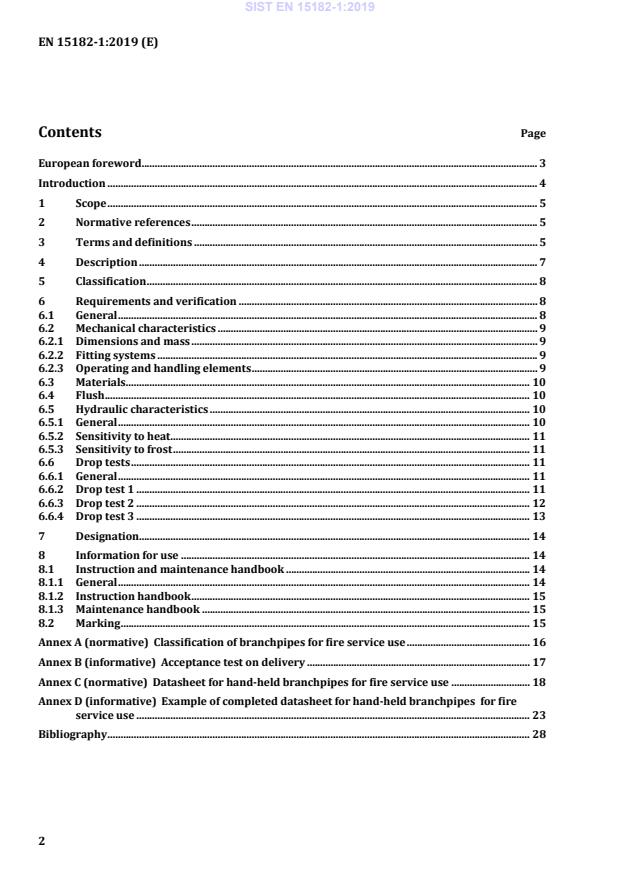
Contents Page
European foreword . 3
Introduction . 4
1 Scope . 5
2 Normative references . 5
3 Terms and definitions . 5
4 Description . 7
5 Classification . 8
6 Requirements and verification . 8
6.1 General . 8
6.2 Mechanical characteristics . 9
6.2.1 Dimensions and mass . 9
6.2.2 Fitting systems . 9
6.2.3 Operating and handling elements . 9
6.3 Materials . 10
6.4 Flush . 10
6.5 Hydraulic characteristics . 10
6.5.1 General . 10
6.5.2 Sensitivity to heat . 11
6.5.3 Sensitivity to frost . 11
6.6 Drop tests . 11
6.6.1 General . 11
6.6.2 Drop test 1 . 11
6.6.3 Drop test 2 . 12
6.6.4 Drop test 3 . 13
7 Designation. 14
8 Information for use . 14
8.1 Instruction and maintenance handbook . 14
8.1.1 General . 14
8.1.2 Instruction handbook . 15
8.1.3 Maintenance handbook . 15
8.2 Marking . 15
Annex A (normative) Classification of branchpipes for fire service use . 16
Annex B (informative) Acceptance test on delivery . 17
Annex C (normative) Datasheet for hand-held branchpipes for fire service use . 18
Annex D (informative) Example of completed datasheet for hand-held branchpipes for fire
service use . 23
Bibliography . 28
European foreword
This document (EN 15182-1:2019) has been prepared by Technical Committee CEN/TC 192 “Fire and
rescue service equipment”, the secretariat of which is held by BSI.
This European Standard shall be given the status of a national standard, either by publication of an
identical text or by endorsement, at the latest by March 2020, and conflicting national standards shall
be withdrawn at the latest by March 2020.
Attention is drawn to the possibility that some of the elements of this document may be the subject of
patent rights. CEN shall not be held responsible for identifying any or all such patent rights.
This document supersedes EN 15182-1:2007+A1:2009.
Compared to EN 15182-1:2007+A1:2009 the following changes have been made:
— the definitions have been updated and three new definitions have been added (“closed branchpipe”,
“main shut off valve”, “open breanchpipe”);
— each verification has been placed under the corresponding requirement;
— the values of rated discharge at p (see Table 1) have been updated;
R
— p replaced with p in 6.6.4;
N R
— addition of the designation (new Clause 7);
— the marking (Clause 8) has been updated;
— the classification (see Annex A) has been updated in accordance with EN 15182-2:2019;
— improvement of the wording/editorial changes.
According to the CEN-CENELEC Internal Regulations, the national standards organisations of the
following countries are bound to implement this European Standard: Austria, Belgium, Bulgaria,
Croatia, Cyprus, Czech Republic, Denmark, Estonia, Finland, France, Germany, Greece, Hungary, Iceland,
Ireland, Italy, Latvia, Lithuania, Luxembourg, Malta, Netherlands, Norway, Poland, Portugal, Republic of
North Macedonia, Romania, Serbia, Slovakia, Slovenia, Spain, Sweden, Switzerland, Turkey and the
United Kingdom.
Introduction
This document has been created to provide a minimum level of safety and performance criteria.
Its purpose is not to define a specific branchpipe design but to help the user in understanding and
choosing the correct equipment.
1 Scope
This document applies to hand-held branchpipes. It deals with:
— safety requirements;
— performance requirements;
— test methods;
— classification and designation;
— instructions for use and maintenance;
— marking.
It is advised to read this document in conjunction with parts 2, 3 or 4.
This document does not apply to branchpipes covered by EN 671 series, foam branchpipes covered by
EN 16712-3, powder branchpipes, or branchpipes with a maximum working pressure above 40 bar.
NOTE 1 The Working Group has thoroughly addressed and discussed the issue of electrical safety in relation to
using water branchpipes. However, an electrical test is not incorporated into this document as international
experience, as well as research (NFPA handbook, French research, etc) have shown that any “artificial” or
“laboratory style” testing will not take into account poor visibility and other conditions present on any fire ground,
nor the problem of estimating distances under these conditions. When fighting fires in or near electrical
installations, the power is cut off as soon as possible (see the operating instructions, 8.1). Also, it is best practice to
maintain a maximum possible safety distance (at least 1 m up to 1 000 V) and to use a spray jet with a minimum
spray angle of 30 °.
NOTE 2 It is essential to take into account reaction forces before choosing and operating branchpipes.
2 Normative references
The following documents are referred to in the text in such a way that some or all of their content
constitutes requirements of this document. For dated references, only the edition cited applies. For
undated references, the latest edition of the referenced document (including any amendments) applies.
EN 15182-2:2019, Portable equipment for projecting extinguishing agents supplied by firefighting
pumps — Hand-held branchpipes for fire service use — Part 2: Combination branchpipes PN 16
EN 15182-3:2019, Portable equipment for projecting extinguishing agents supplied by firefighting
pumps — Hand-held branchpipes for fire service use — Part 3: Smooth bore jet and/or one fixed spray jet
angle branchpipes PN 16
EN 15182-4:2019, Portable equipment for projecting extinguishing agents supplied by firefighting
pumps — Hand-held branchpipes for fire service use — Part 4: High pressure branchpipes PN 40
3 Terms and definitions
For the purposes of this document, the following terms and definitions apply.
ISO and IEC maintain terminological databases for use in standardization at the following addresses:
— IEC Electropedia: available at http://www.electropedia.org/
— ISO Online browsing platform: available at http://www.iso.org/obp
3.1
branchpipe
combination of components that connects to a liquid extinguishing agent supply via a hose and coupling
and projects liquid extinguishing agent according to the operators requirements
3.2
closed branchpipe
branchpipe where the main shut off valve is in the closed position
3.3
main shut off valve
valve that is first in the flow line
3.4
open branchpipe
branchpipe where all valves are in the fully open position
3.5
nozzle
component of a branchpipe that controls the liquid extinguishing agent flow rate and/or pattern
3.6
pressures
Note 1 to entry: Pressures expressed in bars are measured at the inlet of the branchpipe.
Note 2 to entry: 1 bar = 0,1 MPa (10 Pa).
3.6.1
reference pressure
p
R
standard working pressure used to run hydraulic tests
3.6.2
median pressure
p
m
for type 4 branchpipes, average pressure of the pressure control range
Note 1 to entry: Type 4 branchpipes are defined in EN 15182-2:2019 and Annex A.
3.6.3
nominal pressure
p
N
maximum working pressure
3.6.4
test pressure
p
t
static pressure used for leakage tests
3.6.5
burst pressure
p
B
static pressure used for burst test
3.7
straight jet
jet having the maximum throw and mechanical effect
3.8
spray jet
any jet different to the straight jet
3.9
flush
position allowing the branchpipe to clear debris
4 Description
The components of a branchpipe, where used or necessary, are named as followed and shown in
Figure 1:
— fitting system;
— gripping device;
— open and shut-off device (e.g. operated by a valve handle, a lever or a trigger, an open and shut-off
device can also be accommodated in a twist shut-off nozzle);
— jet/spray system(s);
— flow adjustment system (e.g. operated by a valve handle, a rotating operating element or a trigger).
These components may consist of a single piece or several parts.
Key
1 nozzle
2 valve handle
3 handhold
4 rotating operating element
5 lever
6 trigger
7 fitting system
Figure 1 — Components of a hand-held branchpipe
5 Classification
Branchpipes shall be classified in accordance with Annex A.
6 Requirements and verification
6.1 General
All the tests defined in this document are type tests.
Unless otherwise specified, tests shall be carried out, at the reference pressure p at a water
R
temperature between 10 °C and 25 °C.
Actual test results can be entered on the data sheet when these results exceed the minimum
requirements given in this document.
NOTE Guidance for acceptance tests on delivery is given in Annex B.
Branchpipes should be ergonomically designed so that they can be easily operated without risk of
injury when wearing firefighter's gloves complying with EN 659.
----------------------
...