

EN 1759-1:2004
(Main)Flanges and their joint - Circular flanges for pipes, valves, fittings and accessories, Class designated - Part 1: Steel flanges, NPS 1/2 to 24
- Abstract
This European Standard specifies dimensions, tolerances, materials, P/T ratings and technical conditions of delivery for steel flanges with bore size DN 15 to DN 600, Class designated; based on ANSI-B 16.5-1988 + Addenda 1992.
- Status
- Published
- Publication Date
- 23-Nov-2004
- Withdrawal Date
- 30-May-2005
- Technical Committee
- CEN/TC 74 - Flanges and their joints
- Drafting Committee
- CEN/TC 74/WG 2 - Steel flanges
- Current Stage
- 9060 - Closure of 2 Year Review Enquiry - Review Enquiry
- Start Date
- 04-Mar-2022
- Completion Date
- 04-Mar-2022

Overview
EN 1759-1:2004 is a CEN European Standard that defines requirements for steel circular flanges used on pipes, valves, fittings and accessories. It covers Class-designated flanges from NPS 1/2 to NPS 24 (nominal bore DN 15 to DN 600) and Class 150 to Class 2500, and is based on ANSI/ASME B16.5 (1988 + Addenda 1992). The standard sets out dimensions, tolerances, materials, pressure/temperature (p/T) ratings and technical delivery conditions for steel flanges intended for pressure piping systems.
Key topics
- Scope and designation
- Class-designated flange system (NPS/DN cross-reference).
- Flange and facing type identification and ordering information.
- Dimensions and tolerances
- Mating dimensions and hard-metricated values for all flange types (tables for NPS 1/2–24).
- Materials and traceability
- Permitted steel grades listed in material tables (Tables 3a/3b).
- Requirements for forgings, castings and plate manufacture for specific flange types.
- Material certificates and traceability per EN 10204 where required.
- Pressure/temperature (p/T) ratings
- p/T tables for material groups (Tables 16–22) with linear interpolation allowed for intermediate temperatures; Annex D provides determination guidance.
- Bolting and joint design
- Bolt sizes and numbers per flange size/class; bolting selection rules reference EN 1515-1 and prEN 1515-3.
- Notes on using inch (imperial) bolting vs. metric bolting (Annex C).
- Weld preparations and welding
- Recommendations for weld ends (Annex A); restrictions on repair welding and marking of welded repairs.
- Annexes and supporting content
- Annexes A–E cover weld ends, bolting classification, metric bolting use, p/T calculations for EN materials, and approximate masses.
Applications and who uses it
EN 1759-1 is used by:
- Flange and pipe manufacturers for design and production of steel flanges.
- Piping designers and mechanical engineers specifying flanged connections in oil & gas, petrochemical, power generation, water treatment and industrial process plants.
- Procurement/specification teams preparing purchase orders and ensuring compatibility with ASME B16.5-based components.
- Quality, inspection and welding engineers enforcing material traceability, weld procedures and repair rules.
Practical benefits include assured interchangeability, clear p/T ratings, and unified metric dimensions for ASME-origin flanges.
Related standards
- ASME B16.5 (ANSI B16.5): basis for dimensions and facing compatibility
- EN 1515-1 / prEN 1515-3: bolting selection and classification
- EN 1092 series: covers DIN/PN-based flanges (alternate European system)
- EN 10204, material and delivery conditions
Keywords: EN 1759-1:2004, steel flanges, class designated, NPS 1/2 to 24, flange dimensions, p/T ratings, ASME B16.5, bolting selection, flange facings, CEN standard.
Relations
- Effective Date
- 25-Aug-2026
- Effective Date
- 25-Aug-2026
- Effective Date
- 25-Aug-2026
- Effective Date
- 25-Aug-2026
- Effective Date
- 25-Aug-2026
- Effective Date
- 25-Aug-2026
- Effective Date
- 09-Feb-2026
- Effective Date
- 28-Jan-2026
- Effective Date
- 28-Jan-2026
- Effective Date
- 28-Jan-2026
- Effective Date
- 28-Jan-2026
- Effective Date
- 28-Jan-2026
- Effective Date
- 28-Jan-2026
- Effective Date
- 28-Jan-2026
- Effective Date
- 28-Jan-2026
Get Certified
Connect with accredited certification bodies for this standard

Institut za varilstvo d.o.o. (Welding Institute)
Slovenia's leading welding institute since 1952. ISO 3834, EN 1090, pressure equipment certification, NDT personnel, welder qualification. Only IIW Au
Sponsored listings
Frequently Asked Questions
EN 1759-1:2004 is a standard published by the European Committee for Standardization (CEN). Its full title is "Flanges and their joint - Circular flanges for pipes, valves, fittings and accessories, Class designated - Part 1: Steel flanges, NPS 1/2 to 24". This standard covers: This European Standard specifies dimensions, tolerances, materials, P/T ratings and technical conditions of delivery for steel flanges with bore size DN 15 to DN 600, Class designated; based on ANSI-B 16.5-1988 + Addenda 1992.
This European Standard specifies dimensions, tolerances, materials, P/T ratings and technical conditions of delivery for steel flanges with bore size DN 15 to DN 600, Class designated; based on ANSI-B 16.5-1988 + Addenda 1992.
EN 1759-1:2004 is classified under the following ICS (International Classification for Standards) categories: 23.040.60 - Flanges, couplings and joints. The ICS classification helps identify the subject area and facilitates finding related standards.
EN 1759-1:2004 has the following relationships with other standards: It is inter standard links to ISO 9328-2:2004, ISO 9328-3:2004, ISO 9327-1:1999, ISO 4955:1994, ISO 9328-5:2004, ISO 4991:1994, ISO 9327-2:1999, EN ISO 887:2000, EN ISO 6708:1995, EN 1515-3:2005, EN 10222-3:2017, EN 4131:2009/AC:2010, EN 10222-4:2017+A1:2021, EN 10222-2:2017+A1:2021, EN 1515-1:1999. Understanding these relationships helps ensure you are using the most current and applicable version of the standard.
EN 1759-1:2004 is available in PDF format for immediate download after purchase. The document can be added to your cart and obtained through the secure checkout process. Digital delivery ensures instant access to the complete standard document.
Standards Content (Sample)
SLOVENSKI STANDARD
01-marec-2005
Prirobnice in prirobnični spoji - Okrogle prirobnice za cevi, ventile, fitinge in pribor
z oznako Class - 1. del: Jeklene prirobnice NPS1/2 do 24
Flanges and their joint - Circular flanges for pipes, valves, fittings and accessories, Class
designated - Part 1: Steel flanges, NPS 1/2 to 24
Flansche und ihre Verbindungen - Runde Flansche für Rohre, Armaturen, Formstücke
und Zubehörteile, nach Class bezeichnet - Teil 1: Stahlflansche, NPS 1/2 bis 24
Brides et leurs assemblages - Brides circulaires pour tubes, appareils de robinetterie,
raccords et accessoires, désignées Class - Partie 1 : Brides en acier NPS 1/2 a 24
Ta slovenski standard je istoveten z: EN 1759-1:2004
ICS:
23.040.60 Prirobnice, oglavki in spojni Flanges, couplings and joints
elementi
2003-01.Slovenski inštitut za standardizacijo. Razmnoževanje celote ali delov tega standarda ni dovoljeno.
EUROPEAN STANDARD
EN 1759-1
NORME EUROPÉENNE
EUROPÄISCHE NORM
November 2004
ICS 23.040.60
English version
Flanges and their joint - Circular flanges for pipes, valves,
fittings and accessories, Class designated - Part 1: Steel
flanges, NPS 1/2 to 24
Brides et leurs assemblages - Brides circulaires pour tubes, Flansche und ihre Verbindungen - Runde Flansche für
appareils de robinetterie, raccords et accessoires, Rohre, Armaturen, Formstücke und Zubehörteile, nach
désignées Class - Partie 1 : Brides en acier NPS 1/2 à 24 Class bezeichnet - Teil 1: Stahlflansche, NPS 1/2 bis 24
This European Standard was approved by CEN on 30 September 2004.
CEN members are bound to comply with the CEN/CENELEC Internal Regulations which stipulate the conditions for giving this European
Standard the status of a national standard without any alteration. Up-to-date lists and bibliographical references concerning such national
standards may be obtained on application to the Central Secretariat or to any CEN member.
This European Standard exists in three official versions (English, French, German). A version in any other language made by translation
under the responsibility of a CEN member into its own language and notified to the Central Secretariat has the same status as the official
versions.
CEN members are the national standards bodies of Austria, Belgium, Cyprus, Czech Republic, Denmark, Estonia, Finland, France,
Germany, Greece, Hungary, Iceland, Ireland, Italy, Latvia, Lithuania, Luxembourg, Malta, Netherlands, Norway, Poland, Portugal, Slovakia,
Slovenia, Spain, Sweden, Switzerland and United Kingdom.
EUROPEAN COMMITTEE FOR STANDARDIZATION
COMITÉ EUROPÉEN DE NORMALISATION
EUROPÄISCHES KOMITEE FÜR NORMUNG
Management Centre: rue de Stassart, 36 B-1050 Brussels
© 2004 CEN All rights of exploitation in any form and by any means reserved Ref. No. EN 1759-1:2004: E
worldwide for CEN national Members.
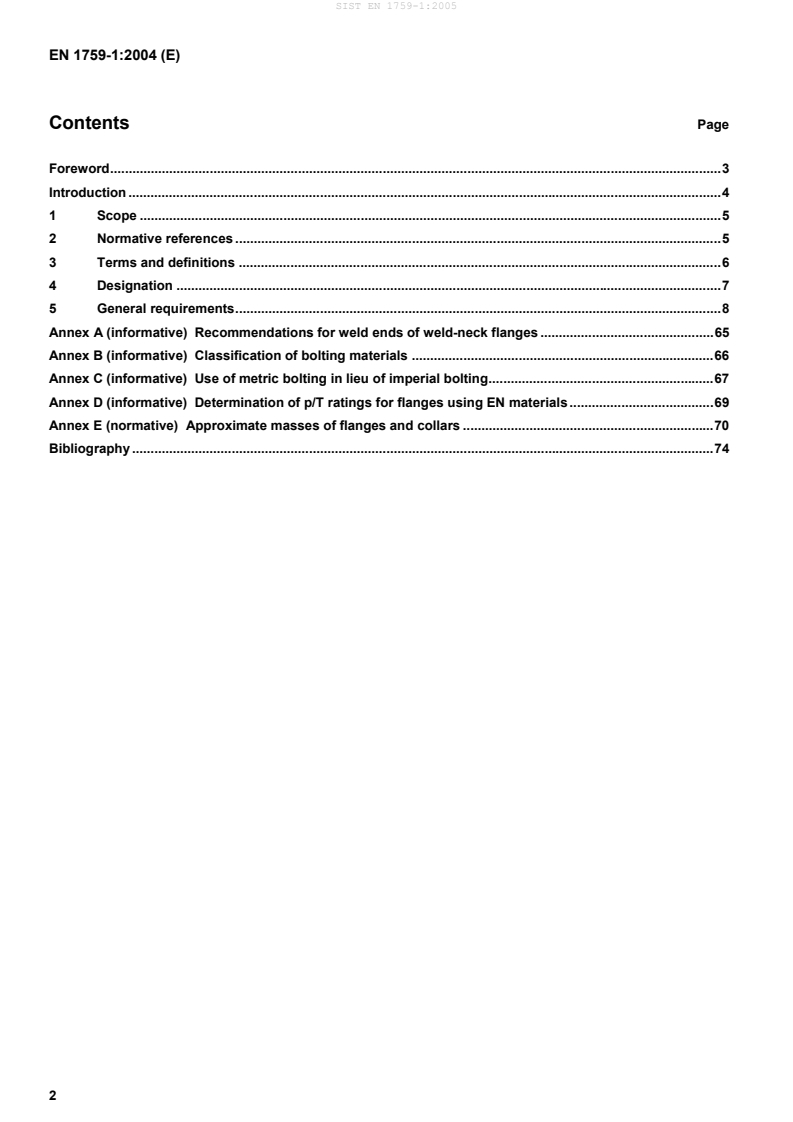
Contents Page
Foreword.3
Introduction .4
1 Scope .5
2 Normative references .5
3 Terms and definitions .6
4 Designation .7
5 General requirements.8
Annex A (informative) Recommendations for weld ends of weld-neck flanges .65
Annex B (informative) Classification of bolting materials .66
Annex C (informative) Use of metric bolting in lieu of imperial bolting.67
Annex D (informative) Determination of p/T ratings for flanges using EN materials .69
Annex E (normative) Approximate masses of flanges and collars .70
Bibliography .74
Foreword
This document (EN 1759-1:2004) has been prepared by Technical Committee CEN/TC 74 "Flanges and their
joints" the secretariat of which is held by DIN.
This European Standard shall be given the status of a national standard, either by publication of an identical text or
by endorsement, at the latest by May 2005, and conflicting national standards shall be withdrawn at the latest by
May 2005.
EN 1759 consists of the following parts:
Part 1: Steel flanges;
Part 3: Copper alloy flanges ;
Part 4: Aluminium alloy flanges .
This document includes a Bibliography.
According to the CEN/CENELEC Internal Regulations, the national standards organizations of the following
countries are bound to implement this European Standard: Austria, Belgium, Cyprus, Czech Republic, Denmark,
Estonia, Finland, France, Germany, Greece, Hungary, Iceland, Ireland, Italy, Latvia, Lithuania, Luxembourg, Malta,
Netherlands, Norway, Poland, Portugal, Slovakia, Slovenia, Spain, Sweden, Switzerland and United Kingdom.
To be published
Introduction
When Technical Committee, CEN/TC 74, commenced its work of producing this European standard it took as its
basis, the International Standard, ISO 7005-1, Steel flanges.
In taking this decision, CEN/TC 74, agreed that this standard would differ significantly from the ISO standard in
respect of the following:
a) Whereas ISO 7005-1 included in its scope both the original DIN based flanges and also the original
ANSI/ASME based flanges, EN 1759-1 contains only the flanges with ANSI/ASME origin (ASME B16.5).
CEN/TC 74 has produced a separate series of standards, EN 1092 Parts 1, 2, 3 and 4, dealing with the DIN
based flanges in PN designations;
b) In this standard, the flanges are Class designated (not PN designated as in the ISO standard) and those
dimensions taken from ASME B16.5 are hard metricated.
Consequently, whilst the mating dimensions, the flange and facing types and designations are compatible with
those given in ISO 7005-1, it is important to take account of the following differences which exist in EN 1759-1:
1) The use of inch bolting requires the use of suitable gaskets, not necessarily compatible with the gaskets used
with ISO 7005-1 flanges (for metric bolts).
2) This standard specifies grades of ASTM steels similar to those specified in ISO 7005-1, but in addition permits
the use of grades of European steels according to EN 1092-1;
1 Scope
This European Standard for a single system of flanges specifies requirements for circular steel flanges in Class
designations Class 150 to Class 2 500 and nominal sizes from NPS ½ to NPS 24.
NOTE The relationship between nominal size (DN) and nominal size (NPS) is given for reference purposes in Tables 9
to 14.
This standard specifies the flange types and their facings, dimensions, tolerances, threading, bolt sizes, flange jointing
face surface finish, marking, materials and pressure/temperature ratings.
This standard does not apply to flanges made from bar stock by turning, or to flanges of types 11, 12, 13, 14 and
15 made from plate material.
2 Normative references
The following referenced documents are indispensable for the application of this document. For dated references,
only the edition cited applies. For undated references, the latest edition of the referenced document (including any
amendments) applies.
EN 1515-1, Flanges and their joints — Bolting — Part 1: Selection of bolting
prEN 1515-3, Flanges and their joints — Bolting — Part 3: Classification of bolt materials for steel flanges, class
designated
EN 10025, Hot rolled products of non-alloy structural steels — Technical delivery conditions
EN 10028-2, Flat products made of steels for pressure purposes — Part 2: Non alloy and alloy steels with specified
elevated temperature properties
EN 10028-3, Flat products made of steels for pressure purposes — Part 3: Weldable fine grain steels, normalized
EN 10028-4, Flat products made of steels for pressure purposes — Part 4: Nickel alloy steels with specified low
temperature properties
EN 10028-7, Flat products made of steels for pressure purposes — Part 7: Stainless steels
EN 10213-2, Technical delivery conditions for steel castings for pressure purposes — Part 2: Steel grades for use
at room temperature and elevated temperatures
EN 10213-3, Technical delivery conditions for steel castings for pressure purposes — Part 3: Steel grades for use
at low temperatures
EN 10213-4, Technical delivery conditions for steel castings for pressure purposes — Part 4: Austenitic and
austenitic-ferritic steel grades
EN 10222-2, Steel forgings for pressure purposes — Part 2: Ferritic and martensitic steels with specified elevated
temperature properties
EN 10222-3, Steel forgings for pressure purposes — Part 3: Nickel steels with specified low temperature properties
EN 10222-4, Steel forgings for pressure purposes — Part 4: Weldable fine grain steels with high proof strength
EN 10222-5, Steel forgings for pressure purposes - Part 5: Martensitic, austenitic and austenitic-ferritic stainless
steels
EN ISO 887, Plain washers for metric bolts, screws and nuts for general purposes - General plan (ISO 887:2000)
EN ISO 6708, Pipe components — Definition and selection of DN (nominal size) (ISO 6708:1995)
ISO 4955, Heat-resisting steels and alloys
ISO 4991, Steel castings for pressure purposes
ISO 9327-1, Steel forgings and rolled or forged bars for pressure purposes — Technical delivery conditions —Part 1:
General requirements
ISO 9327-2, Steel forgings and rolled or forged bars for pressure purposes —Technical delivery conditions — Part 2:
Non-alloy and alloy (Mo, Cr and CrMo) steels with specified elevated temperature properties
ISO 9328-2, Steel flat products for pressure purposes — Technical delivery conditions —Part 2: Non-alloy and alloy
steels with specified elevated temperature properties
ISO 9328-3, Steel flat products for pressure purposes — Technical delivery conditions — Part 3: Weldable fine
grain steels, normalized
ISO 9328-5, Steel flat products for pressure purposes — Technical delivery conditions — Part 5: Weldable fine grain
steels, thermomechanically rolled
ASME B16.5: 1996 Pipe flanges and flanged fittings — NPS ½ through NPS 24
ASME/ANSI B1.20.1, Pipe threads, general purpose (inch)
ASTM A105/A105M, Forgings, Carbon Steel, for Piping Component
ASTM A182/A182M, Forged or Rolled Alloy-Steel Pipe Flanges, Forged Fittings, and Valves and Parts for High-
Temperature Service
ASTM A203/A203M, Pressure Vessel Plates, Alloy Steel, Nickel
ASTM A204/A204M, Specification for pressure vessel plates, alloy steel, molybdenum
ASTM A216/A216M, Steel Castings, Carbon Suitable for Fusion Welding for High-Temperature Service
ASTM A217/A217M, Steel Castings, Martensitic Stainless and Alloy, for Pressure-Containing Parts Suitable for High-
Temperature Service
ASTM A240/A240M, Heat-Resisting Chromium and Chromium-Nickel Stainless Steel Plate, Sheet, and Strip for
Pressure Vessels
ASTM A325, High-Strength Bolts for Structural Steel Joints
ASTM A350/A350M, Forgings, Carbon and Low-Alloy Steel, Requiring Notch Toughness Testing for Piping
Components
ASTM A351/A351M, Castings, Austenitic, Austenitic-Ferritic (Duplex) for Pressure-Containing Parts
ASTM A352/A352M, Steel Castings, Ferritic and Martensitic, for Pressure-Containing Parts Suitable for Low-
Temperature Service
ASTM A387/A387M, Pressure Vessel Plates, Alloy Steel, Chromium-Molybdenum
ASTM A515/A515M, Pressure Vessel Plates, Carbon Steel, for Intermediate and Higher-Temperature Service
ASTM A516/A516M, Pressure Vessel Plates, Carbon Steel, for Moderate and Lower-Temperature Service
ASTM A537/A537M, Pressure Vessel Plates, Heat-Treated, Carbon-Manganese-Silicon Steel
3 Terms and definitions
For the purposes of this European Standard, the following terms and definitions apply.
3.1
Class
alphanumeric designation used for reference purposes related to a combination of mechanical and dimensional
characteristics of a component of a pipework system. It comprises the word Class followed by a dimensionless
whole number
NOTE 1 The number following the word Class does not represent a measurable value and should not be used for calculation
purposes except where specified in the relevant standard.
NOTE 2 The designation Class is not meaningful unless it is related to the relevant component standard number.
NOTE 3 It is intended that all components with the same Class and NPS (see below) designations should have the same
mating dimensions for compatible flange types.
3.2
DN
see EN ISO 6708
3.3
NPS
alphanumeric designation of size for components of a pipework system, which is used for reference purposes. It
comprises, for the purpose of Class designated flanges according to this standard, the letters NPS followed by a
dimensionless number which is indirectly related to the physical size of the bore or outside diameter of the end
connections
NOTE The number following the letters NPS does not represent a measurable value and should not be used for calculation
purposes except where specified in the relevant standard.
3.4
maximum allowable pressure, PS
means the maximum pressure for which the equipment is designed, as specified by the equipment manufacturer
3.5
maximum allowable temperature, TS
means the maximum temperature for which the equipment is designed, as specified by the equipment
manufacturer
4 Designation
4.1 General
Table 1 and Figure 1 show the flange types and their relevant type numbers. Flanges shall be denoted with "flange
type" and "flange number".
Figure 2 shows flange facing types, which may be used with the flanges shown in Figure 1. Flange facings shall be
denoted with "type" and the relevant symbol.
The range of NPS, applicable to each flange type and each Class designation shall be as given in Table 2.
4.2 Information to be supplied by the equipment manufacturer
The following information should be supplied by the equipment manufacturer in the enquiry and/or order.
Flanges and ancillary components in accordance with this standard shall be designated with the following:
a) Designation, e.g. flange, lapped or collar;
b) Number of this standard, EN 1759-1;
c) Flange type number (see Table 1);
d) Facing type number (see Figure 2);
e) Nominal size (NPS or DN);
f) Class designation followed by the appropriate number;
g) The bore for weld-neck (type 11) and hubbed slip-on (type 12) flanges, if different from those specified in this
standard (see notes to Tables of flange dimensions).
h) Weld end preparation required (see Annex A);
i) Either the symbol or the number or the grade of the material (see 5.1 and Tables 3a and 3b);
j) Any heat treatment required
k) Material certificate, if required (see 5.1.1);
EXAMPLE 1
Designation of a flange type 01 with facing type A of nominal size DN 400 and Class number 150, made of material of group 1.1
Flange EN 1759-1 / 01 / A/DN 400 / Class 150 / material group 1.1
EXAMPLE 2
Designation of a flange type 05 with facing type C of nominal size NPS 6 and Class number 600, made of material ASTM A105
with certificate 3.1B
Flange EN 1759-1 / 05 / C / NPS 6 / Class 600 / A105 / 3.1B
EXAMPLE 3
Designation of a flange type 11 with facing type B of nominal size DN 300 and Class number 900, bore B3 = 298 mm, made of
material of group 6E0
Flange EN 1759-1 / 11 / B / DN 300 / Class 900 / 298 / material group 6E0
5 General requirements
5.1 Flange materials
5.1.1 General
Flanges shall be manufactured from materials given in Tables 3a and 3b. Flanges type 11, 12, 13, 14, 15 and 21
shall be made from forgings. Flanges type 21 shall be made from forgings or steel castings.
NOTE The materials given in Tables 3a and 3b are tabulated in groups having common pressure/temperature ratings as
given in Tables 16 to22.
The flange manufacturer shall provide documentation to ensure traceability of material. An equipment manufacturer
may require a material certificate in accordance with EN 10204, which is suitable for the category of equipment to
which the flange is fitted.
5.1.2 Non alloy steels
The carbon content by ladle analysis of the materials specified in Tables 3a and 3b shall not exceed 0,23 % for
plate and for forgings and 0,25 % for castings.
The steel manufacturer shall ensure on a basis of regular production checks that the carbon equivalent (CEV) by cast
analysis does not exceed 0,45 % where:
Mn Cr + Mo + V Ni + Cu
CEV = C + + +
6 5 15
NOTE The above carbon equivalents do not apply to flange types 01, 05 and 21 manufactured from plate material.
5.2 Repairs
No repair welding shall be permitted without prior approval of the equipment manufacturer and when prohibited by
the applicable material standard.
Where permitted, repair welding shall be carried out by a proven method and shall be in accordance with a written
procedure.
Material repaired by welding shall be marked with the letter W following the specification number.
NOTE For approval of welding procedures, see EN ISO 15607. For approval of welders, see EN 287-1.
5.3 Bolting
5.3.1 General
Flanges shall be suitable for use with the nominal size and number of bolts specified in Tables 9 to 14 as
appropriate.
The bolting shall be chosen according to the pressure, temperature, flange material and gasket so that the flanged
joint remains tight under the expected operating conditions.
5.3.2 Selection of bolting
For selection of bolting, see EN 1515-1, for classification of bolting materials see prEN 1515-3 and Annex B.
Bolting of other materials should be chosen according the parameters above.
NOTE For use of metric bolting see Annex C.
5.4 Gaskets
The various gasket types, dimensions, design characteristics and materials used are not within the scope of this
standard. Dimensions of gaskets are given in EN 12560 Parts 1 to 7.
5.5 Pressure/temperature (p/T) ratings
The pressure/temperature ratings of the flanges manufactured from the materials specified in Tables 3a and 3b shall
be as given in Tables 16, 17, 18, 19, 20, 21 and 22 for the applicable materials, and shall not exceed the value of the
Class shown.
NOTE 1 Linear interpolation is permitted for intermediate temperatures.
NOTE 2 The pressure/temperature ratings of flanges depend upon the properties of the materials specified in Tables 3a and
3b.
For determination of p/T ratings for EN materials see Annex D.
5.6 Dimensions
5.6.1 Flanges
The dimensions of flanges shall be as given in Tables 9 to 14, and as qualified by 5.8 and the notes to Tables 9 to 14, if
appropriate. The diameter of shoulder, dimension G, may be varied from the given value (see note 2), which is a
maximum limit.
NOTE 1 The equipment manufacturer should specify in the enquiry and/or order if dimensions of flanges are to be affected by
5.8 and/or the notes to Tables 9 to 14.
NOTE 2 The centre portion of the face of a blank flange (type 05) need not be machined provided that the diameter of the
unmachined portion does not exceed the recommended shoulder diameter, G, given in Tables 9 to 14.
NOTE 3 A summary of the various types of flanges specified showing the nominal sizes applicable to each type and to each
class is given in Table 2.
5.6.2 Hubs
The hubs of slip-on for welding (type 12) and threaded (type 13) flanges shall be either:
a) parallel; or
b) have a draft angle of not exceeding 7° on the outside surface for forging or casting purposes.
For details of the weld preparation for weld-neck flanges (type 11) see Annex A.
5.6.3 Threaded flanges
5.6.3.1 The threads of hubbed threaded flanges (type 13) shall be taper according to ASME/ANSI B1.20.1.
5.6.3.2 The thread shall be concentric with the axis of the flange and misalignments shall not exceed 5 mm
per metre.
Class 150 flanges shall be manufactured without a counterbore, but to protect the thread they shall be chamfered to the
major diameter of the thread at the hubbed side of the flange, at an angle between 30° and 50° with the axis of the
thread. The chamfer shall be concentric with the thread and shall be included in the measurement of the thread length
provided that the chamfer does not exceed one pitch in length.
Class 300, 600, 900, 1 500 and 2 500 flanges shall be provided with a counterbore as indicated in Tables 10 to 14 and
the thread shall be chamfered to an angle between 30° and 50° at the bottom of the counterbore. The chamfer shall be
concentric with the thread and shall have a major diameter equal to that of the counterbore.
5.6.4 Bolt holes
Bolt holes shall be equally spaced on the pitch circle diameter. In the case of type 21 flanges they shall be positioned
such that they are symmetrical to the principal axes and such that no holes fall on these axes i.e. positioned
“off-centre”, see Figures 5 to 12.
5.7 Flange facings
5.7.1 Types of facings
The types of flange facings and flange face designations shall be as given in Figure 2. Dimensions of facings shall be
as given in Figures 4, 5, 6, and 7 and Tables 5 and 6.
For facings types B, D and F the transition from the edge of the raised face to the flange face shall be by:
a) radius; or
b) chamfer.
5.7.2 Lapped type joints
Facings for lapped type joints (Figure 6) shall be one of the following types:
B, C, D, E, F and J.
The facings shall be in accordance with 5.7.1. The dimension t, indicated in Figure 6 shall be not less than the
minimum thickness of the barrel of the stub-end, except that in the case of a spigot or tongue facing, the dimension t
shall be not less than 6,4 mm.
5.7.3 Jointing face finish
5.7.3.1 All flange jointing faces shall be machine finished and shall have a surface finish in accordance with the
values given in Tables 7 and 8 when compared with reference specimens by visual or tactile means.
NOTE It is not intended that instrument measurements be taken on the faces themselves: the R and R values as defined in
a z
EN ISO 4287 relate to the reference specimens.
5.7.3.2 For flanges with facing types A, B, E and F turning shall be carried out with a round-nosed tool in
accordance with Table 7.
5.7.3.3 For tongue and groove and ring-joint facing types C, D and J the gasket contact surfaces shall be
machined to produce a surface finish in accordance with Table 8.
5.8 Spot facing or back facing of flanges
Any spot facing or back facing shall not reduce the flange thickness to less than the thickness specified.
When spot facing is used, the diameter shall be large enough to accommodate the outside diameter of the
equivalent normal series of washers in accordance with EN ISO 887 for the bolt size being fitted. The bearing
surfaces for the bolting shall be parallel to the flange face within the limits given in Table 15.
When a flange is back faced a minimum fillet radius at the hub, R (see Figure 14) in accordance with Table 23,
shall be maintained.
5.9 Tolerances
Tolerances on dimensions of flanges shall be as specified in Table 15.
5.10 Marking
5.10.1 Other than integral flanges
All flanges, other than integral shall be marked as follows:
a) Flange manufacturer's name or trademark, e.g. X;
b) Number of this standard, i.e. EN 1759-1;
c) Flange type number, e.g. 11;
d) Nominal size (DN) or NPS, e.g. DN 150;
e) Class designation, e.g. Class 150;
f) Nominal size (DN) or NPS e.g. DN 150 or 6; Bore diameter B if necessary, e.g. 146 mm;
g) Either material symbol or material number or material group (see Tables 3a and 3b), e.g. A 105;
h) Cast number of melt identification or suitable quality control number traceable to the cast number, e.g. 12345;
i) Flanges grooved for standard ring type joints shall be marked with the letter "R" and the corresponding ring
number;
EXAMPLE xxx/EN 1759-1/11/DN150//Class 150/146/A105/12345.
For material repaired by welding see 5.2.
5.10.2 Stamping
Where steel stamps are used, the marking shall be positioned on the outer rim of the flange.
NOTE Care should be taken to ensure that steel stamp markings are not liable to cause cracks in the flange material.
5.10.3 Omission of markings
If a flange is too small to enable all the markings required then the minimum marking required shall be:
a) Flange manufacturer's name or trademark;
b) Letters "EN";
c) Class designation;
d) Either the symbol or the number or the grade of the material or the material group;
e) Cast number or melt identification or suitable control number.
5.10.4 Declaration of compliance
Marking EN 1759-1, together with the flange manufacturer's name or trademark on or in relation to a product
represents a flange manufacturer's declaration of compliance, i.e. a claim by or on behalf of the manufacturer that the
product meets the requirements of this standard.
Table 1 — Types of flange
a
Type no. Description
01 Plate flange for welding
05 Blank flange
11 Weld-neck flange
12 Hubbed slip-on flange for welding
13 Hubbed threaded flange
14 Hubbed socket-weld flange
b
15 Loose hubbed flange for lapped pipe end
21 Integral flange
NOTE Flanges and facings may be designated by type number and facing
letter or by description as given in Figures 1 and 2 respectively.
a
Type numbers have been made non-consecutive to permit possible future
additions.
b
Sometimes referred to in industry as lapped flange.
Type 01, Plate flange for welding Type 05, Blank flange
Type 11, Weld-neck flange Type 12, Hubbed slip-on flange for welding
Type 13, Hubbed threaded flange Type 14, Hubbed socket weld flange
Type 15, Loose hubbed flange for lapped pipe end Type 21, Integral flange
NOTE 1 Types 01 and 05 comprise flanges that do not incorporate hub or weld-neck.
NOTE 2 Types 11 to 15 comprise flanges incorporating a hub or weld-neck and are manufactured from forgings or castings.
NOTE 3 Type 21 is an integral part of some other equipment or component.
NOTE 4 Flanges are designated by type numbers.
Figure 1 — Flange types
Type A, Flat face Type E, Spigot
Type B, Raised face Type F, Recess
Type CL (Large tongue) and type CS (Small tongue) Type J, Ring-joint
Type DL (Large groove) and type DS (small groove)
NOTE 1 When provided with a 6,4 mm raised face, type B is identical to type E
NOTE 2 Sketches designated A,B,C,D,E,F and J illustrate the various types of flanges which may be used in conjunction
with the flanges shown in Figure 1.
NOTE 3 Facings are designated by type letters.
Figure 2 — Facing of types A to F and J
Table 2 — Synoptic table
Nominal size, NPS (DN)
Type
a a a
Flange Class
½ ¾ 1 1¼ 1½ 2 2½ 3 4 5 6 8 10 12 14 16 18 20 24
number
(15) (20) (25) (32) (40) (50) (65) (80) (100) (125)(150)(200)(250)(300)(350)(400)(450)(500)(600)
150 X X X X X X X X X X X X X X X X X X X
Plate 01
150 X X X X X X X X X X X X X X X X X X X
300 X X X X X X X X X X X X X X X X X X X
600 X X X X X X X X X X X X X X X X X X X
Blank 05
900 Use Class 1500 X X X X X X X X X X X X
1500 X X X X X X X X X X X X X X X X X X X
2500 X X X X X X X X X X X X X X
150 X X X X X X X X X X X X X X X X X X X
300 X X X X X X X X X X X X X X X X X X X
600 X X X X X X X X X X X X X X X X X X X
Weld-neck 11
900 Use Class 1 500 X X X X X X X X X X X X
1 500 X X X X X X X X X X X X X X X X X X X
2 500 X X X X X X X X X X X X X X
150 X X X X X X X X X X X X X X X X X X X
300 X X X X X X X X X X X X X X X X X X X
Hubbed
12 600 X X X X X X X X X X X X X X X X X X X
slip-on
900 Use Class 1 500 X X X X X X X X X X X X
1 500 X X X X X X X
Table 2 (concluded)
Nominal size, NPS (DN)
Type
a a a
½ ¾ 1 1¼ 1½ 2 2½ 3 4 5 6 8 10 12 14 16 18 20 24
Flange Class
number
(15) (20) (25) (32) (40) (50) (65) (80) (100) (125)(150)(200)(250)(300)(350)(400)(450)(500) (600)
150 X X X X X X X X X X X
300 X X X X X X X X X X X
600 X X X X X X X X X X X
Hubbed
threaded
900 Use Class 1 500 X X X
1 500 X X X X X X X X X X X
2 500 X X X X X X X X X X X
150 X X X X X X X X
300 X X X X X X X X
Hubbed
socket-weld
600 X X X X X X X X
1 500 X X X X X X X
150 X X X X X X X X X X X X X X X X X X X
300 X X X X X X X X X X X X X X X X X X X
Loose
600 X X X X X X X X X X X X X X X X X X X
hubbed
for lapped
900 Use Class 1 500 X X X X X X X X X X X X
pipe end
1 500 X X X X X X X X X X X X X X X X X X X
2 500 X X X X X X X X X X X X X X
150 X X X X X X X X X X X X X X X X X X X
300 X X X X X X X X X X X X X X X X X X X
600 X X X X X X X X X X X X X X X X X X X
Integral 21
900 Use Class 1 500 X X X X X X X X X X X X
1 500 X X X X X X X X X X X X X X X X X X X
2 500 X X X X X X X X X X X X X X
a
These sizes should be avoided in new constructions
Table 3a — Reference standards for ASTM materials
Material ASTM specification ISO standard
Description Remarks Remarks
group and grade and grade
a, b a, b
ASTM A216 ISO 4991
Casting
WCB C26-52H
a, b a, b
ASTM A105 ISO 9327-1
c
ASTM A350 F22
Forging
c c
LF2 F13
F18
1.1
a, d
ASTM A515 ISO 9328-2
a, b a, d
70 PH315
c
ASTM A516 PH355
Plate
a, d
ASTM A537
c
CL1
a, b a, b
ASTM A216 ISO 4991
c c
WCC C26-52H, N (+T)
c c
ASTM A352 C26-52L
Casting
c
LC2 C43L
LC3
LCC
1.2
c c
ASTM A350 ISO 9327-1
Forging
LF3 F44
a, b
ASTM A203 ISO 9328-3
a, b
Plate B 12 Ni 14 G1
a, b
E
a a
ASTM A352 ISO 4991
Casting
LCB C23-46BL
a, d
ASTM A203 ISO 9328-2
a, b a, d
A PH290
a, b a, b
1.3
D PH315
Plate ASTM A515 ISO 9328-3
a, b
65 12 Ni 14 G1
ASTM A516
a, d
c c
ASTM A350 ISO 9327-1
Forging
LF1 F9
a, d
ASTM A515 ISO 9328-2
1.4
a, b a, d
60 PH235
Plate
a, d
ASTM A516 PH265
a, d
60 PH290
b, e b, e
ASTM A217 ISO 4991
WC1 C28H
Casting
c
ASTM A325
LC1
b, e b, e
1.5
ASTM A182 ISO 9327-2
Forging
F1 F28
b, e
ASTM A204 ISO 9328-2
b, e
Plate A 16 Mo 3
b, e
B
Table 3a (continued)
Material ASTM specification ISO standard
Description Remarks Remarks
group and grade and grade
ASTM A217 — —
b
Casting WC4
f
WC5
b
1.7 ASTM A182 — —
Forging
F2
d
ASTM A204 — —
Plate
C
g g
ASTM A217 ISO 4991
Casting
WC6 C32H
ASTM A182 — —
h
1.9 Forging F11
h
F12
h
ASTM A387 — —
Plate
11 CL2
g g
ASTM A217 ISO 4991
Casting
WC9 C34AH
g h
ASTM A182 ISO 9327-2
1.10 Forging
F22 F34Q
h h
ASTM A387 ISO 9328-2
Plate
22 CL2 13 CrMo 9 10 T2
ASTM A217 — ISO 4991 —
Casting
C5 C37H
1.13
ASTM A182 — ISO 9327-2 —
Forging F5 — F37
F5a
ASTM A217 — ISO 4991 —
Casting
C12 C38H
1.14
ASTM A182 — — —
Forging
F9
ASTM A351 ISO 4991
j
Casting CF8 — C46
j —
CF3 C47
ASTM A182 ISO 9327-2 —
2.1
Forging F304 — F49
F304H —
ASTM A240 ISO 9328-5 —
Plate 304 — X 5 CrNi 18 9
j
304H
ASTM A351 ISO 4991
d
CF8M — C57
d d
Casting CF3M C61LC
d
C60
d
C61
ASTM A182 ISO 9327-2
2.2
Forging F316 — F62 —
F316H — F64 —
ASTM A240 ISO 9328-5
316 — X 5 CrNiMo 17 12
Plate
317 —
—
d
316H d
X 7 CrNiMo 17 12
Table 3a (concluded)
Material ASTM specification ISO standard
Description Remarks Remarks
group and grade and grade
ASTM A182 ISO 9327-2
F304L
j
Forging F46 —
F316L d
F59 —
2.3
ASTM A240 ISO 9328-5
j
j
304L X 2 CrNi 18 10
Plate
d
d
316L X 2 CrNiMo 17 12
d
X 2 CrNiMo 17 13
ASTM A182
ISO 9327-2
b
F321
b
F53
Forging
F321H
—
F54B —
2.4
ASTM A240 ISO 9328-5
b
b
Plate 321 X 6 CrNiTi 18 10
—
321H — X 7 CrNiTi 18 10
ISO 9327-2
ASTM A182
b F50
F347
b
F347H F51
—
—
Forging
F348
b —
—
F348H
—
—
—
2.5
ISO 9328-5
ASTM A240
X 6 CrNiNb 18 10
b b
X 7 CrNiNb 18 10
347H — —
Plate
—
b
—
—
348H —
—
ASTM A351
CH8
Casting — — —
CH20
— — —
2.6
ASTM A240 — ISO 4955 —
Plate
309S H14
ASTM A351
— — —
Casting
CK20
k k
ASTM A182 ISO 9327-2
Forging
2.7
F310 F68
k k
ASTM A240 ISO 4955
Plate
310S H15
a
Permissible but not recommended for prolonged use above about 425 °C.
b
Not to be used over 540 °C.
c
Not to be used over 345 °C.
d
Not to be used over 455 °C.
e
Permissible but not recommended for prolonged use above about 455 °C.
f
Not to be used over 565 °C.
g
Not to be used over 590 °C.
h
Permissible but not recommended for prolonged use above about 590 °C.
j
Not to be used over 425 °C.
k
For service temperature 565 °C and above, should be used only when assurance is provided that grain size is not finer
than ASTM No.6.
Table 3b — Reference standards for EN materials
Forgings Castings Hot rolled products
Group
Material Material Material
Symbol Standard Symbol Standard Symbol Standard
number number number
1E0 S235JR EN 10025 1.0037 — — — S235JR EN 10025 1.0037
1E1 S235JRG2 EN 10025 1.0038 — — — S235JRG2 EN 10025 1.0038
2E0 — — — GP240GR EN 10213-2 1.0621 — — —
3E0 P245GH EN 10222-2 1.0352 GP240GH EN 10213-2 1.0619 P265GH EN 10028-2 1.0425
3E1 P280GH EN 10222-2 1.0426 — — — P295GH EN 10028-2 1.0481
4E0 16Mo3 EN 10222-2 1.5445 G20Mo5 EN 10213-2 1.5419 16Mo3 EN 10028-2 1.5415
5E0 13CrMo4-5 EN 10222-2 1.7335 G17CrMo5-5 EN 10213-2 1.7357 13CrMo4-5 EN 10028-2 1.7335
6E0 11CrMo9-10 EN 10222-2 1.7383 G17CrMo9-10 EN 10213-2 1.7379 11CrMo9-10 EN 10028-2 1.7383
6E1 X16CrMo5-1+NT EN 10222-2 1.7366 GX15CrMo5 EN 10213-2 1.7365 — — —
13MnNi6-3 EN 10222-3 1.6217 G17Mn5 EN 10213-3 1.1131 P275NL1 EN 10028-3 1.0488
7E0 — — — G20Mn5 EN 10213-3 1.6220 P275NL2 EN 10028-3 1.1104
— — — — — — 11MnNi5-3 EN 10028-4 1.6212
— — — — — — P355NL1 EN 10028-3 1.0566
— — — — — — P355NL2 EN 10028-3 1.1106
7E1
15NiMn6 EN 10222-3 1.6228 — — — 15NiMn6 EN 10028-4 1.6228
12Ni14 EN 10222-3 1.5637 G9Ni14 EN 10213-3 1.5638 12Ni14 EN 10028-4 1.5637
12Ni19 EN 10222-3 1.5680 — — — 12Ni19 EN 10028-4 1.5680
7E2 X8Ni9 EN 10222-3 1.5662 — — — X8Ni9 EN 10028-4 1.5662
13MnNi6-3 EN 10222-3 1.6217 — — — 11MnNi5-3 EN 10028-4 1.6212
12Ni14 EN 10222-3 1.5637 — — — 12Ni14 EN 10028-4 1.5637
7E3
— EN 10222-3 1.5680 — — — 12Ni19 EN 10028-4 1.5680
X8Ni9 EN 10222-3 1.5662 — — — X8Ni9 EN 10028-4 1.5662
8E0 — — — — — — P275N EN 10028-3 1.0486
8E1 — — — — — — P355N EN 10028-3 1.0562
8E2 P285NH EN 10224-4 1.0487 — — — P275NH EN 10028-3 1.0487
8E3 P355NH EN 10222-4 1.0565 — — — P355NH EN 10028-3 1.0565
9E0 X20CrMoV11-1 EN 10222-2 1.4922 GX23CrMoV12-1 EN 10213-2 1.4931 — — —
10E0 X2CrNi18-9 EN 10222-5 1.4307 GX2CrNi19-11 EN 10213-4 1.4309 X2CrNi18-9 EN 10028-7 1.4306
10E1 X2CrNiN18-10 EN 10222-5 1.4311 — — — X2CrNiN18-10 EN 10028-7 1.4311
11E0 X5CrNi18-10 EN 10222-5 1.4301 GX5CrNi19-10 EN 10213-4 1.4308 X5CrNi18-10 EN 10028-7 1.4301
12E0 X6CrNiTi18-10 EN 10222-5 1.4541 — — — X6CrNiTi18-10 EN 10028-7 1.4541
— — — — GX5CrNiNb19-11 EN 10213-4 1.4552 X6CrNiNb18-10 EN 10028-7 1.4550
13E0 X2CrNiMo17-12-2 EN 10222-5 1.4404 GX2CrNiMo19-11-2 EN 10213-4 1.4409 X2CrNiMo17-12-2 EN 10028-7 1.4404
13E1 X2CrNiMoN17-11-2 EN 10222-5 1.4406 — — — — — —
14E0 X5CrNiMo17-12-2 EN 10222-5 1.4401 GX5CrNiMo19-11-2 EN 10213-4 1.4408 X5CrNiMo17-12-2 EN 10028-7 1.4401
15E0 X6CrNiMoTi17-12-2 EN 10222-5 1.4571 — — — X6CrNiMoTi17-12-2 EN 10028-7 1.4571
— — — GX5CrNiMoNb19-11-2 EN 10213-4 1.4581 X6CrNiMoNb17-12-2 EN 10028-7 1.4580
Hub type flange Blank flange (threaded as Note)
A hub is required if the nominal size of the reduced bore is equal to or greater than the size given in Table 4 for the
nominal pipe size of the flange. Otherwise, a blank flange suitably tapped may be used.
The nominal size appropriate to a flange of a given outside diameter and pressure Class may be found by
reference to the Table of standard flanges of the same pressure Class (see Tables 9 to 14).
NOTE The threading and counterbore etc., should be in accordance with 5.6.3
Figure 3 — Reducing threaded and slip-on flanges, all Classes (see Table 4)
Table 4 — Reducing threaded and slip-on flanges, all Classes
Smallest nominal size of reduced
Nominal pipe size appropriate
bore requiring hub
to the diameter of the flange
(see explanation in Figure 3)
NPS DN For thread ASME B1.20.1
1 25 ½
a
1¼ 32 ½
1½ 40 ½
2 50 1
a
2½ 65 1¼
3 80 1¼
4 100 1½
a
5 125 1½
6 150 2½
8 200 3
10 250 4
12 300 4
14 350 4
16 400 4
18 450 4
20 500 4
24 600 4
a
The use of these sizes should be avoided in new constructions
Dimensions in millimetres
Type A (Flat face) Type B 1,6 mm (Raised face)
Type CL (Large tongue face) or type CS Type E (Spigot face (Large male))
(Small tongue face)
Type DL (Large groove face) or type DS Type FC (Recess face (Large female))
(Small groove face)
Type J (Ring-joint face)
NOTE 1 For dimensions X, O, M, W, Z and other details for facings other than ring-joint, see Table 5.
NOTE 2 For other dimensions and details of ring-joint facings, see Table 6.
NOTE 3 C is the minimum flange thickness, see Tables 9 and 10.
NOTE 4 Dotted lines indicate full-face.
NOTE 5 Spigot/recess and tongue/groove faces are not applicable to Class 150 because of potential dimensional conflicts.
Figure 4 — Flange facings, Classes 150 and 300 only, for other than lapped-type joints
Dimensions in millimetres
Type B (6,4 mm Raised face) Type CL (Large tongue face) or type CS
(Small tongue face)
Type E (Spigot face (Large male)) Type DL (Large groove face) or
type DS (Small groove face)
Type F (Recess face (Large female)) Type J (Ring-joint face)
NOTE 1 For dimensions X, O, M, W, Z and other details for facings other than ring-joint, see Table 5.
NOTE 2 For other dimensions and details of ring-joint facings, see Table 6.
NOTE 3 C is the minimum flange thickness, see Tables 11, 12, 13 and 14.
NOTE 4 Dotted lines indicate full-face.
Figure 5 — Flange facings, Classes 600 to 2 500, for other than lapped-type joints
Dimensions in millimetres
6,4 or t which ever is greater
Type CL (Large tongue face) or type CS
(Small tongue face)
Type B (Raised face)
Type E (Spigot face (Large male)) Type DL (Large groove face) or type DS
(Small groove face)
Type F (Recess face (Large female)) Type J (Ring-joint face)
NOTE 1 For dimensions X, O, M, W, Z and other details for facings other than ring-joint, see Table 5.
NOTE 2 For other dimensions and details of ring-joint facings, see Table 6.
NOTE 3 C is the minimum flange thickness, see Tables 9 to 14.
NOTE 4 t = thickness of barrel of stub-end (see 5.7.2).
Figure 6 — Facings for lapped-type joints
Table 5 — Facing dimensions for flanges other than ring-joint, all Classes
Height of
Outside
Outside raised face Type F, DL, DS
diameter of
Inside Outside
diameter of Inside outside
small tongue diameter diameter Depth
raised face, diameter diameter
and groove
Nominal size of tongue of recess Classes of recess
spigot Classes 150 raised portion
type or groove
600 to
b
and 300
c
2 500
Type B, E,
CS DS Type CL, CS Type F Type DL, DS F, DL DS
CL
T Y R U W Z L K
NPS DN
mm mm mm mm mm mm mm mm mm mm mm
½ 15 35,1 36,6 35,1 25,4 36,6 23,9 1,6 6,4 4,8 46,0 44,5
¾ 20 42,9 44,5 42,9 33,3 44,5 31,8 1,6 6,4 4,8 53,8 52,3
1 25 47,8 49,3 50,8 38,1 52,3 36,6 1,6 6,4 4,8 62,0 57,2
a
32 57,2 58,7 63,5 47,8 65,0 46,0 1,6 6,4 4,8 74,7 66,5
1¼
1½ 40 63,5 65,0 73,2 53,8 74,7 52,3 1,6 6,4 4,8 84,1 73,2
2 50 82,6 84,1 91,9 73,2 93,7 71,4 1,6 6,4 4,8 103,1 91,9
a
65 95,3 96,8 104,6 85,9 106,4 84,1 1,6 6,4 4,8 115,8 104,6
2½
3 80 117,3 119,1 127,0 108,0 128,5 106,4 1,6 6,4 4,8 138,2 127,0
4 100 144,5 146,1 157,2 131,8 158,8 130,0 1,6 6,4 4,8 168,1 157,2
a
125 173,0 174,8 185,7 160,3 187,5 158,8 1,6 6,4 4,8 196,9 185,7
6 150 203,2 204,7 215,9 190,5 217,4 189,0 1,6 6,4 4,8 227,1 215,9
8 200 254,0 255,5 269,7 238,3 271,5 236,5 1,6 6,4 4,8 280,9 269,7
10 250 304,8 306,3 323,9 285,8 325,4 284,2 1,6 6,4 4,8 335,0 323,9
12 300 362,0 363,5 381,0 342,9 382,5 341,4 1,6 6,4 4,8 392,9 381,0
14 350 393,7 395,2 412,8 374,7 414,3 373,1 1,6 6,4 4,8 423,9 412,8
16 400 447,5 449,3 469,9 425,5 471,4 423,9 1,6 6,4 4,8 481,1 469.9
18 450 551,0 512,8 533,4 499,0 534,9 487,4 1,6 6,4 4,8 544,6 533,4
20 500 558,8 560,3 584,2 533,4 585,7 531,9 1,6 6,4 4,8 595,4 584,2
24 600 666,8 668,3 692,2 641,4 693,7 639,8 1,6 6,4 4,8 703,3 692,2
NOTE 1 This Table should be read in conjunction with 5.7 and Figure 4, 5 and 6.
NOTE 2 For ring-joint facing dimensions, see Table 6.
NOTE 3 For tolerances, see Table 15.
a
The use of these sizes should be avoided in new constructions.
b
Raised face height is included in the flange thickness.
c
Raised face height is additional to the minimum flange thickness.
Figure 7 — Dimensions of ring-joint facings Type J (all Classes) (see Table 6)
Table 6 — Dimensions of ring-joint facings Type J, all Classes (see Figure 7)
Groove Diameter of raised portion, K Approximate distance between
Nomin
...