


EN 15193-1:2017/prA1
(Amendment)Energy performance of buildings - Energy requirements for lighting - Part 1: Specifications, Module M9
Energy performance of buildings - Energy requirements for lighting - Part 1: Specifications, Module M9
This standard specifies the methodology for evaluating the energy performance of lighting systems for providing general illumination in residential and non-residential buildings and for calculating or measuring the amount of energy required or used for lighting in buildings. The method may be applied to new, existing or refurbished buildings. It also provides a methodology (LENI) as the measure of the energy efficiency of the lighting installations in buildings.
This standard does not cover lighting requirements, the design of lighting systems, the planning of lighting installations, the characteristics of lighting equipment (lamps, control gear and luminaires) and systems used for display lighting, desk lighting or luminaires built into furniture. This standard does not provide any procedure for the dynamic simulation of lighting scene setting.
Table 1 shows the relative position of this standard within the set of EPB standards in the context of the modular structure as set out in EN ISO 52000-1.
NOTE In CEN ISO/TR 52000-2 the same table can be found, with, for each module, the numbers of the relevant EPB standards and accompanying technical reports that are published or in preparation.
The modules represent EPB standards, although one EPB standard may cover more than one module and one module may be covered by more than one EPB standard, for instance a simplified and a detailed method respectively. See also Clause 2.
(...)
Energetische Bewertung von Gebäuden - Energetische Anforderungen an die Beleuchtung - Teil 1: Spezifikationen, Modul M9
Diese Norm legt die Methodik zur Bewertung der Energieeffizienz von Beleuchtungssystemen zur Bereitstellung der allgemeinen Beleuchtung in Wohn- und Tertiärgebäuden fest sowie zur Einschätzung oder Messung der Energiemenge, die zur Beleuchtung in Gebäuden erforderlich ist oder verwendet wird. Die Methode kann auf neue, bestehende oder sanierte Gebäude angewendet werden. Sie stellt auch eine Methodik (LENI) zur Messung der Energieeffizienz von Beleuchtungsinstallationen in Gebäuden bereit.
Diese Norm behandelt nicht die Beleuchtungsanforderungen, die Planung von Beleuchtungssystemen, die Planung von Lichtprodukten, die Merkmale von Beleuchtungsausrüstung (Lampen, Vorschaltgerät und Leuchten) und die Systeme, die zur Display-Beleuchtung oder Schreibtischbeleuchtung verwendet werden, ebenso wenig wie Leuchten, die in Möbel integriert sind. Diese Norm stellt keine Verfahren zur dynamischen Simulation von Beleuchtungseinstellungen bereit.
Tabelle 1 stellt die relative Position dieser Norm innerhalb der EN-EPB-Normreihe im Kontext der in ISO 52000-1 dargelegten Modulstruktur dar.
ANMERKUNG Die gleiche Tabelle kann in ISO/TR 52000-2 für jedes Modul, für die Anzahl der entsprechenden EN-EPB-Normen und der beiliegenden technischen Berichte, die veröffentlicht wurden oder in Vorbereitung sind, gefunden werden.
Die Module stellen die EN-EPB-Normen dar, obwohl eine EN-EPB-Norm für mehr als ein Modul stehen kann und ein Modul mehr als eine EN-EPB-Norm enthalten kann, zum Beispiel eine vereinfachte und eine ausführliche Methode. Siehe auch Abschnitt 2.
Performance énergétique des bâtiments - Exigences énergétiques pour l'éclairage - Partie 1 : Spécifications, module M9
La présente norme spécifie la méthodologie d’évaluation de la performance énergétique des systèmes d’éclairage pour assurer l’éclairage général des bâtiments résidentiels et non résidentiels pour le calcul ou la mesure de la quantité d’énergie requise ou utilisée pour l’éclairage dans les bâtiments. La méthode peut être appliquée aux bâtiments neufs, existants ou réhabilités. La présente norme fournit également une méthodologie (LENI) de mesure de l’efficacité énergétique des installations d’éclairage dans les bâtiments.
La présente norme ne couvre pas les exigences en matière d’éclairage, la conception des systèmes d’éclairage, la planification des installations d’éclairage, les caractéristiques de l’équipement d’éclairage (lampes, appareillage et luminaires) ni les systèmes utilisés pour l’éclairage des écrans, des bureaux ou les luminaires intégrés dans les meubles. La présente norme ne fournit pas de mode opératoire pour la simulation dynamique du paramétrage des ambiances lumineuses.
Le Tableau 1 montre la position relative de la présente norme dans l’ensemble des normes PEB dans le contexte de la structure modulaire définie par l’EN ISO 52000-1.
NOTE Le même tableau figure dans le CEN ISO/TR 52000-2 avec, pour chaque module, le nombre de normes PEB pertinentes ainsi que les rapports techniques connexes, publiés ou en préparation.
Les modules représentent les normes PEB, bien qu’une norme PEB puisse couvrir plusieurs modules et qu’un module puisse être couvert par plusieurs normes PEB, par exemple dans le cas d’une méthode simplifiée et d’une méthode détaillée, respectivement. Voir également l’Article 2.
(...)
Energetska učinkovitost stavb - Energijske zahteve za razsvetljavo - 1. del: Specifikacije, modul M9
General Information
Relations
Overview
EN 15193-1:2017/prA1 is a European standard developed by CEN that focuses on the energy performance of buildings, specifically addressing the energy requirements for lighting. Part 1 of this standard, referred to as Module M9, provides detailed specifications for evaluating and measuring the energy efficiency of lighting systems intended for general illumination in both residential and non-residential buildings. The methodology outlined can be applied to new, existing, or refurbished buildings.
This standard emphasizes a structured and consistent approach to assessing the energy used for lighting within buildings. It also introduces the Lighting Energy Numeric Indicator (LENI) as a key metric to measure the energy efficiency of lighting installations. However, it does not cover lighting design, equipment characteristics, or specific lighting system planning.
Key Topics
Energy Performance Evaluation
Specifies the methodology for calculating and measuring lighting energy consumption, ensuring an accurate assessment of the energy required for general illumination.LENI - Lighting Energy Numeric Indicator
Defines the LENI value as a benchmark for lighting energy efficiency in buildings, facilitating performance comparison and improvements.Daylight Supply Factor Methodology
Includes updated procedures to estimate daylight availability, particularly for rooms with windows in sloped roofs - a new addition in the amendment.- Differentiates between vertical façade windows and roof lights
- Provides geometric adaptations for room height and window size based on the roof slope angle
- Enables accurate estimation of daylight’s contribution to lighting energy savings
Modular Structure Alignment
Integrates with the modular framework of energy performance of buildings standards as set out in EN ISO 52000-1, allowing compatibility and consistency across various EPB modules.Scope Exclusions
- Lighting system design and planning methodologies
- Characteristics of lamps, control gear, and luminaires
- Dynamic lighting scenes or display lighting specifics
Applications
Building Energy Assessment
Utilized by energy auditors, engineers, and architects to conduct systematic energy performance evaluations of lighting systems in various building types.Energy Efficiency Improvement Programs
Guides the development and benchmarking of energy-saving lighting solutions by calculating precise energy requirements and potential savings.Retrofit and Renovation Projects
Supports the evaluation of energy efficiency changes related to lighting when renovating or refurbishing existing buildings.Compliance and Certification
Helps meet regulatory requirements for energy performance in buildings, supporting mandatory certifications and green building standards.Daylight Integration Analysis
Provides methodologies to incorporate daylight supply into lighting energy performance, thus promoting the use of natural light to reduce artificial lighting demand.
Related Standards
EN ISO 52000-1: Offers the modular structure framework for energy performance of buildings, placing EN 15193-1 as part of the overall EPB system.
CEN ISO/TR 52000-2: Supplements EN ISO 52000-1 by detailing relevant EPB standards and technical reports covering various modules including lighting.
EN 15193 Series: May include additional parts addressing other aspects of lighting energy requirements or detailed methods for calculation.
Building Thermal Insulation and Energy Efficiency Standards: EN 15193-1 works alongside thermal insulation standards such as ICS 91.120.10 to provide a holistic view of building energy performance.
Summary
EN 15193-1:2017/prA1 sets a vital foundation for assessing the energy consumption of lighting installations in buildings, promoting energy efficiency and sustainability. Its structured approach to calculating lighting energy and incorporating daylight availability-especially with new methods addressing sloped roof windows-makes it essential for professionals engaged in building energy performance evaluation and optimization. The standard’s compatibility with broader EPB frameworks ensures seamless integration into comprehensive energy assessment and compliance strategies.
Frequently Asked Questions
EN 15193-1:2017/prA1 is a draft published by the European Committee for Standardization (CEN). Its full title is "Energy performance of buildings - Energy requirements for lighting - Part 1: Specifications, Module M9". This standard covers: This standard specifies the methodology for evaluating the energy performance of lighting systems for providing general illumination in residential and non-residential buildings and for calculating or measuring the amount of energy required or used for lighting in buildings. The method may be applied to new, existing or refurbished buildings. It also provides a methodology (LENI) as the measure of the energy efficiency of the lighting installations in buildings. This standard does not cover lighting requirements, the design of lighting systems, the planning of lighting installations, the characteristics of lighting equipment (lamps, control gear and luminaires) and systems used for display lighting, desk lighting or luminaires built into furniture. This standard does not provide any procedure for the dynamic simulation of lighting scene setting. Table 1 shows the relative position of this standard within the set of EPB standards in the context of the modular structure as set out in EN ISO 52000-1. NOTE In CEN ISO/TR 52000-2 the same table can be found, with, for each module, the numbers of the relevant EPB standards and accompanying technical reports that are published or in preparation. The modules represent EPB standards, although one EPB standard may cover more than one module and one module may be covered by more than one EPB standard, for instance a simplified and a detailed method respectively. See also Clause 2. (...)
This standard specifies the methodology for evaluating the energy performance of lighting systems for providing general illumination in residential and non-residential buildings and for calculating or measuring the amount of energy required or used for lighting in buildings. The method may be applied to new, existing or refurbished buildings. It also provides a methodology (LENI) as the measure of the energy efficiency of the lighting installations in buildings. This standard does not cover lighting requirements, the design of lighting systems, the planning of lighting installations, the characteristics of lighting equipment (lamps, control gear and luminaires) and systems used for display lighting, desk lighting or luminaires built into furniture. This standard does not provide any procedure for the dynamic simulation of lighting scene setting. Table 1 shows the relative position of this standard within the set of EPB standards in the context of the modular structure as set out in EN ISO 52000-1. NOTE In CEN ISO/TR 52000-2 the same table can be found, with, for each module, the numbers of the relevant EPB standards and accompanying technical reports that are published or in preparation. The modules represent EPB standards, although one EPB standard may cover more than one module and one module may be covered by more than one EPB standard, for instance a simplified and a detailed method respectively. See also Clause 2. (...)
EN 15193-1:2017/prA1 is classified under the following ICS (International Classification for Standards) categories: 91.120.10 - Thermal insulation of buildings; 91.140.99 - Other installations in buildings; 91.160.01 - Lighting in general. The ICS classification helps identify the subject area and facilitates finding related standards.
EN 15193-1:2017/prA1 has the following relationships with other standards: It is inter standard links to EN 15193-1:2017+A1:2021, EN 15193-1:2017. Understanding these relationships helps ensure you are using the most current and applicable version of the standard.
EN 15193-1:2017/prA1 is associated with the following European legislation: EU Directives/Regulations: 2010/31/EU; Standardization Mandates: M/480. When a standard is cited in the Official Journal of the European Union, products manufactured in conformity with it benefit from a presumption of conformity with the essential requirements of the corresponding EU directive or regulation.
You can purchase EN 15193-1:2017/prA1 directly from iTeh Standards. The document is available in PDF format and is delivered instantly after payment. Add the standard to your cart and complete the secure checkout process. iTeh Standards is an authorized distributor of CEN standards.
Standards Content (Sample)
SLOVENSKI STANDARD
01-januar-2020
Energetska učinkovitost stavb - Energijske zahteve za razsvetljavo - 1. del:
Specifikacije, modul M9
Energy performance of buildings - Energy requirements for lighting - Part 1:
Specifications, Module M9
Energetische Bewertung von Gebäuden - Energetische Anforderungen an die
Beleuchtung - Teil 1: Spezifikationen, Modul M9
Performance énergétique des bâtiments - Exigences énergétiques pour l'éclairage -
Partie 1 : Spécifications, module M9
Ta slovenski standard je istoveten z: EN 15193-1:2017/prA1
ICS:
27.015 Energijska učinkovitost. Energy efficiency. Energy
Ohranjanje energije na conservation in general
splošno
91.120.10 Toplotna izolacija stavb Thermal insulation of
buildings
91.160.10 Notranja razsvetljava Interior lighting
2003-01.Slovenski inštitut za standardizacijo. Razmnoževanje celote ali delov tega standarda ni dovoljeno.
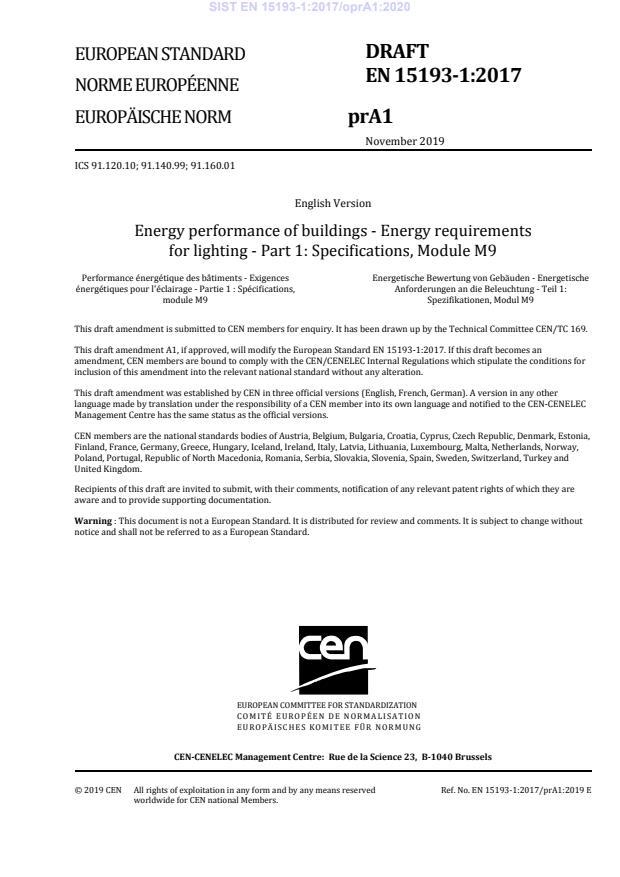
DRAFT
EUROPEAN STANDARD
EN 15193-1:2017
NORME EUROPÉENNE
EUROPÄISCHE NORM
prA1
November 2019
ICS 91.120.10; 91.140.99; 91.160.01
English Version
Energy performance of buildings - Energy requirements
for lighting - Part 1: Specifications, Module M9
Performance énergétique des bâtiments - Exigences Energetische Bewertung von Gebäuden - Energetische
énergétiques pour l'éclairage - Partie 1 : Spécifications, Anforderungen an die Beleuchtung - Teil 1:
module M9 Spezifikationen, Modul M9
This draft amendment is submitted to CEN members for enquiry. It has been drawn up by the Technical Committee CEN/TC 169.
This draft amendment A1, if approved, will modify the European Standard EN 15193-1:2017. If this draft becomes an
amendment, CEN members are bound to comply with the CEN/CENELEC Internal Regulations which stipulate the conditions for
inclusion of this amendment into the relevant national standard without any alteration.
This draft amendment was established by CEN in three official versions (English, French, German). A version in any other
language made by translation under the responsibility of a CEN member into its own language and notified to the CEN-CENELEC
Management Centre has the same status as the official versions.
CEN members are the national standards bodies of Austria, Belgium, Bulgaria, Croatia, Cyprus, Czech Republic, Denmark, Estonia,
Finland, France, Germany, Greece, Hungary, Iceland, Ireland, Italy, Latvia, Lithuania, Luxembourg, Malta, Netherlands, Norway,
Poland, Portugal, Republic of North Macedonia, Romania, Serbia, Slovakia, Slovenia, Spain, Sweden, Switzerland, Turkey and
United Kingdom.
Recipients of this draft are invited to submit, with their comments, notification of any relevant patent rights of which they are
aware and to provide supporting documentation.
Warning : This document is not a European Standard. It is distributed for review and comments. It is subject to change without
notice and shall not be referred to as a European Standard.
EUROPEAN COMMITTEE FOR STANDARDIZATION
COMITÉ EUROPÉEN DE NORMALISATION
EUROPÄISCHES KOMITEE FÜR NORMUNG
CEN-CENELEC Management Centre: Rue de la Science 23, B-1040 Brussels
© 2019 CEN All rights of exploitation in any form and by any means reserved Ref. No. EN 15193-1:2017/prA1:2019 E
worldwide for CEN national Members.
Contents Page
European foreword . 3
1 Modifications to Annex F, Daylight availability . 4
European foreword
This document (EN 15193-1:2017/prA1:2019) has been prepared by Technical Committee CEN/TC 169
“Light and lighting”, the secretariat of which is held by DIN.
This document is currently submitted to the CEN Enquiry.
This amendment 1 is processed to provide a method for estimating the daylight supply for sloped roofs.
This method was still under development during the drafting of EN 15193-1
...
Questions, Comments and Discussion
Ask us and Technical Secretary will try to provide an answer. You can facilitate discussion about the standard in here.
Loading comments...