

EN 15193-1:2017+A1:2021
(Main + Amendment)Energy performance of buildings - Energy requirements for lighting - Part 1: Specifications, Module M9
General Information
- Abstract
This standard specifies the methodology for evaluating the energy performance of lighting systems for providing general illumination in residential and non-residential buildings and for calculating or measuring the amount of energy required or used for lighting in buildings. The method may be applied to new, existing or refurbished buildings. It also provides a methodology (LENI) as the measure of the energy efficiency of the lighting installations in buildings.
This standard does not cover lighting requirements, the design of lighting systems, the planning of lighting installations, the characteristics of lighting equipment (lamps, control gear and luminaires) and systems used for display lighting, desk lighting or luminaires built into furniture. This standard does not provide any procedure for the dynamic simulation of lighting scene setting.
Table 1 shows the relative position of this standard within the set of EPB standards in the context of the modular structure as set out in EN ISO 52000-1.
NOTE In CEN ISO/TR 52000-2 the same table can be found, with, for each module, the numbers of the relevant EPB standards and accompanying technical reports that are published or in preparation.
The modules represent EPB standards, although one EPB standard may cover more than one module and one module may be covered by more than one EPB standard, for instance a simplified and a detailed method respectively. See also Clause 2.
(...)
- Status
- Published
- Publication Date
- 22-Jun-2021
- Withdrawal Date
- 30-Dec-2021
- Technical Committee
- CEN/TC 169 - Lighting applications
- Drafting Committee
- CEN/TC 169/WG 9 - Energy performance of buildings
- Current Stage
- 9093 - Decision to confirm - Review Enquiry
- Start Date
- 10-Oct-2023
- Completion Date
- 30-Sep-2026



Overview
EN 15193-1:2017+A1:2021 - "Energy performance of buildings - Energy requirements for lighting - Part 1: Specifications, Module M9" - defines a standardized methodology to evaluate and report the energy performance of lighting systems in buildings. It covers how to calculate or measure the energy required or used for general illumination in residential and non‑residential buildings (new, existing or refurbished) and introduces LENI (Lighting Energy Numeric Indicator) as a metric of lighting energy efficiency. The standard is part of the EPB modular framework (Module M9) and aligns with EN ISO 52000‑1 concepts.
Key topics and technical requirements
- Three alternative assessment methods
- Method 1 - Comprehensive calculation: detailed time‑step calculation using system, product and operating data.
- Method 2 - Quick calculation: simplified, faster estimation for design or compliance checks.
- Method 3 - Direct metering: uses measured energy consumption for lighting where metering is available.
- LENI methodology: standardized indicator for energy efficiency of lighting installations.
- Input data and models: requirements for lighting system data, luminaire/product data, system design and operating conditions (including daylight and occupancy factors).
- Daylight and controls: methods to account for daylight availability, daylight responsive controls and supply factors (vertical façades, roof lights).
- Installed power estimation: simplified and normative procedures (Annex C, D) for assessing installed lighting power in new and existing buildings.
- Supporting annexes: templates, default data, occupancy estimation, daylight calculations, and quality control procedures.
- Quality control and compliance checks: procedures to verify method application and results.
Note: This standard does not cover lighting design, luminaires/lamps specifications, display/desk lighting, furniture‑integrated luminaires, or dynamic scene simulation.
Practical applications and who uses it
- Building energy assessors and auditors: to quantify lighting energy use for energy performance certificates and compliance with national EPB regulations.
- Energy modelers and consultants: to incorporate standardized lighting energy calculations into whole‑building simulations.
- Facility managers and maintenance teams: to benchmark LENI, assess retrofit benefits and validate measured consumption (Method 3).
- Policy makers and regulators: to define compliance rules and compare lighting efficiency across building stocks.
- Architects and sustainability consultants: for early‑stage energy assessments where lighting energy budget is needed.
Applicable to new construction, refurbishment projects and existing building audits where standardized, comparable lighting energy metrics are required.
Related standards
- EN ISO 52000‑1 (EPB modular structure) - positions Module M9 within the broader energy performance framework.
- CEN ISO/TR 52000‑2 - cross‑reference table listing EPB modules and related documents.
Keywords: EN 15193-1:2017+A1:2021, energy performance of buildings, energy requirements for lighting, LENI, lighting energy calculation, Module M9, daylight supply factor, installed power estimation.
Relations
- Effective Date
- 19-Jan-2023
- Effective Date
- 18-Jan-2023
- Effective Date
- 09-Feb-2026
- Effective Date
- 09-Feb-2026
- Effective Date
- 09-Feb-2026
- Refers
EN IEC 60598-2-20:2024/A11:2024 - Luminaires - Part 2-20: Particular requirements - Lighting chains - Effective Date
- 09-Feb-2026
- Effective Date
- 09-Feb-2026
- Effective Date
- 09-Feb-2026
- Effective Date
- 09-Feb-2026
- Effective Date
- 09-Feb-2026
- Effective Date
- 09-Feb-2026
- Effective Date
- 09-Feb-2026
- Effective Date
- 09-Feb-2026
- Refers
EN 60598-2-11:2013/A1:2022 - Luminaires - Part 2-11: Particular requirements - Aquarium luminaires - Effective Date
- 09-Feb-2026
- Effective Date
- 09-Feb-2026
Get Certified
Connect with accredited certification bodies for this standard

DIBt (Deutsches Institut für Bautechnik)
German Institute for Building Technology.
DIN CERTCO
DIN Group product certification.

Aboma Certification B.V.
Specialized in construction, metal, and transport sectors.
Sponsored listings
Frequently Asked Questions
EN 15193-1:2017+A1:2021 is a standard published by the European Committee for Standardization (CEN). Its full title is "Energy performance of buildings - Energy requirements for lighting - Part 1: Specifications, Module M9". This standard covers: This standard specifies the methodology for evaluating the energy performance of lighting systems for providing general illumination in residential and non-residential buildings and for calculating or measuring the amount of energy required or used for lighting in buildings. The method may be applied to new, existing or refurbished buildings. It also provides a methodology (LENI) as the measure of the energy efficiency of the lighting installations in buildings. This standard does not cover lighting requirements, the design of lighting systems, the planning of lighting installations, the characteristics of lighting equipment (lamps, control gear and luminaires) and systems used for display lighting, desk lighting or luminaires built into furniture. This standard does not provide any procedure for the dynamic simulation of lighting scene setting. Table 1 shows the relative position of this standard within the set of EPB standards in the context of the modular structure as set out in EN ISO 52000-1. NOTE In CEN ISO/TR 52000-2 the same table can be found, with, for each module, the numbers of the relevant EPB standards and accompanying technical reports that are published or in preparation. The modules represent EPB standards, although one EPB standard may cover more than one module and one module may be covered by more than one EPB standard, for instance a simplified and a detailed method respectively. See also Clause 2. (...)
This standard specifies the methodology for evaluating the energy performance of lighting systems for providing general illumination in residential and non-residential buildings and for calculating or measuring the amount of energy required or used for lighting in buildings. The method may be applied to new, existing or refurbished buildings. It also provides a methodology (LENI) as the measure of the energy efficiency of the lighting installations in buildings. This standard does not cover lighting requirements, the design of lighting systems, the planning of lighting installations, the characteristics of lighting equipment (lamps, control gear and luminaires) and systems used for display lighting, desk lighting or luminaires built into furniture. This standard does not provide any procedure for the dynamic simulation of lighting scene setting. Table 1 shows the relative position of this standard within the set of EPB standards in the context of the modular structure as set out in EN ISO 52000-1. NOTE In CEN ISO/TR 52000-2 the same table can be found, with, for each module, the numbers of the relevant EPB standards and accompanying technical reports that are published or in preparation. The modules represent EPB standards, although one EPB standard may cover more than one module and one module may be covered by more than one EPB standard, for instance a simplified and a detailed method respectively. See also Clause 2. (...)
EN 15193-1:2017+A1:2021 is classified under the following ICS (International Classification for Standards) categories: 91.120.10 - Thermal insulation of buildings; 91.140.99 - Other installations in buildings; 91.160.01 - Lighting in general. The ICS classification helps identify the subject area and facilitates finding related standards.
EN 15193-1:2017+A1:2021 has the following relationships with other standards: It is inter standard links to EN 15193-1:2017, EN 15193-1:2017/prA1, EN 60598-2-10:2003, EN 60598-2-4:2018, EN IEC 60598-2-17:2018, EN IEC 60598-2-20:2024/A11:2024, EN 60598-2-9:1989/A1:1994, EN IEC 60598-2-18:2022, EN 60598-2-13:2006/A2:2016, EN 60598-2-17:1989/A2:1991, EN 60598-2-6:1994, EN 50470-2:2006, EN 60598-2-8:2013, EN 60598-2-11:2013/A1:2022, EN IEC 60598-2-20:2024. Understanding these relationships helps ensure you are using the most current and applicable version of the standard.
EN 15193-1:2017+A1:2021 is available in PDF format for immediate download after purchase. The document can be added to your cart and obtained through the secure checkout process. Digital delivery ensures instant access to the complete standard document.
Standards Content (Sample)
SLOVENSKI STANDARD
01-oktober-2021
Energetska učinkovitost stavb - Energijske zahteve za razsvetljavo - 1. del:
Specifikacije, modul M9
Energy performance of buildings - Energy requirements for lighting - Part 1:
Specifications, Module M9
Energetische Bewertung von Gebäuden - Energetische Anforderungen an die
Beleuchtung - Teil 1: Spezifikationen, Modul M9
Performance énergétique des bâtiments - Exigences énergétiques pour l’éclairage -
Partie 1 : Spécifications, module M9
Ta slovenski standard je istoveten z: EN 15193-1:2017+A1:2021
ICS:
27.015 Energijska učinkovitost. Energy efficiency. Energy
Ohranjanje energije na conservation in general
splošno
91.120.10 Toplotna izolacija stavb Thermal insulation of
buildings
91.160.01 Razsvetljava na splošno Lighting in general
2003-01.Slovenski inštitut za standardizacijo. Razmnoževanje celote ali delov tega standarda ni dovoljeno.
EN 15193-1:2017+A1
EUROPEAN STANDARD
NORME EUROPÉENNE
June 2021
EUROPÄISCHE NORM
ICS 91.120.10; 91.140.99; 91.160.01 Supersedes EN 15193-1:2017
English Version
Energy performance of buildings - Energy requirements
for lighting - Part 1: Specifications, Module M9
Performance énergétique des bâtiments - Exigences Energetische Bewertung von Gebäuden - Energetische
énergétiques pour l'éclairage - Partie 1 : Spécifications, Anforderungen an die Beleuchtung - Teil 1:
module M9 Spezifikationen, Modul M9
This European Standard was approved by CEN on 27 February 2017 and includes Amendment 1 approved by CEN on 4 May
2021.
CEN members are bound to comply with the CEN/CENELEC Internal Regulations which stipulate the conditions for giving this
European Standard the status of a national standard without any alteration. Up-to-date lists and bibliographical references
concerning such national standards may be obtained on application to the CEN-CENELEC Management Centre or to any CEN
member.
This European Standard exists in three official versions (English, French, German). A version in any other language made by
translation under the responsibility of a CEN member into its own language and notified to the CEN-CENELEC Management
Centre has the same status as the official versions.
CEN members are the national standards bodies of Austria, Belgium, Bulgaria, Croatia, Cyprus, Czech Republic, Denmark, Estonia,
Finland, France, Germany, Greece, Hungary, Iceland, Ireland, Italy, Latvia, Lithuania, Luxembourg, Malta, Netherlands, Norway,
Poland, Portugal, Republic of North Macedonia, Romania, Serbia, Slovakia, Slovenia, Spain, Sweden, Switzerland, Turkey and
United Kingdom.
EUROPEAN COMMITTEE FOR STANDARDIZATION
COMITÉ EUROPÉEN DE NORMALISATION
EUROPÄISCHES KOMITEE FÜR NORMUNG
CEN-CENELEC Management Centre: Rue de la Science 23, B-1040 Brussels
© 2021 CEN All rights of exploitation in any form and by any means reserved Ref. No. EN 15193-1:2017+A1:2021 E
worldwide for CEN national Members.
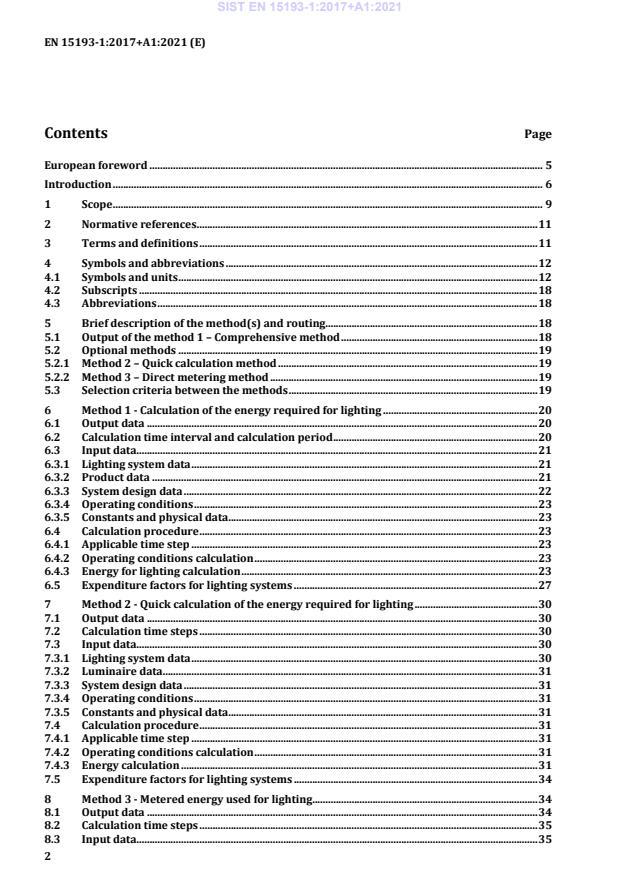
Contents Page
European foreword . 5
Introduction . 6
1 Scope . 9
2 Normative references . 11
3 Terms and definitions . 11
4 Symbols and abbreviations . 12
4.1 Symbols and units . 12
4.2 Subscripts . 18
4.3 Abbreviations . 18
5 Brief description of the method(s) and routing. 18
5.1 Output of the method 1 – Comprehensive method . 18
5.2 Optional methods . 19
5.2.1 Method 2 – Quick calculation method . 19
5.2.2 Method 3 – Direct metering method . 19
5.3 Selection criteria between the methods . 19
6 Method 1 - Calculation of the energy required for lighting . 20
6.1 Output data . 20
6.2 Calculation time interval and calculation period . 20
6.3 Input data. 21
6.3.1 Lighting system data . 21
6.3.2 Product data . 21
6.3.3 System design data . 22
6.3.4 Operating conditions . 23
6.3.5 Constants and physical data . 23
6.4 Calculation procedure . 23
6.4.1 Applicable time step . 23
6.4.2 Operating conditions calculation . 23
6.4.3 Energy for lighting calculation . 23
6.5 Expenditure factors for lighting systems . 27
7 Method 2 - Quick calculation of the energy required for lighting . 30
7.1 Output data . 30
7.2 Calculation time steps . 30
7.3 Input data. 30
7.3.1 Lighting system data . 30
7.3.2 Luminaire data . 31
7.3.3 System design data . 31
7.3.4 Operating conditions . 31
7.3.5 Constants and physical data . 31
7.4 Calculation procedure . 31
7.4.1 Applicable time step . 31
7.4.2 Operating conditions calculation . 31
7.4.3 Energy calculation . 31
7.5 Expenditure factors for lighting systems . 34
8 Method 3 - Metered energy used for lighting . 34
8.1 Output data . 34
8.2 Calculation time steps . 35
8.3 Input data. 35
8.4 Calculation procedure of annual energy . 35
9 Quality control . 36
9.1 Method 1 . 36
9.2 Method 2 . 36
9.3 Method 3 . 36
10 Compliance check . 36
10.1 General . 36
10.2 Method 1 . 36
10.3 Method 2 . 37
10.4 Method 3 . 37
Annex A (normative) Input and method selection data sheet — Template . 38
A.1 General . 38
A.2 System design data . 38
A.2.1 General . 38
A.2.2 Standby energy density . 39
A.2.3 Annual operating hours . 39
A.2.4 Daylight supply factor for vertical façades . 39
A.2.5 Daylight supply factor for roof lights . 39
A.2.6 Absence factor (F ) for rooms in building types . 39
A
A.2.7 Example constant illuminance dependency factors (F ) . 40
C
A.2.8 Installed power for residential buildings . 40
A.2.9 Useful areas in residential buildings . 41
Annex B (informative) Input and method selection data sheet — Default choices . 42
B.1 General . 42
B.2 Method 1 . 42
B.2.1 Luminaire description data . 42
B.2.2 Luminaire technical data tables . 42
B.2.3 System design data . 43
B.3 Method 2 . 43
B.3.1 Luminaire description data . 43
B.3.2 Luminaire technical data tables . 43
B.3.3 System design data . 43
B.4 Method 3 . 49
Annex C (normative) Simplified Method for Installed Power Estimation . 50
C.1 General . 50
C.2 Installed power assessment for non-residential buildings . 50
C.3 Installed power assessment for residential buildings . 52
Annex D (normative) Assessment of the installed power for lighting systems in existing
buildings . 53
Annex E (normative) Occupancy estimation . 54
Annex F (normative) Daylight availability . 59
F.1 General. 59
F.2 Building segmentation: Spaces benefiting from daylight. 61
F.3 Daylight supply factor for vertical façades . 63
F.3.1 Daylight factor classification . 63
F.3.2 Daylight supply factor . 69
F.4 Daylight supply factor for roof lights . 81
F.4.1 General. 81
F.4.2 Daylight availability factor . 81
F.4.3 Daylight supply factor . 86
F.4.4 Relative times, shading activated/ not activated for roof lights . 87
F.4.5 Daylight supply factors as function of the daylight availability classification . 89
F.5 !Daylight supply factor for windows in sloped roofs". 93
F.6 Daylight Responsive Control Systems . 95
F.7 Monthly evaluation method . 97
F.8 Determination of daytime and night time hours . 98
F.9 Comprehensive calculation . 101
F.10 Collection of input data required for daylight calculations. 102
Annex G (normative) Constant illuminance . 103
G.1 General. 103
G.2 Constant illuminance factor (Fc) . 103
G.3 Constant lumen output system (CLO) . 104
Annex H (normative) Standby system energy requirements . 105
H.1 Emergency lighting luminaire standby charging power (P ) . 105
em
H.2 Lighting controls standby power (P ) . 105
pc
Bibliography . 106
European foreword
This document (EN 15193-1:2017+A1:2021) has been prepared by Technical Committee CEN/TC 169
“Light and lighting”, the secretariat of which is held by DIN.
This European Standard shall be given the status of a national standard, either by publication of an
identical text or by endorsement, at the latest by December 2021, and conflicting national standards
shall be withdrawn at the latest by December 2021.
Attention is drawn to the possibility that some of the elements of this document may be the subject of
patent rights. CEN shall not be held responsible for identifying any or all such patent rights.
This document includes Amendment 1 approved by CEN on 4 May 2021.
This document supersedes !EN 15193:2017".
The start and finish of text introduced or altered by amendment is indicated in the text by tags !".
This document has been prepared under a mandate given to CEN by the European Commission and the
European Free Trade Association.
EN 15193 consists of the following parts, under the general title “Energy performance of buildings —
Energy requirements for lighting”.
Part 1: Specifications, Module M9
Part 2: (Technical Report) Explanation and justification of EN 15193-1, Module M9
According to the CEN-CENELEC Internal Regulations, the national standards organisations of the
following countries are bound to implement this European Standard: Austria, Belgium, Bulgaria,
Croatia, Cyprus, Czech Republic, Denmark, Estonia, Finland, France, Germany, Greece, Hungary, Iceland,
Ireland, Italy, Latvia, Lithuania, Luxembourg, Malta, Netherlands, Norway, Poland, Portugal, Republic of
North Macedonia, Romania, Serbia, Slovakia, Slovenia, Spain, Sweden, Switzerland, Turkey and the
United Kingdom.
Introduction
This Standard is part of a series of standards aiming at international harmonization of the methodology
for the assessment of the energy performance of buildings, called “set of EPB standards”.
All EPB standards follow specific rules to ensure overall consistency, unambiguity and transparency.
All EPB standards provide a certain flexibility with regard to the methods, the required input data and
references to other EPB standards, by the introduction of a normative template in Annex A and Annex B
with informative default choices.
For the correct use of this standard a normative template is given in Annex A to specify these choices.
Informative default choices are provided in Annex B.
The main target groups of this standard are all the users of the set of EPB standards (e.g. architects,
engineers, regulators).
Use by or for regulators: In case the standard is used in the context of national or regional legal
requirements, mandatory choices may be given at national or regional level for such specific
applications. These choices (either the informative default choices from Annex B or choices adapted to
national / regional needs, but in any case following the template of this Annex A) can be made available
as national annex or as separate (e.g. legal) document (national data sheet).
NOTE So in this case:
— the regulators will specify the choices;
— the individual user will apply the standard to assess the energy performance of a building, and thereby use
the choices made by the regulators.
Topics addressed in this standard can be subject to public regulation. Public regulation on the same
topics can override the default values in Annex B. Public regulation on the same topics can even, for
certain applications, override the use of this standard. Legal requirements and choices are in general
not published in standards but in legal documents. In order to avoid double publications and difficult
updating of double documents, a national annex may refer to the legal texts where national choices have
been made by public authorities. Different national annexes or national data sheets are possible, for
different applications.
It is expected, if the default values, choices and references to other EPB standards in Annex B are not
followed due to national regulations, policy or traditions, that:
— national or regional authorities prepare data sheets containing the choices and national or regional
values, according to the model in Annex A. In this case the national annex (e.g. NA) refers to this
text;
— or, by default, the national standards body will consider the possibility to add or include a national
annex in agreement with the template of Annex A, in accordance to the legal documents that give
national or regional values and choices.
Further target groups are parties wanting to motivate their assumptions by classifying the building
energy performance for a dedicated building stock.
More information is provided in the Technical Report accompanying this standard (CEN/TR 15193-2
[5]).
CEN/TC 169 deals with light and lighting and the subjects covered by committee are:
— Lighting criteria for indoor and outdoor activities;
— Photometry of lighting systems;
— Lighting terminology;
— Energy efficiency of lighting systems.
This standard specifies three methods for evaluating the energy performance of lighting systems.
It is of paramount importance that correct lighting is provided in buildings. The convention and
procedures in this standard assumes that the designed and installed lighting scheme conforms to good
lighting practices. For new and refurbished installations in the non-residential building sector the
design of the lighting system should conform to the requirements in the lighting applications standards
EN 12464-1 for indoor workplaces, EN 12193 for sports buildings and EN 1838 for emergency escape
lighting. For residential buildings the lighting system should be designed to fulfil the needs of the rooms
in the buildings. Guidance on the requirements is provided in the supporting Technical Report
CEN/TR 15193-2 [5]).
This standard also assumes that the buildings can have access to daylight to provide all or some of the
illumination required in the rooms and that in addition there will be an adequate amount of electric
lighting installed to provide the required illumination in the absence of daylight or with a reduced
daylight contribution.
This standard defines the methods for estimating or measuring the amount of energy required or used
for lighting in buildings. The method of separate metering of the energy used for lighting will also give
regular feedback on the effectiveness of the lighting control.
The methodology of energy estimation not only provides values for the Lighting Energy Numeric
Indicator (LENI) but it will also provide input for the heating and cooling load estimations for the
combined total energy performance of building indicator.
Figure 1 gives an overview of the methodology and the flow of the processes involved.
NOTE The dotted line in Figure 1 linking preliminary annual LENI to the comprehensive lighting design
indicates the requirement to follow-up the budget calculation with a comprehensive calculation during the
detailed lighting design process.
Figure 1 — Flow chart illustrating methods to determine energy for lighting
This standard was developed during the first EPBD mandate and the first edition was published in
2007.
The revision for inclusion in the second mandate package was performed during 2013-2016.
The most important changes are:
— extension of calculation methods,
— inclusion of lighting for residential buildings,
— substantial editorial changes.
1 Scope
This standard specifies the methodology for evaluating the energy performance of lighting systems for
providing general illumination in residential and non-residential buildings and for calculating or
measuring the amount of energy required or used for lighting in buildings. The method may be applied
to new, existing or refurbished buildings. It also provides a methodology (LENI) as the measure of the
energy efficiency of the lighting installations in buildings.
This standard does not cover lighting requirements, the design of lighting systems, the planning of
lighting installations, the characteristics of lighting equipment (lamps, control gear and luminaires) and
systems used for display lighting, desk lighting or luminaires built into furniture. This standard does not
provide any procedure for the dynamic simulation of lighting scene setting.
Table 1 shows the relative position of this standard within the set of EPB standards in the context of the
modular structure as set out in EN ISO 52000-1.
NOTE In CEN ISO/TR 52000-2 the same table can be found, with, for each module, the numbers of the
relevant EPB standards and accompanying technical reports that are published or in preparation.
The modules represent EPB standards, although one EPB standard may cover more than one module
and one module may be covered by more than one EPB standard, for instance a simplified and a
detailed method respectively. See also Clause 2.
Table 1 — Position of this standard within the modular structure of the set of EPB standards
Building
Overarching Technical Building Systems
(as such)
sub1 M1 M2 M3 M4 M5 M6 M7 M8 M9 M10 M11
1 General General General
Common terms
Building
and definitions; EN 15193
a
2 Energy Needs
symbols, units –1
Needs
and subscripts
(Free)
Maximu
Indoor
m Load EN 15193
3 Applications Conditions
and –1
without
Power
Systems
Ways to Ways to
Ways to Express Express
EN 15193
4 Express Energy Energy Energy
–1
Performance Performan Perform
ce ance
Heat
Building
Transfer Emissio
categories and EN 15193
5 by n and
Building –1
Transmiss control
Boundaries
ion
Submodule
Descriptions
Descriptions
Descriptions
Heating
Cooling
Ventilation
Humidification
Dehumidification
Domestic hot water
Lighting
Building
automation and
control
PV, wind, .
Building
Overarching Technical Building Systems
(as such)
sub1 M1 M2 M3 M4 M5 M6 M7 M8 M9 M10 M11
Heat
Transfer
Building
by Distribut
Occupancy and EN 15193
6 Infiltratio ion and
Operating –1
n and control
Conditions
Ventilatio
n
Aggregation of
Energy Storage
Internal
7 Services and and
Heat Gains
Energy control
Carriers
Generati
Solar Heat EN 15193
8 Building zoning on and
Gains –1
control
Load
dispatch
Building
Calculated ing and
Dynamics
9 Energy operatin
(thermal
Performance g
mass)
conditio
ns
Measured Measure
Measured
Energy d Energy EN 15193
10 Energy
Performan Perform –1
Performance
ce ance
Inspecti EN 15193
11 Inspection Inspection
on –1
Ways to
12 Express Indoor BMS
Comfort
External
13 Environment
Conditions
Economic
Calculation
a
The shaded modules are not applicable.
Submodule
Descriptions
Descriptions
Descriptions
Heating
Cooling
Ventilation
Humidification
Dehumidification
Domestic hot water
Lighting
Building
automation and
control
PV, wind, .
2 Normative references
The following documents, in whole or in part, are normatively referenced in this document and are
indispensable for its application. For dated references, only the edition cited applies. For undated
references, the latest edition of the referenced document (including any amendments) applies.
EN 1838, Lighting applications - Emergency lighting
EN 12193, Light and lighting - Sports lighting
EN 12464-1, Light and lighting - Lighting of work places - Part 1: Indoor work places
EN 12665, Light and lighting - Basic terms and criteria for specifying lighting requirements
EN 50470 (all parts), Electricity metering equipment (a.c.)
EN 60598 (all parts), Luminaires
EN 62722-1, Luminaire performance - Part 1: General requirements (IEC 62722-1)
EN ISO 52000-1:2017, Energy performance of buildings - Overarching EPB assessment - Part 1: General
framework and procedures (ISO 52000-1:2017)
ISO 10916, Calculation of the impact of daylight utilization on the net and final energy demand for
lighting
3 Terms and definitions
For the purposes of this document, the terms and definitions given in EN ISO 52000-1 and EN 12665
and the following apply.
3.1
EPB standard
standard that complies with the requirements given in EN ISO 52000-1, CEN/TS 16628 and
CEN/TS 16629
Note 1 to entry: CEN/TS 16628 and CEN/TS 16629 contain specific rules to ensure overall consistency,
unambiguity, transparency and flexibility, supported by common templates. EN ISO 52000-1, the overarching EPB
standard, is indispensable for each EPB standard, because of the modular structure, common terms and
definitions, symbols and subscripts and because it provides the general framework for the EPB assessment.
[SOURCE: EN ISO 52000-1:2017]
3.2
time step
t
s
period in which the energy is evaluated
Note 1 to entry: Measured in hour/month/year.
3.3
standby energy
energy required for charging batteries and/or the energy required for lighting controls during the time
the electric lights are switched off
Note 1 to entry: Lighting controls and emergency battery charging circuits are only considered where power is
supplied via a luminaire.
3.4
lighting controls
devices connected to the luminaire to vary the light output
Note 1 to entry: In this standard lighting controls are only considered where power is supplied via a luminaire.
3.5
lighting system
set of light sources and/or lamps interacting with luminaires and/or related equipment to provide
solutions to satisfy lighting application requirements
Note 1 to entry: The lighting system can be dedicated to
a) the support of (a) specified visual task(s) under specified conditions considering other requirements such as
human comfort, safety, the appearance of the surrounding environment and energy consumption;
b) the support of other than human tasks, such as plant growth or breeding of animals.
Note 2 to entry: The lighting system can include physical components, communication protocols, user
interfaces, software and networks to provide central control and monitoring functions.
3.6
expenditure factor
expense factor
effort factor
indicator of the energy efficiency of a given lighting system compared to a reference system
4 Symbols and abbreviations
4.1 Symbols and units
For the purposes of this standard, the symbols given in EN ISO 52000-1 and the specific symbols listed
in Table 2 apply.
Table 2 — Symbols and units
Symbol Name of quantity Unit
A Area of the raw building carcass opening of the area under m
Ca
consideration
A Partial area which is lit by daylight m
D
a Depth of the daylight area m
D
a Maximum depth of the daylight area m
D,max
A Area receiving daylight m
Dj
A Glazed area of a dome or strip skylight m
FS
a Depth of the courtyard or atrium m
ln,At
A The area not lit by daylight m
ND
A Area not receiving daylight m
NDj
A Glazed area of a shed rooflight m
Rb
Symbol Name of quantity Unit
A Sum of task areas within the room m
S
b Width of the daylight area m
D
b Width of the courtyard or atrium m
ln,At
C Factor for reduction to take account of weekends -
we
D Daylight factor %
D External daylight factor %
a
D Daylight factor for raw carcass opening %
CA,j
D Daylight factor from carcass opening %
CA
Mean daylight factor with rooflight, shading activated %
D
SA
Mean daylight factor with rooflight, shading not activated %
D
SNA
E Horizontal external illuminance from an overcast sky lx
A
E Illuminance on the external surface of the skylight from lx
F
overcast sky
e Expenditure factor for lighting systems -
L
e Partial expenditure factor for constant illuminance control -
L,C
e Partial expenditure factor for daylight dependant lighting -
L,D
control
e Partial expenditure factor for the electric lighting system -
L,ES
e Partial expenditure factor for delivery of electric light -
L,ES,del
e Partial expenditure factor for distribution of electric light -
L,ES,dis
e Partial expenditure factor for generation of electric light -
L,ES,gen
e Partial expenditure factor for occupancy dependant lighting -
L,O
control
Maintained illuminance lx
E
m
E Maintained illuminance on immediate surround of task area lx
SUR
E Maintained illuminance on the task area lx
task
F Dependency Factor -
F Absence factor -
A
f Factor for the efficiency of the operating device -
B
F Constant illuminance factor -
c
F Factor for reduced power of area -
CA
F Factor for the efficiency of the constant illuminance control -
cc
F Daylight dependency factor -
D
Symbol Name of quantity Unit
F Lighting control factor -
D,C
F Daylight responsive control system factor for the area -
D,C,nj
under consideration
F Factor for monthly partial-load daylight operation -
D,j,i
F Monthly daylight dependency factor -
D,mth
F Daylight dependency factor for the area under -
D,n,j
consideration
F Daylight supply factor -
D,S
F Daylight supply factor for a vertical façade -
D,S,j
F Daylight supply factor for the area under consideration -
D,S,nj
F Daylight supply factor of the area when solar or glare -
D,S,SA,j
protection system is activated
F Daylight supply factor of the area for when solar or glare -
D,S,SNA,j
protection system is not activated
F Factor for light source efficiency -
L
F Correction factor for MF -
MF
F Occupancy dependency factor -
o
F Controls function factor -
oc
F Utilization factor of the luminaire -
u
F Utilization factor for determination of the energy use -
ue
H Luminous exposure from direct insolation lx s
dir
H / H Ratio for climate characterization -
dir glob
H Luminous exposure from global insolation lx s
glob
h Height of the window lintel above the floor m
Li
h Height of the courtyard or atrium from floor level to the m
lm,At
roof level
h Mounting height of luminaire m
m
h Distance between workplane and ceiling m
R
h Distance between floor and ceiling height in an area with m
Rj
roof lights
h Height of the task area above the floor. m
Ta
I Space depth index of the area under consideration -
RD,j
I Correction factor for glazed double façades of the area -
Sh,GDF
under consideration
I Correction factor for overhang shading of the area under -
Sh,hA
consideration
Symbol Name of quantity Unit
I Shading index of the area under consideration -
Sh,j
I Correction factor for linear obstruction of the area under -
Sh,lsh
consideration
I Correction factor for internal courtyard and atrium shading -
Sh,ln,At
of the area under consideration
I Correction factor for side shading of the area under -
Sh,vA
consideration
I Correction factor for vertical projection -
Sh,vf
I Transparency index in the area under consideration -
Tr,j
J Day of the month -
i
K Room Index -
k Reduction factor for the frames or subdivisions -
k Reduction factor for pollution of the glazing -
k Reduction factor of non-vertical light incident upon the -
glazing
k Reduction factor for the frames or subdivisions in rooflights -
Obl,1
k Reduction factor by pollution of the glazing of rooflights -
Obl,2
k Reduction factor for non-vertical light incidence on the -
Obl,3
rooflight glazing
k Reduction factor for the frames or subdivisions in a double -
Sh,GDF,1
glazed façade
k Reduction factor by pollution of the glazing of the double -
Sh,GDF,2
glazed façade
k Reduction factor for non-vertical light incidence on the -
Sh,GDF,3
façade glazing
k Reduction factor for the frames or subdivisions in the -
Sh,ln,At,1
atrium façade
k Reduction factor by pollution of the glazing of the atrium -
Sh,ln,At,2
façade
k Reduction factor for non-vertical light incidence of the -
Sh,ln,At,3
atrium façade
L time period at which x % of the measured initial luminous h
flux value is maintained
L Length of room m
R
N Number days in the respective month d
i
P Luminaire control standby power W
ci
P Electrical evaluation power density for determination of the W/m
e
energy use
P Luminaire emergency standby power W
ei
Symbol Name of quantity Unit
P Total emergency standby power W
em
P Luminaire power for illumination W
i
P Power density of the area W/m
j
P Power density per lux W/lm
j,lx
P Maximum luminaire power with value taken at the end of W
max
the luminaire light source maintenance cycle
P Minimum luminaire power with value taken at the start of W
min
the luminaire light source maintenance cycle
P Total power of n number of luminaires for illumination W
n
P Total controls standby power W
pc
t Time usage after sunset h
as,i
t Time usage before sunrise h
bs,i
t Daylight time h
D
t Monthly daylight time hours h
Day
t Daylight time for the area under consideration h
Day,nj
t Battery charge time only h
e
t Daylight effective time for the area under consideration h
eff,Day,nj
t Time at the end of usage Real time in h
end,i
t Time difference between apparent solar time and mean h
eq
solar time (formula of time)
t Daylight absence time h
N
t Monthly night time hours h
Night
t The relative portion of the total operating time during h
rel,D,SA,j
which the solar or glare protection system is activated
t The relative portion of the total operating time during h
rel,D,SNA,j
which the solar or glare protection system is not activated
t Time step Hour / month
s
/ year
t Time when solar or glare protection is activated h
SA
t Time when solar or glare protection is not activated h
SNA
t Time of the beginning of usage Real time in h
start,i
t Sunrise time Real time in h
sunrise,i
t Sunset time Real time in h
sunset,i
t Total operating hours h
tot
t Number of hours in a standard year h
y
Symbol Name of quantity Unit
v Factor for monthly distribution -
month,j
W Annual energy required for lighting for an area or a zone kWh/year
az
w Well index -
i
W Total energy for illumination kWh
L,t
W Metered energy kWh
mt
W Energy needed for lighting kWh
nd
W Total energy for standby kWh
P,t
W Standby energy density for automatic lighting controls of kWh/(m
pc
the luminaire per year year)
W Standby energy density for battery charging of emergency kWh/(m
pe
luminaires per year year)
w Width of room m
R
...