

EN ISO 9004:2009
(Main)Managing for the sustained success of an organization - A quality management approach (ISO 9004:2009)
- Abstract
ISO 9004:2009 provides guidance to organizations to support the achievement of sustained success by a quality management approach. It is applicable to any organization, regardless of size, type and activity.
ISO 9004:2009 is not intended for certification, regulatory or contractual use.
- Status
- Withdrawn
- Publication Date
- 31-Oct-2009
- Withdrawal Date
- 06-Oct-2026
- Technical Committee
- CEN/SS F20 - Quality assurance
- Drafting Committee
- CEN/SS F20 - Quality assurance
- Current Stage
- 9960 - Withdrawal effective - Withdrawal
- Start Date
- 11-Apr-2018
- Completion Date
- 07-Oct-2026
Buy Documents



Relations
- Effective Date
- 07-Nov-2009
- Effective Date
- 18-Apr-2018
- Effective Date
- 09-Feb-2026
- Consolidated By
ISO 9004:2009 - Managing for the sustained success of an organization — A quality management approach - Effective Date
- 12-Feb-2026
Buy Documents
Get Certified
Connect with accredited certification bodies for this standard

BSI Group
BSI (British Standards Institution) is the business standards company that helps organizations make excellence a habit.

Bureau Veritas
Bureau Veritas is a world leader in laboratory testing, inspection and certification services.

DNV
DNV is an independent assurance and risk management provider.
Sponsored listings
Frequently Asked Questions
EN ISO 9004:2009 is a standard published by the European Committee for Standardization (CEN). Its full title is "Managing for the sustained success of an organization - A quality management approach (ISO 9004:2009)". This standard covers: ISO 9004:2009 provides guidance to organizations to support the achievement of sustained success by a quality management approach. It is applicable to any organization, regardless of size, type and activity. ISO 9004:2009 is not intended for certification, regulatory or contractual use.
ISO 9004:2009 provides guidance to organizations to support the achievement of sustained success by a quality management approach. It is applicable to any organization, regardless of size, type and activity. ISO 9004:2009 is not intended for certification, regulatory or contractual use.
EN ISO 9004:2009 is classified under the following ICS (International Classification for Standards) categories: 03.100.70 - Management systems; 03.120.10 - Quality management and quality assurance. The ICS classification helps identify the subject area and facilitates finding related standards.
EN ISO 9004:2009 has the following relationships with other standards: It is inter standard links to EN ISO 9004:2000, EN ISO 9004:2018, ISO 9000:2005, ISO 9004:2009. Understanding these relationships helps ensure you are using the most current and applicable version of the standard.
EN ISO 9004:2009 is available in PDF format for immediate download after purchase. The document can be added to your cart and obtained through the secure checkout process. Digital delivery ensures instant access to the complete standard document.
Standards Content (Sample)
2003-01.Slovenski inštitut za standardizacijo. Razmnoževanje celote ali delov tega standarda ni dovoljeno.Vodenje za trajno uspešnost organizacije - Pristop z vodenjem kakovosti (ISO 9004:2009)Leiten und Lenken für den nachhaltigen Erfolg einer Organisation - Ein Qualitätsmanagementansatz (ISO 9004:2009)Gestion des performances durables d'un organisme - Approche de management par la qualité (ISO 9004:2009)Managing for the sustained success of an organization - A quality management approach (ISO 9004:2009)03.120.10Vodenje in zagotavljanje kakovostiQuality management and quality assuranceICS:Ta slovenski standard je istoveten z:EN ISO 9004:2009SIST EN ISO 9004:2009en01-december-2009SIST EN ISO 9004:2009SLOVENSKI
STANDARDSIST EN ISO 9004:20041DGRPHãþD
EUROPEAN STANDARD NORME EUROPÉENNE EUROPÄISCHE NORM
EN ISO 9004
November 2009 ICS 03.120.10 Supersedes EN ISO 9004:2000English Version
Managing for the sustained success of an organization - A quality management approach (ISO 9004:2009)
Gestion des performances durables d'un organisme - Approche de management par la qualité (ISO 9004:2009) Leiten und Lenken für den nachhaltigen Erfolg einer Organisation - Ein Qualitätsmanagementansatz (ISO 9004:2009) This European Standard was approved by CEN on 1 October 2009.
CEN members are bound to comply with the CEN/CENELEC Internal Regulations which stipulate the conditions for giving this European Standard the status of a national standard without any alteration. Up-to-date lists and bibliographical references concerning such national standards may be obtained on application to the CEN Management Centre or to any CEN member.
This European Standard exists in three official versions (English, French, German). A version in any other language made by translation under the responsibility of a CEN member into its own language and notified to the CEN Management Centre has the same status as the official versions.
CEN members are the national standards bodies of Austria, Belgium, Bulgaria, Cyprus, Czech Republic, Denmark, Estonia, Finland, France, Germany, Greece, Hungary, Iceland, Ireland, Italy, Latvia, Lithuania, Luxembourg, Malta, Netherlands, Norway, Poland, Portugal, Romania, Slovakia, Slovenia, Spain, Sweden, Switzerland and United Kingdom.
EUROPEAN COMMITTEE FOR STANDARDIZATION
COMITÉ EUROPÉEN DE NORMALISATION EUROPÄISCHES KOMITEE FÜR NORMUNG
Management Centre:
Avenue Marnix 17,
B-1000 Brussels © 2009 CEN All rights of exploitation in any form and by any means reserved worldwide for CEN national Members. Ref. No. EN ISO 9004:2009: ESIST EN ISO 9004:2009
Reference numberISO 9004:2009(E)© ISO 2009
INTERNATIONAL STANDARD ISO9004Third edition2009-11-01Managing for the sustained success of an organization — A quality management approach Gestion des performances durables d'un organisme — Approche de management par la qualité
ISO 9004:2009(E) PDF disclaimer This PDF file may contain embedded typefaces. In accordance with Adobe's licensing policy, this file may be printed or viewed but shall not be edited unless the typefaces which are embedded are licensed to and installed on the computer performing the editing. In downloading this file, parties accept therein the responsibility of not infringing Adobe's licensing policy. The ISO Central Secretariat accepts no liability in this area. Adobe is a trademark of Adobe Systems Incorporated. Details of the software products used to create this PDF file can be found in the General Info relative to the file; the PDF-creation parameters were optimized for printing. Every care has been taken to ensure that the file is suitable for use by ISO member bodies. In the unlikely event that a problem relating to it is found, please inform the Central Secretariat at the address given below.
©
ISO 2009 All rights reserved. Unless otherwise specified, no part of this publication may be reproduced or utilized in any form or by any means, electronic or mechanical, including photocopying and microfilm, without permission in writing from either ISO at the address below or ISO's member body in the country of the requester. ISO copyright office Case postale 56 • CH-1211 Geneva 20 Tel.
+ 41 22 749 01 11 Fax
+ 41 22 749 09 47 E-mail
copyright@iso.org Web
www.iso.org Published in Switzerland
ii © ISO 2009 – All rights reserved
ISO 9004:2009(E) © ISO 2009 – All rights reserved iii Contents Page Foreword.iv Introduction.v 1 Scope.1 2 Normative references.1 3 Terms and definitions.1 4 Managing for the sustained success of an organization.1 4.1 General.1 4.2 Sustained success.2 4.3 The organization's environment.2 4.4 Interested parties, needs and expectations.3 5 Strategy and policy.3 5.1 General.3 5.2 Strategy and policy formulation.3 5.3 Strategy and policy deployment.4 5.4 Strategy and policy communication.5 6 Resource management.5 6.1 General.5 6.2 Financial resources.6 6.3 People in the organization.6 6.4 Suppliers and partners.7 6.5 Infrastructure.8 6.6 Work environment.9 6.7 Knowledge, information and technology.9 6.8 Natural resources.10 7 Process management.11 7.1 General.11 7.2 Process planning and control.11 7.3 Process responsibility and authority.12 8 Monitoring, measurement, analysis and review.12 8.1 General.12 8.2 Monitoring.12 8.3 Measurement.13 8.4 Analysis.16 8.5 Review of information from monitoring, measurement and analysis.16 9 Improvement, innovation and learning.17 9.1 General.17 9.2 Improvement.17 9.3 Innovation.18 9.4 Learning.19 Annex A (informative)
Self-assessment tool.20 Annex B (informative)
Quality management principles.38 Annex C (informative)
Correspondence between ISO 9004:2009 and ISO 9001:2008.43 Bibliography.45
ISO 9004:2009(E) iv © ISO 2009 – All rights reserved Foreword ISO (the International Organization for Standardization) is a worldwide federation of national standards bodies (ISO member bodies). The work of preparing International Standards is normally carried out through ISO technical committees. Each member body interested in a subject for which a technical committee has been established has the right to be represented on that committee. International organizations, governmental and non-governmental, in liaison with ISO, also take part in the work. ISO collaborates closely with the International Electrotechnical Commission (IEC) on all matters of electrotechnical standardization. International Standards are drafted in accordance with the rules given in the ISO/IEC Directives, Part 2. The main task of technical committees is to prepare International Standards. Draft International Standards adopted by the technical committees are circulated to the member bodies for voting. Publication as an International Standard requires approval by at least 75 % of the member bodies casting a vote. Attention is drawn to the possibility that some of the elements of this document may be the subject of patent rights. ISO shall not be held responsible for identifying any or all such patent rights. ISO 9004 was prepared by Technical Committee ISO/TC 176, Quality management and quality assurance, Subcommittee SC 2, Quality systems. This third edition cancels and replaces the second edition (ISO 9004:2000), which has been technically revised. Managing for the sustained success of an organization is a major change in focus for ISO 9004, leading to substantial changes to its structure and contents. SIST EN ISO 9004:2009
ISO 9004:2009(E) © ISO 2009 – All rights reserved v Introduction This International Standard provides guidance to support the achievement of sustained success for any organization in a complex, demanding, and ever-changing environment, by a quality management approach. The sustained success of an organization is achieved by its ability to meet the needs and expectations of its customers and other interested parties, over the long term and in a balanced way. Sustained success can be achieved by the effective management of the organization, through awareness of the organization's environment, by learning, and by the appropriate application of either improvements, or innovations, or both. This International Standard promotes self-assessment as an important tool for the review of the maturity level of the organization, covering its leadership, strategy, management system, resources and processes, to identify areas of strength and weakness and opportunities for either improvements, or innovations, or both. This International Standard provides a wider focus on quality management than ISO 9001; it addresses the needs and expectations of all relevant interested parties and provides guidance for the systematic and continual improvement of the organization's overall performance. An extended model of a process-based quality management system incorporating the elements of ISO 9001 and ISO 9004 is given in Figure 1.
Key
Information flow
Value-adding activities Figure 1 — Extended model of a process-based quality management system SIST EN ISO 9004:2009
ISO 9004:2009(E) vi © ISO 2009 – All rights reserved This International Standard has been developed to maintain consistency with ISO 9001 and be compatible with other management system standards. Such standards complement each other, but can also be used independently. Annex A provides a tool for organizations to self-assess their own strengths and weaknesses, to determine their level of maturity, and to identify opportunities for improvement and innovation. Annex B provides a description of the quality management principles that are the basis of the quality management standards prepared by ISO/TC 176. Annex C gives a clause by clause correspondence between ISO 9001:2008 and this International Standard.
INTERNATIONAL STANDARD ISO 9004:2009(E) © ISO 2009 – All rights reserved 1 Managing for the sustained success of an organization — A quality management approach 1 Scope This International Standard provides guidance to organizations to support the achievement of sustained success by a quality management approach. It is applicable to any organization, regardless of size, type and activity. This International Standard is not intended for certification, regulatory or contractual use. 2 Normative references The following referenced documents relate to the application of this document. For dated references, only the edition cited applies. For undated references, the latest edition of the referenced document (including any amendments) applies. ISO 9000, Quality management systems — Fundamentals and vocabulary 3 Terms and definitions For the purposes of this document, the terms and definitions given in ISO 9000 and the following apply. 3.1 sustained success 〈organization〉 result of the ability of an organization to achieve and maintain its objectives in the long term 3.2 organization's environment combination of internal and external factors and conditions that can affect the achievement of an organization's objectives and its behaviour towards its interested parties 4 Managing for the sustained success of an organization 4.1 General To achieve sustained success, top management should adopt a quality management approach. The organization's quality management system should be based on the principles described in Annex B. These principles describe concepts that are the foundation of an effective quality management system. To achieve sustained success, top management should apply these principles to the organization's quality management system. The organization should develop the organization's quality management system to ensure ⎯ the efficient use of resources, SIST EN ISO 9004:2009
ISO 9004:2009(E) 2 © ISO 2009 – All rights reserved ⎯ decision making based on factual evidence, and ⎯ focus on customer satisfaction, as well as on the needs and expectations of other relevant interested parties. NOTE In this International Standard, the term “top management” refers to the highest level of decision making authority in an organization and the term “the organization” covers all people in an organization. This is consistent with the definitions of these terms given in ISO 9000. 4.2 Sustained success The organization can achieve sustained success by consistently meeting the needs and expectations of its interested parties, in a balanced way, over the long term. An organization's environment is ever-changing and uncertain, and to achieve sustained success its top management should ⎯ have a long-term planning perspective, ⎯ constantly monitor and regularly analyse the organization's environment, ⎯ identify all its relevant interested parties, assess their individual potential impacts on the organization's performance, as well as determining how to meet their needs and expectations in a balanced way, ⎯ continually engage interested parties and keep them informed of the organization's activities and plans, ⎯ establish mutually beneficial relationships with suppliers, partners and other interested parties, ⎯ make use of a wide variety of approaches, including negotiation and mediation, to balance the often competing needs and expectations of interested parties, ⎯ identify associated short and long-term risks and deploy an overall strategy for the organization to mitigate them, ⎯ anticipate future resource needs (including the competences required of its people), ⎯ establish processes appropriate to achieving the organization's strategy, ensuring that they are capable of responding quickly to changing circumstances, ⎯ regularly assess compliance with current plans and procedures, and take appropriate corrective and preventive actions, ⎯ ensure that people in the organization have opportunities for learning for their own benefit, as well as for maintaining the vitality of the organization, and ⎯ establish and maintain processes for innovation and continual improvement. 4.3 The organization's environment An organization's environment will be undergoing change continually, regardless of its size (large or small), its activities and products, or its type (for profit or not-for-profit); consequently this should be monitored constantly by the organization. Such monitoring should enable the organization to identify, assess and manage the risks related to interested parties, and their changing needs and expectations. Top management should make decisions for organizational change and innovation in a timely manner in order to maintain and improve the organization's performance. NOTE For more information on risk management, see ISO 31000. SIST EN ISO 9004:2009
ISO 9004:2009(E) © ISO 2009 – All rights reserved 3 4.4 Interested parties, needs and expectations Interested parties are individuals and other entities that add value to the organization, or are otherwise interested in, or affected by, the activities of the organization. Meeting the needs and expectations of interested parties contributes to the achievement of sustained success by the organization. In addition, the needs and expectations of individual interested parties are different, can be in conflict with those of other interested parties, or can change very quickly. The means by which the needs and expectations of interested parties are expressed and met can take a wide variety of forms, including collaboration, cooperation, negotiation, outsourcing, or by terminating an activity. Table 1 — Examples of interested parties and their needs and expectations Interested party Needs and expectations Customers Quality, price and delivery performance of products Owners/shareholders Sustained profitability
Transparency People in the organization Good work environment
Job security Recognition and reward Suppliers and partners Mutual benefits and continuity Society Environmental protection Ethical behaviour Compliance with statutory and regulatory requirements
NOTE Although most organizations use similar descriptions for their interested parties (e.g. customers, owners/shareholders, suppliers and partners, people in the organization), the composition of those categories can differ significantly over time and between organizations, industries, nations and cultures. 5 Strategy and policy 5.1 General To achieve sustained success, top management should establish and maintain a mission, a vision and values for the organization. These should be clearly understood, accepted and supported by people in the organization and, as appropriate, by other interested parties. NOTE In this International Standard, a “mission” is a description of why the organization exists, and a “vision” describes its desired state, i.e. what the organization wants to be and how it wants to be seen by its interested parties. 5.2 Strategy and policy formulation Top management should set out the organization's strategy and policies clearly, in order to get the mission, vision and values accepted and supported by its interested parties. The organization's environment should be regularly monitored to determine if there is a need to review and (when appropriate) revise the strategy and policies. In order to establish, adopt and sustain an effective strategy and policy, the organization should have processes to ⎯ continually monitor and regularly analyse the organization's environment, including its customers' needs and expectations, the competitive situation, new technologies, political changes, economic forecasts, or sociological factors, ⎯ identify and determine the needs and expectations of other interested parties, SIST EN ISO 9004:2009
ISO 9004:2009(E) 4 © ISO 2009 – All rights reserved ⎯ assess its current process capabilities and resources, ⎯ identify future resource and technology needs, ⎯ update its strategy and policies, and ⎯ identify the outputs necessary to meet the needs and expectations of the interested parties. These processes should be established in a timely manner, with any necessary plans and resources being provided to support them. The formulation of an organization's strategy should also consider activities such as analyses of customer or regulatory demands, its products, its strengths, weaknesses, opportunities, and threats. A defined process should exist for the formulation and review of the organization's strategy. NOTE A “strategy” means a logically structured plan or method for achieving objectives, especially over a long period of time. 5.3 Strategy and policy deployment 5.3.1 General To implement a strategy and policies for sustained success, the organization should establish and maintain processes and practices that ⎯ translate its strategy and policies into measurable objectives for all relevant levels of the organization, as appropriate, ⎯ establish timelines for each objective and assign responsibility and authority for achieving the objective, ⎯ evaluate strategic risks and define adequate counter measures, ⎯ provide the resources required to deploy needed activities, and ⎯ execute the activities needed to achieve these objectives. 5.3.2 Processes and practices In order to ensure that its processes and practices are effective and efficient, the organization should perform activities for ⎯ anticipating any potential conflicts arising from the different needs and expectations of its interested parties, ⎯ assessing and understanding the organization's current performance and the root-causes of problems in the past, in order to avoid their recurrence, ⎯ keeping interested parties informed, gaining their commitment, keeping them aware of progress against plans, and obtaining feedback and ideas for improvement from them, ⎯ reviewing the management system and its processes, and updating them as necessary, ⎯ monitoring, measuring, analysing, reviewing and reporting, ⎯ providing any required resources, including those for improvement, innovation and learning, SIST EN ISO 9004:2009
ISO 9004:2009(E) © ISO 2009 – All rights reserved 5 ⎯
the development, updating and accomplishment of its objectives, including defining timeframes for their achievement, and ⎯ ensuring that the results are consistent with the strategy. 5.3.3 Deployment To deploy its strategy and policies, the organization should identify the relationships between its processes. A description of the sequence and interaction of the processes can assist review activities by ⎯ showing the relationship between organizational structures, systems and processes, ⎯ identifying potential problems in the interactions between processes, ⎯ providing a means for prioritizing improvement and other change initiatives, and ⎯ providing a framework for setting, aligning and deploying objectives to all relevant levels of the organization. 5.4 Strategy and policy communication The effective communication of the strategy and policies is essential to the sustained success of the organization. Such communication should be meaningful, timely and continual. Communication should also include a feedback mechanism, a review cycle and should incorporate provisions to proactively address changes in the organization's environment. The organization's communication process should operate both vertically and horizontally and should be tailored to the differing needs of its recipients. For example, the same information can be conveyed differently to people within the organization than to customers or other interested parties. 6 Resource management 6.1 General The organization should identify the internal and external resources that are needed for the achievement of the organization's objectives in the short and long term. The organization's policies and methods for resource management should be consistent with its strategy. To ensure that resources (such as equipment, facilities, materials, energy, knowledge, finance and people) are used effectively and efficiently, it is necessary to have processes in place to provide, allocate, monitor, evaluate, optimize, maintain and protect those resources. To ensure the availability of the resources for future activities, the organization should identify and assess the risks of potential scarcity, and continually monitor current use of resources to find opportunities for improvement of their use. In parallel, research for new resources, optimized processes and new technologies should take place. The organization should periodically review the availability and suitability of the identified resources, including outsourced resources, and take action as necessary. The results of these reviews should also be used as inputs into the organization's reviews of its strategy, objectives and plans. SIST EN ISO 9004:2009
ISO 9004:2009(E) 6 © ISO 2009 – All rights reserved 6.2 Financial resources Top management should determine the organization's financial needs and establish the necessary financial resources for current and future operations. Financial resources can take many different forms such as cash, securities, loans or other financial instruments. The organization should establish and maintain processes for monitoring, controlling and reporting the effective allocation and efficient usage of financial resources related to the organization's objectives. Reporting of such matters can also provide means for determining ineffective or inefficient activities, and initiating suitable improvement actions. Financial reporting of activities related to the performance of the management system and product conformity should be used in management reviews. Improving the effectiveness and efficiency of the management system can positively influence the financial results of the organization in many ways. Examples include ⎯ internally, by reducing process and product failures and eliminating the waste of materials or time, and ⎯ externally, by reducing product failures, costs of compensation under guarantees and warranties, product liabilities and other legal exposure, costs of lost customers and markets. NOTE ISO 10014 provides examples of how an organization can identify and obtain financial and economic benefits from the application of the ISO 9000 quality management principles. 6.3 People in the organization 6.3.1 Management of people People are a significant resource of an organization and their full involvement enhances their ability to create value for interested parties. Top management should, through its leadership, create and maintain a shared vision, shared values and an internal environment in which people can become fully involved in achieving the organization's objectives. As people are a most valuable and critical resource, it is necessary to ensure that their work environment encourages personal growth, learning, knowledge transfer and teamwork. People management should be performed through a planned, transparent, ethical and socially responsible approach. The organization should ensure that the people understand the importance of their contribution and roles. The organization should establish processes that empower people to ⎯ translate the organization's strategic and process objectives into individual job objectives, and to establish plans for their achievement, ⎯ identify constraints to their performance, ⎯ take ownership and responsibility to solve problems, ⎯ assess personal performance against individual job objectives, ⎯ actively seek opportunities to enhance their competence and experience, ⎯ promote teamwork and encourage synergy between people, and ⎯ share information, knowledge and experience within the organization. SIST EN ISO 9004:2009
ISO 9004:2009(E) © ISO 2009 – All rights reserved 7 6.3.2 Competence of people In order to ensure that it has the necessary competences, the organization should establish and maintain a “people development plan” and associated processes; these should assist the organization in identifying, developing and improving the competence of its people through the following steps ⎯ identifying the professional and personal competences the organization could need in the short and long term, in accordance with its mission, vision, strategy, policies, and objectives, ⎯ identifying the competences currently available in the organization and the gaps between what is available and what is currently needed and could be needed in the future, ⎯ implementing actions to improve and/or acquire competences to close the gaps, ⎯ reviewing and evaluating the effectiveness of actions taken to ensure that the necessary competences have been acquired, and ⎯ maintaining competences that have been acquired. NOTE See ISO 10015 for further guidance on competence and training. 6.3.3 Involvement and motivation of people The organization should motivate people to understand the significance and importance of their responsibilities and activities in relation to the creation and provision of value for the customers and other interested parties. To enhance the involvement and motivation of its people, the organization should consider activities such as ⎯ developing a process to share knowledge and use the competence of people, e.g. a scheme for collecting ideas for improvement, ⎯ introducing an appropriate recognition and reward system, that is based on individual evaluations of the accomplishments of the people, ⎯ establishing a skills qualification system and career planning, to promote personal development, ⎯ continually reviewing the level of satisfaction and needs and expectations of people, and ⎯ providing opportunities for mentoring and coaching. NOTE For more information about the “involvement of people”, see the related quality management principle in Annex B. 6.4 Suppliers and partners 6.4.1 General Partners can be suppliers of products, service providers, technological and financial institutions, governmental and non-governmental organizations or other interested parties. Partners can contribute with any type of resource, as agreed and defined in a partnership agreement. The organization and its partners are interdependent and a mutually beneficial relationship enhances their capabilities to create value. The organization should consider partnership as a specific form of relationship with suppliers, where suppliers can invest in and share the profits or losses of the organization's area of activity. SIST EN ISO 9004:2009
ISO 9004:2009(E) 8 © ISO 2009 – All rights reserved When an organization is developing partnerships, the organization should give consideration to issues such as ⎯ the provision of information to partners, as appropriate, to maximize their contributions, ⎯ supporting partners, in terms of providing them with resources (such as information, knowledge, expertise, technology, processes, and shared training), ⎯ the sharing of profits and losses with partners, and ⎯ improving the performance of partners. NOTE For more information about “mutually beneficial relationships”, see the related quality management principle in Annex B. 6.4.2 Selection, evaluation and improvement of the capabilities of suppliers and partners The organization should establish and maintain processes to identify, select, and evaluate its suppliers and partners, in order to continually improve their capabilities and to ensure that the products or other resources they provide meet the needs and expectations of the organization. In selecting and evaluating suppliers and partners, the organization should consider issues such as ⎯ their contribution to the organization's activities and ability to create value for the organization and its interested parties, ⎯ the potential for continually improving their capabilities, ⎯ the enhancement of its own capabilities that can be achieved through co-operation with the suppliers and partners, and ⎯ the risks associated in the relationships with the suppliers and partners. Together with its suppliers and partners, the organization should seek to continually improve the quality, price and delivery of products provided by the suppliers and partners, and the effectiveness of their management systems, based on periodic evaluation and feedback of their performance. The organization should continually review and strengthen its relationships with its suppliers and partners, while considering the balance between its short- and long-term objectives. 6.5 Infrastructure The organization should plan, provide and manage its infrastructure effectively and efficiently. It should periodically assess the suitability of the infrastructure to meet organizational objectives. Appropriate consideration should be given to ⎯ the dependability of the infrastructure (including consideration of availability, reliability, maintainability, and maintenance support), ⎯ safety and security, ⎯ infrastructure elements related to products and processes, ⎯ the efficiency, cost, capacity and work environment, and ⎯ the impact of the infrastructure on the work environment. SIST EN ISO 9004:2009
ISO 9004:2009(E) © ISO 2009 – All rights reserved 9 The organization should identify and assess the risks associated with the infrastructure and take action to mitigate the risks, including the establishment of adequate contingency plans. NOTE For more information about environmental impacts, see ISO 14001 and other standards prepared by ISO/TC 207. 6.6 Work environment The organization should provide and manage a suitable work environment to achieve and maintain the sustained success of the organization and the competitiveness of its products. A suitable work environment, as a combination of human and physical factors, should include consideration of ⎯ creative work methods and opportunities for greater involvement to realize the potential of people in the organization, ⎯ safety rules and guidance and the use of protective equipment, ⎯ ergonomics, ⎯ psychological factors, including workload and stress, ⎯ workplace location, ⎯ facilities for people in the organization, ⎯ maximization of efficiency and minimization of waste, ⎯ heat, humidity, light, airflow, and ⎯ hygiene, cleanliness, noise, vibration and pollution. The work environment should encourage productivity, creativity and well-being for the people who are working in or visiting the organization's premises (e.g. customers, suppliers, and partners). At the same time, the organization should ensure that its work environment complies with applicable statutory and regulatory requirements and addresses applicable standards (such as those for environmental and occupational health and safety management). 6.7 Knowledge, information and technology 6.7.1 General The organization should establish and maintain processes to manage knowledge, information and technology as essential resources. The processes should address how to identify, obtain, maintain, protect, use and evaluate the need for these resources. The organization should share such knowledge, information and technology with its interested parties, as appropriate. 6.7.2 Knowledge Top management should assess how the organization's current knowledge base is identified and protected. Top management should also consider how to obtain the knowledge required to meet the present and future needs of the organization from internal and external sources, such as academic and professional institutions. There are many issues to consider when defining how to identify, maintain and protect knowledge, such as ⎯ learning from failures, near miss situations and successes, ⎯ capturing the knowledge and experience of people in the organization, SIST EN ISO 9004:2009
ISO 9004:2009(E) 10 © ISO 2009 – All rights reserved ⎯ gathering knowledge from customers, suppliers and partners, ⎯ capturing undocumented knowledge (tacit and explicit) that exists within the organization, ⎯ ensuring the effective communication of important information content (particularly at each interface in the supply and production chains), and ⎯ managing data and records. 6.7.3 Information The organization should establish and maintain processes to gather reliable and useful data and for converting such data into the information necessary for decision making. This includes the processes needed for the storage, security, protection, communication and distribution of data and information to all relevant parties. The organization's information and communication systems need to be robust and accessible, to ensure their capabilities. The organization should ensure the integrity, confidentiality and availability of information relating to its performance, process improvements, and on progress towards the achievement of sustained success. 6.7.4 Technology Top management should consider technological options to enhance the organization's performance in areas such as product realization, marketing, benchmarking, customer interaction, supplier relations and outsourced processes. The organization should establish processes for the assessment of ⎯ the current levels of technology inside and outside the organization, including emerging trends. ⎯ economic costs and benefits, ⎯ the evaluation of risks related to changes in technology, ⎯ the competitive environment, and ⎯ its speed and ability to react to customer requirements promptly, to ensure that it remains competitive. NOTE For more information on how to protect knowledge, see ISO/IEC 27000 and other standards prepared by ISO/JTC 1/SC 27 on information technology security techniques. 6.8 Natural resources The availability of natural resources is one of the factors that can influence an organization's sustained success and ability to meet the requirements of its customers and other interested parties. The organization should consider the risks and opportunities related to the availability and use of energy and natural resources in the short and long term. The organization should give appropriate consideration to the integration of environmental protection aspects into product design and development, as well as to the development of its processes to mitigate identified risks. The organization should seek to minimize environmental impacts over the full life cycle of its products and its infrastructure, from design, through manufacturing or service delivery, to product distribution, use and disposal. NOTE For more information, see ISO 14001 and other standards prepared by ISO/TC 207 on environmental management. SIST EN ISO 9004:2009
ISO 9004:2009(E) © ISO 2009 – All rights reserved 11 7 Process management 7.1 General Processes are specific to an organization and vary depending on the type, size and level of maturity of the organization. The activities within each process should be determined and adapted to the size and distinctive features of the organization. The organization should ensure the proactive management of all processes, including outsourced processes, to ensure that they are effective and efficient, in order to achieve its objectives. This can be facilitated by adopting a “process approach” that includes establishing processes, interdependencies, constraints and shared resources. Processes and their interrelationships should be reviewed on a regular basis and suitable actions should be taken for their improvement. The processes should be managed as a system by creating and understanding the networks of processes, their sequences and interactions. The consistent operation of this system is often referred to as the "systems approach to management". The network can be described in a map of the processes and their interfaces. NOTE For further information on the “process approach”, see the related quality management principle in Annex B of this International Standard, as well as ISO 9000 and the ISO 9000 “Introduction and Support Package” document Guidance on the Concept and Use of the Process Approach for management systems[34]. 7.2 Process planning and control The organization should determine and plan its processes and define the functions that are necessary for providing products that can continue to meet the needs and expectations of customers and other interested parties, on an ongoing basis. Processes should be planned and controlled to be in accordance with the organization's strategy and should address management activities, provision of resources, product realization, monitoring, measurement and reviewing activities. In the planning and control of processes, consideration should be given to ⎯ analyses of the organization's environment, ⎯ sh
...
S L O V E N S K I SIST EN ISO 9004
STANDARD
december 2009
Vodenje za trajno uspešnost organizacije – Pristop z vodenjem kakovosti
(ISO 9004:2009)
Managing for the sustained success of an organization – A quality management
approach (ISO 9004:2009)
Gestion des performances durables d'un organisme – Approche de management
par la qualité (ISO 9004:2009)
Leiten und Lenken für den nachhaltigen Erfolg einer Organisation –
Ein Qualitätsmanagementansatz (ISO 9004:2009)
Referenčna oznaka
ICS 03.120.10 SIST EN ISO 9004:2009
Nadaljevanje na straneh II in III ter od 1 do 97
© 2009-12. Slovenski inštitut za standardizacijo. Razmnoževanje celote ali delov ni dovoljeno.
SIST EN ISO 9004 : 2009
NACIONALNI UVOD
Standard SIST EN ISO 9004 (sl, en), Vodenje za trajno uspešnost organizacije – Pristop z vodenjem
kakovosti, 2009, ima status slovenskega standarda in je istoveten evropskemu standardu EN ISO
9004, Managing for the sustained success of an organization – A quality management approach (ISO
9004:2009), 2009.
NACIONALNI PREDGOVOR
Mednarodni standard ISO 9004:2009 je pripravil tehnični odbor Mednarodne organizacije za
standardizacijo ISO/TC 176 Vodenje in zagotavljanje kakovosti. Slovenski standard SIST EN ISO
9004:2009 je prevod angleškega besedila evropskega standarda EN ISO 9004:2009, ki je istoveten
mednarodnemu standardu, dodan je evropski predgovor k dokumentu. V primeru spora glede besedila
slovenskega prevoda v tem standardu je odločilen izvirni evropski standard v angleškem jeziku.
Slovensko-angleško izdajo standarda je pripravil in dne 8. oktobra 2009 potrdil za izdajo SIST/TC VZK
Vodenje in zagotavljanje kakovosti.
ZVEZE S STANDARDI
S privzemom tega evropskega standarda, ki je istoveten mednarodnemu standardu, veljajo za
omejeni namen referenčnih standardov vsi standardi, navedeni v izvirniku, razen standardov, ki so že
sprejeti v nacionalno standardizacijo:
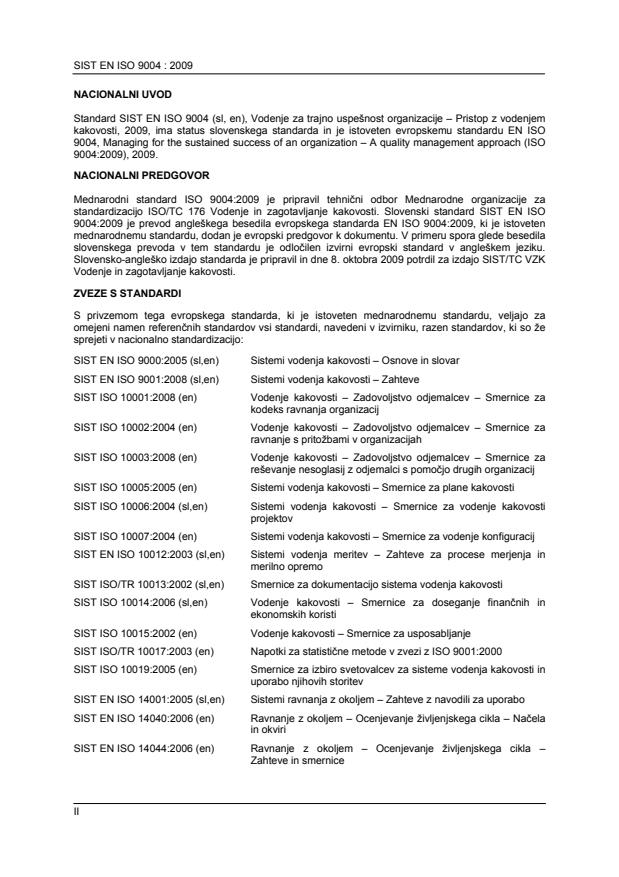
SIST EN ISO 9000:2005 (sl,en) Sistemi vodenja kakovosti – Osnove in slovar
SIST EN ISO 9001:2008 (sl,en) Sistemi vodenja kakovosti – Zahteve
SIST ISO 10001:2008 (en) Vodenje kakovosti – Zadovoljstvo odjemalcev – Smernice za
kodeks ravnanja organizacij
SIST ISO 10002:2004 (en) Vodenje kakovosti – Zadovoljstvo odjemalcev – Smernice za
ravnanje s pritožbami v organizacijah
SIST ISO 10003:2008 (en) Vodenje kakovosti – Zadovoljstvo odjemalcev – Smernice za
reševanje nesoglasij z odjemalci s pomočjo drugih organizacij
SIST ISO 10005:2005 (en) Sistemi vodenja kakovosti – Smernice za plane kakovosti
SIST ISO 10006:2004 (sl,en) Sistemi vodenja kakovosti – Smernice za vodenje kakovosti
projektov
SIST ISO 10007:2004 (en) Sistemi vodenja kakovosti – Smernice za vodenje konfiguracij
SIST EN ISO 10012:2003 (sl,en) Sistemi vodenja meritev – Zahteve za procese merjenja in
merilno opremo
SIST ISO/TR 10013:2002 (sl,en) Smernice za dokumentacijo sistema vodenja kakovosti
SIST ISO 10014:2006 (sl,en) Vodenje kakovosti – Smernice za doseganje finančnih in
ekonomskih koristi
SIST ISO 10015:2002 (en) Vodenje kakovosti – Smernice za usposabljanje
SIST ISO/TR 10017:2003 (en) Napotki za statistične metode v zvezi z ISO 9001:2000
SIST ISO 10019:2005 (en) Smernice za izbiro svetovalcev za sisteme vodenja kakovosti in
uporabo njihovih storitev
SIST EN ISO 14001:2005 (sl,en) Sistemi ravnanja z okoljem – Zahteve z navodili za uporabo
SIST EN ISO 14040:2006 (en) Ravnanje z okoljem – Ocenjevanje življenjskega cikla – Načela
in okviri
SIST EN ISO 14044:2006 (en) Ravnanje z okoljem – Ocenjevanje življenjskega cikla –
Zahteve in smernice
II
SIST EN ISO 9004 : 2009
SIST-TP ISO/TR 14047:2008 (en,fr) Ravnanje z okoljem – Ocenjevanje vpliva življenjskega cikla –
Primeri uporabe ISO 14042
SIST-TS ISO/TS 14048:2008 (en,fr) Ravnanje z okoljem – Ocenjevanje življenjskega cikla – Oblika
dokumentiranja podatkov za ocenjevanje življenjskega cikla
SIST-TP ISO/TR 14049:2008 (en,fr) Ravnanje z okoljem – Ocenjevanje življenjskega cikla – Primeri
uporabe ISO 14041 za opredelitev cilja in namena ter
inventarizacijo
SIST-TP ISO/TR 14062:2008 (en,fr) Ravnanje z okoljem – Vključitev okoljskih vidikov v načrtovanje
in razvoj proizvodov
SIST EN ISO 19011:2003 (sl,en) Smernice za presojanje sistemov vodenja kakovosti in/ali
sistemov ravnanja z okoljem
SIST EN 60300-1:2004 (en) Vodenje zagotovljivosti – 1. del: Sistemi vodenja zagotovljivosti
SIST EN 61160:2007 (en) Pregled zasnove.
PREDHODNA IZDAJA
– SIST EN ISO 9004:2004 (sl,en)
OSNOVA ZA IZDAJO STANDARDA
– Privzem standarda EN ISO 9004:2009.
OPOMBE
– Povsod, kjer se v besedilu standarda uporablja izraz “evropski” ali “mednarodni” standard, v SIST
– Nacionalni uvod in nacionalni predgovor nista sestavna dela standarda.
– Ta nacionalni dokument je istoveten EN ISO 9004:2009 in je objavljen z dovoljenjem
CEN
Rue de Stassart, 36
1050 Bruxelles
Belgija
– This national document is identical to EN ISO 9004:2009 and is published with the permission of
CEN
Rue de Stassart, 36
1050 Bruxelles
Belgium
III
SIST EN ISO 9004 : 2009
IV
EVROPSKI STANDARD EN ISO 9004:2009
EUROPEAN STANDARD
EUROPÄISCHE NORM
NORME EUROPÉENNE november 2009
ICS: 03.120 10 Nadomešča EN ISO 9004:2000
Slovenska izdaja
Vodenje za trajno uspešnost organizacije –
Pristop z vodenjem kakovosti (ISO 9004:2009)
Managing for the sustained Gestion des performances durables Leiten und Lenken für den nachhaltigen
success of an organization - d'un organisme – Approche de Erfolg einer Organisation - Ein
Aquality management management par la qualité Qualitätsmanagementansatz
approach (ISO 9004:2009) (ISO 9004:2009) (ISO 9004:2009)
Ta evropski standard je CEN sprejel dne 1. oktobra 2009.
Članice CEN morajo izpolnjevati določila poslovnika CEN/CENELEC, s katerim je predpisano, da
mora biti ta standard brez kakršnihkoli sprememb sprejet kot nacionalni standard. Seznami
najnovejših izdaj teh nacionalnih standardov in njihovi bibliografski podatki so na voljo pri Centralnem
sekretariatu ali članicah CEN.
Ta evropski standard obstaja v treh uradnih izdajah (nemški, angleški in francoski). Izdaje v drugih
jezikih, ki jih članice CEN na lastno odgovornost prevedejo in izdajo ter prijavijo pri centralnem
sekretariatu CEN, veljajo kot uradne izdaje.
Članice CEN so nacionalne ustanove za standardizacijo Avstrije, Belgije, Bolgarije, Cipra, Češke
republike, Danske, Estonije, Finske, Francije, Grčije, Irske, Islandije, Italije, Latvije, Litve,
Luksemburga, Madžarske, Malte, Nemčije, Nizozemske, Norveške, Poljske, Portugalske, Romunije,
Slovaške, Slovenije, Španije, Švedske, Švice in Združenega kraljestva.
CEN
Evropski komite za standardizacijo
European Committee for Standardization
Europäisches Komitee für Normung
Comité Européen de Normalisation
Centralni sekretariat: Avenue Marnix 17, B-1000 Bruselj
© 2009. Lastnice avtorskih pravic so vse države članice CEN Ref. oznaka EN ISO 9004:2009 E
SIST EN ISO 9004 : 2009
Predgovor
Ta dokument (EN ISO 9004:2009) je pripravil tehnični odbor ISO/TC 176 "Vodenje in zagotavljanje
kakovosti".
Ta evropski standard mora dobiti status nacionalnega standarda z objavo istovetnega besedila ali z
razglasitvijo najpozneje do maja 2010, nacionalne standarde, ki so v nasprotju s tem standardom, pa
je treba umakniti najpozneje do maja 2010.
Opozoriti je treba na možnost, da so lahko nekateri elementi tega standarda predmet patentnih pravic.
CEN (in/ali CENELEC) ne prevzemata odgovornosti za identifikacijo katerih koli ali vseh takih
patentnih pravic.
Ta evropski standard nadomešča EN ISO 9004:2000.
V skladu z notranjimi predpisi CEN/CENELEC morajo ta evropski standard obvezno uvesti nacionalne
organizacije za standardizacijo naslednjih držav: Avstrije, Belgije, Bolgarije, Cipra, Češke republike,
Danske, Estonije, Finske, Francije, Grčije, Irske, Islandije, Italije, Latvije, Litve, Luksemburga,
Madžarske, Malte, Nemčije, Nizozemske, Norveške, Poljske, Portugalske, Romunije, Slovaške,
Slovenije, Španije, Švedske, Švice in Združenega kraljestva.
Razglasitvena objava
Besedilo standarda ISO 9004:2009 je CEN odobril kot standard EN ISO 9004:2009 brez
kakršnihkoli sprememb.
SIST EN ISO 9004 : 2009
SIST EN ISO 9004 : 2009
VSEBINA Stran
Predgovor .6
Uvod .8
1 Področje uporabe .12
2 Zveza z drugimi standardi .12
3 Izrazi in definicije .12
4 Vodenje za trajno uspešnost organizacije.12
4.1 Splošno.12
4.2 Trajna uspešnost.12
4.3 Okolje organizacije .14
4.4 Zainteresirane strani, potrebe in pričakovanja .14
5 Strategija in politika .16
5.1 Splošno.16
5.2 Oblikovanje strategije in politike.16
5.3 Udejanjanje strategije in politike.18
5.4 Sporočanje strategije in politike.20
6 Vodenje virov.20
6.1 Splošno.20
6.2 Finančni viri .20
6.3 Zaposleni v organizaciji .20
6.4 Dobavitelji in partnerji .24
6.5 Infrastruktura .24
6.6 Delovno okolje.26
6.7 Znanje, informacije in tehnologija.26
6.8 Naravni viri.28
7 Vodenje procesov.30
7.1 Splošno.30
7.2 Planiranje in obvladovanje procesov.30
7.3 Odgovornosti in pooblastila za procese .32
8 Nadzorovanje, merjenje, analize in pregled .32
8.1 Splošno.32
8.2 Nadzorovanje .32
8.3 Merjenje.32
8.4 Analize.38
8.5 Pregled informacij, pridobljenih z nadzorovanjem, merjenjem in analizami.40
9 Izboljševanje, inovacije in učenje .40
9.1 Splošno.40
9.2 Izboljševanje.42
9.3 Inovacije .42
9.4 Učenje .44
Dodatek A (informativni) Orodje za samoocenjevanje .48
Dodatek B (informativni) Načela vodenja kakovosti.82
Dodatek C (informativni) Primerjava med ISO 9004:2009 in ISO 9001:2008.90
Bibliografija .94
SIST EN ISO 9004 : 2009
CONTENTS Page
Foreword. 7
Introduction.9
1 Scope .13
2 Normative references.13
3 Terms and definitions.13
4 Managing for the sustained success of an organization.13
4.1 General .13
4.2 Sustained success .13
4.3 The organization's environment.15
4.4 Interested parties, needs and expectations .15
5 Strategy and policy.17
5.1 General .17
5.2 Strategy and policy formulation.17
5.3 Strategy and policy deployment.19
5.4 Strategy and policy communication .19
6 Resource management.21
6.1 General .21
6.2 Financial resources.21
6.3 People in the organization .21
6.4 Suppliers and partners.25
6.5 Infrastructure.25
6.6 Work environment.27
6.7 Knowledge, information and technology.27
6.8 Natural resources.29
7 Process management .31
7.1 General .31
7.2 Process planning and control.31
7.3 Process responsibility and authority .33
8 Monitoring, measurement, analysis and review.33
8.1 General .33
8.2 Monitoring .33
8.3 Measurement .33
8.4 Analysis.39
8.5 Review of information from monitoring, measurement and analysis .41
9 Improvement, innovation and learning.41
9.1 General .41
9.2 Improvement .43
9.3 Innovation.43
9.4 Learning .45
Annex A (informative) Self-assessment tool .49
Annex B (informative) Quality management principles .83
Annex C (informative) Correspondence between ISO 9004:2009 and ISO 9001:2008 .91
Bibliography.95
SIST EN ISO 9004 : 2009
Predgovor
ISO (Mednarodna organizacija za standardizacijo) je svetovna zveza nacionalnih organov za
standarde (članov ISO). Mednarodne standarde ponavadi pripravljajo tehnični odbori ISO. Vsak član,
ki želi delovati na določenem področju, za katero je bil ustanovljen tehnični odbor, ima pravico biti
zastopan v tem odboru. Pri delu sodelujejo tudi mednarodne vladne in nevladne organizacije,
povezane z ISO. V vseh zadevah, ki so povezane s standardizacijo na področju elektrotehnike, ISO
tesno sodeluje z Mednarodno elektrotehniško komisijo (IEC).
Mednarodni standardi so pripravljeni skladno s pravili, podanimi v 2. delu Direktiv ISO/IEC.
Glavna naloga tehničnih odborov je priprava mednarodnih standardov. Osnutki mednarodnih
standardov, ki jih sprejmejo tehnični odbori, se pošljejo vsem članom v glasovanje. Za objavo
mednarodnega standarda je treba pridobiti soglasje vsaj 75 odstotkov članov, ki se udeležijo
glasovanja.
Opozarjamo na možnost, da so lahko nekateri elementi tega mednarodnega standarda predmet patentnih
pravic. ISO ne prevzema odgovornosti za identifikacijo katerihkoli ali vseh takih patentnih pravic.
ISO 9004 je pripravil tehnični odbor ISO/TC 176 Vodenje kakovosti in zagotavljanje kakovosti,
pododbor SC 2 Sistemi kakovosti.
Ta tretja izdaja razveljavlja in nadomešča drugo izdajo (ISO 9004:2000), ki je strokovno revidirana.
Glavna sprememba pri standardu ISO 9004 je osredotočenost na trajno uspešnost organizacije, ki
vodi k bistvenim spremembam v njegovi zgradbi in vsebini.
SIST EN ISO 9004 : 2009
Foreword
ISO (the International Organization for Standardization) is a worldwide federation of national
standards bodies (ISO member bodies). The work of preparing International Standards is normally
carried out through ISO technical committees. Each member body interested in a subject for which a
technical committee has been established has the right to be represented on that committee.
International organizations, governmental and non-governmental, in liaison with ISO, also take part in
the work. ISO collaborates closely with the International Electrotechnical Commission (IEC) on all
matters of electrotechnical standardization.
International Standards are drafted in accordance with the rules given in the ISO/IEC Directives,
Part 2.
The main task of technical committees is to prepare International Standards. Draft International
Standards adopted by the technical committees are circulated to the member bodies for voting.
Publication as an International Standard requires approval by at least 75 % of the member bodies
casting a vote.
Attention is drawn to the possibility that some of the elements of this document may be the subject of
patent rights. ISO shall not be held responsible for identifying any or all such patent rights.
ISO 9004 was prepared by Technical Committee ISO/TC 176, Quality management and quality
assurance, Subcommittee SC 2, Quality systems.
This third edition cancels and replaces the second edition (ISO 9004:2000), which has been
technically revised.
Managing for the sustained success of an organization is a major change in focus for ISO 9004,
leading to substantial changes to its structure and contents.
SIST EN ISO 9004 : 2009
Uvod
V tem mednarodnem standardu so podani napotki, kako lahko s pomočjo pristopa vodenja kakovosti
v zapletenem, zahtevnem in nenehno spreminjajočem se okolju vsaka organizacija doseže trajno
uspešnost.
Trajno uspešnost doseže organizacija, ki je sposobna dolgoročno in uravnoteženo izpolnjevati
potrebe in pričakovanja svojih odjemalcev ter drugih zainteresiranih strani. Trajno uspešnost je
mogoče doseči z uspešnim vodenjem organizacije, z zavedanjem o okolju organizacije, z učenjem ter
z ustrezno uporabo izboljšav ali inovacij ali obojega.
Ta mednarodni standard spodbuja samoocenjevanje kot pomembno orodje pregleda stopnje zrelosti
organizacije, ki zajema njeno voditeljstvo, strategijo, sistem vodenja, vire in procese za
prepoznavanje prednosti in slabosti ter priložnosti za izboljšave ali inovacije ali oboje.
Ta mednarodni standard omogoča širšo osredotočenost na vodenje kakovosti kot ISO 9001; odziva
se na potrebe in pričakovanja vseh ustreznih zainteresiranih strani in daje napotke za sistematično
izboljševanje celovitega delovanja organizacije. Na sliki 1 je podan razširjen model na procesih
temelječega sistema vodenja kakovosti, ki vključuje elemente ISO 9001 in ISO 9004.
Nenehno izboljševanje sistema vodenja kakovosti,
Okolje Okolje
organizacije ki vodi k trajni uspešnosti organizacije organizacije
ISO 9004,
Zainteresirane
Zainteresirane točka 4, Vo-
denje za trajno
strani
strani
uspešnost
organizacije
ISO 9004,
ISO 9004,
točka 9,
Potrebe in
točka 5,
Izboljševanje,
pričakovanja Strategija in
ISO 9001, točka 5,
inovacije in
politika
Odgovornost
učenje
vodstva
ISO 9004,
ISO 9004, točka
ISO 9004, pog. točka 8,
ISO 9001, ISO 9001 točka 8,
6, Vodenje
8, Merjenje, Nadzorovanje, Zadovoljstvo
točka 6, Merjenje, analize
ISO 9001
virov
analize, in
merjenje, analize
Vodenje virov in izboljševanje
(razširjeno)
izboljševanje
in pregled
Odjemalci
Odjemalci
ISO 9001, točka 7,
Potrebe in
Realizacija
Proizvod
pričakovanja
proizvoda
ISO 9004,
točka 7,
Vodenje
procesov
Temelj: Načela vodenja kakovosti (ISO 9000)
Ključ
Pretok informacij
Aktivnosti, ki dodajajo vrednost
Slika 1: Razširjeni model na procesih temelječega sistema vodenja kakovosti
SIST EN ISO 9004 : 2009
Introduction
This International Standard provides guidance to support the achievement of sustained success for
any organization in a complex, demanding, and ever-changing environment, by a quality management
approach.
The sustained success of an organization is achieved by its ability to meet the needs and expectations
of its customers and other interested parties, over the long term and in a balanced way. Sustained
success can be achieved by the effective management of the organization, through awareness of the
organization's environment, by learning, and by the appropriate application of either improvements, or
innovations, or both.
This International Standard promotes self-assessment as an important tool for the review of the
maturity level of the organization, covering its leadership, strategy, management system, resources
and processes, to identify areas of strength and weakness and opportunities for either improvements,
or innovations, or both.
This International Standard provides a wider focus on quality management than ISO 9001; it
addresses the needs and expectations of all relevant interested parties and provides guidance for the
systematic and continual improvement of the organization's overall performance. An extended model
of a process-based quality management system incorporating the elements of ISO 9001 and
ISO 9004 is given in Figure 1.
ISO 9004
Clause 4
Managing for
sustained
success of an
organization
ISO 9004
ISO 9004
Clause 9
Clause 5
Improvement,
Strategy and ISO 9001,
innovation and
policy) Clause 5,
learning
Management
responsibility
ISO 9004
ISO 9004
ISO 9001, ISO 9001, Clause8 Clause 8
Clause 6
Clause 6, Measurement, Monitoring,
Resource
Resource analysis and
measurement,
management
management improvement analysis and
(extended)
review
ISO 9001,
Needs & Clause 7,
Product
expectations
realization
ISO 9004
Clause 7
Process
management
Foundation: Quality management principles (ISO 9000)
Figure 1 – Extended model of a process-based quality management system
SIST EN ISO 9004 : 2009
Ta mednarodni standard je bil razvit za vzdrževanje skladnosti z ISO 9001 in združljivosti z drugimi
standardi za sisteme vodenja. Taki standardi se dopolnjujejo, lahko pa se uporabljajo tudi
samostojno.
Dodatek A organizacijam omogoča samoocenjevanje njihovih prednosti in slabosti, ugotavljanje
njihove stopnje zrelosti in prepoznavanje priložnosti za izboljšave in inovacije.
Dodatek B opisuje načela vodenja kakovosti, ki so podlaga za standarde vodenja kakovosti, ki jih
pripravlja ISO/TC 176.
Dodatek C od poglavja do poglavja navaja ujemanje med ISO 9001:2008 in tem mednarodnim
standardom.
SIST EN ISO 9004 : 2009
This International Standard has been developed to maintain consistency with ISO 9001 and be
compatible with other management system standards. Such standards complement each other, but
can also be used independently.
Annex A provides a tool for organizations to self-assess their own strengths and weaknesses, to
determine their level of maturity, and to identify opportunities for improvement and innovation.
Annex B provides a description of the quality management principles that are the basis of the quality
management standards prepared by ISO/TC 176.
Annex C gives a clause by clause correspondence between ISO 9001:2008 and this International
Standard.
SIST EN ISO 9004 : 2009
Vodenje za trajno uspešnost organizacije – Pristop z vodenjem kakovosti
1 Področje uporabe
Ta mednarodni standard daje napotke organizacijam, ki želijo z vodenjem kakovosti doseči trajno
uspešnost. Uporabljajo ga lahko vse organizacije ne glede na velikost, vrsto in dejavnost.
Ta mednarodni standard ni namenjen certificiranju, uporabi v regulativi ali v pogodbah.
2 Zveza z drugimi standardi
Spodnji dokument se nanaša na uporabo tega dokumenta. Pri datiranem sklicevanju velja samo
navedena izdaja. Pri nedatiranem sklicevanju velja zadnja izdaja dokumenta, na katerega se sklicuje
(vključno z morebitnimi dopolnitvami).
ISO 9000, Sistemi vodenja kakovosti – Osnove in slovar
3 Izrazi in definicije
V tem dokumentu se uporabljajo izrazi in definicije iz standarda ISO 9000 ter naslednji izrazi in definicije.
3.1
trajna uspešnost
〈organizacije〉 rezultat sposobnosti organizacije, da dolgoročno dosega in vzdržuje svoje cilje
3.2
okolje organizacije
kombinacija notranjih in zunanjih dejavnikov ter razmer, ki lahko vplivajo na doseganje ciljev
organizacije in na njen odnos do zainteresiranih strani
4 Vodenje za trajno uspešnost organizacije
4.1 Splošno
Za doseganje trajne uspešnosti naj najvišje vodstvo sprejme pristop z vodenjem kakovosti. Sistem
vodenja kakovosti organizacije naj temelji na načelih, opisanih v dodatku B. Ta načela opisujejo
koncepte, ki so temelj uspešnega sistema vodenja kakovosti. Najvišje vodstvo naj za doseganje
trajne uspešnosti uporabi ta načela v sistemu vodenja kakovosti organizacije.
Organizacija naj razvija svoj sistem vodenja kakovosti, da bo zagotavljal:
– učinkovito uporabo virov,
– odločanje na podlagi količinskih podatkov,
– osredotočenost na zadovoljstvo odjemalcev ter tudi na potrebe in pričakovanja drugih ustreznih
zainteresiranih strani.
OPOMBA: V tem mednarodnem standardu se izraz "najvišje vodstvo" nanaša na najvišjo raven organa oblasti, ki v
organizaciji sprejema odločitve, izraz "organizacija" pa zajema vse zaposlene v organizaciji. To je v skladu z
definicijama teh dveh izrazov v standardu ISO 9000.
4.2 Trajna uspešnost
Organizacija lahko doseže trajno uspešnost z dolgoročnim, uravnoteženim ter doslednim
izpolnjevanjem potreb in pričakovanj svojih zainteresiranih strani.
SIST EN ISO 9004 : 2009
Managing for the sustained success of an organization – A quality
management approach
1 Scope
This International Standard provides guidance to organizations to support the achievement of
sustained success by a quality management approach. It is applicable to any organization, regardless
of size, type and activity.
This International Standard is not intended for certification, regulatory or contractual use.
2 Normative references
The following referenced documents relate to the application of this document. For dated references,
only the edition cited applies. For undated references, the latest edition of the referenced document
(including any amendments) applies.
ISO 9000, Quality management systems – Fundamentals and vocabulary
3 Terms and definitions
For the purposes of this document, the terms and definitions given in ISO 9000 and the following apply.
3.1
sustained success
〈organization〉 result of the ability of an organization to achieve and maintain its objectives in the long
term
3.2
organization's environment
combination of internal and external factors and conditions that can affect the achievement of an
organization's objectives and its behaviour towards its interested parties
4 Managing for the sustained success of an organization
4.1 General
To achieve sustained success, top management should adopt a quality management approach. The
organization's quality management system should be based on the principles described in Annex B.
These principles describe concepts that are the foundation of an effective quality management
system. To achieve sustained success, top management should apply these principles to the
organization's quality management system.
The organization should develop the organization's quality management system to ensure
– the efficient use of resources,
– decision making based on quantitative data,
– focus on customer satisfaction, as well as on the needs and expectations of other relevant
interested parties.
NOTE In this International Standard, the term “top management” refers to the highest level of decision making
authority in an organization and the term “the organization” covers all people in an organization. This is
consistent with the definitions of these terms given in ISO 9000.
4.2 Sustained success
The organization can achieve sustained success by consistently meeting the needs and expectations
of its interested parties, in a balanced way, over the long term.
SIST EN ISO 9004 : 2009
Okolje organizacije se nenehno spreminja in je negotovo, zato naj najvišje vodstvo za doseganje
trajne uspešnosti:
– naravna svoje planiranje dolgoročno,
– stalno spremlja in redno analizira okolje organizacije,
– identificira vse ustrezne zainteresirane strani, oceni njihove morebitne posamezne vplive na
delovanje organizacije in ugotovi, kako naj uravnoteženo izpolnjuje njihove potrebe in
pričakovanja,
– zainteresirane strani nenehno priteguje k sodelovanju in jih stalno obvešča o aktivnostih in
načrtih organizacije,
– vzpostavlja vzajemno koristne odnose z dobavitelji, partnerji in drugimi zainteresiranimi stranmi,
– uporablja široko paleto pristopov, vključno s pogajanjem in posredovanjem, da bo uravnotežilo
potrebe in pričakovanja zainteresiranih strani, ki so pogosto konkurenčni,
– identificira s tem povezano kratko- in dolgoročno tveganje in uporablja celovito strategijo
organizacije za njegovo ublažitev,
– predvideva prihodnje potrebe po virih (vključno s potrebnimi kompetencami zaposlenih v
organizaciji),
– vzpostavlja ustrezne procese za doseganje strategije organizacije in zagotavlja, da so se ti
procesi sposobni hitro odzivati na spremenjene okoliščine,
– redno ocenjuje skladnost s trenutnimi plani in postopki ter sprejema ustrezne korektivne in
preventivne ukrepe,
– zaposlenim v organizaciji zagotavlja priložnosti za učenje, tako za lastno korist kot tudi za
vzdrževanje vitalnosti organizacije, ter
– vzpostavlja in vzdržuje procese za inovacije in nenehno izboljševanje.
4.3 Okolje organizacije
Okolje organizacije se nenehno spreminja ne glede na njeno velikost (velika ali majhna), dejavnosti in
proizvode oziroma vrsto (pridobitna ali nepridobitna), zato ga mora organizacija stalno spremljati.
Tako spremljanje omogoča organizaciji identificirati, oceniti in obvladovati tveganje, povezano z
zainteresiranimi stranmi ter njihovimi spreminjajočimi se potrebami in pričakovanji.
Najvišje vodstvo naj pravočasno sprejema odločitve za spremembe in inovacije v organizaciji, da bo
vzdrževalo in izboljševalo delovanje organizacije.
OPOMBA: Za več informacij o obvladovanju tveganja glej ISO 31000.
4.4 Zainteresirane strani, potrebe in pričakovanja
Zainteresirane strani so posamezniki in drugi subjekti, ki dodajajo vrednost organizaciji ali so kako
drugače zainteresirani za organizacijo ali na katere vplivajo dejavnosti organizacije. S tem, ko
organizacija izpolnjuje potrebe in pričakovanja zainteresiranih strani, prispeva k doseganju trajne
uspešnosti.
Poleg tega so potrebe in pričakovanja posameznih zainteresiranih strani različni, lahko so v nasprotju
s potrebami in pričakovanji drugih zainteresiranih strani ali pa se zelo hitro spreminjajo. Potrebe in
pričakovanja zainteresiranih strani se lahko izražajo in izpolnjujejo z različnimi sredstvi, vključno s
sodelovanjem, pogajanjem, oddajanjem del zunanjim izvajalcem ali s prenehanjem dejavnosti.
SIST EN ISO 9004 : 2009
An organization's environment is ever-changing and uncertain, and to achieve sustained success its
top management should
– have a long-term planning perspective,
– constantly monitor and regularly analyse the organization's environment,
– identify all its relevant interested parties, assess their individual potential impacts on its
performance, as well as determining how to meet their needs and expectations in a balanced
way,
– continually engage interested parties and keep them informed of the organization's activities and
plans,
– establish mutually beneficial relationships with suppliers, partners and other interested parties,
– make use of a wide variety of approaches, including negotiation and mediation, to balance the
often competing needs and expectations of interested parties,
– identify associated short- and long-term risks and deploy an overall strategy for the organization
to mitigate them,
– anticipate future resource needs (including the competences required of its people),
– establish processes appropriate to achieving the organization's strategy, ensuring that they are
capable of responding quickly to changing circumstances,
– regularly assess compliance with current plans and procedures, and take appropriate corrective
and preventive actions,
– ensure that people in the organization have opportunities for learning for their own benefit, as
well as for maintaining the vitality of the organization, and
– establish and maintain processes for innovation and continual improvement.
4.3 The organization's environment
An organization's environment will be undergoing change continually, regardless of its size (large or
small), its activities and products, or its type (for profit or not-for-profit); consequently this should be
monitored constantly by the organization. Such monitoring should enable the organization to identify,
assess and manage the risks related to interested parties, and their changing needs and
expectations.
Top management should make decisions for organizational change and innovation in a timely
manner in order to maintain and improve the organization's performance.
NOTE For more information on risk management, see ISO 31000.
4.4 Interested parties, needs and expectations
Interested parties are individuals and other entities that add value to the organization, or are
otherwise interested in, or affected by, the activities of the organization. Meeting the needs and
expectations of interested parties contributes to the achievement of sustained success by the
organization.
In addition, the needs and expectations of individual interested parties are different, can be in conflict
with those of other interested parties, or can change very quickly. The means by which the needs and
expectations of interested parties are expressed and met can take a wide variety of forms, including
collaboration, cooperation, negotiation, outsourcing, or by terminating an activity.
SIST EN ISO 9004 : 2009
Preglednica 1: Primeri zainteresiranih strani ter njihovih potreb in pričakovanj
Zainteresirana stran Potrebe in pričakovanja
Odjemalci Kakovost, cena in zanesljivost dobav proizvodov
Trajna donosnost
Lastniki/delničarji
Preglednost
Dobro delovno okolje
Zaposleni v organizaciji
Varnost zaposlitve
Priznavanje in nagrajevanje
Dobavitelji in partnerji Vzajemne koristi in kontinuiteta
Varstvo okolja
Družba
Etično vedenje
Skladnost z zahtevami zakonodaje in regulative
OPOMBA: Čeprav večina organizacij uporablja za svoje zainteresirane strani podobne opise (npr. odjemalci,
lastniki/delničarji, dobavitelji in partnerji, zaposleni v organizaciji), pa se lahko sestava teh kategorij sčasoma in
med organizacijami, industrijami, državami ter kulturami bistveno razlikuje.
5 Strategija in politika
5.1 Splošno
Da bi najvišje vodstvo doseglo trajno uspešnost, naj vzpostavi in vzdržuje poslanstvo, vizijo in
vrednote organizacije. Zaposleni v organizaciji, če je primerno pa tudi druge zainteresirane strani, naj
jih dobro razumejo, sprejemajo in podpirajo.
OPOMBA: V tem mednarodnem standardu pomeni "poslanstvo" opis, zakaj organizacija obstaja, "vizija" pa opis njenega
želenega stanja, tj. kaj organizacija želi biti in kako želi, da bi jo videle njene zainteresirane strani.
5.2 Oblikovanje strategije in politike
Najvišje vodstvo naj jasno razgrne strategijo in politiko organizacije, tako da bodo njene zainteresirane
strani sprejele in podprle poslanstvo, vizijo in vrednote. Redno naj spremlja okolje organizacije, da
ugotovi, ali je treba strategijo in politiko pregledati in (po potrebi) spremeniti. Da bo organizacija lahko
vzpostavila, sprejela in ohranjala uspešno politiko in strategijo, naj ima procese za:
– nenehno spremljanje in redno analiziranje okolja organizacije, vključno s potrebami in
pričakovanji njenih odjemalcev, stanjem konkurence, novimi tehnologijami, političnimi
spremembami, ekonomskimi napovedmi ali družbenimi dejavniki,
– identifikacijo in ugotavljanje potreb in pričakovanj drugih zainteresiranih strani,
– ocenjevanje svojih trenutnih procesnih zmogljivosti in virov,
– identifikacijo prihodnjih potreb po virih in tehnologiji,
– obnavljanje svoje strategije in politike ter
– identifikacijo rezultatov, ki so potrebni za izpolnjevanje potreb in pričakovanj zainteresiranih strani.
Ti procesi naj bodo pravočasno vzpostavljeni ter podprti z vsemi potrebnimi plani in viri.
Pri oblikovanju strategije naj organizacija upošteva tudi aktivnosti, kot so analize zahtev odjemalcev ali
regulative, svojih proizvodov, svojih prednosti, slabosti, priložnosti in nevarnosti. Določen naj bo
proces za oblikovanje in pregledovanje strategije organizacije.
OPOMBA: "St
...