

EN 13561:2004+A1:2008
(Main + Amendment)External blinds - Performance requirements including safety
- Abstract
This European Standard specifies the performance requirements which external blinds shall fulfil when fitted to a building. It deals also with the significant hazards for construction, transport, installation, operation and maintenance of the external blinds (see list of significant machine hazards in annex B).
It applies to all external blinds as well as similar products whatever their design and nature of the materials used, as follows and defined in EN 12216:
- folding arm awning, trellis arm awning, pivot arm awning, slide arm awning, vertical roller awning, marquisolette, façade awning, skylight awning, conservatory awning, Dutch awning, insect screen;
- solar screen.
This European Standard does not cover the wind resistance of fixed nor semi-fixed products, e.g. Dutch awnings, fixed or mobile and solar screen. They are not exempt from wind resistance requirements although no test methods have been established at the present time.
The products covered by this European Standard may be operated manually, with or without compensating springs or by means of electric motors (power operated products).
This document is not applicable to external blinds which are manufactured before the date of publication of this document.
Noise aspects are not treated in the standard because this is not considered a safety issue.
- Status
- Withdrawn
- Publication Date
- 30-Sep-2008
- Withdrawal Date
- 06-Oct-2026
- Technical Committee
- CEN/TC 33 - Doors, windows, shutters and building hardware
- Drafting Committee
- CEN/TC 33/WG 3 - Blinds and shutters
- Current Stage
- 9960 - Withdrawal effective - Withdrawal
- Start Date
- 20-May-2015
- Completion Date
- 07-Oct-2026
- Directive
- 2006/42/EC - Directive 2006/42/EC of the European Parliament and of the Council of 17 May 2006 on machinery, and amending Directive 95/16/EC (recast)OJ Ref: C, C 214 OJ Date: 08-Sep-2009
305/2011 - Regulation (eu) No 305/2011 of the European Parliament and of the Council of 9 march 2011 laying down harmonised conditions for the marketing of construction products and repealing council directive 89/106/eecOJ Ref: C, C 259 OJ Date: 08-Aug-2014
89/106/EEC - Construction productsOJ Ref: C, C 152 OJ Date: 04-Jul-2009
98/37/EC - MachineryOJ Ref: C, C 74 OJ Date: 28-Mar-2009

Relations
- Effective Date
- 18-Jan-2023
- Effective Date
- 22-Dec-2008
- Effective Date
- 26-May-2015
- Effective Date
- 25-Aug-2026
- Effective Date
- 09-Feb-2026
- Effective Date
- 09-Feb-2026
- Effective Date
- 09-Feb-2026
- Effective Date
- 28-Jan-2026
- Effective Date
- 28-Jan-2026
- Effective Date
- 28-Jan-2026
- Effective Date
- 28-Jan-2026
- Effective Date
- 28-Jan-2026
- Effective Date
- 28-Jan-2026
- Effective Date
- 28-Jan-2026
- Effective Date
- 28-Jan-2026
Get Certified
Connect with accredited certification bodies for this standard

DIBt (Deutsches Institut für Bautechnik)
German Institute for Building Technology.
DIN CERTCO
DIN Group product certification.

Aboma Certification B.V.
Specialized in construction, metal, and transport sectors.
Sponsored listings
Frequently Asked Questions
EN 13561:2004+A1:2008 is a standard published by the European Committee for Standardization (CEN). Its full title is "External blinds - Performance requirements including safety". This standard covers: This European Standard specifies the performance requirements which external blinds shall fulfil when fitted to a building. It deals also with the significant hazards for construction, transport, installation, operation and maintenance of the external blinds (see list of significant machine hazards in annex B). It applies to all external blinds as well as similar products whatever their design and nature of the materials used, as follows and defined in EN 12216: - folding arm awning, trellis arm awning, pivot arm awning, slide arm awning, vertical roller awning, marquisolette, façade awning, skylight awning, conservatory awning, Dutch awning, insect screen; - solar screen. This European Standard does not cover the wind resistance of fixed nor semi-fixed products, e.g. Dutch awnings, fixed or mobile and solar screen. They are not exempt from wind resistance requirements although no test methods have been established at the present time. The products covered by this European Standard may be operated manually, with or without compensating springs or by means of electric motors (power operated products). This document is not applicable to external blinds which are manufactured before the date of publication of this document. Noise aspects are not treated in the standard because this is not considered a safety issue.
This European Standard specifies the performance requirements which external blinds shall fulfil when fitted to a building. It deals also with the significant hazards for construction, transport, installation, operation and maintenance of the external blinds (see list of significant machine hazards in annex B). It applies to all external blinds as well as similar products whatever their design and nature of the materials used, as follows and defined in EN 12216: - folding arm awning, trellis arm awning, pivot arm awning, slide arm awning, vertical roller awning, marquisolette, façade awning, skylight awning, conservatory awning, Dutch awning, insect screen; - solar screen. This European Standard does not cover the wind resistance of fixed nor semi-fixed products, e.g. Dutch awnings, fixed or mobile and solar screen. They are not exempt from wind resistance requirements although no test methods have been established at the present time. The products covered by this European Standard may be operated manually, with or without compensating springs or by means of electric motors (power operated products). This document is not applicable to external blinds which are manufactured before the date of publication of this document. Noise aspects are not treated in the standard because this is not considered a safety issue.
EN 13561:2004+A1:2008 is classified under the following ICS (International Classification for Standards) categories: 91.060.50 - Doors and windows. The ICS classification helps identify the subject area and facilitates finding related standards.
EN 13561:2004+A1:2008 has the following relationships with other standards: It is inter standard links to EN 13561:2004/prA1, EN 13561:2004, EN 13561:2015, ISO 9227:2006, EN IEC 60335-1:2023, EN 61310-1:2008, EN IEC 60335-2-97:2023, EN 1670:2007, EN ISO 139:2005, EN 1050:1996, EN 13125:2001, EN ISO 10077-1:2017, EN ISO 105-B04:2024, EN 1933:1998, EN 12194:2000. Understanding these relationships helps ensure you are using the most current and applicable version of the standard.
EN 13561:2004+A1:2008 is associated with the following European legislation: EU Directives/Regulations: 2006/42/EC, 305/2011, 89/106/EEC, 98/37/EC; Standardization Mandates: M/079, M/101, M/396. When a standard is cited in the Official Journal of the European Union, products manufactured in conformity with it benefit from a presumption of conformity with the essential requirements of the corresponding EU directive or regulation.
EN 13561:2004+A1:2008 is available in PDF format for immediate download after purchase. The document can be added to your cart and obtained through the secure checkout process. Digital delivery ensures instant access to the complete standard document.
Standards Content (Sample)
2003-01.Slovenski inštitut za standardizacijo. Razmnoževanje celote ali delov tega standarda ni dovoljeno.Markisen - Leistungs- und SicherheitsanforderungenStores extérieurs - Exigences de performance, y compris la sécuritéExternal blinds - Performance requirements including safety91.060.50Vrata in oknaDoors and windowsICS:Ta slovenski standard je istoveten z:EN 13561:2004+A1:2008SIST EN 13561:2004+A1:2009en,fr,de01-maj-2009SIST EN 13561:2004+A1:2009SLOVENSKI
STANDARD
EUROPEAN STANDARD NORME EUROPÉENNE EUROPÄISCHE NORM
EN 13561:2004+A1
October 2008 ICS 91.060.50 Supersedes EN 13561:2004 English Version
External blinds - Performance requirements including safety
Stores extérieurs - Exigences de performance, y compris la sécurité
Markisen - Leistungs- und Sicherheitsanforderungen This European Standard was approved by CEN on 9 February 2004 and includes Amendment 1 approved by CEN on 18 August 2008.
CEN members are bound to comply with the CEN/CENELEC Internal Regulations which stipulate the conditions for giving this European Standard the status of a national standard without any alteration. Up-to-date lists and bibliographical references concerning such national standards may be obtained on application to the CEN Management Centre or to any CEN member.
This European Standard exists in three official versions (English, French, German). A version in any other language made by translation under the responsibility of a CEN member into its own language and notified to the CEN Management Centre has the same status as the official versions.
CEN members are the national standards bodies of Austria, Belgium, Bulgaria, Cyprus, Czech Republic, Denmark, Estonia, Finland, France, Germany, Greece, Hungary, Iceland, Ireland, Italy, Latvia, Lithuania, Luxembourg, Malta, Netherlands, Norway, Poland, Portugal, Romania, Slovakia, Slovenia, Spain, Sweden, Switzerland and United Kingdom.
EUROPEAN COMMITTEE FOR STANDARDIZATION
COMITÉ EUROPÉEN DE NORMALISATION EUROPÄISCHES KOMITEE FÜR NORMUNG
Management Centre: rue de Stassart, 36
B-1050 Brussels © 2008 CEN All rights of exploitation in any form and by any means reserved worldwide for CEN national Members. Ref. No. EN 13561:2004+A1:2008: ESIST EN 13561:2004+A1:2009
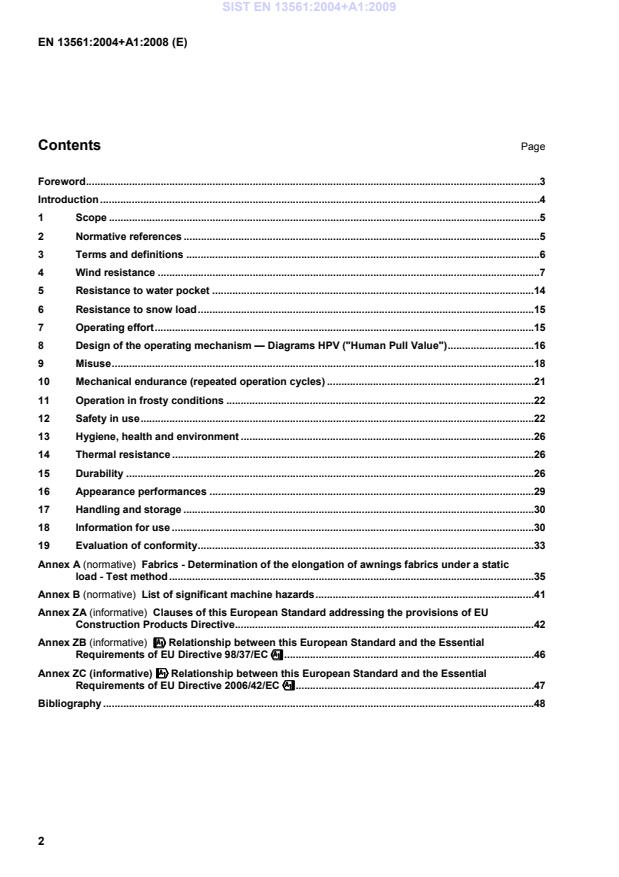
Fabrics - Determination of the elongation of awnings fabrics under a static load - Test method.35 Annex B (normative)
List of significant machine hazards.41 Annex ZA (informative)
Clauses of this European Standard addressing the provisions of EU Construction Products Directive.42 Annex ZB (informative)
!!!!Relationship between this European Standard and the Essential Requirements of EU Directive 98/37/EC"""".46 Annex ZC (informative) !!!!Relationship between this European Standard and the Essential Requirements of EU Directive 2006/42/EC"""".47 Bibliography.48
EN ISO 105-B04, Textiles – Tests for colour fastness – Part B04: Colour fastness to artificial weathering – Xenon arc fading lamp test (ISO 105-B04:1994). EN ISO 1421, Rubber- or plastic-coated fabrics – Determination of tensile strength and elongation at break (ISO 1421:1998). EN ISO 10077-1, Thermal performance of windows, doors and shutters – Calculation of thermal transmittance – Part 1: Simplified method (ISO 10077-1:2000). EN ISO 12100-2:2003, Safety of machinery – Basic concepts, general principles for design – Part 2: Technical principles (ISO 12100-2:2003). ISO 9227, Corrosion tests in artificial atmospheres – Salt spray tests. 3 Terms and definitions For the purposes of this European Standard, the terms and definitions in EN 1070:1998 and EN 12216:2002 and the following apply. 3.1 intrinsic performance overall performances of the blind regardless of its application as opposed to specific performance 3.2 specific performance performance which may be additional and complementary to the intrinsic performances and refers to a specific product (for example thermic, etc.) 3.3 curtain part of the product which is set in motion by the operating mechanism and ensures its function 3.4 extension/retraction movement of the curtain resulting in an increase/decrease in the surface area covered 3.5 opening/closing terms used to describe the increase in light (opening) or reduction of light (closing) in an extended position for products with laths, slats or louvres which can be tilted or adjusted SIST EN 13561:2004+A1:2009
FN = ββββ ×××× p ×××× L ×××× H
(1) where L, H
is the width and height of blind as specified in EN 1932. p is the threshold value of wind test pressure in N/m2 corresponding to the class of wind resistance under consideration (see 4.4). β
is the conversion of the effect of distributed loading relative to those of test loads. It depends on the type of awning (see Tables 1 to 5). β = 0,5 in the case of folding arm awning, trellis arm awning, projecting awning and marquisolette (see Tables 1 to 3). β = 1 in the case of blind with lateral guiderail with or without tension system (see Tables 4 and 5). 4.3.3 Safety load FS For folding arm awning, trellis arm awning, pivot arm awning and marquisolette, a test shall be carried out using a safety load FS, 20 % greater than the nominal load FN, and for which no rupture of the product shall occur. FS = γγγγ ×××× FN with γγγγ = 1,20
(2) The value γ of 1,20 is judged to be representative of the extra load that the product shall be able to support between the appearance of allowable residual deformations (under the nominal load) and the risk of breaking. It takes into consideration that a retractable external blind is not supposed to be extended permanently and shall be retracted if the wind speed becomes higher than the value stated in the technical instructions of the manufacturer corresponding to the class of wind resistance of the blind. Tables 1 to 5 give, for the different blinds, the sequences of loading and the corresponding performances criteria required. SIST EN 13561:2004+A1:2009
LOAD PERFORMANCE CRITERIA
FN
= ββββ ×××× p ×××× L ×××× H (ββββ = 0,5) Sequences
Appearance
Operation
Safety 1 Set in horizontal position (tolerance ± 5°)
______
______
______ 2 Extension at ½ H load ½ FN
then load released
______
manual operating effort maintained inside the class
______ 3 Extension at H Measure of reference Zl0, Zr0 (see Table 2)
______
______
______ 4 Direct nominal load FN
Then load released residual vertical movement allowed after releasing load
| Zl1 - Zl0 | ≤ 10 % H
| Zr1 - Zr0 | ≤ 10 % H
| (Zl1 - Zl0) - (Zr1 - Zr0) | ≤ 1 % L
manual operating effort maintained inside the class
for folding arm awning with box, correct closing of box shall be ensured
______ 5 Inversed nominal load -FN
Then load released residual vertical movement allowed after releasing load
| Zl2 - Zl0 | ≤ 10 % H
| Zr2 - Zr0 | ≤ 10 % H
| (Zl2 - Zl0) - (Zr2 - Zr0) | ≤ 1 % Lmanual operating effort maintained inside the class
for folding arm awning with box, correct closing of box shall be ensured
______ SIST EN 13561:2004+A1:2009
Table 1 — Folding and trellis arm awnings — Performance criteria (concluded)
LOAD PERFORMANCE CRITERIA
FN
= ββββ ×××× p ×××× L ×××× H (ββββ = 0,5) Sequences
Appearance
Operation
Safety 6 Safety load FS = 1,2 ×××× FN
______
______
no rupture
Table 2 — Folding and trellis arm awnings — Measurement of reference for sequence 3
Plane of reference
Zl ; Zr: vertical distances taken from the front profile to the horizontal plane of reference at the connection points
Zl0 ; Zr0: measurement of the reference before loading (sequence 3)
Zl1 ; Zr1: measurement after load is released (sequence 4)
Zl2 ; Zr2: distances measured after load is released (sequence 5)
LOAD PERFORMANCE CRITERIA
FN = ββββ ×××× p ×××× L ×××× H or FN
= ββββ ×××× p ×××× L (H1 + H2) (ββββ = 0,5) Sequences
Appearance
Operation
Safety 1 Direct nominal load FN
Then load released
no onset of tearing no localised splitting of seams
manual operating effort maintained inside the class
______ 2 Inverse nominal load -FN (blinds with obstructed articulation)
Then load released x obstruction
residual movement allowed after release of load
| Zl2 - Zl0 | ≤ 2% H or 2% H2
| Zr2 - Zr0 | ≤ 2% H or 2% H2 | (Zl2 - Zl0) - (Zr2 - Zr0) | ≤ 1% L
manual operating effort maintained inside the class
______ 3 Direct safety load FS = 1,2 x FN
______
______
no tearing
no rupture 4 Inverse safety load (blocked articulation blinds) -FS = -1,2 x FN
x obstruction
______
______
no tearing
no rupture
LOAD PERFORMANCE CRITERIA
FN
= ββββ ×××× p ×××× L ×××× N (ββββ = 1) Sequences
Appearance
Operation
Safety 1
Direct nominal load FN
Then load released
x obstruction
no onset of tearing the fabric
no rupture of seams
no permanent damage to front profile or guiderails
manual operating effort maintained inside the class
the front profile shall not come out of its guiderails
Lifting of front profile by 31 H Alternately block one side and release the other side
x obstruction
no onset of tearing the fabric
no rupture of seams
no permanent damage to front profile or guiderails
manual operating effort maintained inside the class
the front profile shall not come out of its guiderails a
Vertical roller blind, conservatory and façade blind.
LOAD PERFORMANCE CRITERIA
FN
= ββββ ×××× p ×××× L ×××× H (ββββ = 1) H = greatest available height Sequences
Appearance
Operation
Safety 1
Direct nominal load FN
Then load released
no onset of tearing
no rupture of seams
no permanent damage to front profile or guiderails
manual operating effort maintained inside the class
no blocking of the moving part in the side guides
the front profile shall not come out of its guiderails
Raise test bar with FN, releasing one end of the test bar alternatively.
no onset of tearing
no rupture of seams
no permanent damage to front profile or guiderails
operation effort maintained inside the class
no blocking of the moving part in the side guides
the front profile shall not come out of its guiderails a
Facade awning, rooflight awning, verandah awning or conservatory awning.
4.4 Classes of wind resistance The classes of wind resistance are given by the threshold values of nominal test pressure p, specified in Table 6; Table 6 — Classes of wind resistance Classes 0 1 2 3 Nominal test pressure p (N/m²) < 40 40 70 110 Safety test pressure 1,2 p (N/m²) < 48 48 84 132
Beaufort scale 4 5 6 V (km/h) (maximum values)
49 Pressure p (N/m²)
NOTE 2 Class 0 corresponds to either performance not required or not declared or a product that does not fulfil the requirements of class 1. NOTE 3 The test pressure p is linked to the dynamic pressure q due to the wind to be considered by the following relation.
p = αααα q
with αααα = Cpe - Cpi
(3) and Cpe is the pressure coefficient on external face of blind. Cpi is the pressure coefficient on internal face of blind. The coefficient α depends on the type of product and its position. For folding arm awnings, α = 0,6 NOTE 4 For folding blinds, the maximum dynamic pressure q under consideration corresponds to the maximum wind speed compatible with the extended position of the blind. NOTE 5 The conditions to be met in order to fulfil the performance requirement are defined for static loads and do not consider the dynamic effect of repeated loads to which the fabric and the arms are submitted in a real situation. For these reasons, class 2 or class 3 is a general recommendation. 5 Resistance to water pocket 5.1 General This applies to folding arm awning, trellis arm awning and Dutch awning. Under the action of precipitation, the external blind is susceptible to the retention of water forming a pocket of water and shall withstand the corresponding load. 5.2 Determination Shall be in accordance with the test method specified in EN 1933. 5.3 Performance requirement For an incline of 14° corresponding to a slope of 25 % (or for a lesser incline specified by the manufacturer), the fully extended blind shall withstand the force created by a possible retention of water by the fabric (no rupture), or the water shall drain off to avoid forming a pocket of water. After releasing the load and drying of the fabric, the operating force shall be maintained inside the class. SIST EN 13561:2004+A1:2009
6 Resistance to snow load Apart from fixed products (fixed Dutch awnings) for which the resistance to snow load is justified by calculation according to regulations existing in individual countries, products concerned in this standard are not designed to withstand snow load. 7 Operating effort 7.1 General Does not apply for power operated products. The effort FC necessary to set the curtain in motion in retraction or extension, and tilting the laths (for tilting louvre arrays) is a function of the type of operation. 7.2 Determination Shall be in accordance with the test methods specified in EN 13527. 7.3 Performance requirement and operating effort classes Operating effort FC shall not exceed the values in Table 8. Table 8 — Maximum values Fc for operating effort TYPES OF OPERATION Fc N
Class 1 Class 2 Crank or winch handle a 30 15 Belt, cord or chain a,b 90 50 Rod, vertical plane 90 50 hand
horizontal or sloping plane 50 30 For spring loaded systems, 1,5 Fc may be reached for locking in the fully extended or retracted position. A blind belongs to class 2 if both the operations of moving the blind and tilting the laths belong to class 2. Otherwise the blind is class 1. a
Operation mechanism shall also fulfill the requirements in clause 9. b
One direction movement and endless movement of the operating mechanism.
Particular case for folding arm awning (see Figure 1) SIST EN 13561:2004+A1:2009
(4) where FCP
is the maximum value of the peak force, needed to unlock the arms during the first round of the roller tube in retraction, the folding arm awning being in the fully extended position. FCN is the maximum value of the operating force, needed during the rest of travel (retraction and extension). The maximum values for Fc are given in Table 9.
Table 9 — Maximum values for Fc for particular case of folding arm awning
Fc = {FCP , FCN} N CRANK HANDLE Class 1 Class 2 Class 3 Class 4 OPERATION {90 , 30} {60 , 15} {30 , 30} {15 , 15}
NOTE Class 3 and class 4 characterize operations without peak force.
Key 1 Rounds of roller tube 2 FCN value 3 FCP value Figure 1 — Folding arm awning — Characterization of a class of operating force with peak 8 Design of the operating mechanism — Diagrams HPV ("Human Pull Value") 8.1 General Geometrical characteristics of operating mechanisms taking into account the comfort of the operation. SIST EN 13561:2004+A1:2009
Apparent cord diameter for HPV for n cords with diameter d d is the diameter of a single cord
Key
1 Acceptable 2 Non acceptable 3 Operating effort Figure 2 — Diagrams HPV for cord or chain operation
Key 1 Acceptable 2 Non acceptable 3 Operating effort Figure 3 — Diagram HPV for belt operation 9 Misuse 9.1 Curtain and slats – General 9.1.1 General requirement Under the action of abnormal but foreseeable use (misuse), the external blind shall not become misshapen or damaged to the extent that: a) the damage impairs its correct operation; b) the damage which leads to a deterioration in appearance as defined in Tables 1 to 5. Misuse operations are related to the displacement of the curtain and to the tilting of the laths. 9.1.2 Displacement of the curtain Rough operation Rough operation occurs during extension and retraction. Forced operation Forced operation occurs in the direction of extension and retraction, the curtain being either stopped or blocked in extended or retracted position, or blocked in an intermediate position. Figure 4 illustrates the six possibilities of forced operations. SIST EN 13561:2004+A1:2009
a)
b)
c) Key 1 Direction of extension 2 Direction of retraction 3 Obstruction a Curtain fully extended b Curtain fully retracted c Curtain in intermediate position, obstructed during extension and/or retraction. Figure 4 — Illustration of the six possibilities of forced operation In the case of the folding arm awning, only the situations a1 and b2 have to be taken into account. Reversed operation Reversed operations are only applicable to roller blinds or to products using a rolling mechanism for extension or retraction. For these products, operation in situation a1 or b2 illustrated Figure 4, is a reversed operation when the movement in the opposite direction is possible with an effort less than the limit of the class of operation. If the movement is not possible, it is a forced operation. Reversed operation occurs on extension with the curtain fully extended and on retraction with the curtain fully retracted. 9.1.3 Tilting of the laths Rough operation Rough operation is not possible, the conditions defining its occurrence are not likely to occur (no excessive speed, no inertia of laths). Forced operation Forced operation occurs in both closed positions which are the result of tilting the laths in both directions from the open position. Reversed operation Not applicable. SIST EN 13561:2004+A1:2009
PB = 2 Fc CB Not applicablea
rough Movement of curtain / Tilting of laths
PF = 180 CF = 60 × Rb forced c d PI ≤ FC CI ≤ FC × R reversed Fc = value of operating effort of class obtained P = exerted misuse force C = exerted misuse torque B = rough, F = forced, I = reversed
R = maximum length of crank handle described in the technical instructions of the manufacturer with R ≤ 0,20 m a
Operation by gear is never rough. b
In the case of folding arm awning, CF = 120 x R in situations a1 and b2 of Figure 3. c
If the operating mechanism is equipped with a system which limits the force or the torque (see clause 11), the values of PF and CF are those given by this system. d
For power operated operations, the effort to be applied is that produced by the motor.
NOTE There are no performance classes. SIST EN 13561:2004+A1:2009
(5) where Τ1 is the time taken for full retraction of the curtain, measured at the beginning of the endurance test, after five cycles of functioning. Τ2
is the time taken for full retraction of the curtain measured at the end of the endurance test. * Accuracy of the positions of limit stops The variation of the fully retracted and fully extended positions, measured in the two rotation directions and expressed as an angle in relation to the initial value, shall remain in the range of values given in Table 11. SIST EN 13561:2004+A1:2009
* Characteristics of the mechanical brake Stopping the movement of the curtain shall not lead to an angular displacement more than 20°. The displacement of the front profile, after applying an overload of 15% of the weight of the curtain, shall not exceed 5 mm, the measurement from the intermediate position carried out after 12 h. NOTE A mechanical brake is a brake applied mechanically by stored energy (spring force) until released with an external sustained electrical power supply under the control of the operator or automatically. * Grease and oil traces There shall be no visible traces of grease and oil. 10.4 Classes of endurance Table 12 gives the endurance cycles corresponding to the three endurance classes specified. Table 12 — Classes of endurance Number of cycles Class 1 Class 2 Class 3 Extension / retraction 3 000 7 000 10 000 Tilting 6 000 14 000 20 000
NOTE Class 2 corresponds to 10 years use with 2 cycles per day. 11 Operation in frosty conditions The technical instructions of the manufacturer shall state whether or not the product can be operated in frosty conditions (in case of formation of ice) and if not, the product shall have a warning: "The operation in frosty conditions may damage the awning". 12 Safety in use 12.1 General The significant machinery hazards dealt with are listed in annex B. SIST EN 13561:2004+A1:2009
Key 1 Front profile 2 Shearing area 3 Roller 4
Width e of the shearing area 5
Distance Z from the floor 6
Transmitted force F
Figure 5 — Conservatory awning — Shearing area defined by the passage of the front profile at each guiding roller The requirement is met if, at least, one of the following conditions is present: a) The front profile moves only by gravity with a mass less than 15 kg; b) The transmitted force (operating force) of the front profile is less than 150 N and its speed is less than 0,20 m/s:
F < 150 N and V < 0,20 m/s; SIST EN 13561:2004+A1:2009
e ≥ 0,07 m; d) The conservatory awning has a hold-to-run control and the switch is incorporated in the product or installed, in such a way that it allows the control in the direct view of the front profile. In that last case, it shall be mentioned in the installation instructions; e) The shearing area is found at a distance Z more than or equal to 2,50 m from the floor or from any other permanent access level:
Z ≥ 2,50 m; f) The conservatory awning is equipped with a safety device which: either prevents contact in the crushing area (guards); or limits the transmitted force to a value lower than 150 N and allows removal of the obstacle either by reversing the movement of the front profile or by stopping it. With that last solution, it shall be possible to lift up the front profile with a force less than 25 N. Guards designed to protect from the mobile elements of transmission shall be fixed in such a way that they can be only dismounted with the use of a tool. 12.4.3.2 Protection in the crushing area of guided awnings The requirement is fulfilled if, at least, one of the following conditions is present: a) The front profile moves only by gravity with a mass less than 15 kg; b) The transmitted force (operating force) of the front profile is less than 150 N and its speed is less than 0,20 m/s:
F < 150 N and V < 0,20 m/s; c) The front profile is at least 0,40 m from a fixed object; d) The awning has a hold-to-run control and the switch is incorporated in the product or installed on site, in such a way that it allows the control in the direct view of the front profile. In that last case, it shall be mentioned in the installation instructions; e) The front profile is found at a distance Z greater than or equal to 2,50 m from the floor or from any other permanent access level:
Z ≥ 2,50 m; f) The awning is equipped with a safety device which: either prevents contact in the crushing area (guards); or limits the transmitted force to a value lower than 150 N and allows removal of the obstacle either by reversing the movement of the front profile or by stopping it. With the last solution, it shall be possible to lift up the front profile with a force less than 25 N. Guards designed to protect from the mobile elements of transmission shall be fixed in such a way that they can be only dismounted with the use of a tool. SIST EN 13561:2004+A1:2009
„
„ metal … …
„
Only the requirements described by a „ are covered by this standard. The requirements with a
will be the subject of further developments. Selected crite
...