

EN 15737:2009
(Main)Timber Structures - Test methods - Torsional resistance of driving in screws
- Abstract
This standard specifies a test method to determine the torsional resistance to driving of screws in solid timber or glued laminated timber or other wood based materials.
- Status
- Published
- Publication Date
- 18-Aug-2009
- Withdrawal Date
- 27-Feb-2010
- Technical Committee
- CEN/TC 124 - Timber structures
- Drafting Committee
- CEN/TC 124/WG 1 - Test methods
- Current Stage
- 9093 - Decision to confirm - Review Enquiry
- Start Date
- 06-May-2026
- Completion Date
- 07-Oct-2026

Overview
EN 15737:2009 is a European standard developed by CEN (European Committee for Standardization) that specifies a test method for determining the torsional resistance to driving screws in timber materials. This standard is essential for evaluating the performance of screws used in solid timber, glued laminated timber, and other wood-based materials, ensuring reliable and durable timber structures.
The standard defines procedures and criteria for measuring the torsional strength and resistance during screw insertion, which is crucial for the quality control of timber fasteners and structural timber components. It supports compliance with EN 14592 requirements related to dowel-type fasteners.
Key Topics
Scope and Application
EN 15737:2009 applies to test methods for screws driven into solid timber, glued laminated timber, or other wood-based materials, focusing on torsional resistance characteristics.Test Setup and Equipment
The method uses a moment cell to measure torque during screw insertion and displacement transducers to record vertical movement. The setup ensures precision by requiring:- Accuracy within 1% for torque measurement.
- Controlled screw insertion speed (≤ 100 revolutions per minute).
- Proper fixing of test specimens to avoid movement.
Material and Sampling Requirements
Test pieces should be conditioned to an equilibrium moisture content at 20 ± 2°C and 65 ± 5% relative humidity. Density and grain direction of the timber are critical to ensure representativeness and consistency.Test Procedure
Screws are installed according to manufacturer instructions, including pre-drilling if necessary. Maximum torque recorded prior to screw head contact defines the torsional resistance.Reporting Requirements
The test report must detail:- Screw specifications, material type, moisture content, and dimensions.
- Test conditions including temperature, humidity, and equipment.
- Results showing maximum insertion moment and penetration depth.
- Influencing factors such as pre-drilling and screw orientation.
Applications
EN 15737:2009 is widely applied in the construction, timber engineering, and fastener manufacturing industries for:
Quality Control of Screws in Timber Structures
Ensures screws meet performance requirements before market release or during production.Design Validation of Timber Connections
Provides data for verifying connection strength and durability in structural engineering designs.Research and Development
Facilitates performance comparison between different screw types, materials, and coatings under controlled conditions.Standard Compliance and Certification
Assists manufacturers and testing laboratories in meeting European standards, linking to EN 14592 requirements for dowel-type fasteners in timber.
Related Standards
EN 14592:2008 – Timber Structures – Dowel Type Fasteners – Requirements
Specifies product requirements that complement the testing methods for screws as detailed in EN 15737.ISO 3130 – Wood – Determination of Moisture Content for Physical and Mechanical Tests
Defines the procedure for determining moisture content, crucial for conditioning timber test specimens.ISO 3131 – Wood – Determination of Density for Physical and Mechanical Tests
Provides methods for measuring the density of wood, essential for material characterization in testing.
Summary
EN 15737:2009 offers a rigorous, standardized test method for assessing the torsional resistance of screws driven into timber-based materials. It supports enhanced safety, performance reliability, and compliance in timber construction by providing clear guidelines on sample preparation, test setup, execution, and reporting. This standard is an important tool for architects, engineers, manufacturers, and quality assurance professionals engaged in timber structure design and assessment.
Keywords: EN 15737:2009, torsional resistance, screw insertion, timber structures, test methods, glued laminated timber, wood-based materials, screw testing, timber fasteners, structural timber, CEN standards.
Relations
- Effective Date
- 13-May-2026
- Effective Date
- 13-May-2026
- Effective Date
- 28-Jan-2026
- Effective Date
- 28-Jan-2026
- Effective Date
- 28-Jan-2026
Get Certified
Connect with accredited certification bodies for this standard

DIBt (Deutsches Institut für Bautechnik)
German Institute for Building Technology.
DIN CERTCO
DIN Group product certification.

Aboma Certification B.V.
Specialized in construction, metal, and transport sectors.
Sponsored listings
Frequently Asked Questions
EN 15737:2009 is a standard published by the European Committee for Standardization (CEN). Its full title is "Timber Structures - Test methods - Torsional resistance of driving in screws". This standard covers: This standard specifies a test method to determine the torsional resistance to driving of screws in solid timber or glued laminated timber or other wood based materials.
This standard specifies a test method to determine the torsional resistance to driving of screws in solid timber or glued laminated timber or other wood based materials.
EN 15737:2009 is classified under the following ICS (International Classification for Standards) categories: 91.080.20 - Timber structures. The ICS classification helps identify the subject area and facilitates finding related standards.
EN 15737:2009 has the following relationships with other standards: It is inter standard links to ISO 3131:1975, ISO 3130:1975, EN 14592:2008, EN 14592:2008+A1:2012, EN 14592:2022. Understanding these relationships helps ensure you are using the most current and applicable version of the standard.
EN 15737:2009 is available in PDF format for immediate download after purchase. The document can be added to your cart and obtained through the secure checkout process. Digital delivery ensures instant access to the complete standard document.
Standards Content (Sample)
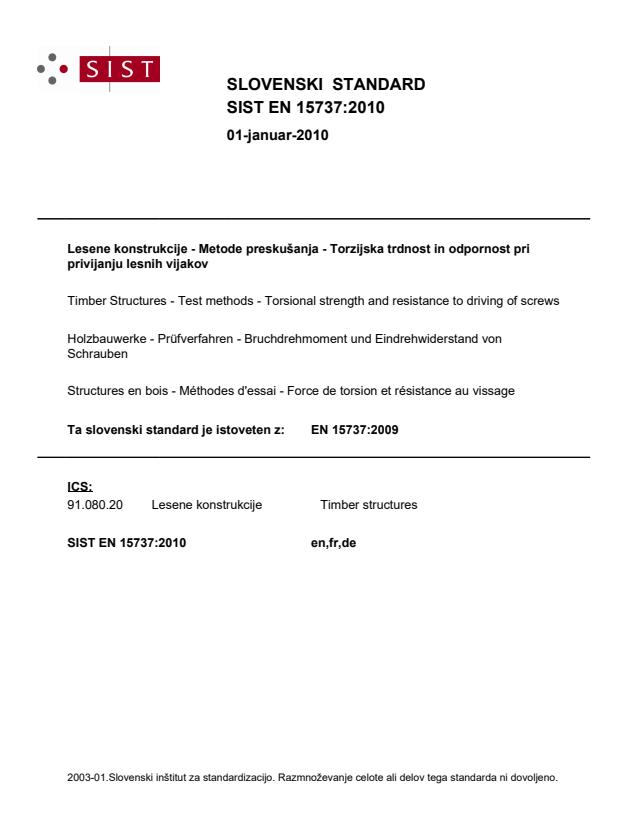
2003-01.Slovenski inštitut za standardizacijo. Razmnoževanje celote ali delov tega standarda ni dovoljeno.Lesene konstrukcije - Metode preskušanja - Torzijska trdnost in odpornost pri privijanju lesnih vijakovHolzbauwerke - Prüfverfahren - Bruchdrehmoment und Eindrehwiderstand von SchraubenStructures en bois - Méthodes d'essai - Force de torsion et résistance au vissageTimber Structures - Test methods - Torsional strength and resistance to driving of screws91.080.20Lesene konstrukcijeTimber structuresICS:Ta slovenski standard je istoveten z:EN 15737:2009SIST EN 15737:2010en,fr,de01-januar-2010SIST EN 15737:2010SLOVENSKI
STANDARD
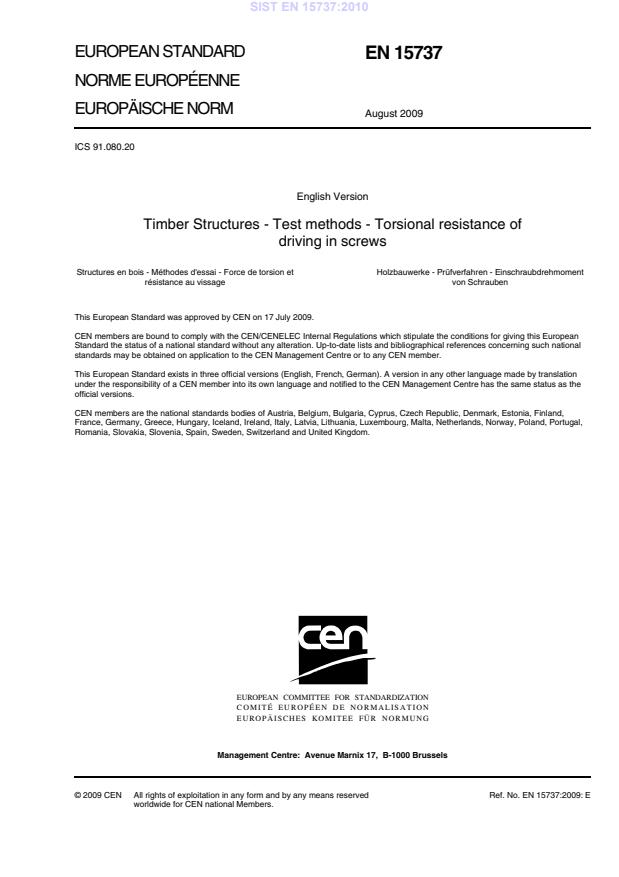
EUROPEAN STANDARDNORME EUROPÉENNEEUROPÄISCHE NORMEN 15737August 2009ICS 91.080.20 English VersionTimber Structures - Test methods - Torsional resistance ofdriving in screwsStructures en bois - Méthodes d'essai - Force de torsion etrésistance au vissageHolzbauwerke - Prüfverfahren - Einschraubdrehmomentvon SchraubenThis European Standard was approved by CEN on 17 July 2009.CEN members are bound to comply with the CEN/CENELEC Internal Regulations which stipulate the conditions for giving this EuropeanStandard the status of a national standard without any alteration. Up-to-date lists and bibliographical references concerning such nationalstandards may be obtained on application to the CEN Management Centre or to any CEN member.This European Standard exists in three official versions (English, French, German). A version in any other language made by translationunder the responsibility of a CEN member into its own language and notified to the CEN Management Centre has the same status as theofficial versions.CEN members are the national standards bodies of Austria, Belgium, Bulgaria, Cyprus, Czech Republic, Denmark, Estonia, Finland,France, Germany, Greece, Hungary, Iceland, Ireland, Italy, Latvia, Lithuania, Luxembourg, Malta, Netherlands, Norway, Poland, Portugal,Romania, Slovakia, Slovenia, Spain, Sweden, Switzerland and United Kingdom.EUROPEAN COMMITTEE FOR STANDARDIZATIONCOMITÉ EUROPÉEN DE NORMALISATIONEUROPÄISCHES KOMITEE FÜR NORMUNGManagement Centre:
Avenue Marnix 17,
B-1000 Brussels© 2009 CENAll rights of exploitation in any form and by any means reservedworldwide for CEN national Members.Ref. No. EN 15737:2009: ESIST EN 15737:2010
...