

EN 14592:2008
(Main)Timber structures - Dowel-type fasteners - Requirements
- Abstract
This European Standard specifies the requirements and test methods for materials, geometry, strength, stiffness and durability ascpects (i.e. corrosion protection) of dowel-type fasteners for use in load bearing timber structures.
Only dowel-type fasteners manufactured from steel are covered by this European Standard. For the purpose of this standard, dowel-type fasteners for timber structures are taken to be nails, staples, screws, dowels, and bolts with nuts. Definitions of these items are given in Clause 3. This European Standard specifies also the evaluation of conformity procedures and includes requirements for marking of these products.
This European Standard does not cover resin coated dowel-type fasteners and fasterners treated with fire retardants to improve their fire performance. It also does not cover resin coated fasteners.
- Status
- Withdrawn
- Publication Date
- 30-Sep-2008
- Withdrawal Date
- 15-May-2012
- Technical Committee
- CEN/TC 124 - Timber structures
- Drafting Committee
- CEN/TC 124/WG 4 - Connectors
- Current Stage
- 9960 - Withdrawal effective - Withdrawal
- Start Date
- 16-May-2012
- Completion Date
- 16-May-2012
89/106/EEC - Construction productsOJ Ref: C, C 152 OJ Date: 04-Jul-2009

Relations
- Effective Date
- 19-Jan-2023
- Referred By
EN 15737:2009 - Timber Structures - Test methods - Torsional resistance of driving in screws - Effective Date
- 28-Jan-2026
- Effective Date
- 02-Oct-2010
Get Certified
Connect with accredited certification bodies for this standard

DIBt (Deutsches Institut für Bautechnik)
German Institute for Building Technology.
DIN CERTCO
DIN Group product certification.

Aboma Certification B.V.
Specialized in construction, metal, and transport sectors.
Sponsored listings
Frequently Asked Questions
EN 14592:2008 is a standard published by the European Committee for Standardization (CEN). Its full title is "Timber structures - Dowel-type fasteners - Requirements". This standard covers: This European Standard specifies the requirements and test methods for materials, geometry, strength, stiffness and durability ascpects (i.e. corrosion protection) of dowel-type fasteners for use in load bearing timber structures. Only dowel-type fasteners manufactured from steel are covered by this European Standard. For the purpose of this standard, dowel-type fasteners for timber structures are taken to be nails, staples, screws, dowels, and bolts with nuts. Definitions of these items are given in Clause 3. This European Standard specifies also the evaluation of conformity procedures and includes requirements for marking of these products. This European Standard does not cover resin coated dowel-type fasteners and fasterners treated with fire retardants to improve their fire performance. It also does not cover resin coated fasteners.
This European Standard specifies the requirements and test methods for materials, geometry, strength, stiffness and durability ascpects (i.e. corrosion protection) of dowel-type fasteners for use in load bearing timber structures. Only dowel-type fasteners manufactured from steel are covered by this European Standard. For the purpose of this standard, dowel-type fasteners for timber structures are taken to be nails, staples, screws, dowels, and bolts with nuts. Definitions of these items are given in Clause 3. This European Standard specifies also the evaluation of conformity procedures and includes requirements for marking of these products. This European Standard does not cover resin coated dowel-type fasteners and fasterners treated with fire retardants to improve their fire performance. It also does not cover resin coated fasteners.
EN 14592:2008 is classified under the following ICS (International Classification for Standards) categories: 91.080.20 - Timber structures. The ICS classification helps identify the subject area and facilitates finding related standards.
EN 14592:2008 has the following relationships with other standards: It is inter standard links to EN 14592:2008+A1:2012, EN 15737:2009, EN 14592:2008/FprA1. Understanding these relationships helps ensure you are using the most current and applicable version of the standard.
EN 14592:2008 is associated with the following European legislation: EU Directives/Regulations: 305/2011, 89/106/EEC; Standardization Mandates: M/112. When a standard is cited in the Official Journal of the European Union, products manufactured in conformity with it benefit from a presumption of conformity with the essential requirements of the corresponding EU directive or regulation.
EN 14592:2008 is available in PDF format for immediate download after purchase. The document can be added to your cart and obtained through the secure checkout process. Digital delivery ensures instant access to the complete standard document.
Standards Content (Sample)
2003-01.Slovenski inštitut za standardizacijo. Razmnoževanje celote ali delov tega standarda ni dovoljeno.Holzbauwerke - Stiftförmige Verbindungsmittel - AnforderungenStructures en bois - Elémens de fixation - ExigencesTimber structures - Dowel-type fasteners - Requirements91.080.20Lesene konstrukcijeTimber structures21.060.01Vezni elementi na splošnoFasteners in generalICS:Ta slovenski standard je istoveten z:EN 14592:2008SIST EN 14592:2009en,fr,de01-december-2009SIST EN 14592:2009SLOVENSKI
STANDARD
EUROPEAN STANDARDNORME EUROPÉENNEEUROPÄISCHE NORMEN 14592October 2008ICS 91.080.20 English VersionTimber structures - Dowel-type fasteners - RequirementsStructures en bois - Eléments de fixation - ExigencesHolzbauwerke - Stiftförmige Verbindungsmittel -AnforderungenThis European Standard was approved by CEN on 9 August 2008.CEN members are bound to comply with the CEN/CENELEC Internal Regulations which stipulate the conditions for giving this EuropeanStandard the status of a national standard without any alteration. Up-to-date lists and bibliographical references concerning such nationalstandards may be obtained on application to the CEN Management Centre or to any CEN member.This European Standard exists in three official versions (English, French, German). A version in any other language made by translationunder the responsibility of a CEN member into its own language and notified to the CEN Management Centre has the same status as theofficial versions.CEN members are the national standards bodies of Austria, Belgium, Bulgaria, Cyprus, Czech Republic, Denmark, Estonia, Finland,France, Germany, Greece, Hungary, Iceland, Ireland, Italy, Latvia, Lithuania, Luxembourg, Malta, Netherlands, Norway, Poland, Portugal,Romania, Slovakia, Slovenia, Spain, Sweden, Switzerland and United Kingdom.EUROPEAN COMMITTEE FOR STANDARDIZATIONCOMITÉ EUROPÉEN DE NORMALISATIONEUROPÄISCHES KOMITEE FÜR NORMUNGManagement Centre: rue de Stassart, 36
B-1050 Brussels© 2008 CENAll rights of exploitation in any form and by any means reservedworldwide for CEN national Members.Ref. No. EN 14592:2008: ESIST EN 14592:2009
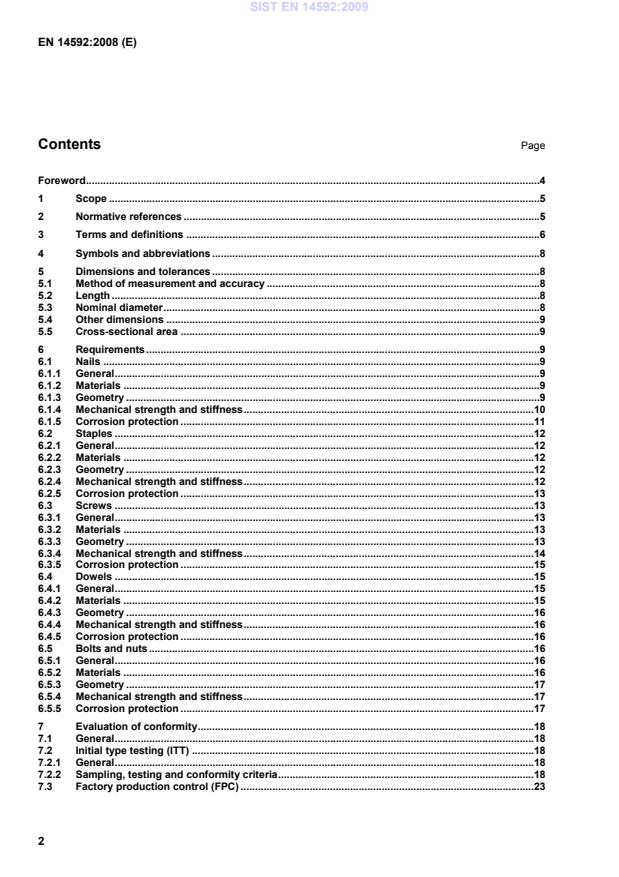
Expression of corrosion protection specifications.32 Annex B (normative)
Method of determining the torsion resistance to insertion of screws into timber.33 Annex ZA (informative)
Clauses of this European Standard addressing the provisions of the EU Contruction Products Directive.35 Bibliography.41
Only dowel-type fasteners manufactured from steel are covered by this European Standard. For the purpose of this standard, dowel-type fasteners for timber structures are taken to be nails, staples, screws, dowels, and bolts with nuts.
Definitions of these items are given in Clause 3. This European Standard specifies also the evaluation of conformity procedures and includes requirements for marking of these products. This European Standard does not cover resin coated dowel-type fasteners and fasterners treated with fire retardants to improve their fire performance. It also does not cover resin coated fasteners. 2 Normative references The following referenced documents are indispensable for the application of this document. For dated references, only the edition cited applies. For undated references, the latest edition of the referenced document (including any amendments) applies. EN 409, Timber structures - Test methods - Determination of the yield moment of dowel type fasteners - Nails EN 1382, Timber structures - Test methods - Withdrawal capacity of timber fasteners EN 1383:1999, Timber structures - Test methods - Pull-through resistance of timber fasteners EN 1995-1-1:2004, Eurocode 5: Design of timber structures - Part 1-1: General - Common rules and rules for buildings EN 10016 (all parts), Non-alloy steel rod for drawing and/or cold rolling
EN 10025-2, Hot rolled products of structural steels - Part 2: Technical delivery conditions for non-alloy structural steels EN 10025-3, Hot rolled products of structural steels - Part 3: Technical delivery conditions for normalized/normalized rolled weldable fine grain structural steels EN 10083-1, Steels for quenching and tempering - Part 1: General technical delivery conditions EN 10083-2, Steels for quenching and tempering - Part 2: Technical delivery conditions for non alloy steels EN 10088-1, Stainless steels - Part 1: List of stainless steels EN 10088-2, Stainless steels - Part 2: Technical delivery conditions for sheet/plate and strip of corrosion resisting steels for general purposes EN 10149-1, Hot-rolled flat products made of high yield strength steels for cold forming – Part 1: General delivery conditions EN 10218-1, Steel wire and wire products - General - Part 1: Test methods EN 10230-1, Steel wire nails - Part 1: Loose nails for general applications
EN 10278, Dimensions and tolerances of bright steel products SIST EN 14592:2009
ISO 2081, Metallic coatings - Electroplated coatings of zinc on iron or steel 3 Terms and definitions For the purposes of this document, terms and definitions given in EN 1995-1-1:2004 and the following apply. 3.1
plain shank nail (smooth nail) nail that has a constant cross-section along its entire length (e.g. round, square or grooved nails)
3.2 threaded nail nail that has its shank profiled or deformed over a part of its length
3.3 staple crown width distance between the outer edges of the staple legs 3.4 dowel cylindrical metal fastener that does not contain an integral head NOTE Dowels may be threaded and have nuts fitted at either end. 3.5 bolt
cylindrical metal fastener containing an integral head at one end and a threaded portion to receive a nut at the other end SIST EN 14592:2009
parameter measuring the resistance of a timber test piece to the withdrawal of a timber fastener 3.7 head pull-through parameter
parameter measuring the resistance of a timber test piece to the pulling through of the head of a timber fastener or the crown of a staple 3.8 tensile capacity
tensile capacity measured during a test following the principle of EN 1383, as described in 6.1.4.5 3.9 nominal diameter
screws intended for use in load bearing timber structures, d being the maximum outer cross-section diameter of the threaded part, and for nails d being the minimum outer cross-sectional dimension of the unprofiled part, when measured as described in 5.3 NOTE For plain shank nails, spiral rolled nails or annular ring shank nails, intended for use in load bearing timber structures, d is the minimum outer cross-sectional diameter of the round nail wire, or the side length dimension of the minimum cross-sectional for a square nail, for all other profiled nails, intended for use in load bearing timber structures; d is the minimum cross-sectional diameter of the original wire rod, from which the profiled nail has been produced (see Figure 1).
Figure 1 – Nominal diameter and length of nails 3.10 effective screw diameter parameter used in the calculation of the characteristic yield moment of screws as given in EN 1995-1-1 NOTE Defined in EN 1995-1-1 as d – diameter in mm measured on the smooth shank, it only applies for part threaded screws which have their threaded part turned down from the original rod diameter, and therefore have a shank diameter equal to the maximum outer cross-sectional diameter of the threaded part. For all other screws produced by rolling or forging, d is the maximum cross-sectional diameter of the threaded part, as described in 6.3.1 (see Figures 1 and 3). SIST EN 14592:2009
value based on required bend angle (deformation), α of the characteristic yield strength (capacity) either found by testing or calculated according to EN 1995-1-1
4 Symbols and abbreviations For the purposes of this standard, the symbols and abbreviations given in EN 1995-1-1 and the following apply. A80
percentage elongation (%) Ah
nail head cross-sectional area (mm2) As
staple leg cross-sectional area (mm2) d
nominal diameter (mm) dh
head diameter (mm) di
inner thread diameter; inner diameter of fluting (mm) def
effective screw diameter (mm) fax,k
characteristic withdrawal parameter (N/mm2) fhead,k
characteristic head pull-through parameter (N/mm2) ftens,k
characteristic tensile capacity (head pull-off or shank tensile capacity) (kN) ftor,k
characteristic torsional strength (Nmm) fu
tensile strength of the wire (N/mm2) ht
nail head thickness (mm) l
overall fastener length (mm) lg
length of profiling/threading (mm) lp
length of the nail point (mm) My,k
characteristic yield moment (Nmm) Rtor,k
characteristic torsional resistance to insertion into timber with a density of 450 kg/m3 when conditioned to constant mass at 20 ºC and 65 % relative humidity (Nmm) α
bend angle (o) ρk
characteristic timber density when conditioned to constant mass at 20 ºC and 65 % relative
humidity (kg/m3) 5 Dimensions and tolerances 5.1 Method of measurement and accuracy
Dimensions shall be taken on the completed fastener using a calibrated device capable of achieving an accuracy of ± 1 % of the measurement.
5.2 Length
Where appropriate the overall length of a fastener shall be measured and the result declared. When sampled in accordance with Tables 2 to 6 and measured, the overall length shall be within ± 2,5 % of the declared value. 5.3 Nominal diameter Where appropriate, the nominal diameter of a fastener shall be measured and the result declared. Unless otherwise stated in this standard, the nominal diameter shall be within ± 2,5 % of the declared value when sampled in accordance with Tables 2 to 6 and measured as follows: the diameter shall be measured at several points around the circumference and along the length; the maximum measurement shall be taken as the nominal diameter. SIST EN 14592:2009
Figure 2 – Geometry of nails heads and points NOTE Standard dimensions for various types of loose nail are given in EN 10230-1. 6.1.4 Mechanical strength and stiffness 6.1.4.1 General For the purpose of the mechanical strength of nails the following characteristic properties shall be used in this standard: characteristic yield moment, characteristic withdrawal parameter, characteristic head pull-through parameter, characteristic tensile capacity. The characteristic strength results for nails (see 6.1.4.2 to 6.1.4.5) shall be declared either directly from tests or, in certain cases and types of nails, from equations given in EN 1995-1-1. Where characteristic strength values are declared from test results, they shall be calculated in accordance with EN 14358. For the purposes of strength calculations for nailed joints, the nail diameter shall be taken as the nominal diameter, d, measured in accordance with 5.3. For the purpose of the mechanical stiffness of nails the following characteristic properties shall be used in this standard: characteristic yield moment. For the purposes of stiffness (bend angle α), for round or square cross-section nails, the declaration is related to the result of the characteristic yield moment My,k which shall be declared either directly by testing in accordance with EN 409 or calculated from the relevant equations given in EN 1995-1-1. For all other types of nail the result shall be declared by testing in accordance with EN 409. SIST EN 14592:2009
the result shall be declared on one or more characteristic timber densities or on other types of wood based products, either directly by testing in accordance with EN 1383 or declared by calculation according to the relevant equations given in EN 1995-1-1.
For all other types of nail, the characteristic head pull-through parameter fhead,k
the result shall be declared on one or more characteristic timber densities or on other types of wood based products, by testing in accordance with EN 1383. 6.1.4.5 Characteristic tensile capacity The characteristic tensile capacity of nails ftens,k (head pull-off or shank tensile capacity) the result shall be declared by testing in accordance with EN 1383, using a steel plate to replace the head side timber member shown in Figure 4 of that standard. The steel plate shall be of sufficient thickness to induce either a pull-off failure of the head, or a tensile failure of the shank and shall contain a pre-drilled hole for the nail which shall not exceed the maximum outer diameter of the nail + 1 mm in diameter. For partially profiled nails the area of transition from the profiled to the smooth part of the shank shall be located within the free length of testing and shall have a clear distance from the jaws of the testing equipment of at least 3 d. The rate of loading shall be chosen so that the failure load (ultimate load) is reached within 10 s ± 5 s. 6.1.5 Corrosion protection For nails, where corrosion protection is required, the grade of the parent material or thickness of coating shall be declared in accordance with Annex A. Examples of minimum corrosion protection or material specifications for different service classes are given in EN 1995-1-1. SIST EN 14592:2009
a) staples with rectangular cross-section, the leg diameter d shall be taken as the square root of the product of both dimensions,
b) staples with circular or deformed-circular cross-section, the diameter shall be taken as the minimum cross sectional dimension measured about the perimeter, c) staples with rectangular or circular or deformed-circular cross-section, the crown shall have a minimum width of 6 d,
d) staples with rectangular or circular or deformed-circular cross-section,
1) the leg length (l), shall have a maximum length of 65 d, 2) each leg shall have a minimum cross-sectional area As of 1,7 mm2 and a maximum cross-sectional area of 3,2 mm2. 6.2.4 Mechanical strength and stiffness 6.2.4.1 General For the purpose of the mechanical strength of staples the following characteristic properties shall be used in this standard: characteristic yield moment, characteristic withdrawal parameter, characteristic head pull-through parameter. The characteristic strength results for staples (see 6.2.4.2 to 6.2.4.4) shall be declared either directly from tests or, in certain cases and types of staples, from equations given in EN 1995-1-1. Where characteristic strength values are declared from test results, they shall be calculated in accordance with EN 14358. For the purpose of the mechanical stiffness of staples the following characteristic properties shall be used in this standard: characteristic yield moment. SIST EN 14592:2009
Figure 3 – Geometry of screws
6.3.4 Mechanical strength and stiffness 6.3.4.1 General For the purpose of the mechanical strength of screws the following characteristic properties shall be used in this standard: characteristic yield moment, characteristic withdrawal parameter, characteristic head pull-through parameter, characteristic tensile capacity, characteristic torsional ratio. Characteristic strength results for screws (see 6.3.4.2 to 6.3.4.6) shall either be declared directly from tests or, in the case of certain strength properties and types of screws, from equations given in EN 1995-1-1. Where the characteristic strength values of screws are declared from test results, they shall be calculated in accordance with EN 14358. For the purpose of the mechanical stiffness of screws the following characteristic properties shall be used in this standard: characteristic yield moment. For the purposes of stiffness (bend angle α), the declaration is related to the result of the characteristic yield moment My,k which shall be declared either directly by testing in accordance with EN 409 or calculated from the relevant equations given in EN 1995-1-1. 6.3.4.2 Characteristic yield moment
The characteristic yield moment of screws My,k shall be declared and the result shall either be found directly by testing in accordance with EN 409, or calculated from the relevant equations given in EN 1995-1-1. Where My,k is declared by testing, it shall be taken as the minimum characteristic value determined on both the threaded section and the smooth section of the screw, from tests carried out in accordance with EN 409, SIST EN 14592:2009
For screws the characteristic withdrawal parameter fax,k the result shall be declared on one or more characteristic timber densities or on other types of timber products, either directly by testing in accordance with EN 1382 or declared by calculation according to the relevant equations given in EN 1995-1-1. 6.3.4.4 Characteristic head pull-through parameter For screws the characteristic head pull-through parameter fhead,k the result shall be declared by testing in accordance with EN 1383 on one or more characteristic timber densities or on other types of wood based products. NOTE Combining the screw with a washer, where appropriate, may enhance the head pull-through parameter. 6.3.4.5 Characteristic tensile capacity For screws the characteristic tensile capacity ftens,k (head pull-off or shank tensile capacity) the result shall be declared by testing in accordance with EN 1383:1999, using a steel plate to replace the head side timber member shown in Figure 4 of that standard. The steel plate shall be of sufficient thickness to induce either a pull-off failure of the head, or a tensile failure of the shank and shall contain a pre-drilled hole for the screw which may not exceed the maximum outer diameter of the screw + 1 mm in diameter. For partially profiled screws the area of transition from the profiled to the smooth part of the shank shall be located within the free length of testing and shall have a clear distance from the jaws of the testing equipment of at least 3 d1. The rate of loading shall be chosen so that the failure load (ultimate load) is reached within 10 s ± 5 s. 6.3.4.6 Characteristic torsional ratio For screws the characteristic torsional strength ftor,k shall be determined by testing in accordance with the method given in EN ISO 10666:1999, 4.2.3, and the torsional resistance to insertion into timber, Rtor,k,
shall be determined in accordance with the method given in Annex B of this standard. The ratio ftor,k / Rtor,k ≥
1,5 shall be maintained for screws used in load-bearing timber structures. 6.3.5 Corrosion protection For screws, where corrosion protection is required, the grade of the parent material or thickness of coating shall be declared in accordance with Annex A. Examples of minimum corrosion protection or material specifications for different service classes are given in EN 1995-1-1. 6.4 Dowels 6.4.1 General Dowels shall have a circular, deformed circular or rectangular cross-section. 6.4.2 Materials Dowels shall be produced from steel rods to EN 10025-2, EN 10025-3 or EN 10149-1. The relevant specification shall be declared. The minimum steel specification shall be S235 to EN 10025-2, and a minimum percentage elongation (A80) of 16 %. SIST EN 14592:2009
Table 1 – Material specifications for bolts and nuts Bolts Nuts Grade Standard Grade Standard 4.6 EN ISO 4016 4
d > M16 4.8 EN ISO 4018 5
d ≤ M16 5.6 EN ISO 4014 EN ISO 4017 5 EN ISO 4034 8.8 EN ISO 4014 EN ISO 4017 8 EN ISO 4032 EN ISO 780 6.5.3 Geometry Bolts shall either have heads and nuts of hexagonal shape or, if the heads and nuts are not hexagonal, shall have equivalent performance to a bolt of the same size with a hexagonal head and nut. Bolts shall have a minimum diameter of 6 mm and a maximum diameter of 30 mm.
The nominal diameter and length of the bolt shall be declared. 6.5.4 Mechanical strength and stiffness 6.5.4.1 General For the purpose of the mechanical strength of bolts the following characteristic properties shall be used in this standard: characteristic yield moment. The characteristic strength results (see 6.5.4.2) shall be declared either directly from tests or, in the case of certain strength properties and types of bolts, from equations given in EN 1995-1-1. Where characteristic strength values are declared from test results, they shall be calculated in accordance with EN 14358. For the purposes of stiffness (bend angle α), the declaration is related to the result of the characteristic yield moment My,k which shall be declared either directly by testing in accordance with EN 409 or calculated from the relevant equations given in EN 1995-1-1. 6.5.4.2 Characteristic yield moment The characteristic yield moment of steel bolts My,k shall be declared and the result shall either be found by testing in accordance with EN 409, where the bend angle, α, is limited to 45/d 0,7 degrees (where d is in mm), or calculated from the relevant equations given in EN 1995-1-1. 6.5.5 Corrosion protection For bolts where corrosion protection is required, the grade of the parent material or thickness of coating shall be declared in accordance with in Annex A. SIST EN 14592:2009
Table 6, for bolts and nuts. SIST EN 14592:2009
...