

EN 13019:2001+A1:2008
(Main + Amendment)Machines for road surface cleaning - Safety requirements
- Abstract
This European Standard applies to road surface cleaning machines, which are defined in clause 3. The equipment would normally be mounted on a carrier vehicle (e.g. truck, tractor, construction machinery and mobile industrial handling equipment). It is also possible to mount a road surface cleaning machine on its own chassis construction and propulsion system. In all cases the machine and chassis form an integral unit. Directives and standards for the vehicular truck chassis aspect, termed 'carrier vehicle' in this standard, would be those relative to that equipment, even where specific modifications have been made to realize the road surface cleaning application. The use in public road traffic is governed by the national regulations.
This European Standard deals with all significant hazards identified through a risk assessment pertinent to road surface cleaning machines when they are used as intended and under the conditions foreseen by the manufacturer. This European Standard does not deal with significant hazards associated with EMC. This European Standard only specifies the appropriate technical measures to eliminate or reduce risks arising from the significant hazards associated with machine operation, setting and adjustments, load discharge and routine maintenance.
This European Standard does not include requirements for the carrier vehicles (e.g. truck) or special constructions. These are covered in directives related to the construction of vehicles. Demountable bodywork systems (e.g. demountable containers) are specified in other standards.
This European Standard does not apply to road surface cleaning machines such as front mounted tractor brooms according to EN 13524:2003.
This European Standard does not apply to machines or components that are specifically designed for cleaning tram-lines and rail tracks.
This European Standard does not deal with the risks associated with the operation of machines in potentially explosive atmospheres.
- Status
- Withdrawn
- Publication Date
- 09-Dec-2008
- Withdrawal Date
- 06-Oct-2026
- Technical Committee
- CEN/TC 151 - Construction equipment and building material machines - Safety
- Current Stage
- 9960 - Withdrawal effective - Withdrawal
- Start Date
- 20-Oct-2021
- Completion Date
- 07-Oct-2026
- Directive
- 2006/42/EC - Directive 2006/42/EC of the European Parliament and of the Council of 17 May 2006 on machinery, and amending Directive 95/16/EC (recast)OJ Ref: C, C 214 OJ Date: 08-Sep-2009
98/37/EC - MachineryOJ Ref: C, C 74 OJ Date: 28-Mar-2009

Relations
- Effective Date
- 22-Dec-2008
- Effective Date
- 08-Jun-2022
- Effective Date
- 08-Jun-2022
- Effective Date
- 25-Aug-2026
- Effective Date
- 28-Jan-2026
- Effective Date
- 28-Jan-2026
- Effective Date
- 28-Jan-2026
- Effective Date
- 28-Jan-2026
- Effective Date
- 28-Jan-2026
- Effective Date
- 28-Jan-2026
- Effective Date
- 28-Jan-2026
- Effective Date
- 28-Jan-2026
- Effective Date
- 09-Feb-2026
- Effective Date
- 09-Feb-2026
- Effective Date
- 28-Jan-2026
Get Certified
Connect with accredited certification bodies for this standard

TÜV Rheinland
TÜV Rheinland is a leading international provider of technical services.

TÜV SÜD
TÜV SÜD is a trusted partner of choice for safety, security and sustainability solutions.

DEKRA Certification Inc.
DEKRA US certification services.
Sponsored listings
Frequently Asked Questions
EN 13019:2001+A1:2008 is a standard published by the European Committee for Standardization (CEN). Its full title is "Machines for road surface cleaning - Safety requirements". This standard covers: This European Standard applies to road surface cleaning machines, which are defined in clause 3. The equipment would normally be mounted on a carrier vehicle (e.g. truck, tractor, construction machinery and mobile industrial handling equipment). It is also possible to mount a road surface cleaning machine on its own chassis construction and propulsion system. In all cases the machine and chassis form an integral unit. Directives and standards for the vehicular truck chassis aspect, termed 'carrier vehicle' in this standard, would be those relative to that equipment, even where specific modifications have been made to realize the road surface cleaning application. The use in public road traffic is governed by the national regulations. This European Standard deals with all significant hazards identified through a risk assessment pertinent to road surface cleaning machines when they are used as intended and under the conditions foreseen by the manufacturer. This European Standard does not deal with significant hazards associated with EMC. This European Standard only specifies the appropriate technical measures to eliminate or reduce risks arising from the significant hazards associated with machine operation, setting and adjustments, load discharge and routine maintenance. This European Standard does not include requirements for the carrier vehicles (e.g. truck) or special constructions. These are covered in directives related to the construction of vehicles. Demountable bodywork systems (e.g. demountable containers) are specified in other standards. This European Standard does not apply to road surface cleaning machines such as front mounted tractor brooms according to EN 13524:2003. This European Standard does not apply to machines or components that are specifically designed for cleaning tram-lines and rail tracks. This European Standard does not deal with the risks associated with the operation of machines in potentially explosive atmospheres.
This European Standard applies to road surface cleaning machines, which are defined in clause 3. The equipment would normally be mounted on a carrier vehicle (e.g. truck, tractor, construction machinery and mobile industrial handling equipment). It is also possible to mount a road surface cleaning machine on its own chassis construction and propulsion system. In all cases the machine and chassis form an integral unit. Directives and standards for the vehicular truck chassis aspect, termed 'carrier vehicle' in this standard, would be those relative to that equipment, even where specific modifications have been made to realize the road surface cleaning application. The use in public road traffic is governed by the national regulations. This European Standard deals with all significant hazards identified through a risk assessment pertinent to road surface cleaning machines when they are used as intended and under the conditions foreseen by the manufacturer. This European Standard does not deal with significant hazards associated with EMC. This European Standard only specifies the appropriate technical measures to eliminate or reduce risks arising from the significant hazards associated with machine operation, setting and adjustments, load discharge and routine maintenance. This European Standard does not include requirements for the carrier vehicles (e.g. truck) or special constructions. These are covered in directives related to the construction of vehicles. Demountable bodywork systems (e.g. demountable containers) are specified in other standards. This European Standard does not apply to road surface cleaning machines such as front mounted tractor brooms according to EN 13524:2003. This European Standard does not apply to machines or components that are specifically designed for cleaning tram-lines and rail tracks. This European Standard does not deal with the risks associated with the operation of machines in potentially explosive atmospheres.
EN 13019:2001+A1:2008 is classified under the following ICS (International Classification for Standards) categories: 43.160 - Special purpose vehicles. The ICS classification helps identify the subject area and facilitates finding related standards.
EN 13019:2001+A1:2008 has the following relationships with other standards: It is inter standard links to EN 13019:2001, EN 17106-1:2021, EN 17106-2:2021, ISO 6750:2005, EN 953:1997, EN 982:1996, CEN/TR 15855:2009, EN ISO 13732-1:2008, EN ISO 2867:2006, EN ISO 12100-1:2003, EN 983:1996, EN ISO 12100-2:2003, EN 61360-2:2013, EN 61360-2:2002, CR 13935:2000. Understanding these relationships helps ensure you are using the most current and applicable version of the standard.
EN 13019:2001+A1:2008 is associated with the following European legislation: EU Directives/Regulations: 2006/42/EC, 98/37/EC; Standardization Mandates: M/079, M/396. When a standard is cited in the Official Journal of the European Union, products manufactured in conformity with it benefit from a presumption of conformity with the essential requirements of the corresponding EU directive or regulation.
EN 13019:2001+A1:2008 is available in PDF format for immediate download after purchase. The document can be added to your cart and obtained through the secure checkout process. Digital delivery ensures instant access to the complete standard document.
Standards Content (Sample)
2003-01.Slovenski inštitut za standardizacijo. Razmnoževanje celote ali delov tega standarda ni dovoljeno.Maschinen zur Straßenreinigung - SicherheitsanforderungenMachines de nettoiement des chaussées - Exigences de sécuritéMachines for road surface cleaning - Safety requirements43.160Vozila za posebne nameneSpecial purpose vehiclesICS:Ta slovenski standard je istoveten z:EN 13019:2001+A1:2008SIST EN 13019:2002+A1:2009en01-februar-2009SIST EN 13019:2002+A1:2009SLOVENSKI
STANDARD
EUROPEAN STANDARD NORME EUROPÉENNE EUROPÄISCHE NORM
EN 13019:2001+A1
December 2008 ICS 43.160 Supersedes EN 13019:2001English Version
Machines for road surface cleaning - Safety requirements
Machines de nettoiement des chaussées - Exigences de sécurité
Maschinen zur Straßenreinigung - Sicherheitsanforderungen This European Standard was approved by CEN on 1 January 2001 and includes Amendment 1 approved by CEN on 9 November 2008.
CEN members are bound to comply with the CEN/CENELEC Internal Regulations which stipulate the conditions for giving this European Standard the status of a national standard without any alteration. Up-to-date lists and bibliographical references concerning such national standards may be obtained on application to the CEN Management Centre or to any CEN member.
This European Standard exists in three official versions (English, French, German). A version in any other language made by translation under the responsibility of a CEN member into its own language and notified to the CEN Management Centre has the same status as the official versions.
CEN members are the national standards bodies of Austria, Belgium, Bulgaria, Cyprus, Czech Republic, Denmark, Estonia, Finland, France, Germany, Greece, Hungary, Iceland, Ireland, Italy, Latvia, Lithuania, Luxembourg, Malta, Netherlands, Norway, Poland, Portugal, Romania, Slovakia, Slovenia, Spain, Sweden, Switzerland and United Kingdom.
EUROPEAN COMMITTEE FOR STANDARDIZATION
COMITÉ EUROPÉEN DE NORMALISATION EUROPÄISCHES KOMITEE FÜR NORMUNG
Management Centre: rue de Stassart, 36
B-1050 Brussels © 2008 CEN All rights of exploitation in any form and by any means reserved worldwide for CEN national Members. Ref. No. EN 13019:2001+A1:2008: ESIST EN 13019:2002+A1:2009
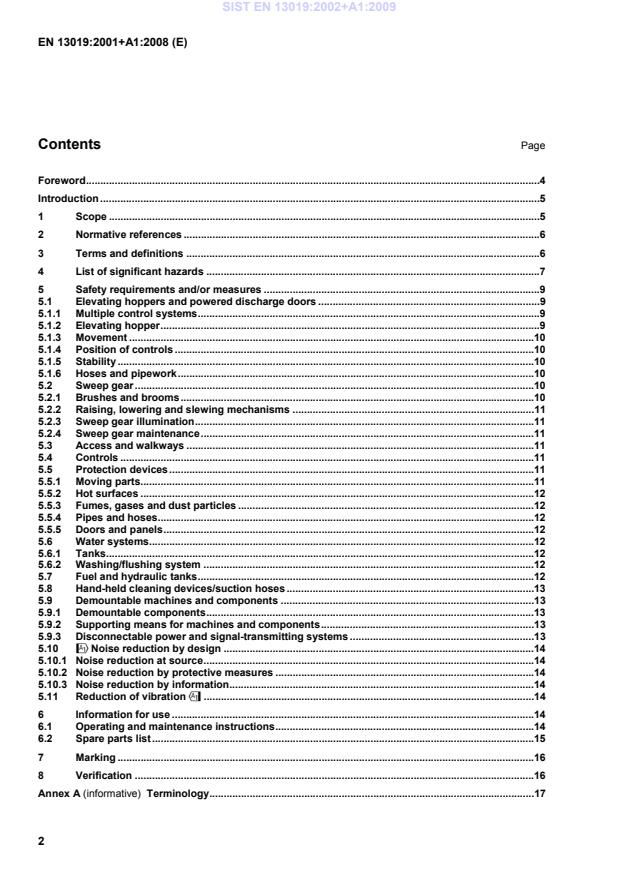
Terminology.17 SIST EN 13019:2002+A1:2009
Hopper safety device.20 Annex ZA (informative)
!Relationship between this European Standard and the Essential Requirements of EU Directive 98/37/EC".21 Annex ZB (informative)
!Relationship between this European Standard and the Essential Requirements of EU Directive 2006/42/EC".22 Bibliography.23
Typical location of hazard Relative Subclauses
1 Mechanical hazards (caused for example by: - shape; - relative location; - mass and stability;
(potential energy of elements) - mass and velocity;
(kinetic energy of elements) - inadequacy of mechanical
strength - accumulation of potential energy by:
- elastic elements (springs), or
- liquids or gases under pressure or
- vacuum
of the machine or parts or workpieces).
1.1 Crushing hazard Under elevating hopper Under hopper door 5.1.2 5.1.3 5.5.5 1.2 Shearing hazard Sweep gear mechanisms 5.2.2 1.3 Entanglement Rotating machinery Sweeping brushes 5.5.1 5.2.1 1.4 Drawing-in or trapping hazard Rotating brushes 5.2.1 1.5 Impact hazard Protruding parts 5.5.5 1.6 Friction or abrasion hazards Sweeping brushes and brooms 5.2.1 1.7 High pressure fluid injection hazard Hydraulic pipes/hoses High pressure washing system 5.1.6 5.5.4 5.6.2 1.8 Ejection of parts (of machinery and processed material/workpieces) Fan systems High pressure jets 5.5.1 b) 5.6.2 1.9
Slip, trip and fall hazards in relationship with machinery (because of their mechanical nature) Access, on or from walkways From climbing on equipment or from access ladders 5.3
2 Thermal hazards resulting in:
Typical location of hazard Relative Subclauses
2.1 Burns and scalds, by a possible contact of persons, by flames or explosions and also by the radiation of heat sources Engine cooling systems Engine exhaust systems 5.5.2 5.5.3 3 Hazards generated by materials and substances processed, used or exhausted by machinery for example:
3.1 Hazards resulting from contact with or inhalation of harmful fluids, gases, mists, fumes and dusts Fumes in cab Dust from brushes and brooms 5.5.3 4 Hazards generated by neglecting ergonomic principles in machine design (mismatch of machinery with human characteristics and abilities) caused for example by:
4.1 Unhealthy postures or excessive efforts
Seats and control devices
Manipulating heavy doors and
access panels
Hand held cleaning devices 5.1.4 5.5.5
5.8 5.9.1 4.2 Inadequate local lighting Within cleaning zones 5.2.3 4.3 Human errors Lifting of the hopper during carrier
vehicle movement 5.1.5 5 Hazards caused by failure of energy supply, breaking down of machinery parts and other functional disorders, for example:
5.1 Failure of energy supply (of drive and/or control circuits) Elevating hopper Demountable machine systems Sweep gear stowage Hopper discharge door 5.1.3 5.9.1 5.2.2 5.2.2 5.1.3 5.2 Unexpected ejection of machine parts or fluids Pipes and hoses Outlet of centrifugal fan Brushes and brooms 5.1.6 5.5.1 b) 5.2.1 5.3 Errors of fitting Safety props Load descent control systems Demountable components Disconnectable systems Hydraulic pipes/hoses 5.1.2 5.2.2 5.9.1 5.9.3 6.1 5.4 Overturn, unexpected loss of machine stability Elevating hopper Demountable components in general 5.1.5 5.9.1 6 Hazards caused by (temporary) missing and/or incorrectly positioned safety related measures/means, for example:
6.1 All kinds of guard Rotating machinery Hot surfaces Fixed guards 5.5.1 5.5.2 5.2.1 SIST EN 13019:2002+A1:2009
Typical location of hazard Relative Subclauses
6.2 Safety signs and signals Rotating machinery Rotating brushes and brooms Elevating hopper
Support legs Disconnectable systems 5.2.1 5.1.1 5.9.2
5.9.1 5.9.3 6.3 Essential equipment and accessories for safe adjusting and/or maintaining
!7 Hazards generated by noise, resulting in:
7.1 Hearing loss (deafness), other physiological disorders (e.g. loss of balance, loss of awareness)
5.10 7.2 Interference with speech communication, acoustic signals, etc.
5.10 8 Hazards generated by vibration
8.1 Whole-body vibration, particularly when combined with poor postures
5.11"
5 Safety requirements and/or measures The machines shall comply with the safety requirements and/or measures of this clause. In addition the machines shall be designed to comply with the terms of !EN ISO 12100" for hazards that are relevant but not significant and therefore are not dealt with in this standard. For the application of the reference standards !EN ISO 13732-1", EN 953, EN 982 and EN 983 which are used in this standard, the manufacturer shall carry out an adequate risk assessment relating to those requirements for which a special safety measure or category is necessary. NOTE This specific risk assessment should be part of the general risk assessment relating to the hazards not covered by this standard. 5.1 Elevating hoppers and powered discharge doors 5.1.1 Multiple control systems Multiple control systems shall be designed so that, only one set of controls can be activated for each function respectively.
5.1.2 Elevating hopper ! a) Elevating equipment shall be constructed or designed so that any unintentional lowering of the hopper, including lowering resulting from power interruption, shall be prevented." SIST EN 13019:2002+A1:2009
...