


FprEN 1993-1-11
(Main)Eurocode 3 - Design of steel structures - Part 1-11: Tension components
Eurocode 3 - Design of steel structures - Part 1-11: Tension components
1.1 Scope of EN 1993-1-11
(1) EN 1993-1-11 provides rules for structural design of tension components made of steel, in addition to other parts of EN 1993, for use in structures made of steel or other materials such as concrete, steel-concrete composite and timber.
(2) EN 1993-1-11 covers the resistance, serviceability and durability of steel tension elements.
(3) The following items/aspects are outside the scope of EN 1993-1-11:
— pre- or post-tensioned systems in accordance with EN 1992-1-1;
— reinforcing steel as part of a concrete structure in accordance with EN 1992-1-1;
— tension components in piling;
— detailed design of terminations.
1.2 Assumptions
(1) Unless specifically stated, EN 1990, EN 1991 and the EN 1993-1 series apply.
(2) The design methods given in EN 1993-1-11 are applicable if:
— execution quality is according to EN 1090-2; and
— the construction materials and products used are as specified in the relevant parts of the EN 1993 series, or in the relevant material and product specifications.
Eurocode 3 - Bemessung und Konstruktion von Stahlbauten - Teil 1-11: Zugglieder
1.1 Anwendungsbereich von EN 1993 1 11
(1) EN 1993 1 11 enthält, ergänzend zu anderen Teilen von EN 1993, Regeln für die Bemessung und Konstruktion von Zuggliedern aus Stahl für die Verwendung in Tragwerken aus Stahl oder anderen Werkstoffen, wie z. B. Stahlbeton, Stahl-Beton-Verbund und Holz.
(2) EN 1993 1 11 behandelt die Tragfähigkeit, Gebrauchstauglichkeit und Dauerhaftigkeit von Zuggliedern aus Stahl.
(3) Die folgenden Punkte/Aspekte fallen nicht in den Anwendungsbereich von EN 1993 1 11:
— vorgespannte Systeme mit oder ohne Verbund nach EN 1992 1 1;
— Betonstahl als Teil eines Betontragwerks nach EN 1992 1 1;
— Zugglieder bei Pfählen und Spundwänden;
— detaillierte Bemessung von Verankerungen.
1.2 Voraussetzungen
(1) Sofern nicht ausdrücklich angegeben, gelten EN 1990, EN 1991 und Normenreihe EN 1993 1.
(2) Die in EN 1993 1 11 angegebenen Bemessungsverfahren sind anwendbar, wenn:
— die Ausführungsqualität EN 1090 2 entspricht; und
— die verwendeten Baustoffe und Produkte den maßgebenden Teilen der Normenreihe EN 1993 oder den maßgebenden Werkstoff- und Produktspezifikationen entsprechen.
Eurocode 3 - Calcul des structures en acier - Partie 1-11 : Eléments tendus
1.1 Domaine d'application de l'EN 1993 1 11
(1) L'EN 1993 1 11 fournit des règles relatives au calcul structural des composants tendus en acier, en complément d'autres parties de l'EN 1993, pour une utilisation dans des structures en acier ou en d'autres matériaux tels que le béton, le bois de construction ou des structures mixtes acier-béton.
(2) L'EN 1993 1 11 couvre la résistance, l'aptitude au service et la durabilité des éléments tendus en acier.
(3) Les éléments/aspects suivants ne relèvent pas du domaine d'application de l'EN 1993 1 11 :
— les systèmes précontraints par pré- ou post-tension conformément à l'EN 1992 1 1;
— les aciers d'armature dans le cadre d'une structure en béton conformément à l'EN 1992 1 1 ;
— les composants tendus des pieux et palplanches ;
— le calcul détaillé des extrémités (terminaisons).
1.2 Hypothèses
(1) Sauf indication contraire, l'EN 1990, l'EN 1991 et la série EN 1993 1 s'appliquent.
(2) Les méthodes de calcul données dans l'EN 1993 1 11 sont applicables si :
— la qualité de l'exécution est conforme à l'EN 1090 2 ; et
— les matériaux et produits de construction utilisés sont tels que spécifiés dans les parties pertinentes de la série EN 1993 ou dans les spécifications de matière et de produit appropriées.
Evrokod 3 - Projektiranje jeklenih konstrukcij - 1-11. del: Natezne komponente
General Information
- Status
- Not Published
- Publication Date
- 17-Mar-2026
- Technical Committee
- CEN/TC 250 - Structural Eurocodes
- Drafting Committee
- CEN/TC 250/SC 3/WG 11 - Evolution of EN 1993-1-11 - Tension components
- Current Stage
- 6055 - CEN Ratification completed (DOR) - Publishing
- Start Date
- 28-Dec-2025
- Due Date
- 28-Sep-2021
- Completion Date
- 28-Dec-2025
Relations
- Effective Date
- 19-Jan-2023
Overview
FprEN 1993-1-11, titled Eurocode 3 - Design of steel structures - Part 1-11: Tension Components, is a key European standard developed by CEN/TC 250 for the structural design of steel tension elements. This standard supplements other parts of EN 1993 and applies to structures made of steel as well as composite materials including concrete, steel-concrete composites, and timber. The document focuses on the resistance, serviceability, and durability requirements for steel tension components while excluding pre- or post-tensioned systems per EN 1992-1-1, piling tension components, reinforcing steel in concrete, and detailed termination design.
Developed as part of the second generation Eurocodes under Mandate M/515, this updated draft replaces EN 1993-1-11:2006 and incorporates modern design principles including partial factor methodology and comprehensive material characterization aligned with EN 1990, EN 1991, and the wider EN 1993 series.
Key Topics
- Scope and Application: Rules for steel tension members in various structures, covering ultimate and serviceability limit states alongside durability demands.
- Material Specifications: Includes classifications for different groups of tension elements-structural steel rods, steel wires, strands-and addresses tensile strength, elasticity, creep, relaxation, and friction properties.
- Design Principles: Introduces limit state design methods, structural reliability concepts, and considerations for loads such as self-weight, wind, ice, thermal effects, fatigue, and accidental component loss.
- Structural Analysis: Guidelines for nonlinear, dynamic, and aerodynamic stability assessments to ensure robust tension member performance under varied conditions.
- Ultimate and Serviceability Limit States: Detailed provisions for strength verification, prevention of slipping in clamps, saddle design, and fatigue resistance.
- Testing and Quality Assurance: Normative annexes outline product and test requirements for tension components, supporting compliance with execution standards like EN 1090-2.
Applications
The standard’s practical value is prominent in engineering design and construction within:
- Steel Structures: Bridges, towers, and industrial frameworks requiring optimized tension elements.
- Composite Structures: Steel elements embedded in composite assemblies such as steel-concrete or timber-steel constructions.
- Infrastructure Projects: Especially those with critical tension load paths requiring fatigue-resistant and durable components.
- Specialized Component Design: Including tension rod systems, cable elements, clamps, and saddles used in structural connections and load transfer mechanisms.
Designers benefit from harmonized rules that ensure safety, durability, and performance, allowing cross-border project compliance across Europe.
Related Standards
- EN 1990: Basis of Structural Design – establishes general principles and requirements.
- EN 1991: Actions on Structures – defines loads such as wind, snow, and imposed actions.
- EN 1992-1-1: Design of Concrete Structures – relevant for excluding pre/post-tensioned concrete systems in this standard.
- EN 1090-2: Execution of Steel Structures – sets quality levels vital for the applicability of EN 1993-1-11 design methods.
- Other parts of the EN 1993 series – complement tension components design with provisions for steel structural elements and connections.
By following FprEN 1993-1-11, structural engineers ensure that steel tension components are designed according to the latest European standards, enhancing safety, reliability, and consistency across structural steel projects. This supports interoperability within the EU market and advances state-of-the-art engineering practices.

Frequently Asked Questions
FprEN 1993-1-11 is a draft published by the European Committee for Standardization (CEN). Its full title is "Eurocode 3 - Design of steel structures - Part 1-11: Tension components". This standard covers: 1.1 Scope of EN 1993-1-11 (1) EN 1993-1-11 provides rules for structural design of tension components made of steel, in addition to other parts of EN 1993, for use in structures made of steel or other materials such as concrete, steel-concrete composite and timber. (2) EN 1993-1-11 covers the resistance, serviceability and durability of steel tension elements. (3) The following items/aspects are outside the scope of EN 1993-1-11: — pre- or post-tensioned systems in accordance with EN 1992-1-1; — reinforcing steel as part of a concrete structure in accordance with EN 1992-1-1; — tension components in piling; — detailed design of terminations. 1.2 Assumptions (1) Unless specifically stated, EN 1990, EN 1991 and the EN 1993-1 series apply. (2) The design methods given in EN 1993-1-11 are applicable if: — execution quality is according to EN 1090-2; and — the construction materials and products used are as specified in the relevant parts of the EN 1993 series, or in the relevant material and product specifications.
1.1 Scope of EN 1993-1-11 (1) EN 1993-1-11 provides rules for structural design of tension components made of steel, in addition to other parts of EN 1993, for use in structures made of steel or other materials such as concrete, steel-concrete composite and timber. (2) EN 1993-1-11 covers the resistance, serviceability and durability of steel tension elements. (3) The following items/aspects are outside the scope of EN 1993-1-11: — pre- or post-tensioned systems in accordance with EN 1992-1-1; — reinforcing steel as part of a concrete structure in accordance with EN 1992-1-1; — tension components in piling; — detailed design of terminations. 1.2 Assumptions (1) Unless specifically stated, EN 1990, EN 1991 and the EN 1993-1 series apply. (2) The design methods given in EN 1993-1-11 are applicable if: — execution quality is according to EN 1090-2; and — the construction materials and products used are as specified in the relevant parts of the EN 1993 series, or in the relevant material and product specifications.
FprEN 1993-1-11 is classified under the following ICS (International Classification for Standards) categories: 91.010.30 - Technical aspects; 91.080.13 - Steel structures; 93.040 - Bridge construction. The ICS classification helps identify the subject area and facilitates finding related standards.
FprEN 1993-1-11 has the following relationships with other standards: It is inter standard links to EN 1993-1-11:2006. Understanding these relationships helps ensure you are using the most current and applicable version of the standard.
FprEN 1993-1-11 is associated with the following European legislation: EU Directives/Regulations: 305/2011; Standardization Mandates: M/515. When a standard is cited in the Official Journal of the European Union, products manufactured in conformity with it benefit from a presumption of conformity with the essential requirements of the corresponding EU directive or regulation.
You can purchase FprEN 1993-1-11 directly from iTeh Standards. The document is available in PDF format and is delivered instantly after payment. Add the standard to your cart and complete the secure checkout process. iTeh Standards is an authorized distributor of CEN standards.
Standards Content (Sample)
SLOVENSKI STANDARD
oSIST prEN 1993-1-11:2024
01-junij-2024
Nadomešča:
SIST EN 1993-1-11:2007
Evrokod 3 - Projektiranje jeklenih konstrukcij - 1-11. del: Natezne komponente
Eurocode 3 - Design of steel structures - Part 1-11: Tension components
Eurocode 3 - Bemessung und Konstruktion von Stahlbauten - Teil 1-11: Zugglieder
Eurocode 3 - Calcul des structures en acier - Partie 1-11 : Eléments tendus
Ta slovenski standard je istoveten z: prEN 1993-1-11
ICS:
91.010.30 Tehnični vidiki Technical aspects
91.080.13 Jeklene konstrukcije Steel structures
93.040 Gradnja mostov Bridge construction
oSIST prEN 1993-1-11:2024 en,fr,de
2003-01.Slovenski inštitut za standardizacijo. Razmnoževanje celote ali delov tega standarda ni dovoljeno.
oSIST prEN 1993-1-11:2024
oSIST prEN 1993-1-11:2024
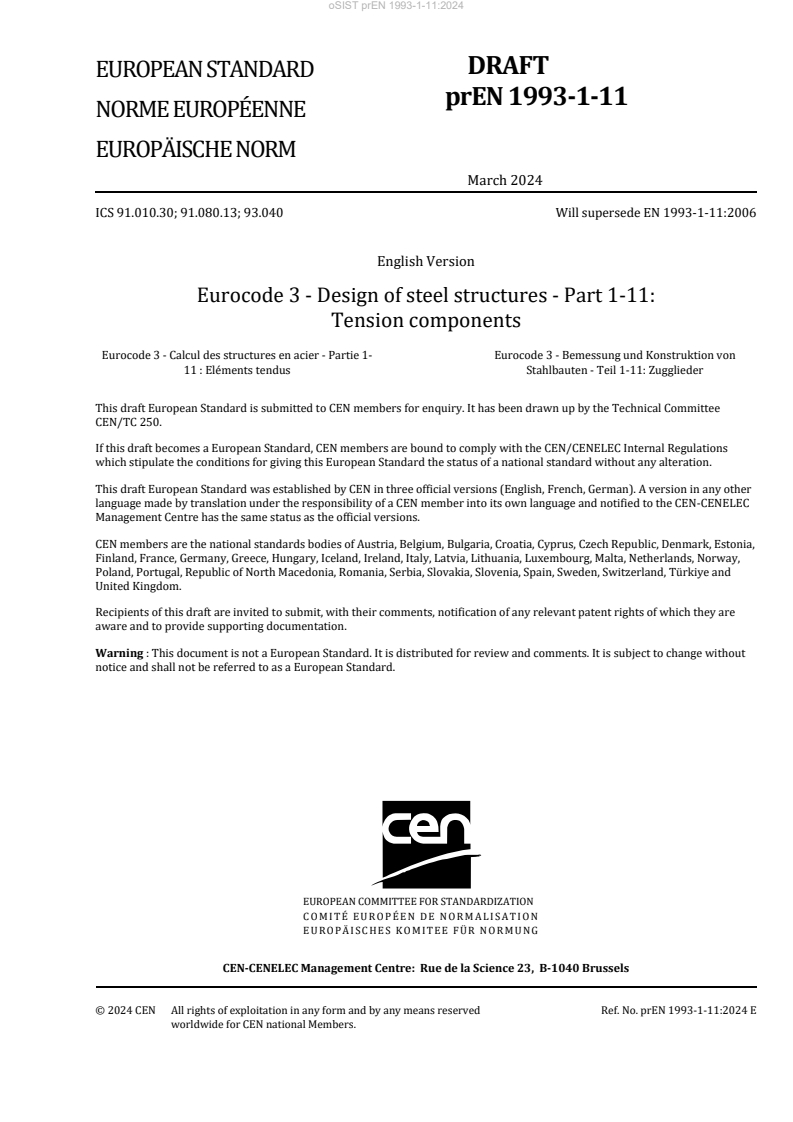
DRAFT
EUROPEAN STANDARD
prEN 1993-1-11
NORME EUROPÉENNE
EUROPÄISCHE NORM
March 2024
ICS 91.010.30; 91.080.13; 93.040 Will supersede EN 1993-1-11:2006
English Version
Eurocode 3 - Design of steel structures - Part 1-11:
Tension components
Eurocode 3 - Calcul des structures en acier - Partie 1- Eurocode 3 - Bemessung und Konstruktion von
11 : Eléments tendus Stahlbauten - Teil 1-11: Zugglieder
This draft European Standard is submitted to CEN members for enquiry. It has been drawn up by the Technical Committee
CEN/TC 250.
If this draft becomes a European Standard, CEN members are bound to comply with the CEN/CENELEC Internal Regulations
which stipulate the conditions for giving this European Standard the status of a national standard without any alteration.
This draft European Standard was established by CEN in three official versions (English, French, German). A version in any other
language made by translation under the responsibility of a CEN member into its own language and notified to the CEN-CENELEC
Management Centre has the same status as the official versions.
CEN members are the national standards bodies of Austria, Belgium, Bulgaria, Croatia, Cyprus, Czech Republic, Denmark, Estonia,
Finland, France, Germany, Greece, Hungary, Iceland, Ireland, Italy, Latvia, Lithuania, Luxembourg, Malta, Netherlands, Norway,
Poland, Portugal, Republic of North Macedonia, Romania, Serbia, Slovakia, Slovenia, Spain, Sweden, Switzerland, Türkiye and
United Kingdom.
Recipients of this draft are invited to submit, with their comments, notification of any relevant patent rights of which they are
aware and to provide supporting documentation.
Warning : This document is not a European Standard. It is distributed for review and comments. It is subject to change without
notice and shall not be referred to as a European Standard.
EUROPEAN COMMITTEE FOR STANDARDIZATION
COMITÉ EUROPÉEN DE NORMALISATION
EUROPÄISCHES KOMITEE FÜR NORMUNG
CEN-CENELEC Management Centre: Rue de la Science 23, B-1040 Brussels
© 2024 CEN All rights of exploitation in any form and by any means reserved Ref. No. prEN 1993-1-11:2024 E
worldwide for CEN national Members.
oSIST prEN 1993-1-11:2024
prEN 1993-1-11:2024 (E)
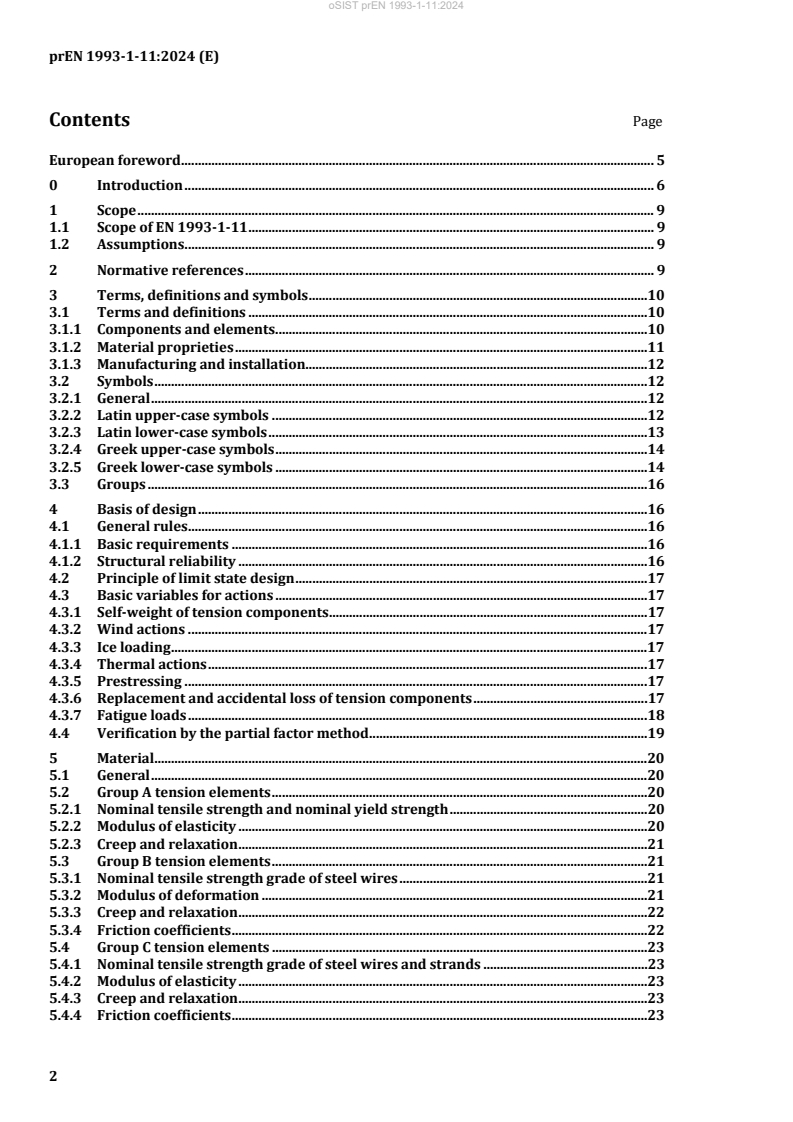
Contents Page
European foreword . 5
0 Introduction . 6
1 Scope . 9
1.1 Scope of EN 1993-1-11 . 9
1.2 Assumptions . 9
2 Normative references . 9
3 Terms, definitions and symbols .10
3.1 Terms and definitions .10
3.1.1 Components and elements .10
3.1.2 Material proprieties .11
3.1.3 Manufacturing and installation.12
3.2 Symbols .12
3.2.1 General .12
3.2.2 Latin upper-case symbols .12
3.2.3 Latin lower-case symbols .13
3.2.4 Greek upper-case symbols .14
3.2.5 Greek lower-case symbols .14
3.3 Groups .16
4 Basis of design .16
4.1 General rules .16
4.1.1 Basic requirements .16
4.1.2 Structural reliability .16
4.2 Principle of limit state design .17
4.3 Basic variables for actions .17
4.3.1 Self-weight of tension components .17
4.3.2 Wind actions .17
4.3.3 Ice loading .17
4.3.4 Thermal actions .17
4.3.5 Prestressing .17
4.3.6 Replacement and accidental loss of tension components .17
4.3.7 Fatigue loads .18
4.4 Verification by the partial factor method .19
5 Material .20
5.1 General .20
5.2 Group A tension elements .20
5.2.1 Nominal tensile strength and nominal yield strength .20
5.2.2 Modulus of elasticity .20
5.2.3 Creep and relaxation .21
5.3 Group B tension elements .21
5.3.1 Nominal tensile strength grade of steel wires .21
5.3.2 Modulus of deformation .21
5.3.3 Creep and relaxation .22
5.3.4 Friction coefficients .22
5.4 Group C tension elements .23
5.4.1 Nominal tensile strength grade of steel wires and strands .23
5.4.2 Modulus of elasticity .23
5.4.3 Creep and relaxation .23
5.4.4 Friction coefficients .23
oSIST prEN 1993-1-11:2024
prEN 1993-1-11:2024 (E)
6 Durability . 24
7 Structural analysis . 24
7.1 General . 24
7.2 Nonlinear effects from deformations . 24
7.3 Nonlinear analysis . 25
7.4 Dynamic analysis . 25
7.5 Aerodynamic instability . 26
8 Ultimate limit states . 26
8.1 General . 26
8.2 Group A tension components . 27
8.2.1 Tension rod system made of structural steel or stainless steel. 27
8.2.2 Tension rod system made of concrete reinforcement steel or prestressing steel . 27
8.3 Group B tension components . 28
8.4 Group C tension components . 29
8.5 Saddles . 30
8.5.1 General . 30
8.5.2 Group B tension components . 30
8.5.3 Group C tension components . 32
8.6 Clamps . 36
8.6.1 General . 36
8.6.2 Prevention of slipping of clamps . 36
8.6.3 Transverse pressure. 40
9 Serviceability limit states . 40
10 Fatigue . 40
10.1 General . 40
10.2 Terminations . 40
10.3 Tension elements . 40
11 Testing . 43
Annex A (normative) Product and test requirements for tension components . 44
A.1 Use of this annex . 44
A.2 Scope and field of application . 44
A.3 Group A tension components . 44
A.4 Group B tension components . 47
A.5 Group C tension components . 53
Annex B (informative) Glossary . 63
B.1 Use of this annex . 63
B.2 Scope and field of application . 63
B.3 Group A tension components . 64
B.4 Group B tension components . 68
B.5 Group C tension components . 72
B.6 Group D parallel wire tension components for suspended structures . 75
Annex C (normative) Additional rules for Group D parallel wire tension components for
suspended structures . 77
C.1 Use of this annex . 77
oSIST prEN 1993-1-11:2024
prEN 1993-1-11:2024 (E)
C.2 Scope and field of application .77
C.3 Materials .77
C.4 Ultimate limit states .78
Bibliography .83
oSIST prEN 1993-1-11:2024
prEN 1993-1-11:2024 (E)
European foreword
This document (prEN 1993-1-11:2024) has been prepared by Technical Committee CEN/TC 250
“Structural Eurocodes”, the secretariat of which is held by BSI. CEN/TC 250 is responsible for all
Structural Eurocodes and has been assigned responsibility for structural and geotechnical design matters
by CEN.
This document is currently submitted to the CEN Enquiry.
This document will supersede EN 1993-1-11:2006 and its corrigenda.
The first generation of EN Eurocodes was published between 2002 and 2007. This document forms part
of the second generation of the Eurocodes, which have been prepared under Mandate M/515 issued to
CEN by the European Commission and the European Free Trade Association.
The Eurocodes have been drafted to be used in conjunction with relevant execution, material, product
and test standards, and to identify requirements for execution, materials, products and testing that are
relied upon by the Eurocodes.
The Eurocodes recognize the responsibility of each Member State and have safeguarded their right to
determine values related to regulatory safety matters at national level through the use of National
Annexes.
oSIST prEN 1993-1-11:2024
prEN 1993-1-11:2024 (E)
0 Introduction
0.1 Introduction to the Eurocodes
The Structural Eurocodes comprise the following standards generally consisting of a number of Parts:
— EN 1990 Eurocode — Basis of structural and geotechnical design
— EN 1991 Eurocode 1 — Actions on structures
— EN 1992 Eurocode 2 — Design of concrete structures
— EN 1993 Eurocode 3 — Design of steel structures
— EN 1994 Eurocode 4 — Design of composite steel and concrete structures
— EN 1995 Eurocode 5 — Design of timber structures
— EN 1996 Eurocode 6 — Design of masonry structures
— EN 1997 Eurocode 7 — Geotechnical design
— EN 1998 Eurocode 8 — Design of structures for earthquake resistance
— EN 1999 Eurocode 9 — Design of aluminium structures
— New parts are under development, e.g. Eurocode for design of structural glass
The Eurocodes are intended for use by designers, clients, manufacturers, constructors, relevant
authorities (in exercising their duties in accordance with national or international regulations),
educators, software developers, and committees drafting standards for related product, testing and
execution standards.
NOTE Some aspects of design are most appropriately specified by relevant authorities or, where not specified,
can be agreed on a project-specific basis between relevant parties such as designers and clients. The Eurocodes
identify such aspects making explicit reference to relevant authorities and relevant parties.
0.2 Introduction to the EN 1993 series
(1) The EN 1993 series applies to the design of buildings and civil engineering works in steel. It complies
with the principles and requirements for the safety and serviceability of structures, the basis of their
design and verification that are given in EN 1990 Eurocode — Basis of structural and geotechnical design.
(2) The EN 1993 series is concerned only with requirements for resistance, serviceability, durability and
fire resistance of steel structures. Other requirements, e.g. concerning thermal or sound insulation, are
not covered.
(3) The EN 1993 series is subdivided in various parts:
EN 1993-1, Design of Steel Structures — Part 1: General rules and rules for buildings;
EN 1993-2, Design of Steel Structures — Part 2: Bridges;
EN 1993-3, Design of Steel Structures — Part 3: Towers, masts and chimneys;
EN 1993-4, Design of Steel Structures — Part 4: Silos and tanks;
EN 1993-5, Design of Steel Structures — Part 5: Piling;
oSIST prEN 1993-1-11:2024
prEN 1993-1-11:2024 (E)
EN 1993-6, Design of Steel Structures — Part 6: Crane supporting structures;
EN 1993-7, Design of steel structures — Part 7: Sandwich panels.
(4) EN 1993-1 in itself does not exist as a physical document, but comprises the following 14 separate
parts, the basic part being EN 1993-1-1:
EN 1993-1-1, Design of Steel Structures — Part 1-1: General rules and rules for buildings;
EN 1993-1-2, Design of Steel Structures — Part 1-2: Structural fire design;
EN 1993-1-3, Design of Steel Structures — Part 1-3: Cold-formed members and sheeting;
NOTE Cold formed hollow sections supplied according to EN 10219 are covered in EN 1993-1-1.
EN 1993-1-4, Design of Steel Structures — Part 1-4: Stainless steel structures;
EN 1993-1-5, Design of Steel Structures — Part 1-5: Plated structural elements;
EN 1993-1-6, Design of Steel Structures — Part 1-6: Strength and stability of shell structures;
EN 1993-1-7, Design of Steel Structures — Part 1-7: Plate assemblies with elements under transverse loads
EN 1993-1-8, Design of Steel Structures — Part 1-8: Joints;
EN 1993-1-9, Design of Steel Structures — Part 1-9: Fatigue;
EN 1993-1-10, Design of Steel Structures — Part 1-10: Material toughness and through-thickness
properties;
EN 1993-1-11, Design of Steel Structures — Part 1-11: Tension components;
EN 1993-1-12, Design of Steel Structures — Part 1-12: Additional rules for steel grades up to S960;
EN 1993-1-13, Design of Steel Structures — Part 1-13: Beams with large web openings;
EN 1993-1-14, Design of Steel Structures — Part 1-14: Design assisted by finite element analysis.
(5) All subsequent parts EN 1993-1-2 to EN 1993-1-14 treat general topics that are independent from
the structural type like structural fire design, cold-formed members and sheeting, stainless steels, plated
structural elements, etc.
(6) All subsequent parts numbered EN 1993-2 to EN 1993-7 treat topics relevant for a specific structural
type like steel bridges, towers, masts and chimneys, silos and tanks, piling, crane supporting structures,
etc. EN 1993-2 to EN 1993-7 refer to the generic rules in EN 1993-1 and supplement them.
0.3 Introduction to EN 1993-1-11
EN 1993-1-11 provides rules for structural design of tension components made of steel, in addition to
other parts of EN 1993, for use in structures made of steel or other materials as e.g. concrete, steel-
concrete composite and timber.
EN 1993-1-11 is intended for use by:
— committees drafting design related products, testing and execution standards,
— clients (e.g. for the formulation of their specific requirements),
— designers and constructors,
— relevant authorities.
Numerical values for partial factors and other reliability parameters are recommended as basic values
that provide an acceptable level of reliability. They have been selected assuming that an appropriate level
of workmanship and quality management applies.
oSIST prEN 1993-1-11:2024
prEN 1993-1-11:2024 (E)
0.4 Verbal forms used in the Eurocodes
The verb “shall” expresses a requirement strictly to be followed and from which no deviation is permitted
in order to comply with the Eurocodes.
The verb “should” expresses a highly recommended choice or course of action. Subject to national
regulation and/or any relevant contractual provisions, alternative approaches could be used/adopted
where technically justified.
The verb “may” expresses a course of action permissible within the limits of the Eurocodes.
The verb “can” expresses possibility and capability; it is used for statements of fact and clarification of
concepts.
0.5 National annex for EN 1993-1-11
National choice is allowed in this standard where explicitly stated within notes. National choice includes
the selection of values for Nationally Determined Parameters (NDPs).
The national standard implementing EN 1993-1-11 can have a National Annex containing all national
choices to be used for the design of buildings and civil engineering works to be constructed in the relevant
country.
When no national choice is given, the default choice given in this standard is to be used.
When no national choice is made and no default is given in this standard, the choice can be specified by a
relevant authority or, where not specified, agreed for a specific project by appropriate parties.
National choice is allowed in EN 1993-1-11 through notes to the following clauses:
4.3.6(1) 4.3.6(3) 4.4(3) 5.2.1(2)
5.3.1(2) 5.4.1(2) 8.2.2(1) 8.3(1)
8.4(1) 8.5.2.2(1) 8.5.3.2(1) 8.6.2(1)
10.3(1) 11(1) C.3.1(1) C.4.2(1)
C.4.3.2(1) C.4.4.1 (1)
National choice is allowed in EN 1993-1-11 on the application of the following informative annex:
Annex B
The National Annex can contain, directly or by reference, non-contradictory complementary information
for ease of implementation, provided it does not alter any provisions of the Eurocodes.
oSIST prEN 1993-1-11:2024
prEN 1993-1-11:2024 (E)
1 Scope
1.1 Scope of EN 1993-1-11
(1) EN 1993-1-11 provides rules for structural design of tension components made of steel, in addition
to other parts of EN 1993, for use in structures made of steel or other materials such as concrete, steel-
concrete composite and timber.
(2) EN 1993-1-11 covers the resistance, serviceability and durability of steel tension elements.
(3) The following items/aspects are outside the scope of EN 1993-1-11:
— pre- or post-tensioned systems in accordance with EN 1992-1-1 and EN 1992-2;
— reinforcing steel as part of a concrete structure in accordance with EN 1992-1-1;
— tension components in piling;
— detailed design of terminations.
1.2 Assumptions
(1) Unless specifically stated, EN 1990, EN 1991 and the EN 1993-1 series apply.
(2) The design methods given in EN 1993-1-11 are applicable if:
— execution quality is according to EN 1090-2; and
— the construction materials and products used are as specified in the relevant parts of the EN 1993
series, or in the relevant material and product specifications.
(3) EN 1993-1-11 is used in conjunction with ENs, EADs and ETAs for tension components.
2 Normative references
The following documents are referred to in the text in such a way that some or all of their content
constitutes requirements of this document. For dated references, only the edition cited applies. For
undated references, the latest edition of the referenced document (including any amendments) applies.
NOTE See the Bibliography for a list of other documents cited that are not normative references, including
those referenced as recommendations (i.e. in ‘should’ clauses), permissions (i.e. through ‘may’ clauses), possibilities
(‘can’ clauses), and in notes.
EN 1090-2, Execution of steel structures and aluminium structures — Part 2: Technical requirements for
steel structures
EN 1990:2023, Eurocode — Basis of structural and geotechnical design
EN 1991 (all parts), Eurocode 1 — Actions on structures
EN 1993 (all parts), Eurocode 3 — Design of steel structures
As impacted by EN 1990:2023/prA1:2024
oSIST prEN 1993-1-11:2024
prEN 1993-1-11:2024 (E)
3 Terms, definitions and symbols
3.1 Terms and definitions
For the purposes of this document, the following terms and definitions apply.
3.1.1 Components and elements
3.1.1.1
tension component
tension element with terminations including accessories if applicable (e.g. corrosion protection,
guiding, .)
3.1.1.2
tension element
component to transfer tensile forces from one termination to the other
3.1.1.3
termination
component to transfer tensile forces from the tension element into the structure or into axially connected
tension elements
3.1.1.4
rod
circular solid rods made of structural steel, stainless steel, concrete reinforcement steel or prestressing
steel
3.1.1.5
wire
product manufactured by cold working of wire rod that is in a suitable metallurgical condition for cold
working
3.1.1.6
strand
product made of an assembly of wires of appropriate shape and dimensions laid helically in the same or
opposite direction in one or more layers around a centre wire
3.1.1.7
7-wire strand
product consisting of six cold drawn wires laid helically in the same direction and with the same lay length
around a centre wire
3.1.1.8
spiral rope
product made of a minimum of two layers of wires laid helically around a centre wire
3.1.1.9
spiral strand rope
product comprising only round wires
3.1.1.10
stranded rope
product made of several strands laid helically in one or more layers around a core (single layer rope) or
centre (rotation-resistant or parallel-closed rope)
oSIST prEN 1993-1-11:2024
prEN 1993-1-11:2024 (E)
3.1.1.11
full-locked coil rope
product made of a core wire and of one or several layers of round wires stranded on top of this round
wire core and one or several layers of shaped wires in alternating direction
3.1.1.12
parallel wire system
PWS
product made of a bundle of parallel prestressing wires with terminations
3.1.1.13
parallel strand system
PSS
product made of a bundle of parallel 7-wire strands with terminations
3.1.1.14
prefabricated parallel wire strands
PPWS
products made of a bundle of parallel high strength steel wires with terminations at both ends
Note 1 to entry: The parallel wires in each PPWS are usually assembled in a hexagonal shape by means of special
bands. Several PPWSs are usually assembled and compacted to form a circular cable which is wrapped with a mild
steel wire.
3.1.1.15
air spun bundles
tension elements made from arial spinning of parallel high strength wire
Note 1 to entry: Several bundles are usually compacted to a circular shape and wrapped by a mild steel wire.
3.1.1.16
saddle
support between a continuous tension element and the structure, transferring deviation forces
3.1.1.17
clamp
part that transfers the load from a secondary tension component to a continuous tension element
3.1.2 Material proprieties
3.1.2.1
modulus of deformation
equivalent material property resulting from the axial deformation property of tension elements that can
be a combination of the wire modulus and geometric assembly of the wires if arranged in helixes
3.1.2.2
creep
time-dependant elongation (strain) of tension elements under permanent constant stress
3.1.2.3
relaxation
time-dependant reduction of stress in tension elements under fixed strain
oSIST prEN 1993-1-11:2024
prEN 1993-1-11:2024 (E)
3.1.3 Manufacturing and installation
3.1.3.1
pre-stretching
several load cycles that are applied to a spiral rope as part of the manufacturing process
Note 1 to entry: Pre-stretching removes initial permanent elongation and makes the rope perform linear elastic.
3.1.3.2
prestressing
process of initial tensioning of a tension component by applying a controlled deformation or a controlled
force
3.2 Symbols
3.2.1 General
(1) For the purposes of this document, the following symbols apply.
3.2.2 Latin upper-case symbols
A nominal metallic cross-section of the tension element
m
E modulus of elasticity of steel used in the tension component
design value of the effect of the action with all tension components intact
E
d1
design value of the effect of the action with the relevant tension components removed
E
d2
design value of the effect of the accidental loss of the tension component(s)
E
d
E modulus of deformation of group B tension element
Q
effective modulus of elasticity of the tension component
E
t
F calculated minimum breaking force of the tension element
c.min
design value of the tension element axial force
F
Ed
component of external design load parallel to the tension element
F
Ed
component of the external design load perpendicular to the continuous tension element
F
Ed⊥
F friction force measured in a clamp slippage test
frict
F characteristic value of maximal tensile strength for prestressing steel
m
F characteristic value of the strength for 0,1 % strain of prestressing steel
p0,1
Fp,C preloading force for a bolt
design value of the tension element resistance
F
Rd
clamping force
F
r
initial clamping force, and equal to the initial preloading force in the bolts, summed over all bolts
F
ri
slip resistant force measured in a slippage clamp test
F
r||
F characteristic value of the tension element breaking force
uk
oSIST prEN 1993-1-11:2024
prEN 1993-1-11:2024 (E)
F characteristic value of the tension element yield strength
yk
L total arc length of the saddle
L arc length of the saddle between the two theoretical tangent points of the tension element under
the most unfavourable characteristic combination of actions and the catenary effects
contact length of the clamp
L
clamp
horizontal projection length of the tension component between terminations
L
h
N
number of stress cycles during the design service life
*
reference value of the number of stress cycles for fatigue resistance ∆σ*
N
design value of the applied number of cycles
N
Ed
P bound perimeter
P characteristic value of the prestressing force
k
R radius of curvature of the tension element inside the saddle
R minimum radius of curvature of the saddle of group C tension component
min
3.2.3 Latin lower-case symbols
d nominal diameter of the rope, single wire, or strand
′ contact width of the rope
d
bond strength in the ultimate limit state between strands and grout or between grout and saddle
f
bpd
tube
design tensile strength of the grout
f
ctd
f characteristic tensile strength of prestressing steel
pk
f characteristic value of tensile strength of reinforcement steel
t
f characteristic value of the tensile strength of steel wires or (prestressing) strands
uk
f characteristic value of 0,2 %-yield strength of reinforcement steel
yk
number of individual wires or strands passing in the saddle
n
w
number of bolts of a clamp
n
b
number of activated surfaces for shear transfer
n
s
number of strand’s layers of a type 2 saddle of group C tension component
n sl
k factor to account the dynamic effect of an accidental loss of a tension component(s)
slopes of fatigue resistance curve
m ,
m
bending factor to consider measures to minimize bending stresses of the tension element at the
k
b
termination
oSIST prEN 1993-1-11:2024
prEN 1993-1-11:2024 (E)
clamping force coefficient to account for the relationship between the bolt force and the integral
k
c,s
contact pressure between clamp and the tension element, for each surface
loss factor for the termination
k
e
external load coefficient
k
ef,s
consequence factor applicable to actions for reliability differentiation
k
F
phase factor to consider the design situation for group B tension components
k
p,B
phase factor to consider the design situation for group C tension components
k
pC,
bolt force reduction coefficient due to long term effects
k
r
transverse pressure due to the clamping force
q
Ed
limiting value of the transverse pressure for clamps and saddles
q
lim
radius of the saddle at the contact surface with the tension element
r
rounding radius at the saddle ends
r
w unit weight of the tension component
3.2.4 Greek upper-case symbols
additional action effect due to the accidental loss of the tension component(s)
∆E
d
∆L additional arc length of the saddle
∆α
imposed tension element rotations of the test specimen
∆σ stress range
∆σ* reference value of the fatigue resistance at N* cycles
∆σ reference value of the fatigue resistance at N = 2 million stress cycles (detail category)
C C
design value of the applied stress range according to EN 1993-1-9
∆σ
Ed
∆σt axial stress range of the test specimen
ΔT Temperature variation of the test specimen
3.2.5 Greek lower-case symbols
α arc angle in radians between theoretical tangent points (deviation angle) of the tension element
passing over the saddle
γE Partial factor applied to the effects of actions accounting for the uncertainties covered by γf and
γ
Rd
γ Partial factor for actions, accounting for the uncertainties covered by γ and γ
F f Rd
γ partial factor for permanent actions
G
γ partial factor for a permanent action that produces favourable effects
G,fav
γ partial factor for fatigue resistance
Mf
oSIST prEN 1993-1-11:2024
prEN 1993-1-11:2024 (E)
partial factor for friction between group B tension element and the saddle resulting from the
γ
M,,fr B1
deviation force of the tension element
partial factor for friction between group B tension element and a clamp or saddle resulting from
γ
M,,fr B2
the clamping force
partial factor for friction between group B tension element and a clamp resulting from the
γ
M,,fr B3
component of the external design load perpendicular to the continuous tension element
partial factor for friction between group B tension element and a clamp resulting from the
γ
M,,fr B4
clamping force
partial factor for friction between group C tension element and the saddle resulting from the
γ
M,,fr C1
deviation force of the tension element
partial factor for friction between group D tension element and the saddle resulting from the
γ
M,,fr D1
deviation force of the tension element
partial factor for friction between group D tension element and a clamp resulting from the
γ
M,,fr D3
component of the external design load perpendicular to the continuous tension element
partial factor for friction between group D tension element and a clamp resulting from the
γ
M,,fr D4
clamping force
partial factor for group A tension elements
γ
Mt,A
partial factor for group B tension elements
γ
Mt,B
partial factor for group C tension elements
γ
Mt,C
partial factor for group D tension elements
γ
Mt,D
partial factor for prestressing actions of the tension component
γ
PT
partial factor for prestressing actions of the tension component that produces favourable
γ
PT,fav
effects
partial factor for reinforcing or prestressing steel
γ
s
µ friction coefficient
coefficient that takes into account the type of tendon and the bond situation at the saddle
η
p2
σ stress in the tension component
σ constant axial stress of the test specimen
cst
σ maximum axial stress of the test specimen
max
σ minimum axial stress of the test specimen
min
σ maximum stress as a function of the fatigue detail category
sup,Cd
σ maximal stress caused by the frequent combinations of actions
sup,Ed
σ characteristic value of the breaking strength of the steel used in the tension element
u,k
oSIST prEN 1993-1-11:2024
prEN 1993-1-11:2024 (E)
3.3 Groups
(1) Tension components are classified into groups A, B and C according to Table 3.1.
Table 3.1 — Groups of tension components
Group Tension element Tension component
tension rod system made of structural
steel or stainless steel
tension rod system made of concrete
A rod
reinforcement steel
tension rod system made of prestressing
steel
rope made of circular wire spiral strand rope with terminations
rope made of circular wire and stranded wire stranded rope (type IWRC or WSC) with
B
terminations
rope made of circular and Z-shaped wires full-locked coil rope with terminations
bundle made of circular prestressing wires parallel wire system (PWS)
C
bundle made of 7-wire prestressing strands parallel strand system (PSS)
NOTE 1 In addition, Group D tension components are defined in Annex C – Parallel wire tension components for
suspended structures.
NOTE 2 Examples of tension components for groups A, B, C and D are illustrated in Annex B.
(2) For the design of Group D, parallel wires tension components for suspended structures (i.e. for
suspension bridges and other suspended structures), use the additional provisions in Annex C
(normative).
(3) For hangers of tied-arch bridges using rod tension elements, the rules from prEN 1993-2:2024,
Annex A should additionally apply.
4 Basis of design
4.1 General rules
4.1.1 Basic requirements
(1) The design of tension components shall be in accordance with the general rules given in
EN 1990:2023 and the EN 1991 series and the specific design provisions for steel structures given in the
other relevant parts of the EN 1993-1 series.
(2) Tension components designed according to this document shall be executed according to EN 1090-2.
(3) Tension components designed according to this document shall comprise construction materials and
products used as specified in the relevant parts of EN 1993, or in the relevant material and product
specifications.
4.1.2 Structural reliability
(1) The rules in EN 1993-1-1 apply.
oSIST prEN 1993-1-11:2024
prEN 1993-1-11:2024 (E)
4.2 Principle of limit state design
(1) The following limit states shall be considered in designing tension components:
1) Ultimate Limit States (ULS): Applied axial loads shall not exceed the design tension resistance in
accordance with Clause 8.
Fatigue stress ranges from axial load shall not exceed the limiting values in accordance with
Clause 10.
Effects from transverse loads shall be addressed by adequate structural details in accordance with
Clause 8 and Clause 10.
2) Serviceability Limit States (SLS): Stress levels and deflection in the tension component shall be in
accordance with Clause 9.
4.3 Basic variables for actions
4.3.1 Self-weight of tension components
(1) The characteristic value of the self-weight of tension components should be determined from their
geometry and the density of the materials, including corrosion protection system and casing if applicable.
(2) For tension elements of group B data for self-weight may be in accordance with EN 12385-2,
EN 12385-4 and EN 12385-10.
4.3.2 Wind actions
(1) The wind effects should include:
— the static effects of wind drag on the tension component in accordance with EN 1991-1-4, including
deflections and bending effects near the ends of the tension component,
— aerodynamic and other excitation causing possible oscillation of the tension components in
accordance with 7.4 and 7.5 and EN 1991-1-4.
4.3.3 Ice loading
(1) The ice loading should be in accordance with EN 1991-1-9.
4.3.4 Thermal actions
(1) The thermal actions in accordance with EN 1991-1-5 should include temperature changes and the
effects of differential temperatures between the tension components and the structure.
4.3.5 Prestressing
(1) Prestressing of a tension component should be performed either by applying a controlled
deformation or a controlled force.
(2) The design value of prestress may be based on the characteristic value of the prestressing force, P , in
k
accordance with EN 1990:2023, 6.1.3.
4.3.6 Replacement and accidental loss of tension components
(1) Wh
...
Le document intitulé "FprEN 1993-1-11" présente un aperçu exhaustif et précis des normes Eurocode 3 concernant la conception des structures en acier, spécifiquement pour les composants en tension. Cette norme, essentielle pour l'ingénierie structurelle, garantit que les éléments en tension, qu'ils soient en acier ou composés d'autres matériaux, répondent à des exigences de résistance, de serviceabilité et de durabilité. Parmi les forces de la norme EN 1993-1-11, on note son approche systématique en présentant des règles claires qui s'appliquent à une large gamme de structures. En effet, cette norme couvre non seulement les exigences spécifiques pour les composants en tension en acier, mais elle établit également des connexions avec les documents normatifs pertinents tels que EN 1990 et EN 1991, assurant ainsi une intégration harmonieuse au sein du cadre normatif global. La norme précise également les conditions préalables à son application. En stipulant que les méthodes de conception présentées ne s’appliquent que lorsque la qualité d'exécution est conforme à EN 1090-2, elle garantit que les matériaux et produits utilisés soient conformes aux spécifications pertinentes, renforçant ainsi la fiabilité de l'ensemble du processus de conception. Un autre aspect significatif est que la norme EN 1993-1-11 s'intègre de manière coordonnée avec d'autres normes, les EAD et les ETA, permettant ainsi une utilisation optimale dans le contexte de la conception de composants en tension. Toutefois, il est important de noter que certains éléments, tels que les systèmes préalablement ou post-tensionnés et la conception détaillée des terminaisons, sont explicitement exclus du champ d'application de cette norme. Cette précision renforce la focalisation de la norme sur les composants en tension en acier sans dispersion dans d’autres domaines, permettant ainsi aux ingénieurs de se concentrer sur les exigences spécifiques de leur conception. En somme, la norme FprEN 1993-1-11 constitue un outil crucial pour les professionnels de l'ingénierie structurelle, en garantissant non seulement la sécurité et la performance des composants en tension, mais aussi en affirmant son rôle déterminant dans la conception sûre et efficace des structures en acier.
The standard FprEN 1993-1-11, titled "Eurocode 3 - Design of steel structures - Part 1-11: Tension components," provides a comprehensive framework for the structural design of tension components made of steel. Its primary scope encompasses rules that extend beyond the foundational provisions of other parts of EN 1993, ensuring compatibility and functionality within structures designed in steel as well as composite materials such as concrete, steel-concrete composites, and timber. One significant strength of EN 1993-1-11 is its thorough coverage of critical aspects such as the resistance, serviceability, and durability of steel tension elements. This ensures that engineers and designers have a robust guideline to follow, reinforcing safety and performance standards in structural applications. By focusing specifically on tension components, the standard fills an essential gap in existing design codes, enabling a more specialized approach to the handling of these critical elements. Furthermore, the relevant assumptions outlined in the document strengthen its applicability. The reference to the necessity of adhering to other standards such as EN 1990 and EN 1991 ensures that practitioners engage with a holistic approach to design, linking different aspects of structural integrity. The stipulation regarding the execution quality per EN 1090-2 further underlines the standard's emphasis on quality assurance, which is paramount in ensuring that steel tension components perform as expected under load conditions. Additionally, EN 1993-1-11's integration with European Norms (ENs), European Assessment Documents (EADs), and European Technical Assessments (ETAs) for tension components exemplifies its relevance in a broader context, facilitating standardization and adherence to best practices across various materials and design scenarios. However, it is essential to note the limitations of the standard, as certain items, such as pre- or post-tensioned systems, reinforcing steel as part of concrete structures, and detailed design of terminations, are explicitly excluded from its scope. This specificity enables engineers and designers to direct their focus appropriately, ensuring that they do not apply the standard beyond its intended parameters. In summary, FprEN 1993-1-11 is a vital standard for the design of steel tension components. It provides crucial guidelines that enhance the reliability and safety of structures, making it an essential reference for professionals in the field of structural engineering and design.
Die Norm FprEN 1993-1-11 stellt einen wichtigen Teil des Eurocode 3 dar und beschäftigt sich speziell mit der Bemessung von Zugbauteilen aus Stahl. Der gültige Anwendungsbereich dieser Norm umfasst die strukturelle Gestaltung von Zugkomponenten in verschiedenen Bauweisen, einschließlich solcher aus Beton, Stahl-Beton-Verbund und Holz. Dies zeigt bereits die breite Anwendbarkeit des Dokuments, das darauf abzielt, sichere und zuverlässige Lösungen im Stahlbau zu fördern. Ein herausragendes Merkmal der Norm ist die umfassende Behandlung der Eigenschaften der Zugbauteile, insbesondere deren Widerstandsfähigkeit, Gebrauchstauglichkeit und Dauerhaftigkeit. Diese Aspekte sind entscheidend für die langfristige Leistungsfähigkeit und Sicherheit von Bauwerken aus Stahl. Somit bietet EN 1993-1-11 den Ingenieuren präzise Regeln, die sich auf die Anforderungen an die Zugkomponenten konzentrieren und die Grundlage für die Berechnungen und Ausführungen schaffen. Die klare Abgrenzung der Anwendungsbereiche – insbesondere die Ausschlüsse wie Vorschriften zu vorgespannten Systemen oder zur Bewehrung in Betonbauwerken – sorgt dafür, dass Missverständnisse in der Anwendung der Norm vermieden werden. Dies fördert die Kooperation zwischen verschiedenen Bereichen des Bauingenieurwesens und stellt sicher, dass die Norm nur dort Anwendung findet, wo sie tatsächlich relevant und wirksam ist. Darüber hinaus ist die Norm im Kontext des Eurocode-Systems positioniert, was bedeutet, dass die in EN 1993-1-11 dargelegten Entwurfsmethoden nur in Verbindung mit den passenden anderen Normen und spezifischen Anforderungen angewendet werden können. Diese Vernetzung steigert die Relevanz der Norm, da sie in einem breiteren Rahmen von Standards operiert, die in der Bauindustrie Anwendung finden. Zusammengefasst ist FprEN 1993-1-11 eine umfassende, gut strukturierte Norm, die nicht nur den technischen Anforderungen der Zugbauteile gerecht wird, sondern auch sicherstellt, dass diese Elemente effizient und unter Berücksichtigung der neuesten Standards des Bauens entwickelt werden. Ihre Bedeutung für die Bemessung von Stahlkonstruktionen kann nicht hoch genug eingeschätzt werden, da sie eine solide Grundlage für die praktischen Anwendungen im Stahlbau bietet.
oSIST prEN 1993-1-11:2024는 강재로 제작된 장력 구성 요소의 구조 설계를 위한 규칙을 제공하는 중요한 표준입니다. 이 표준은 강재 구조물은 물론, 콘크리트, 강-콘크리트 복합체, 목재 등의 다양한 재료로 제작된 구조물에서 사용될 수 있는 지침을 포함하고 있습니다. EN 1993-1-11의 주요 강점 중 하나는 강재 장력 요소의 저항성, 사용 가능성 및 내구성을 포괄적으로 다룬다는 점입니다. 이 표준은 건축 설계에서 장력 요소의 신뢰성을 높이는 데 기여하여, 구조물의 전반적인 안전성과 성능을 개선합니다. 또한, 표준의 적용 범위는 명확하게 정의되어 있습니다. 전통적인 기준과 규정에서 벗어나, EN 1993-1-11은 특정 전제 하에 다른 EN 표준과 함께 사용할 수 있으며, 이는 설계 처리 과정에서 통합성을 보장합니다. 하지만 EN 1993-1-11의 범위 밖에는 프리텐션 또는 포스트텐션 시스템, 콘크리트 구조물의 보강철, 파일링의 장력 구성 요소 및 단말 설계의 세부사항이 포함되지 않으므로, 이러한 분야에는 다른 관련 표준을 적용해야 합니다. 이러한 사항을 명확히 규명함으로써 사용자들은 필요한 정보와 지침을 효율적으로 찾을 수 있습니다. 결론적으로, EN 1993-1-11은 강재 장력 구성 요소 설계에 있어 필수적인 기준을 제공하며, 이는 현대 건설과 구조 설계의 복잡성을 고려했을 때 매우 중요합니다.
標準FprEN 1993-1-11は、鋼構造の設計における重要な基準であり、特に引張部材に関する詳細なガイドラインを提供しています。この標準は、鋼、コンクリート、鋼コンクリート複合、木材など、さまざまな材料を使用した構造物に対して適用されるルールを定めています。EN 1993-1-11の強みの一つは、鋼製引張要素の抵抗、使用性、耐久性に関する包括的な指針を提供している点です。これにより、設計者やエンジニアは、鋼構造の安全性と信頼性を確保するための基準に基づいた適切な設計を行うことができます。 また、標準は特定の前提条件を明確に示しており、EN 1990、EN 1991およびEN 1993-1シリーズとの整合性を持たせることで、他の関連基準との関係を明確にしています。これにより、設計者は、厳格な品質基準(EN 1090-2に準拠)を満たす施工の下で、適切な材料と製品を用いた設計を行うことができるため、誤解が生じることを避ける助けとなります。 さらに、EN 1993-1-11は、引張部材に関する設計方法を詳述しており、他の欧州規格(ENs)、欧州承認文書(EADs)および技術評価(ETAs)と併用できる点も評価されます。この適用性は、建設業界における標準化と品質向上に寄与し、国際的な競争力を確保する上で極めて重要です。 上記の特徴から、FprEN 1993-1-11は、鋼構造における引張部材の設計に関連する重要な基準であり、構造設計の効率と効果を向上させるための基盤を提供するものであると言えます。
Questions, Comments and Discussion
Ask us and Technical Secretary will try to provide an answer. You can facilitate discussion about the standard in here.
Loading comments...