

EN 13980:2002
(Main)Potentially explosive atmospheres - Application of quality systems
- Abstract
1.1 General
This European Standard specifies particular requirements and information for establishing and maintaining a quality system in accordance with the requirements of Annex IV and Annex VII of Directive 94/9/EC.
It is intended for use by manufacturers, notified bodies and regulatory authorities.
Therefore, when notified bodies assess the quality systems of manufacturers this document is intended to be the basis of the initial assessment and subsequent visits.
1.2 Application
Only those requirements in clause 7 of this European Standard pertaining to the difference between Annex IV and VII of the Directive may be excluded, provided that conformity of the product can still be demonstrated.
Permissible exclusions with respect to Annex VII of Directive 94/9/EC are as follows:
7.1 Planning of product realisation;
7.2.3 Customer communication;
7.4 Purchasing;
7.5.1 Control of production and service provision;
7.5.2 Validation of processes for production and service provision;
7.5.3 Identification and traceability.
No explicit requirements in Annex IV and VII relate to the concept of "continuous improvement". As a consequence, references in this European Standard to the requirements of EN¬ ISO¬ 9001:2000 exclude this concept.
- Status
- Withdrawn
- Publication Date
- 22-Oct-2002
- Withdrawal Date
- 12-Jul-2011
- Technical Committee
- CEN/TC 305 - Potentially explosive atmospheres - Explosion prevention and protection
- Drafting Committee
- CEN/TC 305/WG 4 - Terminology and Methodology
- Current Stage
- 9960 - Withdrawal effective - Withdrawal
- Start Date
- 13-Jul-2011
- Completion Date
- 13-Jul-2011
- Directive
- 94/9/EC - Equipment and protective systems intended for use in potentially explosive atmospheres (ATEX)OJ Ref: C 192, C 20, C 204, C 300, C 57 OJ Date: 14-Aug-2003

Relations
- Effective Date
- 10-Feb-2026
Get Certified
Connect with accredited certification bodies for this standard

BSI Group
BSI (British Standards Institution) is the business standards company that helps organizations make excellence a habit.

Bureau Veritas
Bureau Veritas is a world leader in laboratory testing, inspection and certification services.

DNV
DNV is an independent assurance and risk management provider.
Sponsored listings
Frequently Asked Questions
EN 13980:2002 is a standard published by the European Committee for Standardization (CEN). Its full title is "Potentially explosive atmospheres - Application of quality systems". This standard covers: 1.1 General This European Standard specifies particular requirements and information for establishing and maintaining a quality system in accordance with the requirements of Annex IV and Annex VII of Directive 94/9/EC. It is intended for use by manufacturers, notified bodies and regulatory authorities. Therefore, when notified bodies assess the quality systems of manufacturers this document is intended to be the basis of the initial assessment and subsequent visits. 1.2 Application Only those requirements in clause 7 of this European Standard pertaining to the difference between Annex IV and VII of the Directive may be excluded, provided that conformity of the product can still be demonstrated. Permissible exclusions with respect to Annex VII of Directive 94/9/EC are as follows: 7.1 Planning of product realisation; 7.2.3 Customer communication; 7.4 Purchasing; 7.5.1 Control of production and service provision; 7.5.2 Validation of processes for production and service provision; 7.5.3 Identification and traceability. No explicit requirements in Annex IV and VII relate to the concept of "continuous improvement". As a consequence, references in this European Standard to the requirements of EN¬ ISO¬ 9001:2000 exclude this concept.
1.1 General This European Standard specifies particular requirements and information for establishing and maintaining a quality system in accordance with the requirements of Annex IV and Annex VII of Directive 94/9/EC. It is intended for use by manufacturers, notified bodies and regulatory authorities. Therefore, when notified bodies assess the quality systems of manufacturers this document is intended to be the basis of the initial assessment and subsequent visits. 1.2 Application Only those requirements in clause 7 of this European Standard pertaining to the difference between Annex IV and VII of the Directive may be excluded, provided that conformity of the product can still be demonstrated. Permissible exclusions with respect to Annex VII of Directive 94/9/EC are as follows: 7.1 Planning of product realisation; 7.2.3 Customer communication; 7.4 Purchasing; 7.5.1 Control of production and service provision; 7.5.2 Validation of processes for production and service provision; 7.5.3 Identification and traceability. No explicit requirements in Annex IV and VII relate to the concept of "continuous improvement". As a consequence, references in this European Standard to the requirements of EN¬ ISO¬ 9001:2000 exclude this concept.
EN 13980:2002 is classified under the following ICS (International Classification for Standards) categories: 03.120.10 - Quality management and quality assurance; 13.230 - Explosion protection. The ICS classification helps identify the subject area and facilitates finding related standards.
EN 13980:2002 has the following relationships with other standards: It is inter standard links to EN ISO/IEC 80079-34:2011. Understanding these relationships helps ensure you are using the most current and applicable version of the standard.
EN 13980:2002 is associated with the following European legislation: EU Directives/Regulations: 94/9/EC; Standardization Mandates: M/BC/CEN/92/46. When a standard is cited in the Official Journal of the European Union, products manufactured in conformity with it benefit from a presumption of conformity with the essential requirements of the corresponding EU directive or regulation.
EN 13980:2002 is available in PDF format for immediate download after purchase. The document can be added to your cart and obtained through the secure checkout process. Digital delivery ensures instant access to the complete standard document.
Standards Content (Sample)
2003-01.Slovenski inštitut za standardizacijo. Razmnoževanje celote ali delov tega standarda ni dovoljeno.Potentially explosive atmospheres - Application of quality systemsPotencialno eksplozivne atmosfere – Uporaba sistemov za kakovostAtmospheres explosibles - Application des systemes qualitéExplosionsgefährdete Bereiche - Anwendung von Qualitätsmanagementsystemen13.230Varstvo pred eksplozijoExplosion protection03.120.10Vodenje in zagotavljanje kakovostiQuality management and quality assuranceICS:SIST EN 13980:2002enTa slovenski standard je istoveten z:EN 13980:200201-december-2002SIST EN 13980:2002SLOVENSKI
STANDARD
EUROPEAN STANDARDNORME EUROPÉENNEEUROPÄISCHE NORMEN 13980October 2002ICS 03.120.10; 13.230English versionPotentially explosive atmospheres - Application of qualitysystemsAtmosphères explosibles - Application des systèmesqualitéExplosionsgefährdete Bereiche - Anwendung vonQualitätsmanagementsystemenThis European Standard was approved by CEN on 12 September 2002.CEN members are bound to comply with the CEN/CENELEC Internal Regulations which stipulate the conditions for giving this EuropeanStandard the status of a national standard without any alteration. Up-to-date lists and bibliographical references concerning such nationalstandards may be obtained on application to the Management Centre or to any CEN member.This European Standard exists in three official versions (English, French, German). A version in any other language made by translationunder the responsibility of a CEN member into its own language and notified to the Management Centre has the same status as the officialversions.CEN members are the national standards bodies of Austria, Belgium, Czech Republic, Denmark, Finland, France, Germany, Greece,Iceland, Ireland, Italy, Luxembourg, Malta, Netherlands, Norway, Portugal, Spain, Sweden, Switzerland and United Kingdom.EUROPEAN COMMITTEE FOR STANDARDIZATIONCOMITÉ EUROPÉEN DE NORMALISATIONEUROPÄISCHES KOMITEE FÜR NORMUNGManagement Centre: rue de Stassart, 36
B-1050 Brussels© 2002 CENAll rights of exploitation in any form and by any means reservedworldwide for CEN national Members.Ref. No. EN 13980:2002 E
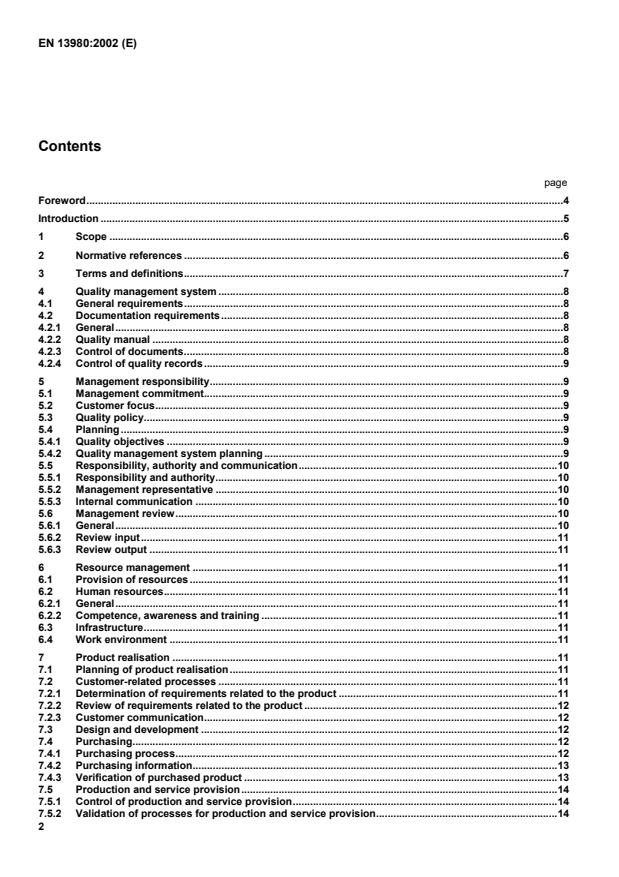
Information relevant to particular types of protection.18Annex B (informative)
Verification criteria for sintered components used as an integral part of a typeof protection.25Annex ZA (informative)
Clauses of this European Standard addressing essential requirements or otherprovisions of EU Directives.28Bibliography.29
Forexample, instructions, related drawings, data sheets and sales literature3.9type of protectionspecific measures applied to product to avoid ignition of a surrounding explosive atmosphere
Someof these products can have different persons responsible for them.
Therefore, if one product with a common component anddrawing number is revised to meet a need and the necessary supplementary certificate obtained, there needs to be a system forensuring that any other certificates that call up such components are also subject to supplementary certification in order to avoidthose products not being in compliance with their equipment documents.f)Where a manufacturer also has drawings for products not intended for use in potentially explosiveatmospheres then the manufacturer shall have a system that enables both the related drawings and scheduledrawings to be clearly identifiedNOTEThe following examples indicate some methods of achieving this:-the use of visual markers;-the use of a unique series of drawing numbers, e.g. all drawings concerning a certified product have an Ex prefixto the drawing number.g)The manufacturer shall document which notified body is responsible for the quality system notification for eachEC type-examination certificate;h)Where equipment documents or manufacturer’s documents are passed to a third party, they shall be providedin a way that is not misleading.
intended for use in potentially explosiveatmospheres;b) the need to liase with the notified body responsible for the issue of the EC type-examination certificate withrespect to any proposed change to the design defined in the EC type-examination certificate and the technicaldocumentation;c) the need to liase with the notified body responsible for the assessment of the quality system with respect tointended updating of
the quality system;NOTE It is not practicable for the manufacturer to inform the notified body each time the quality system is updated.
It isonly practicable to inform the notified body of “substantial” updating of the quality system relevant to the type of protection.Similarly, it is not practicable to specify in general terms what types of updating are or are not “substantial”.
It is thereforerecommended that the manufacturer establishes and maintains a system for categorising updates as “substantial” or not andinforming the notified body as appropriate.d) the authorising of initial approval and changes to related drawings, where appropriate;e) the authorising of concessions (see 8.3 f));f) informing its customer of any applicable special conditions for safe use and any schedules of limitations;NOTE 1Certificates with a suffix X can contain special conditions for safe use. Component certificates, with a suffix U cancontain schedules of limitations.NOTE 2For each EC type-examination certificate it is recommended that an authorised person is appointed who shouldhave responsibility and authority for the above activities so providing an unambiguous focal point within the organization.5.5.2 Management representative5.5.2 of EN ISO 9001:2000 applies.5.5.3 Internal communication5.5.3 of EN ISO 9001:2000 applies.5.6 Management review5.6.1 General5.6.1 of EN ISO 9001:2000 applies.a) the maximum intervals between reviews should normally be 12 months and shall not exceed 14 months;b) top management shall chair the review;c) the person(s) responsible for the activities as detailed in 5.5.1 shall participate in the review.
with the EC type-examination certificate shall not be sub-contracted;b) Suppliers providing a product, process, or service that can affect the product’s compliance with the EC type-examination certificate shall only be selected after an evaluation has demonstrated that they have thecapability of ensuring compliance with all specified requirements;1) The evaluation shall be made by one or more of the following methods:¾ the supplier has third party quality system certification to the appropriate standard and scope issuedby an accredited body which can demonstrate that it operates in compliance with EN 45012. This canbe achieved by an accredited certification;¾ a documented evaluation which provides objective evidence that the supplier can provide product,process or service that are fit for purpose;¾ a documented site assessment to ensure that all relevant controls are available, documented,understood and effective.NOTEThe evaluation should take the following into account:¾ criticality of the product, process or service;¾ degree of difficulty, or variability in the manufacturing process;¾ location of the supplier and hence the effectiveness of communications;¾ does the supplier, in turn sub-contract the product, process or service;2) Suppliers providing calibration services shall be evaluated on their ability to meet stated requirements;3) Where the features affecting the type of protection can not be verified at a later stage e. g. encapsulatedintrinsically safe circuits, then the evaluation shall include initial and periodic site assessments at thesuppliers premises to ensure relevant controls are available, documented, understood and effective;c) Suppliers not used for a period exceeding one year shall be re-evaluated prior to the placing of the contract;
...