


EN 13145:2001+A1:2011
(Main)Railway applications - Track - Wood sleepers and bearers
Railway applications - Track - Wood sleepers and bearers
This European Standard defines wood species, quality requirements, origin, manufacturing conditions, forms, dimensions and tolerances as well as the durability and preservation of wood sleepers and bearers for use in railway tracks. It does not cover specific finishing processes which may be required by the customer. It does not apply to other track timbers.
Bahnanwendungen - Oberbau - Gleis- und Weichenschwellen aus Holz
Diese Europäische Norm bezeichnet Holzarten, Qualitätsanforderungen, Herkunft, Bearbeitungsbedingungen, Formen, Abmessungen und Toleranzen sowie die Dauerhaftigkeit und die Konservierung der Gleis- und Weichenschwellen aus Holz zur Anwendung im Gleisbau. Sie behandelt keine besonderen Verfahren zur Endfertigung, welche kundenseitig gefordert werden. Ferner gilt diese Norm nicht für andere Hölzer im Gleisbau.
Applications ferroviaires - Voie - Traverses et supports en bois
Cette norme européenne définit les essences, les exigences de qualité, l’origine, les conditions de fabrication, les formes, dimensions et tolérances, tout comme la durabilité et le traitement de préservation des traverses et supports en bois utilisés dans les voies ferrées. Elle ne couvre pas les finitions spécifiques pouvant être demandées par le client. Elle ne s’applique pas aux autres pièces de bois utilisées dans la voie.
Železniške naprave - Zgornji ustroj - Leseni pragi in kretniški leseni pragi
Ta evropski standard opredeljuje vrste lesa, zahteve glede kakovosti, izvor, pogoje izdelave, oblike, mere in odstopanja ter trajnost in ohranjanje lesenih pragov in kretniških lesenih pragov, ki se uporabljajo pri železniškem zgornjem ustroju. Ne zajema posebnih postopkov dodelave, ki jih morda zahteva kupec. Ne velja za drug les za zgornji ustroj.
General Information
- Status
- Published
- Publication Date
- 11-Oct-2011
- Technical Committee
- CEN/TC 256 - Railway applications
- Drafting Committee
- CEN/TC 256/SC 1/WG 16 - Sleepers and bearers
- Current Stage
- 9093 - Decision to confirm - Review Enquiry
- Start Date
- 03-Dec-2021
- Completion Date
- 14-Apr-2025
Relations
- Effective Date
- 18-Jan-2023
- Effective Date
- 18-Jan-2023
Overview - EN 13145:2001+A1:2011 (Wood sleepers and bearers)
EN 13145 is a CEN European standard for railway track wood sleepers and bearers. It defines acceptable wood species, quality requirements, manufacturing conditions, permissible forms, dimensions and tolerances, and rules for durability and preservative treatment. The standard applies only to wood sleepers and bearers used in track and switchwork and does not cover other track timbers or customer-specific finishing processes. EN 13145 incorporates Amendment 1 (2011) and supports essential requirements of EU Directive 2008/57/EC.
Key topics and technical requirements
- Scope and definitions: Clear terminology for sleepers, bearers, heartwood, sapwood, chairing area (250 mm each side of rail centre for sleepers), knots, checks, shakes and other defects.
- Approved species: Lists suitable European hardwoods (e.g., oak, beech), European softwoods (e.g., Pinus sylvestris, P. pinaster, P. nigra, Pseudotsuga menziesii, Larix) and selected tropical hardwoods (e.g., Lophira alata, Shorea spp., Dicorynia, Eucalyptus spp., Mora).
- Forms and dimensions: Nominal rectangular cross-sections and standard forms for sleepers (forms E1/E2) and bearers; customers specify required length, width and height.
- Tolerances: Typical dimensional tolerances for ready-for-use or preservative-treated units: length +30 mm; width +10/-3 mm; height +10/-3 mm; max cross‑section angular deviation 3°.
- Durability and preservation: Requirements on natural durability, required preservative penetration/retention classes, and references to laboratory and field test methods for preservative performance.
- Defects and quality control: Rules on permitted and prohibited features after seasoning - e.g., rot and included sapwood are not permitted; sapwood limits vary by species; limits on knots, grain deviation, and annual ring growth in softwoods.
- Factory production control & marking: Requirements for production control and product marking to ensure traceability and conformity.
Practical applications and users
Who uses EN 13145:
- Railway infrastructure engineers and track designers specifying sleepers/bearers
- Timber suppliers and sawmills manufacturing railway sleepers
- Preservation and pressure-treatment plants validating penetration and retention
- Procurement teams and quality inspectors for conformity checks How it’s used:
- Specifying material and dimensional requirements in contracts
- Selecting species and preservative systems to meet durability classes
- Establishing inspection criteria and acceptance tolerances for deliveries
- Ensuring compliance with EU technical requirements for interoperability
Related standards
Normative references commonly used alongside EN 13145 include:
- EN 252 (field tests for preservative effectiveness)
- EN 335-1, EN 350-2 (durability and hazard classes)
- EN 351-1 (preservative penetration/retention)
- EN 599-1 (performance of wood preservatives)
- EN 844 series (timber terminology)
EN 13145 is an essential reference for safe, durable and standardized timber components in European railway track construction.


Frequently Asked Questions
EN 13145:2001+A1:2011 is a standard published by the European Committee for Standardization (CEN). Its full title is "Railway applications - Track - Wood sleepers and bearers". This standard covers: This European Standard defines wood species, quality requirements, origin, manufacturing conditions, forms, dimensions and tolerances as well as the durability and preservation of wood sleepers and bearers for use in railway tracks. It does not cover specific finishing processes which may be required by the customer. It does not apply to other track timbers.
This European Standard defines wood species, quality requirements, origin, manufacturing conditions, forms, dimensions and tolerances as well as the durability and preservation of wood sleepers and bearers for use in railway tracks. It does not cover specific finishing processes which may be required by the customer. It does not apply to other track timbers.
EN 13145:2001+A1:2011 is classified under the following ICS (International Classification for Standards) categories: 79.040 - Wood, sawlogs and sawn timber; 93.100 - Construction of railways. The ICS classification helps identify the subject area and facilitates finding related standards.
EN 13145:2001+A1:2011 has the following relationships with other standards: It is inter standard links to EN 13145:2001/FprA1, EN 13145:2001. Understanding these relationships helps ensure you are using the most current and applicable version of the standard.
EN 13145:2001+A1:2011 is associated with the following European legislation: EU Directives/Regulations: 2008/57/EC; Standardization Mandates: M/483. When a standard is cited in the Official Journal of the European Union, products manufactured in conformity with it benefit from a presumption of conformity with the essential requirements of the corresponding EU directive or regulation.
EN 13145:2001+A1:2011 is available in PDF format for immediate download after purchase. The document can be added to your cart and obtained through the secure checkout process. Digital delivery ensures instant access to the complete standard document.
Standards Content (Sample)
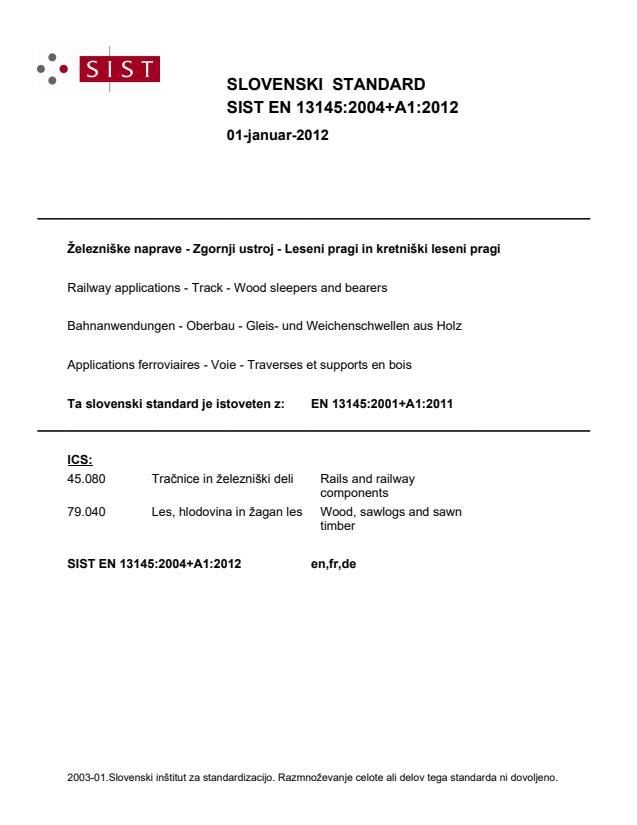
2003-01.Slovenski inštitut za standardizacijo. Razmnoževanje celote ali delov tega standarda ni dovoljeno.Železniške naprave - Zgornji ustroj - Leseni pragi in kretniški leseni pragiBahnanwendungen - Oberbau - Gleis- und Weichenschwellen aus HolzApplications ferroviaires - Voie - Traverses et supports en boisRailway applications - Track - Wood sleepers and bearers79.040Les, hlodovina in žagan lesWood, sawlogs and sawn timber45.080Rails and railway componentsICS:Ta slovenski standard je istoveten z:EN 13145:2001+A1:2011SIST EN 13145:2004+A1:2012en,fr,de01-januar-2012SIST EN 13145:2004+A1:2012SLOVENSKI
STANDARD
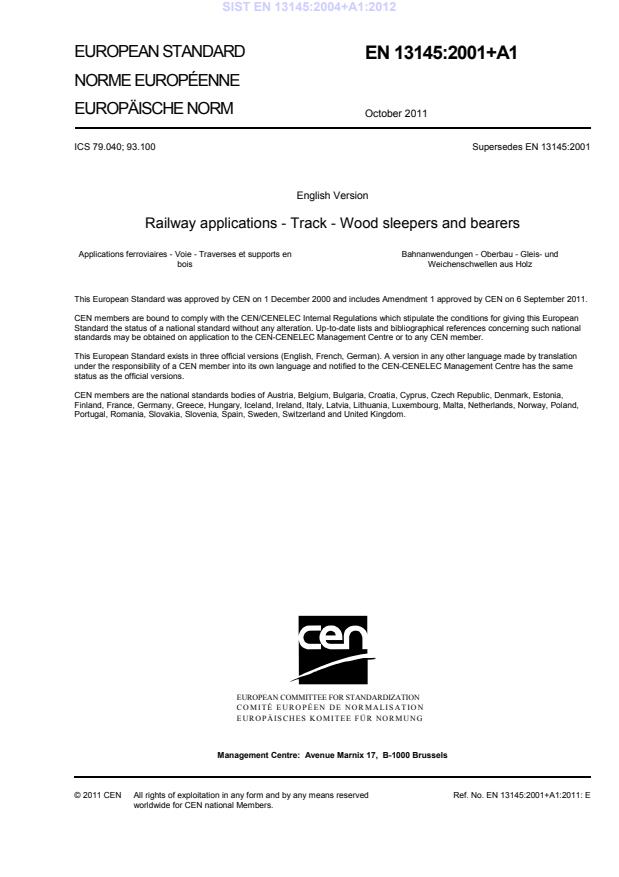
EUROPEAN STANDARD NORME EUROPÉENNE EUROPÄISCHE NORM
EN 13145:2001+A1
October 2011 ICS 79.040; 93.100 Supersedes EN 13145:2001English Version
Railway applications - Track - Wood sleepers and bearers
Applications ferroviaires - Voie - Traverses et supports en bois
Bahnanwendungen - Oberbau - Gleis- und Weichenschwellen aus Holz This European Standard was approved by CEN on 1 December 2000 and includes Amendment 1 approved by CEN on 6 September 2011. CEN members are bound to comply with the CEN/CENELEC Internal Regulations which stipulate the conditions for giving this European Standard the status of a national standard without any alteration. Up-to-date lists and bibliographical references concerning such national standards may be obtained on application to the CEN-CENELEC Management Centre or to any CEN member.
This European Standard exists in three official versions (English, French, German). A version in any other language made by translation under the responsibility of a CEN member into its own language and notified to the CEN-CENELEC Management Centre has the same status as the official versions.
CEN members are the national standards bodies of Austria, Belgium, Bulgaria, Croatia, Cyprus, Czech Republic, Denmark, Estonia, Finland, France, Germany, Greece, Hungary, Iceland, Ireland, Italy, Latvia, Lithuania, Luxembourg, Malta, Netherlands, Norway, Poland, Portugal, Romania, Slovakia, Slovenia, Spain, Sweden, Switzerland and United Kingdom.
EUROPEAN COMMITTEE FOR STANDARDIZATION
COMITÉ EUROPÉEN DE NORMALISATION EUROPÄISCHES KOMITEE FÜR NORMUNG
Management Centre:
Avenue Marnix 17,
B-1000 Brussels © 2011 CEN All rights of exploitation in any form and by any means reserved worldwide for CEN national Members. Ref. No. EN 13145:2001+A1:2011: ESIST EN 13145:2004+A1:2012
Most commonly used dimensions for sleepers and bearers . 17Annex ZA (informative)
!Relationship between this European Standard and the Essential Requirements of EU Directive 2008/57/EC" . 19 SIST EN 13145:2004+A1:2012
EU Directive 2008/57/EC. For relationship with EU Directive 2008/57/EC, see informative Annex ZA, which is an integral part of this document." This document includes Amendment 1, approved by CEN on 2011-09-06. This document supersedes EN 13145:2001. The start and finish of text introduced or altered by amendment is indicated in the text by tags ! ". Attention is drawn to the possibility that some of the elements of this document may be the subject of patent rights. CEN [and/or CENELEC] shall not be held responsible for identifying any or all such patent rights. According to the CEN/CENELEC Internal Regulations, the national standards organizations of the following countries are bound to implement this European Standard: Austria, Belgium, Bulgaria, Croatia, Cyprus, Czech Republic, Denmark, Estonia, Finland, France, Germany, Greece, Hungary, Iceland, Ireland, Italy, Latvia, Lithuania, Luxembourg, Malta, Netherlands, Norway, Poland, Portugal, Romania, Slovakia, Slovenia, Spain, Sweden, Switzerland and United Kingdom.
[EN 844-7:1997] 3.4 sapwood outer zone of wood that, in the growing tree, contains living cells and conducts sap [EN 844-7:1997] 3.5 included sapwood presence in the heartwood of a complete or incomplete ring having the colour and the properties of sapwood [EN 844-9:1997] 3.6 red heart in beech red or brown stain affecting the central portion of beech wood, sharply defined [EN 844-10:1998] 3.7 grey, purple heart grey or purple discoloration of the heartwood due to fungal attack 3.8 grain general direction or arrangement of fibres [EN 844-7:1997] 3.9 edge grain timber converted so that the growth rings meet the upper face of the sleeper or bearer at an angle greater than 45° when measured at the centre of the upper face (see figure 1) Figure 1 - Edge grain The line a-b is a tangent to the growth ring where it meets the upper face of the sleeper or bearer. The angle is measured at c 3.10 annual ring growth ring corresponding to an annual period of growth [EN 844-7:1997] 3.11 wane original rounded surface of a log, with or without bark, on any face or edge of sawn timber (see figure 2)
[EN 844-3:1995] abc SIST EN 13145:2004+A1:2012
Figure 2 - Wane 3.12 chairing area for sleepers, the chairing area is the area on the upper surface covering a length of 250 mm on both sides of the centre of each rail to be mounted For bearers, the chairing area covers the whole length with the exception of 250 mm at each end. 3.13 rot decomposition of wood by fungi or other micro-organisms resulting in softening, progressive loss of mass and strength, and often a change of texture and colour [EN 844-10:1998] 3.14 knot portion of a branch embedded in the wood [EN 844-9:1997] 3.15 sound knot knot showing no indication of rot [EN 844-9:1997] 3.16 intergrown knot knot that, on the surface considered, is intergrown with the surrounding wood for more than 3/4 of its cross-sectional perimeter [EN 844-9:1997] 3.17 dead knot knot that, on the surface considered, is intergrown with the surrounding wood for less than 1/4 of its cross sectional perimeter [EN 844-9:1997] 3.18 loose knot dead knot that is not held firmly in place [EN 844-9:1997] 3.19 unsound knot knot affected by rot [EN 844-9:1997] 3.20 indent recess caused by mechanical removal of an unsound knot down to the sound part of the timber 3.21 bark pocket bark that is partly or wholly enclosed in the wood [EN 844-9:1997] SIST EN 13145:2004+A1:2012
top view Figure 3 - Spring SIST EN 13145:2004+A1:2012
side view Figure 4 - Bow 3.31 cup curvature of a piece of timber across the width of the face (see figure 5) [EN 844-3:1995]
Figure 5 - Cup 3.32 twist lengthwise spiral distortion of a piece of timber (see figure 6) [EN 844-3:1995]
Figure 6 - Twist 3.33 resin pocket lens-shaped cavity in timber containing, or that has contained, a resin [EN 844-9:1997] 3.34 gum vein vein in timber containing, or that has contained, a resinous substance 3.35 bore hole hole or tunnel in timber caused by insects [EN 844-11:1998] 3.36 pith zone within the first growth ring that consists chiefly of soft tissue [EN 844-7:1997] 3.37 creosote oil distilled from coal tar 3.38 tropical hardwood hardwood grown in the tropics and all other southern hemisphere forests SIST EN 13145:2004+A1:2012
Quercus robur Quercus petraea Quercus pubescens European oak Fagus sylvatica Beech European softwoods
Pinus sylvestris Scots pine Pinus pinaster (Pinus maritima) Maritime pine Pinus pinea Stone pine Pinus nigra Corsican/Austrian pine Pseudotsuga menziesii Douglas fir Larix Sp.1) Larch Tropical hardwoods
Lophira alata Azobé, Ekki, Bongossi Shorea laevis, Shorea sp. div. 1) Bangk
...
Questions, Comments and Discussion
Ask us and Technical Secretary will try to provide an answer. You can facilitate discussion about the standard in here.
Loading comments...