


prEN 16261
(Main)Pyrotechnic articles - Fireworks, Category F4
General Information
- Abstract
This document specifies requirements for the construction, performance, protective packaging and labelling of Category F4 fireworks, as listed in Clauses 4, 5 and 6.
This document does not apply to fireworks intended to be kept or used at temperatures below −20 °C or above 50 °C.
- Status
- Not Published
- Publication Date
- 21-Mar-2027
- Technical Committee
- CEN/TC 212 - Fireworks
- Drafting Committee
- CEN/TC 212/WG 2 - Fireworks, category 4
- Current Stage
- 4060 - Closure of enquiry - Enquiry
- Start Date
- 30-Apr-2026
- Due Date
- 19-May-2026
- Completion Date
- 30-Apr-2026

Overview
prEN 16261:2026 is a draft European Standard developed by CEN/TC 212 for Category F4 fireworks. It specifies robust requirements for the design, construction, performance, protective packaging, and labelling of professional pyrotechnic articles falling under Category F4. Intended for use by professionals, F4 fireworks are not suitable for public sale and are distinguished by their potential for serious hazards.
This standard supersedes earlier parts (EN 16261-1, -2, -3, -4), consolidating requirements to promote safety, uniformity, and compliance across the European market. Its scope excludes fireworks stored or operated at temperatures below −20 °C or above 50 °C.
Key Topics
- Construction Requirements: Defines technical criteria for materials, assembly, and structural integrity of F4 fireworks to ensure consistent functioning and safe handling.
- Performance Standards: Outlines test regimes and functional checks for stability, effect, and composition under controlled conditions.
- Protective Packaging: Specifies packaging design to safeguard ignition means and prevent unintentional initiation during transport and storage.
- Labelling: Details mandatory safety information, traceability codes, CE marking, instructions for use, and disposal guidelines to aid proper handling and regulatory compliance.
- Testing and Quality Assurance: Introduces type and batch testing procedures, including sampling plans and nonconformity classifications, to maintain quality consistency across production runs.
- Environmental Considerations: Addresses the use of plastic components, requirements for biodegradable materials, and impact reduction strategies where applicable.
Applications
prEN 16261 serves as the benchmark for manufacturers, importers, and testing authorities involved in the professional fireworks industry, ensuring products are:
- Consistently Safe: By conforming to these standards, manufacturers reduce the risk of malfunction and injury during displays.
- Compliant Across Borders: Uniform labelling and safety requirements support ease of distribution throughout the EU, facilitating international trade of pyrotechnic articles.
- Professionally Operated: By focusing on Category F4, the standard helps firework technicians and display organizers select products fit for complex public and private events, where elevated hazard levels demand rigorous controls.
- Traceable and Accountable: Clearly defined batch numbers and manufacturer information help trace products, support recall actions, and meet regulatory obligations.
- Environmentally Conscious: Guidance on plastics use and requirements for labelling facilitate greater environmental responsibility in the sector.
Common users include:
- Firework manufacturers and importers
- Professional display operators and event organizers
- Safety inspectors and compliance officers
- Regulatory and customs authorities
Related Standards
The following international and European standards are referenced within prEN 16261 to support specific aspects of fireworks safety and compliance:
- EN 13763-1: Requirements for explosives, detonators, and detonating cord relays
- EN 61672-1: Electroacoustics - sound level meter specifications, relevant for measuring aural effects
- EN ISO 3166-1: Country codes for labelling and documentation
- ISO 2859-1: Sampling procedures for batch testing and acceptance
- ISO 22863 series: Fireworks test methods for chemical composition and hazardous substance limits
prEN 16261:2026 is aligned with the essential safety requirements of Directive 2013/29/EU, ensuring harmonized compliance with EU legislation on pyrotechnic articles.
By following prEN 16261, stakeholders in the fireworks industry enhance safety, support regulatory compliance, and facilitate smooth operations within the professional pyrotechnics sector.
Relations
- Effective Date
- 03-Dec-2025
- Effective Date
- 03-Dec-2025
- Effective Date
- 03-Dec-2025
- Effective Date
- 03-Dec-2025
Get Certified
Connect with accredited certification bodies for this standard

ECOCERT
Organic and sustainability certification.

Eurofins Food Testing Global
Global leader in food, environment, and pharmaceutical product testing.

Intertek Bangladesh
Intertek certification and testing services in Bangladesh.
Sponsored listings
Frequently Asked Questions
prEN 16261 is a draft published by the European Committee for Standardization (CEN). Its full title is "Pyrotechnic articles - Fireworks, Category F4". This standard covers: This document specifies requirements for the construction, performance, protective packaging and labelling of Category F4 fireworks, as listed in Clauses 4, 5 and 6. This document does not apply to fireworks intended to be kept or used at temperatures below −20 °C or above 50 °C.
This document specifies requirements for the construction, performance, protective packaging and labelling of Category F4 fireworks, as listed in Clauses 4, 5 and 6. This document does not apply to fireworks intended to be kept or used at temperatures below −20 °C or above 50 °C.
prEN 16261 is classified under the following ICS (International Classification for Standards) categories: 71.100.30 - Explosives. Pyrotechnics and fireworks. The ICS classification helps identify the subject area and facilitates finding related standards.
prEN 16261 has the following relationships with other standards: It is inter standard links to EN 16261-4:2012, EN 16261-2:2013, EN 16261-3:2012, EN 16261-1:2012. Understanding these relationships helps ensure you are using the most current and applicable version of the standard.
prEN 16261 is associated with the following European legislation: EU Directives/Regulations: 2013/29/EU; Standardization Mandates: M/583. When a standard is cited in the Official Journal of the European Union, products manufactured in conformity with it benefit from a presumption of conformity with the essential requirements of the corresponding EU directive or regulation.
prEN 16261 is available in PDF format for immediate download after purchase. The document can be added to your cart and obtained through the secure checkout process. Digital delivery ensures instant access to the complete standard document.
Standards Content (Sample)
SLOVENSKI STANDARD
01-april-2026
Pirotehnični izdelki - Ognjemet, kategorija F4
Pyrotechnic articles - Fireworks, Category F4
Pyrotechnische Gegenstände - Feuerwerkskörper, Kategorie 4 - Anforderungen
Articles pyrotechniques - Artifices de divertissement, Catégorie F4
Ta slovenski standard je istoveten z: prEN 16261
ICS:
71.100.30 Eksplozivi. Pirotehnika in Explosives. Pyrotechnics and
ognjemeti fireworks
2003-01.Slovenski inštitut za standardizacijo. Razmnoževanje celote ali delov tega standarda ni dovoljeno.
DRAFT
EUROPEAN STANDARD
NORME EUROPÉENNE
EUROPÄISCHE NORM
February 2026
ICS 71.100.30 Will supersede EN 16261-1:2012, EN 16261-2:2013,
EN 16261-3:2012, EN 16261-4:2012
English Version
Pyrotechnic articles - Fireworks, Category F4
Articles pyrotechniques - Artifices de divertissement, Pyrotechnische Gegenstände - Feuerwerkskörper,
Catégorie F4 Kategorie 4 - Anforderungen
This draft European Standard is submitted to CEN members for enquiry. It has been drawn up by the Technical Committee
CEN/TC 212.
If this draft becomes a European Standard, CEN members are bound to comply with the CEN/CENELEC Internal Regulations
which stipulate the conditions for giving this European Standard the status of a national standard without any alteration.
This draft European Standard was established by CEN in three official versions (English, French, German). A version in any other
language made by translation under the responsibility of a CEN member into its own language and notified to the CEN-CENELEC
Management Centre has the same status as the official versions.
CEN members are the national standards bodies of Austria, Belgium, Bulgaria, Croatia, Cyprus, Czech Republic, Denmark, Estonia,
Finland, France, Germany, Greece, Hungary, Iceland, Ireland, Italy, Latvia, Lithuania, Luxembourg, Malta, Netherlands, Norway,
Poland, Portugal, Republic of North Macedonia, Romania, Serbia, Slovakia, Slovenia, Spain, Sweden, Switzerland, Türkiye and
United Kingdom.
Recipients of this draft are invited to submit, with their comments, notification of any relevant patent rights of which they are
aware and to provide supporting documentation.
Warning : This document is not a European Standard. It is distributed for review and comments. It is subject to change without
notice and shall not be referred to as a European Standard.
EUROPEAN COMMITTEE FOR STANDARDIZATION
COMITÉ EUROPÉEN DE NORMALISATION
EUROPÄISCHES KOMITEE FÜR NORMUNG
CEN-CENELEC Management Centre: Rue de la Science 23, B-1040 Brussels
© 2026 CEN All rights of exploitation in any form and by any means reserved Ref. No. prEN 16261:2026 E
worldwide for CEN national Members.
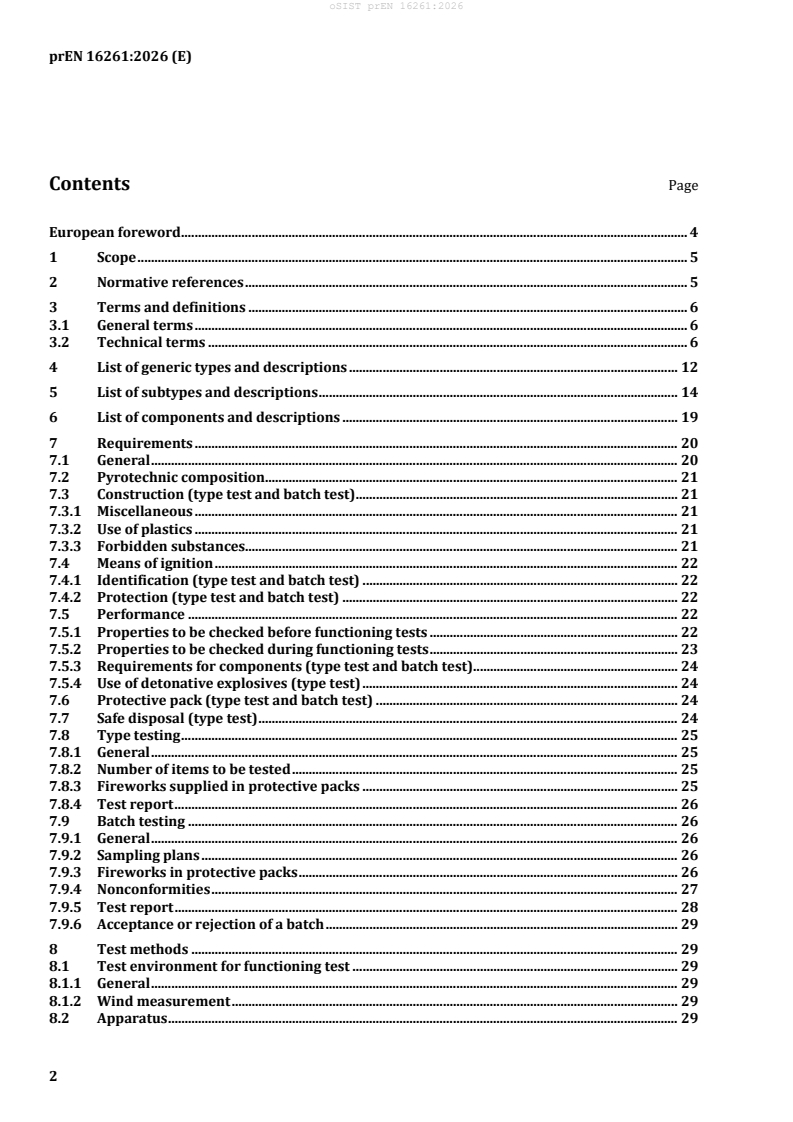
Contents Page
European foreword . 4
1 Scope . 5
2 Normative references . 5
3 Terms and definitions . 6
3.1 General terms . 6
3.2 Technical terms . 6
4 List of generic types and descriptions . 12
5 List of subtypes and descriptions . 14
6 List of components and descriptions . 19
7 Requirements . 20
7.1 General . 20
7.2 Pyrotechnic composition . 21
7.3 Construction (type test and batch test) . 21
7.3.1 Miscellaneous . 21
7.3.2 Use of plastics . 21
7.3.3 Forbidden substances. 21
7.4 Means of ignition . 22
7.4.1 Identification (type test and batch test) . 22
7.4.2 Protection (type test and batch test) . 22
7.5 Performance . 22
7.5.1 Properties to be checked before functioning tests . 22
7.5.2 Properties to be checked during functioning tests . 23
7.5.3 Requirements for components (type test and batch test) . 24
7.5.4 Use of detonative explosives (type test) . 24
7.6 Protective pack (type test and batch test) . 24
7.7 Safe disposal (type test) . 24
7.8 Type testing . 25
7.8.1 General . 25
7.8.2 Number of items to be tested . 25
7.8.3 Fireworks supplied in protective packs . 25
7.8.4 Test report . 26
7.9 Batch testing . 26
7.9.1 General . 26
7.9.2 Sampling plans . 26
7.9.3 Fireworks in protective packs . 26
7.9.4 Nonconformities . 27
7.9.5 Test report . 28
7.9.6 Acceptance or rejection of a batch . 29
8 Test methods . 29
8.1 Test environment for functioning test . 29
8.1.1 General . 29
8.1.2 Wind measurement . 29
8.2 Apparatus . 29
8.3 Test methods . 33
8.3.1 Construction and stability . 33
8.3.2 Design – Verification . 34
8.3.3 Determination of tube angle . 34
8.3.4 Angle of ascent and burst height . 35
8.3.5 Measurement of sound pressure level . 35
8.3.6 Extinguishing of flames . 36
8.3.7 Visual and audible inspections . 36
8.3.8 Mechanical conditioning . 36
8.3.9 Thermal conditioning . 37
8.3.10 Function test . 37
8.3.11 Measuring of CE-marking . 39
8.3.12 Use of detonative explosives . 39
9 Minimum labelling requirements . 43
9.1 General . 43
9.2 Name and type of firework . 43
9.3 Category, registration number, product, batch or serial numbers . 43
9.4 Identification number of the notified body . 44
9.5 Net explosive content . 44
9.6 Safety and disposal information . 44
9.7 Year of production . 44
9.8 Details on manufacturer or importer. 44
9.9 Printing . 44
9.10 Marking of very small items . 44
9.11 Minimum safety information. 45
9.11.1 General . 45
9.11.2 Mandatory parameters . 45
9.11.3 Format . 45
9.12 Specific labelling for individual items . 46
9.12.1 Specific labelling requirement for combinations . 46
9.12.2 Specific labelling requirement for shells . 46
9.12.3 Specific labelling requirement for components . 46
9.13 Additional information . 46
9.14 Operating instructions . 46
Annex A (normative) Mandatory/optional performance parameters . 47
Annex B (informative) List of nonconformities for Category F4 fireworks regarding safety in
functioning . 50
Annex C (informative) Mechanical conditioning (shock apparatus) . 52
Annex D (informative) Procedures for calculation of heights . 55
Annex E (informative) Calculation method for safety-/protection distance . 59
Annex F (informative) List of mandatory and optional parameters and corresponding codes . 60
Annex G (normative) Decision tree for Category F4 fireworks containing plastic parts . 62
Annex ZA (informative) Relationship between this European Standard and the essential
safety requirements of Directive 2013/29/EU aimed to be covered . 63
Bibliography . 65
European foreword
This document (prEN 16261:2026) has been prepared by Technical Committee CEN/TC 212
“Pyrotechnic articles”, the secretariat of which is held by NEN.
This document is currently submitted to CEN Enquiry.
This document will supersede EN 16261-1:2012 EN 16261-2:2013, EN 16261-3:2012 and
EN 16261-4:2012.
EN 16261-3:2012 and EN 16261-4:2012:
— the 4 parts have been merged;
— the subclause 7.3.2 “Use of plastics” has been added;
— the Annex G has been added;
— the Annex ZA has been updated.
This document has been prepared under a standardization request addressed to CEN by the European
Commission. The Standing Committee of the EFTA States subsequently approves these requests for its
Member States.
For the relationship with EU Legislation, see informative Annex ZA, which is an integral part of this
document.
1 Scope
This document specifies requirements for the construction, performance, protective packaging and
labelling of Category F4 fireworks, as listed in Clauses 4, 5 and 6.
This document does not apply to fireworks intended to be kept or used at temperatures below −20 °C or
above 50 °C.
2 Normative references
The following documents are referred to in the text in such a way that some or all of their content
constitutes requirements of this document. For dated references, only the edition cited applies. For
undated references, the latest edition of the referenced document (including any amendments) applies.
EN 13763-1:2025, Explosives for civil uses — Detonators and detonating cord relays — Part 1:
Requirements
EN 61672-1:2013, Electroacoustics — Sound level meters — Part 1: Specifications
EN ISO 3166-1:2020, Codes for the representation of names of countries and their subdivisions — Part 1:
Country code (ISO 3166-1:2020)
EN ISO 13385-1:2019, Geometrical product specifications (GPS) — Dimensional measuring equipment —
Part 1: Design and metrological characteristics of callipers (ISO 13385-1:2019)
ISO 2859-1:1999, Sampling procedures for inspection by attributes — Part 1: Sampling schemes indexed
by acceptance quality limit (AQL) for lot-by-lot inspection
ISO 22863-1:2020, Fireworks — Test methods for determination of specific chemical substances — Part 1:
General
ISO 22863-2:2020, Fireworks — Test methods for determination of specific chemical substances — Part 2:
Hexachlorobenzene by gas chromatography
ISO 22863-3:2020, Fireworks — Test methods for determination of specific chemical substances — Part 3:
Lead and lead compounds by atomic absorption
ISO 22863-4:2021, Fireworks — Test methods for determination of specific chemical substances — Part 4:
Analysis of lead and lead compounds by X-ray fluorescence spectrometry (XRF)
ISO 22863-5:2021, Fireworks — Test methods for determination of specific chemical substances — Part 5:
Analysis of lead and lead compounds by inductively coupled plasma spectrometry (ICP)
ISO 22863-8:2021, Fireworks — Test methods for determination of specific chemical substances — Part 8:
Arsenic content by hydride generation atomic fluorescence spectrometry
ISO 22863-9:2021, Fireworks — Test methods for determination of specific chemical substances — Part 9:
Mercury content by hydride generation atomic fluorescence spectrometry
ISO 22863-11:2022, Fireworks — Test methods for determination of specific chemical substances —
Part 11: Phosphorus content by inductively coupled plasma optical emission spectrometry (ICP-OES)
Impacted by ISO 2859-1:1999/A1:2011
ISO 22863-12:2022, Fireworks — Test methods for determination of specific chemical substances —
Part 12: Picrates and picric acid by high performance liquid chromatography
3 Terms and definitions
For the purposes of this document, the following terms and definitions apply.
3.1 General terms
3.1.1
firework assembly
assembly of individual elements that have EU-type examination certification, except components
Note 1 to entry: These elements are described in Tables 4 and 5
3.1.2
generic type
set of articles with a common, very general, design feature and/or with a common characteristic effect
3.1.3
individual item
article within a generic type and/or a subtype, for which every feature and characteristic has been fixed
Note 1 to entry: Each feature and characteristic will be specified in the technical name or a technical data sheet,
as appropriate.
3.1.4
subtype
set of articles within a generic type with specific design features
3.1.5
technical documentation provided with the article
all technical information about the article to be provided for EU-type examination certification
3.1.6
technical name
general description of an individual item
3.1.7
trade name
description of an individual item from a particular supplier
3.1.8
type
sample representative of the production envisaged
3.2 Technical terms
3.2.1
acceptance quality limit
AQL
quality level that is the worst tolerable process average when a continuing series of lots is submitted for
acceptance sampling
3.2.2
batch test
test performed on a sample of products taken at random from a production batch to check compliance
with a given standard
Note 1 to entry: Batch testing needs all products in the production batch to comply with the characteristics the
standard requires to ensure homogeneity of the whole batch. It aims at proving that all products which are placed
on the market are in conformity with the type which is described in the EU-type examination certificate and have
been successfully submitted to type tests as determined by the standard.
3.2.3
biodegradable
decomposable at the end of life in naturally occurring soil conditions
Note 1 to entry: Decomposition products can comprise carbon dioxide, water, microbial mass and minerals (non-
exhaustive list).
Note 2 to entry: Biodegradable materials can be both biobased or fossil-based.
3.2.4
burst height
altitude of the bursting point of the effect or the article
Note 1 to entry: For single break shells, this is the height at which the bursting charge of the shell functions. For
complex shells, it is the highest bursting effect.
3.2.5
calibre
external diameter of a cylindrical or spherical firework designed to be fired from a mortar tube or the
internal diameter of a tube which contains pre-assembled items
Note 1 to entry: It is important that the internal diameter of the mortar tube is close to the external diameter of
the firework, enabling the existence of a peripheral gap which is a compromise between the necessity of a free
motion of the firework in the tube and a lowest escape of lift gases passing by the firework during its motion in the
tube.
3.2.6
critical nonconforming unit
nonconforming unit with one or more critical nonconformities, with or without major or minor
nonconformities
3.2.7
critical nonconformity
nonconformity that judgement and experience indicate is likely to result in hazardous or unsafe
conditions
Note 1 to entry: This type of nonconformity is referred to as 'class A nonconformity' in ISO 2859-1:1999.
3.2.8
debris
part of the firework which remains after the firework has ceased to function
Note 1 to entry: Chemical products resulting from the combustion of the pyrotechnic compositions are not
considered as “debris”.
3.2.9
delay fuse
fuse incorporated into the initial fuse of a firework to introduce a delay between firing and functioning or
the internal fuse in a firework to enable sequential firing of elements of the firework
3.2.10
detonation
reaction which propagates through an explosive at supersonic velocity in the reacting explosive
3.2.11
detonative explosive
substance or mixture of substances which can undergo a fast internal decomposition reaction leading to
a detonation in normal use
3.2.12
drift
movement of a firework away from the direction of firing, as a result of the action of the wind or other
effects
Note 1 to entry: For instance, an aerial wheel might drift away from the vertical direction in which it was fired.
Drift can be quantified in terms of angle or distance.
3.2.13
drop
information whether incandescent or burning matter hits the level where the firework is fired
3.2.14
drop height
minimum distance from the ground at which the effect ends or the falling debris stop burning
3.2.15
effect broadness
broadness of effect
horizontal dimension of the firework effect
3.2.16
effect dimension
maximum horizontal extension of the effect of aquatic fireworks perpendicularly to the direction of firing
3.2.17
effect height
maximum height achieved by the firework
Note 1 to entry: For a shell, this would equate to the burst height plus the burst radius of the shell. For waterfalls,
this corresponds with the vertical length of the effect.
3.2.18
effect range
horizontal distance between the firing point and the point of explosion (or functioning) on to the water
3.2.19
effect time
total duration of effect from its visible and/or aural emergence until vanishing
3.2.20
end closure
part or crimp which is designed to seal one end of a firework case
3.2.21
explosion
sudden release of energy accompanied by a bang with or without a flash
3.2.22
firework case
container which is designed to retain pyrotechnic compositions
Note 1 to entry: Depending on its mechanical strength, this container may intentionally (by design) influence the
firework's behaviour.
3.2.23
firing angle
angle (measured from the vertical) of an item as prepared for firing
3.2.24
flash powder
uncompacted pyrotechnic composition used to produce an aural effect, with or without emission of an
intense and short flash light, or used as a bursting charge or lifting charge
3.2.25
flying debris
projected, propelled or dispersed part or debris of fireworks that are likely to end up in the environment
3.2.26
friction head
ignition head designed to be ignited by friction
3.2.27
fuse
small tube or cord containing a pressed or compacted pyrotechnic composition which burns gradually to
ignite a pyrotechnic composition or article
Note 1 to entry: By extension, this term also applies to other types of fire transmission devices like quickmatch
or blackmatch or pressed fuse.
3.2.28
gross mass
total mass of the firework which does not include any frame or other ancillary equipment
3.2.29
ignition head
initial fuse consisting of pyrotechnic composition only
3.2.30
initial fuse
component of a firework which is ignited in order to start the firework functioning
3.2.31
initial fuse time
burning time of the initial fuse
3.2.32
lifting charge
non-consolidated pyrotechnic composition used to project the firework as a whole or a subcomponent of
the firework into the air
3.2.33
major nonconforming unit
nonconforming unit with one or more major nonconformities, with or without minor nonconformities,
but with no critical nonconformities
3.2.34
major nonconformity
nonconformity, other than a critical nonconformity, which is likely to result in failure, to reduce materially
the usability of the firework, or to increase the potential hazard
Note 1 to entry: This type of nonconformity is referred to as ‘class B nonconformity’ in ISO 2859-1:1999.
3.2.35
minor nonconforming unit
nonconforming unit with one or more minor nonconformities, but with no critical or major
nonconformities
3.2.36
minor nonconformity
nonconformity that is not likely to reduce materially the usability of the firework
Note 1 to entry: This type of nonconformity is referred to as ‘class C nonconformity’ in ISO 2859-1:1999.
3.2.37
mortar
tube which is closed at the lower end and from which a firework is projected
3.2.38
net explosive content
NEC
mass of pyrotechnic composition in the firework
Note 1 to entry: For the purpose of this standard series, the NEC does not include the pyrotechnic composition in
the initial fuse or transmitting fuses, friction or ignition heads.
3.2.39
nonconforming unit
firework or assembly of fireworks fused together at the manufacturing level with one or more
nonconformities
3.2.40
nonconformity
non-fulfilment of a requirement
[SOURCE: EN ISO 9000:2015, 3.6.9] [1]
3.2.41
overall duration
time from the start of the first effect until the end of the last effect and, for an aerial wheel, the flight time
from the take off until the landing
3.2.42
packaging
wrapping or encasing in which an item is presented for transport, storage and/or sale
3.2.43
plastic
material which contains, as an essential ingredient, a polymer and which, at some stage in its processing
into finished products, can be shaped by heat and/or pressure
Note 1 to entry: Plastics consist mainly of polymers and minor contents of additives.
Note 2 to entry: Plastics comprise both thermoplastic and thermoset materials.
Note 3 to entry: Materials that are biodegradable are not regarded as plastics.
3.2.44
principal effect
main visual and/or aural effect the firework has been designed to display
3.2.45
projected article
article whose movement is produced by a non-consolidated pyrotechnic composition in a single event and
a short duration
3.2.46
projected debris
fragments projected laterally from the firework while functioning
3.2.47
propelled article
article moved by an attached or integral motor, producing thrust over an extended period of time
3.2.48
protective pack
package of one or more fireworks which can act as protection of the means of ignition and/or for labelling
purposes
3.2.49
pyrotechnic composition
explosive substance or mixture of explosive substances which is designed, on ignition or initiation, to
produce heat, light, sound, gas or smoke or a combination of such effects through self-sustained
exothermic chemical reactions
3.2.50
pyrotechnic leakage
pyrotechnic composition released from damaged pyrotechnic articles
3.2.51
pyrotechnic unit
discrete unit that is part of a firework which, upon functioning, will burn or explode to produce a visual
and/or aural effect
Note 1 to entry: The effect produced by a pyrotechnic unit is normally part of a combination of effects produced
by the firework.
3.2.52
radial effect distance
maximum distance of the effect in any direction except in the direction of firing
3.2.53
report effect
aural effect intended to produce a bang
3.2.54
transmitting fuse
component of a firework which is intended to transmit ignition from one part of a firework to another,
with or without a delay
3.2.55
type test
test performed on a sample of products, representative of the production envisaged
Note 1 to entry: The successful submission to type tests leads to the attribution of a type-examination certificate.
3.2.56
wind speed
measured speed of the wind at a defined height
4 List of generic types and descriptions
The list of generic types and descriptions is given in Table 1.
Table 1 — List of generic types and descriptions
Comments
Generic type Description Principal effects
(informative)
4.1 Aerial wheel Tubes containing propellant Some of the tubes (if Rotation and ascent,
charges and sparks-, flame- not all) are fixed in such with emission of
and/or noise-producing a way that the device sparks and flames,
pyrotechnic composition(s), the ascends, in an producing a visual
tubes being fixed to a unsupported manner, and/or aural effect.
supporting structure, designed into the air.
to rotate and ascend into the
air.
4.2 Aquatic firework Firework designed to be Same as Bengal flames,
floated on or near the surface fountains, mines, shells
of water by means of a for example.
buoyancy device or by itself
and to function on or below
water.
Comments
Generic type Description Principal effects
(informative)
4.3 Combination Assembly including several The elements may be As for the individual
elements, of one or more types, fused together in series elements.
each corresponding to one of or parallel, with or
the types of firework listed in without delay fuses, to
this table, with one or more give their effects in a
points of ignition. Firework sequence or at the same
assembly should not be time.
considered as combination.
4.4 Component Article which is included in See “List of
other fireworks, in most cases Components”.
without lifting charge and
which requires further
preparation.
4.5 Fountain Case containing sparks- and/or Emission of sparks and
flame-and/or aural effect- flames with aural
producing pyrotechnic effect other than report
composition. effect or without any
aural effect.
4.6 Guided Firework Article containing pyrotechnic For example, line Emission of a visual
composition designed to rockets can also be and/or aural effect.
function along a rope or other used to transmit
guide and to produce a visual ignition to other
and/or aural effect. fireworks, generally
fixed on a frame located
at a distance from the
firing place, e.g. at the
top of a steeple or a
tower.
4.7 Mine Article which can include pyrotechnic units can be Ejection of all the
integral mortar, containing stars, bangers, pyrotechnic units in a
propellant charge and more butterflies, crackers, single burst producing
than one pyrotechnic unit, hummers, a widely dispersed
having as main effect the spinners/tourbillions, visual and/or aural
discharge of all the pyrotechnic whistles, for example. effect in the air.
units in a single ejection.
4.8 Report Article containing pyrotechnic Bang - may also
composition designed to include a coloured (or
produce a bang. other effect) delay
element.
4.9 Rocket Article containing pyrotechnic Ascend with visual
composition and/or and/or aural effect.
pyrotechnic units, equipped
with a launching motor and
stick(s) or other means for
stabilization of flight, and
designed to be propelled into
the air.
Comments
Generic type Description Principal effects
(informative)
4.10 Roman candle Tube containing a single The pyrotechnic units Ejection of the
charge or alternating can be bombettes, pyrotechnic units in
propellant charges and comets, hummers, succession, producing
pyrotechnic units as well as maroons, mini mines, a series of visual
transmitting fuses. stars, whistles, for and/or aural effects in
example. the air.
4.11 Shell Device with or without lifting pyrotechnic units can be As for the individual
charge, with one or more stars, butterflies, pyrotechnic units.
delays before bursting, crackers, hummers,
containing pyrotechnic unit(s) spinners/tourbillions,
or loose pyrotechnic whistles, etc. as well as
composition and designed to be report shells or other
projected and burst at a shells to produce
distance from a mortar. multiple bursts
simultaneously or
sequentially.
4.12 Smoke/aerosol Article containing smoke Casing of the article Emission of white or
generator producing pyrotechnic may be made of coloured
composition or heat/gas different materials. smoke/aerosol
generating composition to without any aural
evaporate a substance or effect.
disperse hygroscopic particles
and designed to function on
the ground or fixed to a
support.
5 List of subtypes and descriptions
The list of subtypes and descriptions is given in Table 2.
Table 2 — List of subtypes and descriptions
Link to generic
Subtype Description Principal effects
type/Comments
5.1 Aquatic shell Spherical, cylindrical or other See “Aquatic Same effects as
shell designed to be floated on firework”. shells.
water by means of a buoyancy
device or by itself and which is
fired from a mortar.
5.2 Bag mine Container with propellant See “Mine”. Same effects as
charge and pyrotechnic units, mines.
Container is typically
designed to be placed in a
a cloth or paper or
mortar and to function as a
plastic bag or cloth or
mine.
paper cylinder.
Link to generic
Subtype Description Principal effects
type/Comments
5.3 Battery Assembly including several See “Combination”. As for the
elements, each of the same type individual
The elements may be
or sub type and corresponding elements.
fused together in
to one of the types of firework
series or parallel, with
listed in this standard, with one
or without delay fuses,
or more points of ignition.
to give their effects in
a sequence or at the
same time.
5.4 Bengal flame Tube containing slow-burning See “Fountain”. Emission of white
pyrotechnic composition. or coloured flame.
The pyrotechnic
composition may be
pressed or not. The
tube has no choke and
optionally burns away
during functioning.
5.5 Complex shell Shell composed of several See “Shell”. As for the
discrete elements designed to individual
be projected from a mortar elements.
with a single lifting charge and
to function sequentially or
simultaneously.
This subtype includes the
following articles:
— Multibreak Shell:
Shell with several discrete
elements and with or without
propellant charge, with delay
fuse and bursting charge,
pyrotechnic unit(s) or loose
pyrotechnic composition and
designed to be projected from a
mortar and to function
sequentially or simultaneously
by the lighting of multiple
internal delay fuses.
— Peanut Shell:
Shell with two or more
spherical shells in a common
wrapper propelled by the same
propellant charge with
independent internal delay
fuses.
Link to generic
Subtype Description Principal effects
type/Comments
— Repeater Shell:
Shell with several discrete
elements and with or without
propellant charge, with delay
fuse and bursting charge,
pyrotechnic unit(s) or loose
pyrotechnic composition and
designed to be projected from a
mortar and to function
sequentially by the lighting of
the internal delay fuses by the
functioning (burst) of the
previous device.
— Shell of shells (spherical):
Shell with or without
propellant charge, with delay
fuse and bursting charge,
containing report or other
shells as subcomponents and
designed to be projected from a
mortar.
5.6 Daylight shell Spherical, cylindrical or other See “Shell”. Emission of
shell designed to be fired from coloured light
a mortar and which contains and/or smoke,
discrete elements which are and/or aural effect.
visible in the daylight and/or
components which produce an
aural effect.
5.7 Flash banger Non-metallic case containing See “Report”. Report effect and a
metal-based pyrotechnic flash of light.
May be used as
composition.
pyrotechnic units in
fireworks (shells,
Roman candles, for
example).
5.8 Ground maroon Maroon without propellant See “Report”. Production of a
charge and with or without report effect
delay fuse, designed to produce
its report on the ground.
5.9 Lance Small diameter tube containing See “Fountain”. Thermal output
a compacted pyrotechnic and/or visual
The pyrotechnic
composition, burning in a effect.
composition may be
cigarette way, intended to
pressed or simply
deliver a thermal output to
consolidated. The tube
manually ignite other fireworks
has no choke and
or a small white or coloured
generally burns away
flame to be used in lanceworks.
during functioning.
Link to generic
Subtype Description Principal effects
type/Comments
5.10 Maroon Firework containing See “Report”. Production of a
pyrotechnic unit(s) or loose report effect.
Not to be confused
pyrotechnic composition and
with bangers, as their
designed to produce a loud
design is similar to
bang report as main effect.
shells or bombettes,
which is not the case
of bangers.
5.11 Maroon shell Maroon with or without See “Shell” and Production of a
propellant charge and with “Report”. report effect.
delay fuse, designed to be
This article is strictly
projected from a mortar and to
shell-type designed.
produce its report in the air.
5.12 Parachute rocket Article containing pyrotechnic See “Rocket”. As for the
composition and/or pyrotechnic individual
units, which contains subcomponents.
subcomponents some or all of
which will descend on
parachutes and equipped with
a launching motor and stick(s)
or other means for stabilization
of flight, and designed to be
self-propelled into the air.
5.13 Parachute shell Spherical, cylindrical or other See “Shell”. As for the
shell designed to be fired from individual
a mortar and which contains pyrotechnic units
sub-components some or all of contained in the
which will descend on shell.
parachutes.
5.14 Preloaded mortar, Assembly comprising a shell See “Shell”. As for the
shell in mortar inside a mortar from which the individual shell.
shell is designed to be
projected.
5.15 Saxon Tube intended to be attached to See “Fountain”. Rotation, with
a support in its middle so that it emission of sparks
The two pyrotechnic
can rotate and containing and/or flames, with
charges may be
pyrotechnic compacted or without aural
merged in a single
charge(s) which burn opposite effect.
charge. In that case,
and eject their combustion
this charge burns at
products sideways so that
its two free ends.
rotation is obtained.
5.16 Set piece Assembly including one or See “Combination”. As for the
multiple elements which is individual
Generally, these
designed not to rotate. elements.
elements belong to
the sub type of lances,
fountains and
cascades, but can also
include bangers,
ground maroons
and/or whistles.
Link to generic
Subtype Description Principal effects
type/Comments
5.17 Shot tube Tube containing a single See “Roman candle”. Single shot effect,
propellant charge and a as for Roman
The pyrotechnic unit
pyrotechnic unit, with or candles.
can be a bombette, a
without a bursting charge, with
comet, a hummer, a
or without a transmitting fuse.
shell (including
maroon shells), a
whistle, for example.
5.18 Signal rocket Tube containing pyrotechnic See “Rocket”. Constant or
composition and/or pyrotechnic variable pitch
unit(s), equipped with a stick or sound or report
other means for stabilization of effect(s).
flight, and designed to be
propelled into the air to
produce predominantly an
aural effect.
5.19 Spinner Tube or tubes containing See “Aerial wheel”. Rotation and
pyrotechnic composition with ascent, with
aerofoils attached. emission of sparks
and/or flames, with
or without aural
effect.
5.20 Strobe Tube containing an See “Fountain”. Production of
intermittently-burning series of flashes.
The pyrotechnic
pyrotechnic composition to
composition may be
produce long and rapid series
pressed or not.
of flashes at a constant
freq
...