

EN 16261-3:2012
(Main)Pyrotechnic articles - Fireworks, Category 4 - Part 3: Test methods
- Abstract
This European Standard specifies test methods for fireworks of category 4.
- Status
- Published
- Publication Date
- 18-Dec-2012
- Withdrawal Date
- 29-Jun-2013
- Technical Committee
- CEN/TC 212 - Fireworks
- Drafting Committee
- CEN/TC 212/WG 2 - Fireworks, category 4
- Current Stage
- 6060 - Definitive text made available (DAV) - Publishing
- Start Date
- 19-Dec-2012
- Due Date
- 02-Aug-2013
- Completion Date
- 19-Dec-2012
- Directive
- 2007/23/EC - Pyrotechnic articles directiveOJ Ref: C, C 136 OJ Date: 15-May-2013

Overview
EN 16261-3:2012 is the CEN test-methods standard for pyrotechnic articles - Fireworks, Category 4. It specifies the test environment, measurement apparatus and step‑by‑step procedures used to verify the safe functioning, physical characteristics and performance of Category 4 fireworks. The standard supports conformity assessment and market placing under EU Directive 2007/23/EC and is intended for use with the companion parts of EN 16261 (terminology, requirements, labelling).
Key topics and technical requirements
- Scope and test environment: Tests must be performed in a wide open unobstructed area; wind speed at 1.50 m height shall be recorded and testing is not carried out above 5.0 m/s.
- Measurement apparatus: Includes timing devices (readable to 0.1 s), vernier callipers (0.1 mm), rulers, measuring tapes, balances (±0.01 g), class‑1 sound level meters (EN 61672‑1), and surveying instruments or video systems for height measurement.
- Mechanical and thermal conditioning: Procedures and apparatus for mechanical shock and thermal exposure are defined. Example shock-specification: deceleration around 490 m/s² with a shock pulse ~2 ms (see Annex A).
- Function and performance tests: Methods for firing, monitoring angle of ascent, burst height, effect range (including aquatic fireworks), and extinguishing time of flames after functioning.
- Mortar and calibre rules: Guidance on mortar internal diameter and length relative to shell calibre, and clearance ratio ("Q") between shell and mortar, to ensure reproducible rising heights.
- Acoustic measurement: Procedures for recording maximum A‑weighted impulse sound pressure level at a defined distance; Annex C gives example calculation method for safety/protection distance.
- Dimensional and design verification: Outer dimensions, calibre, gross mass, tube angle (goniometer to 1°), and comparison with manufacturer drawings are specified.
- CE‑marking and documentation: Tests include verification steps related to CE marking and supporting information.
Applications and users
This standard is used by:
- Fireworks manufacturers for type and batch testing, design validation and compliance evidence.
- Test laboratories and notified bodies performing conformity assessment and issuing test reports.
- Regulators and customs for product safety verification and market surveillance.
- Importers, distributors and professional users seeking to confirm performance, noise and safety distances for Category 4 fireworks.
- Event safety planners (for understanding burst heights, sound levels and recommended protection distances).
Related standards
- EN 16261-1:2012 - Terminology
- EN 16261-2:2013 - Requirements
- EN 16261-4 - Labelling & instructions
- EN 61672-1 - Sound level meters
- ISO 3599 - Vernier callipers
- EU Directive 2007/23/EC - Placing on the market of pyrotechnic articles
Keywords: EN 16261-3:2012, fireworks test methods, Category 4 fireworks, pyrotechnic articles, CEN standard, mortar dimensions, sound pressure level, mechanical conditioning, CE marking.
Relations
- Effective Date
- 25-Aug-2026
- Effective Date
- 09-Feb-2026
- Effective Date
- 28-Jan-2026
- Effective Date
- 28-Jan-2026
- Effective Date
- 28-Jan-2026
- Effective Date
- 28-Jan-2026
- Effective Date
- 03-Dec-2025
- Effective Date
- 18-Jan-2023
Get Certified
Connect with accredited certification bodies for this standard

ECOCERT
Organic and sustainability certification.

Eurofins Food Testing Global
Global leader in food, environment, and pharmaceutical product testing.

Intertek Bangladesh
Intertek certification and testing services in Bangladesh.
Sponsored listings
Frequently Asked Questions
EN 16261-3:2012 is a standard published by the European Committee for Standardization (CEN). Its full title is "Pyrotechnic articles - Fireworks, Category 4 - Part 3: Test methods". This standard covers: This European Standard specifies test methods for fireworks of category 4.
This European Standard specifies test methods for fireworks of category 4.
EN 16261-3:2012 is classified under the following ICS (International Classification for Standards) categories: 71.100.30 - Explosives. Pyrotechnics and fireworks. The ICS classification helps identify the subject area and facilitates finding related standards.
EN 16261-3:2012 has the following relationships with other standards: It is inter standard links to ISO 3599:1976, EN 61672-1:2013, EN 1183:1997, EN 16261-1:2012, EN 16261-2:2013, EN 16261-4:2012, FprEN 16261, prEN 16261-3. Understanding these relationships helps ensure you are using the most current and applicable version of the standard.
EN 16261-3:2012 is associated with the following European legislation: EU Directives/Regulations: 2007/23/EC, 2013/29/EU; Standardization Mandates: M/416. When a standard is cited in the Official Journal of the European Union, products manufactured in conformity with it benefit from a presumption of conformity with the essential requirements of the corresponding EU directive or regulation.
EN 16261-3:2012 is available in PDF format for immediate download after purchase. The document can be added to your cart and obtained through the secure checkout process. Digital delivery ensures instant access to the complete standard document.
Standards Content (Sample)
2003-01.Slovenski inštitut za standardizacijo. Razmnoževanje celote ali delov tega standarda ni dovoljeno.Pyrotechnische Gegenstände - Feuerwerkskörper, Kategorie 4 - Teil 3: PrüfverfahrenArticles pyrotechniques - Artifices de divertissement, Catégorie 4 - Partie 3: Méthodes d'essaiPyrotechnic articles - Fireworks, Category 4 - Part 3: Test methods71.100.30Eksplozivi. PirotehnikaExplosives. PyrotechnicsICS:Ta slovenski standard je istoveten z:EN 16261-3:2012SIST EN 16261-3:2013en,fr,de01-julij-2013SIST EN 16261-3:2013SLOVENSKI
STANDARD
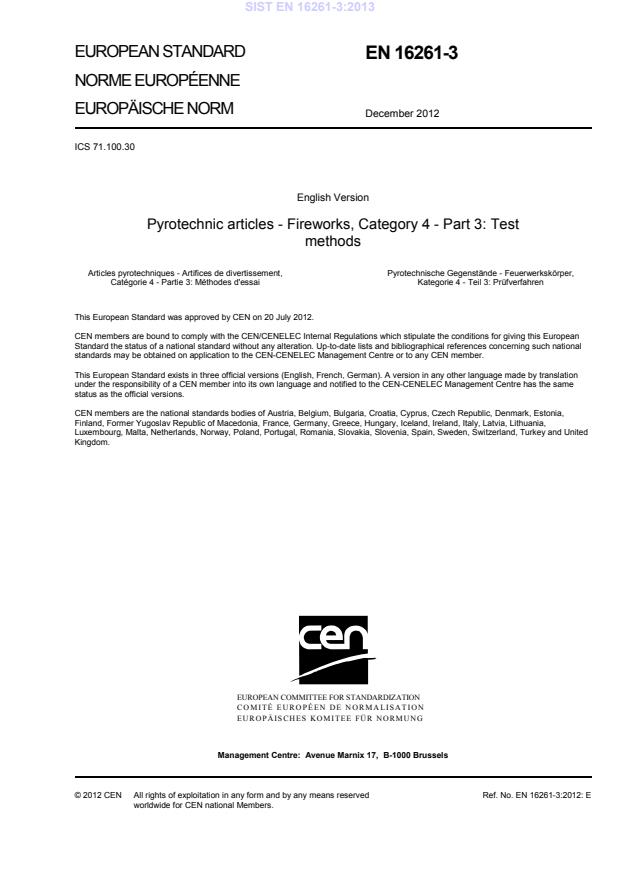
EUROPEAN STANDARD NORME EUROPÉENNE EUROPÄISCHE NORM
EN 16261-3
December 2012 ICS 71.100.30 English Version
Pyrotechnic articles - Fireworks, Category 4 - Part 3: Test methods
Articles pyrotechniques - Artifices de divertissement, Catégorie 4 - Partie 3: Méthodes d'essai
Pyrotechnische Gegenstände - Feuerwerkskörper, Kategorie 4 - Teil 3: Prüfverfahren This European Standard was approved by CEN on 20 July 2012.
CEN members are bound to comply with the CEN/CENELEC Internal Regulations which stipulate the conditions for giving this European Standard the status of a national standard without any alteration. Up-to-date lists and bibliographical references concerning such national standards may be obtained on application to the CEN-CENELEC Management Centre or to any CEN member.
This European Standard exists in three official versions (English, French, German). A version in any other language made by translation under the responsibility of a CEN member into its own language and notified to the CEN-CENELEC Management Centre has the same status as the official versions.
CEN members are the national standards bodies of Austria, Belgium, Bulgaria, Croatia, Cyprus, Czech Republic, Denmark, Estonia, Finland, Former Yugoslav Republic of Macedonia, France, Germany, Greece, Hungary, Iceland, Ireland, Italy, Latvia, Lithuania, Luxembourg, Malta, Netherlands, Norway, Poland, Portugal, Romania, Slovakia, Slovenia, Spain, Sweden, Switzerland, Turkey and United Kingdom.
EUROPEAN COMMITTEE FOR STANDARDIZATION
COMITÉ EUROPÉEN DE NORMALISATION EUROPÄISCHES KOMITEE FÜR NORMUNG
Management Centre:
Avenue Marnix 17,
B-1000 Brussels © 2012 CEN All rights of exploitation in any form and by any means reserved worldwide for CEN national Members. Ref. No. EN 16261-3:2012: ESIST EN 16261-3:2013
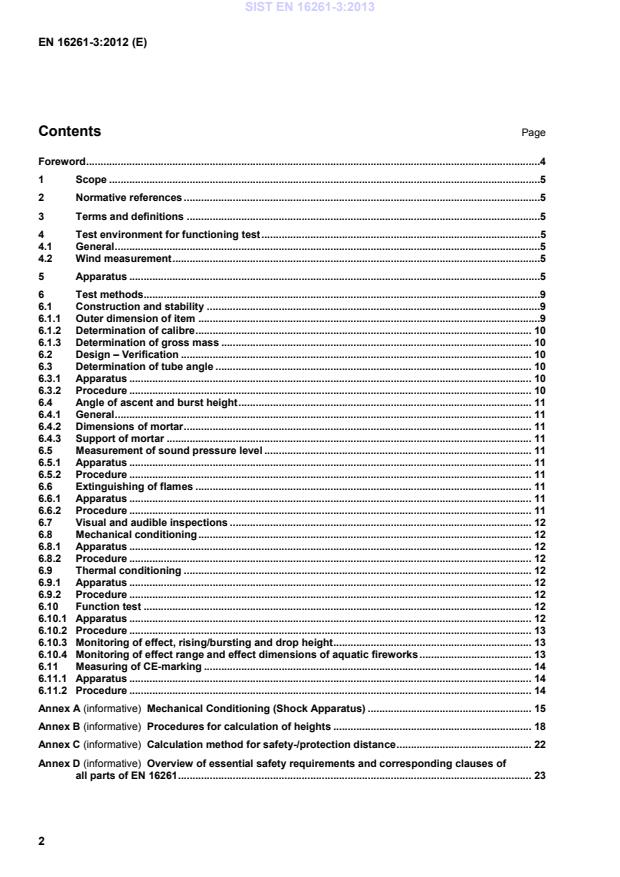
Mechanical Conditioning (Shock Apparatus) . 15 Annex B (informative)
Procedures for calculation of heights . 18 Annex C (informative)
Calculation method for safety-/protection distance . 22 Annex D (informative)
Overview of essential safety requirements and corresponding clauses of all parts of EN 16261 . 23 SIST EN 16261-3:2013
Relationship between this European Standard and the Essential Requirements of EU Directive 2007/23/EC on the placing on the market of pyrotechnic articles . 24 Bibliography . 25
±= 2,5) °C. 5.7.2 Up to (75
±= 2,5) °C. 5.8 Sound level meter. Sound level meter of class 1 conform to EN 61672-1 with a free-field microphone. 5.9 Shock apparatus. The apparatus shall provide a deceleration of 490 m/s2 (-50/+100) m/s2 (when measured at the centre of an unloaded platform) and the shock impulse duration (time elapsed from the starting of the machine's deceleration to the time in which the deceleration reaches its maximum value during each first shock pulse) shall be 2 ms ± 1 ms working at a frequency of 1 Hz ± 0,1 Hz. An example of an apparatus is shown in Annex A. 5.10 Devices for measuring heights. Heights shall be measured using universal surveying instruments (USI) such as theodolites, electronic spirit levels or video (visible and/or infrared) systems. Examples of measuring methods and the calculation of the height are given in Annex B. 5.11 Goniometer. Goniometer reading to 1° or better. 5.12 Mortar. The rising height of shells depends particularly on the clearance of the shell in the mortar (ratio of the maximum cross section area of the shell (AShell) to the inner cross section area of the mortar (Amortar)), also designated as "Q". Q is the ratio of the outer diameter of the shell (do,shell, including the fuse to the lifting charge) squared over the inner diameter of the mortar (di,mortar) squared. The outer diameter of the shell shall be measured horizontally at the place of largest diameter including the fuse to the lifting charge. The following conditions shall be achieved: 98,09,0mortari,2shello,2mortarshell≤==≤ddAAQ SIST EN 16261-3:2013
shello,2mortari,shello,21,102,1ddd⋅≤≤⋅ cor calibre ≤ 100 mm, a wider tolerance can be accepted. The following conditions shall be achieved:
98,083,0*100≤≤≤Q
shello,2mortari,*shello,22,1(02,1ddd⋅≤≤⋅ Another determining factor influencing the rising height is the length of the mortar (lmortar) – length from the mortar muzzle to the mortar ground.
The dimensions of the mortar may also be determined from Figures 1, 2 and 3.
Key X calibre of the shell (mm) Y internal diameter of the mortar (mm) Figure 1 — Dimensions of the mortars for spherical shells – Calibre above 100 mm SIST EN 16261-3:2013
Key X calibre of the shell (mm) Y internal diameter of the mortar (mm) Figure 2 — Dimensions of the mortars for spherical shells – Calibre up to 100 mm SIST EN 16261-3:2013
Key X calibre of the shell (mm) Y inside length of the mortar (mm)
lmortar = 6 X dn + 70
lmortar = 4 X dn + 120 4 X dn + 120 ≤ lmortar (mm) ≤ 6 X dn + 70
dn nominal calibre Figure 3 — Range of the mortar length for spherical shells
6 Test methods NOTE Any equivalent method with the same sensitivity and the same accuracy or better might be used. 6.1 Construction and stability 6.1.1 Outer dimension of item 6.1.1.1 Apparatus Ruler (see 5.3). 6.1.1.2 Procedure Use the ruler to measure the outer dimensions of the tested article to the nearest of 1,0 mm and record the results. SIST EN 16261-3:2013
Key 1 base of firework 2 tube of mine, Roman candle or shot tube Figure 4 — Determination of tube angle SIST EN 16261-3:2013
...