

EN 14471:2013
(Main)Chimneys - System chimneys with plastic flue liners - Requirements and test methods
- Abstract
This European Standard specifies the performance requirements and test methods for system chimneys with plastic flue liners used to convey the products of combustion from appliances to the outside atmosphere under dry and wet conditions. It also specifies the requirements for marking, manufacturer's instructions and evaluation of conformity.
This European Standard describes chimney components from which system chimneys can be assembled.
This European Standard is not applicable to chimneys with sootfire resistance classification class G.
This European Standard is not applicable for chimneys with the following classification:
- corrosion resistance class 2 concerning natural wood );
- corrosion resistance class 3;
- pressure class N2.
This European Standard is applicable to chimneys designed so that no condensate accumulation can occur, e.g. with a minimum inclination of 3° to the horizontal.
This European Standard is not applicable
- for system chimneys with plastic coated flue liners;
- to structurally independent (free-standing or self-supporting) chimneys.
Chimneys with components which need further processing during the installation to reach the final material properties are no system chimneys and therefore also not covered by this standard.
This European Standard does not cover the requirements for horizontal terminals (as defined for C1 installation types in CEN/TR 1749) regarding aerodynamic behaviour, rainwater ingress and icing behaviour.
- Status
- Withdrawn
- Publication Date
- 19-Nov-2013
- Withdrawal Date
- 06-Oct-2026
- Technical Committee
- CEN/TC 166 - Chimneys
- Current Stage
- 9960 - Withdrawal effective - Withdrawal
- Start Date
- 14-Jan-2015
- Completion Date
- 07-Oct-2026

Relations
- Replaces
EN 14471:2005 - Chimneys - System chimneys with plastic flue liners - Requirements and test methods - Effective Date
- 27-Nov-2013
- Effective Date
- 19-Jan-2023
- Effective Date
- 25-Aug-2026
- Effective Date
- 15-Jul-2026
- Effective Date
- 01-Apr-2026
- Effective Date
- 09-Feb-2026
- Effective Date
- 04-Feb-2026
- Effective Date
- 28-Jan-2026
- Effective Date
- 28-Jan-2026
- Effective Date
- 28-Jan-2026
- Effective Date
- 28-Jan-2026
- Effective Date
- 28-Jan-2026
- Effective Date
- 28-Jan-2026
- Effective Date
- 28-Jan-2026
- Effective Date
- 28-Jan-2026
Get Certified
Connect with accredited certification bodies for this standard

DIBt (Deutsches Institut für Bautechnik)
German Institute for Building Technology.
DIN CERTCO
DIN Group product certification.

Aboma Certification B.V.
Specialized in construction, metal, and transport sectors.
Sponsored listings
Frequently Asked Questions
EN 14471:2013 is a standard published by the European Committee for Standardization (CEN). Its full title is "Chimneys - System chimneys with plastic flue liners - Requirements and test methods". This standard covers: This European Standard specifies the performance requirements and test methods for system chimneys with plastic flue liners used to convey the products of combustion from appliances to the outside atmosphere under dry and wet conditions. It also specifies the requirements for marking, manufacturer's instructions and evaluation of conformity. This European Standard describes chimney components from which system chimneys can be assembled. This European Standard is not applicable to chimneys with sootfire resistance classification class G. This European Standard is not applicable for chimneys with the following classification: - corrosion resistance class 2 concerning natural wood ); - corrosion resistance class 3; - pressure class N2. This European Standard is applicable to chimneys designed so that no condensate accumulation can occur, e.g. with a minimum inclination of 3° to the horizontal. This European Standard is not applicable - for system chimneys with plastic coated flue liners; - to structurally independent (free-standing or self-supporting) chimneys. Chimneys with components which need further processing during the installation to reach the final material properties are no system chimneys and therefore also not covered by this standard. This European Standard does not cover the requirements for horizontal terminals (as defined for C1 installation types in CEN/TR 1749) regarding aerodynamic behaviour, rainwater ingress and icing behaviour.
This European Standard specifies the performance requirements and test methods for system chimneys with plastic flue liners used to convey the products of combustion from appliances to the outside atmosphere under dry and wet conditions. It also specifies the requirements for marking, manufacturer's instructions and evaluation of conformity. This European Standard describes chimney components from which system chimneys can be assembled. This European Standard is not applicable to chimneys with sootfire resistance classification class G. This European Standard is not applicable for chimneys with the following classification: - corrosion resistance class 2 concerning natural wood ); - corrosion resistance class 3; - pressure class N2. This European Standard is applicable to chimneys designed so that no condensate accumulation can occur, e.g. with a minimum inclination of 3° to the horizontal. This European Standard is not applicable - for system chimneys with plastic coated flue liners; - to structurally independent (free-standing or self-supporting) chimneys. Chimneys with components which need further processing during the installation to reach the final material properties are no system chimneys and therefore also not covered by this standard. This European Standard does not cover the requirements for horizontal terminals (as defined for C1 installation types in CEN/TR 1749) regarding aerodynamic behaviour, rainwater ingress and icing behaviour.
EN 14471:2013 is classified under the following ICS (International Classification for Standards) categories: 91.060.40 - Chimneys, shafts, ducts. The ICS classification helps identify the subject area and facilitates finding related standards.
EN 14471:2013 has the following relationships with other standards: It is inter standard links to EN 14471:2005, EN 14471:2013+A1:2015, ISO 2859-1:1999, EN ISO 14021:2026, EN ISO 179-1:2026, EN 60529:1991, EN ISO 11925-2:2026, EN ISO 11357-3:2025, EN ISO 178:2019, EN ISO 9969:2016, EN 13216-1:2004, EN 14241-1:2013, EN 13384-1:2002+A2:2008, EN ISO 1183-1:2025, EN ISO 527-1:2019. Understanding these relationships helps ensure you are using the most current and applicable version of the standard.
EN 14471:2013 is associated with the following European legislation: EU Directives/Regulations: 305/2011, 89/106/EEC; Standardization Mandates: M/105. When a standard is cited in the Official Journal of the European Union, products manufactured in conformity with it benefit from a presumption of conformity with the essential requirements of the corresponding EU directive or regulation.
EN 14471:2013 is available in PDF format for immediate download after purchase. The document can be added to your cart and obtained through the secure checkout process. Digital delivery ensures instant access to the complete standard document.
Standards Content (Sample)
2003-01.Slovenski inštitut za standardizacijo. Razmnoževanje celote ali delov tega standarda ni dovoljeno.Abgasanlagen - Systemabgasanlagen mit Kunststoffinnenrohren - Anforderungen und PrüfungenConduits de fumée - Systèmes de conduits de fumée avec parois intérieures en plastique - Exigences et méthodes d'essaiChimneys - System chimneys with plastic flue liners - Requirements and test methods91.060.40Dimniki, jaški, kanaliChimneys, shafts, ductsICS:Ta slovenski standard je istoveten z:EN 14471:2013SIST EN 14471:2014en,fr,de01-februar-2014SIST EN 14471:2014SLOVENSKI
STANDARDSIST EN 14471:20061DGRPHãþD
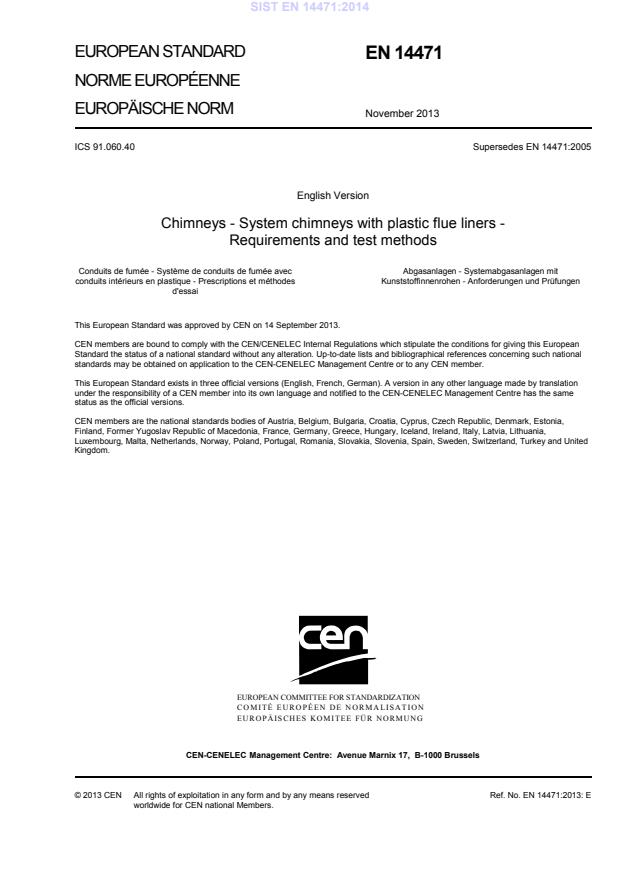
EUROPEAN STANDARD NORME EUROPÉENNE EUROPÄISCHE NORM
EN 14471
November 2013 ICS 91.060.40 Supersedes EN 14471:2005English Version
Chimneys - System chimneys with plastic flue liners - Requirements and test methods
Conduits de fumée - Système de conduits de fumée avec conduits intérieurs en plastique - Prescriptions et méthodes d'essai
Abgasanlagen - Systemabgasanlagen mit Kunststoffinnenrohen - Anforderungen und Prüfungen This European Standard was approved by CEN on 14 September 2013.
CEN members are bound to comply with the CEN/CENELEC Internal Regulations which stipulate the conditions for giving this European Standard the status of a national standard without any alteration. Up-to-date lists and bibliographical references concerning such national standards may be obtained on application to the CEN-CENELEC Management Centre or to any CEN member.
This European Standard exists in three official versions (English, French, German). A version in any other language made by translation under the responsibility of a CEN member into its own language and notified to the CEN-CENELEC Management Centre has the same status as the official versions.
CEN members are the national standards bodies of Austria, Belgium, Bulgaria, Croatia, Cyprus, Czech Republic, Denmark, Estonia, Finland, Former Yugoslav Republic of Macedonia, France, Germany, Greece, Hungary, Iceland, Ireland, Italy, Latvia, Lithuania, Luxembourg, Malta, Netherlands, Norway, Poland, Portugal, Romania, Slovakia, Slovenia, Spain, Sweden, Switzerland, Turkey and United Kingdom.
EUROPEAN COMMITTEE FOR STANDARDIZATION
COMITÉ EUROPÉEN DE NORMALISATION EUROPÄISCHES KOMITEE FÜR NORMUNG
CEN-CENELEC Management Centre:
Avenue Marnix 17,
B-1000 Brussels © 2013 CEN All rights of exploitation in any form and by any means reserved worldwide for CEN national Members. Ref. No. EN 14471:2013: ESIST EN 14471:2014
Test methods for characterization . 45 Annex B (informative)
Examples of characterization . 47 Annex C (normative)
Test methods to determine the effect to long-term thermal load, long-term condensate exposure, wet/dry cycling and resistance to UV . 48 Annex D (normative)
Simplified calculation of thermal resistance for circular flues . 49 SIST EN 14471:2014
Method for applying an evenly distributed load (horizontal) . 51 Annex F (informative)
Resistance to UV . 52 Annex G (normative)
Terminals . 53 G.1 Characteristics of a terminal . 53 G.1.1 General . 53 G.1.2 Types of terminals . 53 G.1.3 Wind direction characteristics . 53 G.2 Requirements . 54 G.2.1 General . 54 G.2.2 Flow resistance of terminals Type I, II and III . 54 G.2.3 Aerodynamic properties of terminals Type II and III . 54 G.2.4 Rain water ingress . 55 G.2.5 Icing behaviour . 55 G.3 Characteristics of the terminal . 55 G.3.1 Flow resistance . 55 G.3.2 Aerodynamic properties . 56 G.3.3 Rainwater ingress . 58 G.3.4 Icing behaviour . 58 Annex H (normative)
Test methods for flow resistance . 59 H.1 For terminal Type I, II and III, test method for flow resistance . 59 H.1.1 Test apparatus . 59 H.1.2 Test sample . 59 H.1.3 Measurement parameters . 59 H.1.4 Test condition . 60 H.1.5 Test procedure . 60 H.1.6 Test result . 60 Annex I (normative)
Test methods for wind effects on pressure . 63 I.1 For terminal Type II, test method for wind velocity pressure . 63 I.1.1 Test apparatus . 63 I.1.2 Test sample . 63 I.1.3 Measurement parameters . 63 I.1.4 Test condition . 64 I.1.5 Test procedure . 64 I.1.6 Test result . 64 I.2 For a terminal Type III, test method for wind velocity pressure . 64 I.2.1 Test apparatus . 64 I.2.2 Test sample . 65 I.2.3 Measurement parameters . 65 I.2.4 Test condition . 66 I.2.5 Test procedure . 66 I.2.6 Test result . 66 Annex J (normative)
Test methods for wind effects on recirculation . 67 J.1 For terminal Type III, test method for recirculation. 67 J.1.1 Test apparatus . 67 J.1.2 Test sample . 67 J.1.3 Measurement parameters . 67 J.1.4 Test condition . 68 J.1.5 Test procedure . 68 J.1.6 Test result . 68 Annex K (normative)
Test method for rain water ingress . 69 K.1 For terminal Type Ib, II and III, test method without wind . 69 K.1.1 Test apparatus . 69 K.1.2 Test sample . 69 K.1.3 Measurement parameters . 69 K.1.4 Test condition . 69 K.1.5 Test procedure . 70 SIST EN 14471:2014
Test method of icing effects . 75 L.1 For terminal Type II and III, test method for icing behaviour . 75 L.1.1 Test apparatus . 75 L.1.2 Test sample . 75 L.1.3 Measurement parameters . 75 L.1.4 Test condition . 76 L.1.5 Test procedure . 76 L.1.6 Test result. 76 Annex ZA (informative)
Clauses of this European Standard addressing the provisions of the EU Construction Products Regulation . 78 ZA.1 Scope and relevant characteristics . 78 ZA.2 Procedure for AVCP of system chimneys with plastic flue liners and terminals . 80 ZA.2.1 Systems of AVCP . 80 ZA.2.2 Declaration of performance (DoP) . 87 ZA.2.2.1 General . 87 ZA.2.2.2 Content . 87 ZA.2.2.3 Example of DoP . 89 ZA.3 CE marking and labelling. 91 Bibliography . 95
2 Normative references
The following documents, in whole or in part, are normatively referenced in this document and are indispensable for its application. For dated references, only the edition cited applies. For undated references, the latest edition of the referenced document (including any amendments) applies. EN 1443:2003, Chimneys — General requirements EN 13216-1:2004, Chimneys — Test methods for system chimneys — Part 1: General test methods EN 13384-1:2002+A2:2008, Chimneys — Thermal and fluid dynamic calculation methods — Part 1: Chimneys serving one appliance EN 13501-1:2007+A1:2009, Fire classification of construction products and building elements — Part 1: Classification using test data from reaction to fire tests EN 13501-2, Fire classification of construction products and building elements — Part 2: Classification using data from fire resistance tests, excluding ventilation services EN 13823, Reaction to fire tests for building products — Building products excluding floorings exposed to the thermal attack by a single burning item
1) There is no sufficient knowledge on data for flue gas condensate from appliances fired with natural wood.
identification (finger print) of the material by determining a combination of properties covering the thermal, mechanical and physicochemical behaviour 3.2 material material composition of which an individual component is made, being the result of a manufacturing process in which the raw material(s) is transformed by extrusion, moulding, welding, etc. in its intended shape 3.3 material test
test in which specific properties of a material as defined in 3.2 are tested Note 1 to entry:
The material test does not include the effects of the performance of the chimney system resulting in stress etc. on the individual components. 3.4 flue passage for conveying the products of combustion to the outside atmosphere
3.5 flue gas gaseous portion of the products of combustion conveyed in a flue
3.6 products of combustion products resulting from the combustion of fuel (gaseous, liquid and solid constituents)
3.7 flue liner wall of a chimney consisting of components the surface of which is in contact with products of combustion
[SOURCE: EN 1443:2003, 3.5] 3.8 coated flue liner flue liner where material is applied to the inner surface of the flue liner to change the surface properties 3.9 chimney structure consisting of a wall or walls enclosing a flue or flues
3.10 chimney component any part of a chimney
[SOURCE: EN 1443:2003, 3.7] 3.11 chimney fitting chimney component conveying products of combustion except a chimney section
3.12 chimney section straight chimney component conveying products of combustion
3.14 multi-wall chimney chimney consisting of a flue liner and at least one additional wall
3.15 outer wall external wall of a chimney the surface of which comes in contact with ambient or external environment, or is within cladding or enclosure
3.16 cladding additional non-structural outer wall around a chimney for protection against heat transfer or weathering, or for decorative purposes
3.17 external installation part of a chimney which is located outside the building 3.18 internal installation part of a chimney which is located inside a building 3.19 joint connection between two components
3.20 support chimney accessory used to fix (or transfer the load of) chimney components to structural elements (building, mast, etc.)
3.21 connecting flue pipe component or components connecting the heating appliance outlet and the chimney
3.22 terminal fitting installed at the outlet of a chimney
3.23 system chimney chimney that is installed using a combination of compatible chimney components, obtained or specified from one manufacturing source with product responsibility for the whole chimney
3.24 enclosure barrier that when built around a chimney will give additional safety in case of fire and may provide additional heat transfer resistance
3.25 dry operating condition condition when a chimney is designed to operate normally with the temperature of the inner surface of the flue liner above the water dew point
3.27 condensate liquid products formed when the flue gas is at or below the water dew point
3.28 negative pressure chimney chimney designed to operate with the pressure inside the flue less than the pressure outside the flue
3.29 positive pressure chimney chimney designed to operate with the pressure inside the flue greater than the pressure outside the flue
3.30 sootfire combustion of the flammable residue deposited on the flue liner
3.31 sootfire resistant chimney chimney that is capable of withstanding a specified thermal shock
3.32 thermal resistance of a chimney resistance to heat transfer through the wall or walls of the chimney
3.33 reaction to fire response of a product in contributing by its own decomposition to a fire to which it is exposed, under specified conditions
3.34 resistance to fire of a chimney ability of the chimney to prevent ignition of adjacent combustible materials and to prevent the spread of fire to adjacent areas
3.35 nominal working temperature average flue gas temperature obtained during the nominal output test for the maximum temperature level
symbol :Tnom in °C 3.36 material test temperature temperature the material is actually exposed to in the oven during long-term resistance to thermal load symbol :Tm in °C 3.37 performance test temperature temperature of the medium in the flue liner of a system chimney which is exposed to during the test according to 7.2 to 7.6 symbol :Tf in °C SIST EN 14471:2014
[SOURCE: EN 13084-1:2007] 3.39 flexible flue liner flue liner that is designed to change its shape by elastic deformation to accommodate bends in the route of the flue without significantly changing the cross section 3.40 flow resistance of a terminal pressure loss in a terminal due to the flow in the flue duct and where appropriate in the air duct gas at a given temperature and velocity Note 1 to entry: For balanced flue applications there is a pressure loss for the flue and also for the air supply. For non-balanced flue applications there is a pressure loss only for the flue. 3.41 coefficient of flow resistance ratio between the flow resistance of a terminal and the dynamic pressure of the medium due to a directional and/or cross sectional change in the terminal 3.42 wind velocity pressure pressure generated on the terminal due to wind 3.43 coefficient of wind velocity pressure ratio between the pressure generated by wind in the flue duct and where appropriate in the air duct and the dynamic pressure of the wind Note 1 to entry: For balanced flue applications it is the ratio of the differential pressure generated by wind between the flue duct and the air duct and the dynamic pressure of the wind. 3.44 recirculation factor ratio between the amou
...