

EN 13216-1:2019
(Main)Chimneys - Test methods for system chimneys - Part 1: General test methods
General Information
- Abstract
This document specifies material-independent general test methods for all system chimneys. It can be used for all flue gas carrying products.
NOTE The thermal performance tests for the determination of the distance to combustible material for accessories (draught regulators, access components, etc.) are included in different standards of CEN/TC 166.
- Status
- Published
- Publication Date
- 16-Apr-2019
- Withdrawal Date
- 30-Oct-2019
- Technical Committee
- CEN/TC 166 - Chimneys
- Drafting Committee
- CEN/TC 166/WG 1 - General requirements
- Current Stage
- 9093 - Decision to confirm - Review Enquiry
- Start Date
- 13-May-2025
- Completion Date
- 30-Sep-2026



Overview
EN 13216-1:2019 - Chimneys: Test methods for system chimneys - Part 1: General test methods - defines material‑independent, general test methods for system chimneys and for all flue‑gas carrying products. It replaces EN 13216-1:2004 and provides the common test framework used across the EN 13216 series. The standard is intended for laboratory type‑testing, product development, conformity assessment and performance verification of chimney systems and terminals.
Note: thermal performance tests relating to distances to combustible materials for accessories (draught regulators, access components, etc.) are handled in other CEN/TC 166 standards.
Key topics and technical requirements
The standard specifies test environment, instrumentation and a wide range of performance tests, including:
- Test environment and measurement accuracy
- Location, ambient conditions, temperature and pressure measurement requirements.
- Mechanical and durability tests
- Abrasion resistance and relative movement of liners in multi‑wall systems.
- Tightness and condensate behaviour
- Gas tightness; condensate penetration (liquid phase) and condensate resistance (vapour phase).
- Thermal performance
- Thermal performance tests and thermal resistance measurement procedures.
- Aerodynamic and flow tests
- Terminal flow resistance (Types I, II, III), flow resistance of ducts, aerodynamic behaviour under wind and recirculation tests.
- Weather resistance
- Rainwater resistance of chimney sections, rain ingress for terminals (with/without wind), icing behaviour.
- Durability under climatic cycles
- Freeze–thaw resistance tests.
- Annexes and test reporting
- Recommended test sequence, basic test structure, method for measuring hot gas temperature, example test report and terminal characterization.
The standard defines test apparatus, sample preparation, measuring parameters, procedures and criteria for reporting results.
Practical applications
EN 13216-1:2019 is used to:
- Support type testing and CE marking of chimney systems and flue components.
- Provide repeatable methods for R&D and product validation (manufacturers).
- Enable independent test laboratories to produce comparable performance data.
- Inform specifiers, HVAC engineers and installers about expected product behaviour (airflow, condensation, weather resistance).
- Support regulatory and conformity assessment by national authorities and certification bodies.
Who uses this standard?
- Chimney and flue system manufacturers
- Independent testing and certification laboratories
- HVAC and building services engineers
- Product safety and compliance officers
- Regulators and technical assessors
Related standards
- Other parts of the EN 13216 series covering product‑specific tests and accessories
- Standards and documents developed by CEN/TC 166 (chimney and flue systems)
Keywords: EN 13216-1:2019, system chimneys, chimney test methods, flue gas, thermal performance, gas tightness, condensate resistance, terminal flow resistance, rain ingress, aerodynamic behaviour.
Relations
- Replaces
EN 13216-1:2004 - Chimneys - Test methods for system chimneys - Part 1: General test methods - Effective Date
- 18-Jun-2014
- Effective Date
- 09-Feb-2026
- Effective Date
- 28-Jan-2026
- Effective Date
- 28-Jan-2026
- Referred By
EN 16497-1:2015 - Chimneys - Concrete System Chimneys - Part 1: Non-balanced flue applications - Effective Date
- 28-Jan-2026
- Effective Date
- 28-Jan-2026
- Effective Date
- 28-Jan-2026
- Effective Date
- 28-Jan-2026
- Effective Date
- 28-Jan-2026
- Referred By
EN 15035:2006 - Heating boilers - Special requirements for oil fired room sealed units up to 70 kW - Effective Date
- 28-Jan-2026
- Effective Date
- 28-Jan-2026
- Referred By
EN 26:2015 - Gas-fired instantaneous water heaters for the production of domestic hot water - Effective Date
- 28-Jan-2026
- Effective Date
- 28-Jan-2026
- Effective Date
- 28-Jan-2026
- Effective Date
- 28-Jan-2026
Get Certified
Connect with accredited certification bodies for this standard

DIBt (Deutsches Institut für Bautechnik)
German Institute for Building Technology.
DIN CERTCO
DIN Group product certification.

Aboma Certification B.V.
Specialized in construction, metal, and transport sectors.
Sponsored listings
Frequently Asked Questions
EN 13216-1:2019 is a standard published by the European Committee for Standardization (CEN). Its full title is "Chimneys - Test methods for system chimneys - Part 1: General test methods". This standard covers: This document specifies material-independent general test methods for all system chimneys. It can be used for all flue gas carrying products. NOTE The thermal performance tests for the determination of the distance to combustible material for accessories (draught regulators, access components, etc.) are included in different standards of CEN/TC 166.
This document specifies material-independent general test methods for all system chimneys. It can be used for all flue gas carrying products. NOTE The thermal performance tests for the determination of the distance to combustible material for accessories (draught regulators, access components, etc.) are included in different standards of CEN/TC 166.
EN 13216-1:2019 is classified under the following ICS (International Classification for Standards) categories: 91.060.40 - Chimneys, shafts, ducts. The ICS classification helps identify the subject area and facilitates finding related standards.
EN 13216-1:2019 has the following relationships with other standards: It is inter standard links to EN 13216-1:2004, EN 60529:1991, EN 13384-1:2015, EN 10088-1:2023, EN 16497-1:2015, EN 1443:2003, EN 1857:2010, EN 16475-3:2016, EN 1366-13:2019, EN 15035:2006, EN 13501-2:2023, EN 26:2015, EN 15502-2-1:2022, EN 1858:2008+A1:2011, EN 15287-2:2023. Understanding these relationships helps ensure you are using the most current and applicable version of the standard.
EN 13216-1:2019 is associated with the following European legislation: EU Directives/Regulations: 305/2011; Standardization Mandates: M/105, M/447. When a standard is cited in the Official Journal of the European Union, products manufactured in conformity with it benefit from a presumption of conformity with the essential requirements of the corresponding EU directive or regulation.
EN 13216-1:2019 is available in PDF format for immediate download after purchase. The document can be added to your cart and obtained through the secure checkout process. Digital delivery ensures instant access to the complete standard document.
Standards Content (Sample)
SLOVENSKI STANDARD
01-julij-2019
Nadomešča:
SIST EN 13216-1:2004
Dimovodne naprave - Preskusne metode za sistemske dimovodne naprave - 1. del:
Splošne preskusne metode
Chimneys - Test methods for system chimneys - Part 1: General test methods
Abgasanlagen - Prüfverfahren für System-Abgasanlagen - Teil 1: Allgemeine
Prüfverfahren
Conduits de fumée - Méthodes d'essai pour les systèmes de conduits de fumée - Partie
1 : Méthodes d'essai générales
Ta slovenski standard je istoveten z: EN 13216-1:2019
ICS:
91.060.40 Dimniki, jaški, kanali Chimneys, shafts, ducts
2003-01.Slovenski inštitut za standardizacijo. Razmnoževanje celote ali delov tega standarda ni dovoljeno.
EN 13216-1
EUROPEAN STANDARD
NORME EUROPÉENNE
April 2019
EUROPÄISCHE NORM
ICS 91.060.40 Supersedes EN 13216-1:2004
English Version
Chimneys - Test methods for system chimneys - Part 1:
General test methods
Conduits de fumée - Méthodes d'essai pour les Abgasanlagen - Prüfverfahren für System-
systèmes de conduits de fumée - Partie 1 : Méthodes Abgasanlagen - Teil 1: Allgemeine Prüfverfahren
d'essai générales
This European Standard was approved by CEN on 12 November 2018.
CEN members are bound to comply with the CEN/CENELEC Internal Regulations which stipulate the conditions for giving this
European Standard the status of a national standard without any alteration. Up-to-date lists and bibliographical references
concerning such national standards may be obtained on application to the CEN-CENELEC Management Centre or to any CEN
member.
This European Standard exists in three official versions (English, French, German). A version in any other language made by
translation under the responsibility of a CEN member into its own language and notified to the CEN-CENELEC Management
Centre has the same status as the official versions.
CEN members are the national standards bodies of Austria, Belgium, Bulgaria, Croatia, Cyprus, Czech Republic, Denmark, Estonia,
Finland, Former Yugoslav Republic of Macedonia, France, Germany, Greece, Hungary, Iceland, Ireland, Italy, Latvia, Lithuania,
Luxembourg, Malta, Netherlands, Norway, Poland, Portugal, Romania, Serbia, Slovakia, Slovenia, Spain, Sweden, Switzerland,
Turkey and United Kingdom.
EUROPEAN COMMITTEE FOR STANDARDIZATION
COMITÉ EUROPÉEN DE NORMALISATION
EUROPÄISCHES KOMITEE FÜR NORMUNG
CEN-CENELEC Management Centre: Rue de la Science 23, B-1040 Brussels
© 2019 CEN All rights of exploitation in any form and by any means reserved Ref. No. EN 13216-1:2019 E
worldwide for CEN national Members.
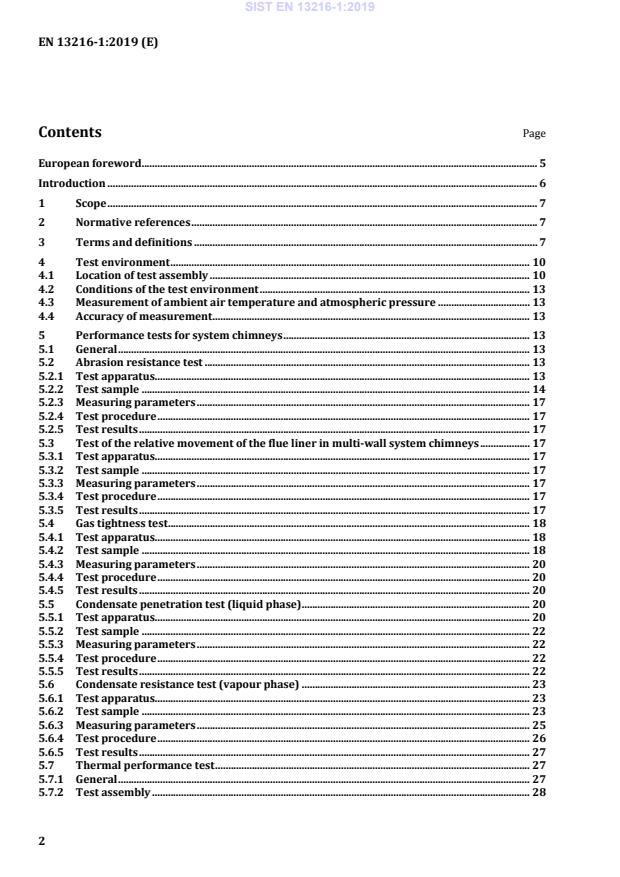
Contents Page
European foreword . 5
Introduction . 6
1 Scope . 7
2 Normative references . 7
3 Terms and definitions . 7
4 Test environment . 10
4.1 Location of test assembly . 10
4.2 Conditions of the test environment . 13
4.3 Measurement of ambient air temperature and atmospheric pressure . 13
4.4 Accuracy of measurement . 13
5 Performance tests for system chimneys . 13
5.1 General . 13
5.2 Abrasion resistance test . 13
5.2.1 Test apparatus. 13
5.2.2 Test sample . 14
5.2.3 Measuring parameters . 17
5.2.4 Test procedure . 17
5.2.5 Test results . 17
5.3 Test of the relative movement of the flue liner in multi-wall system chimneys . 17
5.3.1 Test apparatus. 17
5.3.2 Test sample . 17
5.3.3 Measuring parameters . 17
5.3.4 Test procedure . 17
5.3.5 Test results . 17
5.4 Gas tightness test . 18
5.4.1 Test apparatus. 18
5.4.2 Test sample . 18
5.4.3 Measuring parameters . 20
5.4.4 Test procedure . 20
5.4.5 Test results . 20
5.5 Condensate penetration test (liquid phase) . 20
5.5.1 Test apparatus. 20
5.5.2 Test sample . 22
5.5.3 Measuring parameters . 22
5.5.4 Test procedure . 22
5.5.5 Test results . 22
5.6 Condensate resistance test (vapour phase) . 23
5.6.1 Test apparatus. 23
5.6.2 Test sample . 23
5.6.3 Measuring parameters . 25
5.6.4 Test procedure . 26
5.6.5 Test results . 27
5.7 Thermal performance test . 27
5.7.1 General . 27
5.7.2 Test assembly . 28
5.7.3 Test procedure . 38
5.7.4 Test results . 40
5.8 Thermal resistance test . 40
5.8.1 Test apparatus . 40
5.8.2 Test sample . 42
5.8.3 Measuring parameters. 42
5.8.4 Test procedure . 42
5.8.5 Test results . 44
5.9 Terminal flow resistance for terminal Type I, II and III . 44
5.9.1 General . 44
5.9.2 Test apparatus . 44
5.9.3 Test sample . 44
5.9.4 Measurement parameters . 45
5.9.5 Test condition . 45
5.9.6 Test procedure . 45
5.9.7 Test result . 45
5.9.8 Flow resistance in the flue duct for terminals Type I, II and III . 48
5.9.9 Flow resistance in the air duct for terminals Type III . 48
5.10 Aerodynamic behaviour of terminal under wind conditions . 49
5.10.1 For terminal Type II, test method for wind velocity pressure . 49
5.10.2 For a terminal Type III, test method for wind velocity pressure . 51
5.10.3 For terminal Type III, test method for recirculation . 53
5.11 Flow resistance of the test chimney, of fittings or liners . 55
5.11.1 Test apparatus . 55
5.11.2 Test sample . 56
5.11.3 Measuring parameter. 57
5.11.4 Test procedure . 57
5.11.5 Test results . 58
5.12 Rainwater resistance of chimney sections . 59
5.12.1 Test apparatus . 59
5.12.2 Test sample . 60
5.12.3 Measuring parameters. 60
5.12.4 Test procedure . 60
5.12.5 Test results . 60
5.13 Freeze–thaw resistance . 60
5.13.1 Apparatus . 60
5.13.2 Test samples . 61
5.13.3 Test procedure . 61
5.13.4 Test result . 63
5.14 Rainwater ingress for terminals . 63
5.14.1 General . 63
5.14.2 For terminal Type Ib, II and III, test method without wind . 64
5.14.3 For terminal Type Ib, II and III, test method with wind . 66
5.15 Icing behaviour, test method for terminal Type II and III . 69
5.15.1 Test apparatus . 69
5.15.2 Test sample . 69
5.15.3 Measuring parameters. 69
5.15.4 Test condition . 69
5.15.5 Test procedure . 70
5.15.6 Test result . 71
Annex A (informative) Recommended test sequence . 72
Annex B (normative) Basic test structure . 73
Annex C (normative) Method of measuring the hot gas temperature . 75
Annex D (informative) Example of a test report . 77
Annex E (informative) Terminals . 79
E.1 Characterization of a terminal . 79
E.1.1 Types of terminals . 79
E.1.1.1 Type I . 79
E.1.1.2 Type II . 79
E.1.1.3 Type III . 79
E.1.2 Wind direction characteristics . 79
E.2 Requirements . 80
E.2.1 General . 80
E.2.2 Flow resistance of terminals Type I, II and III . 80
E.2.3 Aerodynamic properties of terminals Type II and III . 80
E.2.3.1 Terminal Type II . 80
E.2.3.2 Terminal Type III . 80
E.2.4 Rain water ingress . 81
E.2.5 Icing behaviour . 81
Annex F (informative) Type of test structure . 82
European foreword
This document (EN 13216-1:2019) has been prepared by Technical Committee CEN/TC 166
“Chimneys”, the secretariat of which is held by ASI.
This document shall be given the status of a national standard, either by publication of an identical text
or by endorsement, at the latest by month year of October 2019, and conflicting national standards shall
be withdrawn at the latest by January 2021.
Attention is drawn to the possibility that some of the elements of this document may be the subject of
patent rights. CEN shall not be held responsible for identifying any or all such patent rights.
This document will supersede EN 13216:2004.
System chimneys type tested prior to this revision need not be retested, if historical data covers the
intended configuration for the relevant test.
In comparison to the previous edition the following changes were made:
a) clarification of the scope;
b) revision of terms and definitions;
c) revision of the thermal test assembly and test structure to include options for alternative building
insulation levels;
d) revision of the test procedure;
e) incorporation of terminals;
f) incorporation of test for freeze–thaw resistance;
g) incorporation of testing of concentric balanced flue systems;
h) editorial changes.
According to the CEN-CENELEC Internal Regulations, the national standards organisations of the
following countries are bound to implement this European Standard: Austria, Belgium, Bulgaria,
Croatia, Cyprus, Czech Republic, Denmark, Estonia, Finland, Former Yugoslav Republic of Macedonia,
France, Germany, Greece, Hungary, Iceland, Ireland, Italy, Latvia, Lithuania, Luxembourg, Malta,
Netherlands, Norway, Poland, Portugal, Romania, Serbia, Slovakia, Slovenia, Spain, Sweden, Switzerland,
Turkey and the United Kingdom.
Introduction
CEN/TC 166 intends to publish the test methods for system chimneys as separate parts of a series of
standards.
The first part of the series of EN 13216 includes material-independent test methods for system
chimneys.
Further parts of the multi-part standard include material-specific test methods, each material used for
the inner wall being decisive. The material-specific test methods are based on the general material-
independent test methods. Considering the various characteristics, the material tests can be carried out
on deviating specimens or can include other test procedures that however have correlation to those
given in this document.
It is intended to prepare further parts if further material-specific standards are published.
1 Scope
This document specifies material-independent general test methods for all system chimneys. It can be
used for all flue gas carrying products.
NOTE The thermal performance tests for the determination of the distance to combustible material for
accessories (draught regulators, access components, etc.) are included in different standards of CEN/TC 166.
2 Normative references
The following documents are referred to in the text in such a way that some or all of their content
constitutes requirements of this document. For dated references, only the edition cited applies. For
undated references, the latest edition of the referenced document (including any amendments) applies.
EN 1443, Chimneys - General requirements
EN 10088-1, Stainless steels - Part 1: List of stainless steels
EN 13384-1:2015, Chimneys - Thermal and fluid dynamic calculation methods - Part 1: Chimneys serving
one heating appliance
EN 60529, Degrees of protection provided by enclosures (IP Code) (IEC 60529)
3 Terms and definitions
For the purposes of this document, the terms and definitions given in EN 1443 and the following apply.
ISO and IEC maintain terminological databases for use in standardization at the following addresses:
— IEC Electropedia: available at http://www.electropedia.org/
— ISO Online browsing platform: available at http://www.iso.org/obp
3.1
test chimney
test sample necessary to enable the system chimney to be assessed for the performance criteria defined
in the relevant product standard
3.2
test assembly
construction of all parts necessary to enable the specific performance criteria to be assessed,
comprising test sample, test structures, and measuring equipment
3.3
test sample
assembly of chimney components necessary to enable the system chimney to be assessed for specific
performance criteria
3.4
test structure
assembly of the additional materials (non-chimney components) to enable the test sample to be
assessed for the specific performance criteria
3.5
thermal performance test
method to assess the temperature characteristics of the system chimney
3.6
heat stress test
method to assess the temperature characteristics of the system chimney under normal operating
conditions
3.7
sootfire resistance test
method to assess the sootfire resistance characteristics of the system chimney (internal to external)
3.8
condensate resistance test (vapour phase)
method to assess the system chimney’s resistance to vapour and condensate
Note 1 to entry: This describes the vapour phase.
3.9
condensate penetration test (liquid phase)
method to assess the components or sub-assemblies of system chimney’s resistance to condensate in
the liquid phase
Note 1 to entry: This describes the liquid phase.
3.10
accuracy
ability of the measuring instruments to give response in the specified range from the true value
3.11
uncertainty of measurement
combination of all parameters to give response in the specified range from the true result
Note 1 to entry: Parameters are e.g. accuracy, human parameter, or environmental parameters.
3.12
tolerance
range in which a parameter has to be met
3.13
distance to combustible material
declared distance to combustible material verified in the thermal performance test
3.14
test apparatus
equipement used to perform a test
3.15
conditioning
stabilisation of the sample in ambient air as specified in product standard
3.16
pit
damage in form of superficial fault consisting of a fraction of material detached from the body of the
test-sample with a mean dimension of over 7 mm
3.17
hair crack
damage which is deemed to be harmless in form of superficial crack having a width of not more than
0,15 mm
3.18
nascent crack
damage which is deemed to be harmless in form of crack formation at the edge, only crack penetrating
slightly into the interior of the test sample
3.19
surface crack
damage caused by crack of more than 0,15 mm width which does not pass through the test sample
3.20
scaling
damage caused by surface raising, nascent chipping or crack, which initiates damage
3.21
peeling
damage characterised by the loss of part of the superficial layer of the test sample
3.22
surface damage
damage caused by breaking off (detachment) a part of the surface of the test sample; the surface area of
the test sample remains unchanged
3.23
flaking
damage characterised by a progressive loss of material affecting the whole, or part of the thickness of
the sample
3.24
structural crack
structural damage consisting of a more or less regular crack running throughout the entire thickness of
the test sample and visible to the naked eye
3.25
break
structural damage consisting of a separation of the test sample into two or more fragments
3.26
delamination
damage in the form of lamellar flaking in a succession of parallel layers
4 Test environment
4.1 Location of test assembly
The distance between the test assembly as shown in Figure 1 a) to 1 c) and other structures (e.g. test
room walls) shall be sufficient to not influence the test results; a distance of at least 1,0 m is deemed to
satisfy this requirement.
a) — Test assembly (schematic)
Dimensions in millimetres
b) — Test assembly (detailed)
Dimensions in millimetres
c) — Example of free standing test assembly
NOTE Figure 1 c) illustrates the principle of test assembly and does not represent any specific test assembly.
Key
test apparatus
test structure
test chimney
1 plywood 9 zone C
2 insulation 10 zone B
3 plywood 11 zone A
4 extract provisions x distance to combustible
5 hot gas generator D inner diameter of the test chimney
6 enclosure measuring point for human contact (Figure 1b)
7 test chimney ambient air temperature
8 opening hot gas temperature
ambient air temperature
hot gas temperature
surface temperature, test chimney (Figure 1c)
Figure 1 — Test assemblies
4.2 Conditions of the test environment
The ambient air temperature in the test room shall not vary during the heat stress test by more than 5 K
and shall remain in the temperature range of 15 °C up to 30 °C.
The ambient air temperature in the test room shall not vary during the sootfire resistance test by more
than 15 K and shall remain in the temperature range of 15 °C up to 35 °C.
The test environment shall consist of a ventilated space not subject to air movement greater than
0,5 m/s measured at the ambient thermocouple position. This requirement is deemed fulfilled in a
closed test room.
The humidity shall be controlled between 30 % to 70 % RH.
4.3 Measurement of ambient air temperature and atmospheric pressure
The ambient air temperature shall be measured at a position diagonally from the free corner of the test
assembly (2 ± 0,1) m away from the inside corner of the test rig at the level in the centre of the first
floor (±0,1 m), see Figure 1 b).
Shield a calibrated thermocouple by placing it centrally within a length of aluminium painted metal
tube, (150 ± 2) mm long and 50 mm nominal diameter, open at each end. The metal tube shall be placed
vertically to avoid direct radiation to the thermocouple.
The atmospheric pressure has to be measured.
4.4 Accuracy of measurement
The ambient air temperature shall be measured with an accuracy of ± 1,5 K.
The velocity of the ambient air shall be measured with an accuracy of ± 0,1 m/s.
The atmospheric pressure shall be measured with an accuracy of ± 1 %.
5 Performance tests for system chimneys
5.1 General
Annex A gives a recommended test sequence.
5.2 Abrasion resistance test
5.2.1 Test apparatus
A tight fitting metal sleeve attached to a guide funnel shall be fitted into the top opening of the flue of
the test chimney (see Figure 2). The alternative test sample from chimney sections may be tested as
shown in Figure 3. A tight fitting metal sleeve attached to a plate which has an opening matching the
area of the opening to the flue shall be fitted into the bottom opening of this test sample.
The bottom plate supported directly over a collection box is positioned to collect any material which is
dislodged during the test, and which is sufficiently deep to allow the brush to pass through the complete
length of the test sample.
The brush shall be attached either to a rod or to a sweeping equipment as shown in Figure 4.
Use a sweeping brush having flat spring-steel bristles of stainless steel in accordance with EN 10088-1,
grade X10CrNi18-8, steel number 1.4310, with a cross section of (2,0 ± 0,2) mm x (0,25 ± 0,05) mm
with the ends cut square. The bristles shall be arranged so that there are 5 per 10 mm length of the
perimeter of the plan area of the brush. The brush may be a combination of single brushes.
The over-all dimension of the brush shall be (25 ± 5) mm greater than the internal dimension of a round
flue or the corresponding dimension of a flue with square or rectangular cross section, see Figure 4. The
brush shall be held securely between plates having a plan dimension (100 ± 5) mm less than the
internal dimension of the flue.
The balance to weigh the deposit shall have an accuracy of 1,0 g.
5.2.2 Test sample
The test sample shall be the test chimney used for the thermal performance tests, see Figure 2 or the
alternative test sample, see Figure 3, after thermal performance tests (according to 5.7). The test
sample shall be assembled as specified in the product standards.
Dimensions in millimetres
Key
1 test chimney
2 catchment funnel
Figure 2 — Abrasion resistance – test chimney
Dimensions in millimetres
Key
1 test sample
2 catchment funnel
3 collection box
4 bottom plate
Figure 3 — Abrasion resistance – test sample
Dimensions in millimetres
Key
1 rope
2 striking element
3 brush
4 steel spring bristles
5 chain
6 weight
7 flue liner cross section (round/square/rectangular)
Figure 4 — Abrasion resistance – sweeping test equipment
5.2.3 Measuring parameters
Measure the weight of material dislodged from the inner surface of the test sample after the cycles
specified in the system chimney standards with an accuracy of 1,0 g.
The area for the inner surface of the test sample exposed to abrasion shall be calculated.
5.2.4 Test procedure
The brush shall be pushed down and up through the total length of the test sample with a maximum
speed of 2 m/s, and this represents one cycle. The number of cycles shall be specified in the material
dependant system chimney standard.
Record the weight of material dislodged and the dimensions of the inner surface.
5.2.5 Test results
The recorded mass of material abraded from the inner surface of the test sample over the specified
cycles shall be expressed in terms of kilograms per square meter of the total exposed area of the inner
surface of the flue or flue liner.
5.3 Test of the relative movement of the flue liner in multi-wall system chimneys
5.3.1 Test apparatus
Use a test apparatus which allows the measurement of longitudinal change of position between the flue
liner and the outer wall of multi-wall-system chimneys. This is measured at the chimney outlet prior to
and after the thermal performance test.
The accuracy shall be ± 0,001 m.
5.3.2 Test sample
The test sample shall be the test chimney subjected to the thermal performance tests according to the
product designation. The test sample shall be assembled as specified in product standards and the
provisions in 5.7.
5.3.3 Measuring parameters
Measure the surface temperature of the test chimney in accordance with 5.7.2.5.5.
Measure the change in position of the flue liner relative to the outer wall at the top of the test sample
before and after the thermal performance tests.
5.3.4 Test procedure
All measurements shall be made before and after the thermal performance tests appropriate to the
designation.
Record the difference in length between the flue liner and the outer wall when all thermocouples have
reached ambient air temperature within 5 K.
5.3.5 Test results
The results are expressed by the change in position of the flue liner relative to the outer wall after the
test sample has cooled down to room temperature.
5.4 Gas tightness test
5.4.1 Test apparatus
Provide an air supply capable of delivering air at a flow rate sufficient to achieve and maintain the
required test pressure at the leakage rate appropriate to the designation.
Seal the flue inlet and the flue outlet of the test chimney with an air tight seal in a typical manner, see
Figure 5.
For measurement of pressure use:
— for chimneys designated “N”, a device with the pressure to an accuracy of ± 1 Pa;
— for chimneys designated “P”, a device with the pressure to an accuracy of ± 5 Pa;
— for chimneys designated “M”, a device with the pressure to an accuracy of ± 50 Pa;
— for chimneys designated “H”, a device with the pressure to an accuracy of ± 50 Pa.
5.4.2 Test sample
The test sample shall be the test chimney used for the thermal performance tests. The test sample shall
be assembled as specified in system chimney standards and the provisions in 5.7. For the arrangement
of the gas tightness test see Figure 5.
Where the product standard requires additional tightness tests without thermal conditioning, the test
sample (i.e. with an opening where appropriate) shall consist of at least two chimney sections or fittings
with one joint where applicable.
Key
1 test chimney (example)
2 equipment for closing the outlet (plate or bladder)
3 sealing element
4 flowmeter
5 fan (air supply)
6 manometer
Figure 5 — Gas tightness – test chimney
5.4.3 Measuring parameters
Measure and record:
— gas leakage and the pressure maintained during the test in accordance with pressure class
designation as defined in EN 1443;
— dimensions (e.g. inner diameter of the flue liner, length between closing devices) of the test sample.
Calculate the inner surface area.
Record the leakage rate, the pressure and the dimensions (e.g. inner diameter of the flue liner, length
between closing devices) of the test sample.
5.4.4 Test procedure
Deliver air from the air supply to the flue at a rate necessary to achieve and maintain the required test
pressure given in EN 1443 with a tolerance of:
— ± 5 % for chimneys designated “N”;
— ± 5 % for chimneys designated “P”;
— ± 5 % for chimneys designated “M”;
— ± 5 % for chimneys designated “H”.
The gas leakage shall be measured at ambient temperature.
5.4.5 Test results
The results are expressed by the leakage rate related to the inner surface area of the test sample.
5.5 Condensate penetration test (liquid phase)
5.5.1 Test apparatus
A test apparatus which allows spraying of water into the flue, in accordance with Figure 6, shall be used.
The balance to weigh components of the test sample shall have an accuracy of ± 1 g up to 10 kg
and ± 2 g for more than 10 kg.
Key
1 tank containing water 4 gate valve 7 spray equipment
2 electric heating 5 air supply 8 test chimney
3 thermometer 6 air tight cap 9 condensate outlet
Figure 6 — Condensate resistance (liquid phase) – test chimney
5.5.2 Test sample
The test sample shall be in accordance with the product standard. It consists of minimum two sections
or fittings subjected to thermal performance tests according to the product designation with at least
one joint.
5.5.3 Measuring parameters
Measure:
— the spray temperature and the spray volume;
— the change in weight of the test sample.
Check the appearance of water on the outside of the test sample of fittings or chimney sections of the
test chimney by visual inspection.
5.5.4 Test procedure
Spray water over the total inner circumference at the outlet of the flue liner:
— with a temperature of (50 ± 5) °C;
— with a spray pressure of a maximum of 3 bar;
3 3
-1 -1 -
— with a water volume related to the inner circumference at 0,040 m ⋅ h ⋅ m ± 0,008 m ⋅ h
1 -1
⋅ m ;
for 4 h or until water appears on the outside of the test sample.
Wipe any surface (inside and outside) water from the test sample. The test sample shall be weighed
immediately afterwards.
Dry and weigh the test sample again.
5.5.5 Test results
Record:
— location of any appearance of water on the outside of any fitting or chimney section of the test
samples; and
— any change in weight of the test sample.
5.6 Condensate resistance test (vapour phase)
5.6.1 Test apparatus
A test apparatus which allows to deliver water vapour saturated air at a temperature of (52 ± 2) °C and
a velocity of (1 ± 0,2) m/s, consisting of a fan, a heater, a vapour steam vessel and a flow rectifier, see
Figure 7.
Use measurement equipment for:
— flue gas temperature with an accuracy of ± 1,5 K,
— layer temperature with an accuracy of ± 0,5 K, and
— humidity with an accuracy of ± 2 % in the range of 0 % to 80 % and of ± 3 % in the range of 80 % to
100 %.
The balance to weigh components of the test sample shall have an accuracy of ± 1 g up to 10 kg
and ± 2 g for more than 10 kg. The balance shall be capable of weighing at least two flue liners or two
chimney sections.
For measurement of chimney draught use a device with an accuracy of ± 1 Pa.
For measurement of flue gas velocity use a device with an accuracy of ± 0,1 m/s.
5.6.2 Test sample
The test sample shall be the test chimney used for the thermal performance tests which was subjected
to the thermal performance tests in accordance with the intended designation. For the arrangement for
the condensate resistance test, see Figure 7.
Dimensions in millimetres
Key
1 fan measuring point
2 electric heating a velocity
3 steam injection b pressure
4 rectifier c temperature
5 insulation surface temperature
6 test chimney humidity
7 flue liner air temperature
8 outer wall
Figure 7 — Condensate resistance test (vapour phase) non-enclosed, measuring points in a
multi-wall chimney
5.6.3 Measuring parameters
5.6.3.1 General
Measure and record the temperatures and relative humidity of:
— the flue gas;
— the specified layers of the test sample;
— the ambient air.
Measure and record any change in weight, where appropriate.
5.6.3.2 Ambient air temperature and humidity
For ambient air temperature, see 4.3. Ambient humidity shall be measured at the same position.
5.6.3.3 Flue gas temperature and humidity
Measure the flue gas temperature with an accuracy of ± 1,5 K at a position (100 ± 2) mm before the inlet
to the test chimney and at a position 500 mm below the exit at the top of the test sample. Measure the
flue gas humidi
...