

EN 10088-2:2014
(Main)Stainless steels - Part 2: Technical delivery conditions for sheet/plate and strip of corrosion resisting steels for general purposes
- Abstract
This European Standard specifies the technical delivery conditions for hot or cold rolled sheet/plate and strip of standard grades and special grades of corrosion resisting stainless steels for general purposes.
NOTE General purposes include the use of stainless steels in contact with foodstuffs.
The general technical delivery conditions specified in EN 10021 apply in addition to the specifications of this European Standard, unless otherwise specified in this European Standard.
This European Standard does not apply to components manufactured by further processing of the product forms listed above with quality characteristics altered as a result of such further processing.
- Status
- Withdrawn
- Publication Date
- 21-Oct-2014
- Withdrawal Date
- 06-Oct-2026
- Current Stage
- 9960 - Withdrawal effective - Withdrawal
- Start Date
- 25-Sep-2024
- Completion Date
- 07-Oct-2026
Buy Documents


Relations
- Effective Date
- 08-Jun-2022
- Effective Date
- 28-Oct-2020
- Effective Date
- 19-Aug-2026
- Effective Date
- 28-Jan-2026
- Effective Date
- 28-Jan-2026
- Effective Date
- 28-Jan-2026
- Effective Date
- 28-Jan-2026
- Effective Date
- 28-Jan-2026
- Effective Date
- 28-Jan-2026
- Effective Date
- 28-Jan-2026
- Effective Date
- 28-Jan-2026
- Effective Date
- 28-Jan-2026
- Effective Date
- 28-Jan-2026
- Effective Date
- 28-Jan-2026
- Effective Date
- 28-Jan-2026
Buy Documents
Get Certified
Connect with accredited certification bodies for this standard

Element Materials Technology
Materials testing and product certification.

Inštitut za kovinske materiale in tehnologije
Institute of Metals and Technology. Materials testing, metallurgical analysis, NDT.
Sponsored listings
Frequently Asked Questions
EN 10088-2:2014 is a standard published by the European Committee for Standardization (CEN). Its full title is "Stainless steels - Part 2: Technical delivery conditions for sheet/plate and strip of corrosion resisting steels for general purposes". This standard covers: This European Standard specifies the technical delivery conditions for hot or cold rolled sheet/plate and strip of standard grades and special grades of corrosion resisting stainless steels for general purposes. NOTE General purposes include the use of stainless steels in contact with foodstuffs. The general technical delivery conditions specified in EN 10021 apply in addition to the specifications of this European Standard, unless otherwise specified in this European Standard. This European Standard does not apply to components manufactured by further processing of the product forms listed above with quality characteristics altered as a result of such further processing.
This European Standard specifies the technical delivery conditions for hot or cold rolled sheet/plate and strip of standard grades and special grades of corrosion resisting stainless steels for general purposes. NOTE General purposes include the use of stainless steels in contact with foodstuffs. The general technical delivery conditions specified in EN 10021 apply in addition to the specifications of this European Standard, unless otherwise specified in this European Standard. This European Standard does not apply to components manufactured by further processing of the product forms listed above with quality characteristics altered as a result of such further processing.
EN 10088-2:2014 is classified under the following ICS (International Classification for Standards) categories: 77.140.20 - Stainless steels; 77.140.50 - Flat steel products and semi-products. The ICS classification helps identify the subject area and facilitates finding related standards.
EN 10088-2:2014 has the following relationships with other standards: It is inter standard links to EN 10088-2:2005, EN 10088-2:2024, EN ISO 6892-2:2026, EN 10027-2:2015, EN 10088-1:2014, EN 10168:2004, EN ISO 6508-1:2023, EN ISO 6892-1:2019, EN 10052:1993, EN 10204:2004, EN 10079:2007, EN ISO 3651-2:1998, EN ISO 6507-1:2023, EN 10021:2006, EN ISO 14284:2022. Understanding these relationships helps ensure you are using the most current and applicable version of the standard.
EN 10088-2:2014 is available in PDF format for immediate download after purchase. The document can be added to your cart and obtained through the secure checkout process. Digital delivery ensures instant access to the complete standard document.
Standards Content (Sample)
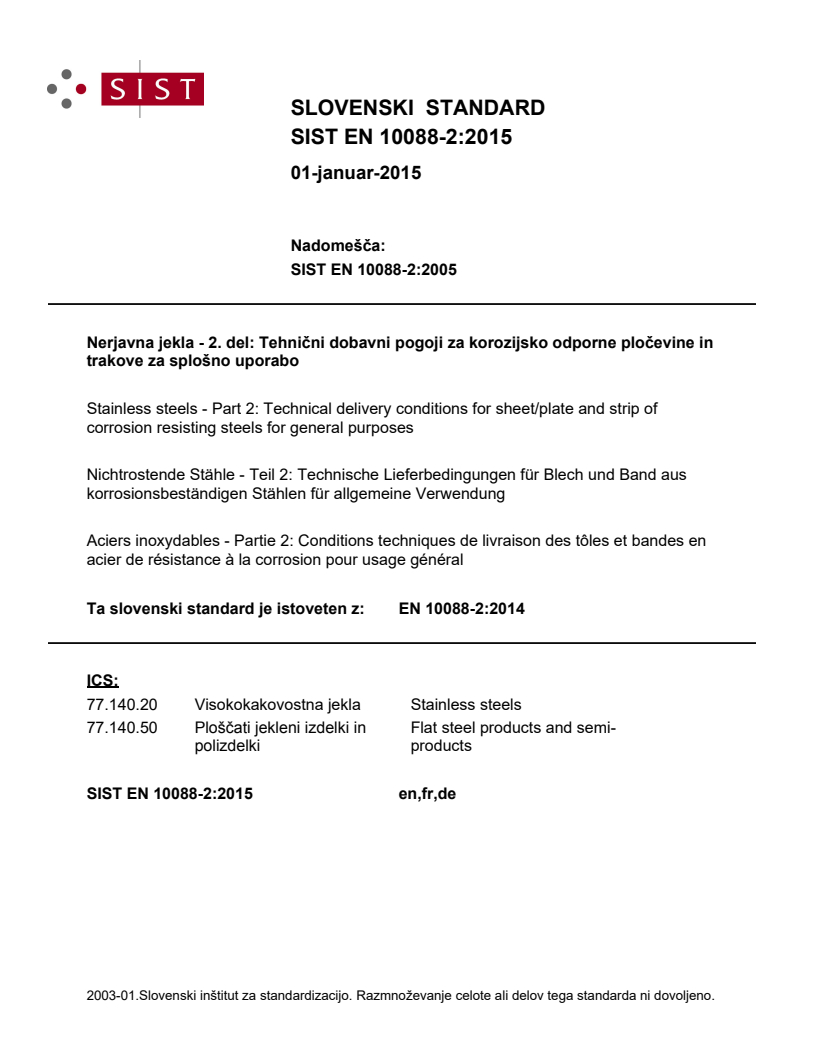
2003-01.Slovenski inštitut za standardizacijo. Razmnoževanje celote ali delov tega standarda ni dovoljeno.Nichtrostende Stähle - Teil 2: Technische Lieferbedingungen für Blech und Band aus korrosionsbeständigen Stählen für allgemeine VerwendungAciers inoxydables - Partie 2: Conditions techniques de livraison des tôles et bandes en acier de résistance à la corrosion pour usage généralStainless steels - Part 2: Technical delivery conditions for sheet/plate and strip of corrosion resisting steels for general purposes77.140.50SROL]GHONLFlat steel products and semi-products77.140.20Visokokakovostna jeklaStainless steelsICS:Ta slovenski standard je istoveten z:EN 10088-2:2014SIST EN 10088-2:2015en,fr,de01-januar-2015SIST EN 10088-2:2015SLOVENSKI
STANDARDSIST EN 10088-2:20051DGRPHãþD
EUROPEAN STANDARD NORME EUROPÉENNE EUROPÄISCHE NORM
EN 10088-2
October 2014 ICS 77.140.20; 77.140.50 Supersedes EN 10088-2:2005English Version
Stainless steels - Part 2: Technical delivery conditions for sheet/plate and strip of corrosion resisting steels for general purposes
Aciers inoxydables - Partie 2: Conditions techniques de livraison des tôles et bandes en acier de résistance à la corrosion pour usage général
Nichtrostende Stähle - Teil 2: Technische Lieferbedingungen für Blech und Band aus korrosionsbeständigen Stählen für allgemeine VerwendungThis European Standard was approved by CEN on 9 August 2014.
CEN members are bound to comply with the CEN/CENELEC Internal Regulations which stipulate the conditions for giving this European Standard the status of a national standard without any alteration. Up-to-date lists and bibliographical references concerning such national standards may be obtained on application to the CEN-CENELEC Management Centre or to any CEN member.
This European Standard exists in three official versions (English, French, German). A version in any other language made by translation under the responsibility of a CEN member into its own language and notified to the CEN-CENELEC Management Centre has the same status as the official versions.
CEN members are the national standards bodies of Austria, Belgium, Bulgaria, Croatia, Cyprus, Czech Republic, Denmark, Estonia, Finland, Former Yugoslav Republic of Macedonia, France, Germany, Greece, Hungary, Iceland, Ireland, Italy, Latvia, Lithuania, Luxembourg, Malta, Netherlands, Norway, Poland, Portugal, Romania, Slovakia, Slovenia, Spain, Sweden, Switzerland, Turkey and United Kingdom.
EUROPEAN COMMITTEE FOR STANDARDIZATION
COMITÉ EUROPÉEN DE NORMALISATION EUROPÄISCHES KOMITEE FÜR NORMUNG
CEN-CENELEC Management Centre:
Avenue Marnix 17,
B-1000 Brussels © 2014 CEN All rights of exploitation in any form and by any means reserved worldwide for CEN national Members. Ref. No. EN 10088-2:2014 ESIST EN 10088-2:2015
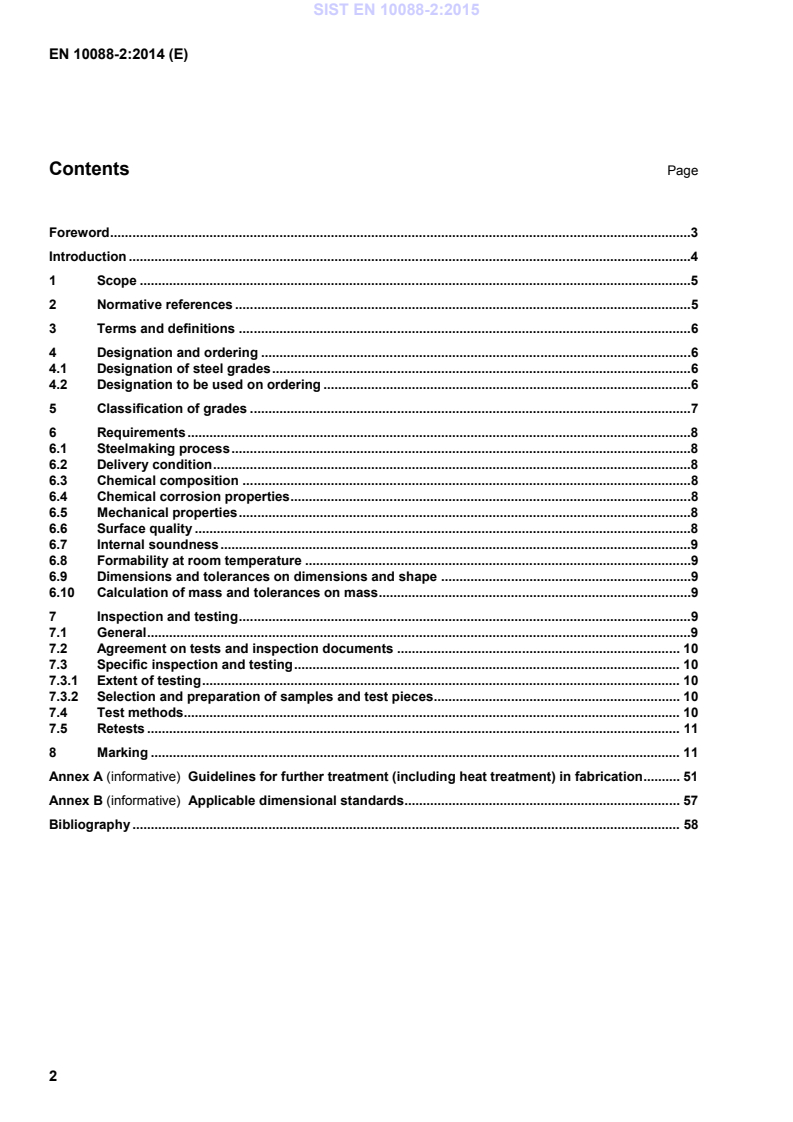
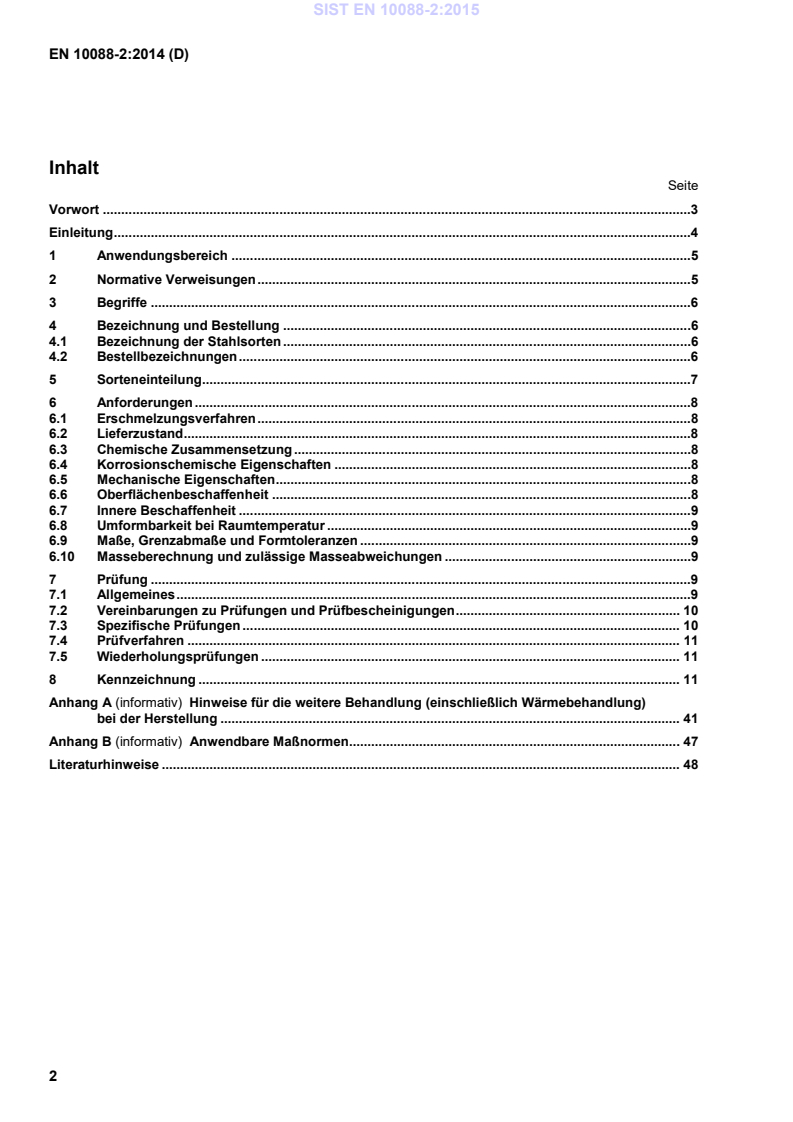
Foreword .3 Introduction .4 1 Scope .5 2 Normative references .5 3 Terms and definitions .6 4 Designation and ordering .6 4.1 Designation of steel grades .6 4.2 Designation to be used on ordering .6 5 Classification of grades .7 6 Requirements .8 6.1 Steelmaking process .8 6.2 Delivery condition .8 6.3 Chemical composition .8 6.4 Chemical corrosion properties .8 6.5 Mechanical properties .8 6.6 Surface quality .8 6.7 Internal soundness .9 6.8 Formability at room temperature .9 6.9 Dimensions and tolerances on dimensions and shape .9 6.10 Calculation of mass and tolerances on mass .9 7 Inspection and testing .9 7.1 General .9 7.2 Agreement on tests and inspection documents . 10 7.3 Specific inspection and testing . 10 7.3.1 Extent of testing . 10 7.3.2 Selection and preparation of samples and test pieces. 10 7.4 Test methods . 10 7.5 Retests . 11 8 Marking . 11 Annex A (informative)
Guidelines for further treatment (including heat treatment) in fabrication. 51 Annex B (informative)
Applicable dimensional standards. 57 Bibliography . 58
2,00 to 4,5 0,30 - - X12CrMnNiN17–7-5 1.4372 0,15 1,00 5,5 to 7,5 0,045 0,015 16,0 to 18,0 - 3,5 to 5,5 0,05 to 0,25 - - X2CrMnNiN17–7-5 1.4371 0,030 1,00 6,0 to 8,0 0,045 0,015 16,0 to 17,5 - 3,5 to 5,5 0,15 to 0,25 1,00 - X9CrMnNiCu17–8-5–2 1.4618 0,10 1,00 5,5 to 9,5 0,070 0,010 16,5 to 18,5 - 4,5 to 5,5 0,15 1,00 to 2,50 - X12CrMnNiN18–9-5 1.4373 0,15 1,00 7,5 to 10,5 0,045 0,015 17,0 to 19,0 - 4,0 to 6,0 0,05 to 0,25 - - X11CrNiMnN19–8-6 1.4369 0,07 to 0,15 0,50 to 1,00 5,0 to 7,5 0,030 0,015 17,5 to 19,5 - 6,5 to 8,5 0,20 to 0,30 - - X6CrMnNiCuN18–12–4-2*) 1.4646*) 0,02 to 0,10 1,00 10,5 to 12,5 0,050 0,015 17,0 to 19,0 0,50 3,5 to 4,5 0,20 to 0,30 1,50 to 3,00 - X1CrNi25–21 1.4335 0,020 0,25 2,00 0,025 0,010 24,0 to 26,0 0,20 20,0 to 22,0 0,10 - - X6CrNiMoNb17–12–2 1.4580 0,08 1,00 2,00 0,045 0,015 16,5 to 18,5 2,00 to 2,50 10,5 to 13,5 - - Nb: 10 x C to 1,00 X3CrNiMo17–13–3 1.4436 0,05 1,00 2,00 0,045 0,015b 16,5 to 18,5 2,50 to 3,00 10,5 to 13,0 0,10 - - X2CrNiMoN17–13–3 1.4429 0,030 1,00 2,00 0,045 0,015 16,5 to 18,5 2,50 to 3,00 11,0 to 14,0 0,12 to 0,22 - - X2CrNiMoN18–12–4 1.4434 0,030 1,00 2,00 0,045 0,015 16,5 to 19,5 3,0 to 4,0 10,5 to 14,0 0,10 to 0,20 - - X2CrNiMo18–15–4 1.4438 0,030 1,00 2,00 0,045 0,015b 17,5 to 19,5 3,0 to 4,0 13,0 to 16,0 0,10 - - X1CrNiMoCuN20–18–7 1.4547 0,020 0,70 1,00 0,030 0,010 19,5 to 20,5 6,0 to 7,0 17,5 to 18,5 0,18 to 0,25 0,50 to 1,00 - X1CrNiMoN25–22–2 1.4466 0,020 0,70 2,00 0,025 0,010 24,0 to 26,0 2,00 to 2,50 21,0 to 23,0 0,10 to 0,16 - - X1CrNiMoCuNW24–22–6 1.4659 0,020 0,70 2,00 to 4,0 0,030 0,010 23,0 to 25,0 5,5 to 6,5 21,0 to 23,0 0,35 to 0,50 1,00 to 2,00 W: 1,50 to 2,50 X1CrNiMoCuN24–22–8 1.4652 0,020 0,50 2,00 to 4,0 0,030 0,005 23,0 to 25,0 7,0 to 8,0 21,0 to 23,0 0,45 to 0,55 0,30 to 0,60 - X2CrNiMnMoN25–18–6-5 1.4565 0,030 1,00 5,0 to 7,0 0,030 0,015 24,0 to 26,0 4,0 to 5,0 16,0 to 19,0 0,30 to 0,60 - Nb: 0,15 X1CrNiMoCuN25–25–5 1.4537 0,020 0,70 2,00 0,030 0,010 24,0 to 26,0 4,7 to 5,7 24,0 to 27,0 0,17 to 0,25 1,00 to 2,00 - SIST EN 10088-2:2015
controlled sulfur content of 0,008 % to 0,015 % is recommended and permitted. For polishability, a controlled sulfur content of 0,015 % max. is recommended. *) Patented steel grade.
1.4477 0,030 0,50 0,80 to 1,50 0,030 0,015 28,0 to 30,0 1,50 to 2,60 5,8 to 7,5 0,30 to 0,40 0,80 - Elements not quoted in this table shall not be intentionally added to the steel without the agreement of the purchaser except for finishing the cast. All appropriate precautions are to be taken to avoid the addition of such elements from scrap and other materials used in production which would impair mechanical properties and the suitability of the steel a Maximum values unless indicated otherwise. b By agreement, this grade can be delivered with a Pitting Resistance Equivalent Number (PRE = Cr + 3,3 Mo + 16 N, compare Table D.1 of EN 10088-1:2014) greater than 34. *) Patented steel grade.
0,030 1,00 [4 × (C+N) + 0.15] to 0,80 c - X2CrTi21*) 1.4611*) 0,030 1,00 1,00 0,050 0,050 19,0 to 22,0 0,50 0,50 - - [4x(C+N) + 0.20] to 1.00 c Cu: 0,50, Al: 0,05 X2CrNbCu21 1.4621 0,030 1,00 1,00 0,040 0,015 20,0 to 21,5 - - 0,030 0,20 to 1,00 - Cu: 0,10 to 1,00 X2CrTi24*) 1.4613*) 0,030 1,00 1,00 0,050 0,050 22,0 to 25,0 0,50 0,50 - - [4x(C+N) + 0.20] to 1.00 c Cu: 0,50, Al:0,05 X5CrNiMoTi15–2 1.4589 0,08 1,00 1,00 0,040 0,015 13,5 to 15,5 0,20 to 1,20 1,00 to 2,50 - - 0,30 to 0,50 - X2CrMoTi17–1 1.4513 0,025 1,00 1,00 0,040 0,015 16,0 to 18,0 0,80 to 1,40 - 0,020 - [4x(C+N) + 0,15] to 0,80c - X6CrMoNb17–1 1.4526 0,08 1,00 1,00 0,040 0,015 16,0 to 18,0 0,80 to 1,40 - 0,040 [7x(C+N)+0,10 ] to 1,00 - - X2CrMoTi29–4 1.4592 0,025 1,00 1,00 0,030 0,010 28,0 to 30,0 3,5 to 4,5 - 0,045 - [4x(C+N) + 0,15] to 0,80c - Elements not quoted in this table shall not be intentionally added to the steel without the agreement of the purchaser except for finishing the cast. All precautions are to be taken to avoid the addition of such elements from scrap and other materials used in production which would impair mechanical properties and the suitability of the steel. a Maximum values unless indicated otherwise. b Particular ranges of sulfur content may provide improvement of particular properties. For machinability a controlled sulfur content of 0,015 % to 0,030 % is recommended and permitted. For weldability, a
controlled sulfur content of 0,008 % to 0,015 % is recommended and permitted. For polishability, a controlled sulfur content of 0,015 % max. is recommended. c Stabilization may be by use of titanium and/or niobium and/or zirconium. According to the atomic mass of these elements and the content of carbon and nitrogen, the equivalence shall be the following:
Nb (% by mass) A wr (% by mass) A T/4 Ti (% by mass). *) Patented steel grade.
≤ 0,030 + 0,005 > 0,030 ≤ 0,20 ±0,01 > 0,20 ≤ 0,60 ±0,02 > 0,60 ≤ 1,20 ±0,03 Silicon
≤ 1,00 + 0,05 > 1,00 ≤ 3,00 ±0,10 > 3,00 ≤ 6,00 ±0,15 Manganese
≤ 1,00 + 0,03 > 1,00 ≤ 2,00 ±0,04 > 2,00 ≤ 15,0 ±0,10 Phosphorus
≤ 0,045 +0,005 > 0,045 0,070 ±0,010 Sulfur
≤ 0,015 +0,003 > 0,015 ≤ 0,030 ±0,005 ≥ 0,10 ≤ 0,50 ±0,02 Chromium ≥ 10,5 ≤ 15,0 ±0,15 > 15,0 ≤ 20,0 ±0,20 > 20,0 ≤ 35,0 ±0,25 Molybdenum
≤ 0,60 + 0,03 > 0,60 ≤ 1,75 ±0,05 > 1,75 ≤ 8,0 ±0,10 Nickel
≤ 1,00 + 0,03 > 1,00 ≤ 5,0 ±0,07 > 5,0 ≤ 10,0 ±0,10 > 10,0 ≤ 20,0 ±0,15 > 20,0 ≤ 38,0 ±0,20 Nitrogen
≤ 0,1
...
2003-01.Slovenski inštitut za standardizacijo. Razmnoževanje celote ali delov tega standarda ni dovoljeno.Nichtrostende Stähle - Teil 2: Technische Lieferbedingungen für Blech und Band aus korrosionsbeständigen Stählen für allgemeine VerwendungAciers inoxydables - Partie 2: Conditions techniques de livraison des tôles et bandes en acier de résistance à la corrosion pour usage généralStainless steels - Part 2: Technical delivery conditions for sheet/plate and strip of corrosion resisting steels for general purposes77.140.50SROL]GHONLFlat steel products and semi-products77.140.20Visokokakovostna jeklaStainless steelsICS:Ta slovenski standard je istoveten z:EN 10088-2:2014SIST EN 10088-2:2015en,fr,de01-januar-2015SIST EN 10088-2:2015SLOVENSKI
STANDARDSIST EN 10088-2:20051DGRPHãþD
EUROPÄISCHE NORM EUROPEAN STANDARD NORME EUROPÉENNE
EN 10088-2
Oktober 2014 ICS 77.140.20; 77.140.50 Ersatz für EN 10088-2:2005Deutsche Fassung
Nichtrostende Stähle - Teil 2: Technische Lieferbedingungen für Blech und Band aus korrosionsbeständigen Stählen für allgemeine Verwendung
Stainless steels - Part 2: Technical delivery conditions for sheet/plate and strip of corrosion resisting steels for general purposes
Aciers inoxydables - Partie 2: Conditions techniques de livraison des tôles et bandes en acier de résistance à la corrosion pour usage général Diese Europäische Norm wurde vom CEN am 9. August 2014 angenommen.
Die CEN-Mitglieder sind gehalten, die CEN/CENELEC-Geschäftsordnung zu erfüllen, in der die Bedingungen festgelegt sind, unter denen dieser Europäischen Norm ohne jede Änderung der Status einer nationalen Norm zu geben ist. Auf dem letzten Stand befindliche Listen dieser nationalen Normen mit ihren bibliographischen Angaben sind beim Management-Zentrum des CEN-CENELEC oder bei jedem CEN-Mitglied auf Anfrage erhältlich.
Diese Europäische Norm besteht in drei offiziellen Fassungen (Deutsch, Englisch, Französisch). Eine Fassung in einer anderen Sprache, die von einem CEN-Mitglied in eigener Verantwortung durch Übersetzung in seine Landessprache gemacht und dem Management-Zentrum mitgeteilt worden ist, hat den gleichen Status wie die offiziellen Fassungen.
CEN-Mitglieder sind die nationalen Normungsinstitute von Belgien, Bulgarien, Dänemark, Deutschland, der ehemaligen jugoslawischen Republik Mazedonien, Estland, Finnland, Frankreich, Griechenland, Irland, Island, Italien, Kroatien, Lettland, Litauen, Luxemburg, Malta, den Niederlanden, Norwegen, Österreich, Polen, Portugal, Rumänien, Schweden, der Schweiz, der Slowakei, Slowenien, Spanien, der Tschechischen Republik, der Türkei, Ungarn, dem Vereinigten Königreich und Zypern.
EUROPÄISCHES KOMITEE FÜR NORMUNG EUROPEAN COMMITTEE FOR STANDARDIZATION
COMITÉ EUROPÉEN DE NORMALISATION
CEN-CENELEC Management-Zentrum:
Avenue Marnix 17,
B-1000 Brüssel © 2014 CEN Alle Rechte der Verwertung, gleich in welcher Form und in welchem Verfahren, sind weltweit den nationalen Mitgliedern von CEN vorbehalten.Ref. Nr. EN 10088-2:2014 DSIST EN 10088-2:2015
Seite Vorwort .3 Einleitung .4 1 Anwendungsbereich .5 2 Normative Verweisungen .5 3 Begriffe .6 4 Bezeichnung und Bestellung .6 4.1 Bezeichnung der Stahlsorten .6 4.2 Bestellbezeichnungen .6 5 Sorteneinteilung .7 6 Anforderungen .8 6.1 Erschmelzungsverfahren .8 6.2 Lieferzustand .8 6.3 Chemische Zusammensetzung .8 6.4 Korrosionschemische Eigenschaften .8 6.5 Mechanische Eigenschaften .8 6.6 Oberflächenbeschaffenheit .8 6.7 Innere Beschaffenheit .9 6.8 Umformbarkeit bei Raumtemperatur .9 6.9 Maße, Grenzabmaße und Formtoleranzen .9 6.10 Masseberechnung und zulässige Masseabweichungen .9 7 Prüfung .9 7.1 Allgemeines .9 7.2 Vereinbarungen zu Prüfungen und Prüfbescheinigungen . 10 7.3 Spezifische Prüfungen . 10 7.4 Prüfverfahren . 11 7.5 Wiederholungsprüfungen . 11 8 Kennzeichnung . 11 Anhang A (informativ)
Hinweise für die weitere Behandlung (einschließlich Wärmebehandlung) bei der Herstellung . 41 Anhang B (informativ)
Anwendbare Maßnormen . 47 Literaturhinweise . 48
Dieses Dokument ersetzt EN 10088-2:2005. Dieses Dokument weicht von der Ausgabe 2005 in folgenden Punkten wesentlich ab:
a) Hinzufügung der austenitischen Stahlsorten 1.4618, 1.4376, 1.4640, 1.4646, Hinzufügung der austenitisch-ferritischen (Duplex) Stahlsorten 1.4162, 1.4662, 1.4482, 1.4062,
Hinzufügung der ferritischen Stahlsorten 1.4600, 1.4607, 1.4611, 1.4613, 1.4630, 1.4634;
b) Die chemische Zusammensetzung der folgenden Stahlsorten wurde geändert: austenitische Stahlsorten 1.4371, 1.4597, austenitisch-ferritische Stahlsorte 1.4362; c) Als übliche Prüfbescheinigung wurde das Werkszeugnis 2.2 nach EN 10204 festgelegt; d) Erzeugnisse, in der Ausführungsart warm- oder kaltgewalzt werden mit einer „primären“ Oberfläche ausgeliefert; e) Für kaltgewalzte Erzeugnisse wurde eine neue Ausführungsart (2A) für ferritische nichtrostende Stahlsorten eingeführt, welche “blankgebeizt und nachgewalzt“ wurden; f) Die mechanischen Werte wurden für die austenitische Stahlsorte 1.4372, für die ferritische Stahlsorte 1.4016 und für die martensitische Stahlsorte 1.4034 geändert. EN 10088, unter dem Titel „Nichtrostende Stähle“ besteht aus den folgenden Teilen: Teil 1: Verzeichnis der nichtrostenden Stähle (einschließlich einer Tabelle mit Europäischen Normen in denen diese Stähle näher spezifiziert sind, siehe Anhang B), Teil 2: Technische Lieferbedingungen für Blech und Band aus korrosionsbeständigen Stählen für allgemeine Verwendung, Teil 3: Technische Lieferbedingungen für Halbzeug, Stäbe, Walzdraht, gezogenen Draht, Profile und Blankstahlerzeugnisse aus korrosionsbeständigen Stählen für allgemeine Verwendung
Teil 4: Technische Lieferbedingungen für Blech und Band aus korrosionsbeständigen Stählen für das Bauwesen Teil 5: Technische Lieferbedingungen für Stäbe, Walzdraht, gezogenen Draht, Profile und Blankstahlerzeugnisse aus korrosionsbeständigen Stählen für das Bauwesen Entsprechend der CEN-CENELEC-Geschäftsordnung sind die nationalen Normungsinstitute der folgenden Länder gehalten, diese Europäische Norm zu übernehmen: Belgien, Bulgarien, Dänemark, Deutschland, die SIST EN 10088-2:2015
Der Halter dieser Patentrechte hat CEN zugesichert, dass er bereit ist, über Lizenzen zu vernünftigen und nicht diskriminierenden Geschäftsbedingungen mit Antragstellern in der ganzen Welt zu verhandeln. In diesem Zusammenhang ist die Erklärung des Halters dieser Patentrecht bei CEN registriert. Informationen sind erhältlich: Grade 1.4162, 1.4662 Outokumpu Stainless AB SE-77480 Avesta, Sweden Grade 1.4062,
Ugitech F-73403 Ugine Cedex, France Grade 1.4062 Industeel F-71200 Creusot, 56 Rue Clemenceau, France Grade 1.4646, 1.4611, 1.4613 Acciai Speciali Terni I-05100 Terni, Italy
EN 10021, Allgemeine technische Lieferbedingungen für Stahl und Stahlerzeugnisse EN 10027-1, Bezeichnungssysteme für Stähle — Teil 1: Kurznamen, Hauptsymbole EN 10027-2, Bezeichnungssysteme für Stähle — Teil 2: Nummernsystem EN 10052:1993, Begriffe der Wärmebehandlung von Eisenwerkstoffen EN 10079:2007, Begriffsbestimmungen für Stahlerzeugnisse EN 10088-1:2014, Nichtrostende Stähle — Teil 1: Verzeichnis der nichtrostenden Stähle EN 10163-2, Delivery requirements for surface condition of hot rolled steel plates, wide flats and sections — Part 2: Plate and wide flats EN 10168, Stahlerzeugnisse — Prüfbescheinigungen — Liste und Beschreibung der Angaben EN 10204, Metallische Erzeugnisse — Arten von Prüfbescheinigungen EN 10307, Zerstörungsfreie Prüfung — Ultraschallprüfung von Flacherzeugnissen aus austenitischem und austenitisch-ferritischem nichtrostendem Stahl ab 6 mm Dicke (Refexionsverfahren) EN ISO 148-1, Metallische Werkstoffe — Kerbschlagbiegeversuch nach Charpy — Teil 1: Prüfverfahren (ISO 148-1) EN ISO 377, Stahl und Stahlerzeugnisse — Lage und Vorbereitung von Probenabschnitten und Proben für mechanische Prüfungen (ISO 377) EN ISO 3651-2, Ermittlung der Beständigkeit nichtrostender Stähle gegen interkristalline Korrosion — Teil 2: Nichtrostende austenitische und ferritisch-austenitische (Duplex)-Stähle; Korrosionsversuch in schwefelsäure-haltigen Medien (ISO 3651-2)
EN ISO 6506-1, Metallische Werkstoffe — Härteprüfung nach Brinell — Teil 1: Prüfverfahren (ISO 6506-1) EN ISO 6507-1, Metallische Werkstoffe — Härteprüfung nach Vickers — Teil 1: Prüfverfahren (ISO 6507-1) EN ISO 6508-1, Metallische Werkstoffe — Härteprüfung nach Rockwell — Teil 1: Prüfverfahren (Skalen A, B, C, D, E, F, G, H, K, N, T) (ISO 6508-1) SIST EN 10088-2:2015
ANMERKUNG 1 zum Begriff
Sie werden nach ihren wesentlichen Eigenschaften weiter unterteilt in korrosionsbeständige, hitzebeständige und warmfeste Stähle ANMERKUNG 2 zum Begriff
Ein Stahl in Tabelle 7 der EN 10088-1:2014 und fünf in Tabelle 9 der EN 10088-1:2014 enthalten weniger Chrom als für nichtrostende Stähle definiert. Sie wurden aber dennoch bei den hitzebeständigen und warmfesten Stählen aufgeführt, weil sie Teil dieser beiden Stahlgruppen sind. 3.2 korrosionsbeständige Stähle Stähle mit mindestens 10,5 % Cr und höchstens 1,20 % C, falls ihre Korrosionsbeständigkeit von höchster Wichtigkeit ist 3.3 allgemeine Verwendung Verwendungen außer den in den Literaturhinweisen erwähnten besonderen Verwendungen 3.4 Standardgüten Sorten mit einer guten Verfügbarkeit und einem weiten Anwendungsbereich 3.5 Sondergüten Sorten für eine besondere Anwendung und/oder mit begrenzter Verfügbarkeit 4 Bezeichnung und Bestellung 4.1 Bezeichnung der Stahlsorten Die Kurznamen und Werkstoffnummern (siehe Tabellen 1 bis 4) wurden nach EN 10027-1 und EN 10027-2 gebildet. 4.2 Bestellbezeichnungen Die vollständige Bezeichnung für die Bestellung eines Erzeugnisses nach diesem Dokument muss folgende Angaben enthalten: die verlangte Menge; SIST EN 10088-2:2015
Breite und Länge Klasse B, Ebenheitstoleranzen der Klasse N aus einer Stahlsorte nach EN 10088-2 mit dem Kurznamen X5CrNi18-10 und der Werkstoffnummer 1.4301 in Ausführungsart 1D (siehe Tabelle 6), Prüfbescheinigung 3.1 nach EN 10204: 10 Bleche EN ISO 18286 – 8 x 2 000 x 5 000 B Stahl EN 10088-2 – X5CrNi18-10+1D Prüfbescheinigung 3.1 oder 10 Bleche EN ISO 18286 – 8 x 2 000 x 5 000 B Stahl EN 10088-2 – 1.4301+1D Prüfbescheinigung 3.1 5 Sorteneinteilung Die in diesem Dokument enthaltenen Stähle sind nach ihrem Gefüge eingeteilt in austenitische Stähle, austenitisch-ferritische Stähle, ferritische Stähle, martensitische Stähle, ausscheidungshärtende Stähle. Siehe ebenfalls Anhang C zu EN 10088-1:2014. SIST EN 10088-2:2015
1.4401 0,07 1,00 2,00 0,045 0,015b 16,5 bis 18,5 2,00 bis 2,50 10,0 bis 13,0 0,10 - - X6CrNiMoTi17-12-2 1.4571 0,08 1,00 2,00 0,045 0,015b 16,5 bis 18,5 2,00 bis 2,50 10,5 bis 13,5 - - Ti: 5 x C bis 0,70 X2CrNiMo17-12-3 1.4432 0,030 1,00 2,00 0,045 0,015b 16,5 bis 18,5 2,50 bis 3,00 10,5 bis 13,0 0,10 - - X2CrNiMo18-14-3 1.4435 0,030 1,00 2,00 0,045 0,015b 17,0 bis 19,0 2,50 bis 3,00 12,5 bis15,0 0,10 - - X2CrNiMoN17-13-5 1.4439 0,030 1,00 2,00 0,045 0,015b 16,5 bis18,5 4,0 bis 5,0 12,5 bis 14,5 0,12 bis 0,22 - - X1NiCrMoCu25-20-5 1.4539 0,020 0,70 2,00 0,030 0,010 19,0 bis 21,0 4,0 bis 5,0 24,0 bis 26,0 0,15 1,20 bis 2,00 - Sondergüten X5CrNi17-7 1.4319 0,07 1,00 2,00 0,045 0,030 16,0 bis 18,0 - 6,0 bis 8,0 0,10 - - X5CrNiN19-9 1.4315 0,06 1,00 2,00 0,045 0,015 18,0 bis 20,0 - 8,0 bis 11,0 0,12 bis 0,22 - - X5CrNiCu19-6-2 1.4640 0,030 bis 0,08 0,50 1,50 bis 4,0 0,045 0,015 18,0 bis 19,0 - 5,5 bis 6,9 0,03 bis 0,11 1,30 bis 2,00 - X6CrNiNb18-10 1.4550 0,08 1,00 2,00 0,045 0,015 17,0 bis 19,0 - 9,0 bis 12,0 - - Nb: 10 x C bis 1,00 X1CrNiSi18-15-4 1.4361 0,015 3,7 bis 4,5 2,00 0,025 0,010 16,5 bis 18,5 0,20 14,0 bis 16,0 0,10 - - X8CrMnCuN17-8-3 1.4597 0,10 2,00 6,5 bis 9,0 0,040 0,030 15,0 bis 18,0 1,00 3,00 0,10 bis 0,30 2,00 bis 3,5 - X8CrMnNi19-6-3 1.4376 0,10 1,00 5,0 bis 8,0 0,045 0,015 17,0 bis 20,5
2,00 bis 4,5 0,30 - - X12CrMnNiN17-7-5 1.4372 0,15 1,00 5,5 bis 7,5 0,045 0,015 16,0 bis 18,0 - 3,5 bis 5,5 0,05 bis 0,25 - - X2CrMnNiN17-7-5 1.4371 0,030 1,00 6,0 bis 8,0 0,045 0,015 16,0 bis 17,5 - 3,5 bis 5,5 0,15 bis 0,25 1,00 - X9CrMnNiCu17-8-5-2 1.4618 0,10 1,00 5,5 bis 9,5 0,070 0,010 16,5 bis 18,5 - 4,5 bis 5,5 0,15 1,00 bis 2,50 - X12CrMnNiN18-9-5 1.4373 0,15 1,00 7,5 bis 10,5 0,045 0,015 17,0 bis 19,0 - 4,0 bis 6,0 0,05 bis 0,25 - - X11CrNiMnN19-8-6 1.4369 0,07 bis 0,15 0,50 bis 1,00 5,0 bis 7,5 0,030 0,015 17,5 bis 19,5 - 6,5 bis 8,5 0,20 bis 0,30 - - X6CrMnNiCuN18-12-4-2∗) 1.4646∗) 0,02 bis 0,10 1,00 10,5 bis 12,5 0,050 0,015 17,0 bis 19,0 0,50 3,5 bis 4,5 0,20 bis 0,30 1,50 bis 3,00 - X1CrNi25-21 1.4335 0,020 0,25 2,00 0,025 0,010 24,0 bis 26,0 0,20 20,0 bis 22,0 0,10 - - X6CrNiMoNb17-12-2 1.4580 0,08 1,00 2,00 0,045 0,015 16,5 bis 18,5 2,00 bis 2,50 10,5 bis 13,5 - - Nb: 10 x C bis 1,00 X3CrNiMo17-13-3 1.4436 0,05 1,00 2,00 0,045 0,015b 16,5 bis 18,5 2,50 bis 3,00 10,5 bis 13,0 0,10 - - X2CrNiMoN17-13-3 1.4429 0,030 1,00 2,00 0,045 0,015 16,5 bis 18,5 2,50 bis 3,00 11,0 bis 14,0 0,12 bis 0,22 - - X2CrNiMoN18-12-4 1.4434 0,030 1,00 2,00 0,045 0,015 16,5 bis 19,5 3,0 bis 4,0 10,5 bis 14,0 0,10 bis 0,20 - - X2CrNiMo18-15-4 1.4438 0,030 1,00 2,00 0,045 0,015b 17,5 bis 19,5 3,0 bis 4,0 13,0 bis 16,0 0,10 - - X1CrNiMoCuN20-18-7 1.4547 0,020 0,70 1,00 0,030 0,010 19,5 bis 20,5 6,0 bis 7,0 17,5 bis 18,5 0,18 bis 0,25 0,50 bis 1,00 - X1CrNiMoN25-22-2 1.4466 0,020 0,70 2,00 0,025 0,010 24,0 bis 26,0 2,00 bis 2,50 21,0 bis 23,0 0,10 bis 0,16 - - X1CrNiMoCuNW24-22-6 1.4659 0,020 0,70 2,00 bis 4,0 0,030 0,010 23,0 bis 25,0 5,5 bis 6,5 21,0 bis 23,0 0,35 bis 0,50 1,00 bis 2,00 W: 1,50 bis 2,50 SIST EN 10088-2:2015
0,030 1,00 [4 x (C+N) + 0.15] bis 0,80 c - X2CrTi21*) 1.4611*) 0,030 1,00 1,00 0,050 0,050 19,0 bis 22,0
0,50 0,50 - - [4x(C+N) + 0.20] bis 1.00 c Cu: 0,50, Al: 0,05 X2CrNbCu21 1.4621 0,030 1,00 1,00 0,040 0,015 20,0 bis 21,5 - - 0,030 0,20 bis 1,00 - Cu: 0,10 bis 1,00 X2CrTi24*) 1.4613*) 0,030 1,00 1,00 0,050 0,050 22,0 bis 25,0 0,50 0,50 - - [4x(C+N) + 0.20] bis 1.00 c Cu: 0,50, Al:0,05 X5CrNiMoTi15-2 1.4589 0,08 1,00 1,00 0,040 0,015 13,5 bis 15,5 0,20 bis 1,20 1,00 bis 2,50 - - 0,30 bis 0,50 - X2CrMoTi17-1 1.4513 0,025 1,00 1,00 0,040 0,015 16,0 bis 18,0 0,80 bis 1,40 - 0,020 - [4x(C+N) + 0,15] bis 0,80c - X6CrMoNb17-1 1.4526 0,08 1,00 1,00 0,040 0,015 16,0 bis 18,0 0,80 bis 1,40 - 0,040 [7x(C+N)+0,10 ] bis 1,00 - - X2CrMoTi29-4 1.4592 0,025 1,00 1,00 0,030 0,010 28,0 bis 30,0 3,5 bis 4,5 - 0,045 - [4x(C+N) + 0,15] bis 0,80c - In dieser Tabelle nicht aufgeführte Elemente dürfen dem Stahl, außer zum Fertigbehandeln der Schmelze, ohne Zustimmung des Bestellers nicht absichtlich zugesetzt werden. Es sind alle angemessenen Vorkehrungen zu treffen, um die Zufuhr solcher Elemente aus dem Schrott und anderen bei der Herstellung verwendeten Stoffen zu vermeiden, die die mechanischen Eigenschaften und die Verwendbarkeit des Stahls beeinträchtigen. a Maximale Anteile, falls nicht anders angegeben. b Besondere Schwefelspannen können bestimmte Eigenschaften verbessern. Für spanend zu bearbeitende Erzeugnisse wird ein kontrollierter Schwefelanteil von 0,015 % bis 0,030 % empfohlen und ist erlaubt. Zur Sicherung der Schweißeignung wird ein kontrollierter Schwefelanteil von 0,008 % bis 0,015 % empfohlen und ist erlaubt. Zur Sicherung der Polierbarkeit wird ein kontrollierter Schwefelanteil von höchstens 0,015 % empfohlen. c Die Stabilisierung kann durch die Verwendung von Titan, Niob und/oder Zirkon erfolgen. Entsprechend der Atommasse dieser Elemente und dem Anteil an Kohlenstoff und Stickstoff gilt Folgendes: Nb (Massenanteil in %) = Zr SIST EN 10088-2:2015
X4CrNiMo16-5-1 1.4418 0,06 0,70 1,50 0,040 0,015b 15,0 bis 17,0 0,80 bis 1,50 4,0 bis 6,0 - N: ≥ 0,020 X39CrMo17-1 1.4122 0,33 bis 0,45 1,00 1,50 0,040 0,015b 15,5 bis 17,5 0,80 bis 1,30 1,00 - - Sondergüten (martensitische Stähle) X1CrNiMoCu12-5-2 1.4422 0,020 0,50 2,00
0,040 0,003 11,0 bis 13,0 1,30 bis 1,80 4,0 bis 5,0 0,20 bis 0,80 N: 0,020 X1CrNiMoCu12-7-3 1.4423 0,020 0,50 2,00
0,040 0,003 11,0 bis 13,0 2,30 bis 2,80 6,0 bis 7,0 0,20 bis 0,80 N: 0,020 Sondergüten (ausscheidungshärtende Stähle) X5CrNiCuNb16-4 1.4542 0,07 0,70 1,50 0,040 0,015b 15,0 bis 17,0 0,60 3,0 bis 5,0 3,0 bis 5,0 Nb: 5 x C bis 0,45 X7CrNiAI17-7 1.4568 0,09 0,70 1,00 0,040 0,015 16,0 bis 18,0 - 6,5 bis 7,8d - AI: 0,70 bis 1,50 In dieser Tabelle nicht aufgeführte Elemente dürfen dem Stahl, außer zum Fertigbehandeln der Schmelze, ohne Zustimmung des Bestellers nicht absichtlich zugesetzt werden. Es sind alle angemessenen Vorkehrungen zu treffen, um die Zufuhr solcher Elemente aus dem Schrott und anderen bei der Herstell
...