

prEN 12326-2
(Main)Slate and stone for discontinuous roofing and external cladding - Part 2: Test methods
- Abstract
This document specifies test methods for slate, carbonate slate, schist and schistose stone for discontinuous roofing and external cladding, as defined in 3.1, 3.2, and 3.3 of EN 12326-1:2014 and 3.1 of prEN 12326-3:2021, used for assembly into discontinuous roofs and external wall cladding. In this sense, when the test describes a slate, it could also be considered as carbonate slate.
- Status
- Not Published
- Publication Date
- 07-Jul-2025
- Technical Committee
- CEN/TC 128 - Roof covering products for discontinuous laying and products for wall cladding
- Drafting Committee
- CEN/TC 128/SC 8 - Slate and stone products for roofing
- Current Stage
- 4098 - Decision to abandon - Enquiry
- Start Date
- 07-Oct-2025
- Completion Date
- 07-Oct-2026

Overview
The prEN 12326-2:2024 standard, developed by the European Committee for Standardization (CEN), defines test methods for slate, carbonate slate, schist, and schistose stone used in discontinuous roofing and external cladding systems. As the second part of the EN 12326 series, this document focuses specifically on standardized procedures to evaluate the physical and mechanical properties of natural stone materials employed in roofing and cladding applications. This ensures high-quality, durable, and consistent building materials across the European market.
The standard covers test methods applicable to natural slates and similar stones as described in EN 12326-1 and introduces updated procedures replacing the previous EN 12326-2:2011 edition. It provides detailed guidance on sample preparation, testing apparatus, and data reporting for various physical attributes and durability characteristics of roofing and cladding stone products.
Key Topics
prEN 12326-2:2024 includes comprehensive test methods addressing essential performance parameters of discontinuous roofing and external cladding stones:
Dimensional Accuracy
- Measuring length, width, and thickness of slates
- Assessing deviation from specified dimensions and flatness
- Determining rectangularity and edge straightness
Mechanical Strength
- Determination of modulus of rupture and characteristic modulus of rupture to assess load-bearing capacity
Durability Testing
- Water absorption and freeze-thaw resistance tests to evaluate weather resilience
- Thermal cycling tests and sulfur dioxide exposure to simulate environmental aging and pollutant effects
Chemical Analysis
- Quantification of calcium carbonate and other carbonate content by catalytic thermal decomposition
Petrographic Examination
- Microscopic interpretation of mineral content and stone structure to ensure material suitability and predict performance
Each test method includes detailed steps on apparatus setup, sample preparation, execution, result expression, and required documentation for transparency and reproducibility.
Applications
The prEN 12326-2:2024 standard is essential for stakeholders involved in the natural stone industry and construction sectors emphasizing quality and conformity in discontinuous roofing and external cladding:
Manufacturers of slate and natural stone products can utilize these test methods for quality control and certification, ensuring products meet consistent performance standards.
Architects and engineers rely on standardized test data to select appropriate stone materials that comply with structural safety and durability requirements in building designs.
Construction professionals and contractors benefit from knowing the tested properties of roofing and cladding stones, improving installation outcomes and longevity.
Regulatory bodies and certification organizations use the standard as a benchmark for compliance verification and market approvals.
By adhering to prEN 12326-2:2024, the industry enhances product reliability, supports sustainable construction, and minimizes building maintenance costs.
Related Standards
The prEN 12326-2:2024 standard is part of a wider framework covering natural stone materials for roofing and cladding:
EN 12326-1:2014 – Defines product specifications, terminology, and basic requirements for slate and stone products used in discontinuous roofing and cladding.
prEN 12326-3:2021 – Complements Parts 1 and 2 by addressing requirements for slate products used in wall cladding.
EN 12326-2:2011 – The previous edition of test methods that prEN 12326-2:2024 is set to supersede, introducing modernized and clarified procedures.
Other CEN standards related to roofing and construction materials, which ensure harmonized performance and testing across building product categories.
Together, these standards provide a robust framework guaranteeing the quality, safety, and durability of slate and stone materials within European construction practices.
Keywords: prEN 12326-2, slate test methods, discontinuous roofing, external cladding, natural stone testing, carbonate slate, schist testing, roofing stone durability, modulus of rupture, freeze-thaw resistance, water absorption, petrographic examination, CEN standards.
Relations
- Effective Date
- 29-Mar-2023
Get Certified
Connect with accredited certification bodies for this standard

DIBt (Deutsches Institut für Bautechnik)
German Institute for Building Technology.
DIN CERTCO
DIN Group product certification.

Aboma Certification B.V.
Specialized in construction, metal, and transport sectors.
Sponsored listings
Frequently Asked Questions
prEN 12326-2 is a draft published by the European Committee for Standardization (CEN). Its full title is "Slate and stone for discontinuous roofing and external cladding - Part 2: Test methods". This standard covers: This document specifies test methods for slate, carbonate slate, schist and schistose stone for discontinuous roofing and external cladding, as defined in 3.1, 3.2, and 3.3 of EN 12326-1:2014 and 3.1 of prEN 12326-3:2021, used for assembly into discontinuous roofs and external wall cladding. In this sense, when the test describes a slate, it could also be considered as carbonate slate.
This document specifies test methods for slate, carbonate slate, schist and schistose stone for discontinuous roofing and external cladding, as defined in 3.1, 3.2, and 3.3 of EN 12326-1:2014 and 3.1 of prEN 12326-3:2021, used for assembly into discontinuous roofs and external wall cladding. In this sense, when the test describes a slate, it could also be considered as carbonate slate.
prEN 12326-2 is classified under the following ICS (International Classification for Standards) categories: 91.100.15 - Mineral materials and products. The ICS classification helps identify the subject area and facilitates finding related standards.
prEN 12326-2 has the following relationships with other standards: It is inter standard links to EN 12326-2:2011. Understanding these relationships helps ensure you are using the most current and applicable version of the standard.
prEN 12326-2 is associated with the following European legislation: EU Directives/Regulations: 305/2011; Standardization Mandates: M/BC/CEN/87/13. When a standard is cited in the Official Journal of the European Union, products manufactured in conformity with it benefit from a presumption of conformity with the essential requirements of the corresponding EU directive or regulation.
prEN 12326-2 is available in PDF format for immediate download after purchase. The document can be added to your cart and obtained through the secure checkout process. Digital delivery ensures instant access to the complete standard document.
Standards Content (Sample)
SLOVENSKI STANDARD
01-april-2024
Skrilavec in izdelki iz naravnega kamna za polaganje streh in zidov - 2. del:
Preskusne metode
Slate and stone for discontinuous roofing and external cladding - Part 2: Test methods
Schiefer und Naturstein für überlappende Dachdeckungen und Außenwandbekleidungen
- Teil 2: Prüfverfahren für Schiefer und carbonathaltige Schiefer
Ardoises et pierres pour toiture et bardage extérieur pour pose en discontinu - Partie 2 :
Méthodes d'essai
Ta slovenski standard je istoveten z: prEN 12326-2
ICS:
91.100.15 Mineralni materiali in izdelki Mineral materials and
products
2003-01.Slovenski inštitut za standardizacijo. Razmnoževanje celote ali delov tega standarda ni dovoljeno.
DRAFT
EUROPEAN STANDARD
NORME EUROPÉENNE
EUROPÄISCHE NORM
February 2024
ICS 91.100.15 Will supersede EN 12326-2:2011
English Version
Slate and stone for discontinuous roofing and external
cladding - Part 2: Test methods
Ardoises et pierres pour toiture et bardage extérieur Schiefer und Naturstein für überlappende
pour pose en discontinu - Partie 2 : Méthodes d'essai Dachdeckungen und Außenwandbekleidungen - Teil 2:
Prüfverfahren für Schiefer und carbonathaltige
Schiefer
This draft European Standard is submitted to CEN members for enquiry. It has been drawn up by the Technical Committee
CEN/TC 128.
If this draft becomes a European Standard, CEN members are bound to comply with the CEN/CENELEC Internal Regulations
which stipulate the conditions for giving this European Standard the status of a national standard without any alteration.
This draft European Standard was established by CEN in three official versions (English, French, German). A version in any other
language made by translation under the responsibility of a CEN member into its own language and notified to the CEN-CENELEC
Management Centre has the same status as the official versions.
CEN members are the national standards bodies of Austria, Belgium, Bulgaria, Croatia, Cyprus, Czech Republic, Denmark, Estonia,
Finland, France, Germany, Greece, Hungary, Iceland, Ireland, Italy, Latvia, Lithuania, Luxembourg, Malta, Netherlands, Norway,
Poland, Portugal, Republic of North Macedonia, Romania, Serbia, Slovakia, Slovenia, Spain, Sweden, Switzerland, Türkiye and
United Kingdom.
Recipients of this draft are invited to submit, with their comments, notification of any relevant patent rights of which they are
aware and to provide supporting documentation.
Warning : This document is not a European Standard. It is distributed for review and comments. It is subject to change without
notice and shall not be referred to as a European Standard.
EUROPEAN COMMITTEE FOR STANDARDIZATION
COMITÉ EUROPÉEN DE NORMALISATION
EUROPÄISCHES KOMITEE FÜR NORMUNG
CEN-CENELEC Management Centre: Rue de la Science 23, B-1040 Brussels
© 2024 CEN All rights of exploitation in any form and by any means reserved Ref. No. prEN 12326-2:2024 E
worldwide for CEN national Members.
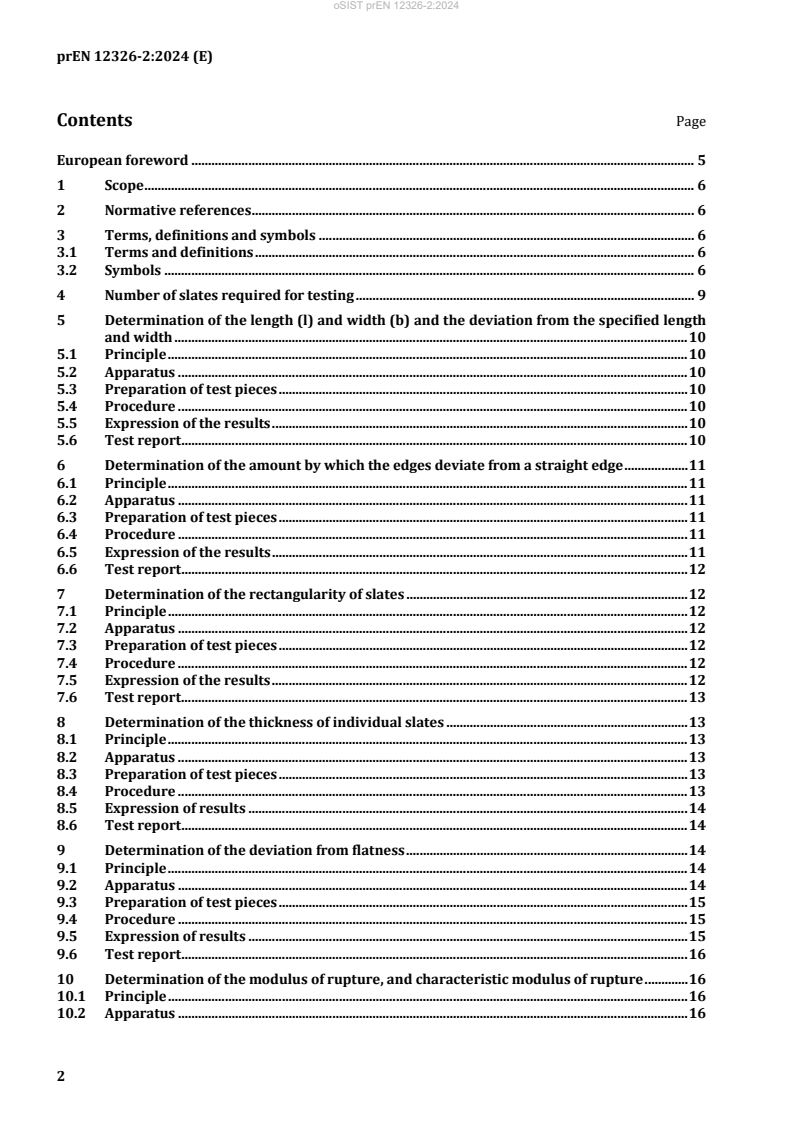
Contents Page
European foreword . 5
1 Scope . 6
2 Normative references . 6
3 Terms, definitions and symbols . 6
3.1 Terms and definitions . 6
3.2 Symbols . 6
4 Number of slates required for testing . 9
5 Determination of the length (l) and width (b) and the deviation from the specified length
and width . 10
5.1 Principle . 10
5.2 Apparatus . 10
5.3 Preparation of test pieces . 10
5.4 Procedure . 10
5.5 Expression of the results . 10
5.6 Test report . 10
6 Determination of the amount by which the edges deviate from a straight edge . 11
6.1 Principle . 11
6.2 Apparatus . 11
6.3 Preparation of test pieces . 11
6.4 Procedure . 11
6.5 Expression of the results . 11
6.6 Test report . 12
7 Determination of the rectangularity of slates . 12
7.1 Principle . 12
7.2 Apparatus . 12
7.3 Preparation of test pieces . 12
7.4 Procedure . 12
7.5 Expression of the results . 12
7.6 Test report . 13
8 Determination of the thickness of individual slates . 13
8.1 Principle . 13
8.2 Apparatus . 13
8.3 Preparation of test pieces . 13
8.4 Procedure . 13
8.5 Expression of results . 14
8.6 Test report . 14
9 Determination of the deviation from flatness . 14
9.1 Principle . 14
9.2 Apparatus . 14
9.3 Preparation of test pieces . 15
9.4 Procedure . 15
9.5 Expression of results . 15
9.6 Test report . 16
10 Determination of the modulus of rupture, and characteristic modulus of rupture . 16
10.1 Principle . 16
10.2 Apparatus . 16
10.3 Preparation of test pieces . 17
10.4 Procedure . 17
10.5 Expression of the results . 18
10.6 Test report . 19
11 Water absorption test . 20
11.1 Principle . 20
11.2 Reagents . 20
11.3 Apparatus . 20
11.4 Preparation of test pieces . 20
11.5 Procedure . 20
11.6 Expression of the results . 21
11.7 Test report . 21
12 Freeze-thaw resistance. 21
12.1 Principle . 21
12.2 Reagent . 21
12.3 Apparatus . 22
12.4 Preparation of Test pieces. 22
12.5 Procedure . 22
12.6 Expression of results and test report . 22
13 Determination of the apparent calcium carbonate and non carbonate carbon content by
catalytic thermal decomposition . 22
13.1 Principle . 23
13.2 Reagents . 23
13.3 Apparatus . 23
13.4 Preparation of powdered test pieces . 23
13.5 Procedure . 23
13.6 Expression of results . 24
13.7 Test report . 24
14 Sulfur dioxide exposure tests . 25
14.1 Sulfur dioxide exposure test for slates with a carbonate content ≤ 20 % (mass %) . 25
14.2 Sulfur dioxide exposure test for slates with a calcium carbonate content > 20 % (mass %)
............................................................................................................................................................................. 26
14.3 Test report . 32
15 Thermal cycle . 33
15.1 Principle . 33
15.2 Reagents . 33
15.3 Apparatus . 33
15.4 Preparation of test pieces . 33
15.5 Procedure . 33
15.6 Test report . 34
16 Petrographic examination. 34
16.1 Introduction . 34
16.2 Principle . 34
16.3 Apparatus . 34
16.4 Reagents . 35
16.5 Preparation of test pieces . 35
16.6 Procedure . 36
16.7 Expression of results . 37
16.8 Test report . 37
Annex A (informative) Petrographic interpretation . 39
A.1 Connection between the micas . 39
A.2 Bedding and cleavage, angle of intersection . 39
Annex B (informative) Guidance To interpretate the Codes for the Thermal Cycle test . 41
Bibliography . 47
European foreword
This document (prEN 12326-2:2024) has been prepared by Technical Committee CEN/TC 128 “Roof
covering products for discontinuous laying and products for wall cladding”, the secretariat of which is
held by NBN.
This document is currently submitted to the CEN Enquiry.
This document will supersede EN 12326-2:2011.
This document is one of a series of product standards for building materials, which consists of the
following parts:
— Part 1: Specifications for slate and carbonate slate
— Part 2: Test methods
1 Scope
This document specifies test methods for slate, carbonate slate, schist and schistose stone for
discontinuous roofing and external cladding, as defined in 3.1, 3.2, and 3.3 of EN 12326-1:2014 and 3.1
of prEN 12326-3:2021, used for assembly into discontinuous roofs and external wall cladding. In this
sense, when the test describes a slate, it could also be considered as carbonate slate.
2 Normative references
The following documents are referred to in the text in such a way that some or all of their content
constitutes requirements of this document. For dated references, only the edition cited applies. For
undated references, the latest edition of the referenced document (including any amendments) applies.
EN 12326-1:2014, Slate and stone for discontinuous roofing and external cladding - Part 1: Specifications
for slate and carbonate slate
3 Terms, definitions and symbols
For the purposes of this document, the following terms, definitions and symbols apply.
ISO and IEC maintain terminology databases for use in standardization at the following addresses:
— IEC Electropedia: available at https://www.electropedia.org/
— ISO Online browsing platform: available at https://www.iso.org/obp/
3.1 Terms and definitions
3.1.1
constant mass
mass achieved when two successive weightings taken 24 h apart do not differ by more than 0,005 g or
0,05 % of the mass of the test piece, whichever is greater
3.1.2
modulus of rupture
maximum stress sustained by a slate test piece when a bending moment is applied
Note 1 to entry: In this document, the geometry of the test is three point bending.
3.2 Symbols
Symbol Physical quantity Unit
A water absorption %
w
A rate of application of stress in the modulus of rupture test (N/mm )/s
B width mm
C’ apparent mass percentage calcium carbonate in slate %
a
C carbonate carbon content of slate %
c
̄
𝐶𝐶 mean carbonate carbon content of a slate %
𝑐𝑐
C carbon dioxide content of a test piece or standard preparation %
d
C non-carbonate carbon in a slate %
nc
C total carbon in a slate %
T
e to e individual thickness measurements in the SO exposure test mm
1A 4A 2
e Individual thickness measurement of slates or test pieces mm
i
E thickness of a individual slate or a test piece mm
i
mean of 8 individual thickness measurements in the modulus of rupture test mm
e
i8
E maximum deviation of the thickness of a slate from the mean thickness %
d
e mean of three thickness measurements used to determine the rate of mm
mi
application of load in the modulus of rupture test
emax the individual thickness measurement from the four individual thickness mm
measurements with the maximum difference with the mean individual
thickness carried out on one slate or a test piece
e thickness of the softened layer in the SO exposure test mm
s 2
F deviation from flatness of a slate mm
d
λKα wavelength of the α radiation used in the x-ray diffraction analysis nm
l length mm
l distance between the bending supports to base mm
t
m dry mass of a test piece in the water absorption test g
o
m mass of a powdered test piece of slate mg
p
mw wet mass of a test piece in the water absorption test g
n number of slates subject to a test -
P failure load of individual slates in the modulus of rupture test N
i
r individual measurements of the deviation of a slate from a rectangle mm
d
r maximum deviation of a slate from a rectangle mm
dmax
R deviation of a test slate from a rectangle as a percentage of its length %
d
R modulus of rupture of individual test slates N/mm
i
�
𝑅𝑅 sample mean modulus of rupture of test slates N/mm
sample mean modulus of rupture of test slates measured in the longitudinal N/mm
R
l
orientation
sample mean modulus of rupture of test slates measured in the transverse N/mm
R
t
orientation
R characteristic modulus of rupture of test slates N/mm
c
sample mean modulus of rupture of the control test pieces in the freeze- N/mm
R
thaw test
sample mean modulus of rupture of the frost exposed test pieces in the N/mm
R
freeze-thaw test
s sample standard deviation of the modulus of rupture -
s sample standard deviation of the modulus of rupture in the longitudinal -
l
orientation
s sample standard deviation of the modulus of rupture in the transverse -
t
orientation
s sample standard deviation of the modulus of rupture of the control test -
pieces after the freeze-thaw test
s standard deviation of the modulus of rupture of the frost exposed test pieces -
after the freeze-thaw test
s deviation of the edge of a slate from a straight edge mm
d
S deviation of the edge of a slate from a straight edge as a percentage of its %
d
length
v rate of application of the load in the modulus of rupture test N/s
l
o
α deviation of a slate from rectangle
o
θ angle of incidence of the beam in the X-ray diffraction analysis
4 Number of slates required for testing
Table 1 indicates the number of slates required for each test.
In addition, specimens for testing shall be representative of the product and any processes that the stone
is subjected to.
Table 1 — Number of slates required to carry out each test
Test Number of slates required for each test
Length and width 1
Straight edges 1
Rectangularity 1
Individual thickness 1
Curvature 1
Modulus of Rupture 20/40*
Water absorption 5
Freeze thaw 20/40*
Non-carbonate carbon content 3
Carbonate content 3
Sulfur dioxide exposure for less than or equal to 20 % 12
carbonate
Sulfur dioxide exposure for more than 20 % carbonate 6 or 12*
Thermal cycle 6
Where there is a possibility that the slates being tested may contain localized harmful inclusions, such as
calcite veins or oxidizable minerals, the preparation of the test pieces or powdered test pieces should be
modified to ensure sufficient inclusions are contained in the test piece to provide a representative result.
Sampling should preferably be carried out by the recipient or his representative in the presence of the
supplier.
For the tests marked * the number of slates required depends on their size.
The individual tests indicate the size and number of test pieces or powdered test pieces required.
NOTE Because many of the tests do not require whole slates it is possible to carry out a full set of tests with fewer
than the total number of slates listed in this table.
5 Determination of the length (l) and width (b) and the deviation from the
specified length and width
5.1 Principle
The dimensions of slates are measured using a steel rule placed on the midline of the length and the width.
The percentage deviation from the specified dimension is calculated.
5.2 Apparatus
5.2.1 A steel rule capable of reading to 0,5 mm.
5.2.2 Two steel bars longer and thicker than the slates under test. Each bar shall have one edge which
shall not deviate from a straight edge by more than ± 0,1 mm.
5.3 Preparation of test pieces
Whole slates are used and do not need any preparation unless any corners are oversized within 50 mm
of the corner. In this case, remove the oversize corner(s) at an angle of approximately 45° from a point
50 mm from the corner, using a suitable cutting tool.
Figure 1 — Corner oversized within 50 mm of the corner.
5.4 Procedure
Place the slate with the chamfered edge facing down. Align the straight edges of the two steel bars along
the long edges of the slate. Using a steel rule find the midpoints of the length of the slate on each side to
the nearest 1,0 mm at each end and mark the positions on the slate. Place the steel rule across the distance
between the bars at the marked points. Read off and record the width to the nearest 1,0 mm.
Repeat for the length.
5.5 Expression of the results
Calculate the difference of the length from the specified length as a percentage.
Calculate the difference of the width from the specified width as a percentage.
5.6 Test report
Report the length and width in millimetres and the deviation in percentage from the specified length and
width.
The test report shall also include the identification of the product, reference to this method and the
identifier of this document, i.e. prEN 12326-2:2024.
6 Determination of the amount by which the edges deviate from a straight edge
6.1 Principle
The deviation of the long edges of slates from a straight edge is measured using a steel rule. For slates
500 mm long or longer the deviation is calculated as a percentage of the length.
6.2 Apparatus
6.2.1 A steel rule capable of reading to 0,5 mm.
6.2.2 A steel bar longer and thicker than the slates under test with one edge which shall not deviate
from a straight edge by more than ± 0,1 mm.
6.3 Preparation of test pieces
Whole slates are used and do not need any preparation unless any corners are oversized within 50 mm
of the corner. In this case, the oversize corner(s) shall be removed at an angle of approximately 45° from
a point 50 mm from the corner, using a suitable cutting tool.
6.4 Procedure
Place the slate with the chamfered edge facing down and position the straight edge of the steel bar
alongside one edge of the slate. Using the steel rule measure the maximum deviation (S ) of the edge of
d1
the slate from the steel bar to the nearest 0,5 mm. Ignore small deviations and flaking resulting from the
dressing of the edges (Figure 1). Repeat and record the deviation for the other edge (S ).
d2
Key
1 deviation from a straight edge
2 acceptable minor deviations and flaking
Figure 2 — Illustration of acceptable small variations and flaking resulting from the dressing of
the edges of slates. The chamfer is shown facing upwards
Measure the length of the slate (l ) by the method given in Clause 5.
s
6.5 Expression of the results
For slates of 500 mm or longer and for each edge calculate the percentage deviation from a straight edge
) using the formula:
(Sd
S .100
dx
S =
d
l
where
S is the deviation for each edge, S and S in millimetres,
dx d1 d2
l is the length of the slate, in millimetres.
6.6 Test report
For slates less than 500 mm long, report for each edge the deviation in mm from a straight edge.
For slates 500 mm long or longer, report for each edge the deviation in mm from a straight edge and the
percentage deviation.
The test report shall also include the identification of the product, reference to this method and the
identifier of this document, i.e. prEN 12326-2:2024.
7 Determination of the rectangularity of slates
7.1 Principle
The deviation from a right angle of the angles enclosing any two sides is measured using a goniometer or
an engineering set square. The deviation is calculated as a percentage of the length.
7.2 Apparatus
7.2.1 A set square with blades longer and thicker than the slates under test calibrated to an angular
deviation of 0,1°.
7.2.2 Alternatively, a goniometer (calibrated adjustable square) with blades longer and thicker than
the slates under test capable of being read to 0,1°.
7.3 Preparation of test pieces
Whole slates are used and do not need any preparation unless any corners are oversized within 50 mm
of the corner. In this case remove the oversize corner(s) at an angle of approximately 45° from a point
50 mm from the corner using a suitable cutting tool.
7.4 Procedure
Place the slate in the set square with one end tightly against the blade so that the long edge of the slate
touches the opposite blade. Using the steel rule measure the maximum deviation (r ) of the long edge
d1
from the opposing blade of the set square to the nearest 0,5 mm.
Repeat for all four corners to obtain the values (R ), (R ) and (R ).
d2 d3 d4
Alternatively, if a goniometer is used read the deviation in degrees to the nearest 0,1°.
Measure the length of the slate (l ) by the method given in Clause 5.
s
7.5 Expression of the results
For each edge calculate the percentage deviation (R ) from a rectangle using the formula:
d
r .100
d max
R =
d
ls
where
r is the maximum value of (r ) to (r ), in millimetres
dmax d1 d4
is the slate length, in millimetres
ls
Alternatively, if a goniometer has been used calculate the percentage deviation using the formula:
R = tan α .100
d
where
α is the maximum angle measured in 7.4.
7.6 Test report
Report the maximum percent deviation.
The test report shall also include the identification of the product, reference to this method and the
identifier of this document, i.e. prEN 12326-2:2024.
8 Determination of the thickness of individual slates
8.1 Principle
The thickness of a slate is measured at four points using a micrometer, or similar equipment.
Four individual readings (ei) shall be taken.
The mean of the four individual readings corresponds with the thickness of that individual slate (E ).
i
8.2 Apparatus
Dial gauge, micrometer or similar equipment capable of measuring thickness to 0,05 mm with a contact
area of 5 mm to 10 mm diameter.
8.3 Preparation of test pieces
Whole slates are used. They do not require any preparation.
8.4 Procedure
Measure the thickness of the slate to 0,1 mm at four points (approximately at the middle of the sides of
the slates, see Figure 2) avoiding all dressed edges and any localized thick or thin areas.
NOTE Figure 3 indicates the approximate points of measurement for various slate shapes.
Key
perimeter zone of the slate (width 25 mm) excluded from thickness measurements.
point of measurement recommended (25 mm to 30 mm from edge)
Figure 3 — Approximate positions for measurements of individual thickness
8.5 Expression of results
Take four individual thickness readings (e ) and calculate the mean of the four individual measurements
i
(E ).
i
) and the mean value (E), calculate the
Using the largest difference between the individual values (ei i
maximum deviation (E ) from the individual thickness (E ) as a percentage to two significant figures using
d i
the formula:
E = 100 x emax / E
d i
where
e = max |e – E |
max i i
e is from the four individual thickness measurements (e ) the one with the maximum
max i
difference with the thickness of individual slates (Ei), carried out on one slate or a test
piece;
E is the thickness of the individual slate, in millimetres.
i
8.6 Test report
Report the mean thickness and the thickness of individual slates (E ) to 0,1 mm and report the maximum
i
percent deviation from the mean E .
d
The test report shall also include the identification of the product, reference to this method and the
identifier of this document, i.e. prEN 12326-2:2024.
9 Determination of the deviation from flatness
9.1 Principle
The deviation from flatness of individual slates is determined by measuring the difference between the
height of the highest point measured with a dial gauge placed in contact with the convex face of a slate
(h) and the individual thickness of a slate in millimetres, (E ), (Clause 8).
i
9.2 Apparatus
Apparatus comprising a dial gauge or similar device capable of reading deflections of 0,1 mm and with a
contact area of 5 mm to 10 mm diameter arranged above a surface plate as large as the slates to be tested.
The dial gauge shall be capable of being moved to various positions above the slate. A typical apparatus
is shown in Figure 3. Other similar apparatus can be used. At least two wedges will be used to fix slate
position.
Key
1 dial gauge
2 Test slate in position with the highest point (maximum curvature or maximum irregularity) under gauge.
Convex side upwards.
3 wedge
Figure 4 — Typical apparatus for measuring the deviation from flatness
9.3 Preparation of test pieces
Individual slates are used but they do not need any preparation.
9.4 Procedure
Measure the individual thickness of a slate in millimetres, (E ) (Clause 8).
i
Lay the slate convex face uppermost on the surface plate of the test apparatus. If one of the corners of the
slate is not in contact with the surface plate, use two wedges between slate and the surface space to level
the slate piece and avoid undesired movements. The wedges shall be positioned on two diagonally
opposite corners of the slate piece. After placing the wedges, two diagonally opposite corners of the slate
must be in contact with surface plate and the other two must be in contact with the wedges. Move the dial
gauge over the highest point on the slate. Record the height (h) of the highest point of the slate surface in
millimetres.
Figure 5 — Wedge placing
9.5 Expression of results
Calculate the deviation from flatness (F) using the formula:
F = 100 x (h – E )/ E
d i i
9.6 Test report
Report the deviation from flatness (F ) as percentage. The test report shall also include the identification
d
of the product, reference to this method and the identifier of this document, i.e. prEN 12326-2:2024.
) for rectangular slates
Table 4 — Maximum deviation from flatness (Fd
a
Slate flatness Maximum deviation from flatness (F ) as a percentage of E ,
d i
the thickness of the individual slate
Very flat ≤ 40 %
Flat ≤ 60 %
Normal ≤ 70 %
b
Slates for special situations No limit
a As specified by the manufacturer.
b Slates for which there is no limit on the deviation from flatness are only suitable for use in special
situations such as curved slating.
Curved slates shall be manufactured so that the bevelled edges are applied to the convex face of the slate.
10 Determination of the modulus of rupture, and characteristic modulus of
rupture
10.1 Principle
Tests are carried out on prepared test pieces to measure the failure load in bending. From the results the
modulus of rupture and the characteristic modulus of rupture are calculated.
The characteristic modulus of rupture shall be determined for slates with the same reference and the
value will be valid for all nominal thickness. The characteristic modulus of rupture shall be determined
only for one nominal thickness. The same value of the characteristic modulus of rupture is valid for other
slates with different nominal thickness.
10.2 Apparatus
10.2.1 A three point bending test machine, capable of applying a constant rate of loading. The support
bars and load bar shall have a diameter of 20 mm and the load bar and any two of the load and support
bars shall be free to align themselves to the test piece. The load bar shall be parallel to the support bars.
The support bars shall be (180 ± 1,0) mm apart and the load bar shall be central over the span.
NOTE Where an apparatus capable of applying a constant rate of loading is not available a constant rate of
deflection is acceptable.
10.2.2 Oven, ventilated and capable of maintaining a temperature of (110 ± 10) °C.
10.2.3 Water cooled diamond saw.
10.2.4 Metal rule or similar equipment, capable of measurements to 1 mm.
10.2.5 Micrometer or similar equipment, capable of measuring thickness to 0,05 mm with a contact
area of 5 mm to 10 mm diameter.
10.3 Preparation of test pieces
Determine the number of test pieces required by reference to Clause 4 but using not less than 20 for each
orientation (Figure 6).
Using a water-cooled diamond saw, cut from each slate one test piece parallel (longitudinal) to the long
edge and measuring (125 ± 1,0) mm by the length of the slate (minimum 190 mm), and one test piece
perpendicular (transverse) to the long edge and measuring (125 ± 1,0) mm by the width of the slate
(minimum 190 mm). Make the saw cuts so that they avoid the dressed edges of the slates and trim off the
ends with the saw. If the slates are too small to cut test pieces for each orientation from one slate, two
slates shall be used.
Dry the test pieces in the oven at (110 ± 10) °C for at least 17± 2 h and then allow them to cool to ambient
temperature.
Dimensions in millimetres
Key
1 slate
2 test piece
3 orientation of the load bar in the test
4 perpendicular or transverse orientation
5 parallel or longitudinal orientation
NOTE The description of the test pieces as transverse or longitudinal is the opposite of that used in some
standards for roofing slates.
Figure 6 — Orientations of test pieces in the Modulus of Rupture test
10.4 Procedure
Using the micrometer or similar apparatus measure the thickness of each test piece in three equally
spaced positions across the width. For each test piece calculate the mean (e ) of the three values. Using
mi
a metal ruler measure the width (b) of each test piece to the nearest 1 mm by the method given in
Clause 5.
Calculate the loading rate in N/s for each test piece using the formula:
2 be
mi
va=
l
3 l
t
where
a is the rate of application of stress and is equal to (1,00 ± 0,25) (N/mm )/s;
v is the rate of loading to be used in the test, in N/s;
l
b is the width of the test piece, in millimetres;
e is the mean thickness of the test pieces, in millimetres;
mi
l is the distance between the support bars (normally 180 mm).
t
Place the test piece in the three point bending test machine centrally under the load bar and check that is
(180 ± 1,0) mm. Apply the load at the calculated rate v .
l
NOTE If it is not possible to apply a constant rate of loading, it is acceptable to apply a constant rate of deflection
so that failure occurs in 20 s to 30 s.
Record the failure load in bending in newtons to the nearest 1 N. Using a micrometer or similar
equipment, measure the thickness of the slate (e) to 0,1 mm at four evenly spaced points on each side of
the break at a distance of 25 mm to 30 mm from the rupture line (8 measurements). Repeat for each of
the test pieces.
10.5 Expression of the results
For each orientation, calculate:
a) the modulus of rupture (R ) in N/mm for each test piece using the formula:
i
3.Pl
i t
R =
i
2.be
i8
where
P is the failure load, in newtons;
i
l is 180 mm;
t
b is the test piece width, in millimetres;
is the mean of the 8 individual thickness measurements in mm, taken after testing, at
e
i8
a distance of 25 mm of the rupture line (4 measurements in each side of the rupture
line equally spread).
b) Identify the outliers using the following method:
Order the R values obtained from lower (R ) to higher (R ).
i 1 n
1. First exclude the largest difference between the mean flexion strength and the individual flexion
strength.
2. Calculate with the other results the mean value and the standard deviation (s).
3. If the excluded value lies in the interval of the mean value + or – 3s, the value is not an outlier
and you stop your calculations.
If the value you excluded lies outside the interval of the mean value + 3s or – 3s, the value is an
outlier and should be excluded.
4. Repeat the procedure 1-3 for the second largest difference till all the values are within the
interval of the mean value + 3s or – 3s. Exclude the outliers from the following steps of the
calculation.
c) calculate the mean modulus of rupture ( ) in N/mm , for the total number of slates tested
R
excluding the outliers;
d) calculate the characteristic modulus of rupture (R ), in N/mm , for the total number of slates tested
c
excluding the outliers using the formula:
R=Rk−× s
c s
where
Σ−RR
...