

EN 16729-5:2023
(Main)Railway applications - Infrastructure - Non-destructive testing on rails in track - Part 5: Non-destructive testing on welds in track
General Information
- Abstract
This document specifies the procedures of visual testing and ultrasonic testing of rail welds in track for rail profiles meeting the requirements of EN 13674-1.
This document specifies the principles for testing procedures for manufactured welds. This document defines the procedure for repair welds and joint welds. This document does not define the number of welds to be tested.
This document is not concerned with the approval of the welding procedure.
- Status
- Published
- Publication Date
- 04-Apr-2023
- Technical Committee
- CEN/TC 256 - Railway applications
- Drafting Committee
- CEN/TC 256/SC 1/WG 50 - Monitoring and treatment of rails
- Current Stage
- 6060 - Definitive text made available (DAV) - Publishing
- Start Date
- 05-Apr-2023
- Due Date
- 10-Mar-2023
- Completion Date
- 05-Apr-2023

Overview
EN 16729-5:2023 (CEN) is a European standard that specifies procedures for non‑destructive testing (NDT) of rail welds in track. It covers both visual testing (VT) and ultrasonic testing (UT) of manufactured, repair and joint welds for rail profiles that meet EN 13674‑1. The standard defines inspection principles, inspection/inspection‑zone concepts, documentation requirements and informative procedures (Annex A and B). It does not prescribe the number of welds to be tested nor does it approve welding procedures.
Key topics and requirements
- Scope and applicability
- Applies to rail welds in track for profiles conforming to EN 13674‑1.
- Intended primarily for new welds but applicable to other welds if required by the Infrastructure Manager (IM).
- NDT methods
- Visual testing (VT): inspection zones, surface defect examples and VT equipment/technique guidance (Annex A).
- Ultrasonic testing (UT): multiple phased inspection methods with probe configurations and reference blocks (Annex B). Phases referenced include W (walking stick), H (hand‑held single probes), T (tandem 45° on running surface) and TS (tandem 70° on head, web and foot).
- Defect descriptions
- Detailed descriptions of volumetric and planar defects for repair welds, flash‑butt (tri‑metallic) and aluminothermic welds are provided (porosity, planar defects, thermal contraction, fatigue cracks, etc.).
- Calibration and reference
- Use of reference blocks, transfer correction, DAC/IG concepts and couplant considerations for reliable UT sensitivity.
- Documentation
- Requirements for recording VT and UT results, registration levels and inspection records (Chapter 7). Informative annexes do not supply acceptance criteria-these are to be defined by the IM.
Applications
- Routine and acceptance inspection of welds after manufacturing, repair or installation on railway tracks.
- Detection and classification of internal and surface defects that may affect rail integrity and safety.
- Basis for developing inspection procedures, UT calibration protocols and inspection records for maintenance teams.
Who should use this standard
- Railway Infrastructure Managers (IMs) and track maintenance planners
- NDT technicians and UT/VT operators working on rails
- Track welding contractors, quality assurance and compliance teams
- Standards bodies and safety assessors developing inspection programs
Related standards
- EN 13674‑1 (rail profile and material requirements) - referenced for applicable rail types.
- Other parts of EN 16729 (NDT on rails) may be consulted for broader NDT guidance on rails in track.
Keywords: EN 16729‑5:2023, non‑destructive testing, NDT, rail welds, ultrasonic testing, visual testing, railway infrastructure, weld inspection, EN 13674‑1.
Get Certified
Connect with accredited certification bodies for this standard

DVS-ZERT GmbH
German welding certification society.
CARES (UK Certification Authority for Reinforcing Steels)
UK certification for reinforcing steels and construction.
EWF/IIW (European/International Welding Federation)
International welding personnel certification.
Sponsored listings
Frequently Asked Questions
EN 16729-5:2023 is a standard published by the European Committee for Standardization (CEN). Its full title is "Railway applications - Infrastructure - Non-destructive testing on rails in track - Part 5: Non-destructive testing on welds in track". This standard covers: This document specifies the procedures of visual testing and ultrasonic testing of rail welds in track for rail profiles meeting the requirements of EN 13674-1. This document specifies the principles for testing procedures for manufactured welds. This document defines the procedure for repair welds and joint welds. This document does not define the number of welds to be tested. This document is not concerned with the approval of the welding procedure.
This document specifies the procedures of visual testing and ultrasonic testing of rail welds in track for rail profiles meeting the requirements of EN 13674-1. This document specifies the principles for testing procedures for manufactured welds. This document defines the procedure for repair welds and joint welds. This document does not define the number of welds to be tested. This document is not concerned with the approval of the welding procedure.
EN 16729-5:2023 is classified under the following ICS (International Classification for Standards) categories: 25.160.40 - Welded joints and welds; 93.100 - Construction of railways. The ICS classification helps identify the subject area and facilitates finding related standards.
EN 16729-5:2023 is available in PDF format for immediate download after purchase. The document can be added to your cart and obtained through the secure checkout process. Digital delivery ensures instant access to the complete standard document.
Standards Content (Sample)
SLOVENSKI STANDARD
01-junij-2023
Železniške naprave - Infrastruktura - Neporušitveno preskušanje na progi - 5. del:
Neporušitveno preskušanje zvarnih spojev na progi
Railway applications - Infrastructure - Non-destructive testing on rails in track - Part 5:
Non-destructive testing on welds in track
Bahnanwendungen - Oberbau - Zerstörungsfreie Prüfung an Schienen im Gleis - Teil 5:
Zerstörungsfreie Prüfung an Schweißungen im Gleis
Applications ferroviaires - Infrastructure - Essais non destructifs sur les rails en voie -
Partie 5 : Essais non destructifs sur les soudures en voie
Ta slovenski standard je istoveten z: EN 16729-5:2023
ICS:
19.100 Neporušitveno preskušanje Non-destructive testing
25.160.40 Varjeni spoji in vari Welded joints and welds
93.100 Gradnja železnic Construction of railways
2003-01.Slovenski inštitut za standardizacijo. Razmnoževanje celote ali delov tega standarda ni dovoljeno.
EN 16729-5
EUROPEAN STANDARD
NORME EUROPÉENNE
April 2023
EUROPÄISCHE NORM
ICS 25.160.40; 93.100
English Version
Railway applications - Infrastructure - Non-destructive
testing on rails in track - Part 5: Non-destructive testing on
welds in track
Applications ferroviaires - Infrastructure - Essais non Bahnanwendungen - Oberbau - Zerstörungsfreie
destructifs sur les rails en voie - Partie 5 : Essais non Prüfung an Schienen im Gleis - Teil 5: Zerstörungsfreie
destructifs sur les soudures en voie Prüfung an Schweißungen im Gleis
This European Standard was approved by CEN on 27 February 2023.
CEN members are bound to comply with the CEN/CENELEC Internal Regulations which stipulate the conditions for giving this
European Standard the status of a national standard without any alteration. Up-to-date lists and bibliographical references
concerning such national standards may be obtained on application to the CEN-CENELEC Management Centre or to any CEN
member.
This European Standard exists in three official versions (English, French, German). A version in any other language made by
translation under the responsibility of a CEN member into its own language and notified to the CEN-CENELEC Management
Centre has the same status as the official versions.
CEN members are the national standards bodies of Austria, Belgium, Bulgaria, Croatia, Cyprus, Czech Republic, Denmark, Estonia,
Finland, France, Germany, Greece, Hungary, Iceland, Ireland, Italy, Latvia, Lithuania, Luxembourg, Malta, Netherlands, Norway,
Poland, Portugal, Republic of North Macedonia, Romania, Serbia, Slovakia, Slovenia, Spain, Sweden, Switzerland, Türkiye and
United Kingdom.
EUROPEAN COMMITTEE FOR STANDARDIZATION
COMITÉ EUROPÉEN DE NORMALISATION
EUROPÄISCHES KOMITEE FÜR NORMUNG
CEN-CENELEC Management Centre: Rue de la Science 23, B-1040 Brussels
© 2023 CEN All rights of exploitation in any form and by any means reserved Ref. No. EN 16729-5:2023 E
worldwide for CEN national Members.
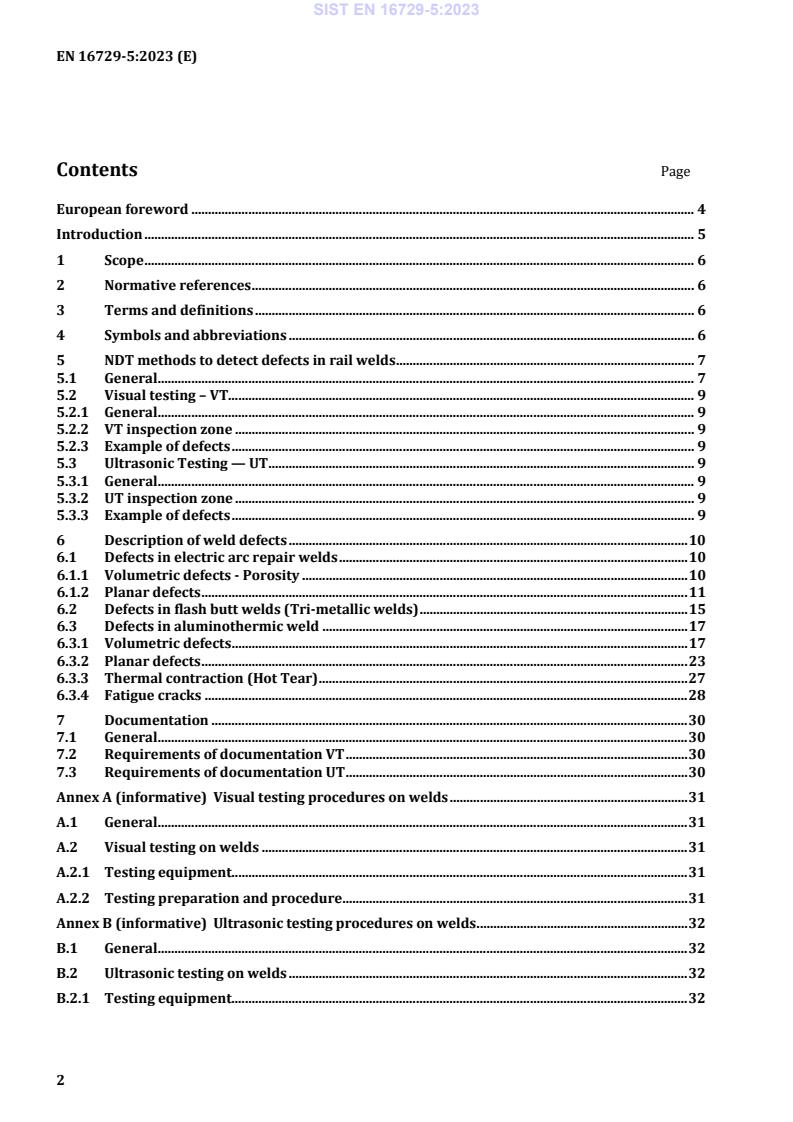
Contents Page
European foreword . 4
Introduction . 5
1 Scope . 6
2 Normative references . 6
3 Terms and definitions . 6
4 Symbols and abbreviations . 6
5 NDT methods to detect defects in rail welds . 7
5.1 General . 7
5.2 Visual testing – VT. 9
5.2.1 General . 9
5.2.2 VT inspection zone . 9
5.2.3 Example of defects . 9
5.3 Ultrasonic Testing — UT . 9
5.3.1 General . 9
5.3.2 UT inspection zone . 9
5.3.3 Example of defects . 9
6 Description of weld defects . 10
6.1 Defects in electric arc repair welds . 10
6.1.1 Volumetric defects - Porosity . 10
6.1.2 Planar defects . 11
6.2 Defects in flash butt welds (Tri-metallic welds) . 15
6.3 Defects in aluminothermic weld . 17
6.3.1 Volumetric defects . 17
6.3.2 Planar defects . 23
6.3.3 Thermal contraction (Hot Tear) . 27
6.3.4 Fatigue cracks . 28
7 Documentation . 30
7.1 General . 30
7.2 Requirements of documentation VT . 30
7.3 Requirements of documentation UT . 30
Annex A (informative) Visual testing procedures on welds . 31
A.1 General . 31
A.2 Visual testing on welds . 31
A.2.1 Testing equipment. 31
A.2.2 Testing preparation and procedure . 31
Annex B (informative) Ultrasonic testing procedures on welds . 32
B.1 General . 32
B.2 Ultrasonic testing on welds . 32
B.2.1 Testing equipment. 32
B.2.2 Testing preparation and procedures . 39
B.3 Phase W: Walking stick . 39
B.3.1 General . 39
B.3.2 Overview . 39
B.3.3 Reference block for inspection W.1 . 39
B.3.4 Reference block for inspections W.2 and W.3 . 39
B.3.5 Transfer correction applied to inspections W.1 to W.3 . 40
B.3.6 Couplant . 40
B.3.7 Inspection zone . 40
B.4 Phase H: Single probes . 40
B.4.1 General . 40
B.4.2 Overview . 40
B.4.3 Reference block for inspection H.1 . 40
B.4.4 Reference block for inspection H.2 . 41
B.4.5 Reference block for inspections H.3 and H.4 . 41
B.4.6 Transfer correction applied to inspections H.1 to H.4 . 41
B.4.7 Couplant . 44
B.4.8 Inspection zones . 44
B.5 Phase T: Tandem 45° on the running surface. 48
B.5.1 Overview . 48
B.5.2 Reference block for inspection T.1 . 48
B.5.3 Transfer correction applied to inspection T.1 . 48
B.5.4 Couplant . 48
B.5.5 Inspection zone for T.1 . 48
B.6 Phase TS: Tandem 70° on the side of the rail head, web and foot . 49
B.6.1 Overview . 49
B.6.2 Reference block for inspection TS.1 . 50
B.6.3 Reference block for inspection TS.2 . 51
B.6.4 Reference block for inspection TS.3 . 52
B.6.5 Transfer correction applied to inspections TS.1 to TS.3 . 52
B.6.6 Couplant . 53
B.6.7 Inspection zones . 53
Bibliography . 55
European foreword
This document (EN 16729-5:2023) has been prepared by Technical Committee CEN/TC 256 “Railway
applications”, the secretariat of which is held by DIN.
This European Standard shall be given the status of a national standard, either by publication of an
identical text or by endorsement, at the latest by October 2023, and conflicting national standards shall
be withdrawn at the latest by October 2023.
Attention is drawn to the possibility that some of the elements of this document may be the subject of
patent rights. CEN shall not be held responsible for identifying any or all such patent rights.
Any feedback and questions on this document should be directed to the users’ national standards body.
A complete listing of these bodies can be found on the CEN website.
According to the CEN-CENELEC Internal Regulations, the national standards organisations of the
following countries are bound to implement this European Standard: Austria, Belgium, Bulgaria, Croatia,
Cyprus, Czech Republic, Denmark, Estonia, Finland, France, Germany, Greece, Hungary, Iceland, Ireland,
Italy, Latvia, Lithuania, Luxembourg, Malta, Netherlands, Norway, Poland, Portugal, Republic of North
Macedonia, Romania, Serbia, Slovakia, Slovenia, Spain, Sweden, Switzerland, Türkiye and the United
Kingdom.
Introduction
The procedures are intended for new welds but are applicable to all welds on demand of the responsible
IM. If welds are to be tested, they should be tested by the procedures defined in this document.
1 Scope
This document specifies the procedures of visual testing and ultrasonic testing of rail welds in track for
rail profiles meeting the requirements of EN 13674-1.
This document specifies the principles for testing procedures for manufactured welds. This document
defines the procedure for repair welds and joint welds. This document does not define the number of
welds to be tested.
This document is not concerned with the approval of the welding procedure.
2 Normative references
There are no normative references in this document.
3 Terms and definitions
For the purposes of this document, the following terms and definitions apply.
ISO and IEC maintain terminology databases for use in standardization at the following addresses:
— ISO Online browsing platform: available at https://www.iso.org/obp
— IEC Electropedia: available at https://www.electropedia.org/
3.1
collar
excess of weld material outside the rail profile
3.2
registration level
ultrasonic signal amplitude where indications shall be recorded, not to be confused with acceptance
criteria
3.3
tandem rig
rig that ensures a correct distance between two ultrasonic probes
3.4
testing zone
location where probes or devices are placed/moved on the rail surface
3.5
inspection zone
area or volume which is checked for indications
4 Symbols and abbreviations
For the purposes of this document, the abbreviations in Table 1 apply.
Table 1 — Abbreviations
Abbreviation Abbreviated term
DAC Distance Amplitude Correction
FBH Flat Bottom Hole, see EN 16729-1
FSH Full Screen Height
H Phase H for testing with hand-held single probes
T Phase T for testing with tandem 45° on the running surface
TS Phase TS for testing with tandem 70° on the side of the rail head, web and foot
UT Ultrasonic testing
VT Visual testing
W Phase W for testing with a walking stick
IG Inspection gain
G
Gain distance amplitude correction
DAC
ΔG Transfer gain compensation
G
Gain needed for 80 % FSH in the weld
weld
G
Gain needed for 80 % FSH in the plain rail
plain_rail
IM Infrastructure manager
5 NDT methods to detect defects in rail welds
5.1 General
This part of this document specifies non-destructive testing methods for the detection of internal and
surface defects in rail welds and the suitability of the test methods for the detection and assessment of
weld defects in rails in track. The description of the defects can be found in Table 3 to Table 17, including
the respective Figure 1 to Figure 19. The procedures for detecting indications in rail welds are presented
in the Annex A and Annex B. The procedures according to defect and inspection number are presented in
Table 2.
The requirements to inspect welds are determined by the IM. If the inspection of a selection or all the
welds is required by the IM, the IM should define which procedure and which inspection number shall be
performed.
The informative annexes do not give acceptance criteria. The acceptance criteria can be defined on the
basis of the reference blocks and the level of sensitivity, including the number of indications which exceed
the sensitivity and the registration level. These parameters should be defined in the inspection
instruction approved by the IM.
Table 2 — Testing procedures of the weld defects according to the inspection number in Annex A and Annex B
Procedures in Annex VT UT
a
W.1 W.2 W.3 H.1 H.2 H.3 H.4 T.1 TS.1 TS.2 TS.3
Inspection phase
Volumetric defects Porosity X X X X X X X X X
Surface cracking X X X X X X X X X
Electric arc repair
welds
Planar defects Transverse cracking X X X X X X X X X
Lack of fusion X X X X X X X X X
Flash butt welds Volumetric defects Lack of fusion X X X X X X X
Porosity X X X X X X X X X X X X
Inclusions X X X X X X X X X X X
Volumetric defects
Shrinkage X
Lack of fusion X X X X X X X X X X X
Sand burn X X X X X X X X X
Surface defects in the weld
X X
Alumino-thermic
collar
welds
Thermal contraction (hot
X X X X X X X X X X X
tear)
Planar defects
Fatigue cracks X X X X X X X X X X X X
Transversal tearing of the
X X X X X X X X
surface weld material
Weld collar damage at vent
X X X X
riser
a
Overview of inspection numbers in Table B.1.
5.2 Visual testing – VT
5.2.1 General
Visual testing of welds in rails is an examination of the surface, to detect the presence of a defect and to
define and measure it.
5.2.2 VT inspection zone
Visual testing can inspect all surface areas of welds.
5.2.3 Example of defects
Examples of defects identified by visual testing are:
— broken welds;
— gas holes;
— surface porosity;
— surface breaking cracks;
— sand inclusions;
— geometrical errors.
5.3 Ultrasonic Testing — UT
5.3.1 General
Ultrasonic testing of welds in rails is an examination of the internal volume, to detect the presence of a
defect and to define and measure it.
5.3.2 UT inspection zone
Ultrasonic testing can inspect the internal volume of the weld, fusion zone and heat affected zone. The
inspection zone depends on welding type and expected indications.
5.3.3 Example of defects
Examples of defects identified by ultrasonic testing are:
— lack of fusion;
— cracks;
— inclusions;
— porosity;
— hot tear.
6 Description of weld defects
6.1 Defects in electric arc repair welds
6.1.1 Volumetric defects - Porosity
Table 3 — Porosity
Weld type: Electric arc repair welds
Defect type: Porosity
Appearance, causes and location:
— Porosity in electric arc repair welds is characterized by small inclusions on the welding material.
— It is presented on the surface or inside the welding material itself, more common on the
longitudinal limits of the repair weld.
— It can derive from poor execution on the part of the welder, unfavourable environmental
conditions and the quality/suitability of the electrodes used.
— It can develop cracks under impact loads.
Figure 1 — Porosity on electric arc repair welds (a)
Figure 2 — Porosity on electric arc repair welds (b)
6.1.2 Planar defects
6.1.2.1 Surface cracking
Table 4 — Surface cracking
Weld type: Electric arc repair welds
Defect type: Surface cracking
Appearance, causes and location:
— Surface cracking on electric arc repair welds is characterized by superficial cracks on the welding
surface material.
— It originates either isolated or associated with superficial porosities.
— It is presented on the surface of the repair weld, more common on the longitudinal limits of the
repair weld.
— It can derive from poor execution on the part of the welder, unfavourable environmental
conditions and the quality/suitability of the electrodes used.
— It has accelerated propagation due to impact loads, especially at joints in poor conditions.
— It may progress into spalling and at a later stage pieces of welding material may break away.
Figure 3 — Surface cracking
6.1.2.2 Transverse cracking
Table 5 — Transverse cracking
Weld type: Electric arc repair welds
Defect type: Transverse cracking
Appearance, causes and location:
— Transverse cracking on electric arc repair welds has its point of origin in the head of the rail in or
under the repair weld.
— It can derive from either not sufficient removal of rail material to eliminate pre-existing cracks in
the rail head or by slag intrusion at the fusion face of the weld.
— It may occur due to residual stresses caused by incorrect welding procedure such as incorrect pre-
heat or wrong consumables.
— It can rapidly develop in size and severity, mainly associated with the heating produced during the
weld repair procedure.
Figure 4 — Transverse cracking
6.1.2.3 Lack of fusion
Table 6 — Lack of fusion
Weld type: Electric arc repair welds
Defect type: Lack of fusion
Appearance, causes and location:
— Lack of fusion between the welding and the rail material is characterized by poor contact between
the two materials.
— It can develop in to a breakaway of a significant piece of welding material, down to the rail material
under the repair weld.
— It derives mainly from insufficient preheating of the rail under repair, but it can also be associated
with poor execution on the part of the welder, unfavourable environmental conditions and the
quality/suitability of the electrodes used.
— It has accelerated propagation due to impact loads, especially at joints in poor conditions.
— It shall not to be confused with a severe stage of spalling on the weld material.
Figure 5 — Lack of fusion
6.2 Defects in flash butt welds (Tri-metallic welds)
Table 7 — Lack of fusion
Weld type: Flash butt welds
Defect type: Lack of fusion
Appearance, causes and location:
— Lack of fusion on tri-metallic weld is characterized by a transverse crack between the stainless-
steel insert and the pearlitic rail or within the stainless-steel insert running into the manganese
crossing.
— It is presented on the surface generally at the fusion face at the lower half of the weld and may be
visible only from the underside of the foot.
— It can derive from inclusions within the cast stainless steel insert, insufficient weld process control
or heavy grinding of the weld.
— It can have accelerated propagation under impact loads, especially large cracks on the pearlitic side
due to small stress raisers. Defects within the stainless insert and manganese generally propagate
slower, but this is dependent on local conditions.
Figure 6 — Transverse tri-metallic zone weld defect (a)
Figure 7 — Transverse tri-metallic zone weld defect (b)
6.3 Defects in aluminothermic weld
6.3.1 Volumetric defects
6.3.1.1 Porosity
Table 8 — Porosity
Weld type: Aluminothermic weld
Defect type: Porosity
Appearance, causes and location:
— Porosity in aluminothermic weld is an accumulation of gas bubbles with a smooth and clean
surface. Porosity can appear either in the surface of the weld or within the welding material.
— It is caused by humidity, insufficient preheating or damp mould, crucible and consumables.
— It weakens the weld but is unlikely to propagate due to fatigue. Breaks can occur due to load
conditions or poor track geometry.
Figure 8 — Porosity on aluminothermic welds
6.3.1.2 Inclusions
Table 9 — Non-metallic volumetric inclusions
Weld type: Aluminothermic weld
Defect type: Non-metallic volumetric inclusions (Slag or sand)
Appearance, causes and location:
— Non-metallic volumetric inclusions in aluminothermic weld are foreign materials within the weld.
Inclusions usually have a rough surface and irregular shapes. Inclusions due to slag appear as black
and are more likely to occur at the upper parts of the rail web and head; inclusions due to sand
appear as white and can occur anywhere in the weld.
— Slag inclusions may be caused by
— inadequate cleaning of long-life crucible for multiple use,
— inadequate slag removal after flame cutting of the rail ends,
— missing mould plug and
— early pouring of the aluminothermic portion due to automatic tapping thimble malfunction.
— Sand inclusions may be caused by
— inadequate covering of rail gap during sealing, causing luting sand to fall into the rail gap,
— luting sand pressed into the rail gap, when sealing moulds covering rail ends with a height
difference and
— piece of mould broken off when mounting the moulds or due to too hard pre-heating.
— It weakens the weld but is unlikely to propagate due to fatigue. Breaks can occur due to load
conditions or poor track geometry.
Figure 9 — Non-metallic volumetric inclusion (a)
Figure 10 — Non-metallic volumetric inclusion (b)
--------------
...