

prEN 18324
(Main)Accessibility requirements and recommendations for charging stations for electric road vehicles
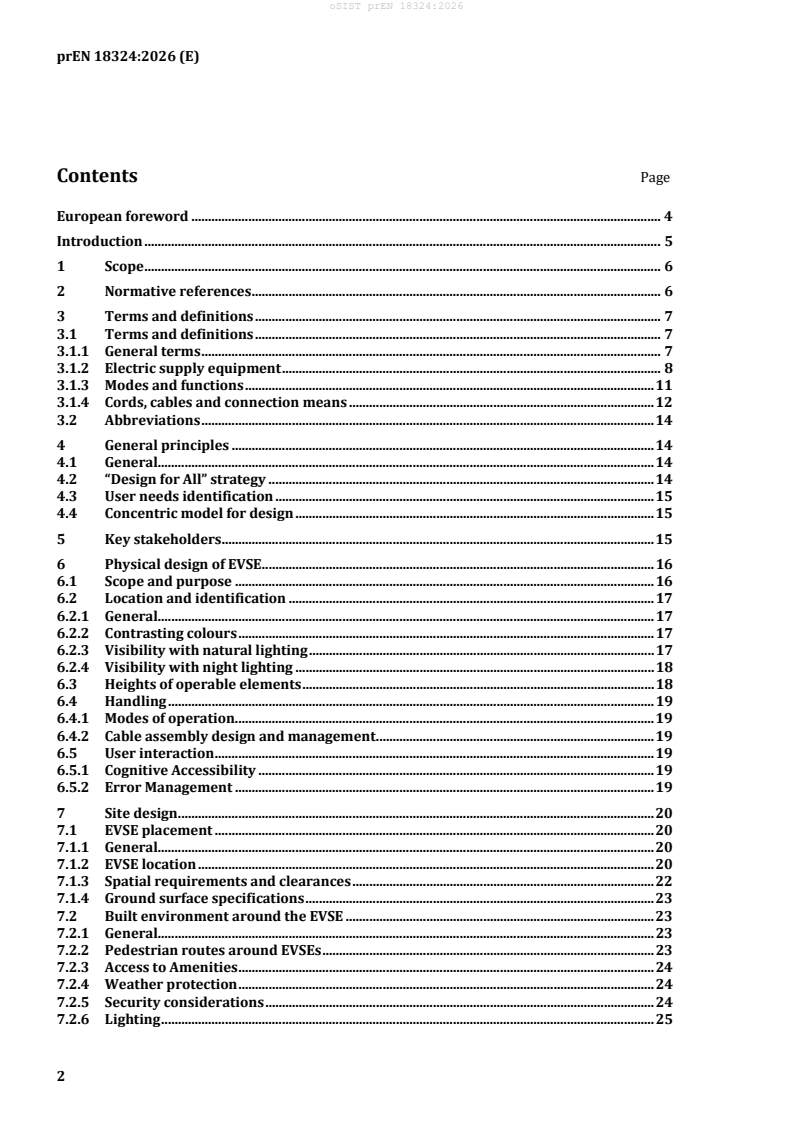
General Information
- Abstract
This document specifies accessibility requirements and recommendations for accessible charging stations for electric road vehicles, following a “Design for All”/“Universal Design” approach.
This document applies to the charging infrastructure for M1 electric vehicles, which are used for the carriage of passengers and are equipped with at least four wheels and comprising not more than eight seats in addition to the driver's seat, and for N1 electric vehicles, which are used for the carriage of goods and having a maximum mass not exceeding 3,5 tonnes.
This document sets out requirements and recommendations designed to ensure that the charging infrastructure is accessible and usable for all drivers, including those with specific mobility needs. Autonomous driving vehicles are excluded from the scope of this document.
This document is applicable to charging infrastructures, whether public or private, intended for electric vehicle charging. While it primarily addresses requirements and recommendations for conductive charging, wireless/inductive charging is also considered where relevant.
This document covers:
— the built environment surrounding electric vehicle charging stations, including its location, identification, signage and information;
— the built environment close to the electric vehicle to enable the charging process;
— factors to be taken into account in the design and specification of electric vehicle supply equipment;
— the platform and applications to enable the type of charging and payment, when relevant;
— other possible basic services associated with the charging process: pedestrian connection, associated toilets, etc.
This document does not cover:
— electric vehicles categories other than M1 and N1, although its users could also benefit from the requirements given in this document;
— specific materials used within an electric vehicle supply equipment;
— definition of charging rates or charging prices;
— user personal safety and protection;
— grid connections for electric vehicle charging stations;
— parking policy and planning policy related to designated accessible parking spaces or electric vehicle charging.
NOTE Some of the requirements given in this document might not be applicable to private infrastructures (e.g. the ones related to the payment system).
- Status
- Not Published
- Publication Date
- 27-Jun-2027
- Technical Committee
- CEN/CLC/TC 11 - Accessibility in the built environment
- Drafting Committee
- WG 2 - Accessible recharging stations
- Current Stage
- 4060 - Closure of enquiry - Enquiry
- Start Date
- 28-May-2026
- Due Date
- 22-May-2026
- Completion Date
- 28-May-2026

Overview
prEN 18324 specifies accessibility requirements and recommendations for charging stations for electric road vehicles, promoting barrier-free access for all users. Developed by CEN, this draft European standard adopts a “Design for All” or “Universal Design” approach for electric vehicle (EV) charging infrastructures. It covers both public and private charging points intended for M1 vehicles (passenger cars) and N1 vehicles (light commercial vehicles up to 3.5 tonnes), focusing on making these stations user-friendly for all drivers, including those with disabilities, older people, and anyone with temporary or situational impairments.
The standard addresses the physical, digital, and environmental aspects of charging infrastructure, aiming to enhance social inclusion and independent mobility as e-mobility adoption accelerates across Europe.
Key Topics
- Scope of Accessibility: Requirements and recommendations apply to most users, especially those with specific mobility needs. Autonomous driving vehicles are excluded.
- Physical Environment: Provisions include location, identification, and signage of charging stations and their integration into the surrounding built environment.
- User Interface & Payment: Digital and physical interfaces, including mobile apps, wayfinding, and payment systems, are considered for cognitive and physical accessibility.
- EV Supply Equipment (EVSE) Design: Focus on the placement, operability, and ergonomics of physical charging hardware, including cable management.
- Associated Amenities: Guidance includes accessible pedestrian routes, toilets, and other essential services related to charging.
- System Approach: Emphasizes the interconnectedness of site layout, hardware, information provision, and user interaction.
Applications
prEN 18324 is relevant for:
- Public and Private Charging Infrastructure: Operators of both types of facilities can apply the standard to ensure widespread accessibility.
- Designers and Manufacturers: Creation and installation of inclusive, intuitive, and ergonomic EV charging stations.
- Operators and Service Providers: Provision of barrier-free digital and physical user interfaces, accessible information, and multi-channel payment solutions.
- Municipalities and Urban Planners: Integration of accessible charging points into public spaces, ensuring EV charging supports mobility for all.
- Facility Owners & Procurement Officers: Guidance on specifying and tendering for accessible EV supply equipment and related site modifications.
Practical examples include:
- Installing charging stations with clear visual and tactile signage and adequate lighting.
- Configuring charging bays and walkways to allow easy wheelchair access.
- Ensuring user interfaces on charge points and associated digital platforms are operable with assistive technologies and available in multiple languages.
- Deploying accessible payment systems that accommodate users with different abilities.
Accessibility features can improve the overall user experience, expand the potential customer base, and support compliance with regional and national regulations.
Related Standards
To ensure consistency and harmonization with broader requirements, prEN 18324 makes reference to the following key standards:
- EN 17210: Accessibility and usability of the built environment - Functional requirements
- EN 301549: Accessibility requirements for ICT products and services
- ISO 21542: Building construction - Accessibility and usability of the built environment
- EN IEC 62196-1: Conductive charging for electric vehicles - General requirements for connectors, inlets, and outlets
- ISO 7000, ISO 7001: Graphical symbols used on equipment and public information signage
These standards help ensure comprehensive coverage for accessible EV charging solutions, integrating both built environment and digital accessibility best practices.
By adhering to prEN 18324, organizations contribute to the development of an inclusive, user-centric EV charging network supporting sustainable and equitable mobility across Europe. Integrating accessibility into charging infrastructure future-proofs investments and aligns with evolving societal and regulatory expectations.
Get Certified
Connect with accredited certification bodies for this standard

TÜV Rheinland
TÜV Rheinland is a leading international provider of technical services.

TÜV SÜD
TÜV SÜD is a trusted partner of choice for safety, security and sustainability solutions.

DEKRA Certification Inc.
DEKRA US certification services.
Sponsored listings
Frequently Asked Questions
prEN 18324 is a draft published by the European Committee for Standardization (CEN). Its full title is "Accessibility requirements and recommendations for charging stations for electric road vehicles". This standard covers: This document specifies accessibility requirements and recommendations for accessible charging stations for electric road vehicles, following a “Design for All”/“Universal Design” approach. This document applies to the charging infrastructure for M1 electric vehicles, which are used for the carriage of passengers and are equipped with at least four wheels and comprising not more than eight seats in addition to the driver's seat, and for N1 electric vehicles, which are used for the carriage of goods and having a maximum mass not exceeding 3,5 tonnes. This document sets out requirements and recommendations designed to ensure that the charging infrastructure is accessible and usable for all drivers, including those with specific mobility needs. Autonomous driving vehicles are excluded from the scope of this document. This document is applicable to charging infrastructures, whether public or private, intended for electric vehicle charging. While it primarily addresses requirements and recommendations for conductive charging, wireless/inductive charging is also considered where relevant. This document covers: — the built environment surrounding electric vehicle charging stations, including its location, identification, signage and information; — the built environment close to the electric vehicle to enable the charging process; — factors to be taken into account in the design and specification of electric vehicle supply equipment; — the platform and applications to enable the type of charging and payment, when relevant; — other possible basic services associated with the charging process: pedestrian connection, associated toilets, etc. This document does not cover: — electric vehicles categories other than M1 and N1, although its users could also benefit from the requirements given in this document; — specific materials used within an electric vehicle supply equipment; — definition of charging rates or charging prices; — user personal safety and protection; — grid connections for electric vehicle charging stations; — parking policy and planning policy related to designated accessible parking spaces or electric vehicle charging. NOTE Some of the requirements given in this document might not be applicable to private infrastructures (e.g. the ones related to the payment system).
This document specifies accessibility requirements and recommendations for accessible charging stations for electric road vehicles, following a “Design for All”/“Universal Design” approach. This document applies to the charging infrastructure for M1 electric vehicles, which are used for the carriage of passengers and are equipped with at least four wheels and comprising not more than eight seats in addition to the driver's seat, and for N1 electric vehicles, which are used for the carriage of goods and having a maximum mass not exceeding 3,5 tonnes. This document sets out requirements and recommendations designed to ensure that the charging infrastructure is accessible and usable for all drivers, including those with specific mobility needs. Autonomous driving vehicles are excluded from the scope of this document. This document is applicable to charging infrastructures, whether public or private, intended for electric vehicle charging. While it primarily addresses requirements and recommendations for conductive charging, wireless/inductive charging is also considered where relevant. This document covers: — the built environment surrounding electric vehicle charging stations, including its location, identification, signage and information; — the built environment close to the electric vehicle to enable the charging process; — factors to be taken into account in the design and specification of electric vehicle supply equipment; — the platform and applications to enable the type of charging and payment, when relevant; — other possible basic services associated with the charging process: pedestrian connection, associated toilets, etc. This document does not cover: — electric vehicles categories other than M1 and N1, although its users could also benefit from the requirements given in this document; — specific materials used within an electric vehicle supply equipment; — definition of charging rates or charging prices; — user personal safety and protection; — grid connections for electric vehicle charging stations; — parking policy and planning policy related to designated accessible parking spaces or electric vehicle charging. NOTE Some of the requirements given in this document might not be applicable to private infrastructures (e.g. the ones related to the payment system).
prEN 18324 is classified under the following ICS (International Classification for Standards) categories: 43.120 - Electric road vehicles. The ICS classification helps identify the subject area and facilitates finding related standards.
prEN 18324 is associated with the following European legislation: EU Directives/Regulations: 2023/1804. When a standard is cited in the Official Journal of the European Union, products manufactured in conformity with it benefit from a presumption of conformity with the essential requirements of the corresponding EU directive or regulation.
prEN 18324 is available in PDF format for immediate download after purchase. The document can be added to your cart and obtained through the secure checkout process. Digital delivery ensures instant access to the complete standard document.
Standards Content (Sample)
SLOVENSKI STANDARD
01-maj-2026
Zahteve in priporočila za dostopnost polnilnih postaj za električna cestna vozila
Accessibility requirements and recommendations for charging stations for electric road
vehicles
Anforderungen und Empfehlungen zur Barrierefreiheit von Ladestationen für
Elektrofahrzeuge
Exigences et recommandations d’accessibilité relatives aux bornes de charge pour
véhicules routiers électriques
Ta slovenski standard je istoveten z: prEN 18324
ICS:
43.120 Električna cestna vozila Electric road vehicles
2003-01.Slovenski inštitut za standardizacijo. Razmnoževanje celote ali delov tega standarda ni dovoljeno.
EUROPEAN STANDARD DRAFT
NORME EUROPÉENNE
EUROPÄISCHE NORM
March 2026
ICS 43.120
English version
Accessibility requirements and recommendations for
charging stations for electric road vehicles
Exigences et recommandations d'accessibilité relatives Anforderungen und Empfehlungen zur Barrierefreiheit
aux bornes de charge pour véhicules routiers von Ladestationen für Elektrofahrzeuge
électriques
This draft European Standard is submitted to CEN members for enquiry. It has been drawn up by the Technical Committee
CEN/CLC/JTC 11.
If this draft becomes a European Standard, CEN and CENELEC members are bound to comply with the CEN/CENELEC Internal
Regulations which stipulate the conditions for giving this European Standard the status of a national standard without any
alteration.
This draft European Standard was established by CEN and CENELEC in three official versions (English, French, German). A
version in any other language made by translation under the responsibility of a CEN and CENELEC member into its own language
and notified to the CEN-CENELEC Management Centre has the same status as the official versions.
CEN and CENELEC members are the national standards bodies and national electrotechnical committees of Austria, Belgium,
Bulgaria, Croatia, Cyprus, Czech Republic, Denmark, Estonia, Finland, France, Germany, Greece, Hungary, Iceland, Ireland, Italy,
Latvia, Lithuania, Luxembourg, Malta, Netherlands, Norway, Poland, Portugal, Republic of North Macedonia, Romania, Serbia,
Slovakia, Slovenia, Spain, Sweden, Switzerland, Türkiye and United Kingdom.
Recipients of this draft are invited to submit, with their comments, notification of any relevant patent rights of which they are
aware and to provide supporting documentation.Recipients of this draft are invited to submit, with their comments, notification
of any relevant patent rights of which they are aware and to provide supporting documentation.
Warning : This document is not a European Standard. It is distributed for review and comments. It is subject to change without
notice and shall not be referred to as a European Standard.
Contents Page
European foreword . 4
Introduction . 5
1 Scope . 6
2 Normative references . 6
3 Terms and definitions . 7
3.1 Terms and definitions . 7
3.1.1 General terms . 7
3.1.2 Electric supply equipment . 8
3.1.3 Modes and functions . 11
3.1.4 Cords, cables and connection means . 12
3.2 Abbreviations . 14
4 General principles . 14
4.1 General. 14
4.2 “Design for All” strategy . 14
4.3 User needs identification . 15
4.4 Concentric model for design . 15
5 Key stakeholders . 15
6 Physical design of EVSE . 16
6.1 Scope and purpose . 16
6.2 Location and identification . 17
6.2.1 General. 17
6.2.2 Contrasting colours . 17
6.2.3 Visibility with natural lighting . 17
6.2.4 Visibility with night lighting . 18
6.3 Heights of operable elements . 18
6.4 Handling . 19
6.4.1 Modes of operation. 19
6.4.2 Cable assembly design and management . 19
6.5 User interaction . 19
6.5.1 Cognitive Accessibility . 19
6.5.2 Error Management . 19
7 Site design . 20
7.1 EVSE placement . 20
7.1.1 General. 20
7.1.2 EVSE location . 20
7.1.3 Spatial requirements and clearances . 22
7.1.4 Ground surface specifications . 23
7.2 Built environment around the EVSE . 23
7.2.1 General. 23
7.2.2 Pedestrian routes around EVSEs . 23
7.2.3 Access to Amenities . 24
7.2.4 Weather protection . 24
7.2.5 Security considerations . 24
7.2.6 Lighting . 25
7.2.7 Site maintenance. 25
8 Information and communications . 25
8.1 Digital information and communications . 25
8.1.1 General . 25
8.1.2 Pre-charging information provision . 25
8.1.3 Digital user interface on EVSEs) . 25
8.1.4 Language and clarity . 25
8.1.5 Mobile applications and online platforms . 26
8.1.6 Charging session feedback . 26
8.1.7 User support and emergency communication . 26
8.1.8 Interoperability and open access . 26
8.1.9 Network connectivity . 26
8.1.10 Payment accessibility . 26
8.1.11 Data privacy and security . 26
8.1.12 User feedback and reporting . 26
8.1.13 Consistency across platforms . 26
8.2 Physical information and communications . 27
8.2.1 General . 27
8.2.2 Directional and wayfinding signage . 27
8.2.3 On-site identification and operational information . 27
8.2.4 Signage design and accessibility . 27
8.2.5 Parking spot signs and restrictions . 27
8.2.6 Ground markings . 27
8.2.7 Lighting and visibility . 28
8.2.8 Physical wayfinding cues and hazard marking . 28
8.2.9 Supplementary signage and consistency . 28
8.2.10 Physical payment information . 28
8.2.11 Environmental and contextual information . 28
8.2.12 Temporary conditions and maintenance . 28
Bibliography . 30
European foreword
This document (prEN 18324:2026) has been prepared by Joint Technical Committee CEN/CLC/JTC 11
“Accessibility in the built environment”, the secretariat of which is held by UNE.
This document is currently submitted to the CEN Enquiry.
Introduction
The transition to electric mobility is reshaping transport systems. Ensuring that EVSEs are accessible is
essential to enabling independent mobility, social inclusion and equal participation in daily life for all
drivers, including persons with disabilities, older persons, and individuals with temporary or situational
impairments.
This document provides requirements and recommendations for the accessible design, installation and
operation of charging infrastructure for M1 and N1 electric vehicles. Building on the principles of
Universal Design, it supports designers, manufacturers, operators, procurers and regulators in creating
environments, products and services that can be used equitably, safely and independently.
The provisions given in this document recognize that charging infrastructure is a composite system in
which physical, digital and environmental components interact. Accessibility considerations are
integrated from the physical design of electric vehicle supply equipment (EVSE) to the layout of the
charging space, and from digital user interfaces to wayfinding, information provision and payment
systems.
This document complements existing European and international standards on accessibility, the built
environment, electric vehicle charging systems and digital accessibility. It is intended to support
harmonization across Europe and contribute to a charging network that is inclusive, user-centred and
aligned with the principles of Universal Design.
1 Scope
This document specifies accessibility requirements and recommendations for accessible charging
stations for electric road vehicles, following a “Design for All”/“Universal Design” approach.
This document applies to the charging infrastructure for M1 electric vehicles, which are used for the
carriage of passengers and are equipped with at least four wheels and comprising not more than eight
seats in addition to the driver's seat, and for N1 electric vehicles, which are used for the carriage of goods
and having a maximum mass not exceeding 3,5 tonnes.
This document sets out requirements and recommendations designed to ensure that the charging
infrastructure is accessible and usable for all drivers, including those with specific mobility needs.
Autonomous driving vehicles are excluded from the scope of this document.
This document is applicable to charging infrastructures, whether public or private, intended for electric
vehicle charging. While it primarily addresses requirements and recommendations for conductive
charging, wireless/inductive charging is also considered where relevant.
This document covers:
— the built environment surrounding electric vehicle charging stations, including its location,
identification, signage and information;
— the built environment close to the electric vehicle to enable the charging process;
— factors to be taken into account in the design and specification of electric vehicle supply equipment;
— the platform and applications to enable the type of charging and payment, when relevant;
— other possible basic services associated with the charging process: pedestrian connection, associated
toilets, etc.
This document does not cover:
— electric vehicles categories other than M1 and N1, although its users could also benefit from the
requirements given in this document;
— specific materials used within an electric vehicle supply equipment;
— definition of charging rates or charging prices;
— user personal safety and protection;
— grid connections for electric vehicle charging stations;
— parking policy and planning policy related to designated accessible parking spaces or electric vehicle
charging.
NOTE Some of the requirements given in this document might not be applicable to private infrastructures (e.g.
the ones related to the payment system).
2 Normative references
The following documents are referred to in the text in such a way that some or all of their content
constitutes requirements of this document. For dated references, only the edition cited applies. For
undated references, the latest edition of the referenced document (including any amendments) applies.
EN 17210, Accessibility and usability of the built environment - Functional requirements
EN 301549, Accessibility requirements for ICT products and services
ISO 7000, Graphical symbols for use on equipment — Registered symbols
ISO 7001:2003, Graphical symbols — Registered public information symbols
ISO 21542, Building construction — Accessibility and usability of the built environment
EN IEC 62196-1:2022, Plugs, socket-outlets, vehicle connectors and vehicle inlets - Conductive charging of
electric vehicles - Part 1: General requirements
3 Terms and definitions
For the purposes of this document, the following terms and definitions apply.
ISO and IEC maintain terminology databases for use in standardization at the following addresses:
— ISO Online browsing platform: available at https://www.iso.org/obp/
— IEC Electropedia: available at https://www.electropedia.org/
3.1 Terms and definitions
3.1.1 General terms
3.1.1.1
accessibility
extent to which products, systems, services, environments and facilities can be used by people from a
population with the widest range of user needs, characteristics and capabilities to achieve identified goals
in identified contexts of use
Note 1 to entry: Context of use includes direct use or use supported by assistive technologies.
Note 2 to entry: The identified goals of an accessible built environment are for people to independently and
safely gain access to, enter, use and exit this environment.
[SOURCE: EN ISO 9241-112:2025, 3.11, modified — Note 2 to entry added]
3.1.1.2
built environment
external and internal environments and any element, component or fitting that is commissioned,
designed, constructed and managed for use by people
Note 1 to entry: Loose items are excluded because decisions with respect to their location within the built
environment are more likely to be under the day-to-day control of facilities managers and not of those who
commission, design or construct the built environment.
[SOURCE: ISO 21542:2021, 3.4]
3.1.1.3
Universal Design
UD
design of products, environments, programmes and services to be usable by all people, to the greatest
extent possible, without the need for adaptation or specialised design
Note 1 to entry: “Universal Design” does not exclude the need of assistive devices for particular groups or
persons with disabilities where relevant.
Note 2 to entry: Terms such as “Universal Design”, “accessible design”, “Design for All”, “barrier-free design”,
“inclusive design” and “transgenerational design” are often used interchangeably with the same meaning.
[SOURCE: EN 17210:2021, 3.52]
3.1.1.4
system approach
methodology that considers the entire system and its interconnected parts, adopting an integrated
perspective
3.1.1.5
charging infrastructure
integrated system of physical, digital, and spatial components required to enable the charging of the EV
Note 1 to entry: EV supply equipment is part of a charging infrastructure.
3.1.1.6
charging user
driver of the EV who interacts with the charging process and may also interact with the surrounding built
environment associated with the charging infrastructure
3.1.1.7
ground level
surface of the ground where the vehicle’s wheels rest, used as reference
Note 1 to entry: Where there is a slope, the reference is the point where the wheel closest to the EVSE rests.
3.1.2 Electric supply equipment
3.1.2.1
EV supply equipment
EVSE
equipment or a combination of equipment, providing dedicated functions to supply electric energy from
a fixed electrical installation or supply network to an EV for the purpose of charging
EXAMPLE 1 For Mode 3 case B, the EV supply equipment consists of the Mode 3 charging station and the cable
assembly.
EXAMPLE 2 For Mode 3 case C, the EV supply equipment consists of the Mode 3 charging station with its cable
assembly.
Note 1 to entry: EV supply equipment is either permanently connected or connected by a cable and plug to the
electrical installation.
Note 2 to entry: Terms such as “EVSE”, “chargepoint” and “recharging point” are often used interchangeably
with the same meaning.
[SOURCE: prEN IEC 61851-1:2025, 3.1.1, modified, — Note 2 to entry added. EXAMPLE 1 modified.
EXAMPLE 2 modified]
3.1.2.2
charging station
part of EV supply equipment permanently connected to an electrical installation
Note 1 to entry: For case C, the cable assembly is part of the charging station.
[SOURCE: prEN IEC 61851-1:2025, 3.1.5, modified — Prefix “EV” deleted from the term. Note 1 modified]
3.1.2.3
case A
connection of an EV to an electrical installation with a cable assembly permanently attached to the EV
Note 1 to entry: The cable assembly is part of the vehicle.
Note 2 to entry: See Figure 1.
Key
(a) socket-outlet
(b) plug
(c) cable assembly
(d) vehicle connector
(e) vehicle coupler
(f) vehicle inlet
(g) charging station
(h) EV socket-outlet
(i) EV plug
Figure 1 — Case A connection
[SOURCE: prEN IEC 61851-1:2025, 3.1.6, modified — Prefix “EV” deleted from key (g)]
3.1.2.4
case B
connection of an EV to an electrical installation with a cable assembly detachable at both ends
Note 1 to entry: The detachable cable assembly is not part of the vehicle or the charging station.
Note 2 to entry: See Figure 2.
Key
(a) socket-outlet
(b) plug
(c) cable assembly
(d) vehicle connector
(e) vehicle coupler
(f) vehicle inlet
(g) charging station
(h) EV socket-outlet
(i) EV plug
Figure 2 — Case B connection
[SOURCE: prEN IEC 61851-1:2025, 3.1.7, modified — Note 1 to entry modified]
3.1.2.5
case C
connection of an EV to an electrical installation utilizing a cable assembly permanently attached to the
charging station
Note 1 to entry: The cable assembly is part of the charging station.
Note 2 to entry: See Figure 3.
Key
(a) socket-outlet
(b) plug
(c) cable assembly
(d) vehicle connector
(e) vehicle coupler
(f) vehicle inlet
(g) charging station
(h) EV socket-outlet
(i) EV plug
Figure 3 — Case C connection
[SOURCE: prEN IEC 61851-1:2025, 3.1.7, modified — Prefix “EV” deleted from definition. Note 1 to entry
modified]
3.1.2.6
charging space
area that includes the EV supply equipment, the associated parking spot, and the built environment
required to enable the charging of the EV
3.1.3 Modes and functions
3.1.3.1
charging
transfer of electric energy from the electrical installation to an EV
[SOURCE: prEN IEC 61851-1:2025, 3.3.6, modified — Terms “forward power transfer” and “FPT” deleted]
3.1.3.2
electric vehicle
EV
vehicle with one or more electric drive(s) for vehicle propulsion
Note 1 to entry: In this document, these terms refer only to those vehicles that can be charged from an external
electrical source.
Note 2 to entry: Electric vehicle is called electrically propelled vehicle in ISO standards.
[SOURCE: prEN IEC 61851-1:2025, 3.3.19]
3.1.3.3
charging Mode 1
Mode 1
method for the connection of an EV to a standard socket-outlet of an AC electrical installation, utilizing a
cable and plug, both of which are not fitted with any supplementary pilot or auxiliary contacts
[SOURCE: prEN IEC 61851-1:2025, 3.3.2]
3.1.3.4
charging Mode 2
Mode 2
method for the connection of an EV to a standard socket-outlet of an AC electrical installation utilizing an
AC EV supply equipment with a cable and plug, with a control pilot function and system for personal
protection against electric shock placed between the standard plug and the EV
[SOURCE: prEN IEC 61851-1:2025, 3.3.3]
3.1.3.5
charging Mode 3
Mode 3
method for the connection of an EV to an AC EV supply equipment permanently connected to an AC
electrical installation, with a control pilot function that extends from the AC EV supply equipment to the
EV
[SOURCE: prEN IEC 61851-1:2025, 3.3.4]
3.1.3.6
charging Mode 4
Mode 4
method for the connection of an EV to an AC or DC electrical installation utilizing a DC EV supply
equipment, with a control pilot function that extends from the DC EV supply equipment to the EV
[SOURCE: prEN IEC 61851-1:2025, 3.3.5]
3.1.4 Cords, cables and connection means
3.1.4.1
socket-outlet
accessory having socket-contacts designed to engage with the contacts of a plug and having terminals for
the connection of cables or cords
[SOURCE: prEN IEC 61851-1:2025, 3.4.1]
3.1.4.2
EV socket-outlet
specific socket-outlet intended to be used as part of EV supply equipment
Note 1 to entry: EV socket-outlets are defined in the IEC 62196 series.
Note 2 to entry: An EV socket-outlet is not intended to be installed as a standard socket-outlet in building
installations and is not intended to connect to standard plugs.
[SOURCE: prEN IEC 61851-1:2025, 3.4.1, modified – reference to the IEC 62196 series was moved to a
note to entry]
3.1.4.3
plug
accessory having contacts designed to engage with the contacts of a socket-outlet, also incorporating
means for the electrical connection and mechanical retention of flexible cables or cords
[SOURCE: prEN IEC 61851-1:2025, 3.4.4]
3.1.4.4
EV plug
specific socket-outlet intended to be used as part of EV supply equipment
Note 1 to entry: EV plugs are defined in the IEC 62196 series.
Note 2 to entry: An EV plug is not intended to connect directly to standard socket-outlets provided in the
building installation.
[SOURCE: prEN IEC 61851-1:2025, 3.4.5, modified – reference to the IEC 62196 series was moved to a
note to entry]
3.1.4.5
vehicle connector
part of a vehicle coupler integral with, or intended to be attached to the cable assembly
[SOURCE: prEN IEC 61851-1:2025, 3.4.7]
3.1.4.6
vehicle inlet
part of a vehicle coupler incorporated in, or fixed to, the electric vehicle
[SOURCE: prEN IEC 61851-1:2025, 3.4.8]
3.1.4.7
vehicle coupler
means of enabling the connection at will of a flexible cable to an electric vehicle
Note 1 to entry: It consists of two parts: a vehicle connector and a vehicle inlet.
[SOURCE: prEN IEC 61851-1:2025, 3.4.9]
3.1.4.8
connecting point
terminating point in an electrical installation where energy is transferred between that electrical
installation and one electric vehicle
EXAMPLE a socket-outlet, a vehicle connector or a supply device of a wireless power transfer device
Note 1 to entry: The connecting point can be part of the charging station.
Note 2 to entry: The connecting point for Mode 1, Mode 2 and Mode 4, connected by a cable and plug is the point
where one electric vehicle is connected to the electrical installation, means the standard socket-outlet.
Note 3 to entry: The connecting point for Mode 3 and permanently connected Mode 4 is the EV socket-outlet
(case A and case B) or the vehicle connector (case C).
Note 4 to entry: EV supply equipment can have one or more connecting points to supply energy to EVs.
[SOURCE: prEN IEC 61851-1:2025, 3.4.10, modified — Note 1 to entry modified]
3.1.4.9
cable assembly
assembly which consists of flexible cable or cord fitted with a standard plug or EV plug on the one end
and/or a vehicle connector on the other end, and which is used to establish the connection between the
EV and the electrical installation
Note 1 to entry: A cable assembly can be detachable (case B: EV plug on the one end, and vehicle connector on
the other end), or be a part of the EV (case A Mode 1: standard plug on the one end, and open conductors on the
other end), or be a part of the charging station (case C: open conductors on one end, and vehicle connector on the
other end).
[SOURCE: prEN IEC 61851-1:2025, 3.4.11, modified — definition grammatically corrected; Note 1 to
entry modified; Note 2 to entry, Note 3 to entry deleted]
3.1.4.10
cable management system
one or more devices that are intended to protect a cable assembly from mechanical damage and/or to
facilitate its handling
EXAMPLE Cable suspension device.
[SOURCE: prEN IEC 61851-1:2025, 3.4.12]
...