

EN 14730-1:2006+A1:2010
(Main + Amendment)Railway applications - Track - Aluminothermic welding of rails - Part 1: Approval of welding processes
- Abstract
This standard defines the laboratory tests and requirements for approval of an aluminothermic welding process using welds produced in workshop conditions.
It applies to the joining of new, Vignole rails as described in EN 13674-1 of the same profile and steel grade.
Compliance with the requirements of this standard does not of itself ensure the suitability of a welding process for specific conditions of track and traffic.
The standard does not cover welds made between different rail sections, differently worn rails and different rail grades.
In addition to the definitive requirements this standard also requires the items detailed in Clause 4 to be documented. For compliance with this standard, it is important that both the definitive requirements and the documented items be satisfied.
- Status
- Withdrawn
- Publication Date
- 06-Jul-2010
- Withdrawal Date
- 06-Oct-2026
- Technical Committee
- CEN/TC 256 - Railway applications
- Drafting Committee
- CEN/TC 256/SC 1/WG 4 - Rails
- Current Stage
- 9960 - Withdrawal effective - Withdrawal
- Start Date
- 01-Mar-2017
- Completion Date
- 07-Oct-2026

Relations
- Effective Date
- 18-Jan-2023
- Effective Date
- 08-Jun-2022
- Effective Date
- 28-Jan-2026
- Effective Date
- 28-Jan-2026
- Effective Date
- 28-Jan-2026
- Effective Date
- 28-Jan-2026
- Effective Date
- 28-Jan-2026
- Effective Date
- 28-Jan-2026
Get Certified
Connect with accredited certification bodies for this standard

DVS-ZERT GmbH
German welding certification society.
CARES (UK Certification Authority for Reinforcing Steels)
UK certification for reinforcing steels and construction.
EWF/IIW (European/International Welding Federation)
International welding personnel certification.
Sponsored listings
Frequently Asked Questions
EN 14730-1:2006+A1:2010 is a standard published by the European Committee for Standardization (CEN). Its full title is "Railway applications - Track - Aluminothermic welding of rails - Part 1: Approval of welding processes". This standard covers: This standard defines the laboratory tests and requirements for approval of an aluminothermic welding process using welds produced in workshop conditions. It applies to the joining of new, Vignole rails as described in EN 13674-1 of the same profile and steel grade. Compliance with the requirements of this standard does not of itself ensure the suitability of a welding process for specific conditions of track and traffic. The standard does not cover welds made between different rail sections, differently worn rails and different rail grades. In addition to the definitive requirements this standard also requires the items detailed in Clause 4 to be documented. For compliance with this standard, it is important that both the definitive requirements and the documented items be satisfied.
This standard defines the laboratory tests and requirements for approval of an aluminothermic welding process using welds produced in workshop conditions. It applies to the joining of new, Vignole rails as described in EN 13674-1 of the same profile and steel grade. Compliance with the requirements of this standard does not of itself ensure the suitability of a welding process for specific conditions of track and traffic. The standard does not cover welds made between different rail sections, differently worn rails and different rail grades. In addition to the definitive requirements this standard also requires the items detailed in Clause 4 to be documented. For compliance with this standard, it is important that both the definitive requirements and the documented items be satisfied.
EN 14730-1:2006+A1:2010 is classified under the following ICS (International Classification for Standards) categories: 25.160.10 - Welding processes; 93.100 - Construction of railways. The ICS classification helps identify the subject area and facilitates finding related standards.
EN 14730-1:2006+A1:2010 has the following relationships with other standards: It is inter standard links to EN 14730-1:2006, EN 14730-1:2017, EN ISO 6507-1:2023, EN ISO 6506-1:2014, EN 13674-1:2011+A1:2017, EN ISO 7500-1:2004, EN ISO 9712:2022, EN ISO 8936:2009. Understanding these relationships helps ensure you are using the most current and applicable version of the standard.
EN 14730-1:2006+A1:2010 is associated with the following European legislation: EU Directives/Regulations: 2008/57/EC, 93/38/EEC; Standardization Mandates: M/024. When a standard is cited in the Official Journal of the European Union, products manufactured in conformity with it benefit from a presumption of conformity with the essential requirements of the corresponding EU directive or regulation.
EN 14730-1:2006+A1:2010 is available in PDF format for immediate download after purchase. The document can be added to your cart and obtained through the secure checkout process. Digital delivery ensures instant access to the complete standard document.
Standards Content (Sample)
2003-01.Slovenski inštitut za standardizacijo. Razmnoževanje celote ali delov tega standarda ni dovoljeno.Bahnanwendungen - Oberbau - Aluminothermisches Schweißen von Schienen - Teil 1: Zulassung der SchweißverfahrenApplications ferroviaires - Voie - Soudage des rails par aluminothermie - Partie 1 : Approbation des procédés de soudageRailway applications - Track - Aluminothermic welding of rails - Part 1: Approval of welding processes45.080Rails and railway components25.160.10Varilni postopki in varjenjeWelding processesICS:Ta slovenski standard je istoveten z:EN 14730-1:2006+A1:2010SIST EN 14730-1:2007+A1:2010en,fr,de01-september-2010SIST EN 14730-1:2007+A1:2010SLOVENSKI
STANDARD
EUROPEAN STANDARD NORME EUROPÉENNE EUROPÄISCHE NORM
EN 14730-1:2006+A1
July 2010 ICS 25.160.10; 93.100 Supersedes EN 14730-1:2006English Version
Railway applications - Track - Aluminothermic welding of rails - Part 1: Approval of welding processes
Applications ferroviaires - Voie - Soudage des rails par aluminothermie - Partie 1 : Approbation des procédés de soudage
Bahnanwendungen - Oberbau - Aluminothermisches Schweißen von Schienen - Teil 1: Zulassung der Schweißverfahren This European Standard was approved by CEN on 12 June 2006 and includes Amendment 1 approved by CEN on 15 May 2010.
CEN members are bound to comply with the CEN/CENELEC Internal Regulations which stipulate the conditions for giving this European Standard the status of a national standard without any alteration. Up-to-date lists and bibliographical references concerning such national standards may be obtained on application to the CEN Management Centre or to any CEN member.
This European Standard exists in three official versions (English, French, German). A version in any other language made by translation under the responsibility of a CEN member into its own language and notified to the CEN Management Centre has the same status as the official versions.
CEN members are the national standards bodies of Austria, Belgium, Bulgaria, Croatia, Cyprus, Czech Republic, Denmark, Estonia, Finland, France, Germany, Greece, Hungary, Iceland, Ireland, Italy, Latvia, Lithuania, Luxembourg, Malta, Netherlands, Norway, Poland, Portugal, Romania, Slovakia, Slovenia, Spain, Sweden, Switzerland and United Kingdom.
EUROPEAN COMMITTEE FOR STANDARDIZATION
COMITÉ EUROPÉEN DE NORMALISATION EUROPÄISCHES KOMITEE FÜR NORMUNG
Management Centre:
Avenue Marnix 17,
B-1000 Brussels © 2010 CEN All rights of exploitation in any form and by any means reserved worldwide for CEN national Members. Ref. No. EN 14730-1:2006+A1:2010: ESIST EN 14730-1:2007+A1:2010
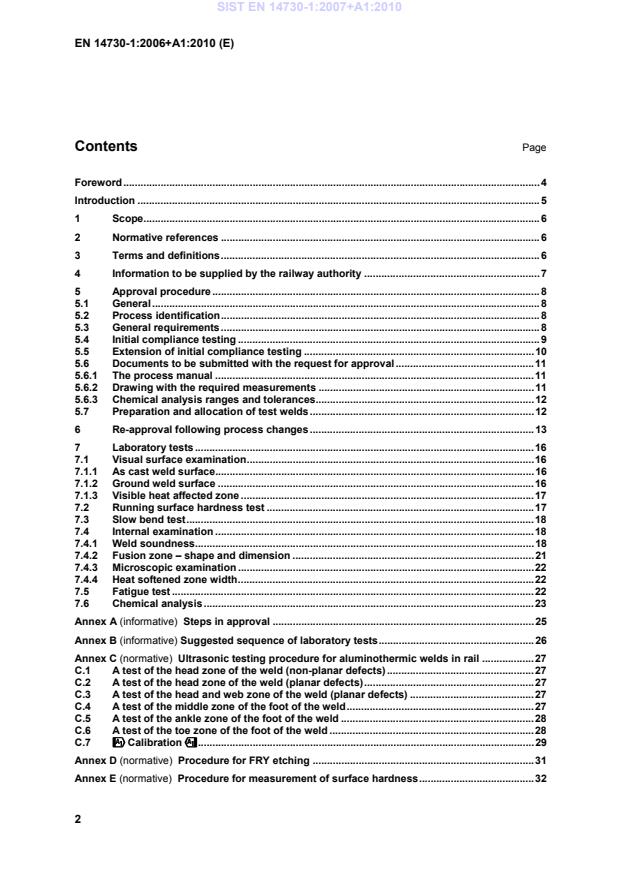
Steps in approval . 25Annex B (informative) Suggested sequence of laboratory tests . 26Annex C (normative)
Ultrasonic testing procedure for aluminothermic welds in rail . 27C.1A test of the head zone of the weld (non-planar defects) . 27C.2A test of the head zone of the weld (planar defects) . 27C.3A test of the head and web zone of the weld (planar defects) . 27C.4A test of the middle zone of the foot of the weld . 27C.5A test of the ankle zone of the foot of the weld . 28C.6A test of the toe zone of the foot of the weld . 28C.7!!!!Calibration"""" . 29Annex D (normative)
Procedure for FRY etching . 31Annex E (normative)
Procedure for measurement of surface hardness . 32SIST EN 14730-1:2007+A1:2010
Procedure for slow bend test . 33Annex G (normative)
Procedure for recording test weld fracture face defects . 34Annex H (normative)
Ultrasonic inspection procedure on aluminothermic welds to be sectioned . 36H.1Principle . 36H.2Apparatus . 36H.3Preparation of samples . 36H.4Calibration . 36H.5Testing. 37H.6Reporting . 37Annex I (normative)
Procedure for microscopic examination of the visible heat affected zone and fusion zone of welds . 38Annex J (normative)
Procedure for measurement of the heat softened zone width. 39J.1Measurement of hardness. 39J.2Evaluation of hardness data . 40J.2.1General . 40J.2.2Mean hardness of parent rail . 40J.2.3Measurement hardness line . 40J.2.4Heat softened zone width measurement . 41J.2.5Parent rail hardness variation . 41Annex K (normative)
Fatigue test methods for aluminothermic welds . 42K.1Scope. 42K.2Test equipment . 42K.3Calibration procedure . 43K.3.1General . 43K.3.2Test piece . 43K.3.3Test piece preparation . 43K.3.4Instrumentation . 44K.3.5Procedure . 44K.4Fatigue test method . 47K.4.1General . 47K.4.2Staircase testing method . 47K.4.3Example of the data analysis of a fatigue strength determination by the staircase method . 49K.4.4Past-the-post testing method . 50Annex L (informative)
A–deviations . 51 SIST EN 14730-1:2007+A1:2010
b) Initial compliance with this standard shall be achieved by undertaking the tests specified in category 1 of Table 2 using either grade R220 or grade R260 rail of one profile in either group 1 or 2 of Table 1. Compliance with all the criteria specified and with the railway authority’s documented requirements specified in Clause 4 shall be demonstrated. A test sequence is outlined in informative Annex B. A test specimen can be used for several different tests. SIST EN 14730-1:2007+A1:2010
Category 2b
Category 3c
R200/R220/ R260/R260Mn R320Cr R350HT R350LH T A Hardness Test 7.2 6 Nil 6 6 ____6_____ B Surface Examination - Visual 7.1.1 7.1.2 All All All All _____All_____ C Visible Heat Affected Zone 7.1.3 2 2 2 2 ______2_____ D Slow Bend Test 7.3
6 2 2 6 _____6______ E Ultrasonic Inspection - Annex H 7.4.1.1 5 2 Nil Nil Nil Nil F Fatigue Test 7.5 n* Nil Nil n* Nil n* G Fusion Zone -Weld Soundness 7.4.1 5 2 Nil Nil Nil Nil 7.3 (6) (2) (2) (2) ______2_____ 7.5.3 (n*) Nil Nil (n*) Nil n* H Fusion Zone
- Shape and Dimensions 7.4.2 5 2 Nil Nil Nil Nil I Chemical Analysis 7.6 3 Nil 3 3 ______3______ J Heat Softened Zone
- Hardness Distribution 7.4.4 2 2 2 2 ______2_______ K Structure
- Fusion Zone
- Heat Affected Zone 7.4.3.3 7.4.3.2 1 1 Nil Nil 1 1 ______1_______ 1 1 ______1_______ L Ultrasonic Inspection - Annex C 5.7 d) All All All All All All NOTE 1 n* indicates the number of welds required for one staircase or past the post evaluation. Typically 10 test pieces will be required for a staircase and 3 for a past the post evaluation. NOTE 2 ____X____ indicates that tests in one rail grade cover the other indicated grade NOTE 3 ( ) indicates weld soundness evaluation of the fracture face of the slow bend test or fatigue specimens a Category 1 Initial tests to be conducted using R220 or R260 grade rail and one profile from either of rail profile groups 1 or 2 (Table 1). b Category 2 Tests to be carried out on one profile from each of the remaining rail profile groups in order to extend approval to that group. c Category 3 Tests required extending approval to other rail grades. Tests on one rail profile cover all profile groups approved in categories 1 and 2.
5.5 Extension of initial compliance testing Initial compliance can be extended as follows: The relevant railway authority requirements defined in Clause 4 a) to k) shall be met for each of the items below: a) To other groups of rail profiles of Table 1 [subclause 5.4 a)] by the tests in category 2 of Table 2 [subclause 5.4 b)] to be conducted on one profile from each of the appropriate groups.
Failure of any test shall cause non-compliance for the group of rail profiles being tested. b) To other rail grades by the tests in category 3 of Table 2 [subclause 5.4 b)]. Failure of any test shall cause non-compliance for that rail grade. Tests on one rail profile cover all profiles in categories 1 and 2. c) To process changes as prescribed by the limits and tests of Clause 6. Failure of the relevant tests of Table 3 shall cause non-compliance of the process change. SIST EN 14730-1:2007+A1:2010
Key 1 Figure showing the width of the weld collar around the weld 2 Riser cross section on the neutral axis mm² 3 25 % of the foot width 4 Riser cross section at the foot mm2 5 Longitudinal axis under the rail foot Figure 1 — Dimensions taken from mould pattern 5.6.3 Chemical analysis ranges and tolerances The chemical analysis ranges and tolerances according to 7.6.1. 5.7 Preparation and allocation of test welds a) Welds required for the tests shall be produced in accordance with the process manual (5.6.1) under the supervision of the approving authority recognised by the railway authority. Rails to be used for the production of test welds shall be new rails. Fifty percent of test welds shall be made with minimum gap and fifty percent at maximum gap. b) Welding gap shall be measured after weld alignment (peaking) on both sides of the rail head (or on the running surface), web mid point and both foot tips. The maximum gap is the maximum at any of the above points and minimum the minimum of any of the above points. c) The weld gap for all welds made for Table 2 tests shall be within the specified range. In the case of the welds required for test H in category 1 of Table 2, three welds shall be produced at the minimum gap and two at the maximum, and for category 2 of Table 2, one weld at the maximum gap and one weld at the minimum gap. Measurements shall be made to an accuracy of ± 0,5 mm. d) All welds shall be tested ultrasonically using the procedure given in Annex C and the results recorded. SIST EN 14730-1:2007+A1:2010
(max.) 10 15 20 3 2 1
The number and dimensions of slag or sand inclusions shall not exceed the values specified in the information supplied by the railway authority [Clause 4 b)]: the condition of the surface left by riser removal (other than that on the ground rail head) shall conform with the requirements specified in the information supplied by the railway authority [(Clause 4 c)]. 7.1.2 Ground weld surface The head and the ground weld collar surface on either side of the rail head shall comply with the following: There shall be no cracks. Joints between weld collars and rail and flashing and rail are not cracks; There shall be no defects (pores, slag, sand inclusions, metal beads) with a dimension greater than 1 mm or limit fixed by the railway authority if the limit is less than 1 mm [Clause 4 d)]; A defect with a maximum dimension of 2 mm shall be accepted in the hatched zone 1 of Figure 2 for no more than 10 % of the test welds or one weld if fewer than 10 welds; Any additional non-destructive testing requirements specified in the information supplied by the railway authority [Clause 4, e)]. SIST EN 14730-1:2007+A1:2010
Key 1 Zone with a 2 mm radius 2 Rail head 3 Weld collar 4 Rail web Figure 2 — Ground collar surface 7.1.3 Visible heat affected zone Following FRY etching in accordance with Annex D the visible heat affected zones on each side of the weld shall be measured on the rail running surface centre line. Their widths shall not exceed 20 mm, 30 mm or 40 mm as specified in the information supplied by the railway authority [Clause 4 f)]. The visible heat affected zone shall be nominally symmetrical about the longitudinal axis of the rail and transverse axis of the weld. 7.2 Running surface hardness test Measurements shall be made in accordance with Annex E. The average of the three hardness measurements made on each weld shall fall within the range given in Table 5 for the appropriate parent rail grade. Table 5 — Ranges for running surface hardness tests Rail grade Hardness range HBW
Rail running surface on the unaffected parent rail Weld centre-line R200 200 to 240 230 ± 20 R220 220 to 260 250 ± 20 R260 260 to 300 280 ± 20 R260 260 to 300 300 ± 20 R260Mn 260 to 300 280 ± 20 R320Cr 320 to 360 330 ± 20 R350HT 350 to 390 350 ± 20 R350LHT 350 to 390 350 ± 20 NOTE 0,5 mm should be ground from the running surface before a hardness impression is made.
Key 1 Head 2 Profile of rail 3 Profile of weld 4 Web 5 Foot Figure 3 — Head, web and foot of the rail
7.4.1.2 The rails containing the welds shall then be sectioned to give: longitudinal vertical section on the symmetry plane (cut 1 in Figure 4); longitudinal vertical sections in the rail foot (cuts 2 in Figure 4); cuts as appropriate at least 5 mm from any apparent defects located by the ultrasonic testing method specified in Annex H. For each defect, the size shall be determined by progressively grinding and measuring until the maximum dimension is found. SIST EN 14730-1:2007+A1:2010
Key 1 Longitudinal vertical section on centre line 2 Longitudinal vertical section of foot tip Figure 4 — Sectioning of welds 7.4.1.3 Visual examination of the cut sections (polished to 220 grit) shall show no evidence of lack of fusion between the rail and fusion face. The weld collar's edge is permitted to be unfused to the rail surface for a maximum of 2 mm from the edge of the collar unless a lesser figure is specified in the information supplied by the railway authority [Clause 4, h)]. 7.4.1.4 The maximum dimension of any pores, slag inclusions, sand inclusions or metal beads shall be recorded. If multiple defects are revealed, they shall be counted and measured as a single defect if they are less than 1 mm apart. The maximum dimension of each defect shall be grouped in 1 mm size bands for the head, web and foot and summed for the number of sectioned welds examined in each test category of test G in Table 2 and Table 3. The size bands shall be as follows: Greater than 0 mm to 1 mm; Greater than 1 mm to 2 mm; Greater than 2 mm to 3 mm, etc. Per population of test welds in test G in Tables 2 and 3: no more than one defect with maximum dimension greater than 2 mm in the region of the head above the line A-A on Figure 3 shall be permitted. SIST EN 14730-1:2007+A1:2010
Key * Datum marks on foot tip 1 Fusion line 2 Rail ends before welding 3 Rail head 4 Rail foot Figure 5 — Shape of fusion zone on the etched longitudinal vertical section 7.4.2.3 The fusion zone shall exhibit a nominally symmetrical shape about the welding gap. SIST EN 14730-1:2007+A1:2010
7.5 Fatigue test 7.5.1 Fatigue strength shall be evaluated by the staircase or past the post procedure in accordance with Annex K. 7.5.2 The fatigue strength in terms of the mean fatigue strength and standard deviation for the staircase method or the minimum value of upper stress in the rail foot for the past the post method shall comply with the information supplied by the railway authority [Clause 4 j)]. 7.5.3 All test pieces remaining unbroken after fatigue testing shall be broken by slow bending in order to examine the fracture faces. For staircase testing the fracture faces of those welds broken during fatigue testing shall be examined visually. If fatigue has initiated at a lack of fusion defect, the process shall be rejected. The fracture faces of all welds, however broken, shall be examined for soundness in accordance with 7.4.1.5. SIST EN 14730-1:2007+A1:2010
Minimum Maximum
Carbon 0,30 0,35 0,40 0,50 0,55 0,70 0,75 0,85 ± 0,12 ± 0,12 ± 0,12 ± 0,12 R200 R220 R260, R260Mn R320Cr, R350HT, R350LHT Silicon 0,00 1,20 ±0,25 All Manganese 0,40 0,45 0,50
...