

EN 17243:2020
(Main)Cathodic protection of internal surfaces of metallic tanks, structures, equipment, and piping containing seawater
- Abstract
This document specifies the requirements and recommendations for cathodic protection systems applied to the internal surfaces of metallic tanks, structures, equipment and piping containing natural or treated seawater or brackish waters to provide an efficient protection from corrosion.
Cathodic protection inside fresh water systems is excluded from this document. This is covered by EN 12499.
NOTE EN 12499 covers internal cathodic protection for any kind of waters, including general aspects for seawater but excluding industrial cooling water systems. This document specifically details applications in seawater and brackish waters.
- Status
- Published
- Publication Date
- 10-Mar-2020
- Withdrawal Date
- 29-Sep-2020
- Technical Committee
- CEN/TC 219 - Cathodic protection (provisional)
- Drafting Committee
- CEN/TC 219/WG 3 - Cathodic protection of steel structures in sea-water
- Current Stage
- 9060 - Closure of 2 Year Review Enquiry - Review Enquiry
- Start Date
- 02-Sep-2025
- Completion Date
- 02-Sep-2025


Overview
EN 17243:2020 - Cathodic protection of internal surfaces of metallic tanks, structures, equipment and piping containing seawater is a CEN standard that specifies requirements and recommendations for internal cathodic protection (CP) systems in contact with natural or treated seawater and brackish waters. It covers design, installation, commissioning, operation and maintenance to control corrosion of metallic internal surfaces. Fresh water internal CP is excluded (see EN 12499).
Keywords: EN 17243:2020, cathodic protection, internal surfaces, seawater, brackish water, corrosion control.
Key topics and technical requirements
- Scope and applicability: Internal CP for ballast tanks, storage tanks, piping, heat exchangers, filters, harbour/lock gates, sea defences and offshore foundations when filled with seawater or brackish water.
- Design fundamentals: Definition of CP zones, driving voltage, wetting/ullage factors, coating breakdown factor and sizing criteria for anodes and power supplies.
- Anode technologies: Guidance for galvanic anode systems and impressed current cathodic protection (ICCP) systems, including electrochemical characteristics and design considerations.
- Safety and environment: Controls to prevent sparking/exposure of energized anodes, management of gaseous hydrogen/oxygen/chlorine generation, and use limitations near hydrocarbon-containing tanks.
- Competence and certification: Personnel competence requirements for design, installation, commissioning and maintenance; EN ISO 15257 is referenced for certification of CP personnel.
- Testing & monitoring: Commissioning, measurement techniques and ongoing monitoring to demonstrate effective polarization and to avoid over-polarization (hydrogen embrittlement risks).
- Informative annexes: Environmental checklist, design current densities, potential distribution in pipes/tubes, anode resistance and life calculations, and ICCP design guidance.
Practical applications
- Corrosion mitigation in ship ballast tanks, seawater piping, cooling/processing equipment, filters, condensers, harbour structures and offshore wind foundations.
- Used for new designs, retrofits, temporary protection during hydrotesting and preservation/storage of filled vessels.
- Helps prevent galvanic corrosion between dissimilar metals and limits risks such as hydrogen stress cracking in sensitive alloys.
Who should use this standard
- Corrosion engineers and cathodic protection designers
- Naval architects and marine/offshore engineers
- Facilities and asset owners (ports, shipowners, offshore operators)
- Contractors installing CP systems, inspection and maintenance teams
- Certification bodies and safety auditors
Related standards
- EN 12473 - General principles of cathodic protection in seawater
- EN 12496 - Galvanic anodes for seawater
- EN 12499 - Internal cathodic protection (general, freshwater)
- EN 13509 - CP measurement techniques
- EN ISO 15257 - Competence levels for CP personnel
EN 17243:2020 is the practical, seawater-focused reference for designing and managing internal cathodic protection systems to ensure reliable corrosion protection in marine and brackish-water environments.
Relations
- Effective Date
- 28-Jan-2026
- Effective Date
- 28-Jan-2026
- Effective Date
- 28-Jan-2026
- Effective Date
- 28-Jan-2026
- Effective Date
- 28-Jan-2026
- Effective Date
- 28-Jan-2026
- Effective Date
- 28-Jan-2026
- Effective Date
- 28-Jan-2026
- Effective Date
- 28-Jan-2026
Get Certified
Connect with accredited certification bodies for this standard

DNV
DNV is an independent assurance and risk management provider.

Lloyd's Register
Lloyd's Register is a global professional services organisation specialising in engineering and technology.

Element Materials Technology
Materials testing and product certification.
Sponsored listings
Frequently Asked Questions
EN 17243:2020 is a standard published by the European Committee for Standardization (CEN). Its full title is "Cathodic protection of internal surfaces of metallic tanks, structures, equipment, and piping containing seawater". This standard covers: This document specifies the requirements and recommendations for cathodic protection systems applied to the internal surfaces of metallic tanks, structures, equipment and piping containing natural or treated seawater or brackish waters to provide an efficient protection from corrosion. Cathodic protection inside fresh water systems is excluded from this document. This is covered by EN 12499. NOTE EN 12499 covers internal cathodic protection for any kind of waters, including general aspects for seawater but excluding industrial cooling water systems. This document specifically details applications in seawater and brackish waters.
This document specifies the requirements and recommendations for cathodic protection systems applied to the internal surfaces of metallic tanks, structures, equipment and piping containing natural or treated seawater or brackish waters to provide an efficient protection from corrosion. Cathodic protection inside fresh water systems is excluded from this document. This is covered by EN 12499. NOTE EN 12499 covers internal cathodic protection for any kind of waters, including general aspects for seawater but excluding industrial cooling water systems. This document specifically details applications in seawater and brackish waters.
EN 17243:2020 is classified under the following ICS (International Classification for Standards) categories: 47.020.30 - Piping systems; 77.060 - Corrosion of metals. The ICS classification helps identify the subject area and facilitates finding related standards.
EN 17243:2020 has the following relationships with other standards: It is inter standard links to EN ISO 9606-1:2017, EN ISO 9351:2025, EN ISO 15607:2019, EN ISO 15609-1:2019, EN 13509:2003, EN 12473:2014, EN ISO 8044:2025, EN ISO 15257:2017, EN 12499:2003. Understanding these relationships helps ensure you are using the most current and applicable version of the standard.
EN 17243:2020 is available in PDF format for immediate download after purchase. The document can be added to your cart and obtained through the secure checkout process. Digital delivery ensures instant access to the complete standard document.
Standards Content (Sample)
SLOVENSKI STANDARD
01-maj-2020
Katodna zaščita notranjih površin kovinskih rezervoarjev, konstrukcij, opreme in
cevovodov, ki vsebujejo morsko vodo
Cathodic protection of internal surfaces of metallic tanks, structures, equipment, and
piping containing seawater
Kathodischer Schutz der inneren Oberflächen von metallischen Tanks, Strukturen,
Ausrüstung und Rohrleitungen die Meerwasser enthalten
Protection cathodique des surfaces internes des réservoirs, ouvrages, équipements et
tuyauteries métalliques contenant de l’eau de mer
Ta slovenski standard je istoveten z: EN 17243:2020
ICS:
47.020.30 Sistemi cevi Piping systems
77.060 Korozija kovin Corrosion of metals
2003-01.Slovenski inštitut za standardizacijo. Razmnoževanje celote ali delov tega standarda ni dovoljeno.
EN 17243
EUROPEAN STANDARD
NORME EUROPÉENNE
March 2020
EUROPÄISCHE NORM
ICS 47.020.30; 77.060
English Version
Cathodic protection of internal surfaces of metallic tanks,
structures, equipment, and piping containing seawater
Protection cathodique des surfaces internes des Kathodischer Schutz der inneren Oberflächen von
réservoirs, ouvrages, équipements et tuyauteries metallischen Tanks, Strukturen, Ausrüstung und
métalliques contenant de l'eau de mer Rohrleitungen die Meerwasser enthalten
This European Standard was approved by CEN on 11 November 2019.
CEN members are bound to comply with the CEN/CENELEC Internal Regulations which stipulate the conditions for giving this
European Standard the status of a national standard without any alteration. Up-to-date lists and bibliographical references
concerning such national standards may be obtained on application to the CEN-CENELEC Management Centre or to any CEN
member.
This European Standard exists in three official versions (English, French, German). A version in any other language made by
translation under the responsibility of a CEN member into its own language and notified to the CEN-CENELEC Management
Centre has the same status as the official versions.
CEN members are the national standards bodies of Austria, Belgium, Bulgaria, Croatia, Cyprus, Czech Republic, Denmark, Estonia,
Finland, France, Germany, Greece, Hungary, Iceland, Ireland, Italy, Latvia, Lithuania, Luxembourg, Malta, Netherlands, Norway,
Poland, Portugal, Republic of North Macedonia, Romania, Serbia, Slovakia, Slovenia, Spain, Sweden, Switzerland, Turkey and
United Kingdom.
EUROPEAN COMMITTEE FOR STANDARDIZATION
COMITÉ EUROPÉEN DE NORMALISATION
EUROPÄISCHES KOMITEE FÜR NORMUNG
CEN-CENELEC Management Centre: Rue de la Science 23, B-1040 Brussels
© 2020 CEN All rights of exploitation in any form and by any means reserved Ref. No. EN 17243:2020 E
worldwide for CEN national Members.
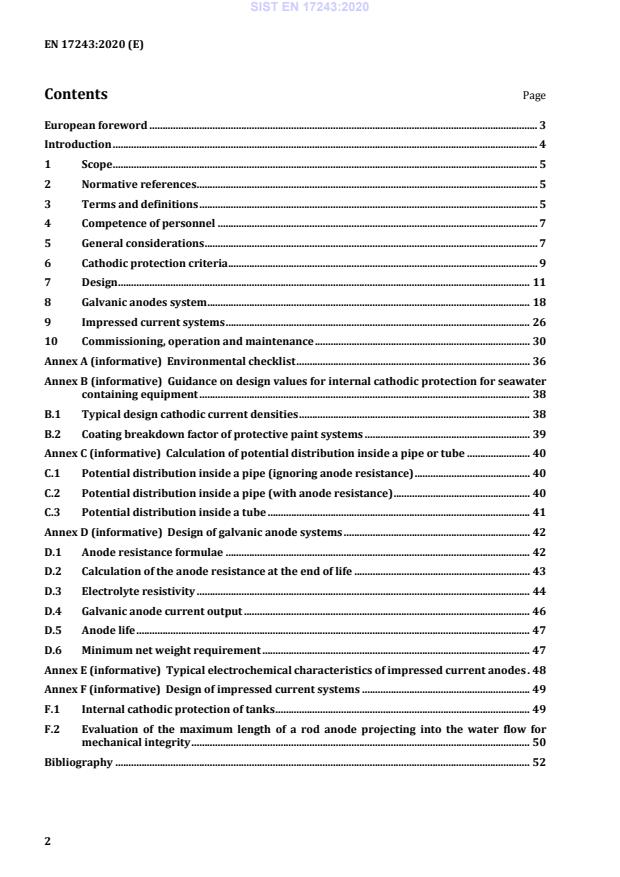
Contents Page
European foreword . 3
Introduction . 4
1 Scope . 5
2 Normative references . 5
3 Terms and definitions . 5
4 Competence of personnel . 7
5 General considerations . 7
6 Cathodic protection criteria . 9
7 Design . 11
8 Galvanic anodes system . 18
9 Impressed current systems . 26
10 Commissioning, operation and maintenance . 30
Annex A (informative) Environmental checklist . 36
Annex B (informative) Guidance on design values for internal cathodic protection for seawater
containing equipment . 38
B.1 Typical design cathodic current densities . 38
B.2 Coating breakdown factor of protective paint systems . 39
Annex C (informative) Calculation of potential distribution inside a pipe or tube . 40
C.1 Potential distribution inside a pipe (ignoring anode resistance) . 40
C.2 Potential distribution inside a pipe (with anode resistance) . 40
C.3 Potential distribution inside a tube . 41
Annex D (informative) Design of galvanic anode systems . 42
D.1 Anode resistance formulae . 42
D.2 Calculation of the anode resistance at the end of life . 43
D.3 Electrolyte resistivity . 44
D.4 Galvanic anode current output . 46
D.5 Anode life . 47
D.6 Minimum net weight requirement . 47
Annex E (informative) Typical electrochemical characteristics of impressed current anodes . 48
Annex F (informative) Design of impressed current systems . 49
F.1 Internal cathodic protection of tanks . 49
F.2 Evaluation of the maximum length of a rod anode projecting into the water flow for
mechanical integrity . 50
Bibliography . 52
European foreword
This document (EN 17243:2020) has been prepared by Technical Committee CEN/TC 219 “Cathodic
protection”, the secretariat of which is held by BSI.
This European Standard shall be given the status of a national standard, either by publication of an
identical text or by endorsement, at the latest by September 2020, and conflicting national standards shall
be withdrawn at the latest by September 2020.
Attention is drawn to the possibility that some of the elements of this document may be the subject of
patent rights. CEN shall not be held responsible for identifying any or all such patent rights.
According to the CEN-CENELEC Internal Regulations, the national standards organisations of the
following countries are bound to implement this European Standard: Austria, Belgium, Bulgaria, Croatia,
Cyprus, Czech Republic, Denmark, Estonia, Finland, France, Germany, Greece, Hungary, Iceland, Ireland,
Italy, Latvia, Lithuania, Luxembourg, Malta, Netherlands, Norway, Poland, Portugal, Republic of North
Macedonia, Romania, Serbia, Slovakia, Slovenia, Spain, Sweden, Switzerland, Turkey and the United
Kingdom.
Introduction
Metallic structures containing seawater or brackish waters are exposed to the risk of corrosion. Even
when a coating is applied to reduce this risk, cathodic protection (CP) is usually used to ensure corrosion
control during the structure design life. This is especially important in the presence of galvanic couples
between various metals and alloys because corrosion is then concentrated to the less noble material.
Cathodic protection works by supplying sufficient direct current to the internal surface of the structures
in contact with water in order to change the structure to electrolyte potential to values where the
corrosion rate is insignificant.
The general principles and theoretical aspects of cathodic protection in seawater are detailed in
EN 12473.
1 Scope
This document specifies the requirements and recommendations for cathodic protection systems applied
to the internal surfaces of metallic tanks, structures, equipment and piping containing natural or treated
seawater or brackish waters to provide an efficient protection from corrosion.
Cathodic protection inside fresh water systems is excluded from this document. This is covered by
EN 12499.
NOTE EN 12499 covers internal cathodic protection for any kind of waters, including general aspects for
seawater but excluding industrial cooling water systems. This document specifically details applications in seawater
and brackish waters.
2 Normative references
The following documents are referred to in the text in such a way that some or all of their content
constitutes requirements of this document. For dated references, only the edition cited applies. For
undated references, the latest edition of the referenced document (including any amendments) applies.
EN 12473, General principles of cathodic protection in seawater
EN 12496, Galvanic anodes for cathodic protection in seawater and saline mud
EN 12499, Internal cathodic protection of metallic structures
EN 13509, Cathodic protection measurement techniques
EN ISO 8044, Corrosion of metals and alloys — Basic terms and definitions (ISO 8044)
EN ISO 9606-1, Qualification testing of welders — Fusion welding — Part 1: Steels (ISO 9606-1)
EN ISO 15257, Cathodic protection — Competence levels of cathodic protection persons — Basis for
certification scheme (ISO 15257)
EN ISO 15607, Specification and qualification of welding procedures for metallic materials —General rules
(ISO 15607)
EN ISO 15609-1, Specification and qualification of welding procedures for metallic materials — Welding
procedure specification — Part 1: Arc welding (ISO 15609-1)
3 Terms and definitions
For the purposes of this document the terms and definitions given in EN 12473 and EN ISO 8044 and the
following apply.
ISO and IEC maintain terminological databases for use in standardization at the following addresses:
— IEC Electropedia: available at http://www.electropedia.org/
— ISO Online browsing platform: available at https://www.iso.org/obp/ui
3.1
anode redundancy factor
multiplier applied to the theoretical number of anodes to allow for anode damage and failures for
ensuring that protection will continue to be achieved when one or more anodes are lost, without
modifying the unit weight of anodes
3.2
back electro motive force
e.m.f
overvoltages generated at anode and cathode interfaces at the operating conditions
3.3
cathodic protection zone
CP zone
part of the structure that can be considered independently with respect to cathodic protection design
3.4
coating breakdown factor
f
c
ratio of cathodic current density for a coated metallic material to the cathodic current density of the bare
material
3.5
critical crevice potential
potential more positive than the potential which there is a risk of initiation of crevice corrosion for a given
environment and crevice geometry
3.6
driving voltage
difference between the structure to electrolyte potential and the anode to electrolyte potential when the
cathodic protection is operating
3.7
over-polarization
occurrence in which the structure to electrolyte potentials are more negative than those required for
satisfactory cathodic protection
Note 1 to entry: Over-polarization provides no useful function and can even cause damage to the structure such as
cracking due to hydrogen embrittlement of sensitive materials or coating disbondment.
Note 2 to entry: Often incorrectly referred to as over-protection.
3.8
ullage factor
u
f
ratio of the surface area of a ballast tank which may be in contact with water to the total surface area
Note 1 to entry: When the entire surface area may be wetted, u = 1.
f
3.9
wetting factor
k
fraction of structure design life when the internal surface of a tank or a structure is in contact with water
Note 1 to entry: When the tank is permanently filled with water, k = 1.
Note 2 to entry: For changing conditions an average value can be considered.
Note 3 to entry: Also known as loading factor, see Reference [1] in the Bibliography.
3.10
hydrogen embrittlement
process resulting in a decrease of the toughness or ductility of a metal due to absorption of hydrogen
3.11
hydrogen stress cracking
HSC
cracking that results from the presence of hydrogen in a metal and tensile stress (residual and/or
applied)
Note 1 to entry: HSC describes cracking in metals which may be embrittled by hydrogen produced by cathodic
polarization without any detrimental effect caused by specific chemicals such as sulphides.
4 Competence of personnel
Personnel who undertake the design, supervision of installation, commissioning, supervision of
operation, measurements, monitoring and supervision of maintenance of cathodic protection systems
shall have the appropriate level of competence for the tasks undertaken. This competence should be
independently assessed and documented.
EN ISO 15257 constitutes a suitable method of assessing and certifying competence of cathodic
protection personnel.
Competence of cathodic protection personnel to the appropriate level for tasks undertaken should be
demonstrated by certification in accordance with EN ISO 15257 or by another equivalent prequalification
procedure.
5 General considerations
5.1 Structures and equipment to be protected
This document applies to the internals of any metallic tanks, structures, equipment, and piping. Examples
include ballast tanks, aboveground or buried storage tanks including firewater tanks, filters such as sand
filters, heat-exchangers and condensers, flooded sections of harbour and lock gates, sea defence barriers,
dolphins, and offshore wind turbine foundations.
This document applies to the external submerged areas of appurtenances and other independent
equipment fitted within tanks, such as pumps and piping, when they are not electrically isolated from the
structure. Where this document is applied to tanks, internal items that are integral to the tank, such as
stiffeners, shall also be included
This document applies also to the internal cathodic protection of piping transporting seawater or
brackish waters, including valves, pumps and fittings. In such applications, additional considerations are
required for the design and installation of cathodic protection.
This document is also applicable for temporary cathodic protection systems used to prevent corrosion
by seawater or brackish waters when structures are being hydrotested (see 7.3.4) and when filled tanks
or other equipment is in storage before commissioning and operation.
5.2 Materials
This document covers the cathodic protection of structures fabricated from or containing low carbon
steel, carbon manganese steel or cast iron. This document is applicable to coated and to bare structures.
This document also covers the cathodic protection of structures fabricated from or containing stainless
steels, nickel alloys, copper alloys or titanium alloys. This document is applicable to coated and to bare
structures.
The requirements and the recommendations for the cathodic protection systems described in this
document are intended to ensure control over any galvanic coupling, which could be caused by the use
of various metallic materials, and minimize risks due to hydrogen embrittlement or hydrogen stress
cracking (see EN 12473).
5.3 Environment
This document is applicable only to structures containing seawater or brackish waters. Seawater may be
either natural or treated (e.g. using chlorination systems) for preventing fouling of piping systems or for
preserving biodiversity when ship ballast tanks are filled and emptied in various locations of the world,
see Reference [2]. Special requirements can be necessary for structures containing polluted seawater or
other fluids, e.g. slop tanks.
For surfaces which are alternately immersed and exposed to the atmosphere, cathodic protection is only
effective when the structure is submerged and the immersion time is sufficiently long for the metal to
remain polarized.
5.4 Safety and environmental protection
5.4.1 General
This document does not cover routine safety and environmental protection aspects which are not
especially associated with cathodic protection. Safety requirements specific to the application of cathodic
protection within the scope of this document are covered.
An environmental checklist is supplied in Annex A.
For impressed current cathodic protection systems (ICCP), automatic control of applied potential shall
be used (see subclause 9.1). Provision shall be made to prevent sparking if the anode is energized outside
liquid level. Procedures to be adopted may include positioning of the anode so that it is always submerged
and/or incorporation of emergency shutdown procedures so that if the anode is temporarily exposed all
DC current is disabled.
The use of impressed current systems and of some galvanic anodes can be prohibited for some
applications, for instance when in the vicinity of tanks containing hydrocarbons (see subclause 8.5).
5.4.2 Evolution of dangerous gases
Cathodic protection will generate gaseous hydrogen and can generate oxygen and chlorine. Some
mixtures of oxygen and hydrogen are explosive; chlorine can be toxic and corrosive.
The design and operation of the cathodic protection systems shall take these risks into account to ensure
that harmful and dangerous levels of gas accumulation are not allowed to occur. This may include the
control of potential and/or the use of ventilation systems.
With galvanic anodes, the selection of alloy material should be carried out to minimize the risk.
5.4.3 Release of hydrogen gas
For impressed current systems, and with galvanic anodes (particularly magnesium anodes), the
polarization causes evolution of hydrogen gas on the protected structure. Thus, in situations such as
closed tanks where hydrogen can collect, an explosion hazard can arise. To mitigate this hazard, it is
necessary for all designs to include venting to prevent the build-up of a significant gaseous volume of
hydrogen. Gas levels should be monitored.
The rate of hydrogen evolution is related to the structure to electrolyte potential. Where hydrogen
evolution can produce an explosion hazard the structure to electrolyte potential shall be limited by design
or control.
5.4.4 Chlorine evolution
For impressed current cathodic protection systems working in seawater and brackish waters, one of the
anodic reactions results in the electrolytic formation of chlorine. Such a formation can cause physical
discomfort or downstream corrosion effects.
NOTE References [3] and [4] of the Bibliography provide information on toxic levels.
Chlorine production is related to the operating potential and material of the Impressed Current Cathodic
Protection (ICCP). In order to reduce chlorine production, the anode current density can be reduced at
design stage.
5.4.5 Access and emptying
Before opening an enclosed structure the impressed current cathodic protection system shall be turned
off. For galvanic and ICCP systems, the enclosure gas levels shall be declared safe.
6 Cathodic protection criteria
6.1 General
The criteria for cathodic protection shall be in accordance with EN 12473. The criteria are based on the
structure to electrolyte potential and the measurement techniques used shall ensure that this is
measured accurately (see subclause 10.2).
When different metals and alloys are in electrical continuity, the protection potential shall be the most
negative one in order to prevent any galvanic corrosion of the less noble of them
A negative limit to the potential may be required depending upon the metallic material in order to avoid
coating disbondment (see ISO 15711) [5] and/or adverse effects due to hydrogen evolution or high pH.
The potential criteria and limit values are expressed without IR errors. IR errors, due to cathodic
protection current flowing through resistive electrolyte and surface films on the protected surface, are
generally considered insignificant in marine applications. However, potential measurements using
“Instant OFF” techniques or “coupon Instant OFF” techniques can be necessary in applications described
in this document in order to adequately demonstrate the achievement of the protection criteria
(see EN 13509). Particular attention should be given to this in brackish waters and sedimentary deposits
or close to impressed current anodes.
The errors due to variations in salinity when using Ag/AgCl/sea water reference electrode in brackish
waters shall be addressed (see EN 12473).
6.2 Carbon and low alloy steels
To ensure the protection of carbon and low alloy steels in aerated seawater a protection potential more
negative than – 0,80 V with respect to (wrt) Ag/AgCl/sea water shall be achieved. This corresponds
approximately to + 0,23 V when measured with respect to a pure zinc electrode (e.g. alloy type Z2 as
defined in EN 12496) or + 0,25 V when measured with respect to a zinc electrode made with galvanic
anode alloy types Z1, Z3 or Z4 as defined in EN 12496.
When the water temperature or surface temperature of steel is higher than 60 °C, the criterion shall be –
0,90 V wrt Ag/AgCl/sea water. Between 40 °C and 60 °C the protection potential shall be interpolated
between −0,80 and −0,90 V wrt Ag/AgCl/sea water.
For tanks and structures containing seawater or brackish where the electrolyte is not frequently renewed
(e.g. less than once a month) the criterion for anaerobic conditions, i.e. – 0,90 Vwrt Ag/AgCl/sea water,
shall be adopted regardless of temperature.
6.3 Stainless steels and nickel alloys
In chloride-containing aerated environments such as natural seawater and brackish waters, stainless
steels are known to resist uniform corrosion and the possibility for crevice corrosion and pitting remains
the principal concern. To ensure the protection of such alloys in these environments, the protection
potentials given in EN 12473 apply, i.e. −0,30 V wrt Ag/AgCl/sea water for stainless steels with PREN ≥ 40
and −0,50 V wrt Ag/AgCl/sea water for stainless steels with PREN < 40.
However, less conservative criteria can be used provided that these are justified and documented. In this
case, the selected protection criteria shall be more negative than the critical crevice potential determined
for a combination of a particular alloy (PREN, microstructure, etc.), crevice parameters (geometry,
surface finish, type of gaskets, sealing pressure of flanges, etc.), and operating environmental conditions
(composition, temperature, velocity, etc.).
The determination of the critical crevice potential shall be carried out on the basis of demonstrated
service feedback and/or on laboratory tests relevant to the service conditions. In the absence of a more
relevant method for a given practical situation, the methods given in the References [6][7][8] should be
used.
In the case of galvanic couples between parts in stainless steel or nickel alloy and parts in carbon and low
alloy steel, the protection potential criterion of the carbon and low alloy steel shall be more negative
than – 0,80 V wrt Ag/AgCl/sea water.
In chlorinated seawater, the recommended protection potentials criteria for stainless steels and nickel
alloys are the same as those in natural seawater, but the protection current densities can be less (see
subclause 7.2.7).
6.4 Cracking risks induced by over polarization
Where there is a risk of hydrogen embrittlement or HSC of high strength steels or other metals which
may be adversely affected by cathodic protection to excessively negative values, a less negative potential
limit shall be defined and applied. If there is insufficient information for a given material, this specific
negative potential limit shall be determined relative to the metallurgical and mechanical conditions by
testing. Refer to EN 12473 for more details.
For carbon and low alloy steels, a potential negative limit of – 1,10 V wrt Ag/AgCl/sea water is
recommended in order to minimize cathodic disbondment. Other potential negative limits shall be
applied to prevent HSC of vulnerable metal compositions (refer to EN 12473).
For stainless steels and nickel alloys, ferritic and martensitic microstructures can suffer from hydrogen
embrittlement when the potentials are too negative. Potentials more negative than the particular limit
values should be avoided. EN 12473 gives information on this risk and also provides recommendations
for qualification of the materials.
Titanium and its alloys are prone to titanium hydride formation in cathodic protection applications. This
hydride can lead to cracking when stresses reach a critical level.
Heat exchanger tube inlets are areas of high mechanical stress due to construction methods. When heat
exchanger tubes are swaged into the tube sheets the tubes may be subject to high residual stress.
Titanium grade 2 tubes should not be subject to a potential more negative than – 0,75 V wrt Ag/AgCl/sea
water [9], some more conservative figures being found in the literature, see References [10][11], e.g. –
0,70 V [12] and even −0,65 V [13].
This conservative approach can be replaced by other criteria provided that these are justified and
documented by an assessment to ensure that the risk is acceptable. Such an assessment shall consider all
load contributions causing stress and strain. In any case, potential of the titanium shall not be more
negative than – 1,00 V wrt Ag/AgCl/seawater as specified in EN 12499 and documented in the literature,
see Reference [9].
For other applications where stresses and strains are lower, e.g. tubular plates, a negative limit of – 1,05 V
wrt Ag/AgCl/seawater is sufficiently conservative, see Reference [14].
7 Design
7.1 General considerations
The objective of a cathodic protection system is to deliver sufficient current to each part of the internal
surfaces of metallic tanks and structures, including bonded equipment, to achieve the protection criteria
defined in Clause 6. This current should be distributed so that the structure to electrolyte potential of
each part is within the limits given by the protection criteria during its normal service conditions (see
Clause 6). Permanent reference electrodes should be installed to allow measurement of the potentials at
selected locations.
Uniform levels of cathodic protection may be difficult to achieve in some areas or parts of structures. In
this case the use of reference electrodes installed in shielded areas is recommended, especially for
assisting the commissioning. The cathodic protection system for tanks and structures is generally
combined with a protective coating system, even though some equipment such as pumps and small pipes
may not be coated. A good coating is especially recommended when temperature and/or velocity of the
water is high, such as in pipeline systems or heat-exchanger cooling water boxes.
In the absence of instructions for the design life of the cathodic protection system, it shall be designed
either for the structure design life or for a period corresponding to a planned maintenance, such as dry-
docking interval in the case of ballast tanks on ships or floating offshore structures. Alternatively, when
it is not feasible to design the cathodic protection system for the structure design life or if planned
maintenance is not possible, the system should be designed for easy replacement of cathodic protection
components. Access fittings allowing replacement of anodes and reference electrodes can be considered,
e.g. for pipeline systems.
Where small current demands are anticipated over the entire structure design life, cathodic protection
can be achieved by galvanic anode systems. Impressed current systems are generally used for other
instances, such as higher current demand, temporary protection of large equipment containing seawater
or brackish water for hydrotesting, pipe systems or water boxes of large heat-exchangers.
Each stage of the design, the installation, the energizing, the commissioning, the long-term operation and
the records of all the elements of cathodic protection systems shall be documented and maintained.
Each part of the work should be undertaken in accordance with a quality plan.
NOTE EN ISO 9001 [15] constitutes a suitable Quality Management Systems Standard.
All test instrumentation shall have valid calibration certificates traceable to national or European
Standards of calibration.
All the documentation required in the above shall constitute part of the permanent records.
7.2 Design parameters
7.2.1 General
The design of a cathodic protection system shall be conducted according to the following steps:
a) Determine the coated and non-coated areas exposed to water;
b) Determine the maximum and mean current demands for each of these areas taking into account
temperature and velocity of the water;
c) Determine the type of cathodic protection system (galvanic, impressed current, or hybrid);
d) Determine the size, shape and number of anodes required to last the design life of the cathodic
protection system in order to deliver the required distribution of current and to meet any constraint
of the structure
e) Determine anode locations and installation;
f) Determine reference electrodes types, location and installation.
The design of a cathodic protection system shall demonstrate that each structure subdivision is supplied
with the cathodic protection current necessary to provide cathodic protection to meet the criteria in
Clause 6 for all service conditions.
The anode distribution shall take into account the location of interfaces between dissimilar metallic
materials.
Two different values shall be considered:
— I : maximum current demand, which corresponds to the most severe working conditions (e.g. end
max
of life coating breakdown factor and maximum surface areas, maximum water temperature and
velocity) and is used to design the maximum current required to be available from the cathodic
protection system;
— I : mean current demand, which is used to calculate the minimum mass of galvanic anode
mean
material or design life of impressed current anodes necessary to maintain cathodic protection
throughout the design period.
For optimizing the design, the following should be specified:
— maximum and minimum resistivity, temperature and velocity of the water;
— design life of the cathodic protection system;
— initial current density necessary to achieve initial polarization of the structure, j ;
i
— maintenance current density necessary to maintain polarization of the structure, j ;
m
— mean coating breakdown factor, f ;
cm
— final coating breakdown factor, f .
cf
NOTE As the initial polarization period before the steady-state is normally short compared to the structure
design life, the mean current density over the structure design life is usually very close to the maintenance current
density.
Indicative values for maintenance and initial protective current densities and mean and final coating
breakdown factors of conventional paint systems are given in Annex B.
The units shall be consistent in the following calculations and follow the state of the art in the field of
engineering.
7.2.2 Subdivision of the surfaces to be protected
Items to be protected should be divided into different cathodic protection zones to ensure a good current
distribution, which can be considered independently with respect to cathodic protection design, although
they may not necessarily be electrically isolated.
NOTE Complex geometries such as those encountered at the bottom of ballast tanks due to the presence of
stiffeners constitute a typical example.
Each cathodic protection zone may consist of several components, the parameters of which should be
identified, including material (steel, cast iron, etc.), surface area and coating characteristics if any (type,
lifetime and coating breakdown factor).
7.2.3 Effective surface areas to be considered for calculations
All the surface areas wetted with water shall be considered in the design of the cathodic protection
systems. It is preferable to determine the surface areas from computer aided systems.
The maximum surface area (S ) is used as a basis for calculating the maximum current demand and
max
includes the area of the flats as well as the supporting structure of T-beams, baffles, piping, etc. In all
cases, it includes the area of the top of the tank or of the structure.
For tanks with varying levels (e.g. ballast tanks) there are two additional factors to be considered. Firstly
the ullage factor (u ), which defines the maximum proportion of the surface of the tank that will be wetted
f
and, secondly, the wetting factor (k), which determines for what proportion of the structure design life
the surfaces will be wetted. These two factors will allow the mean surface area (S ) to be calculated
mean
and used for the determination of the mean current demand for tanks with varying levels. The mean
surface area is the maximum surface area (S ) multiplied by an ullage factor (u ) and a wetting factor
max f
(k).
S = S . u . k (1)
mean max f
In the case of heat-exchanger water boxes, the tube sheets, which are generally made of uncoated copper
alloy, titanium or stainless steel, consume the major part of the protective current as compared to the
surface of the coated steel water box. A current drain to the heat exchanger tubes shall also be taken into
account.
7.2.4 Calculation of current demand for coated surface areas
7.2.4.1 Maximum current demand
The maximum current demand I is calculated as follows:
max c
= S . f . j (2)
I
max c max c cf m
where
S is the maximum wetted coated surface area,
max c
f is the final coating breakdown factor, and
cf
j is the maintenance protective current density of bare metal in the most severe
m
conditions as far as temperature and velocity are concerned.
7.2.4.2 Mean current demand
The mean current demand I is calculated as follows:
mean c
I = S . f . j (3)
mean c mean c cm m
where
S is the mean wetted coated surface area,
mean c
f is the mean coating breakdown factor, and
cm
j is the maintenance protective current density of bare
m
metal.
7.2.5 Calculation of current demand for bare surface areas
7.2.5.1 Maximum current demand
The maximum current demand I is calculated as follows:
max b
I = S . j (4)
max b max b i
where
S is the maximum bare surface area, and
max b
j is the initial protection current density of bare steel in the most severe conditions as
i
far as temperature and velocity are concerned.
7.2.5.2 Mean current demand
The mean current demand I is calculated as follows:
mean b
I = S . j (5)
mean b mean b m
where
S is the mean wetted bare surface area, and
mean b
j is the maintenance protective current density of bare
m
metal.
NOTE For enclosed vessels, the final current demand for repolarization is often the same as the maintenance
current demand.
7.2.6 Protection current density for bare carbon or low alloy steels
The protection current density required for bare carbon or low alloy steels is dependent on operating
temperature, flow rate (water velocity) and dissolved oxygen content, all of which can interact in a
complex way (see comments concerning the effect of environmental factors on current demand in
EN 12473).
At high water velocities the rate of oxygen transport to the surface is increased, leading to increased
protection current demand.
Where the dissolved oxygen content is lower than normal (e.g. due to consumption of the oxygen by the
cathodic reaction in a poorly renewed water system such as inside flooded members) the current density
may be reduced.
-1
At low temperatures (typically less than 5 °C) and/or high velocities (typically greater than10 m.s )
calcareous film formation is limited and hence high maintenance current densities are required.
Guidance on required protection current densities are given in B.1.
In the absence of specific data, cathodic protection current demand for other metals and alloys such as
copper alloys or stainless steels may be evaluated from the same hypothesis as for carbon or low alloy
steels.
7.2.7 Protection current density for stainless steels and nickel alloys
Current densities required to achieve protection in different waters should be established on the basis of
data available. The documents cited in references [16][17] provide some guidance. When establishing
design current densities, it should be noted that the following phenomena have been observed:
1) initial current densities required to polarize carbon steels to −0,80 V wrt Ag/AgCl/sea water are
sufficient to polarize stainless steels to their protection potential criteria (−0,30 to −0,50 V wrt
Ag/AgCl/sea water).
2) when the water temperature exceeds 40 °C the protection current density is reduced as compared to
ambient sea water due to a less effective biofilm, see Reference [16].
3) the calcareous deposits formed at more electronegative potentials, may allow protection to be
maintained at lower current densities than those required to polarize to −0,30 to −0,50 V wrt
Ag/AgCl/sea water.
Design values for protection current densities should be established on the basis of reliable data and
documented.
In seawater, chlorination to produce typically residual chlorine levels from 0,2 ppm to 1 ppm can limit
the biofilm and allow relatively low protection current densities to be used. Chlorination of seawater
produces residual chlorine in the seawater. High residual chlorine levels can result in a demand for high
current densities. Examples of the effects of chlorination and biofouling on required protection current
densities are available in the literature, see Reference [17].The protection current density requirements
may increase with temperature, see Reference [16].
7.3 Applications for specific equipment
7.3.1 Piping systems
Piping cathodic protection systems consist of anodes distributed inside the piping, generally at regular
spacings. The spacing and the number of anodes is dependent on the pipe diameter, the coating if any,
the seawater (or brackish water) velocity, possible chlorination, temperature, resistivity, and the anode
redundancy factor. The spacing between anodes shall be close enough to achieve and maintain cathodic
protection.
Due to the elongated shape of the structure to be protected internally, the span of protection or over-
polarization from an anodic system is governed by the attenuation of current due to the ohmic drop in
the water, the resistance in the metal being negligible.
The potential distribution inside the piping system shall be determined to verify the effectiveness of the
design of cathodic protection inside pipes and tubes. In order of priority, this can be achieved by:
— experience feedback in similar conditions;
— measurements of the potential distribution carried out in facilities representing the relevant
parameters of the equipment to be protected;
— mathematical modelling to assess attenuation in pipes and tubes. Modelling is especially useful in
complex geometries;
— simplified methods that are given in informative Annex C.
Note: Some cathodic protection applications require the use of one anode only to locally control galvanic
couples at specific locations. In this case, these simplified calculations methods yield overestimated
length of protection inside pipes due to the contributing factor of adjacent anodes.
The risk of mechanical damage to anodes located inside pipes is significantly increased when velocity
and/or turbulence of water flow increases. The anode design, location and spacing shall be selected for
ensuring robustness and redundancy to the system corresponding to the maintenance programme
applied to the pipes.
An anode redundancy factor can be used to take into account environmental and safety consequences of
leaks, the inspection programme, the intervals between possible interventions to replace anodes, and the
ease and method of replacement of the anodes. The anode redundancy factor is a multiplier applied to
the theoretical number of anodes for ensuring that protection will continue to be achieved when one or
more anodes are lost.
EXAMPLE 1 An anode redundancy factor of 1 is typically chosen for a pipe with easy access and frequent
maintenance interventions for which the risk of local temporary lack of protection is considered acceptable.
EXAMPLE 2 If an anode redundancy factor of 2 is chosen for a pipe where anode replacement is difficult and/or
where the maintenance programme is extended, the actual spacing is only half the calculated anode spacing.
7.3.2 Tube and shell condensers and heat exchangers
Cathodic protection is used to prevent corrosion of the materials and galvanic corrosion risks inside
condensers and heat exchangers using seawater as a coolant, due to high water velocity, dissimilar
metals, and/or high temperature. In particular, tube and shell type condensers and heat exchangers can
be constructed with steel inlet and outlet water boxes with tube sheets and tubes made of copper alloys,
stainless steels or titanium. As the water boxes are generally coated (or lined), particular consideration
shall be given to prevent accelerated corros
...