

EN 14123:2007
(Main)Foodstuffs - Determination of aflatoxin B1 and the sum of aflatoxin B1, B2, G1 and G2 in hazelnuts, peanuts, pistachios, figs, and paprika powder - High performance liquid chromatographic method with post-column derivatisation and immunoaffinity column cleanup
- Abstract
This European Standard is applicable to the determination of aflatoxins B1, B2, G1 and G2 in hazelnuts, figs, pistachios, peanuts and paprika powder. The limit of quantification of the method is 0,8 ng/g for each aflatoxin or better (value derived from in-house and collaborative study), depending on the equipment used.
- Status
- Published
- Publication Date
- 11-Dec-2007
- Withdrawal Date
- 29-Jun-2008
- Technical Committee
- CEN/TC 275 - Food analysis - Horizontal methods
- Drafting Committee
- CEN/TC 275/WG 5 - Biotoxins
- Current Stage
- 9093 - Decision to confirm - Review Enquiry
- Start Date
- 09-Dec-2024
- Completion Date
- 07-Oct-2026


Overview
EN 14123:2007 (CEN) specifies a validated analytical method for the determination of aflatoxin B1 and the sum of aflatoxins B1, B2, G1 and G2 in hazelnuts, peanuts, pistachios, figs and paprika powder. The method uses immunoaffinity column (IAC) cleanup followed by reverse-phase high performance liquid chromatography (RP‑HPLC) with post‑column derivatisation (PCD) and fluorescence detection. The method’s limit of quantification (LOQ) is 0.8 ng/g for each aflatoxin or better (equipment dependent). EN 14123:2007 updates and expands validation data (including hazelnut).
Key topics and technical requirements
- Sample extraction: methanol/water extraction (with optional hexane/cyclohexane defatting for high‑fat matrices).
- Immunoaffinity column (IAC) cleanup: antibodies specific for B1, B2, G1, G2; column capacity ≥ 100 ng B1; recovery ≥ 80% for B1/B2/G1 and ≥ 60% for G2 under aqueous standard conditions. Maximum solvent applied to IAC ≤ 12% methanol.
- HPLC and detection:
- RP‑HPLC column (e.g., C18, 25 cm × 4.6 mm, 5 µm) ensuring baseline resolution of aflatoxin peaks.
- Post‑column derivatisation options:
- Chemical bromination with pyridinium hydrobromide perbromide (PBPB); or
- Electrochemical bromination (e.g., KOBRA cell®) with added KBr/HNO3 in mobile phase.
- Fluorescence detection (typical excitation ≈ 360–365 nm, emission ≈ 420–435 nm).
- Calibration and standards: preparation of mixed aflatoxin stock and calibration solutions; spectrometric verification of stock concentrations.
- Performance and system limits: recommendations for injection loops and system sensitivity (system LOD ≤ 0.2 ng/g, LOQ ≤ 0.5 ng/g for standard solutions where applicable).
- Laboratory practice: acid‑washed glassware to avoid losses, protection from light (aflatoxins are light‑sensitive), and specific reagent and mobile phase formulations.
Applications
- Regulatory compliance testing and monitoring of aflatoxins in nuts, dried fruit and paprika powder.
- Routine quality control in food production, spice processing and ingredient supply chains.
- Import/export screening and official control by food safety authorities.
- Research laboratories validating new sample matrices or methods referencing a harmonized European standard.
Who should use this standard
- Food testing laboratories (public and private) performing mycotoxin analysis
- National reference and control laboratories
- Quality assurance teams in nut, spice and dried‑fruit industries
- Regulatory agencies enforcing aflatoxin limits
Related standards
- EN ISO 3696 (water for analytical laboratory use) - referenced for reagent water quality.
- CEN/TC 275 “Food analysis – Horizontal methods” (technical committee responsible for development).
Keywords: EN 14123, aflatoxin B1, aflatoxins B2 G1 G2, immunoaffinity column, HPLC, post‑column derivatisation, PBPB, KOBRA cell, foodstuffs, hazelnuts, peanuts, pistachios, figs, paprika powder.
Relations
- Effective Date
- 22-Dec-2008
- Effective Date
- 28-Jan-2026
Get Certified
Connect with accredited certification bodies for this standard

BSI Group
BSI (British Standards Institution) is the business standards company that helps organizations make excellence a habit.

Bureau Veritas
Bureau Veritas is a world leader in laboratory testing, inspection and certification services.

DNV
DNV is an independent assurance and risk management provider.
Sponsored listings
Frequently Asked Questions
EN 14123:2007 is a standard published by the European Committee for Standardization (CEN). Its full title is "Foodstuffs - Determination of aflatoxin B1 and the sum of aflatoxin B1, B2, G1 and G2 in hazelnuts, peanuts, pistachios, figs, and paprika powder - High performance liquid chromatographic method with post-column derivatisation and immunoaffinity column cleanup". This standard covers: This European Standard is applicable to the determination of aflatoxins B1, B2, G1 and G2 in hazelnuts, figs, pistachios, peanuts and paprika powder. The limit of quantification of the method is 0,8 ng/g for each aflatoxin or better (value derived from in-house and collaborative study), depending on the equipment used.
This European Standard is applicable to the determination of aflatoxins B1, B2, G1 and G2 in hazelnuts, figs, pistachios, peanuts and paprika powder. The limit of quantification of the method is 0,8 ng/g for each aflatoxin or better (value derived from in-house and collaborative study), depending on the equipment used.
EN 14123:2007 is classified under the following ICS (International Classification for Standards) categories: 67.050 - General methods of tests and analysis for food products; 67.080.10 - Fruits and derived products. The ICS classification helps identify the subject area and facilitates finding related standards.
EN 14123:2007 has the following relationships with other standards: It is inter standard links to EN 14123:2003, EN ISO 3696:1995. Understanding these relationships helps ensure you are using the most current and applicable version of the standard.
EN 14123:2007 is available in PDF format for immediate download after purchase. The document can be added to your cart and obtained through the secure checkout process. Digital delivery ensures instant access to the complete standard document.
Standards Content (Sample)
2003-01.Slovenski inštitut za standardizacijo. Razmnoževanje celote ali delov tega standarda ni dovoljeno.Lebensmittel - Bestimmung von Aflatoxin B1 und der Summe von Aflatoxin B1, B2, G1 und G2 in Haselnüssen, Erdnüssen, Pistazien, Feigen und Paprikapulver - Hochleistungsflüssigchromatographisches Verfahren mit Immunaffinitätssäulen-Reinigung und NachsäulenderivatisierungProduits alimentaires - Dosage de l'aflatoxine B1 et de la somme des aflatoxines B1, B2, G1 et G2 dans les noisettes, les cacahuètes, les pistaches, les figues et le paprika en poudre - Méthode par purification sur colonne d'immuno-affinité suivie d'une chromatographie liquide à haute performance avec dérivation post-colonneFoodstuffs - Determination of aflatoxin B1 and the sum of aflatoxin B1, B2, G1 and G2 in hazelnuts, peanuts, pistachios, figs, and paprika powder - High performance liquid chromatographic method with post-column derivatisation and immunoaffinity column cleanup67.080.01Sadje, zelenjava in njuni proizvodi na splošnoFruits, vegetables and derived products in general67.050Splošne preskusne in analizne metode za živilske proizvodeGeneral methods of tests and analysis for food productsICS:Ta slovenski standard je istoveten z:EN 14123:2007SIST EN 14123:2008en,fr,de01-marec-2008SIST EN 14123:2008SLOVENSKI
STANDARDSIST EN 14123:20031DGRPHãþD
EUROPEAN STANDARD NORME EUROPÉENNE EUROPÄISCHE NORM
EN 14123
December 2007 ICS 67.050 Supersedes EN 14123:2003 English Version
Foodstuffs - Determination of aflatoxin B1 and the sum of aflatoxin B1, B2, G1 and G2 in hazelnuts, peanuts, pistachios, figs, and paprika powder - High performance liquid chromatographic method with post-column derivatisation and immunoaffinity column cleanup
Produits alimentaires - Dosage de l'aflatoxine B1 et de la somme des aflatoxines B1, B2, G1 et G2 dans les noisettes, les cacahuètes, les pistaches, les figues et le paprika en poudre - Méthode par purification sur colonne d'immuno-affinité suivie d'une chromatographie liquide à haute performance avec dérivation post-colonne
Lebensmittel - Bestimmung von Aflatoxin B1 und der Summe von Aflatoxin B1, B2, G1 und G2 in Haselnüssen, Erdnüssen, Pistazien, Feigen und Paprikapulver - Hochleistungsflüssigchromatographisches Verfahren mit Immunaffinitätssäulen-Reinigung und Nachsäulenderivatisierung This European Standard was approved by CEN on 12 November 2007.
CEN members are bound to comply with the CEN/CENELEC Internal Regulations which stipulate the conditions for giving this European Standard the status of a national standard without any alteration. Up-to-date lists and bibliographical references concerning such national standards may be obtained on application to the CEN Management Centre or to any CEN member.
This European Standard exists in three official versions (English, French, German). A version in any other language made by translation under the responsibility of a CEN member into its own language and notified to the CEN Management Centre has the same status as the official versions.
CEN members are the national standards bodies of Austria, Belgium, Bulgaria, Cyprus, Czech Republic, Denmark, Estonia, Finland, France, Germany, Greece, Hungary, Iceland, Ireland, Italy, Latvia, Lithuania, Luxembourg, Malta, Netherlands, Norway, Poland, Portugal, Romania, Slovakia, Slovenia, Spain, Sweden, Switzerland and United Kingdom.
EUROPEAN COMMITTEE FOR STANDARDIZATION
COMITÉ EUROPÉEN DE NORMALISATION EUROPÄISCHES KOMITEE FÜR NORMUNG
Management Centre: rue de Stassart, 36
B-1050 Brussels © 2007 CEN All rights of exploitation in any form and by any means reserved worldwide for CEN national Members. Ref. No. EN 14123:2007: ESIST EN 14123:2008
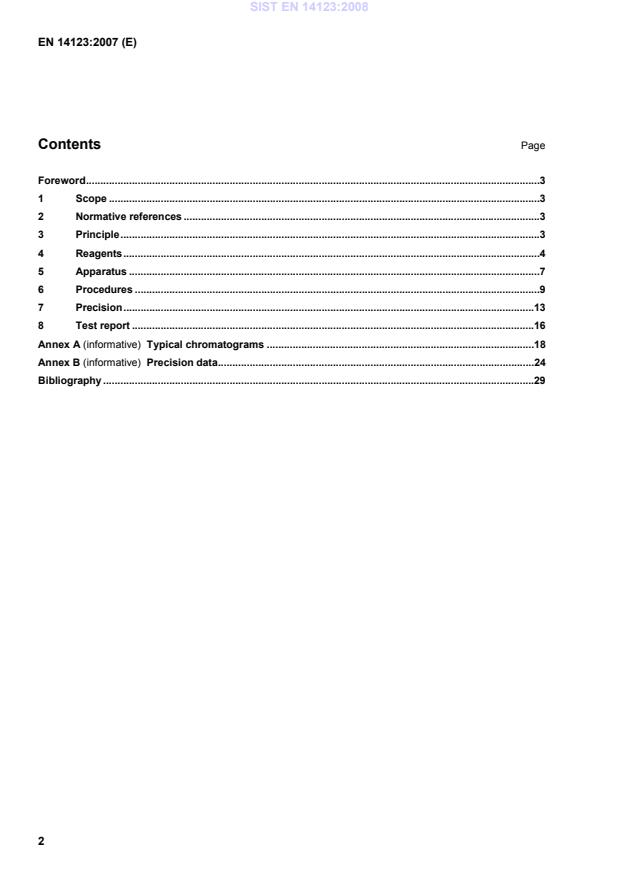
Typical chromatograms.18 Annex B (informative)
Precision data.24 Bibliography.29
b0MAiii×××=100maxρ (1) where: Amax is the absorbance determined at the maximum of the absorption curve; Mi is the molar mass of each aflatoxin, in grams per mol; SIST EN 14123:2008
Aflatoxin Mi g/mol 0i
m2/mol B1 312 1930 B2 314 2040 G1 328 1660 G2 330 1790
4.21 Mixed aflatoxins stock solution Prepare a mixed aflatoxins stock solution containing 1000 ng/ml of aflatoxin B1 and G1, 200 ng/ml of aflatoxin B2 and G2 in the toluene and acetonitrile mixture (4.18) by appropriate dilution of aflatoxins (B1, B2, G1 and G2) stock solutions (4.20). NOTE A commercial total aflatoxins standard solution which is ready to use in a vial containing 1000 ng/ml of total aflatoxin may be used as an alternative. 4.22 Diluted mixed aflatoxins stock solution Prepare a diluted mixed aflatoxins stock solution containing 100 ng/ml of aflatoxin B1 and G1, 20 ng/ml of aflatoxin B2 and G2 in the toluene and acetonitrile mixture (4.18) by pipetting exactly 1,0 ml of the mixed aflatoxins stock solution (4.21) into a 10 ml calibrated volumetric flask (5.10), fill to the mark with the toluene and acetonitrile mixture (4.18) and mix well. Wrap the flask tightly in aluminium foil and store it at less than 4 °C or in a freezer. Before use, do not open the flask until the contents have reached room temperature to avoid incorporation of water by condensation. 4.23 Mixed aflatoxins calibration solutions Use the diluted mixed aflatoxins stock solution containing 100 ng/ml of aflatoxin B1 and G1, 20 ng/ml of aflatoxin B2 and G2 (see 4.22) for pipetting the volumes as given in Table 2 into a set of 10 ml volumetric flasks (5.10). Evaporate the toluene/acetonitrile solution just to dryness under a stream of nitrogen at room temperature. To each flask, add 4 ml of methanol, let aflatoxins dissolve, dilute to 10 ml with water, and shake well. Methanol and water are subject to volume contraction when mixed, so adjust the volume again to the given volume. SIST EN 14123:2008
Taken from diluted stock solution (4.22) µl B1
B2 G1 G2 1 40 0,400 0,080 0,400 0,080 2 120 1,200 0,240 1,200 0,240 3 200 2,000 0,400 2,000 0,400 4 280 2,800 0,560 2,800 0,560 5 360 3,600 0,720 3,600 0,720
4.24 Spiking solution Prepare a spiking solution by pipetting 2 ml of the mixed aflatoxins stock solution (containing 1000 ng/ml of aflatoxin B1 and G1, 200 ng/ml of aflatoxin B2 and G2, see 4.21) into a 10 ml calibrated volumetric flask. Evaporate the toluene/acetonitrile solution just to dryness under a stream of nitrogen at room temperature. Dilute to the mark with methanol and shake well. The concentration of this spiking solution is 200 ng/ml of aflatoxin B1 and G1, and 40 ng/ml of aflatoxin B2 and G2. Wrap the flask tightly in aluminium foil and store it at less than 4 °C. Before use, do not open the flask until the contents have reached room temperature to avoid incorporation of water by condensation. 5 Apparatus 5.1 General All glassware coming into contact with aqueous solutions of aflatoxins shall be washed with acid solution before use. Many laboratory washing machines do this as part of the washing program. Otherwise soak such laboratory glassware in sulfuric acid (2 mol/l) for several hours (e.g. 15 h overnight), then rinse well (e.g. three times) with water to remove all traces of acid. Check the absence of acid with pH paper. This treatment is necessary, because the use of non-acid washed glassware may cause losses of aflatoxins. In practice, the treatment is necessary for round bottomed flasks, volumetric flasks, measuring cylinders, vials or tubes used for calibration solutions and final extracts (particularly autosampler vials), and Pasteur pipettes, if these are used to transfer calibration solutions or extracts. 5.2 Usual laboratory apparatus and, in particular, the following 5.3 Laboratory mill, or explosion proof high speed blender1) , necessary for the production and extraction of pastes from hazelnuts, peanuts, pistachios and figs, with suitable blender jar 5.4 Adjustable vertical or horizontal shaker, needed for the analysis of paprika powder 5.5 Paper filter, e.g. 24 cm diameter, prefolded 5.6 Conical flask, with screw top or glass stopper
1) Contact your National Standardization Institute for appropriate high speed blenders. SIST EN 14123:2008
= 360 nm excitation filter and a wavelength of
= 420 nm cut-off emission filter, or equivalent (e.g. a detector with an adjustable monochromator). Recommended settings for adjustable detectors are 365 nm (excitation wavelength), 435 nm (emission wavelength) and a bandwidth of 18 nm. 5.12 Disposable filter unit, of pore size 0,45 µm Prior to usage, verify that no aflatoxin losses occur during filtration (recovery testing). NOTE There is a possibility that various filter materials can retain aflatoxins. 5.13 Pipettes, 2 ml, 5 ml and 10 ml capacity, with an accuracy of at least 0,5 % 5.14 Analytical balance, capable of weighing to 0,1 mg 5.15 Laboratory balance, capable of weighing to 0,01 g
2) KOBRA cell® is the trade name of a suitable product available commercially. This information is given for the convenience of users of this European Standard and does not constitute an endorsement by CEN of the product named. Equivalent products may be used if they can be shown to lead to the same results. SIST EN 14123:2008
...