


EN 14123:2003
(Main)Foodstuffs - Determination of aflatoxin B1 and the sum of aflatoxin B1, B2, G1 and G2 in peanuts, pistachios, figs, and paprika powder - High performance liquid chromatographic method with postcolumn derivatization and immunoaffinity column clean-up
Foodstuffs - Determination of aflatoxin B1 and the sum of aflatoxin B1, B2, G1 and G2 in peanuts, pistachios, figs, and paprika powder - High performance liquid chromatographic method with postcolumn derivatization and immunoaffinity column clean-up
This draft European Standard is applicable to the determination of aflatoxins B1, B2, G1 and G2 in figs, pistachios, peanuts and paprika powder. The limit of quantification of the method is 0,8 ng/g for each aflatoxin or better (value derived from in-house and collaborative study), depending on the equipment used.
Lebensmittel - Bestimmung von Aflatoxin B1 und der Summe von Aflatoxin B1, B2, G1 und G2 in Erdnüssen, Pistazien, Feigen und Paprikapulver - Hochleistungsflüssigchromatographisches Verfahren mit Immunoaffinitätssäulen-Reinigung und Nachsäulenderivatisierung
Diese Europäische Norm legt ein Verfahren zur Bestimmung des Gehaltes von Aflatoxin B1, B2, G1 und G2 in Erdnüssen, Feigen, Pistazien und Paprikapulver fest. Die Bestimmungsgrenze liegt bei 0,8 ng/g für jedes der Aflatoxine oder besser (der Wert stammt aus einer hausinternen Untersuchung und einem Ringversuch) je nach verwendetem Untersuchungsgerät.
Produits alimentaires - Dosage de l'aflatoxine B1 et de la somme des aflatoxines B1, B2, G1 et G2 présentes dans les cacahuètes, les pistaches, les figues et le paprika en poudre - Méthode de chromatographie liquide haute performance avec dérivation post-colonne et purification sur colonne d'immunoaffinité
Le présent projet de Norme européenne peut être appliqué pour le dosage des aflatoxines B1, B2, G1 et G2 présentes dans les figues, les pistaches, les cacahuètes et le paprika en poudre. La limite de quantification de la méthode est d'au moins 0,8 ng/g pour chaque aflatoxine (valeur obtenue à partir d'une étude interne et d'une étude interlaboratoires) selon l'équipement utilisé.
Živila - Določevanje aflatoksina B1 in vsote aflatoksinov B1, B2, G1 in G2 v arašidih, pistacijah, figah in papriki v prahu - Tekočinska kromatografija visoke ločljivosti s postkolonsko derivatizacijo in imunoafinitetnim kolonskim čiščenjem
General Information
- Status
- Withdrawn
- Publication Date
- 03-Jun-2003
- Withdrawal Date
- 11-Dec-2007
- Technical Committee
- CEN/TC 275 - Food analysis - Horizontal methods
- Drafting Committee
- CEN/TC 275/WG 5 - Biotoxins
- Current Stage
- 9960 - Withdrawal effective - Withdrawal
- Start Date
- 12-Dec-2007
- Completion Date
- 12-Dec-2007
Relations
- Effective Date
- 22-Dec-2008

Get Certified
Connect with accredited certification bodies for this standard

BSI Group
BSI (British Standards Institution) is the business standards company that helps organizations make excellence a habit.

Bureau Veritas
Bureau Veritas is a world leader in laboratory testing, inspection and certification services.

DNV
DNV is an independent assurance and risk management provider.
Sponsored listings
Frequently Asked Questions
EN 14123:2003 is a standard published by the European Committee for Standardization (CEN). Its full title is "Foodstuffs - Determination of aflatoxin B1 and the sum of aflatoxin B1, B2, G1 and G2 in peanuts, pistachios, figs, and paprika powder - High performance liquid chromatographic method with postcolumn derivatization and immunoaffinity column clean-up". This standard covers: This draft European Standard is applicable to the determination of aflatoxins B1, B2, G1 and G2 in figs, pistachios, peanuts and paprika powder. The limit of quantification of the method is 0,8 ng/g for each aflatoxin or better (value derived from in-house and collaborative study), depending on the equipment used.
This draft European Standard is applicable to the determination of aflatoxins B1, B2, G1 and G2 in figs, pistachios, peanuts and paprika powder. The limit of quantification of the method is 0,8 ng/g for each aflatoxin or better (value derived from in-house and collaborative study), depending on the equipment used.
EN 14123:2003 is classified under the following ICS (International Classification for Standards) categories: 67.050 - General methods of tests and analysis for food products. The ICS classification helps identify the subject area and facilitates finding related standards.
EN 14123:2003 has the following relationships with other standards: It is inter standard links to EN 14123:2007. Understanding these relationships helps ensure you are using the most current and applicable version of the standard.
EN 14123:2003 is available in PDF format for immediate download after purchase. The document can be added to your cart and obtained through the secure checkout process. Digital delivery ensures instant access to the complete standard document.
Standards Content (Sample)
2003-01.Slovenski inštitut za standardizacijo. Razmnoževanje celote ali delov tega standarda ni dovoljeno.Lebensmittel - Bestimmung von Aflatoxin B1 und der Summe von Aflatoxin B1, B2, G1 und G2 in Erdnüssen, Pistazien, Feigen und Paprikapulver - Hochleistungsflüssigchromatographisches Verfahren mit Immunoaffinitätssäulen-Reinigung und NachsäulenderivatisierungProduits alimentaires - Dosage de l'aflatoxine B1 et de la somme des aflatoxines B1, B2, G1 et G2 présentes dans les cacahuetes, les pistaches, les figues et le paprika en poudre - Méthode de chromatographie liquide haute performance avec dérivation post-colonne et purification sur colonne d'immunoaffinitéFoodstuffs - Determination of aflatoxin B1 and the sum of aflatoxin B1, B2, G1 and G2 in peanuts, pistachios, figs, and paprika powder - High performance liquid chromatographic method with postcolumn derivatization and immunoaffinity column clean-up67.080.01Sadje, zelenjava in njuni proizvodi na splošnoFruits, vegetables and derived products in general67.050Splošne preskusne in analizne metode za živilske proizvodeGeneral methods of tests and analysis for food productsICS:Ta slovenski standard je istoveten z:EN 14123:2003SIST EN 14123:2003en01-november-2003SIST EN 14123:2003SLOVENSKI
STANDARD
EUROPEAN STANDARDNORME EUROPÉENNEEUROPÄISCHE NORMEN 14123June 2003ICS 67.050English versionFoodstuffs - Determination of aflatoxin B1 and the sum ofaflatoxin B1, B2, G1 and G2 in peanuts, pistachios, figs, andpaprika powder - High performance liquid chromatographicmethod with postcolumn derivatization and immunoaffinitycolumn clean-upProduits alimentaires - Dosage de l'aflatoxine B1 et de lasomme des aflatoxines B1, B2, G1 et G2 dans lescacahuètes, les pistaches, les figues et le paprika enpoudre - Méthode par purification sur colonne d'immuno-affinité suivie d'une chromatographie liquide à hauteperformance avec dérivation post-colonneLebensmittel - Bestimmung von Aflatoxin B1 und derSumme von Aflatoxin B1, B2, G1 und G2 in Erdnüssen,Pistazien, Feigen und Paprikapulver -Hochleistungsflüssigchromatographisches Verfahren mitImmunoaffinitätssäulen-Reinigung undNachsäulenderivatisierungThis European Standard was approved by CEN on 21 April 2003.CEN members are bound to comply with the CEN/CENELEC Internal Regulations which stipulate the conditions for giving this EuropeanStandard the status of a national standard without any alteration. Up-to-date lists and bibliographical references concerning such nationalstandards may be obtained on application to the Management Centre or to any CEN member.This European Standard exists in three official versions (English, French, German). A version in any other language made by translationunder the responsibility of a CEN member into its own language and notified to the Management Centre has the same status as the officialversions.CEN members are the national standards bodies of Austria, Belgium, Czech Republic, Denmark, Finland, France, Germany, Greece,Hungary, Iceland, Ireland, Italy, Luxembourg, Malta, Netherlands, Norway, Portugal, Slovakia, Spain, Sweden, Switzerland and UnitedKingdom.EUROPEAN COMMITTEE FOR STANDARDIZATIONCOMITÉ EUROPÉEN DE NORMALISATIONEUROPÄISCHES KOMITEE FÜR NORMUNGManagement Centre: rue de Stassart, 36
B-1050 Brussels© 2003 CENAll rights of exploitation in any form and by any means reservedworldwide for CEN national Members.Ref. No. EN 14123:2003 ESIST EN 14123:2003
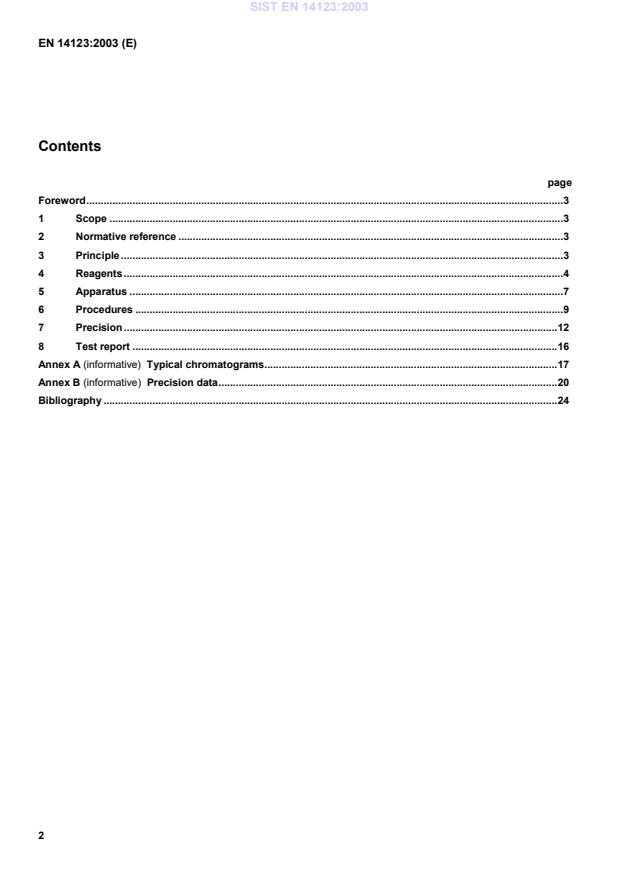
Typical chromatograms.17Annex B (informative)
Precision data.20Bibliography.24SIST EN 14123:2003
for the production and extraction of pastes from peanuts,pistachios and figs, with suitable blender jar.5.4 Adjustable vertical or horizontal shaker, needed for the analysis of paprika powder5.5 Paper filter, e.g. 24 cm diameter, prefolded5.6 Conical flask, with screw top or glass stopper5.7 Glass microfiber filter paper, retention size 1,6 m or smaller5.8 Reservoir, 75 ml with luer tip connector for immunoaffinity column (IAC)5.9 Hand pump, 20 ml syringe with luer lock or rubber stopper for IAC5.10 Volumetric glassware, flasks of e.g. 5 ml, 10 ml and 20 ml, with an accuracy of at least 0,5 %5.11 HPLC system, consisting of5.11.1 HPLC pump, suitable for flow rate at 1,0 ml/min5.11.2 Injection system, capable for total loop injection. A valve with a 200 l loop is recommended.In the case that a different loop size than recommended is used it shall be guaranteed that the limit of detection(LOD) for the system is
0,2 ng/g (signal-to-noise-ratio = 3) and the limit of quantification (LOQ) is
0,5 ng/g(signal-to-noise-ratio = 6) for each aflatoxin (using the standard solutions).5.11.3 RP-HPLC column, e.g. C18 or ODS-2 (length of 25 cm, inner diameter of 4,6 mm and particle size of 5which ensures a baseline resolution of the aflatoxin B1, B2, G1 and G2 peaks from all other peaks. The maximum
1)Contact your National Standardization institute for appropriate high speed blenders.SIST EN 14123:2003
= 360 nm excitation filter and a wavelength of
> 420 nmcut-off emission filter, or equivalent (e.g. a detector with an adjustable monochromator).Recommended settings for adjustable detectors are 365 nm (excitation wavelength), 435 nm (emissionwavelength) and a bandwidth of 18 nm.5.12 Disposable filter unit,
of pore size 0,45 mPrior to usage, verify that no aflatoxin losses occur during filtration (recovery testing).NOTE
There is a possibility that various filter materials can retain aflatoxins.5.13 Pipettes, 2 ml and 10 ml capacity, with an accuracy of at least 0,5 %5.14 Analytical balance, capable of weighing to 0,1 mg5.15 Laboratory balance, capable of weighing to 0,01 g5.16 Calibrated microliter syringe(s) or microliter pipette(s), 25 l to 500 l5.17 Vacuum manifold, optional6 Procedures6.1 Sample preparationHomogenize a suitable amount (e.g. 10 kg, see European legislation, [3]) of pistacios, peanuts and figsappropriately to give a paste, e.g. using a high speed blender (5.3). Information on sample sizes and sampling canbe seen in [3].6.2 Conditioning of immunoaffinity columnsAllow the immunoaffinity columns (4.13) to reach room temperature prior to conditioning. Connect theimmunoaffinity column to the vacuum manifold (5.17) and attach the reservoir (5.8) to the immunoaffinity column.For conditioning transfer 10 ml of PBS (4.2) on the top of the column and let it pass at a speed of 2 ml/min to3 ml/min through the column (e.g. by gravity). Make sure that a small portion (0,5 ml) of the PBS remains on thecolumn until the sample solution is applied.Different conditioning procedures shall be considered in accordance with the manufacturer’s instructions.
2)KOBRA cell® is the trade name of a suitable product available commercially. This information is given for the convenienceof users of this European Standard and does not constitute an endorsement by CEN of the product named. Equivalent productsmay be used if they can be shown to lead to the same results.SIST EN 14123:2003
...
Questions, Comments and Discussion
Ask us and Technical Secretary will try to provide an answer. You can facilitate discussion about the standard in here.
Loading comments...