

EN 17644:2022
(Main)Foodstuffs - Detection of food allergens by liquid chromatography - mass spectrometry (LC-MS) methods - General considerations
- Abstract
This document establishes an overall framework covering qualitative and quantitative methods for the determination of food allergens and allergenic ingredients using mass spectrometry-based methods for the determination of specific peptides/proteins. This document provides general guidelines and performance criteria applicable to this methodology. Guidelines, minimum requirements and performance criteria laid down in this document are intended to ensure that comparable and reproducible results are obtained by different analysts, instrumentation and laboratories.
- Status
- Published
- Publication Date
- 05-Jul-2022
- Withdrawal Date
- 30-Jan-2023
- Technical Committee
- CEN/TC 275 - Food analysis - Horizontal methods
- Drafting Committee
- CEN/TC 275/WG 12 - Food allergens
- Current Stage
- 6060 - Definitive text made available (DAV) - Publishing
- Start Date
- 06-Jul-2022
- Due Date
- 20-Jul-2022
- Completion Date
- 06-Jul-2022



Overview
EN 17644:2022 (CEN) - "Foodstuffs - Detection of food allergens by liquid chromatography‑mass spectrometry (LC‑MS) methods - General considerations" - provides a harmonized framework for qualitative and quantitative LC‑MS/MS determination of protein‑derived marker peptides that indicate the presence of food allergens or allergenic ingredients. The standard sets out general guidelines, laboratory requirements and performance criteria to help ensure comparable and reproducible results across analysts, instruments and laboratories.
Key Topics and Requirements
- Scope & objectives: Framework for targeted mass spectrometry methods to detect specific peptides/proteins as allergen markers; conversion of results to reporting units (e.g., mg protein/kg food).
- General laboratory requirements: Use and maintenance of appropriate HPLC/LC‑MS equipment and validated workflows.
- Method development:
- Sample preparation: milling/grinding, matrix‑specific extraction and purification, and enzymatic digestion (including optional reduction/alkylation).
- Selection of marker peptides: peptide uniqueness/specificity, use of bioinformatics (e.g., BLAST) to confirm identity.
- Detection strategy: targeted MS approaches (SRM/PRM/MRM), selection of precursor → product ion transitions, retention time monitoring.
- Internal standards (IS): preference for stable‑isotope labelled IS for accurate quantitation (AQUA‑type approaches).
- Method validation:
- Key parameters: measurand definition, LOD/LOQ, selectivity, calibration curves, trueness, precision, measurement uncertainty, robustness and fit‑for‑purpose assessment.
- Use of incurred samples and matrix‑relevant validation to reflect processing effects.
- Routine analysis: criteria for validating an analytical run and requirements for the test report.
- Conversion factors: guidance to convert peptide measurements into mg protein/kg food where applicable.
Applications and Who Uses It
EN 17644:2022 is intended for:
- Food testing and analytical laboratories implementing LC‑MS/MS allergen assays.
- Method developers and instrument manufacturers working on targeted peptide assays for allergens.
- Quality control and R&D teams in food manufacturers seeking reliable allergen detection workflows.
- Regulatory and accreditation bodies that evaluate method performance and inter‑laboratory comparability.
Practical applications include detection and quantification of allergenic ingredients in processed foods, verification of label claims, cross‑contamination monitoring, and method transfer between laboratories.
Related Standards
- EN 15842 - Foodstuffs: general considerations and validation of methods for allergen detection (referenced normative document).
- Other CEN/TC 275 guidance on food analysis and HPLC‑MS terminology and validation best practices.
Keywords: EN 17644:2022, food allergens, LC‑MS, HPLC‑MS/MS, marker peptides, targeted mass spectrometry, MRM, SRM, method validation, internal standard, food testing.
Relations
- Effective Date
- 28-Jan-2026
Get Certified
Connect with accredited certification bodies for this standard

BSI Group
BSI (British Standards Institution) is the business standards company that helps organizations make excellence a habit.

Bureau Veritas
Bureau Veritas is a world leader in laboratory testing, inspection and certification services.

DNV
DNV is an independent assurance and risk management provider.
Sponsored listings
Frequently Asked Questions
EN 17644:2022 is a standard published by the European Committee for Standardization (CEN). Its full title is "Foodstuffs - Detection of food allergens by liquid chromatography - mass spectrometry (LC-MS) methods - General considerations". This standard covers: This document establishes an overall framework covering qualitative and quantitative methods for the determination of food allergens and allergenic ingredients using mass spectrometry-based methods for the determination of specific peptides/proteins. This document provides general guidelines and performance criteria applicable to this methodology. Guidelines, minimum requirements and performance criteria laid down in this document are intended to ensure that comparable and reproducible results are obtained by different analysts, instrumentation and laboratories.
This document establishes an overall framework covering qualitative and quantitative methods for the determination of food allergens and allergenic ingredients using mass spectrometry-based methods for the determination of specific peptides/proteins. This document provides general guidelines and performance criteria applicable to this methodology. Guidelines, minimum requirements and performance criteria laid down in this document are intended to ensure that comparable and reproducible results are obtained by different analysts, instrumentation and laboratories.
EN 17644:2022 is classified under the following ICS (International Classification for Standards) categories: 67.050 - General methods of tests and analysis for food products. The ICS classification helps identify the subject area and facilitates finding related standards.
EN 17644:2022 has the following relationships with other standards: It is inter standard links to EN 15842:2019. Understanding these relationships helps ensure you are using the most current and applicable version of the standard.
EN 17644:2022 is available in PDF format for immediate download after purchase. The document can be added to your cart and obtained through the secure checkout process. Digital delivery ensures instant access to the complete standard document.
Standards Content (Sample)
SLOVENSKI STANDARD
01-september-2022
Živila - Odkrivanje prisotnosti alergenov v živilih s tekočinsko kromatografijo
masno spektrometrijo (LC-MS) - Splošne ugotovitve
Foodstuffs - Detection of food allergens by liquid chromatography - mass spectrometry
(LC-MS) methods - General considerations
Lebensmittel - Nachweis von Lebensmittelallergenen mit flüssigkeitschromatographisch-
massenspektrometrischen (LC-MS) Verfahren - Allgemeine Betrachtungen
Produits alimentaires - Détection des allergènes alimentaires par des méthodes de
chromatographie en phase liquide couplée à la spectrométrie de masse (CL-SM) -
Considérations générales
Ta slovenski standard je istoveten z: EN 17644:2022
ICS:
67.050 Splošne preskusne in General methods of tests and
analizne metode za živilske analysis for food products
proizvode
2003-01.Slovenski inštitut za standardizacijo. Razmnoževanje celote ali delov tega standarda ni dovoljeno.
EN 17644
EUROPEAN STANDARD
NORME EUROPÉENNE
July 2022
EUROPÄISCHE NORM
ICS 67.050
English Version
Foodstuffs - Detection of food allergens by liquid
chromatography - mass spectrometry (LC-MS) methods -
General considerations
Produits alimentaires - Détection des allergènes Lebensmittel - Nachweis von Lebensmittelallergenen
alimentaires par des méthodes de chromatographie en mit flüssigkeitschromatographisch-
phase liquide couplée à la spectrométrie de masse (CL- massenspektrometrischen (LC-MS) Verfahren -
SM) - Considérations générales Allgemeine Betrachtungen
This European Standard was approved by CEN on 22 May 2022.
CEN members are bound to comply with the CEN/CENELEC Internal Regulations which stipulate the conditions for giving this
European Standard the status of a national standard without any alteration. Up-to-date lists and bibliographical references
concerning such national standards may be obtained on application to the CEN-CENELEC Management Centre or to any CEN
member.
This European Standard exists in three official versions (English, French, German). A version in any other language made by
translation under the responsibility of a CEN member into its own language and notified to the CEN-CENELEC Management
Centre has the same status as the official versions.
CEN members are the national standards bodies of Austria, Belgium, Bulgaria, Croatia, Cyprus, Czech Republic, Denmark, Estonia,
Finland, France, Germany, Greece, Hungary, Iceland, Ireland, Italy, Latvia, Lithuania, Luxembourg, Malta, Netherlands, Norway,
Poland, Portugal, Republic of North Macedonia, Romania, Serbia, Slovakia, Slovenia, Spain, Sweden, Switzerland, Turkey and
United Kingdom.
EUROPEAN COMMITTEE FOR STANDARDIZATION
COMITÉ EUROPÉEN DE NORMALISATION
EUROPÄISCHES KOMITEE FÜR NORMUNG
CEN-CENELEC Management Centre: Rue de la Science 23, B-1040 Brussels
© 2022 CEN All rights of exploitation in any form and by any means reserved Ref. No. EN 17644:2022 E
worldwide for CEN national Members.
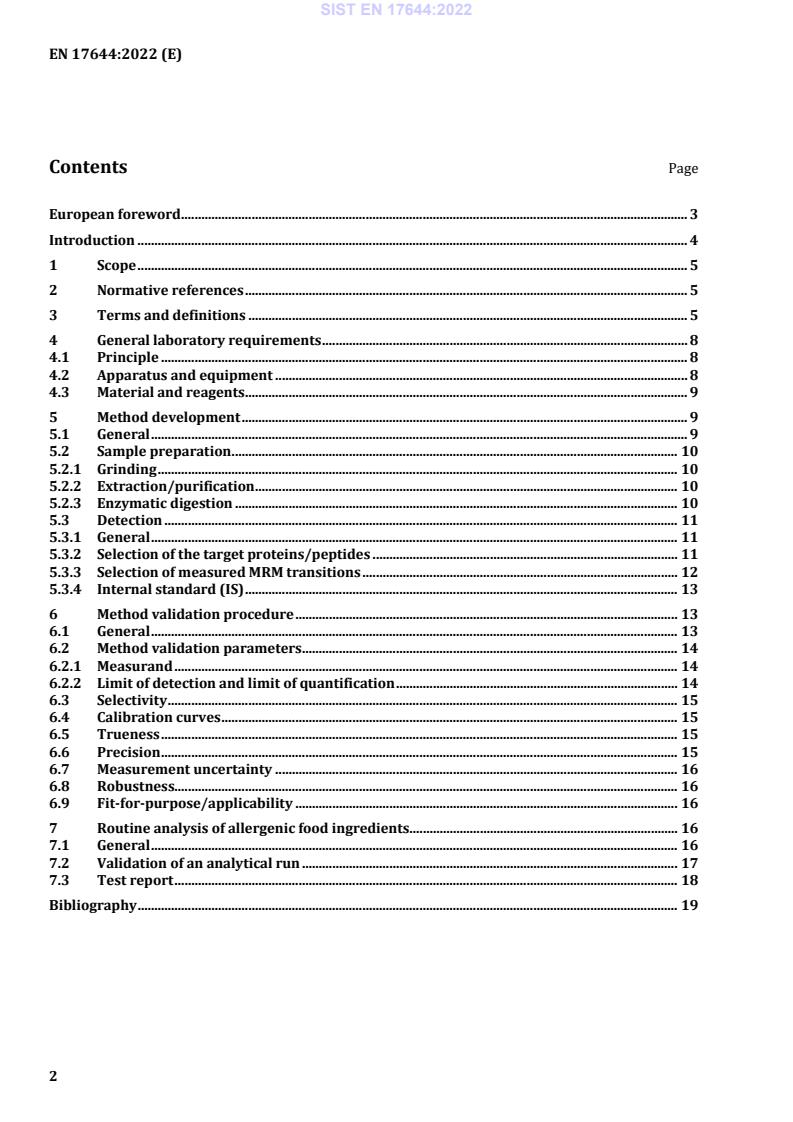
Contents Page
European foreword . 3
Introduction . 4
1 Scope . 5
2 Normative references . 5
3 Terms and definitions . 5
4 General laboratory requirements . 8
4.1 Principle . 8
4.2 Apparatus and equipment . 8
4.3 Material and reagents . 9
5 Method development . 9
5.1 General . 9
5.2 Sample preparation . 10
5.2.1 Grinding . 10
5.2.2 Extraction/purification . 10
5.2.3 Enzymatic digestion . 10
5.3 Detection . 11
5.3.1 General . 11
5.3.2 Selection of the target proteins/peptides . 11
5.3.3 Selection of measured MRM transitions . 12
5.3.4 Internal standard (IS) . 13
6 Method validation procedure . 13
6.1 General . 13
6.2 Method validation parameters . 14
6.2.1 Measurand . 14
6.2.2 Limit of detection and limit of quantification . 14
6.3 Selectivity . 15
6.4 Calibration curves . 15
6.5 Trueness . 15
6.6 Precision . 15
6.7 Measurement uncertainty . 16
6.8 Robustness. 16
6.9 Fit-for-purpose/applicability . 16
7 Routine analysis of allergenic food ingredients. 16
7.1 General . 16
7.2 Validation of an analytical run . 17
7.3 Test report . 18
Bibliography . 19
European foreword
This document (EN 17644:2022) has been prepared by Technical Committee CEN/TC 275 “Food
analysis - Horizontal methods”, the secretariat of which is held by DIN.
This European Standard shall be given the status of a national standard, either by publication of an
identical text or by endorsement, at the latest by January 2023, and conflicting national standards shall
be withdrawn at the latest by January 2023.
Attention is drawn to the possibility that some of the elements of this document may be the subject of
patent rights. CEN shall not be held responsible for identifying any or all such patent rights.
Any feedback and questions on this document should be directed to the users’ national standards body.
A complete listing of these bodies can be found on the CEN website.
According to the CEN-CENELEC Internal Regulations, the national standards organisations of the
following countries are bound to implement this European Standard: Austria, Belgium, Bulgaria, Croatia,
Cyprus, Czech Republic, Denmark, Estonia, Finland, France, Germany, Greece, Hungary, Iceland, Ireland,
Italy, Latvia, Lithuania, Luxembourg, Malta, Netherlands, Norway, Poland, Portugal, Republic of North
Macedonia, Romania, Serbia, Slovakia, Slovenia, Spain, Sweden, Switzerland, Turkey and the United
Kingdom.
Introduction
Specific peptides or groups of peptides deriving from specific proteins can serve as markers for the
presence of food or food ingredients provoking allergic reactions. This document describes the procedure
for the development of qualitative and/or quantitative mass spectrometry-based methods for the
determination of protein-derived peptides as markers for potentially allergenic food ingredients or
constituents by analysing the protein/s extracted from a sample. Appropriate procedures for the
extraction of the targeted proteins are an essential part of each method. This document describes general
considerations for the application of liquid chromatography mass spectrometry-based methods in
qualitative or quantitative targeted analysis of specific peptides (derived from specific proteins) that are
representative for a food allergen. The document includes recommendations for method validation and
for the conversion of the analytical results to units of mg protein/kg food.
1 Scope
This document establishes an overall framework covering qualitative and quantitative methods for the
determination of food allergens and allergenic ingredients using mass spectrometry-based methods for
the determination of specific peptides/proteins. This document provides general guidelines and
performance criteria applicable to this methodology. Guidelines, minimum requirements and
performance criteria laid down in this document are intended to ensure that comparable and
reproducible results are obtained by different analysts, instrumentation and laboratories.
2 Normative references
The following documents are referred to in the text in such a way that some or all of their content
constitutes requirements of this document. For dated references, only the edition cited applies. For
undated references, the latest edition of the referenced document (including any amendments) applies.
EN 15842, Foodstuffs - Detection of food allergens - General considerations and validation of methods
3 Terms and definitions
For the purposes of this document, the terms and definitions given in EN 15842 and the following apply.
ISO and IEC maintain terminological databases for use in standardization at the following addresses:
— IEC Electropedia: available at https://www.electropedia.org/
— ISO Online browsing platform: available at https://www.iso.org/obp
3.1
high-performance liquid chromatography–mass spectrometry
HPLC-MS
analytical chemistry technique that combines the separation capabilities of high-performance liquid
chromatography with the detection capabilities of mass spectrometry (MS)
Note 1 to entry: The abbreviation LC-MS is also used.
3.2
tandem mass spectrometry
MS/MS
MS
sequential combination of two mass analyses
Note 1 to entry: Different mass spectrometer instrument types exist, combining different principles of mass
detection, e.g. quadrupole, time-of-flight, ion trap, Fourier-Transform mass spectrometer.
3.3
multi-stage mass spectrometry
n
MS
sequential combination of more than two mass analyses
3.4
targeted mass spectrometry
mass spectrometry application analysing only specific ions (m/z) at specific retention times (RT)
Note 1 to entry: The targets are specified in an inclusion list.
Note 2 to entry: The opposite is untargeted MS measuring any ion present.
Note 3 to entry: In general, targeted MS increases method sensitivity.
3.5
peptide
amide that consists of two or more amino acids
Note 1 to entry: Peptides are formed by amide bonding of the amino group of one amino acid (AA) with the
carboxyl group of another AA.
Note 2 to entry: Peptides are usually obtained by enzymatic hydrolysis of proteins during sample preparation for
mass spectrometry-based methods.
3.6
marker peptide
peptide that is specific/unique for a definite protein and used as analyte in mass spectrometry-based
methods
Note 1 to entry: Portion of a protein used for its identification, recovery, quantification and purification.
[SOURCE: ISO 20418-1:2018, 3.6, modified – The definition has been moved to a Note to entry and a new
definition has been added.]
3.7
analyte
substance or chemical constituent that is subjected to measurement
[SOURCE: CEN/TS 15968:2010, 3.1]
3.8
measurand
quantity intended to be measured
Note 1 to entry: The specification of a measurand requires knowledge of the kind of quantity, description of the
state of the phenomenon, body, or substance carrying the quantity, including any relevant component, and the
chemical entities involved.
Note 2 to entry: In the second edition of the VIM and in IEC 60050-300:2001, the measurand is defined as the
“particular quantity subject to measurement”.
Note 3 to entry: The measurement, including the measuring system and the conditions under which the
measurement is carried out, might change the phenomenon, body, or substance such that the quantity being
measured may differ from the measurand as defined. In this case, adequate correction is necessary.
[SOURCE: ISO/IEC Guide 99:2007, 2.3, modified – removed Examples and Note 4 to entry.]
3.9
incurred samples
material produced by adding a specific amount of allergenic ingredient to a relevant matrix before it is
processed by food manufacturing techniques
3.10
mass-to-charge ratio
m/z
dimensionless quantity formed by dividing the ratio of the mass (m) of an ion to the unified atomic mass
unit by its charge number (z)
[SOURCE: IUPAC Recommendations 2013: Definitions of terms relating to mass spectrometry, Pure Appl.
Chem., Vol. 85, No. 7, pp. 1515–1609]
3.11
retention time
RT
time taken for an analyte to pass through a chromatography column from injection to detection
3.12
single reaction monitoring
SRM
determination of a targeted analyte by measuring the precursor-ion to product-ion transition in MS/MS
fragmentation
Note 1 to entry: The mass filters in the mass spectrometer are adjusted to the ion masses of, respectively, the
precursor ion and the product ion (“mass windows”), increasing the selectivity and sensitivity of the measurement.
Note 2 to entry: SRM is monitoring only a single fixed mass window.
Note 3 to entry: SRM is also called selected reaction monitoring.
Note 4 to entry: Parent ion is another expression for precursor ion.
Note 5 to entry: Fragment ion is another expression for product ion.
3.13
multiple reaction monitoring
MRM
simultaneous measurement of multiple SRMs
Note 1 to entry: MRM scans rapidly over multiple (narrow) mass windows and thus captures traces of multiple
product/fragment ion masses in parallel.
Note 2 to entry: MRM can also be called parallel reaction monitoring (PRM) in a high resolution mass
spectrometer.
3.14
basic local alignment search tool
BLAST
bioinformatic algorithm for the comparison of primary sequence information such as amino acid
sequences of peptides or/and proteins or nucleotide sequences of DNA and/or RNA molecules
Note 1 to entry: BLAST is maintained by the National Center for Biotechnology Information (NCBI), U.S. National
Library of Medicine, Bethesda MD, USA.
3.15
internal standard
IS
ISTD
substance, which is similar in the chemical behaviour (chemical structure, polarity) and analytical
response to a certain target analyte
Note 1 to entry: Stable-isotope labelled ISTDs are preferred in mass spectrometry-based methods, which are
then sometimes called absolute quantitation (AQUA)-methods.
[SOURCE: EN 62697-1:2012, 3.12, modified – Note 1 to entry has been changed.]
3.16
standard addition
procedure in which a known amount of an analyte is added to a test sample
Note 1 to entry: To perform standard addition procedure, the test sample is divided in two (or more) test
portions. One test portion is analysed as such, whereas known amounts of an analyte are added to the second test
portion before analysis.
3.17
conversion factor
factor for the conversion of measurement results to a reporting unit
Note 1 to entry: The measurement results are converted into mg protein/kg food.
4 General laboratory requirements
4.1 Principle
Samples are extracted for proteins with a high-yielding, reproducible and matrix-specific procedure
including enzymatic digestion for the generation of peptides. A processing step for the reduction and
alkylation may be included. Specific marker peptides are measured by HPLC-MS/MS using targeted MS
analysis for qualitative or quantitative analysis. The signal (usually the peak area) of a marker peptide
measured at a specific chromatographic retention time is used for quantitation.
4.2 Apparatus and equipment
The laboratory shall use properly maintained equipment suitable for the method employed.
NOTE For example, according to the requirements outlined by EN ISO/IEC 17025.
In addition to standard laboratory equipment, additional apparatus are described in the specific methods.
Apparatus and equipment should be maintained according to manufacturer’s instructions. Calibration
systems shall be available and calibration shall be routinely performed for measuring equipment,
according to laboratory quality assurance programmes.
In a tandem mass spectrometer, ions are formed in the ion source and separated by mass-to-charge ratio
in the first stage of mass spectrometry (MS1). In targeted mass spectrometry, ions of a particular mass-
to-charge ratio (precursor ions) are selected and product ions are created by collision-induced
dissociation, ion-molecule reaction, photodissociation, or other processes. The resulting ions are then
separated and detected in a second stage of mass spectrometry (MS2).
In MRM mode, the mass spectrometer is set to scan a very small mass range in MS1, typically one mass
unit, at the expected masses of the targeted precursor ions. After fragmentation, the product ions are
detected in MS2 by successively scanning small mass ranges at their expected masses. Alternatively, some
MS instruments (e.g. high-resolution instruments (HRMS) with fast switching MS to MS/MS capacity)
allow the simultaneous detection of all precursor and product ions (Parallel Reaction Monitoring (PRM)).
In MS-based ion fragmentation analysis, the precursor ion selected for analysis shall be clearly specified,
e.g. as the molecular ion, a characteristic ion adduct of the molecular ion, a characteristic fragment ion or
a typical isotope ion. The signal-to-noise ratio for each product ion should be ≥ 3:1.
4.3 Material and reagents
Analytes shall be clearly described, including the type of standard (e.g. synthetic peptides, purified
protein, protein extracts), and information on purity, protein profiles, storage conditions and shelf-life.
Only reagents of MS quality grade and only de-ionized or distilled water or water that has been purified
should be applied for HPLC-MS analysis, unless otherwise stated in specific method descriptions. Other
reagents, such as enzymes, reducing and alkylating agents, should be of MS-grade. Buffer components,
organic solvents standards, analyte, reference material, controls, and samples are method-specific.
Storage conditions and shelf-life of reagents and samples should be determined in method validation
(method robustness) and clearly specified in the method protocol.
5 Method development
5.1 General
For the use of this document, general requirements of quality assurance for laboratories shall be
observed (e.g. concerning calibration of apparatus, extraction of samples and measurement of replicates,
blanks, use of reference materials, preparation of calibration curves, etc.). The scope of the method,
including applicability to certain food matrices, shall be clearly specified.
Before conducting food allergen analysis, special considerations should be made regarding:
a) the laboratory lay-out (e.g. ideally, extraction working area should be spatially separated from
detection working area);
b) the current workflow (e.g. other activities in the laboratories that can increase the potential for cross-
contamination should be separated);
c) sample types handled (because cross-contamination issues can undermine the capability to perform
analysis reliably);
d) equipment in the laboratories (e.g. the risk of cross-contamination should be considered if
equipment is shared; use dedicated equipment if appropriate);
e) containers (e.g. disposable consumables are preferable, those that exhibit low protein binding - not
polystyrene);
f) general house-keeping tasks (e.g. effective cleaning of items and surfaces is important and should be
considered). Specific cleaning routines for rooms housing mass spectrometry instruments can be
required because cleaning chemicals can disturb the analysis, depending on the MS instrument type.
5.2 Sample preparation
5.2.1 Grinding
To ensure reliable results, sample preparation is a critical step in food allergen analysis. Its objective shall
be to provide a homogenous and representative portion of the original sample material. Equipment
should be available in the laboratory for sample homogenization - including apparatus for milling,
chopping, grinding and/or blending – the exact items depend on the sample types to be routinely
analysed.
A larger test portion will usually improve the potential for detection, as will reducing the particle size to
improve sample homogeneity.
5.2.2 Extraction/purification
The protein is extracted according to the procedure described in the specific method protocol.
Considerations should be given to:
a) the possibility of increasing the amounts, whilst maintaining the ratio between the test portion to
extraction volume, in order to improve the extractability/recovery of the target allergen;
b) the composition of the sample matrix.
5.2.3 Enzymatic digestion
In order to obtain a complete enzymatic digestion of the proteins in the test portion extract, it is important
to ensure that all specific cleavage sites are accessible to the respective enzymes. The following steps are
usually performed:
Denaturation step: unfolds the proteins (e.g. through sonication, addition of detergents or chaotropic
agents such as urea, denaturation with high temperature, etc.).
Reduction step: cleaves any disulfide bond present in the protein, resulting in free thiol groups (mainly
in cysteines).
Alkylation step: prevents disulfide bond reformation by irreversible capping of the free thiols obtained
during the reduction step. Typically, alkylation of cysteine is carried out by using iodoacetamide,
yielding S-carboxyamidomethylcysteine. Disulfide bond regeneration is known to be problematic before
enzymatic digestion is performed, but can also occur in the resulting peptide mixture. The omission of
the alkylation step would lead to random dimerization of cysteine-containing peptides, which would
significantly complicate the mass spectrometry analysis.
A number of enzymes are commonly used for the digestion of proteins in MS sample preparation. Pepsin
cleaves unspecifically the amino acid (AA) chain, whereas trypsin has very specific cleavage sites
(carboxyl side of lysines and arginines). Proteins that are enzymatically digested can differ widely in their
AA compositions and suitability for MS analysis. Therefore, digestion shall be optimized during method
development, and a digestion protocol including the choice of enzyme is part of the sample preparation
procedure.
After enzymatic digestion, protein extracts should immediately be processed; protein extracts could be
stored if stability data are available.
5.3 Detection
5.3.1 General
General information can be found in EN 15842.
5.3.2 Selection of the target proteins/peptides
The full sequence of the protein should be available in a reference protein database
...