

EN 16683:2025
(Main)Railway applications - Call for aid and communication device - Requirements for heavy rail vehicles
- Abstract
This document covers heavy rail rolling stock.
This document does not cover urban rail rolling stock.
NOTE 1 EN 17355 covers communication device requirements for urban rail rolling stock.
This document specifies:
- the functional requirements for a call for aid system and communication device system;
- the dynamic analysis of the call for aid system.
NOTE 2 "Dynamic analysis" is understood here as a sequence of actions.
NOTE 3 In a formation of vehicles where one complies with this document with one that does not, it is possible that the call for aid system is not fully functional.
NOTE 4 The call for aid system function is separate from the Passenger Alarm System (PAS) function, which is provided to deal with emergency situations. The PAS is described in EN 16334-1:2014+A1:2022.
NOTE 5 The communication device system can be different from the PAS, but it can share some or all parts of the PAS to achieve its functionalities.
NOTE 6 The PAS is regarded as a safety relevant system whereas the CFA system and communication device system are non-safety relevant aids to passengers.
- Status
- Published
- Publication Date
- 16-Dec-2025
- Technical Committee
- CEN/TC 256 - Railway applications
- Drafting Committee
- CEN/TC 256/WG 36 - Emergency and alarm systems
- Current Stage
- 6060 - Definitive text made available (DAV) - Publishing
- Start Date
- 17-Dec-2025
- Due Date
- 18-Oct-2024
- Completion Date
- 17-Dec-2025

Overview
EN 16683:2025 is a European Standard developed by CEN, specifying the requirements for call for aid (CFA) and communication device systems on heavy rail rolling stock. This standard is key for supporting accessibility and passenger service on mainline rail vehicles across Europe. It defines functional performance, interface, operational behavior, and interaction requirements to ensure that passengers, especially those with disabilities or reduced mobility, can request individual assistance and communicate effectively with authorized personnel. EN 16683:2025 does not cover urban rail applications-requirements for those systems are defined in EN 17355.
The standard also distinguishes CFA and communication device systems from the Passenger Alarm System (PAS), which is safety-relevant and addressed separately in EN 16334-1. Here, CFA systems and passenger communication devices are treated as essential non-safety aids for convenience, accessibility, and service.
Key Topics
Scope and Coverage
- Applies to heavy rail rolling stock only
- Excludes urban rail vehicles (see EN 17355)
Functional Requirements
- Definition and operation of CFA systems (devices, interfaces, feedback, reset)
- Communication device system roles and interfaces
- Dynamic analysis: expected action sequences during use
System Integration
- CFA must not interfere with train braking, PAS operation, or communication systems
- Recording and traceability of events: operations, resets, acknowledgements
User Interface and Accessibility
- Compliance with standards for Persons with Reduced Mobility (PRM)
- Visual and audible feedback (labels, lights, tones, signals)
- Distinction between CFA, communication, and PAS triggers
Operational Modes
- Supports both Staff On Board Operation (SOO) and Driver Only Operation (DOO)
- Specifics for sleeping coaches, cross-border services
Isolation and Reset Procedures
- Isolation of CFA components allowed for staff only, requiring clear traceability
- Reset capability accessible without tools
Applications
EN 16683:2025 is vital in ensuring that heavy rail vehicles are equipped with standardized, accessible, and reliable systems for passenger assistance and communication. Its requirements are essential for:
Train Manufacturers and Retrofitters
- Ensuring new builds and refurbishments of heavy rail vehicles meet EU harmonized standards for aid call and communication systems
Railway Operators
- Supporting consistent passenger experience and operational efficiency by enabling timely assistance requests and clear communication paths
Accessibility Compliance
- Meeting legal and regulatory obligations for accessibility (e.g., PRM TSI), fostering inclusivity for passengers with disabilities or reduced mobility
Incident Management and Passenger Service
- Providing structured methods for passengers to alert staff for assistance or communicate needs, strengthening service response across diverse train formations
Cross-border Rail Services
- Harmonizing alert signals and interface design to ensure consistent experience and comprehension across different national networks
Related Standards
EN 17355
- Communication device systems for urban rail rolling stock (complementary coverage)
EN 16334-1:2014+A1:2022
- Passenger Alarm System (PAS) – describes safety-relevant systems for emergencies on mainline rail
EN 16584 Series
- PRM use: design, contrast, information, and accessibility requirements for railway rolling stock interfaces
EN ISO 7010, ISO 3864-1
- Safety colors, graphical symbols, and signage design for communication and alarm systems in transport
EN 16683:2025 drives consistency, safety, and accessibility in railway communication and aid systems-underpinning high-quality passenger service and regulatory compliance for heavy rail operators throughout Europe.
Relations
- Effective Date
- 18-Jan-2023
- Effective Date
- 28-Jan-2026
- Effective Date
- 28-Jan-2026
- Effective Date
- 28-Jan-2026
- Effective Date
- 28-Jan-2026
- Effective Date
- 28-Jan-2026
- Effective Date
- 28-Jan-2026
- Effective Date
- 28-Jan-2026
- Effective Date
- 28-Jan-2026
Get Certified
Connect with accredited certification bodies for this standard

IRIS Certification (UNIFE)
International Railway Industry Standard certification.

TÜV SÜD Rail GmbH
TÜV SÜD railway certification services.

Bureau Veritas Railway Certification
Railway and transportation certification.
Sponsored listings
Frequently Asked Questions
EN 16683:2025 is a standard published by the European Committee for Standardization (CEN). Its full title is "Railway applications - Call for aid and communication device - Requirements for heavy rail vehicles". This standard covers: This document covers heavy rail rolling stock. This document does not cover urban rail rolling stock. NOTE 1 EN 17355 covers communication device requirements for urban rail rolling stock. This document specifies: - the functional requirements for a call for aid system and communication device system; - the dynamic analysis of the call for aid system. NOTE 2 "Dynamic analysis" is understood here as a sequence of actions. NOTE 3 In a formation of vehicles where one complies with this document with one that does not, it is possible that the call for aid system is not fully functional. NOTE 4 The call for aid system function is separate from the Passenger Alarm System (PAS) function, which is provided to deal with emergency situations. The PAS is described in EN 16334-1:2014+A1:2022. NOTE 5 The communication device system can be different from the PAS, but it can share some or all parts of the PAS to achieve its functionalities. NOTE 6 The PAS is regarded as a safety relevant system whereas the CFA system and communication device system are non-safety relevant aids to passengers.
This document covers heavy rail rolling stock. This document does not cover urban rail rolling stock. NOTE 1 EN 17355 covers communication device requirements for urban rail rolling stock. This document specifies: - the functional requirements for a call for aid system and communication device system; - the dynamic analysis of the call for aid system. NOTE 2 "Dynamic analysis" is understood here as a sequence of actions. NOTE 3 In a formation of vehicles where one complies with this document with one that does not, it is possible that the call for aid system is not fully functional. NOTE 4 The call for aid system function is separate from the Passenger Alarm System (PAS) function, which is provided to deal with emergency situations. The PAS is described in EN 16334-1:2014+A1:2022. NOTE 5 The communication device system can be different from the PAS, but it can share some or all parts of the PAS to achieve its functionalities. NOTE 6 The PAS is regarded as a safety relevant system whereas the CFA system and communication device system are non-safety relevant aids to passengers.
EN 16683:2025 is classified under the following ICS (International Classification for Standards) categories: 13.320 - Alarm and warning systems; 45.060.01 - Railway rolling stock in general. The ICS classification helps identify the subject area and facilitates finding related standards.
EN 16683:2025 has the following relationships with other standards: It is inter standard links to EN 16683:2015, EN 17343:2023, EN 16585-3:2025, EN 16584-2:2025, EN 16585-2:2025, EN 16585-1:2025, EN 16584-3:2025, EN 16584-1:2025, EN 16186-2:2017. Understanding these relationships helps ensure you are using the most current and applicable version of the standard.
EN 16683:2025 is associated with the following European legislation: EU Directives/Regulations: 2016/797/EU, 2016/797/EU, 2016/797/EU, 2016/797/EU, 2016/797/EU, 2016/797/EU, 2016/797/EU, 2016/797/EU, 2016/797/EU, 2016/797/EU, 2016/797/EU, 2016/797/EU, 2016/797/EU; Standardization Mandates: M/483. When a standard is cited in the Official Journal of the European Union, products manufactured in conformity with it benefit from a presumption of conformity with the essential requirements of the corresponding EU directive or regulation.
EN 16683:2025 is available in PDF format for immediate download after purchase. The document can be added to your cart and obtained through the secure checkout process. Digital delivery ensures instant access to the complete standard document.
Standards Content (Sample)
SLOVENSKI STANDARD
01-februar-2026
Nadomešča:
SIST EN 16683:2016
Železniške naprave - Naprava za klic v sili in naprave za sporočanje, namenjene
potnikom - Zahteve za težka železniška vozila
Railway applications - Call for aid and communication device - Requirements for heavy
rail vehicles
Bahnanwendungen - Hilferufvorrichtung und Kommunikationseinrichtung für Fahrgäste -
Anforderungen für Vollbahnfahrzeuge
Applications ferroviaires - Dispositifs d'appel à l'aide et de communication à disposition
des passagers - Prescriptions pour véhicules ferroviaires lourds
Ta slovenski standard je istoveten z: EN 16683:2025
ICS:
13.320 Alarmni in opozorilni sistemi Alarm and warning systems
35.240.60 Uporabniške rešitve IT v IT applications in transport
prometu
45.060.01 Železniška vozila na splošno Railway rolling stock in
general
2003-01.Slovenski inštitut za standardizacijo. Razmnoževanje celote ali delov tega standarda ni dovoljeno.
EN 16683
EUROPEAN STANDARD
NORME EUROPÉENNE
December 2025
EUROPÄISCHE NORM
ICS 13.320; 45.060.01 Supersedes EN 16683:2015
English Version
Railway applications - Call for aid and communication
device - Requirements for heavy rail vehicles
Applications ferroviaires - Dispositifs d'appel à l'aide et Bahnanwendungen - Hilferufvorrichtung und
de communication - Prescriptions pour véhicules Kommunikationseinrichtung - Anforderungen für
ferroviaires lourds Vollbahnfahrzeuge
This European Standard was approved by CEN on 26 October 2025.
CEN members are bound to comply with the CEN/CENELEC Internal Regulations which stipulate the conditions for giving this
European Standard the status of a national standard without any alteration. Up-to-date lists and bibliographical references
concerning such national standards may be obtained on application to the CEN-CENELEC Management Centre or to any CEN
member.
This European Standard exists in three official versions (English, French, German). A version in any other language made by
translation under the responsibility of a CEN member into its own language and notified to the CEN-CENELEC Management
Centre has the same status as the official versions.
CEN members are the national standards bodies of Austria, Belgium, Bulgaria, Croatia, Cyprus, Czech Republic, Denmark, Estonia,
Finland, France, Germany, Greece, Hungary, Iceland, Ireland, Italy, Latvia, Lithuania, Luxembourg, Malta, Netherlands, Norway,
Poland, Portugal, Republic of North Macedonia, Romania, Serbia, Slovakia, Slovenia, Spain, Sweden, Switzerland, Türkiye and
United Kingdom.
EUROPEAN COMMITTEE FOR STANDARDIZATION
COMITÉ EUROPÉEN DE NORMALISATION
EUROPÄISCHES KOMITEE FÜR NORMUNG
CEN-CENELEC Management Centre: Rue de la Science 23, B-1040 Brussels
© 2025 CEN All rights of exploitation in any form and by any means reserved Ref. No. EN 16683:2025 E
worldwide for CEN national Members.
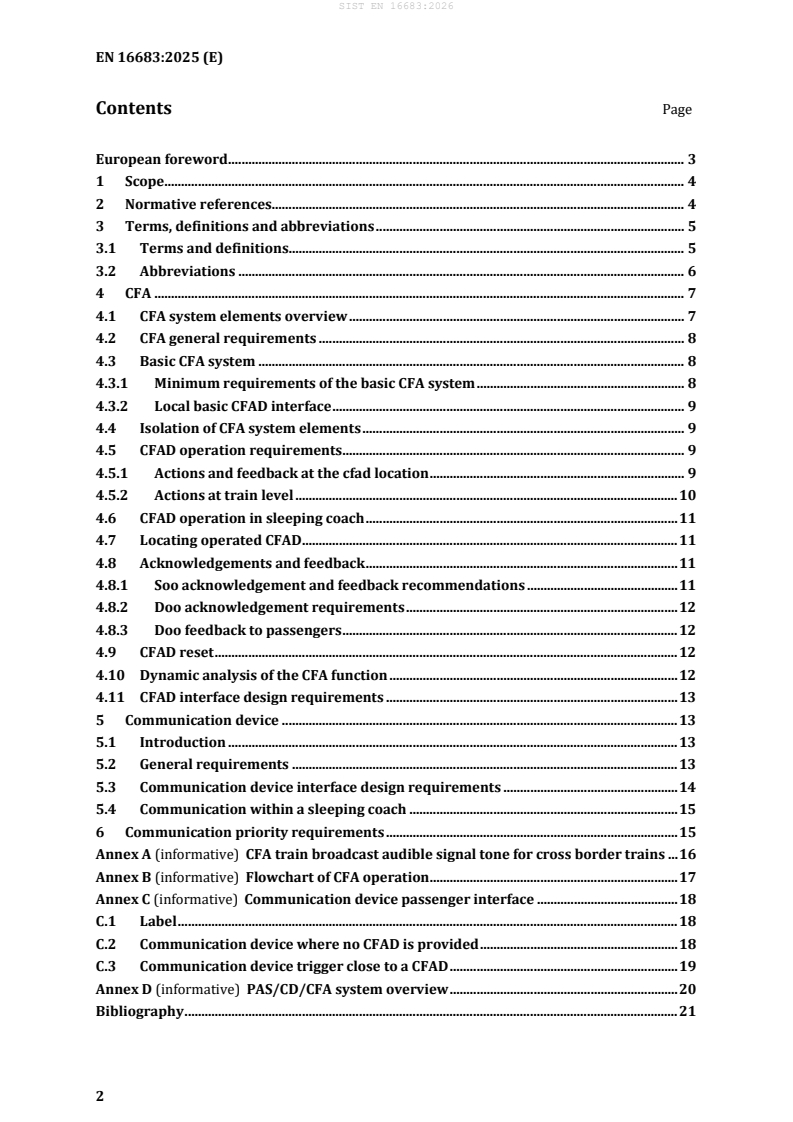
Contents Page
European foreword . 3
1 Scope. 4
2 Normative references . 4
3 Terms, definitions and abbreviations . 5
3.1 Terms and definitions. 5
3.2 Abbreviations . 6
4 CFA . 7
4.1 CFA system elements overview . 7
4.2 CFA general requirements . 8
4.3 Basic CFA system . 8
4.3.1 Minimum requirements of the basic CFA system . 8
4.3.2 Local basic CFAD interface . 9
4.4 Isolation of CFA system elements . 9
4.5 CFAD operation requirements . 9
4.5.1 Actions and feedback at the cfad location . 9
4.5.2 Actions at train level . 10
4.6 CFAD operation in sleeping coach . 11
4.7 Locating operated CFAD . 11
4.8 Acknowledgements and feedback . 11
4.8.1 Soo acknowledgement and feedback recommendations . 11
4.8.2 Doo acknowledgement requirements . 12
4.8.3 Doo feedback to passengers . 12
4.9 CFAD reset . 12
4.10 Dynamic analysis of the CFA function . 12
4.11 CFAD interface design requirements . 13
5 Communication device . 13
5.1 Introduction . 13
5.2 General requirements . 13
5.3 Communication device interface design requirements . 14
5.4 Communication within a sleeping coach . 15
6 Communication priority requirements . 15
Annex A (informative) CFA train broadcast audible signal tone for cross border trains . 16
Annex B (informative) Flowchart of CFA operation . 17
Annex C (informative) Communication device passenger interface . 18
C.1 Label . 18
C.2 Communication device where no CFAD is provided . 18
C.3 Communication device trigger close to a CFAD . 19
Annex D (informative) PAS/CD/CFA system overview . 20
Bibliography . 21
European foreword
This document (EN 16683:2025) has been prepared by Technical Committee CEN/TC 256
“Railway applications”, the secretariat of which is held by DIN.
This European Standard shall be given the status of a national standard, either by publication of
an identical text or by endorsement, at the latest by June 2026, and conflicting national standards
shall be withdrawn at the latest by June 2026.
Attention is drawn to the possibility that some of the elements of this document may be the
subject of patent rights. CEN shall not be held responsible for identifying any or all such patent
rights.
This document supersedes EN 16683:2015.
In comparison with the previous edition EN 16683:2015, the following technical modifications
have been made:
— the scope has been updated and explicitly does not cover urban rail;
— the normative references have been updated;
— Clause 3 (Terms, definitions and abbreviations) has been updated;
— the CFA (Clause 4) description and requirements have been reviewed to remove ambiguities;
— a new subclause 4.11 on CFAD passenger interface design requirements was added;
— subclause 5.5 is now Clause 6 and has been slightly rephrased;
— Annex C has been rewritten;
— Annex D has been added;
— Annex ZA has been removed.
Any feedback and questions on this document should be directed to the users’ national standards
body. A complete listing of these bodies can be found on the CEN website.
According to the CEN-CENELEC Internal Regulations, the national standards organisations of the
following countries are bound to implement this European Standard: Austria, Belgium, Bulgaria,
Croatia, Cyprus, Czech Republic, Denmark, Estonia, Finland, France, Germany, Greece, Hungary,
Iceland, Ireland, Italy, Latvia, Lithuania, Luxembourg, Malta, Netherlands, Norway, Poland,
Portugal, Republic of North Macedonia, Romania, Serbia, Slovakia, Slovenia, Spain, Sweden,
Switzerland, Türkiye and the United Kingdom.
1 Scope
This document covers heavy rail rolling stock.
This document does not cover urban rail rolling stock.
NOTE 1 EN 17355 covers communication device requirements for urban rail rolling stock.
This document specifies:
— the functional requirements for a call for aid system and communication device system;
— the dynamic analysis of the call for aid system.
NOTE 2 “Dynamic analysis” is understood here as a sequence of actions.
NOTE 3 In a formation of vehicles where one complies with this document with one that does not, it is
possible that the call for aid system is not fully functional.
NOTE 4 The call for aid system function is separate from the Passenger Alarm System (PAS) function,
which is provided to deal with emergency situations. The PAS is described in EN 16334-1:2014+A1:2022.
NOTE 5 The communication device system can be different from the PAS, but it can share some or all
parts of the PAS to achieve its functionalities.
NOTE 6 The PAS is regarded as a safety relevant system whereas the CFA system and communication
device system are non-safety relevant aids to passengers.
2 Normative references
The following documents are referred to in the text in such a way that some or all of their content
constitutes requirements of this document. For dated references, only the edition cited applies.
For undated references, the latest edition of the referenced document (including any
amendments) applies.
EN 16584-1:2025, Railway applications — Design for PRM use — General requirements — Part 1:
Contrast
EN 16584-2:2025, Railway applications — Design for PRM use — General requirements — Part 2.
Information (Basel)
EN 16584-3:2025, Railway applications — Design for PRM use — General requirements — Part 3:
Optical and friction characteristics
EN 16585-1:2025, Railway applications — Design for PRM use — Equipment and components
onboard rolling stock - Part 1: Toilets
EN 16585-2:2025, Railway applications — Design for PRM use — Equipment and components on
board rolling stock - Part 2: Elements for sitting, standing and moving
EN 16585-3:2025, Railway applications — Design for PRM use — Equipment and components on
board rolling stock - Part 3: Clearways and internal doors
EN 17343:2023, Railway applications — General terms and definitions
3 Terms, definitions and abbreviations
For the purposes of this document, the following terms, definitions and abbreviations given in
EN 17343:2023, and the following apply.
ISO and IEC maintain terminology databases for use in standardization at the following
addresses:
— IEC Electropedia: available at https://www.electropedia.org
— ISO Online browsing platform: available at https://www.iso.org/obp
3.1 Terms and definitions
3.1.1
authorized person
operational people authorized to deal with the situation following CFAD operation or
communication device trigger operation
Note 1 to entry: An authorized person could be, for example, either staff on the train or at a call centre as
defined by operating rules.
3.1.2
call for aid
CFA
request for individual help of a passenger
3.1.3
call for aid system
CFA system
system used to inform an authorized person or the driver of a request for individual help
3.1.4
call for aid device interface
CFAD interface
arrangement of equipment, including the CFAD, enabling a PRM or any other passenger to operate
the CFAD and to receive information on the status of the CFA system
3.1.5
call for aid device
CFAD
local device used by a PRM, or any other passenger, to inform an authorized person or the driver
of a request for individual help
Note 1 to entry: The TSI PRM defines CFAD location in wheelchair accessible areas
Note 2 to entry: The CFAD is typically a push button.
3.1.6
communication device system
CD
system used to enable the passengers to speak to authorized persons
Note 1 to entry: the term “communication device” as used in the TSI Loc&Pas is equivalent to
“communication device system” in this document.
3.1.7
communication device interface
arrangement of equipment, including the communication device trigger, enabling a passenger to
operate the communication device trigger and to receive information on the status of the
communication device system
Note 1 to entry: The interface typically contains a push button, a microphone and a loudspeaker.
3.1.8
communication device trigger
local device used to enable a passenger to initiate a request for communication with an authorized
person
Note 1 to entry: The communication device trigger is typically a push button.
3.1.9
driver only operation
DOO
train without authorized persons on board, except the driver
3.1.10
public address
PA
system used by authorized persons to broadcast to the passenger areas
Note 1 to entry: This is also known as audible communication system.
3.1.11
sleeping car attendant
dedicated member of staff who is responsible for sleeping car(s) during night operation
3.1.12
staff on board operation
SOO
train with other staff on board in addition to the driver
3.2 Abbreviations
For the purposes of this document, the abbreviated terms in Table 1 apply.
Table 1 — Abbreviations
CFA Call for aid
CFAD Call for aid device
DMI Driver machine interface
DOO Driver only operation
PA Public address
PAS Passenger alarm system (defined in EN 16334-2)
PRM Persons with disabilities and persons with reduced mobility
SOO Staff on board operation
TCMS Train control and monitoring system
4 CFA
4.1 CFA system elements overview
The CFA system overview is summarized, as an example, by Figure 1 to show the different CFA
system elements and their interaction through the train. It also shows those elements considered
mandatory and those considered optional.
The different elements are more precisely described in the following clauses.
Key
shaded box - mandatory CFA system element
dotted box - optional CFA system element
1 CFAD interface (includes 2, 3, 4 and 5)
2 visual feedback
3 CFAD (push button)
4 audible feedback
5 resetting device
6 visual location identification (mandatory for universal toilets and sleeping compartments with CFA)
7 CFA function
8 authorized persons (optional for DOO)
9 broadcast to inform the authorized persons on board that a CFAD has been operated
10 active driver cab or authorized persons area (if applicable)
11 visual and acoustic devices
12 acknowledgement button
13 remote reset command by authorized person
14 wireless link
15 recorder
16 passenger information system
17 others
18 TCMS
19 audio/intercom communication system
20 information about localization of operated CFAD
Figure 1 — Example of CFA general overview
The CFAD interface may include a microphone and a loudspeaker.
Figure D.1 gives an overview of the CFA, the PAS and the CD.
4.2 CFA general requirements
The CFA system shall have no interaction with the brake system.
The CFA system shall not adversely interfere with the operation of the PAS.
The CFA system shall not adversely interfere with the operation of the communication device
system.
For units designed to always be operated with authorized persons on board (SOO), the facilities
for the authorized person shall be provided with the functionality to deal with the CFA system
operation, as set out in this document. In this situation any action by the driver during CFA system
operation should not be required. For units that can be operated by the driver alone (DOO), the
active driver’s cab shall be provided with the functionality to deal with the CFA system operation,
as set out in this document. An external call centre may be advised in parallel to the driver.
NOTE The above requirements are to prevent the CFA system having a direct impact on the driver's
ability to control the train.
For units designed to be operated as DOO or SOO, a device may be provided to suspend the active
driver’s cab CFA system functionality when authorized persons are on board. The operating mode
selected by the device for the CFA system should be consistent with the operating mode selected
for door closing function (driver only operation or staff control).
This document does not define when suspending the active driver cab CFA system functionality
is permitted, as this shall be described through operational rules.
All the changes of state of the CFA system, including all the CFADs (operation, acknowledgement,
reset, etc.), should be recorded, e.g. for monitoring, investigation, etc.
The design of the CFAD passenger interfaces shall comply with EN 16584-1:2025, EN 16584-
2:2025, EN 16584-3:2025, EN 16585-1:2025, EN 16585-2:2025 and EN 16585-3:2025.
At the locations where the CFAD is provided, it is permitted to support this operation with a
communication channel. In this case, the operation of the CFAD shall also provide the additional
functions of the commu
...