

EN 15287-2:2008
(Main)Chimneys - Design, installation and commissioning of chimneys - Part 2: Chimneys for roomsealed appliances
- Abstract
This European Standard describes the method of specifying the design, installation and labelling criteria for chimney systems, connecting flue pipes and air supply pipes for roomsealed heating applications. It also gives information on commissioning of an installed chimney.
This standard does not cover:
chimneys designated H (high positive pressure chimneys), and chimneys designated P (normal positive pressure chimneys) serving more than one appliance,
chimneys which serve a mixture of fan assisted or forced draught burners or natural draught appliances,
installations having a configuration of the type C2.
This European Standard does not apply to freestanding chimneys covered by EN 13084-1.
This standard also specifies limitations for supporting a chimney, and the maximum unsupported chimney height for system chimneys and custom built chimneys.
NOTE Roomsealed gas appliances are classified as type C according to CEN/TR 1749.
- Status
- Withdrawn
- Publication Date
- 18-Mar-2008
- Withdrawal Date
- 06-Oct-2026
- Technical Committee
- CEN/TC 166 - Chimneys
- Drafting Committee
- CEN/TC 166/WG 1 - General requirements
- Current Stage
- 9960 - Withdrawal effective - Withdrawal
- Start Date
- 26-Jul-2023
- Completion Date
- 07-Oct-2026



Relations
- Effective Date
- 19-Jan-2023
- Effective Date
- 25-Mar-2026
- Effective Date
- 28-Jan-2026
- Effective Date
- 28-Jan-2026
- Effective Date
- 28-Jan-2026
- Effective Date
- 28-Jan-2026
- Effective Date
- 28-Jan-2026
- Effective Date
- 28-Jan-2026
- Effective Date
- 28-Jan-2026
- Effective Date
- 28-Jan-2026
- Effective Date
- 28-Jan-2026
- Effective Date
- 28-Jan-2026
- Effective Date
- 28-Jan-2026
- Effective Date
- 28-Jan-2026
- Effective Date
- 28-Jan-2026
Get Certified
Connect with accredited certification bodies for this standard

DIBt (Deutsches Institut für Bautechnik)
German Institute for Building Technology.
DIN CERTCO
DIN Group product certification.

Aboma Certification B.V.
Specialized in construction, metal, and transport sectors.
Sponsored listings
Frequently Asked Questions
EN 15287-2:2008 is a standard published by the European Committee for Standardization (CEN). Its full title is "Chimneys - Design, installation and commissioning of chimneys - Part 2: Chimneys for roomsealed appliances". This standard covers: This European Standard describes the method of specifying the design, installation and labelling criteria for chimney systems, connecting flue pipes and air supply pipes for roomsealed heating applications. It also gives information on commissioning of an installed chimney. This standard does not cover: chimneys designated H (high positive pressure chimneys), and chimneys designated P (normal positive pressure chimneys) serving more than one appliance, chimneys which serve a mixture of fan assisted or forced draught burners or natural draught appliances, installations having a configuration of the type C2. This European Standard does not apply to freestanding chimneys covered by EN 13084-1. This standard also specifies limitations for supporting a chimney, and the maximum unsupported chimney height for system chimneys and custom built chimneys. NOTE Roomsealed gas appliances are classified as type C according to CEN/TR 1749.
This European Standard describes the method of specifying the design, installation and labelling criteria for chimney systems, connecting flue pipes and air supply pipes for roomsealed heating applications. It also gives information on commissioning of an installed chimney. This standard does not cover: chimneys designated H (high positive pressure chimneys), and chimneys designated P (normal positive pressure chimneys) serving more than one appliance, chimneys which serve a mixture of fan assisted or forced draught burners or natural draught appliances, installations having a configuration of the type C2. This European Standard does not apply to freestanding chimneys covered by EN 13084-1. This standard also specifies limitations for supporting a chimney, and the maximum unsupported chimney height for system chimneys and custom built chimneys. NOTE Roomsealed gas appliances are classified as type C according to CEN/TR 1749.
EN 15287-2:2008 is classified under the following ICS (International Classification for Standards) categories: 91.060.40 - Chimneys, shafts, ducts. The ICS classification helps identify the subject area and facilitates finding related standards.
EN 15287-2:2008 has the following relationships with other standards: It is inter standard links to EN 15287-2:2023, EN 1993-3:2026, EN 14989-1:2007, EN 1858:2008+A1:2011, EN 1993-3-2:2006, EN 13063-3:2007, EN 14989-2:2007, EN 1443:2003, EN 13502:2002, EN 15287-1:2007, EN 1856-2:2009, EN 13084-1:2025, EN 13384-1:2002, EN 1857:2010, EN 13063-1:2005+A1:2007. Understanding these relationships helps ensure you are using the most current and applicable version of the standard.
EN 15287-2:2008 is available in PDF format for immediate download after purchase. The document can be added to your cart and obtained through the secure checkout process. Digital delivery ensures instant access to the complete standard document.
Standards Content (Sample)
2003-01.Slovenski inštitut za standardizacijo. Razmnoževanje celote ali delov tega standarda ni dovoljeno.Chimneys - Design, installation and commissioning of chimneys - Part 2: Chimneys for roomsealed appliancesDimniki - Projektiranje, vgradnja in pregled dimnikov - 2. del: Dimniki za kurilne naprave, ki delujejo neodvisno od zraka v prostoruConduits de fumée - Conception et mise en oevre des conduits de fumées - Partie 2 : Conduits de fumée pour appareils qui ne pas dependent de l'air dans la pieceAbgasanlagen - Planung, Montage und Abnahme von Abgasanlagen - Teil 2: Abgasanlagen für raumluftunabhängige FeuerstättenTa slovenski standard je istoveten z:EN 15287-2:2008SIST EN 15287-2:2008en,fr91.060.40ICS:SLOVENSKI
STANDARDSIST EN 15287-2:200801-maj-2008
EUROPEAN STANDARDNORME EUROPÉENNEEUROPÄISCHE NORMEN 15287-2March 2008ICS 91.060.40 English VersionChimneys - Design, installation and commissioning of chimneys- Part 2: Chimneys for roomsealed appliancesCheminées - Conception, installation et mise en servicedes conduits de fumée - Partie 2 : Conduits de fumée pourchaudières étanchesAbgasanlagen - Planung, Montage und Abnahme vonAbgasanlagen - Teil 2: Abgasanlagen fürraumluftunabhängige FeuerstättenThis European Standard was approved by CEN on 10 February 2008.CEN members are bound to comply with the CEN/CENELEC Internal Regulations which stipulate the conditions for giving this EuropeanStandard the status of a national standard without any alteration. Up-to-date lists and bibliographical references concerning such nationalstandards may be obtained on application to the CEN Management Centre or to any CEN member.This European Standard exists in three official versions (English, French, German). A version in any other language made by translationunder the responsibility of a CEN member into its own language and notified to the CEN Management Centre has the same status as theofficial versions.CEN members are the national standards bodies of Austria, Belgium, Bulgaria, Cyprus, Czech Republic, Denmark, Estonia, Finland,France, Germany, Greece, Hungary, Iceland, Ireland, Italy, Latvia, Lithuania, Luxembourg, Malta, Netherlands, Norway, Poland, Portugal,Romania, Slovakia, Slovenia, Spain, Sweden, Switzerland and United Kingdom.EUROPEAN COMMITTEE FOR STANDARDIZATIONCOMITÉ EUROPÉEN DE NORMALISATIONEUROPÄISCHES KOMITEE FÜR NORMUNGManagement Centre: rue de Stassart, 36
B-1050 Brussels© 2008 CENAll rights of exploitation in any form and by any means reservedworldwide for CEN national Members.Ref. No. EN 15287-2:2008: E
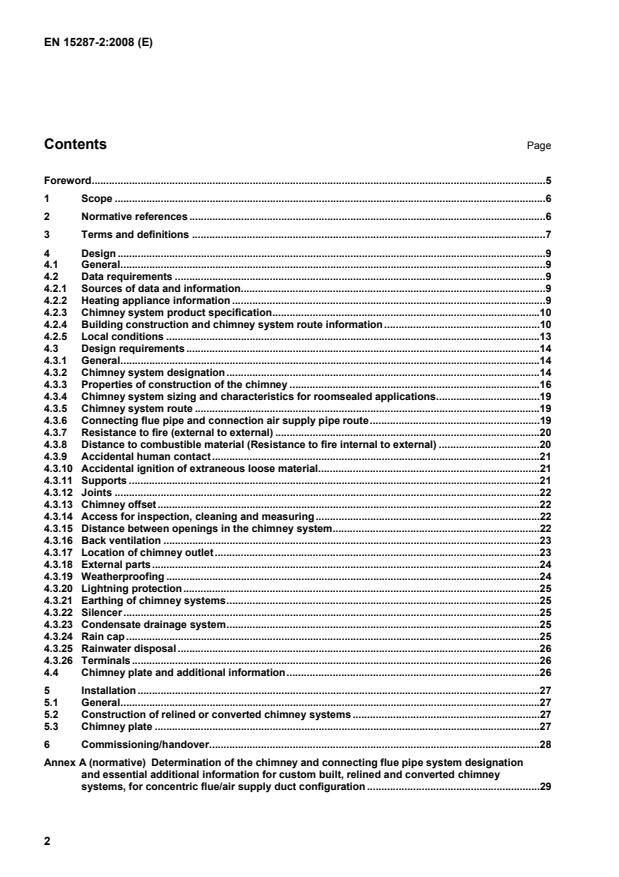
Determination of the chimney and connecting flue pipe system designation and essential additional information for custom built, relined and converted chimney systems, for concentric flue/air supply duct configuration.29
Information for the heating appliance(s).42 Annex C (informative)
Example of system chimney product designation.44 Annex D (informative)
Correlation between designation parameters for clay/ceramic flue liners and clay/ceramic flue blocks and concrete flue blocks.45 Annex E (informative)
Designation of metal system chimneys and correlation between metal liner material designation and corrosion load in Member States (MS).47 Annex F (informative)
Example of chimney system designation for roomsealed applications.53 Annex G (informative)
Example for chimney system plate.54 G.1 Example of a concentric chimney system configuration plate.54 G.2 Example of a separate chimney system configuration plate.54 Annex H (normative)
Determination of the chimney designation for a completed metal system chimney.55 H.1 General.55 H.2 Corrosion resistance class.55 Annex I (informative)
Example of the determination of the designation of a converted/relined chimney system.56 I.1 Input data for a typical converted/relined chimney.56 I.1.1 Existing chimney.56 I.1.2 Liner.56 I.1.3 Insulation.56 I.2 Temperature class designation.57 I.2.1 General.57 I.2.2 Material characteristic.57 I.2.3 Fire protection.58 I.2.4 Human contact.59 I.2.5 Determination of temperature class.59 I.2.6 Check of mean temperatures.59 I.3 Pressure class designation.61 I.4 Resistance to condensate class designation.61 I.5 Corrosion resistance class designation.61 I.6 Sootfire resistance class.61 I.7 Distance to combustible material.61 I.8 Designation of the converted/relined chimney.62 I.9 Chimney plate of the converted/relined chimney in this annex.62 Annex J (informative)
Example for the determination of the designation of a custom built chimney system.63 J.1 Input data for a custom-built chimney system.63 J.1.1 Liner.63 J.1.2 Insulation.63 J.1.3 Air supply duct.63 J.1.4 Combustible wall.63 J.2 Temperature class designation.64 J.2.1 General.64 J.2.2 Material characteristic.64
Location of outlets of chimney systems.70 Annex L (informative)
Method for calculating the temperature of adjacent materials.74 L.1 Method for the calculation of the temperature of adjacent materials.74 L.2 Example for calculation of the temperature of adjacent materials.76 Annex M (informative)
Checking, handling and site storage of materials and components.78 M.1 General.78 M.2 Checking, handling and site storage of materials and components.78 M.2.1 Checking on delivery of materials.78 M.2.2 Checking before installation.78 M.2.3 Check of existing chimney.78 M.2.4 Site handling and storage.78 M.2.5 Coordination of work.79 Annex N (informative)
Chimney commissioning.80 N.1 General.80 N.2 Physical checks.80 N.3 Operational checks.81 N.3.1 Flue flow test.81 N.3.2 Smoke test.81 N.3.3 Gas tightness test.82 Method B: O2 measurement in concentric air supply ducts for gas.82 Annex O (informative)
Recommendations for inspection, cleaning and maintenance.84 O.1 General.84 O.2 Inspection and cleaning.84 O.3 Maintenance.84 Bibliography.85
This standard does not cover: chimneys designated H (high positive pressure chimneys), and chimneys designated P (normal positive pressure chimneys) serving more than one appliance, chimneys which serve a mixture of fan assisted or forced draught burners or natural draught appliances, installations having a configuration of the type C2. This European Standard does not apply to freestanding chimneys covered by EN 13084-1. This standard also specifies limitations for supporting a chimney, and the maximum unsupported chimney height for system chimneys and custom built chimneys. NOTE Roomsealed gas appliances are classified as type C according to CEN/TR 1749. 2 Normative references The following referenced documents are indispensable for the application of this document. For dated references, only the edition cited applies. For undated references, the latest edition of the referenced document (including any amendments) applies. EN 771-1, Specification for masonry units - Part 1: Clay masonry units EN 771-2, Specification for masonry units - Part 2: Calcium silicate masonry units EN 1443: 2003, Chimneys – General requirements EN 1457, Chimneys — Clay/ceramic flue liners — Requirements and test methods EN 1806, Chimneys – Clay/ceramic flue blocks for single wall chimneys - Requirements and test methods EN 1856-1, Chimneys – Requirements for metal chimneys – Part 1: System chimney products EN 1856-2, Chimneys – Requirements for metal chimneys – Part 2: Metal liners and connecting flue pipes EN 1857, Chimneys – Components – Concrete flue liners EN 1858, Chimneys – Components – Concrete flue blocks EN 1993-3-2, Eurocode 3: Design of steel structures – Part 3-2: Towers, masts and chimneys – Chimneys EN 12446, Chimneys – Components – Concrete outer wall elements EN 13063, Chimneys – System chimneys with clay/ceramic flue liners – Part 1: Requirements and test methods for sootfire resistance EN 13063-2, Chimneys – System chimneys with clay/ceramic flue liners – Part 2: Requirements and test methods under wet conditions
3 Terms and definitions For the purposes of this document, the terms and definitions given in EN 1443:2003, EN 15287-1:2007 and the following apply. NOTE 1 Examples of balanced air/flue configurations for roomsealed applications are given in Figures 1 and 2. The configurations of Figure 1 and Figure 2 may be created from converting or relining an existing chimney. NOTE 2 The European scheme for the classification of gas appliances is given in CEN/TR 1749.
3.1 air supply duct duct in a chimney system only for conveying combustion air to a room-sealed appliance 3.2 balanced flue chimney configuration configuration where the air entry to the combustion air supply duct is adjacent to the discharge of combustion products from the flue, the inlet and outlet being so positioned that wind effects are substantially balanced 3.3 concentric chimney configuration configuration in which the chimney flue is fully surrounded by the air supply duct NOTE This includes chimney configurations where the flue duct and air supply duct do not share a common axis. 3.4 connecting air supply pipe component or components connecting the heating appliance air supply to the chimney system air supply duct
3.7 custom-built chimney for roomsealed heating applications chimney configuration that is installed or built on-site using a combination of compatible components that may be from one or different sources 3.8 flue duct the duct containing the flue of the chimney system 3.9 relined chimney existing chimney where a liner is restored or replaced NOTE The process of inserting a new liner into an existing chimney without a change of the air/flue configuration is also regarded as relining the chimney 3.10 roomsealed appliance appliance in which the combustion circuit (air supply, combustion chamber, heat exchanger and evacuation of the products of combustion) is sealed with respect to the room in which the appliance is installed 3.11 roomsealed chimney configuration
combination of both a flue duct and an air supply duct for roomsealed applications 3.12 separate chimney configuration configuration in which the air supply duct and the chimney flue are separate
3.13 system chimney for roomsealed heating applications chimney configuration that is installed using a combination of compatible components, obtained or specified from one manufacturing source with product responsibility for the whole roomsealed chimney configuration NOTE This product is understood to constitute a kit under the Mandate M 105.
Key 1 flue gas 2 combustion air Figure 1 — Concentric configurations
Key 1 flue gas 2 combustion air Figure 2 — Separate configurations 4 Design 4.1 General In order to design a chimney system installation, the following steps should be followed to achieve a safe chimney installation. Specify whether the chimney system design is for a single appliance or multiple appliance application. Specify the type of multiple appliance configuration, i.e. whether cascade or multiple inlet. The design shall specify whether the chimney configuration to be installed shall comprise two concentric or separate ducts. Chimney system shall comply with national regulations and nationally accepted rules. NOTE Where a chimney is approved together with the heating appliance, the information for flue sizing or the designation parameters not associated with the installation aspects are not necessary as the combination of appliance and chimney has been certificated together. 4.2 Data requirements 4.2.1 Sources of data and information The data and information specified in 4.2.2 to 4.2.5 shall be obtained and documented as appropriate. NOTE The sources may be:
-heating appliance manufacturer‘s literature,
-chimney manufacturer‘s literature including installation instructions,
-architects drawings or plans and/or site surveys,
-Annexes of this document (e.g. material characteristics),
-local building rules. A possible source of typical or average data is EN 13384-1, and Annex A of this document. 4.2.2 Heating appliance information The information for the heating appliance(s) in Annex B shall be obtained from the documentation of the heating appliance manufacturer or if not available, default values may be used (see Annex B of EN 13384-1:2002), but the source of the data shall be documented in the design (see 4.2.1).
Key See 4.2.4 Figure 3 - Example for roomsealed installations – dimensions
Key See 4.2.4 Figure 4 — Example for connecting flue pipe and connecting air supply pipe dimensions for C4 application with separate ducts The following is a check list of information from which details of the building construction and chimney system construction and route shall be obtained. The following list of information should be supplied where appropriate (see Figures 3 and 4): H1 height from ground to ceiling (structural or finished); H2 height from intermediary floor to ceiling (structural or finished); H3 height of ridge; γ pitch of roof; T1 depth and thickness of intermediate floor joist timbers and distances between centres; T2 depth and thickness of roof space floor joist timbers and distances between centres; T3 depth and thickness of roof timbers (rafters) and distance between centres; L1 horizontal distance between the centre line of the chimney above roof level and the gable end of the building; L2 horizontal distance between the centre line of the chimney above roof level and the ridge of the roof; C1 distance through loft measured at centre line of the chimney system; C2 height from the ground to the centre line of each flue inlet; C3 height from the ground to the bottom of the liner; C4 total chimney height from the ground to the chimney system outlet;
D1 internal dimensions of cross section of the flue throughout its length; D2 internal dimensions of cross section of the air supply duct throughout its length; D3 internal dimensions of cross section of the connecting flue pipe; D4 internal dimensions of cross section of the connecting air supply duct; materials of each floor; materials of each ceiling; roof finish. Existing chimney details for relined and converted chimney: construction materials to determine thermal performance; condition and nature of inner flue surface of the existing chimney; structural details, e.g. position of inspection/cleaning access; proximity of chimney outlet position to adjacent buildings, obstructions and other building openings, e.g. windows/skylights, etc. 4.2.5 Local conditions Topographical (e.g. altitude, outside temperature) particulars of the site shall be obtained as required in EN 13384-1.
T600 > T450 > T400 > T300 > T250 > T200 > T160 > T140 > T120 > T100 > T080; P > N; W3 > W2 > W1; D3 > D2 > D1; W > D under the same corrosion load; Gxx > Oxx; xx(low) > xx(high); where
T is the temperature class, P is the positive pressure class, N is the negative pressure class, W is wet operating conditions, D is dry operating conditions,
NOTE Chimney products in accordance with EN 1806, EN 1856-1, EN 1858 and EN 14471 may also be used as flue ducts.
NOTE Insulation should not prevent free movement of the duct. 4.3.3.4.1.3 Outer wall The outer wall shall be of a material suitable for the conditions inside and outside the duct (e.g. air supply temperature, heat radiation from the flue duct, durability, UV resistant, rigidity). Outer wall components in accordance with EN 12446, EN 1806, EN 1858, EN 13069 or as speci
...