

EN 12365-4:2003
(Main)Building hardware - Gasket and weatherstripping for doors, windows, shutters and curtain walling - Part 4: Recovery after accelerated ageing test method
General Information
- Abstract
This part 4 of prEN 33/WI131/247 specifies the method to be used to select, condition and test standard extruded samples of typical raw materials, to determine the percentage of long term recovery after being deflected through its working deflection range under the conditions layed down in the test. The test has been devised to cover all likely raw materials.
- Status
- Published
- Publication Date
- 16-Sep-2003
- Technical Committee
- CEN/TC 33 - Doors, windows, shutters and building hardware
- Drafting Committee
- CEN/TC 33/WG 4 - Building hardware
- Current Stage
- 9093 - Decision to confirm - Review Enquiry
- Start Date
- 08-Mar-2023
- Completion Date
- 30-Sep-2026

EN 12365-4:2003 Overview
EN 12365-4:2003 is a European standard developed by CEN that specifies the accelerated ageing test method to evaluate the long-term recovery performance of gaskets and weatherstripping used in building hardware such as doors, windows, shutters, and curtain walling. This fourth part of the EN 12365 series focuses on measuring the percentage of recovery after deflection when materials are subjected to high temperatures over an extended period. The standard ensures the durability and effectiveness of sealing profiles made from typical raw materials through rigorous and reproducible testing procedures.
Key Topics of EN 12365-4:2003
Scope and Applicability
This part addresses the selection, conditioning, and testing of standard extruded samples of raw materials used in gaskets and weatherstripping to determine their performance after accelerated ageing.Temperature Grades
Defines six working temperature ranges from 0 °C to +200 °C to simulate different environmental conditions materials may face in use.Recovery Grades
Establishes seven recovery grades spanning from no specific performance requirement to over 90% recovery to classify material resilience after testing.Test Apparatus
- Compression block for uniform sample deflection to 60% of original height.
- Electrically heated oven compliant with ISO 188 method A for accelerated ageing.
Test Procedure
- Conditioning samples at controlled temperature and humidity.
- Measuring free height before and after compression and ageing cycles.
- Applying compression at maximum working temperature for 504 hours, followed by free recovery measurement.
- Calculating recovery percentage based on sample height changes.
Test Reporting
Detailed recording of testing conditions, sample identification, and recovery results to ensure traceability and standard compliance.
Practical Applications
EN 12365-4:2003 provides a standardized, reliable method to assess the durability and elastic recovery of building hardware seals after prolonged exposure to elevated temperatures. This is critical for:
Manufacturers of Doors and Windows
Ensuring gasket materials retain sealing performance over time despite thermal stresses, reducing air and water infiltration risks.Quality Control and Product Development
Comparing material formulations for long-term resilience, enabling selection of weatherstripping profiles with superior recovery and lifespan.Building Compliance and Certification
Meeting regulatory requirements for thermal performance and weather resistance in façade systems, curtain walls, and window installations.Material Suppliers
Providing data-backed guarantees of product longevity under simulated service conditions, facilitating confidence in raw material performance.
By adopting EN 12365-4 testing, professionals can optimize weatherproofing solutions that maintain functionality, improving energy efficiency, occupant comfort, and reducing maintenance costs.
Related Standards
EN 12365-4:2003 is part of a wider series focused on building hardware gaskets and weatherstripping:
- EN 12365-1:2003 – Performance requirements and classification of gaskets and weatherstripping.
- EN 12365-2 – Linear compression force test method.
- EN 12365-3 – Deflection recovery test method.
- prEN 12519:2003 – Terminology for windows and doors.
Additionally, it references and aligns with relevant ISO standards such as:
- ISO 188 – Rubber accelerated ageing and heat resistance tests.
- ISO 291 – Standard atmospheres for conditioning and testing.
- ISO 815 – Compression set determinations for rubber and thermoplastics.
These complementary standards provide comprehensive guidance for testing, measurement accuracy, and terminology within the building hardware sector.
By adhering to EN 12365-4:2003, stakeholders in the building construction and hardware manufacturing industry ensure that gasket and weatherstripping materials can withstand accelerated thermal ageing while maintaining essential sealing properties, promoting long-lasting and reliable building envelopes.
Relations
- Refers
ISO 188:1998 - Rubber, vulcanized or thermoplastic — Accelerated ageing and heat resistance tests - Effective Date
- 09-Feb-2026
- Effective Date
- 28-Jan-2026
- Effective Date
- 28-Jan-2026
- Effective Date
- 28-Jan-2026
- Effective Date
- 09-Feb-2026
- Effective Date
- 28-Jan-2026
- Effective Date
- 28-Jan-2026
- Effective Date
- 28-Jan-2026
- Referred By
EN 14492-2:2006+A1:2009 - Cranes - Power driven winches and hoists - Part 2: Power driven hoists - Effective Date
- 28-Jan-2026
- Effective Date
- 28-Jan-2026
- Effective Date
- 28-Jan-2026
- Effective Date
- 22-Dec-2008
Get Certified
Connect with accredited certification bodies for this standard

DIBt (Deutsches Institut für Bautechnik)
German Institute for Building Technology.
DIN CERTCO
DIN Group product certification.

Aboma Certification B.V.
Specialized in construction, metal, and transport sectors.
Sponsored listings
Frequently Asked Questions
EN 12365-4:2003 is a standard published by the European Committee for Standardization (CEN). Its full title is "Building hardware - Gasket and weatherstripping for doors, windows, shutters and curtain walling - Part 4: Recovery after accelerated ageing test method". This standard covers: This part 4 of prEN 33/WI131/247 specifies the method to be used to select, condition and test standard extruded samples of typical raw materials, to determine the percentage of long term recovery after being deflected through its working deflection range under the conditions layed down in the test. The test has been devised to cover all likely raw materials.
This part 4 of prEN 33/WI131/247 specifies the method to be used to select, condition and test standard extruded samples of typical raw materials, to determine the percentage of long term recovery after being deflected through its working deflection range under the conditions layed down in the test. The test has been devised to cover all likely raw materials.
EN 12365-4:2003 is classified under the following ICS (International Classification for Standards) categories: 91.060.50 - Doors and windows. The ICS classification helps identify the subject area and facilitates finding related standards.
EN 12365-4:2003 has the following relationships with other standards: It is inter standard links to ISO 188:1998, EN 12365-3:2003, EN 12365-2:2003, EN 12519:2004, EN 50598-2:2014, EN 14351-2:2018, EN 13830:2015+A1:2020, EN 13830:2015, EN 14492-2:2006+A1:2009, EN 12365-1:2003, EN ISO 3661:2010; is excused to EN 12365-1:2003. Understanding these relationships helps ensure you are using the most current and applicable version of the standard.
EN 12365-4:2003 is associated with the following European legislation: EU Directives/Regulations: 305/2011, 89/106/EEC. When a standard is cited in the Official Journal of the European Union, products manufactured in conformity with it benefit from a presumption of conformity with the essential requirements of the corresponding EU directive or regulation.
EN 12365-4:2003 is available in PDF format for immediate download after purchase. The document can be added to your cart and obtained through the secure checkout process. Digital delivery ensures instant access to the complete standard document.
Standards Content (Sample)
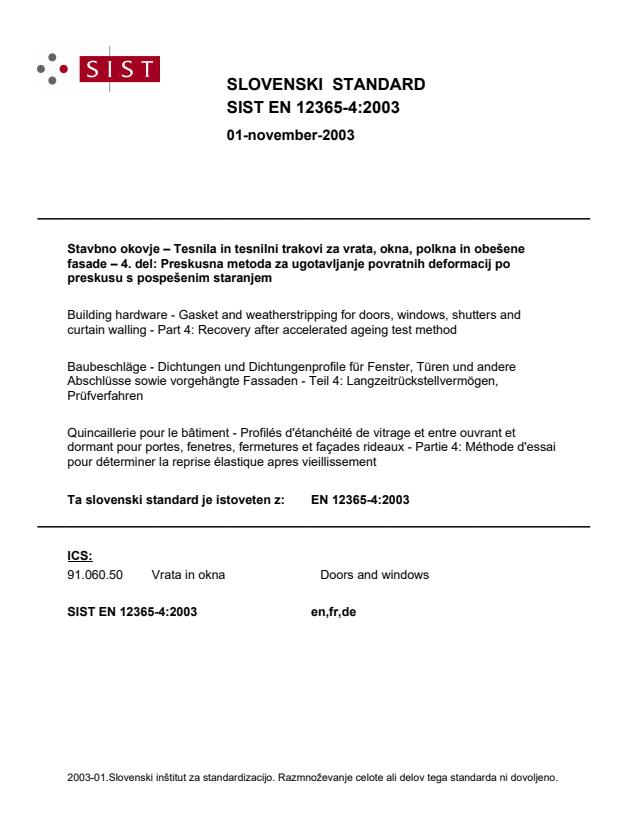
2003-01.Slovenski inštitut za standardizacijo. Razmnoževanje celote ali delov tega standarda ni dovoljeno.Stavbno okovje – Tesnila in tesnilni trakovi za vrata, okna, polkna in obešene fasade – 4. del: Preskusna metoda za ugotavljanje povratnih deformacij po preskusu s pospešenim staranjemBaubeschläge - Dichtungen und Dichtungenprofile für Fenster, Türen und andere Abschlüsse sowie vorgehängte Fassaden - Teil 4: Langzeitrückstellvermögen, PrüfverfahrenQuincaillerie pour le bâtiment - Profilés d'étanchéité de vitrage et entre ouvrant et dormant pour portes, fenetres, fermetures et façades rideaux - Partie 4: Méthode d'essai pour déterminer la reprise élastique apres vieillissementBuilding hardware - Gasket and weatherstripping for doors, windows, shutters and curtain walling - Part 4: Recovery after accelerated ageing test method91.060.50Vrata in oknaDoors and windowsICS:Ta slovenski standard je istoveten z:EN 12365-4:2003SIST EN 12365-4:2003en,fr,de01-november-2003SIST EN 12365-4:2003SLOVENSKI
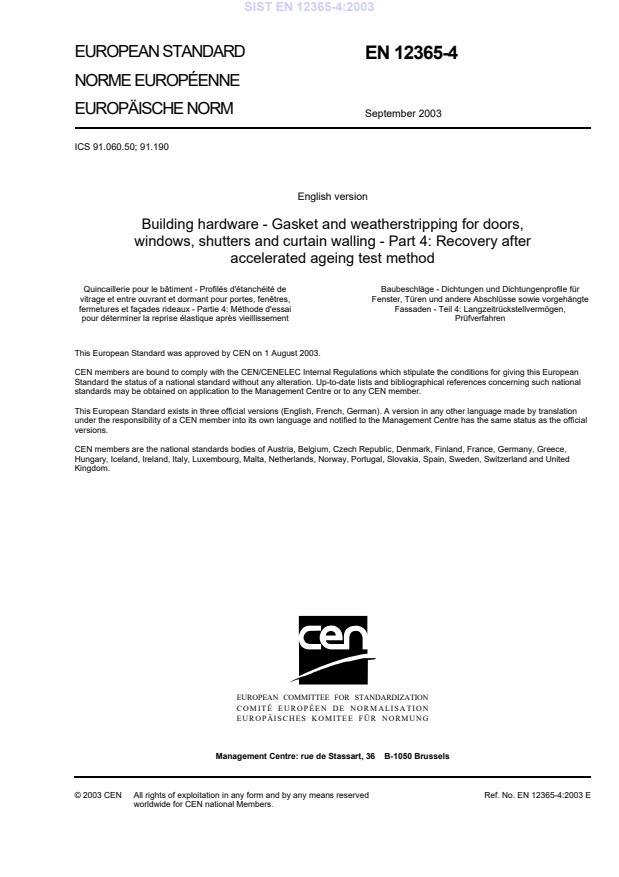
STANDARD
EUROPEAN STANDARDNORME EUROPÉENNEEUROPÄISCHE NORMEN 12365-4September 2003ICS 91.060.50; 91.190English versionBuilding hardware - Gasket and weatherstripping for doors,windows, shutters and curtain walling - Part 4: Recovery afteraccelerated ageing test methodQuincaillerie pour le bâtiment - Profilés d'étanchéité devitrage et entre ouvrant et dormant pour portes, fenêtres,fermetures et façades rideaux - Partie 4: Méthode d'essaipour déterminer la reprise élastique après vieillissementBaubeschläge - Dichtungen und Dichtungenprofile fürFenster, Türen und andere Abschlüsse sowie vorgehängteFassaden - Teil 4: Langzeitrückstellvermögen,PrüfverfahrenThis European Standard was approved by CEN on 1 August 2003.CEN members are bound to comply with the CEN/CENELEC Internal Regulations which stipulate the conditions for giving this EuropeanStandard the status of a national standard without any alteration. Up-to-date lists and bibliographical references concerning such nationalstandards may be obtained on application to the Management Centre or to any CEN member.This European Standard exists in three official versions (English, French, German). A version in any other language made by translationunder the responsibility of a CEN member into its own language and notified to the Management Centre has the same status as the officialversions.CEN members are the national standards bodies of Austria, Belgium, Czech Republic, Denmark, Finland, France, Germany, Greece,Hungary, Iceland, Ireland, Italy, Luxembourg, Malta, Netherlands, Norway, Portugal, Slovakia, Spain, Sweden, Switzerland and UnitedKingdom.EUROPEAN COMMITTEE FOR STANDARDIZATIONCOMITÉ EUROPÉEN DE NORMALISATIONEUROPÄISCHES KOMITEE FÜR NORMUNGManagement Centre: rue de Stassart, 36
B-1050 Brussels© 2003 CENAll rights of exploitation in any form and by any means reservedworldwide for CEN national Members.Ref. No. EN 12365-4:2003 ESIST EN 12365-4:2003
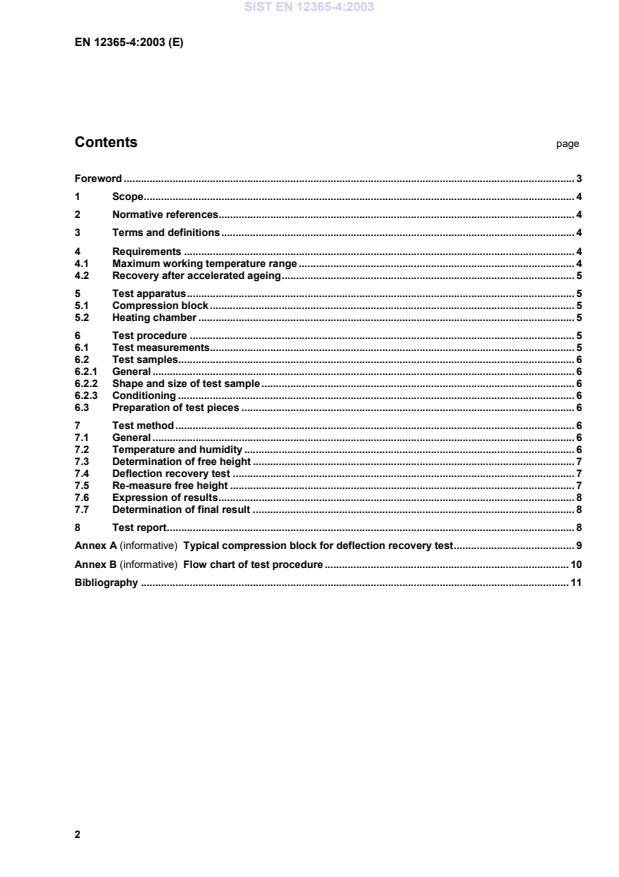
Typical compression block for deflection recovery test.9Annex B (informative)
Flow chart of test procedure.10Bibliography.11SIST EN 12365-4:2003
...