


EN 15502-2-1:2022+A1:2023
(Main)Gas-fired central heating boilers - Part 2-1: Specific standard for type C appliances and type B2, B3 and B5 appliances of a nominal heat input not exceeding 1 000 kW
Gas-fired central heating boilers - Part 2-1: Specific standard for type C appliances and type B2, B3 and B5 appliances of a nominal heat input not exceeding 1 000 kW
This document specifies the requirements and test methods, as well as the classification and marking of gas-fired central heating boilers that are fitted with atmospheric burners, fan assisted atmospheric burners or fully premixed burners, and are hereafter referred to as "boilers".
This document is intended to be used in conjunction with EN 15502-1:2021.
This document covers gas-fired central heating boilers from the types C1 up to C(11) and the types B2, B3 and B5:
NOTE 1 For further background information on appliance types see EN 1749:2020.
a) that have a nominal heat input (on the basis of net calorific value) not exceeding 1 000 kW;
b) that use one or more combustible gases of the three gas families at the pressures stated in EN 437:2021;
c) where the temperature of the heat transfer fluid does not exceed 105 °C during normal operation;
d) where the maximum operating pressure in the water circuit does not exceed 6 bar;
e) which can give rise to condensation under certain circumstances;
f) which are declared in the instructions for installation to be either a "condensing" boiler or a "low temperature boiler" or a "standard boiler"; if no declaration is given the boiler is to be considered a "standard boiler";
g) which are intended to be installed inside a building or in a partially protected place;
h) which are intended to produce also hot water either by the instantaneous or storage principle as a single unit;
i) which are designed for either sealed water systems or for open water systems;
j) which are either modular boilers, or non-modular boilers.
k) which are from the types C(10) that are equipped with a gas-air ratio control and that have a ∆pmax, saf(min) of 25 Pa, and C(11) that have condensing boiler modules that are equipped with a gas-air ratio control and that have a ∆pmax, saf(min) of 25 Pa.
NOTE 2 This document provides requirements for boilers with known constructions. For boilers with any alternative constructions, which might not fully be covered by this standard, the risk associated with this alternative construction needs to be assessed.
An example of an assessment methodology, based upon risk assessment, is given in Clause 11.
This document does not cover all the requirements for:
aa) appliances above 1 000 kW;
ab) appliances that are intended to be connected to gas grids where the quality of the distributed gas is likely to vary to a large extent over the lifetime of the appliance (see Annex AB of EN 15502-1:2021);
ac) appliances using flue dampers;
ad) appliances of the types B21, B31, B51, C21, C41, C51, C61, C71, C81, C(12) and C(13);
ae) C7 appliances that have a nominal heat input (on the basis of net calorific value) exceeding 70 kW;
af) appliances incorporating flexible plastic flue liners;
ag) C(10) boilers:
1) without a gas-air ratio control, or
2) which are non-condensing appliances, or
3) which have a maximum safety pressure difference at minimum heat input not equal to 25 Pa (∆pmax, saf(min));
ah) C(11) boilers that have boiler modules:
1) without a gas-air ratio control, or
2) which are non-condensing appliances, or
3) which have a maximum safety pressure difference at minimum heat input not equal to 25 Pa (∆pmax, saf(min));
ai) appliances intended to be connected to a flue having mechanical extraction;
aj) surface temperatures of external parts particular to children and elderly people;
ak) appliances that are intended to burn natural gases of the second family where hydrogen is added to the natural gas;
al) appliances equipped with an adaptive combustion control function (ACCF);
am) boilers intended to be installed in areas accessible to elderly people and children.
Heizkessel für gasförmige Brennstoffe - Teil 2-1: Heizkessel der Bauart C und Heizkessel der Bauarten B2, B3 und B5 mit einer Nennwärmebelastung nicht größer als 1 000 kW
Dieses Dokument legt Anforderungen und Prüfmethoden sowie die Klassifizierung und Kennzeichnung von gasbefeuerten Heizkesseln fest, die mit atmosphärischen Brennern mit oder ohne Gebläse oder mit Vormischbrenner ausgerüstet sind und nachfolgend kurz "Kessel" genannt werden.
Dieses Dokument ist in Verbindung mit EN 15502-1:2021 zu verwenden.
Dieses Dokument schließt gasbefeuerte Zentralheizungskessel der Bauarten C1 bis C11 und die Bauarten B2, B3 und B5 ein:
ANMERKUNG 1 Zu weiteren Hintergrundinformationen zu Gerätearten siehe EN 1749:2020.
a) die eine Nennwärmebelastung (bezogen auf den Heizwert) von nicht mehr als 1 000 kW haben;
b) die mit einem oder mehreren brennbaren Gasen der drei Gasfamilien mit den in EN 437:2021 genannten Drücken betrieben werden;
c) bei denen die Temperatur der Wärme leitenden Flüssigkeit unter normalen Betriebsbedingungen 105 °C nicht überschreitet;
d) deren maximaler wasserseitiger Betriebsdruck 6 bar nicht überschreitet;
e) bei denen sich unter bestimmten Bedingungen Kondenswasser bilden kann;
f) die in der Installationsanleitung entweder als „Brennwertgeräte“, als „Niedertemperaturkessel“ oder als „Standardkessel“ bezeichnet werden. Wenn keine Angabe gemacht wird, wird der Kessel als „Standardkessel“ betrachtet;
g) die dafür vorgesehen sind, im Gebäude oder an einer teilweise geschützten Stelle aufgestellt zu werden;
h) die dafür vorgesehen sind, nach dem Durchlaufprinzip oder nach dem Speicherprinzip auch Warmwasser als eine Einheit herzustellen;
i) die entweder für geschlossene oder offene Wassersysteme ausgelegt sind;
j) die entweder modulare oder nicht modulare Kessel sind.
k) die von der Art C(10) sind, die mit einem Regel- und Steuergerät für das Gas-Luft-Druckverhältnis ausgestattet sind und ein ∆pmax, saf(min) von 25 Pa haben, sowie C(11) mit Brennwertkesselmodulen, ausgestattet mit einem Regel- und Steuergerät für das Gas-Luft-Druckverhältnis und mit einem ∆pmax, saf(min) von 25 Pa.
ANMERKUNG 2 Dieses Dokument gibt Anforderungen an Kessel mit bekannter Bauweise an. Für Kessel mit alternativer Bauweise, die eventuell nicht vollständig durch diese Norm abgedeckt werden, muss das Risiko, das mit dieser alternativen Bauweise verbunden ist, bewertet werden.
Ein Beispiel für ein Bewertungsverfahren, das auf einer Risikoanalyse beruht, wird in Abschnitt 11 beschrieben.
Dieses Dokument behandelt nicht alle Anforderungen an:
aa) Geräte über 1 000 kW;
ab) Geräte, die dafür ausgelegt sind, an ein Gasnetz angeschlossen zu werden, in dem die Qualität des verteilten Gases über die Lebensdauer des Gerätes wahrscheinlich stark schwankt (siehe Anhang AB von EN 15502-1:2021);
ac) Geräte, die Abgasklappen nutzen;
ad) Geräte der Arten B21, B31, B51, C21, C41, C51, C61, C71, C81, C(12) und C(13);
ae) C7-Geräte, die eine Nennwärmebelastung (auf Basis des Heizwertes) von 70 kW überschreiten;
af) Geräte, die flexible Kunststoffabzüge beinhalten;
ag) C(10)-Kessel:...
Chaudières de chauffage central utilisant les combustibles gazeux - Partie 2-1 : Norme spécifique pour les appareils de type C et les appareils de types B2, B3 et B5 dont le débit calorifique nominal est inférieur ou égal à 1 000 kW
Le présent document spécifie les exigences et les méthodes d'essai, ainsi que la classification et le marquage des chaudières de chauffage central utilisant les combustibles gazeux et étant équipées de brûleurs atmosphériques, de brûleurs atmosphériques avec ventilateur ou de brûleurs à pré-mélange total, ci-après dénommées « chaudières ».
Le présent document est à utiliser conjointement avec l'EN 15502-1:2021.
Le présent document s'applique à certaines chaudières de types C1 à C(11), et des types B2, B3 et B5 :
NOTE 1 Pour plus d'informations sur les types d'appareils, voir l'EN 1749:2020.
a) de débit calorifique nominal (sur la base du pouvoir calorifique inférieur) inférieur à 1 000 kW ;
b) utilisant un ou plusieurs combustibles gazeux appartenant aux trois familles de gaz et aux pressions indiquées dans l'EN 437:2021 ;
c) dont la température du fluide caloporteur ne dépasse pas 105 °C en fonctionnement normal ;
d) dont la pression maximale de fonctionnement dans le circuit d'eau ne dépasse pas 6 bar ;
e) pouvant condenser dans certaines circonstances ;
f) déclarées dans la notice d'installation comme étant « chaudière à condensation » ou « chaudière à basse température » ou « chaudière standard » par le fabricant ; en l'absence d'information la chaudière est considérée comme « chaudière standard » ;
g) destinées à être installées dans un bâtiment ou à un emplacement partiellement protégé ;
h) destinées à produire aussi instantanément de l'eau chaude ou capables de la stocker, sous forme de monobloc ;
i) conçues pour un système avec circuit d'eau fermé ou ouvert ;
j) modulaires ou non ;
k) de type C(10) équipées d'un dispositif de contrôle du rapport air/gaz de ∆pmax, saf(min) de 25 Pa, et de type C(11) constituées de modules de chaudière à condensation équipées d'un dispositif de contrôle du ratio air/gaz de ∆pmax, saf(min) de 25 Pa.
NOTE 2 Le présent document fournit les exigences relatives aux chaudières dont la construction est connue. Pour les chaudières de construction différentes, susceptibles de ne pas être couvertes par la présente norme, le risque associé à cette construction différente doit être évalué.
L'Article 11 donne un exemple de méthodologie d'évaluation basée sur l'évaluation des risques.
Le présent document ne couvre pas toutes les exigences relatives :
aa) aux appareils d'une puissance supérieure à 1 000 kW ;
ab) aux appareils destinés à être raccordés au réseau de gaz lorsque la qualité du gaz distribué peut varier de façon importante pendant la durée de vie de l'appareil (voir l'Annexe AB de l'EN 15502 1:2021) ;
ac) aux appareils munis de registres ;
ad) aux appareils des types B21, B31, B51, C21, C41, C51, C61, C71, C81, C(12) et C(13) ;
ae) aux appareils de type C7 de débit calorifique nominal (basé sur le pouvoir calorifique inférieur) supérieur à 70 kW ;
af) aux appareils utilisant un conduit flexible en plastique pour l'évacuation des produits de combustion ;
ag) aux chaudières de type C(10) :
1) non équipées de dispositif de régulation du rapport air/gaz ; ou
2) qui ne sont pas des chaudières à condensation ; ou
3) qui ont une différence de pression maximale de sécurité au débit calorifique minimal inférieure à 25 Pa (∆pmax, saf(min)) ;
ah) aux chaudières de type C(11), avec des modules de chaudière :
1) non équipées de dispositif de régulation du rapport air/gaz ; ou
2) qui ne sont pas des chaudières à condensation ; ou
3) qui ont une différence de pression maximale de sécurité au débit calorifique minimal inférieure à 25 Pa (∆pmax, saf(min)) ;
ai) aux appareils destinés à être raccordés à un conduit d'évacuation des produits de combustion muni d'un dispositif d'extraction ;
aj) aux températures de surface des surfaces extérieures, en particulier pour les enfants et les personnes âgées ;
...
Plinski kotli za centralno ogrevanje - 2-1. del: Poseben standard za tip kotlov C in tipe kotlov B2, B3 in B5 z nazivno močjo do vključno 1000 kW
Ta dokument določa zahteve in preskusne metode ter klasifikacijo in označevanje plinskih kotlov za centralno ogrevanje z nameščenimi atmosferskimi gorilniki, atmosferskimi gorilniki z ventilatorjem ali gorilniki s popolnim vnaprejšnjim mešanjem (v nadaljevanju: »kotli«).
Ta dokument je treba uporabljati v povezavi s standardom EN 15502-1:2021.
Ta dokument zajema plinske kotle za centralno ogrevanje tipov od C1 do C(11) ter tipov B2, B3 in B5:
OPOMBA 1: Za dodatne informacije o tipih kotlov glej standard EN 1749:2020.
a) z nazivno močjo (glede na neto kurilno vrednost) do vključno 1000 kW;
b) ki uporabljajo enega ali več gorljivih plinov iz treh družin plinov pri tlakih, navedenih v standardu EN 437:2021;
c) pri katerih temperatura tekočine za prenos toplote pri običajnem obratovanju ne presega 105 °C;
d) pri katerih najvišji obratovalni tlak v vodnem omrežju ne presega 6 barov;
d) ki lahko pod določenimi pogoji povzročijo kondenzacijo;
f) ki so v navodilih za namestitev navedeni kot »kondenzacijski kotli« ali »nizkotemperaturni kotli« ali »standardni kotli«; če ni navedene deklaracije, se kotel šteje kot »standardni kotel«;
g) ki so namenjeni vgradnji v zgradbi ali delno zaščitenem prostoru;
h) ki so namenjeni ogrevanju vode po načelu pretočnosti ali načelu shranjevanja;
i) ki so izdelani za zaprte ali odprte vodne sisteme;
j) ki so lahko modularni ali nemodularni kotli;
k) ki so kotli tipa C(10), opremljeni z nadzorom razmerja med plinom/zrakom, pri katerih je Δpmax, saf(min) 25 Pa, ter kotli tipa C(11) z moduli kondenzacijskih kotlov, opremljeni z nadzorom razmerja med plinom/zrakom, pri katerih je Δpmax, saf(min) 25 Pa.
OPOMBA 2: Ta dokument določa zahteve za kotle z znanimi konstrukcijami. V zvezi s kotli z drugačnimi konstrukcijami, ki morda niso v celoti zajeti v tem standardu, je treba oceniti tveganje, povezano z drugačno konstrukcijo.
Primer metodologije ocenjevanja, ki temelji na oceni tveganja, je naveden v točki 11.
Ta dokument ne obravnava vseh zahtev za:
aa) naprave z močjo, večjo od 1000 kW;
ab) naprave, namenjene za povezavo s plinskimi omrežji, v katerih bo kakovost distribuiranega plina med življenjsko dobo naprave verjetno znatno nihala (glej dodatek AB standarda EN 15502-1:2021);
ac) naprave, ki uporabljajo dimniške lopute;
ad) naprave tipov B21, B31, B51, C21, C41, C51, C61, C71, C81, C(12) in C(13);
ae) naprave tipa C7 z nazivno grelno močjo (glede na neto kurilno vrednost) več kot 70 kW;
af) naprave z gibljivimi plastičnimi izpušnimi tuljavami;
ag) kotle tipa C(10):
1) brez nadzora razmerja med plinom/zrakom; ali
2) ki so nekondenzacijske naprave; ali
3) pri katerih največja razlika v varnostnem tlaku pri najmanjši vhodni toplotni moči ni enaka 25 Pa (∆pmax, saf(min));
ah) kotle tipa C(11) z moduli kotlov:
1) brez nadzora razmerja med plinom/zrakom; ali
2) ki so nekondenzacijske naprave; ali
3) pri katerih največja razlika v varnostnem tlaku pri najmanjši vhodni toplotni moči ni enaka 25 Pa (∆pmax, saf(min));
ai) naprave, namenjene za povezavo z dimnikom, ki ima mehansko ekstrakcijo;
aj) površinske temperature zunanjih delov, dostopnih otrokom in starejšim osebam;
ak) naprave, ki za delovanje uporabljajo zemeljske pline druge družine, pri čemer je zemeljskemu plinu dodan vodik;
al) naprave, opremljene s funkcijo prilagodljivega nadzora zgorevanja (ACCF);
am) kotle, namenjene vgradnji v območjih, dostopnih starejšim osebam in otrokom.
General Information
Relations
Overview
EN 15502-2-1:2022+A1:2023 specifies safety, performance and testing requirements for gas-fired central heating boilers of types C and B2, B3, B5 with a nominal heat input up to 1 000 kW. Used together with EN 15502-1:2021, it covers construction, classification, marking and test methods for boilers fitted with atmospheric, fan-assisted atmospheric or fully premixed burners. The standard applies to boilers using gases in the three gas families at pressures in EN 437:2021 and addresses condensing, low-temperature and standard boilers designed for indoor or partially protected installation.
Key topics and technical requirements
- Scope limits: nominal heat input ≤ 1 000 kW; heat transfer fluid temperature ≤ 105 °C; maximum water circuit pressure ≤ 6 bar.
- Appliance types covered: type C1 to C(11) and types B2, B3, B5; specific provisions for C(10) and C(11) modules with gas‑air ratio control and ∆pmax,saf(min) = 25 Pa.
- Construction and materials: design, materials, connections, soundness of gas/combustion/water circuits, and modular vs non‑modular boilers.
- Combustion and flue systems: requirements for supply of combustion air, evacuation of combustion products, flue terminals, ducts and mechanical strength, plus rules for condensate formation and temperature of combustion products.
- Controls and safety devices: ignition, flame supervision, gas pressure regulation, pre‑purge, air proving, control and safety device limits, and resistance to auxiliary energy failure.
- Operational tests & emissions: heat input/output testing, carbon monoxide and NOx considerations, soot/sooting checks and special tests for condensing/low‑temperature boilers.
- Special provisions & exclusions: clause for risk assessment of alternative constructions (Clause 11). The standard excludes appliances > 1 000 kW, certain appliance types (e.g., C12/C13, B21 family), flue dampers, ACCF-equipped boilers, and appliances for variable-quality gas grids.
Practical applications - who uses this standard
- Boiler manufacturers: design verification, compliance, product marking and type testing for CE / regulatory conformity.
- Test laboratories and certification bodies: test methods, measurement procedures and pass/fail criteria.
- Installers, system designers and HVAC engineers: installation limits, flue and combustion air guidance, and compatibility with system pressures and temperatures.
- Regulators and compliance officers: normative references and harmonized requirements for market surveillance and safety assessments.
- Risk assessors: methodology for alternative constructions and modular systems.
Related standards
- EN 15502-1:2021 (general requirements - to be used in conjunction)
- EN 437:2021 (reference gases and pressures)
- EN 1749:2020 (background on appliance types)
Keywords: EN 15502-2-1:2022+A1:2023, gas-fired central heating boilers, condensing boilers, type C boilers, boiler safety, boiler test methods, EN 15502.
Frequently Asked Questions
EN 15502-2-1:2022+A1:2023 is a standard published by the European Committee for Standardization (CEN). Its full title is "Gas-fired central heating boilers - Part 2-1: Specific standard for type C appliances and type B2, B3 and B5 appliances of a nominal heat input not exceeding 1 000 kW". This standard covers: This document specifies the requirements and test methods, as well as the classification and marking of gas-fired central heating boilers that are fitted with atmospheric burners, fan assisted atmospheric burners or fully premixed burners, and are hereafter referred to as "boilers". This document is intended to be used in conjunction with EN 15502-1:2021. This document covers gas-fired central heating boilers from the types C1 up to C(11) and the types B2, B3 and B5: NOTE 1 For further background information on appliance types see EN 1749:2020. a) that have a nominal heat input (on the basis of net calorific value) not exceeding 1 000 kW; b) that use one or more combustible gases of the three gas families at the pressures stated in EN 437:2021; c) where the temperature of the heat transfer fluid does not exceed 105 °C during normal operation; d) where the maximum operating pressure in the water circuit does not exceed 6 bar; e) which can give rise to condensation under certain circumstances; f) which are declared in the instructions for installation to be either a "condensing" boiler or a "low temperature boiler" or a "standard boiler"; if no declaration is given the boiler is to be considered a "standard boiler"; g) which are intended to be installed inside a building or in a partially protected place; h) which are intended to produce also hot water either by the instantaneous or storage principle as a single unit; i) which are designed for either sealed water systems or for open water systems; j) which are either modular boilers, or non-modular boilers. k) which are from the types C(10) that are equipped with a gas-air ratio control and that have a ∆pmax, saf(min) of 25 Pa, and C(11) that have condensing boiler modules that are equipped with a gas-air ratio control and that have a ∆pmax, saf(min) of 25 Pa. NOTE 2 This document provides requirements for boilers with known constructions. For boilers with any alternative constructions, which might not fully be covered by this standard, the risk associated with this alternative construction needs to be assessed. An example of an assessment methodology, based upon risk assessment, is given in Clause 11. This document does not cover all the requirements for: aa) appliances above 1 000 kW; ab) appliances that are intended to be connected to gas grids where the quality of the distributed gas is likely to vary to a large extent over the lifetime of the appliance (see Annex AB of EN 15502-1:2021); ac) appliances using flue dampers; ad) appliances of the types B21, B31, B51, C21, C41, C51, C61, C71, C81, C(12) and C(13); ae) C7 appliances that have a nominal heat input (on the basis of net calorific value) exceeding 70 kW; af) appliances incorporating flexible plastic flue liners; ag) C(10) boilers: 1) without a gas-air ratio control, or 2) which are non-condensing appliances, or 3) which have a maximum safety pressure difference at minimum heat input not equal to 25 Pa (∆pmax, saf(min)); ah) C(11) boilers that have boiler modules: 1) without a gas-air ratio control, or 2) which are non-condensing appliances, or 3) which have a maximum safety pressure difference at minimum heat input not equal to 25 Pa (∆pmax, saf(min)); ai) appliances intended to be connected to a flue having mechanical extraction; aj) surface temperatures of external parts particular to children and elderly people; ak) appliances that are intended to burn natural gases of the second family where hydrogen is added to the natural gas; al) appliances equipped with an adaptive combustion control function (ACCF); am) boilers intended to be installed in areas accessible to elderly people and children.
This document specifies the requirements and test methods, as well as the classification and marking of gas-fired central heating boilers that are fitted with atmospheric burners, fan assisted atmospheric burners or fully premixed burners, and are hereafter referred to as "boilers". This document is intended to be used in conjunction with EN 15502-1:2021. This document covers gas-fired central heating boilers from the types C1 up to C(11) and the types B2, B3 and B5: NOTE 1 For further background information on appliance types see EN 1749:2020. a) that have a nominal heat input (on the basis of net calorific value) not exceeding 1 000 kW; b) that use one or more combustible gases of the three gas families at the pressures stated in EN 437:2021; c) where the temperature of the heat transfer fluid does not exceed 105 °C during normal operation; d) where the maximum operating pressure in the water circuit does not exceed 6 bar; e) which can give rise to condensation under certain circumstances; f) which are declared in the instructions for installation to be either a "condensing" boiler or a "low temperature boiler" or a "standard boiler"; if no declaration is given the boiler is to be considered a "standard boiler"; g) which are intended to be installed inside a building or in a partially protected place; h) which are intended to produce also hot water either by the instantaneous or storage principle as a single unit; i) which are designed for either sealed water systems or for open water systems; j) which are either modular boilers, or non-modular boilers. k) which are from the types C(10) that are equipped with a gas-air ratio control and that have a ∆pmax, saf(min) of 25 Pa, and C(11) that have condensing boiler modules that are equipped with a gas-air ratio control and that have a ∆pmax, saf(min) of 25 Pa. NOTE 2 This document provides requirements for boilers with known constructions. For boilers with any alternative constructions, which might not fully be covered by this standard, the risk associated with this alternative construction needs to be assessed. An example of an assessment methodology, based upon risk assessment, is given in Clause 11. This document does not cover all the requirements for: aa) appliances above 1 000 kW; ab) appliances that are intended to be connected to gas grids where the quality of the distributed gas is likely to vary to a large extent over the lifetime of the appliance (see Annex AB of EN 15502-1:2021); ac) appliances using flue dampers; ad) appliances of the types B21, B31, B51, C21, C41, C51, C61, C71, C81, C(12) and C(13); ae) C7 appliances that have a nominal heat input (on the basis of net calorific value) exceeding 70 kW; af) appliances incorporating flexible plastic flue liners; ag) C(10) boilers: 1) without a gas-air ratio control, or 2) which are non-condensing appliances, or 3) which have a maximum safety pressure difference at minimum heat input not equal to 25 Pa (∆pmax, saf(min)); ah) C(11) boilers that have boiler modules: 1) without a gas-air ratio control, or 2) which are non-condensing appliances, or 3) which have a maximum safety pressure difference at minimum heat input not equal to 25 Pa (∆pmax, saf(min)); ai) appliances intended to be connected to a flue having mechanical extraction; aj) surface temperatures of external parts particular to children and elderly people; ak) appliances that are intended to burn natural gases of the second family where hydrogen is added to the natural gas; al) appliances equipped with an adaptive combustion control function (ACCF); am) boilers intended to be installed in areas accessible to elderly people and children.
EN 15502-2-1:2022+A1:2023 is classified under the following ICS (International Classification for Standards) categories: 27.060.30 - Boilers and heat exchangers; 91.140.10 - Central heating systems. The ICS classification helps identify the subject area and facilitates finding related standards.
EN 15502-2-1:2022+A1:2023 has the following relationships with other standards: It is inter standard links to EN 15502-2-1:2022, EN 15502-2-1:2022+A1:2023/AC:2024. Understanding these relationships helps ensure you are using the most current and applicable version of the standard.
EN 15502-2-1:2022+A1:2023 is associated with the following European legislation: EU Directives/Regulations: 2016/426, 811/2013, 813/2013, 92/42/EEC; Standardization Mandates: M/066, M/535, M/595. When a standard is cited in the Official Journal of the European Union, products manufactured in conformity with it benefit from a presumption of conformity with the essential requirements of the corresponding EU directive or regulation.
You can purchase EN 15502-2-1:2022+A1:2023 directly from iTeh Standards. The document is available in PDF format and is delivered instantly after payment. Add the standard to your cart and complete the secure checkout process. iTeh Standards is an authorized distributor of CEN standards.
Standards Content (Sample)
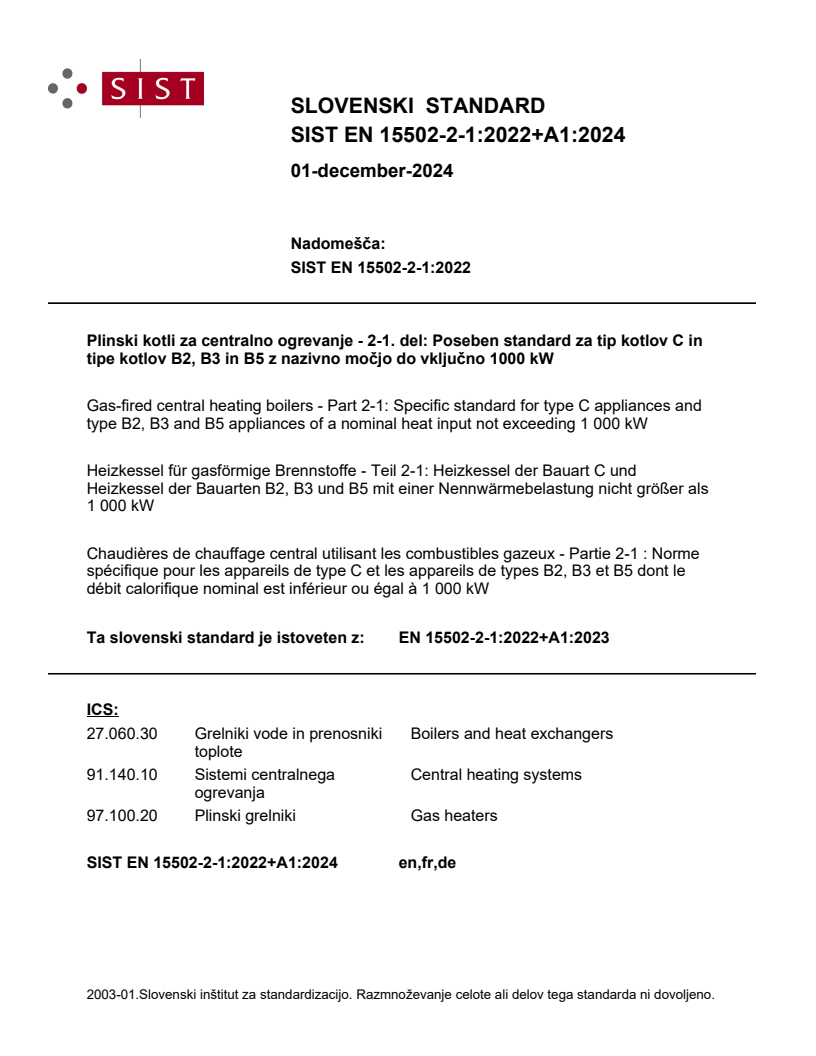
SLOVENSKI STANDARD
01-december-2024
Nadomešča:
SIST EN 15502-2-1:2022
Plinski kotli za centralno ogrevanje - 2-1. del: Poseben standard za tip kotlov C in
tipe kotlov B2, B3 in B5 z nazivno močjo do vključno 1000 kW
Gas-fired central heating boilers - Part 2-1: Specific standard for type C appliances and
type B2, B3 and B5 appliances of a nominal heat input not exceeding 1 000 kW
Heizkessel für gasförmige Brennstoffe - Teil 2-1: Heizkessel der Bauart C und
Heizkessel der Bauarten B2, B3 und B5 mit einer Nennwärmebelastung nicht größer als
1 000 kW
Chaudières de chauffage central utilisant les combustibles gazeux - Partie 2-1 : Norme
spécifique pour les appareils de type C et les appareils de types B2, B3 et B5 dont le
débit calorifique nominal est inférieur ou égal à 1 000 kW
Ta slovenski standard je istoveten z: EN 15502-2-1:2022+A1:2023
ICS:
27.060.30 Grelniki vode in prenosniki Boilers and heat exchangers
toplote
91.140.10 Sistemi centralnega Central heating systems
ogrevanja
97.100.20 Plinski grelniki Gas heaters
2003-01.Slovenski inštitut za standardizacijo. Razmnoževanje celote ali delov tega standarda ni dovoljeno.
EN 15502-2-1:2022+A1
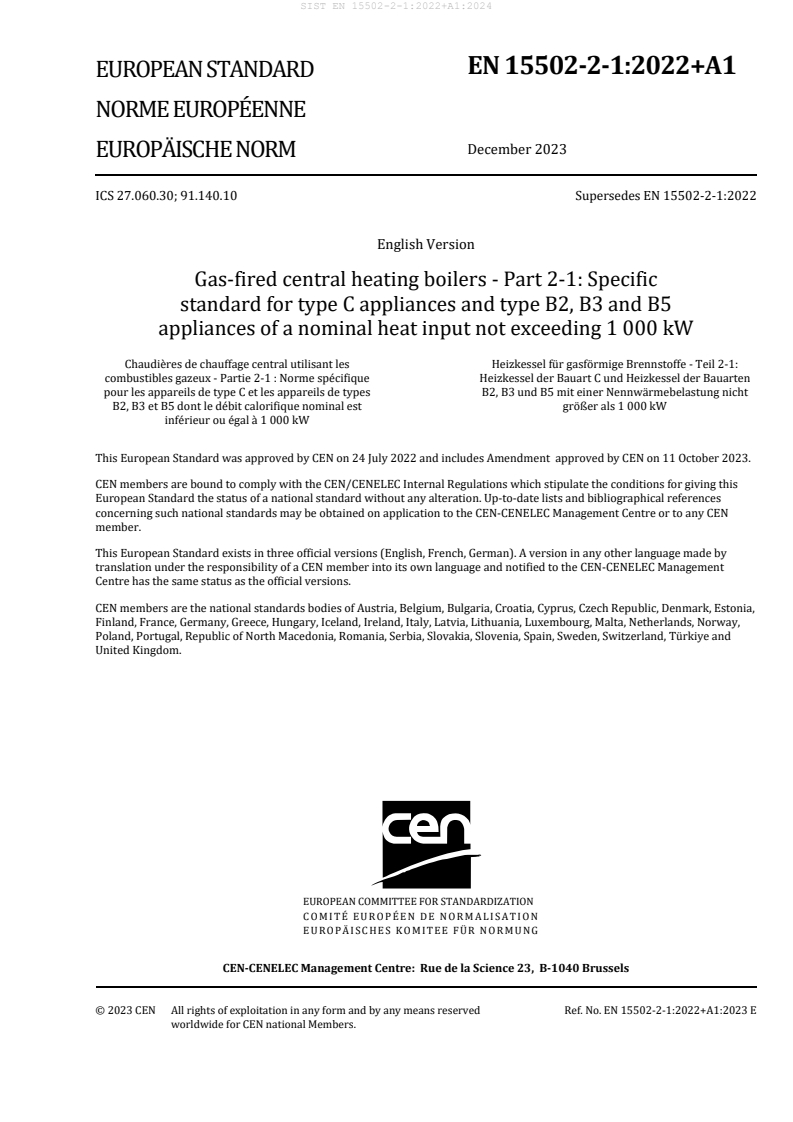
EUROPEAN STANDARD
NORME EUROPÉENNE
December 2023
EUROPÄISCHE NORM
ICS 27.060.30; 91.140.10 Supersedes EN 15502-2-1:2022
English Version
Gas-fired central heating boilers - Part 2-1: Specific
standard for type C appliances and type B2, B3 and B5
appliances of a nominal heat input not exceeding 1 000 kW
Chaudières de chauffage central utilisant les Heizkessel für gasförmige Brennstoffe - Teil 2-1:
combustibles gazeux - Partie 2-1 : Norme spécifique Heizkessel der Bauart C und Heizkessel der Bauarten
pour les appareils de type C et les appareils de types B2, B3 und B5 mit einer Nennwärmebelastung nicht
B2, B3 et B5 dont le débit calorifique nominal est größer als 1 000 kW
inférieur ou égal à 1 000 kW
This European Standard was approved by CEN on 24 July 2022 and includes Amendment approved by CEN on 11 October 2023.
CEN members are bound to comply with the CEN/CENELEC Internal Regulations which stipulate the conditions for giving this
European Standard the status of a national standard without any alteration. Up-to-date lists and bibliographical references
concerning such national standards may be obtained on application to the CEN-CENELEC Management Centre or to any CEN
member.
This European Standard exists in three official versions (English, French, German). A version in any other language made by
translation under the responsibility of a CEN member into its own language and notified to the CEN-CENELEC Management
Centre has the same status as the official versions.
CEN members are the national standards bodies of Austria, Belgium, Bulgaria, Croatia, Cyprus, Czech Republic, Denmark, Estonia,
Finland, France, Germany, Greece, Hungary, Iceland, Ireland, Italy, Latvia, Lithuania, Luxembourg, Malta, Netherlands, Norway,
Poland, Portugal, Republic of North Macedonia, Romania, Serbia, Slovakia, Slovenia, Spain, Sweden, Switzerland, Türkiye and
United Kingdom.
EUROPEAN COMMITTEE FOR STANDARDIZATION
COMITÉ EUROPÉEN DE NORMALISATION
EUROPÄISCHES KOMITEE FÜR NORMUNG
CEN-CENELEC Management Centre: Rue de la Science 23, B-1040 Brussels
© 2023 CEN All rights of exploitation in any form and by any means reserved Ref. No. EN 15502-2-1:2022+A1:2023 E
worldwide for CEN national Members.
Contents Page
European foreword . 6
Introduction . 8
1 Scope . 9
2 Normative references .10
3 Terms, definitions and symbols .12
3.1 Terms and definitions .12
3.2 Symbols .13
4 Classification .13
5 Construction .13
5.1 General .13
5.2 Conversion to different gases .13
5.3 Materials .13
5.4 Method of construction .13
5.4.1 Design .13
5.4.2 Checking the state of operation .13
5.4.3 Use and servicing .13
5.4.4 Connections to the gas and water pipes .13
5.4.5 Soundness .13
5.4.6 Supply of combustion air and evacuation of the combustion products .13
5.4.7 Dampers .14
5.4.8 Air proving .14
5.4.9 Gas/air ratio controls .14
5.4.10 Fan .15
5.4.11 Drainage .15
5.4.12 Operational safety in the event of failure of the auxiliary energy .15
5.4.13 Special provision for low temperature boilers and condensing boilers .15
5.5 Burners .15
5.6 Pressure test points.15
5.7 Requirements for the application of control and safety devices .15
5.8 Additional requirements for modular boilers .15
5.8.101 Additional requirements for non-return valves in type C boilers and C
(10) (11)
boiler modules .15
6 Electrical safety .15
7 Controls .15
8 Operational requirements .15
8.1 General .15
8.1.1 Characteristics of the reference and limit gases .16
8.1.2 General test conditions .16
8.2 Soundness .19
8.2.1 Soundness of the gas circuit .19
8.2.2 Soundness of the combustion circuit . 19
8.2.3 Soundness of the water circuit . 23
8.2.4 Soundness of the domestic water circuit . 23
8.3 Hydraulic resistance . 23
8.4 Heat inputs and heat outputs . 23
8.4.101 Additional operational requirements for type C and C boiler modules . 24
(10) (11)
8.5 Limiting temperatures . 24
8.5.1 General . 24
8.5.2 Limiting temperatures of the adjusting, control and safety devices . 24
8.5.3 Limiting temperatures of the side walls, the front and the top . 25
8.5.4 Limiting temperature of the test panels and the floor . 25
8.5.101 External temperature of the ducts where the ducts are in contact with and or
passing through a wall . 25
8.6 Ignition, cross lighting, flame stability . 25
8.6.1 General . 25
8.6.2 Limit conditions . 25
8.6.3 Special flue conditions . 26
8.6.4 Reduction of the gas rate of the ignition burner . 28
8.6.101 Resistance to draught for type B boilers . 29
8.7 Reduction of the gas pressure . 29
8.8 Defective closure of the gas valve immediately upstream of the main burner . 29
8.9 Pre-purge . 29
8.9.101 General . 29
8.9.102 Tests and test conditions for pre-purging . 31
8.9.103 Requirements for verification of the protected nature of a combustion chamber
8.9.104 Test conditions for verification of the protected nature of a combustion
chamber . 31
8.9.105 Requirements for verification of normal ignition in a combustible air/gas
mixture for type C boilers incorporating a fan . 31
8.9.106 Test conditions for verification of normal ignition in a combustible air/gas
mixture for type C boilers incorporating a fan . 32
8.10 Functioning of a permanent ignition burner when the fan stops during the standby
time . 32
8.11 Adjustment, control and safety devices . 32
8.11.1 General . 32
8.11.2 Boilers intended to be installed in a partially protected place . 32
8.11.3 Combination boilers . 32
8.11.4 Control devices . 32
8.11.5 Ignition devices . 32
8.11.6 Flame supervision device . 32
8.11.7 Gas pressure regulator . 33
8.11.8 Thermostats and water temperature limiting devices . 33
8.11.101 Air proving . 33
8.12 Carbon monoxide . 36
8.12.1 General . 36
8.12.2 Limit conditions . 36
8.12.3 Special conditions . 37
8.12.4 Sooting . 40
8.12.5 Supplementary test for low temperature boilers and condensing boilers . 40
8.13 NO . 40
x
8.14 Special provisions for boilers intended to be installed in a partially protected place
................................................................................................................................................................... 40
8.15 Formation of condensate .40
8.16 Temperature of combustion products .40
8.16.101 General .40
8.16.102 Designation and measurement of reference temperatures of flue systems .41
8.17 Sound power level .41
8.101 Mechanical resistance and stability of ducts, terminal and fitting pieces .41
8.101.1 General requirement .41
8.101.2 Compressive strength .41
8.101.3 Lateral strength .42
8.101.4 Flexible metallic liners .43
8.102 Requirements for plastic in the combustion product evacuation ducts, terminals and
fitting pieces of boilers .43
8.102.1 Thermal resistance .43
8.102.2 Materials .43
8.103 Requirements for elastomeric seals and elastomeric sealants in the combustion
product evacuation ducts, terminals and fitting pieces .49
8.103.1 Characterization .49
8.103.2 Long-term resistance to thermal load .50
8.103.3 Long-term resistance to condensate exposure .51
8.103.4 Cyclic condensate resistance test .52
8.103.5 Relaxation behaviour .52
8.103.6 Compression set .53
8.103.7 Low temperature resistance .53
8.103.8 Joints in elastomeric seals .53
8.104 Additional requirements for non-return valve for type C boilers and C boiler
(10) (11)
modules .53
8.104.1 General .53
8.104.2 Nominal working temperature at the position of the non-return valve .54
8.104.3 Leak tightness of the non-return valve .54
8.104.4 Functional durability of the non-return valve .54
8.104.5 Safety of boilers in case of a failing non-return valve .55
8.105 Additional requirements for the evaluation of the maximum heat input of the
common duct system of type C boilers.56
(11)
8.105.1 Requirements of common duct system without wind conditions .56
8.105.2 Additional requirements of common duct system due to wind influence .57
9 Useful efficiencies .58
10 Electric auxiliary energy .58
11 Risk assessment .58
12 Marking and instructions .58
12.1 Boiler marking .58
12.2 Instructions .58
12.2.1 Instructions for installation .58
12.2.2 Instructions for use and servicing .64
12.3 Presentation .64
Annex A A (normative) Test apparatus for type C boilers .78
Annex X B (normative) Test methods to determine the effects of long-term thermal load,
long-term condensate exposure, condensing/non-condensing cycling and resistance
to UV radiation .79
Annex Y C (informative) This annex is empty on purpose .80
Annex Z D (informative) Example on calculation of common duct system for type C
(11)
boilers . 81
Annex ZA (informative) Left empty on purpose . 83
Annex ZB (informative) Clauses of this European Standard addressing the methods for the
verification of the efficiency of the EU Directive 92/42/EEC, relating to the efficiency
of new hot boilers with an output of (4 – 400) kW . 84
Annex ZC (informative) Relationship between this European Standard and the ecodesign
requirements of Commission Regulation (EU) No 813/2013 L 239/136 aimed to be
covered . 85
Annex ZD (informative) Relationship between this European Standard and the energy
labelling requirements of Commission Delegated Regulation (EU) No
811/2013 L 239/1 aimed to be covered . 88
Annex ZE (informative) Relationship between this European Standard and the essential
requirements of Regulation (EU) 2016/426 of the European Parliament and of the
Council of 9 March 2016 on appliances burning gaseous fuels and repealing
Directive 2009/142/EC aimed to be covered . 91
Bibliography . 105
European foreword
This document (EN 15502-2-1:2022+A1:2023) has been prepared by Technical Committee CEN/TC 109
“Central heating boilers using gaseous fuels”, the secretariat of which is held by NEN.
This European Standard shall be given the status of a national standard, either by publication of an
identical text or by endorsement, at the latest by June 2024, and conflicting national standards shall be
withdrawn at the latest by June 2024.
Attention is drawn to the possibility that some of the elements of this document may be the subject of
patent rights. CEN shall not be held responsible for identifying any or all such patent rights.
This document supersedes !EN 15502-2-1:2022".
This document includes Amendment 1, approved by CEN on 2023-10-11.
The start and finish of text introduced or altered by amendment is indicated in the text by tags !"
!deleted paragraphs"
EN 15502 consists of the following parts under the general title “Gas-fired heating boilers”:
— Part 1: General requirements and tests;
— Part 2-1: Specific standard for type C appliances and type B2, B3 and B5 appliances of a nominal heat
input not exceeding 1 000 kW (this document);
—
Part 2-2: Specific standard for type B1 appliances.
Relationship between this document and EN 15502-1, Gas-fired heating boilers — Part 1: General
requirements and tests:
This document is to be used in conjunction with EN 15502-1:2021 and follows the numbering structure
of EN 15502-1:2021.
Where this European Standard states:
— shall be according to EN 15502-1:2021, (clause number) with the following modification;
— shall be according to EN 15502-1:2021, (clause number) with the following addition;
— EN 15502-1:2021, (clause number) is replaced by the following;
— EN 15502-1:2021, (clause number) is not applicable;
the relevant text of EN 15502-1:2021 is to be adapted accordingly.
This document adds clauses or subclauses to the structure of EN 15502-1:2021 which are particular to
this Part 2 standard. It should be noted that these clauses and subclauses are not indicated as an addition.
Clauses, subclauses and annexes which are additional to those in EN 15502-1:2021 are numbered
starting from 101, or designated as Annex XA, XB, XC, etc.
This document has been prepared under mandates M89/6 and M066, given to CEN by the European
Commission and the European Free Trade Association, and supports essential requirements as meant in
article 3 of EU Directive 2009/142/EC, relating to appliances burning gaseous fuels and the verification
methods valid for production and measurements, as meant in article 5.2 of EU Directive 92/42/EEC,
relating to the efficiency requirements for new hot water boilers fired with liquid or gaseous fuels, with
an output of 4 – 400 kW.
This document has been prepared under the mandates M/534 and M/535, given to CEN by the European
Commission and the European Free Trade Association to provide a means of conforming to:
— requirements of Commission Regulation (EC) No 813/2013 of 2 August 2013 implementing Directive
2009/125/EC of the European Parliament and of the Council with regard to ecodesign requirements
for space heaters and combination heaters;
— requirements of Commission Delegated Regulation (EC) No 811/2013 of 18 February 2013
supplementing Directive 2010/30/EC of the European Parliament and of the Council with regard to
energy labelling of space heaters, combination heaters, packages of space heater, temperature
control and solar device and packages of combination heater, temperature control and solar device.
For relationship with EU Directive(s) / Regulation(s), see informative Annexes ZB, ZC, ZD and ZE which
are integral parts of this document.
Any feedback and questions on this document should be directed to the users’ national standards body.
A complete listing of these bodies can be found on the CEN website.
According to the CEN-CENELEC Internal Regulations, the national standards organisations of the
following countries are bound to implement this European Standard: Austria, Belgium, Bulgaria, Croatia,
Cyprus, Czech Republic, Denmark, Estonia, Finland, France, Germany, Greece, Hungary, Iceland, Ireland,
Italy, Latvia, Lithuania, Luxembourg, Malta, Netherlands, Norway, Poland, Portugal, Republic of North
Macedonia, Romania, Serbia, Slovakia, Slovenia, Spain, Sweden, Switzerland, Türkiye and the United
Kingdom.
Introduction
The basic function of gas-fired heating boiler is to generate heat by direct heat transfer in a heat
exchanger, from the combustion gasses to the water.
The boiler can include in one design more than one function. It can include for example:
— a sanitary hot water function;
— a function to supply the combustion air from the outside/open air;
— a function to dispose the combustion products to the outside/open air.
The boiler can be supplied to the market in more than one part. If the boiler is supplied to the market in
multiple parts, the boiler is the assembly of various parts according to the instructions for installation.
Boilers can be designed to be connected to specific parts of a building. Connection to a chimney and the
means of combustion air supply is particularly relevant.
Matters related to quality assurance systems, tests during production, and certificates of conformity of
auxiliary devices are not dealt with in this series of European Standards.
1 Scope
This document specifies the requirements and test methods, as well as the classification and marking of
gas-fired central heating boilers that are fitted with atmospheric burners, fan assisted atmospheric
burners or fully premixed burners, and are hereafter referred to as “boilers”.
This document is intended to be used in conjunction with EN 15502-1:2021.
This document covers gas-fired central heating boilers from the types C up to C and the types B , B
1 (11) 2 3
and B :
NOTE 1 For further background information on appliance types see EN 1749:2020.
a) that have a nominal heat input (on the basis of net calorific value) not exceeding 1 000 kW;
b) that use one or more combustible gases of the three gas families at the pressures stated in
EN 437:2021;
c) where the temperature of the heat transfer fluid does not exceed 105 °C during normal operation;
d) where the maximum operating pressure in the water circuit does not exceed 6 bar;
e) which can give rise to condensation under certain circumstances;
f) which are declared in the instructions for installation to be either a “condensing” boiler or a “low
temperature boiler” or a “standard boiler”; if no declaration is given the boiler is to be considered a
“standard boiler”;
g) which are intended to be installed inside a building or in a partially protected place;
h) which are intended to produce also hot water either by the instantaneous or storage principle as a
single unit;
i) which are designed for either sealed water systems or for open water systems;
j) which are either modular boilers, or non-modular boilers.
k) which are from the types C that are equipped with a gas-air ratio control and that have a ∆p
(10) max,
of 25 Pa, and C that have condensing boiler modules that are equipped with a gas-air ratio
saf(min) (11)
control and that have a ∆p of 25 Pa.
max, saf(min)
NOTE 2 This document provides requirements for boilers with known constructions. For boilers with any
alternative constructions, which might not fully be covered by this standard, the risk associated with this alternative
construction needs to be assessed.
An example of an assessment methodology, based upon risk assessment, is given in Clause 11.
This document does not cover all the requirements for:
aa) appliances above 1 000 kW;
ab) appliances that are intended to be connected to gas grids where the quality of the distributed gas is
likely to vary to a large extent over the lifetime of the appliance (see Annex AB of EN 15502-1:2021);
ac) appliances using flue dampers;
ad) appliances of the types B , B , B , C , C , C , C , C , C , C and C ;
21 31 51 21 41 51 61 71 81 (12) (13)
ae) C appliances that have a nominal heat input (on the basis of net calorific value) exceeding 70 kW;
af) appliances incorporating flexible plastic flue liners;
ag) C boilers:
(10)
1) without a gas-air ratio control, or
2) which are non-condensing appliances, or
3) which have a maximum safety pressure difference at minimum heat input not equal to 25 Pa
(∆p );
max, saf(min)
ah) C boilers that have boiler modules:
(11)
1) without a gas-air ratio control, or
2) which are non-condensing appliances, or
3) which have a maximum safety pressure difference at minimum heat input not equal to 25 Pa
(∆p );
max, saf(min)
ai) appliances intended to be connected to a flue having mechanical extraction;
aj) surface temperatures of external parts particular to children and elderly people;
ak) appliances that are intended to burn natural gases of the second family where hydrogen is added to
the natural gas;
al) appliances equipped with an adaptive combustion control function (ACCF);
am) boilers intended to be installed in areas accessible to elderly people and children.
2 Normative references
The following documents are referred to in the text in such a way that some or all of their content
constitutes requirements of this document. For dated references, only the edition cited applies. For
undated references, the latest edition of the referenced document (including any amendments) applies.
In this standard the normative references of Part 1 are valid. Furthermore, the following normative
references are valid:
EN 513:2018, Plastics — Poly(vinyl chloride) (PVC) based profiles — Determination of the resistance to
artificial weathering
EN 1856-2:2009, Chimneys — Requirements for metal chimneys — Part 2: Metal flue liners and connecting
flue pipes
EN 1749:2020, Classification of gas appliances according to the method of supplying combustion air and of
evacuation of the combustion products (types)
EN 13216-1:2019, Chimneys — Test methods for system chimneys — Part 1: General test methods
EN 13501-1:2018, Fire classification of construction products and building elements — Part 1:
Classification using data from reaction to fire tests
EN 14241-1:2013, Chimneys — Elastomeric seals and elastomeric sealants — Material requirements and
test methods — Part 1: Seals in flue liners
EN 14471:2013+A1:2015, Chimneys — System chimneys with plastic flue liners — Requirements and test
methods
EN 14989-1:2007, Chimneys — Requirements and test methods for metal chimneys and material
independent air supply ducts for roomsealed heating applications — Part 1: Vertical air/flue terminals for
C6-type appliances
EN 15502-1:2021, Gas-fired heating boilers — Part 1: General requirements and tests
CEN/TS 16134:2011, Chimney terminals — General requirements and material independent test methods
EN ISO 178:2019, Plastics — Determination of flexural properties (ISO 178:2019)
EN ISO 179-1:2010, Plastics — Determination of Charpy impact properties — Part 1: Non-instrumented
impact test (ISO 179-1:2010)
EN ISO 527-1:2019, Plastics — Determination of tensile properties — Part 1: General principles (ISO 527-
1:2019)
EN ISO 527-2:2012, Plastics — Determination of tensile properties — Part 2: Test conditions for moulding
and extrusion plastics (ISO 527-2:2012)
EN ISO 1183-1:2019, Plastics — Methods for determining the density of non-cellular plastics — Part 1:
Immersion method, liquid pycnometer method and titration method (ISO 1183-1:2019, Corrected version
2019-05)
EN ISO 1183-2:2019, Plastics — Methods for determining the density of non-cellular plastics — Part 2:
Density gradient column method (ISO 1183-2:2019)
EN ISO 1183-3:1999, Plastics — Methods for determining the density of non-cellular plastics — Part 3: Gas
pyknometer method (ISO 1183-3:1999)
EN ISO 9969:2016, Thermoplastics pipes — Determination of ring stiffness (ISO 9969:2016)
ISO 37:2017, Rubber, vulcanized or thermoplastic — Determination of tensile stress-strain properties
ISO 188:2011, Rubber, vulcanized or thermoplastic — Accelerated ageing and heat resistance tests
ISO 815-1:2019, Rubber, vulcanized or thermoplastic — Determination of compression set — Part 1: At
ambient or elevated temperatures
ISO 815-2:2019, Rubber, vulcanized or thermoplastic — Determination of compression set — Part 2: At low
temperatures
ISO 1817:2015, Rubber, vulcanized or thermoplastic — Determination of the effect of liquids
ISO 2781:2018, Rubber, vulcanized or thermoplastic — Determination of density
ISO 6914:2014, Rubber, vulcanized or thermoplastic — Determination of ageing characteristics by
measurement of stress relaxation in tension
ISO 48-4:2018, Rubber, vulcanized or thermoplastic — Determination of hardness — Part 4: Indentation
hardness by durometer method (Shore hardness)
ISO 48-5:2018, Rubber, vulcanized or thermoplastic — Determination of hardness — Part 5: Indentation
hardness by IRHD pocket meter method
3 Terms, definitions and symbols
3.1 Terms and definitions
For the purposes of this document, the terms and definitions given in EN 15502-1:2021 and the following
apply. They are numbered in accordance with the specific groups they belong to.
EN 15502-1:2021, 3.1.3.11 is replaced by the following:
3.1.3.11
fitting piece
device that is part of the gas appliance, which allows connection of the appliance to ducts that are not
part of the appliance
Note 1 to entry: Some examples of connections are:
a) the air supply and combustion products evacuation ducts to a single common duct for type C2 boilers;
b) the air supply and combustion products evacuation ducts to two ducts of a common duct system for type C
and C(10) boilers”;
c) type C6 boilers to a system for air supply and combustion products evacuation that is approved and marketed
independently from the boiler;
d) the combustion products evacuation duct to a chimney that is part of the building for type C boilers;
e) the air supply duct to a chimney that is part of the building for type C9 boilers;
f) type B2 boilers to a system for combustion products evacuation that is approved and marketed independently
from the boiler;
g) the combustion products evacuation duct to a shared duct system for type B3 boilers
EN 15502-1:2021, 3.1.3.21 is replaced by the following:
3.1.3.21
common duct
duct to which multiple boilers or boiler modules are connected
Note 1 to entry: A common duct to connect boiler modules of a modular boiler (3.1.10.10) is part of the modular
boiler. A common duct to connect multiple boilers is not part of the boilers but part of the building.
Add the following definitions at the end of EN 15502-1:2021, 3.1.14:
3.1.14.101
declared maximum pressure differences
maximum values of the pressure differences between the combustion products outlet and air inlet at the
end of the fitting pieces where these are connected to the common duct system
3.1.14.102
declared minimum pressure differences
minimum values of the pressure differences between the combustion products outlet and air inlet at the
end of the fitting pieces where these are connected to the common duct system
3.1.14.103
non-return valve
one-way valve that allows fluids to flow through it in only one direction
3.2 Symbols
Shall be according to EN 15502-1:2021, 3.2.
4 Classification
Shall be according to EN 15502-1:2021, Clause 4.
5 Construction
5.1 General
Shall be according to EN 15502-1:2021, 5.1.
5.2 Conversion to different gases
Shall be according to EN 15502-1:2021, 5.2.
5.3 Materials
Shall be according to EN 15502-1:2021, 5.3.
5.4 Method of construction
5.4.1 Design
Shall be according to EN 15502-1:2021, 5.4.1.
5.4.2 Checking the state of operation
Shall be according to EN 15502-1:2021, 5.4.2.
5.4.3 Use and servicing
Shall be according to EN 15502-1:2021, 5.4.3.
5.4.4 Connections to the gas and water pipes
Shall be according to EN 15502-1:2021, 5.4.4.
5.4.5 Soundness
Shall be according to EN 15502-1:2021, 5.4.5.
5.4.6 Supply of combustion air and evacuation of the combustion products
EN 15502-1:2021, 5.4.6 is replaced by the following:
5.4.6.101 General
The boiler shall be so designed that there is an adequate supply of combustion air during ignition and
over the whole range of possible heat inputs stated. A gas/air ratio control is permitted.
Fan assisted boilers may be fitted with a means of adjustment in the combustion circuit intended to adapt
the boiler to the pressure losses in the installed ducts either by restrictors or by setting the means of
adjustment to predetermined positions in accordance with the instructions for installation.
NOTE See the definition of boiler in 3.1.10.2.
5.4.6.102 Air supply and combustion products evacuation ducts
The assembly of the various parts during installation shall be such that no work is necessary other than
adjusting the length of the air supply and combustion products evacuation ducts.
Such adaptation shall not impair the correct operation of the boiler.
It shall be possible to connect the boiler, the air supply and combustion products evacuation ducts and
the terminal or fitting piece using ordinary tools.
The terminal inlets/outlets from separate combustion and air supply circuits for the supply of
combustion air and the evacuation of combustion products:
a) shall fit inside a square of 50 cm × 50 cm for type C and C boilers, for boilers up to 70 kW;
1 3
b) shall fit inside a square of 100 cm × 100 cm for type C and C boilers, for boilers above 70 kW;
1 3
c) may terminate in zones of different pressure for type C boilers, but not on different walls of the
building.
5.4.6.103 Terminal
Terminals on appliances without a fan shall prevent the intrusion of external objects by having no
opening in the external surfaces of the terminal allowing the entry of a 16 mm diameter ball when applied
with a force of 5 N.
Any horizontal terminal for non-condensing boilers shall be designed in such a way that any condensate
which may form is discharged away from the surface of the wall to which the terminal is fitted.
Any horizontal terminal for condensing boilers shall be designed in such a way that condensate is directed
towards the appliance.
5.4.6.104 Terminal guard
If the
...
Le document SIST EN 15502-2-1:2022+A1:2024 présente une norme essentielle pour les chaudières à gaz centralisées de type C et de types B2, B3 et B5, avec une puissance calorifique nominale ne dépassant pas 1 000 kW. Cette norme spécifie les exigences, les méthodes d'essai, ainsi que la classification et le marquage des chaudières à gaz équipées de brûleurs atmosphériques, de brûleurs atmosphériques assistés par ventilateur ou de brûleurs totalement prémélangés. Le champ d'application est clairement défini, englobant une variété de chaudières qui peuvent desservir des systèmes de chauffage et de production d'eau chaude. Ce faisant, la norme assure que les chaudières répondent à des critères spécifiques tels que la température du fluide caloporteur ne dépassant pas 105 °C et une pression d'exploitation maximale dans le circuit d'eau de 6 bar. Une des forces de cette norme est son approche pragmatique face à la sécurité et à l'efficacité des chaudières, notamment en stipulant que pour les chaudières à condensation ou à basse température, des déclarations d'installation doivent être fournies. Cela permet une clarté pour les utilisateurs finaux et contribue à la sécurité des installations. Par ailleurs, la norme est pertinente dans le contexte des nouvelles exigences de durabilité et d'efficacité énergétique, car elle fournit un cadre pour l'évaluation des chaudières avec des constructions connues. Pour les constructions alternatives, la norme inclut une méthodologie d'évaluation des risques, ce qui démontre une prise en compte proactive des innovations dans le secteur. En outre, elle précise des exceptions importantes, garantissant que les utilisateurs sont conscients des limites applicables, notamment pour les appareils dépassant 1 000 kW ou ceux qui utilisent des conduits d'évacuation spécifiques. Ainsi, cette norme se distingue non seulement par la clarté de ses exigences, mais également par sa capacité à s'adapter aux évolutions technologiques dans le domaine de la chauffage à gaz. En incorporant ces nombreux éléments, la norme contribue à améliorer la sécurité, l'efficacité et la performance des chaudières à gaz, ce qui est essentiel pour le secteur de l'énergie moderne.
EN 15502-2-1:2022+A1:2023の標準は、ガス焚き中央暖房ボイラーに関する特定の要件と試験方法を定めており、主にCタイプおよびB系列(B2、B3、B5)のボイラーを対象としています。この標準は、1,000 kWの定格熱入力を超えない装置の設計と性能に関する詳細なガイダンスを提供し、特にその適用範囲は明確であり、使用されるガスの種類や圧力、運転条件に基づいて分類されています。 このドキュメントの強みは、ガス焚きボイラーに対して詳細な要求事項を示し、試験方法や規格の明確な定義を提供している点です。例えば、ボイラーの設置に関する指示書には「凝縮型」、「低温型」、「標準型」のいずれかとして宣言される必要があることが強調されています。これにより、最終使用者に対して安全性と効率性の高い選択肢を促進します。 また、この標準は、既存のEN 15502-1:2021と連携して使用されることが前提となっており、全体としての整合性が保たれています。加えて、リスク評価に基づく代替構造のアセスメント方法を提供している点も特筆すべきです。これにより、新しい技術や設計が導入される際の安全性が評価され、業界の進展を支 援する役割を果たしています。 現在の市場ニーズに応えるため、EN 15502-2-1は、ガス焚き中央暖房ボイラーにおける性能基準を厳格に示しており、特に熱効率や安全性の確保に向けた重要な指針となっています。ボイラーの分類、マーク付け、およびテスト方法に関する明確な規定は、製造業者にとっても大きな利益となり、消費者への信頼性の高い製品供給を可能にします。このため、EN 15502-2-1:2022+A1:2023は、ガス焚き中央暖房ボイラーの領域において極めて関連性が高い標準であると考えられます。
Die Norm EN 15502-2-1:2022+A1:2023 stellt einen wichtigen Rahmen für gasbetriebene Zentralheizkessel dar, insbesondere für die Typen C und B2, B3 sowie B5, deren Nennwärmeleistung 1.000 kW nicht überschreitet. Diese spezifische Norm legt umfassende Anforderungen und Prüfmethoden fest, die für die Klassifizierung und Kennzeichnung von Kesseln erforderlich sind, die mit atmosphärischen Brennern, druckunterstützten atmosphärischen Brennern oder voll-mischenden Brennern ausgestattet sind. Ein wesentlicher Vorteil dieser Norm ist ihr klar definierter Geltungsbereich, der sicherstellt, dass nur Kessel, die die festgelegten technischen Spezifikationen erfüllen, in den Anwendungsbereich fallen. Dies fördert nicht nur die Sicherheit und Effizienz der Heizkessel, sondern auch die Vergleichbarkeit der Geräte auf dem Markt. Die Berücksichtigung von verschiedenen Brennertypen und deren spezifischen Anforderungen sorgt dafür, dass die Norm flexibel auf unterschiedliche technische Gegebenheiten und Marktbedürfnisse reagieren kann. Die Norm ist besonders relevant, da sie darauf abzielt, moderne Heizkessel zu fördern, die eine hohe Energieeffizienz bieten und zudem die Umweltauswirkungen minimieren. Durch die Definition von Kesseln, die unter bestimmten Bedingungen zu Kondensationen neigen, wird die Verbesserung der Heizsysteme in Richtung effizienterer Nutzung der eingesetzten Energieträger unterstützt. Die Gleichstellung von "Kondensations", "Niedertemperatur" und "Standardkesseln" ermöglicht zudem eine klare Kommunikation und Verständnis der Kesselklasse, wodurch Endverbraucher und Installateure besser informiert sind. Die Norm sieht auch eine Risikoanalyse für Kessel mit abweichenden Konstruktionen vor, was ein proaktives Vorgehen zur Gewährleistung der Sicherheit und Effizienz fördert. Dies ist besonders wichtig in einer Zeit, in der alternative Konstruktionen immer häufiger zum Einsatz kommen, und bietet einen wertvollen Anhaltspunkt, um potenzielle Risiken frühzeitig zu identifizieren und zu bewerten. Zusammengefasst bietet die EN 15502-2-1:2022+A1:2023 eine solide Basis für Hersteller, Installateure und Anwender gasbetriebener Zentralheizkessel, indem sie klare Anforderungen, Prüfmethoden und Klassifizierungen definiert. Diese Stärkung der ca. 1.000 kW-Kesseltechnologie wird nicht nur zur Steigerung der Marktakzeptanz beitragen, sondern auch zur Erhöhung der Effizienz und Sicherheit der Heizsysteme in Wohn- und Geschäftsgebäuden.
표준 EN 15502-2-1:2022+A1:2023은 가스 연료 중앙 난방 보일러에 대한 구체적인 요구사항과 시험 방법, 분류 및 표시 관련 규정을 제공합니다. 이 문서는 특히 대기버너, 팬 보조 대기버너 또는 완전 혼합 버너가 장착된 C 타입 및 B2, B3, B5 타입의 보일러를 포함하여, 정격 열 입력이 1,000 kW를 초과하지 않는 보일러에 적용됩니다. 이 표준의 범위는 다양한 연료 가스 사용을 허용하며, 열전달 유체의 온도가 정상 작동 중 105 °C를 초과하지 않도록 하여 안전성을 높입니다. 또한 최대 작동 압력이 6 bar를 초과하지 않도록 설계되어 있어, 사용 중 발생할 수 있는 응축 문제에 대한 지침도 포함하고 있습니다. 이러한 요소들은 실제 사용 환경에서의 안전성을 높이는 데 기여합니다. 표준의 강점 중 하나는 보일러의 설치를 위한 명확한 지침을 제공하여 사용자가 다양한 유형(예: 응축형, 저온형, 표준형) 중에서 선택할 수 있도록 연계된 요구사항을 제시한다는 점입니다. 더불어, 위험 평가 방법론에 대한 예시를 통해, 다양한 구조적 설계에 대한 위험을 사전에 부각시키고 대응할 수 있는 수단을 제공합니다. EN 15502-2-1:2022+A1:2023 표준은 신규 보일러의 설치 및 기존 보일러의 유지보수에 있어 중요한 기준으로 작용하며, 가스 난방 기기의 안전하고 효율적인 운영을 보장하는 데 필수적입니다. 이러한 이유로 이 문서는 현대적인 가스 난방 시스템의 발전에 매우 적합하며, 지속 가능한 에너지 사용 및 소비자 안전을 위한 기초를 제공합니다.
The EN 15502-2-1:2022+A1:2023 standard provides a comprehensive framework for gas-fired central heating boilers with a nominal heat input not exceeding 1,000 kW, specifically focusing on type C appliances and types B2, B3, and B5. This standard stands out for its clear delineation of requirements and test methods applicable to various boiler designs, ensuring consistent performance and safety in diverse operational contexts. One of the notable strengths of this standard is its detailed scope, which encompasses a range of boiler configurations, including atmospheric burners, fan-assisted atmospheric burners, and fully premixed burners. By categorizing boilers from types C1 to C(11) and types B2, B3, and B5, the standard effectively addresses the specific characteristics of these appliances, such as their heat transfer fluid temperature limits and maximum operating pressures. This breadth not only helps manufacturers meet compliance but also enhances consumer safety by ensuring that boilers are suited for their intended use cases. Furthermore, the document emphasizes the importance of classification and marking, which is crucial for both manufacturers and consumers. Proper classification aids in the identification of suitable appliances for particular applications, while the marking requirements foster transparency and trust in the market. The inclusion of requirements that pertain to both condensing and non-condensing boilers reflects an understanding of the diverse heating demands and operational conditions faced by users. The clear definitions and guides provided for appliances that can produce hot water through different principles further enhance the standard's practicality. Moreover, the risk assessment approach noted in Clause 11 allows for the evaluation of alternative boiler constructions not explicitly covered in the document, promoting innovation while maintaining safety standards. This adaptability is vital in an evolving sector where new technologies may emerge. However, the standard does outline exclusions, specifying conditions under which certain appliances fall outside its scope. This clarity prevents ambiguity and helps manufacturers and installers focus on compliant designs without overextending the standard's applicability. Overall, EN 15502-2-1:2022+A1:2023 serves as a pivotal reference point for stakeholders involved in the design, production, and installation of gas-fired central heating boilers. Its thoroughness enhances user safety, product performance, and compliance in the heating industry.
Questions, Comments and Discussion
Ask us and Technical Secretary will try to provide an answer. You can facilitate discussion about the standard in here.
Loading comments...