

EN 10083-3:2006
(Main)Steels for quenching and tempering - Part 3: Technical delivery conditions for alloy steels
- Abstract
This part of EN 10083, in addition to Part 1, specifies the technical delivery requirements for:
semi-finished products, hot formed, e.g. blooms, billets, slabs (see NOTES 2 and 3 in EN 10083-1:2006, Clause 1),
bars (see NOTE 2 in EN 10083-1:2006, Clause 1),
rod,
wide flats,
hot-rolled strip and sheet/plate,
forgings (see NOTE 2 in EN 10083-1:2006, Clause 1),
manufactured from the direct hardening alloy steels for quenching and tempering and the alloy flame and induction hardening steels and supplied in one of the heat treatment conditions given for the different types of products in Table 1, lines 2 to 6, and in one of the surface conditions given in Table 2.
The steels are generally intended for the fabrication of quenched and tempered or induction hardened machine parts.
The requirements for mechanical properties given in this document are restricted to the sizes given in Table 8.
NOTE This document does not apply for bright steel products. For bright steel products EN 10277-1 and EN 10277-5 apply.
In special cases, variations in these technical delivery requirements or additions to them may be agreed at the time of enquiry and order (see Annex A).
- Status
- Withdrawn
- Publication Date
- 01-Aug-2006
- Withdrawal Date
- 06-Oct-2026
- Current Stage
- 9960 - Withdrawal effective - Withdrawal
- Start Date
- 20-Jun-2018
- Completion Date
- 07-Oct-2026
Relations
- Effective Date
- 22-Dec-2008
- Effective Date
- 27-Jun-2018
- Effective Date
- 28-Jan-2026
- Effective Date
- 28-Jan-2026
- Effective Date
- 28-Jan-2026
- Refers
EN ISO 643:2024 - Steels - Micrographic determination of the apparent grain size (ISO 643:2024) - Effective Date
- 28-Jan-2026
- Effective Date
- 28-Jan-2026
- Effective Date
- 28-Jan-2026
- Effective Date
- 28-Jan-2026
- Refers
EN 10083-1:2006 - Steels for quenching and tempering - Part 1: General technical delivery conditions - Effective Date
- 28-Jan-2026
- Effective Date
- 28-Jan-2026
- Effective Date
- 28-Jan-2026
- Effective Date
- 28-Jan-2026
- Effective Date
- 28-Jan-2026
- Effective Date
- 28-Jan-2026
Get Certified
Connect with accredited certification bodies for this standard

Element Materials Technology
Materials testing and product certification.

Inštitut za kovinske materiale in tehnologije
Institute of Metals and Technology. Materials testing, metallurgical analysis, NDT.
Sponsored listings
Frequently Asked Questions
EN 10083-3:2006 is a standard published by the European Committee for Standardization (CEN). Its full title is "Steels for quenching and tempering - Part 3: Technical delivery conditions for alloy steels". This standard covers: This part of EN 10083, in addition to Part 1, specifies the technical delivery requirements for: semi-finished products, hot formed, e.g. blooms, billets, slabs (see NOTES 2 and 3 in EN 10083-1:2006, Clause 1), bars (see NOTE 2 in EN 10083-1:2006, Clause 1), rod, wide flats, hot-rolled strip and sheet/plate, forgings (see NOTE 2 in EN 10083-1:2006, Clause 1), manufactured from the direct hardening alloy steels for quenching and tempering and the alloy flame and induction hardening steels and supplied in one of the heat treatment conditions given for the different types of products in Table 1, lines 2 to 6, and in one of the surface conditions given in Table 2. The steels are generally intended for the fabrication of quenched and tempered or induction hardened machine parts. The requirements for mechanical properties given in this document are restricted to the sizes given in Table 8. NOTE This document does not apply for bright steel products. For bright steel products EN 10277-1 and EN 10277-5 apply. In special cases, variations in these technical delivery requirements or additions to them may be agreed at the time of enquiry and order (see Annex A).
This part of EN 10083, in addition to Part 1, specifies the technical delivery requirements for: semi-finished products, hot formed, e.g. blooms, billets, slabs (see NOTES 2 and 3 in EN 10083-1:2006, Clause 1), bars (see NOTE 2 in EN 10083-1:2006, Clause 1), rod, wide flats, hot-rolled strip and sheet/plate, forgings (see NOTE 2 in EN 10083-1:2006, Clause 1), manufactured from the direct hardening alloy steels for quenching and tempering and the alloy flame and induction hardening steels and supplied in one of the heat treatment conditions given for the different types of products in Table 1, lines 2 to 6, and in one of the surface conditions given in Table 2. The steels are generally intended for the fabrication of quenched and tempered or induction hardened machine parts. The requirements for mechanical properties given in this document are restricted to the sizes given in Table 8. NOTE This document does not apply for bright steel products. For bright steel products EN 10277-1 and EN 10277-5 apply. In special cases, variations in these technical delivery requirements or additions to them may be agreed at the time of enquiry and order (see Annex A).
EN 10083-3:2006 is classified under the following ICS (International Classification for Standards) categories: 77.140.10 - Heat-treatable steels. The ICS classification helps identify the subject area and facilitates finding related standards.
EN 10083-3:2006 has the following relationships with other standards: It is inter standard links to EN 10083-3:1995, EN ISO 683-2:2018, EN ISO 642:2024, EN 10308:2001, EN ISO 3887:2023, EN ISO 643:2024, CEN/TR 10261:2023, EN 10163-2:2004, EN 10027-1:2016, EN 10083-1:2006, EN 10020:2000, EN ISO 6892-1:2019, EN 10204:2004, EN ISO 6508-1:2005, EN 10027-2:2015. Understanding these relationships helps ensure you are using the most current and applicable version of the standard.
EN 10083-3:2006 is associated with the following European legislation: EU Directives/Regulations: 305/2011, 89/106/EEC, 97/23/EC; Standardization Mandates: M/071, M/120. When a standard is cited in the Official Journal of the European Union, products manufactured in conformity with it benefit from a presumption of conformity with the essential requirements of the corresponding EU directive or regulation.
EN 10083-3:2006 is available in PDF format for immediate download after purchase. The document can be added to your cart and obtained through the secure checkout process. Digital delivery ensures instant access to the complete standard document.
Standards Content (Sample)
6,67(16/29(16.,QRYHPEHU67$1'$5'-HNOD]DSREROMãDQMHGHO7HKQLþQLGREDYQLSRJRML]DOHJLUDQDMHNOD6WHHOVIRUTXHQFKLQJDQGWHPSHULQJ3DUW7HFKQLFDOGHOLYHU\FRQGLWLRQVIRUDOOR\VWHHOV !"#$%&'( )&!*- . 5HIHUHQþQDãWHYLOND6,67(1HQ,&6
EUROPEAN STANDARDNORME EUROPÉENNEEUROPÄISCHE NORMEN 10083-3August 2006ICS 77.140.10Supersedes EN 10083-3:1995
English VersionSteels for quenching and tempering - Part 3: Technical deliveryconditions for alloy steelsAciers pour trempe et revenu - Partie 3: Conditionstechniques de livraison des aciers alliésVergütungsstahle - Teil 3: Technische Lieferbedingungenfür legierte StähleThis European Standard was approved by CEN on 30 June 2006.CEN members are bound to comply with the CEN/CENELEC Internal Regulations which stipulate the conditions for giving this EuropeanStandard the status of a national standard without any alteration. Up-to-date lists and bibliographical references concerning such nationalstandards may be obtained on application to the Central Secretariat or to any CEN member.This European Standard exists in three official versions (English, French, German). A version in any other language made by translationunder the responsibility of a CEN member into its own language and notified to the Central Secretariat has the same status as the officialversions.CEN members are the national standards bodies of Austria, Belgium, Cyprus, Czech Republic, Denmark, Estonia, Finland, France,Germany, Greece, Hungary, Iceland, Ireland, Italy, Latvia, Lithuania, Luxembourg, Malta, Netherlands, Norway, Poland, Portugal, Romania,Slovakia, Slovenia, Spain, Sweden, Switzerland and United Kingdom.EUROPEAN COMMITTEE FOR STANDARDIZATIONCOMITÉ EUROPÉEN DE NORMALISATIONEUROPÄISCHES KOMITEE FÜR NORMUNGManagement Centre: rue de Stassart, 36
B-1050 Brussels© 2006 CENAll rights of exploitation in any form and by any means reservedworldwide for CEN national Members.Ref. No. EN 10083-3:2006: E
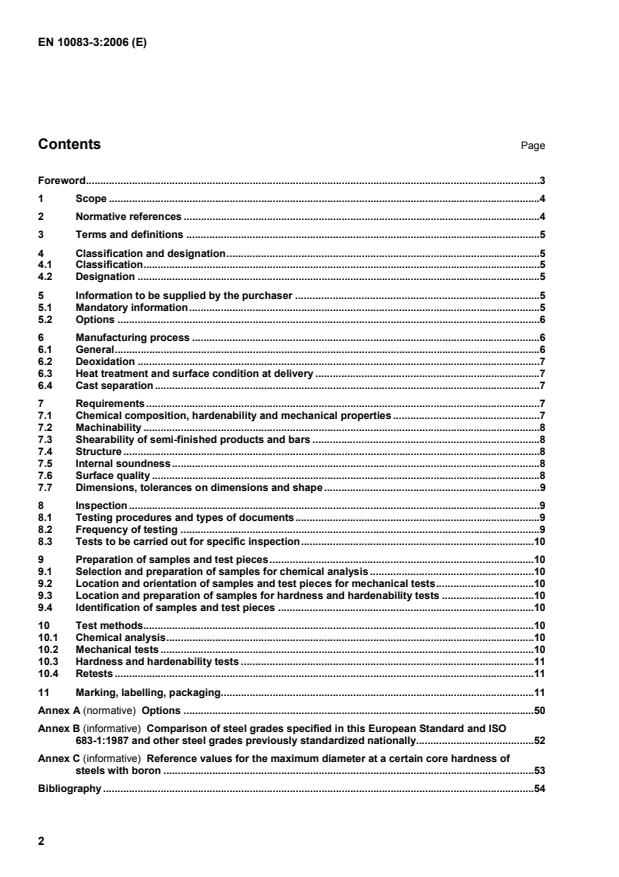
Options.50 Annex B (informative)
Comparison of steel grades specified in this European Standard and ISO 683-1:1987 and other steel grades previously standardized nationally.52 Annex C (informative)
Reference values for the maximum diameter at a certain core hardness of steels with boron.53 Bibliography.54
This document does not apply for bright steel products. For bright steel products EN 10277-1 and EN 10277-5 apply. In special cases, variations in these technical delivery requirements or additions to them may be agreed at the time of enquiry and order (see Annex A). 2 Normative references The following referenced documents are indispensable for the application of this document. For dated references, only the edition cited applies. For undated references, the latest edition of the referenced document (including any amendments) applies. EN 10002-1, Metallic materials – Tensile testing – Part 1: Method of test at ambient temperature EN 10020, Definition and classification of grades of steel EN 10027-1, Designation systems for steels – Part 1: Steel names EN 10027-2, Designation systems for steels – Part 2: Numerical system EN 10045-1, Metallic materials – Charpy impact test – Part 1: Test method EN 10083-1:2006, Steels for quenching and tempering – Part 1: General technical delivery conditions EN 10160, Ultrasonic testing of steel flat product of thickness equal or greater than 6 mm (reflection method) EN 10163-2, Delivery requirements for surface condition of hot-rolled steel plates, wide flats and sections – Part 2: Plate and wide flats EN 10204, Metallic products – Types of inspection documents
6 Manufacturing process 6.1 General The manufacturing process of steel and of the products is left to the discretion of the manufacturer with the restrictions given by the requirements in 6.2 to 6.4.
EN ISO 3887. 7.6.5 If suitability of bars and rods for bright drawing is required, this shall be agreed at the time of enquiry and order. 7.6.6 The removal of surface defects by welding shall only be permitted with the approval of the customer or his representative. If surface discontinuities are repaired, the method and maximum depth of removal shall be agreed at the time of enquiry and order. 7.7 Dimensions, tolerances on dimensions and shape The nominal dimensions, tolerances on dimensions and shape for the product shall be agreed at the time of enquiry and order, if possible, with reference to the dimensional standards applicable (see EN 10083-1:2006, Annex D). 8 Inspection
8.1 Testing procedures and types of documents 8.1.1 Products complying with this document shall be ordered and delivered with one of the inspection documents as specified in EN 10204. The type of document shall be agreed upon at the time of enquiry and order. If the order does not contain any specification of this type, a test report shall be issued. 8.1.2 For the information to be included in a test report, see EN 10083-1:2006, 8.1.2. 8.1.3 For the information to be included in an inspection certificate, see EN 10083-1:2006 8.1.3. 8.1.4 Unless otherwise agreed at the time of the order, inspection of surface quality and dimensions shall be carried out by the manufacturer. 8.2 Frequency of testing 8.2.1 Sampling Sampling shall be in accordance with Table 10. 8.2.2 Test units The test units and the extent of testing shall be in accordance with Table 10.
10.3.3 Surface hardness The surface hardness of steels after flame or induction hardening (see Table 9) shall be determined in accordance with EN ISO 6508-1, scale C. 10.4 Retests See EN 10083-1:2006, 10.4. 11 Marking, labelling, packaging The manufacturer shall mark the products or the bundles or boxes in a suitable way so that it is possible to determine the cast, the steel grade and the origin of the delivery (see A.6).
1 2 3 4 5 6 7 8 9 x indicates applicable for Applicable requirements if the steel is ordered with the designation given in Table 3 Table 5 or 6 1 Heat treatment condition at delivery Symbol Semi- finished products Bars Rod Flat products Hammer and drop forgings 8.1 8.2 9.1 9.2 9.3 2 Untreated none or +U x x x x x a
3 Treated to improve shearability +S x x - x - Table 7 column +Sa 4 Soft annealed +A x x x xb x
Maximum hardness Table 7 column +Aa Hardenability values according to Table 5 or 6 5 Quenched and tempered +QT - x x xb x
Chemical composition according to Tables 3 and 4 Mechanical properties according to Table 8
As in columns 8.1 and 8.2 (see footnote b in Table 3) Not Applicable 6 Others Other treatment conditions, e.g. certain annealing conditions to achieve a certain structure may be agreed at the time of enquiry and order. The treatment condition annealed for spheroidal carbide (+AC) as required for cold upsetting and cold extrusion is covered by EN 10263-4. a For deliveries in the untreated condition and in the "treated to improve shearability" and "soft annealed" condition, the mechanical properties specified in Table 8 shall be
achievable for the ruling end cross-section after appropriate heat treatment (for verification on reference test pieces, see A.1). b It is not possible to deliver all dimensions of flat products in this heat-treatment condition.
1 2 3 4 5 6 7 8 9 1 x indicates in general applicable for Notes
Surface condition at delivery Symbol Semi-finished products (such as blooms, billets) Bars Rod Flat productsHammer and drop forgings
(see note 2 in EN 10083-1:2006, Clause 1)
2 Unless
otherwise agreed Hot worked None or +HW x x x x x - 3 Unformed continuously cast +CC x - - - - - 4 Hot worked and pickled +PI x x x x x a 5 Hot worked and blast cleaned +BC x x x x x a 6 Hot worked and rough machined +RM - x x - x - 7 Particular conditions supplied by agreement Others - - - - - - - a In addition, it may be agreed that the products be oiled or, where appropriate, limed or phosphated.
0,020 to 0,040
37Cr4 1.7034 0,34 to 0,41 0,40 0,60 to 0,90 0,025 max. 0,035 0,90 to 1,20 - - - - 37CrS4 1.7038
0,020 to 0,040
41Cr4 1.7035 0,38 to 0,45 0,40 0,60 to 0,90 0,025 max. 0,035 0,90 to 1,20 - - - - 41CrS4 1.7039
0,020 to 0,040
25CrMo4 1.7218 0,22 to 0,29 0,40 0,60 to 0,90 0,025 max. 0,035 0,90 to 1,20 0,15 to 0,30 - - - 25CrMoS4 1.7213
0,020 to 0,040
34CrMo4 1.7220 0,30 to 0,37 0,40 0,60 to 0,90 0,025 max. 0,035 0,90 to 1,20 0,15 to 0,30 - - - 34CrMoS4 1.7226
0,020 to 0,040
42CrMo4 1.7225 0,38 to 0,45 0,40 0,60 to 0,90 0,025 max. 0,035 0,90 to 1,20 0,15 to 0,30 - - - 42CrMoS4 1.7227
0,020 to 0,040
50CrMo4 1.7228 0,46 to 0,54 0,40 0,50 to 0,80 0,025 max. 0,035 0,90 to 1,20 0,15 to 0,30 - - - 34CrNiMo6 1.6582 0,30 to 0,38 0,40 0,50 to 0,80 0,025 max. 0,035 1,30 to 1,70 0,15 to 0,30 1,30 to 1,70 - - 30CrNiMo8 1.6580 0,26 to 0,34 0,40 0,50 to 0,80 0,025 max. 0,035 1,80 to 2,20 0,30 to 0,50 1,80 to 2,20 - - 35NiCr6 1.5815 0,30 to 0,37 0,40 0,60 to 0,90 0,025 max. 0,025 0,80 to 1,10 - 1,20 to 1,60 - - 36NiCrMo16 1.6773 0,32 to 0,39 0,40 0,50 to 0,80 0,025 max. 0,025 1,60 to 2,00 0,25 to 0,45 3,6 to 4,1 - - 39NiCrMo3 1.6510 0,35 to 0,43 0,40 0,50 to 0,80 0,025 max. 0,035 0,60 to 1,00 0,15 to 0,25 0,70 to 1,00 - - 30NiCrMo16-6 1.6747 0,26 to 0,33 0,40 0,50 to 0,80 0,025 max. 0,025 1,20 to 1,50 0,30 to 0,60 3,3 to 4,3 - - 51CrV4 1.8159 0,47 to 0,55 0,40 0,70 to 1,10 0,025 max. 0,025 0,90 to 1,20 - - 0,10 to 0,25 - Steels with boron 20MnB5 1.5530 0,17 to 0,23 0,40 1,10 to 1,40 0,025 max. 0,035 - - - - 0,0008 to 0,0050 30MnB5 1.5531 0,27 to 0,33 0,40 1,15 to 1,45 0,025 max. 0,035 - - - - 0,0008 to 0,0050 38MnB5 1.5532 0,36 to 0,42 0,40 1,15 to 1,45 0,025 max. 0,035 - - - - 0,0008 to 0,0050 27MnCrB5-2 1.7182 0,24 to 0,30 0,40 1,10 to 1,40 0,025 max. 0,035 0,30 to 0,60 - - - 0,0008 to 0,0050 33MnCrB5-2 1.7185 0,30 to 0,36 0,40 1,20 to 1,50 0,025 max. 0,035 0,30 to 0,60 - - - 0,0008 to 0,0050 39MnCrB6-2 1.7189 0,36 to 0,42 0,40 1,40 to 1,70 0,025 max. 0,035 0,30 to 0,60 - - - 0,0008 to 0,0050 a Elements not quoted in this table shall not be intentionally added to the steel without the agreement of the purchaser, other than for the purpose of finishing the heat and for boron to have its effect
on the hardenability. All reasonable precautions shall be taken to prevent the addition of such elements from scrap or other material used in the manufacture which affect the hardenability,
mechanical properties and applicability. b Where requirements are made on hardenability (see Tables 5 and 6) or on the mechanical properties in the quenched and tempered condition (see Table 8), slight deviations from the limits for
the cast analysis are permissible, except for the elements carbon, phosphorus and sulfur; the deviations shall not exceed the specifications of Table 4. c Steels with improved machinability as a result of the addition of higher sulphur contents up to around 0,10% S (including resulphurized steels with controlled inclusion content (e.g. Ca-treatment))
may be supplied on request. In this case the upper limit for the manganese content may be increased by 0,15 %.
given in Table 3 for the cast analysis Element Permissible maximum content in the cast analysis % by mass Permissible deviationa % by mass C
≤ 0,55 ± 0,02 Si
≤ 0,40 + 0,03 Mn
≤ 1,00 ± 0,04
> 1,00
≤ 1,70 ± 0,05 P
≤ 0,025 + 0,005 S
≤ 0,040 + 0,005b Cr
≤ 2,00 ± 0,05
> 2,00
≤ 2,20 ± 0,10 Mo
≤ 0,30 ± 0,03
> 0,30
≤ 0,60 ± 0,04 Ni
≤ 2,00 ± 0,05
> 2,00
≤ 4,3 ± 0,07 V
≤ 0,25 ± 0,02 B
≤ 0,0050 ± 0,0003 a ± means that in one cast, the deviation may occur over the upper value
or under the lower value of the specified range in Table 3, but not both
at the same time. b For steels with a specified sulphur range of 0,020% to 0,040%
according to cast analysis, the permissible deviation is ± 0,005%.
(+H grades) Steel designation Distance in mm from quenched end Hardness in HRC Name Number Symbol Limits of range 1,5 3 5 7 9 11 13 15 20 25 30 35 40 45 50 Steels without boron 38Cr2 1.7003 +H max. 59 57 54 49 43 39 37 35 32 30 27 - - - -
min. 51 46 37 29 25 22 20 - - - - - - - - 46Cr2 1.7006 +H max. 63 61 59 57 53 47 42 39 36 33 32 - - - -
min. 54 49 40 32 28 25 23 22 20 - - - - - - 34Cr4 1.7033 +H max. 57 57 56 54 52 49 46 44 39 37 35 3
...