

EN 14617-2:2016
(Main)Agglomerated stone - Test methods - Part 2: Determination of flexural strength (bending)
- Abstract
This European Standard specifies a method for the determination of flexural strength under a concentrated load (breaking resistance) of agglomerated stone flat products.
- Status
- Published
- Publication Date
- 31-May-2016
- Withdrawal Date
- 30-Dec-2016
- Technical Committee
- CEN/TC 246 - Natural stones
- Drafting Committee
- CEN/TC 246/WG 4 - Agglomerated stones (JWG 229/246)
- Current Stage
- 9093 - Decision to confirm - Review Enquiry
- Start Date
- 05-Jun-2023
- Completion Date
- 07-Oct-2026


Overview
EN 14617-2:2016 is a European Standard developed by CEN that specifies the test method for determining the flexural strength (bending resistance) of agglomerated stone flat products under a concentrated load. This test method provides a standardized approach to measure the breaking resistance of engineered stone materials used in construction and architectural applications, ensuring consistent quality and performance assessment.
The standard defines the procedures, apparatus, specimen preparation, test execution, data analysis, and reporting requirements vital for accurate and repeatable flexural strength measurements. It is one part of a comprehensive series on agglomerated stone testing that includes physical, mechanical, and durability characteristics.
Key Topics
Scope and Purpose
Specifies a reliable method to determine flexural strength of agglomerated stone, critical for structural safety and material certification.Test Principle
The method uses a three-point bending test where a specimen is supported on two rollers and loaded centrally until fracture occurs. Breaking load data is used to calculate flexural strength.Specimen Preparation
- Minimum dimensions defined for length, width, and thickness appropriate for type testing and factory production control.
- Surface finishes include sawn, honed, polished, or other finishes as required.
- Conditioning at controlled room temperature or drying to constant mass for cement-bonded stones ensures consistent moisture content for accurate results.
Apparatus Requirements
Includes calibrated loading machines, rollers for specimen support and load application, precision balances, ovens for conditioning, and accurate measuring devices.Test Procedure
Load is applied at a controlled rate until specimen failure. Dimensions and breaking load are recorded; fractures occurring outside specified zones or with material flaws necessitate retesting.Result Calculation and Expression
Flexural strength is computed from breaking load and specimen dimensions and expressed in megapascals (MPa) to one decimal place.Statistical Analysis
Annex A provides guidelines for statistical evaluation of test results, including calculation of mean, standard deviation, coefficient of variation, and lower expected value assuming normal or log-normal distributions, enhancing data reliability.Reporting Requirements
Comprehensive test reports must include specimen details, test conditions, flexural strength values with deviations, surface finish, and any deviations from the standard procedure.
Applications
Quality Control in Manufacturing
Enables manufacturers of agglomerated stone products to verify mechanical strength compliance during production and prior to product release.Material Certification
Supports certification bodies in assessing product suitability for structural and architectural usage according to European standards.Research and Development
Provides a reproducible test method for developing new engineered stone products with optimized bending resistance.Construction Industry
Assists architects, engineers, and contractors in selecting materials with verified flexural strength for countertops, tiles, cladding, and other applications where load-bearing capacity is crucial.
Related Standards
EN 14617-2:2016 is part of the broader EN 14617 series on agglomerated stone test methods, complementing measurements of:
- EN 14617-1: Determination of apparent density and water absorption
- EN 14617-4: Abrasion resistance
- EN 14617-5: Freeze and thaw resistance
- EN 14617-6: Thermal shock resistance
- EN 14617-8: Resistance to fixing (dowel hole)
- EN 14617-9: Impact resistance
- EN 14617-10: Chemical resistance
- EN 14617-11: Linear thermal expansion coefficient
- EN 14617-12: Dimensional stability
- EN 14617-13: Electrical resistivity
- EN 14617-15: Compressive strength
- EN 14617-16: Dimensions, geometric characteristics, and surface quality of modular tiles
These related standards ensure comprehensive assessment of agglomerated stone performance properties, supporting harmonized quality and safety across Europe and international markets.
By adhering to EN 14617-2:2016, stakeholders in the natural stone and engineered stone industries can reliably assess flexural strength, contributing to enhanced product quality, safety, and regulatory compliance. This standard plays a crucial role in ensuring the durability and functionality of agglomerated stone materials in diverse construction environments.
Relations
- Effective Date
- 11-May-2015
- Effective Date
- 28-Jan-2026
- Effective Date
- 28-Jan-2026
- Referred By
EN 15285:2008 - Agglomerated stone - Modular tiles for flooring and stairs (internal and external) - Effective Date
- 28-Jan-2026
- Referred By
EN 15564:2008 - Precast concrete products - Resin bound concrete - Requirements and test methods - Effective Date
- 28-Jan-2026
- Effective Date
- 28-Jan-2026
- Effective Date
- 28-Jan-2026
- Referred By
EN 15388:2020 - Agglomerated stone - Slabs and cut-to-size products for vanity and kitchen tops - Effective Date
- 28-Jan-2026
- Referred By
EN 15388:2008 - Agglomerated stone - Slabs and cut-to-size products for vanity and kitchen tops - Effective Date
- 28-Jan-2026
- Referred By
EN 15286:2013 - Agglomerated stone - Slabs and tiles for wall finishes (internal and external) - Effective Date
- 28-Jan-2026
Get Certified
Connect with accredited certification bodies for this standard

DIBt (Deutsches Institut für Bautechnik)
German Institute for Building Technology.
DIN CERTCO
DIN Group product certification.

Aboma Certification B.V.
Specialized in construction, metal, and transport sectors.
Sponsored listings
Frequently Asked Questions
EN 14617-2:2016 is a standard published by the European Committee for Standardization (CEN). Its full title is "Agglomerated stone - Test methods - Part 2: Determination of flexural strength (bending)". This standard covers: This European Standard specifies a method for the determination of flexural strength under a concentrated load (breaking resistance) of agglomerated stone flat products.
This European Standard specifies a method for the determination of flexural strength under a concentrated load (breaking resistance) of agglomerated stone flat products.
EN 14617-2:2016 is classified under the following ICS (International Classification for Standards) categories: 91.100.15 - Mineral materials and products. The ICS classification helps identify the subject area and facilitates finding related standards.
EN 14617-2:2016 has the following relationships with other standards: It is inter standard links to EN 14617-2:2008, EN 12372:2022, EN 16954:2018, EN 15285:2008, EN 15564:2008, EN ISO 13766-2:2018, EN ISO 13766-1:2018, EN 15388:2020, EN 15388:2008, EN 15286:2013. Understanding these relationships helps ensure you are using the most current and applicable version of the standard.
EN 14617-2:2016 is available in PDF format for immediate download after purchase. The document can be added to your cart and obtained through the secure checkout process. Digital delivery ensures instant access to the complete standard document.
Standards Content (Sample)
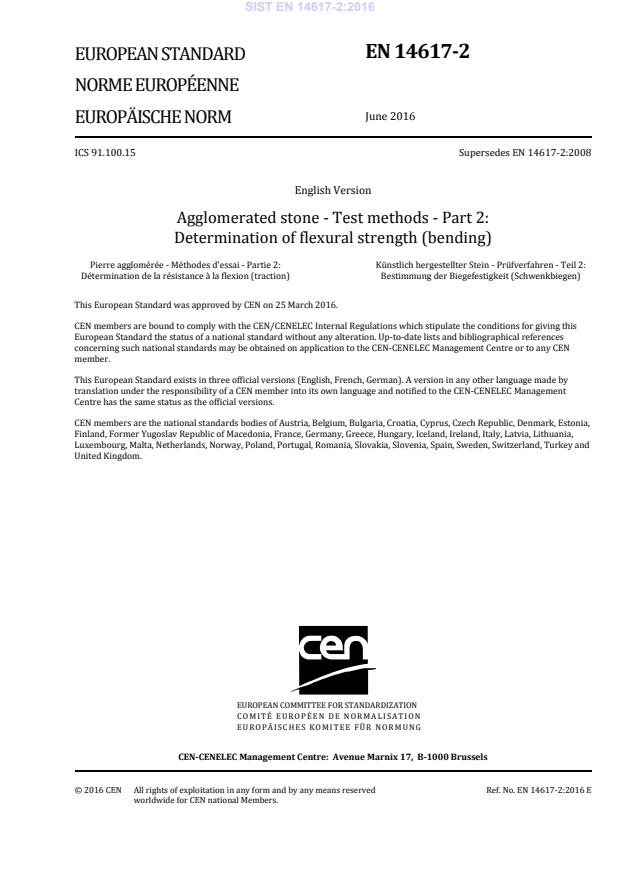
2003-01.Slovenski inštitut za standardizacijo. Razmnoževanje celote ali delov tega standarda ni dovoljeno.Aglomeriran kamen - Preskusne metode - 2. del: Ugotavljanje upogibne trdnosti (zvijanje)Künstlich hergestellter Stein - Prüfverfahren - Teil 2: Bestimmung der Biegefestigkeit (Schwenkbiegen)Pierre agglomérée - Méthodes d'essai - Partie 2: Détermination de la résistance à la flexion (traction)Agglomerated stone - Test methods - Part 2: Determination of flexural strength (bending)91.100.15Mineralni materiali in izdelkiMineral materials and productsICS:Ta slovenski standard je istoveten z:EN 14617-2:2016SIST EN 14617-2:2016en,fr,de01-september-2016SIST EN 14617-2:2016SLOVENSKI
STANDARD
EUROPEAN STANDARD NORME EUROPÉENNE EUROPÄISCHE NORM
EN 14617-2
June
t r s x ICS
{ sä s r rä s w Supersedes EN
s v x s yæ tã t r r zEnglish Version
Agglomerated stone æ Test methods æ Part
tã Pierre agglomérée æ Méthodes d 5essai æ Partie
tã
Künstlich hergestellter Stein æ Prüfverfahren æ Teil
tã This European Standard was approved by CEN on
t w March
t r s xä
egulations which stipulate the conditions for giving this European Standard the status of a national standard without any alterationä Upætoædate lists and bibliographical references concerning such national standards may be obtained on application to the CENæCENELEC Management Centre or to any CEN memberä
translation under the responsibility of a CEN member into its own language and notified to the CENæCENELEC Management Centre has the same status as the official versionsä
CEN members are the national standards bodies of Austriaá Belgiumá Bulgariaá Croatiaá Cyprusá Czech Republicá Denmarká Estoniaá Finlandá Former Yugoslav Republic of Macedoniaá Franceá Germanyá Greeceá Hungaryá Icelandá Irelandá Italyá Latviaá Lithuaniaá Luxembourgá Maltaá Netherlandsá Norwayá Polandá Portugalá Romaniaá Slovakiaá Sloveniaá Spainá Swedená Switzerlandá Turkey andUnited Kingdomä
EUROPEAN COMMITTEE FOR STANDARDIZATION COMITÉ EUROPÉEN DE NORMALISATION EUROPÄISCHES KOMITEE FÜR NORMUNG
CEN-CENELEC Management Centre:
Avenue Marnix 17,
B-1000 Brussels
t r s x CEN All rights of exploitation in any form and by any means reserved worldwide for CEN national Membersä Refä Noä EN
s v x s yæ tã t r s x ESIST EN 14617-2:2016
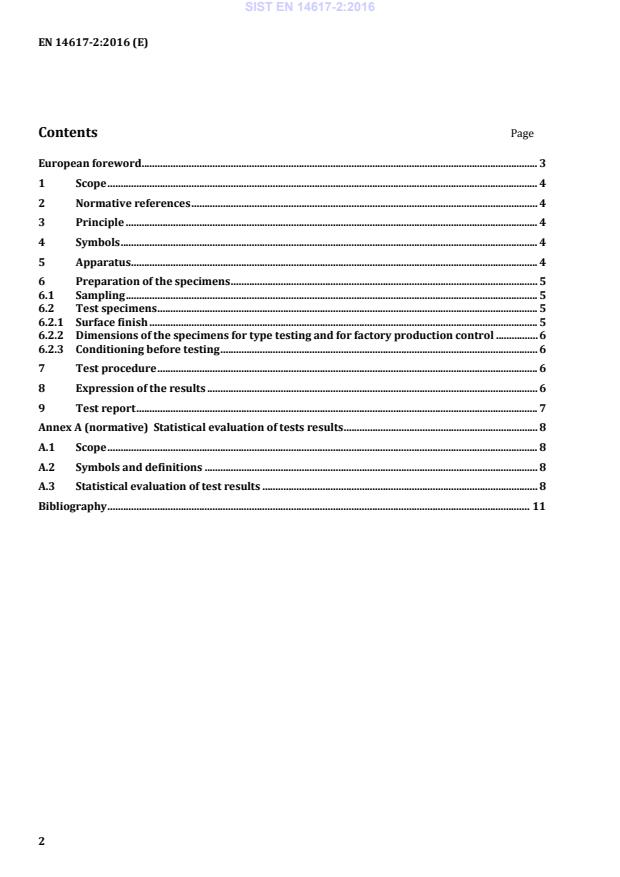
Page European foreword . 3 1 Scope . 4 2 Normative references . 4 3 Principle . 4 4 Symbols . 4 5 Apparatus . 4 6 Preparation of the specimens . 5 6.1 Sampling . 5 6.2 Test specimens . 5 6.2.1 Surface finish . 5 6.2.2 Dimensions of the specimens for type testing and for factory production control . 6 6.2.3 Conditioning before testing . 6 7 Test procedure . 6 8 Expression of the results . 6 9 Test report . 7 Annex A (normative)
Statistical evaluation of tests results . 8 A.1 Scope . 8 A.2 Symbols and definitions . 8 A.3 Statistical evaluation of test results . 8 Bibliography . 11
...