

EN 13483:2013
(Main)Rubber and plastic hoses and hose assemblies with internal vapour recovery for measured fuel dispensing systems - Specification
- Abstract
This European Standard specifies the requirements and test methods for verification for hose assemblies with vapour recovery for delivery systems on petrol filling stations.
The hose assemblies with vapour recovery for delivery systems on petrol filling stations need to be capable of withstanding anticipated mechanical, thermal and chemical stressing and be resistant to the combustible liquids used in these applications as well as their vapour and vapour air mixtures. It is imperative that the assemblies be constructed in such a way that actions during normal operation cannot give rise to dangerous electrostatic charges nor that there will be any reduction in the performance of the vapour recovery.
The assemblies are intended for use at ambient temperatures between –30 °C and +55 °C for normal temperature class and –40 °C and +55 °C for low temperature class at a working pressure 16 bar ).
Hoses can be constructed from rubber or thermoplastic elastomer (TPE) and this document specifies the requirements for three types of hoses in two grades and two classes of hose assemblies for measured fuel dispensing systems, including oxygenated fuels ( 15 % oxygenated compounds) with internal vapour recovery tubing or hose.
NOTE This European Standard is not applicable to multi chamber fuel dispensing hoses.
As part of the certification of a new dispenser, testing of fuel samples in accordance with EN 228 should be carried out at least eight weeks after the first use of the equipment to avoid unrepresentative sulphur content results.
- Status
- Withdrawn
- Publication Date
- 18-Jun-2013
- Withdrawal Date
- 06-Oct-2026
- Technical Committee
- CEN/TC 218 - Rubber and plastics hoses and hose assemblies
- Current Stage
- 9960 - Withdrawal effective - Withdrawal
- Start Date
- 12-Oct-2022
- Completion Date
- 07-Oct-2026



Relations
- Effective Date
- 03-Jul-2010
- Effective Date
- 10-Mar-2020
- Effective Date
- 25-Aug-2026
- Effective Date
- 09-Feb-2026
- Refers
ISO 188:2011 - Rubber, vulcanized or thermoplastic — Accelerated ageing and heat resistance tests - Effective Date
- 09-Feb-2026
- Effective Date
- 09-Feb-2026
- Effective Date
- 09-Feb-2026
- Effective Date
- 09-Feb-2026
- Effective Date
- 28-Jan-2026
- Effective Date
- 28-Jan-2026
- Effective Date
- 28-Jan-2026
- Effective Date
- 28-Jan-2026
- Effective Date
- 28-Jan-2026
- Effective Date
- 28-Jan-2026
- Effective Date
- 28-Jan-2026
Get Certified
Connect with accredited certification bodies for this standard

Element Materials Technology
Materials testing and product certification.

ABS Group Brazil
ABS Group certification services in Brazil.

ABS Quality Evaluations Inc.
American Bureau of Shipping quality certification.
Sponsored listings
Frequently Asked Questions
EN 13483:2013 is a standard published by the European Committee for Standardization (CEN). Its full title is "Rubber and plastic hoses and hose assemblies with internal vapour recovery for measured fuel dispensing systems - Specification". This standard covers: This European Standard specifies the requirements and test methods for verification for hose assemblies with vapour recovery for delivery systems on petrol filling stations. The hose assemblies with vapour recovery for delivery systems on petrol filling stations need to be capable of withstanding anticipated mechanical, thermal and chemical stressing and be resistant to the combustible liquids used in these applications as well as their vapour and vapour air mixtures. It is imperative that the assemblies be constructed in such a way that actions during normal operation cannot give rise to dangerous electrostatic charges nor that there will be any reduction in the performance of the vapour recovery. The assemblies are intended for use at ambient temperatures between –30 °C and +55 °C for normal temperature class and –40 °C and +55 °C for low temperature class at a working pressure 16 bar ). Hoses can be constructed from rubber or thermoplastic elastomer (TPE) and this document specifies the requirements for three types of hoses in two grades and two classes of hose assemblies for measured fuel dispensing systems, including oxygenated fuels ( 15 % oxygenated compounds) with internal vapour recovery tubing or hose. NOTE This European Standard is not applicable to multi chamber fuel dispensing hoses. As part of the certification of a new dispenser, testing of fuel samples in accordance with EN 228 should be carried out at least eight weeks after the first use of the equipment to avoid unrepresentative sulphur content results.
This European Standard specifies the requirements and test methods for verification for hose assemblies with vapour recovery for delivery systems on petrol filling stations. The hose assemblies with vapour recovery for delivery systems on petrol filling stations need to be capable of withstanding anticipated mechanical, thermal and chemical stressing and be resistant to the combustible liquids used in these applications as well as their vapour and vapour air mixtures. It is imperative that the assemblies be constructed in such a way that actions during normal operation cannot give rise to dangerous electrostatic charges nor that there will be any reduction in the performance of the vapour recovery. The assemblies are intended for use at ambient temperatures between –30 °C and +55 °C for normal temperature class and –40 °C and +55 °C for low temperature class at a working pressure 16 bar ). Hoses can be constructed from rubber or thermoplastic elastomer (TPE) and this document specifies the requirements for three types of hoses in two grades and two classes of hose assemblies for measured fuel dispensing systems, including oxygenated fuels ( 15 % oxygenated compounds) with internal vapour recovery tubing or hose. NOTE This European Standard is not applicable to multi chamber fuel dispensing hoses. As part of the certification of a new dispenser, testing of fuel samples in accordance with EN 228 should be carried out at least eight weeks after the first use of the equipment to avoid unrepresentative sulphur content results.
EN 13483:2013 is classified under the following ICS (International Classification for Standards) categories: 23.040.70 - Hoses and hose assemblies; 75.200 - Petroleum products and natural gas handling equipment. The ICS classification helps identify the subject area and facilitates finding related standards.
EN 13483:2013 has the following relationships with other standards: It is inter standard links to EN 13483:2005, EN 13483:2022, ISO 554:1976, ISO 4649:2010, ISO 188:2011, ISO 1817:2011, ISO 37:2011, ISO 527-1:2012, EN ISO 1307:2008, EN ISO 8031:2009, EN ISO 8330:2008, EN 915:1996, EN ISO 4671:2022, EN ISO 8033:2017, EN ISO 7326:2016. Understanding these relationships helps ensure you are using the most current and applicable version of the standard.
EN 13483:2013 is available in PDF format for immediate download after purchase. The document can be added to your cart and obtained through the secure checkout process. Digital delivery ensures instant access to the complete standard document.
Standards Content (Sample)
2003-01.Slovenski inštitut za standardizacijo. Razmnoževanje celote ali delov tega standarda ni dovoljeno.Gummi- und Kunststoffschläuche und -schlauchleitungen mit innenliegender Gasrückführung für Zapfsäulen an Tankstellen - AnforderungenTuyaux et flexibles à récupération interne de vapeur pour un système de livraison mesurée carburant - SpécificationRubber and plastic hoses and hose assemblies with internal vapour recovery for measured fuel dispensing systems - Specification83.140.40Gumene ceviHoses75.200Petroleum products and natural gas handling equipmentICS:Ta slovenski standard je istoveten z:EN 13483:2013SIST EN 13483:2013en,de01-september-2013SIST EN 13483:2013SLOVENSKI
STANDARDSIST EN 13483:20051DGRPHãþD
EUROPEAN STANDARD NORME EUROPÉENNE EUROPÄISCHE NORM
EN 13483
June 2013 ICS 23.040.70; 75.200 Supersedes EN 13483:2005English Version
Rubber and plastic hoses and hose assemblies with internal vapour recovery for measured fuel dispensing systems - Specification
Tuyaux et flexibles en caoutchouc et en plastique à récupération interne de vapeur pour systèmes de livraison mesurée de carburant - Spécification
Gummi- und Kunststoffschläuche und -schlauchleitungen mit innenliegender Gasrückführung für Zapfsäulen an Tankstellen - Anforderungen This European Standard was approved by CEN on 25 April 2013.
CEN members are bound to comply with the CEN/CENELEC Internal Regulations which stipulate the conditions for giving this European Standard the status of a national standard without any alteration. Up-to-date lists and bibliographical references concerning such national standards may be obtained on application to the CEN-CENELEC Management Centre or to any CEN member.
This European Standard exists in three official versions (English, French, German). A version in any other language made by translation under the responsibility of a CEN member into its own language and notified to the CEN-CENELEC Management Centre has the same status as the official versions.
CEN members are the national standards bodies of Austria, Belgium, Bulgaria, Croatia, Cyprus, Czech Republic, Denmark, Estonia, Finland, Former Yugoslav Republic of Macedonia, France, Germany, Greece, Hungary, Iceland, Ireland, Italy, Latvia, Lithuania, Luxembourg, Malta, Netherlands, Norway, Poland, Portugal, Romania, Slovakia, Slovenia, Spain, Sweden, Switzerland, Turkey and United Kingdom.
EUROPEAN COMMITTEE FOR STANDARDIZATION
COMITÉ EUROPÉEN DE NORMALISATION EUROPÄISCHES KOMITEE FÜR NORMUNG
Management Centre:
Avenue Marnix 17,
B-1000 Brussels © 2013 CEN All rights of exploitation in any form and by any means reserved worldwide for CEN national Members. Ref. No. EN 13483:2013: ESIST EN 13483:2013
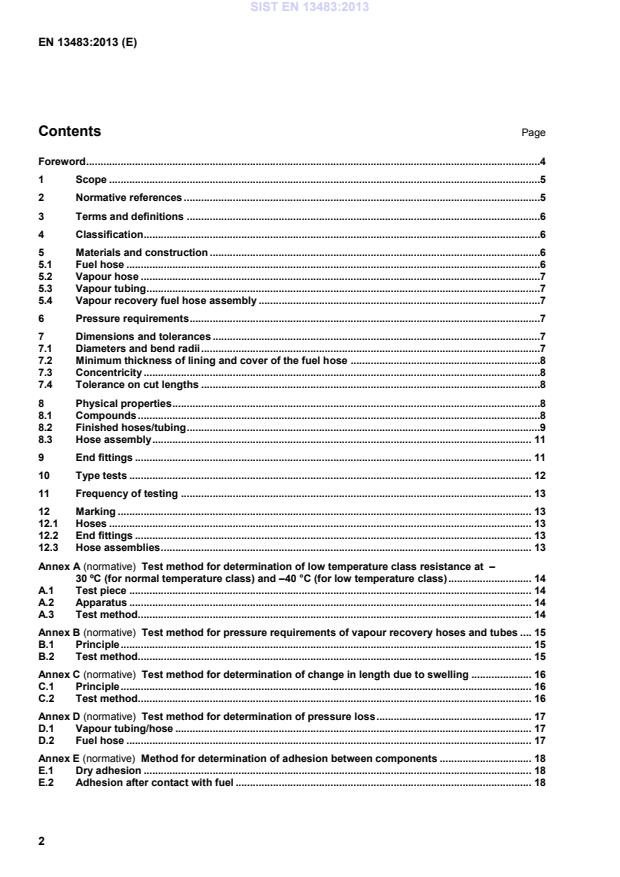
Test method for determination of low temperature class resistance at
–30 ºC (for normal temperature class) and –40 °C (for low temperature class) . 14 A.1 Test piece . 14 A.2 Apparatus . 14 A.3 Test method . 14 Annex B (normative)
Test method for pressure requirements of vapour recovery hoses and tubes . 15 B.1 Principle . 15 B.2 Test method . 15 Annex C (normative)
Test method for determination of change in length due to swelling . 16 C.1 Principle . 16 C.2 Test method . 16 Annex D (normative)
Test method for determination of pressure loss . 17 D.1 Vapour tubing/hose . 17 D.2 Fuel hose . 17 Annex E (normative)
Method for determination of adhesion between components . 18 E.1 Dry adhesion . 18 E.2 Adhesion after contact with fuel . 18 SIST EN 13483:2013
Test method for the determination of low temperature flexibility . 19 F.1 Test piece . 19 F.2 Apparatus . 19 F.3 Test method . 19 Annex G (normative)
Test method for the determination of rate of fuel permeation . 21 G.1 Test piece . 21 G.2 Apparatus . 21 G.3 Test method . 21 Annex H (normative)
Test method for flammability . 22 H.1 Test piece . 22 H.2 Apparatus . 22 H.3 Test method . 22 Annex I (normative)
Test method for the determination of leakage (leak test) . 24 Annex J (normative)
Test method for fatigue strength under reversed bending stresses (flex test) . 25 J.1 Apparatus and test piece . 25 J.2 Test method . 25 J.3 Test observations and report . 26 Annex K (normative)
End-fitting pull-off test . 27 K.1 Test piece . 27 K.2 Apparatus . 27 K.3 Test method . 27 Annex L (normative)
Test frequency for type tests and routine tests. 28 Annex M (informative)
Test frequency for production acceptance tests . 30 Bibliography . 32
1) 1 bar = 0,1 MPa SIST EN 13483:2013
Type 3, fine wire reinforced. Each type of hose shall be divided into two grades: Grade M: electrically bonded; Grade Ω: electrically conductive. Each type of hose shall be divided into two temperature classes: normal temperature class with an ambient working temperature of −30 °C to +55 °C; low temperature class (LT) with an ambient working temperature of −40 °C to +55 °C. 5 Materials and construction 5.1 Fuel hose The fuel hose shall consist of the following: a) a smooth, fuel resistant lining of rubber or thermoplastic elastomer (TPE); b) a suitable reinforcement, related to type; c) a non-corrugated fuel and weather resistant rubber or TPE cover. Hose assemblies shall be capable of conducting an electrical charge from coupling to coupling. SIST EN 13483:2013
Proof test pressure 24 b
Minimum burst pressure 48 18 a The vapour tubing/hose shall be designed for an absolute pressure of 0,2 bar (vacuum) with an external pressurisation of 8 bar. b See Annex B. 7 Dimensions and tolerances 7.1 Diameters and bend radii Diameters and bend radii shall conform to the values given in Table 2. SIST EN 13483:2013
min. Vapour tubing/hose 8,4 — 75 Fuel hose — 32,6 130 Assembly — — 130
7.2 Minimum thickness of lining and cover of the fuel hose When measured in accordance with EN ISO 4671, the thickness of the lining shall be not less than 1,6 mm and the thickness of the cover shall be not less than 1,0 mm. 7.3 Concentricity When determined in accordance with EN ISO 4671, the concentricity, based on a total indicator reading between the internal diameter and the outside diameter, shall not exceed 0,5 mm for the vapour tubing or hose, and shall not exceed 1,0 mm for the fuel hose. 7.4 Tolerance on cut lengths For cut lengths, the tolerances on length shall be in accordance with EN ISO 1307. The length of a hose assembly shall be measured from sealing face to sealing face of the end fittings with a tolerance from the nominal length of ± 1 %. 8 Physical properties 8.1 Compounds When tested in accordance with the methods in Table 3, the physical properties of the compounds used for the lining and cover shall conform to the values given in Table 3. Tests shall be performed either on samples taken from the hose or from moulded vulcanised sheets at a thickness of 2 mm or moulded test pieces vulcanised to the same cured state as the production hoses. SIST EN 13483:2013
Rubber TPE Thermo-plastic
Tensile strength,
min.
Lining and cover of fuel hose
and vapour tubing and hose
MPa
12 Test piece cut from hose or from test sheet
ISO 37
ISO 527-1 (Thermoplastic) Elongation at break,
min.
Lining and cover of fuel hose
and vapour tubing and hose
%
150 Accelerated ageing
Tensile strength change,
Lining and cover fuel hose and
vapour tubing and hose,
max.
ISO 188
(air oven method) 14 days at (70 ± 1) °C
Elongation at break change,
Lining and cover of fuel hose
and vapour tubing and hose,
max.
...