

CEN/TS 15174:2006
(Main)Gas supply systems - Guideline for safety management systems for natural gas transmission pipelines
- Abstract
This Technical Specification is applicable to pipelines for the transmission of processed, non-toxic and non-corrosive natural gas according to ISO 13686 in onland gas supply systems, where:
- the pipeline elements are made of unalloyed or low-alloyed carbon steel;
- the pipeline elements are joined by welds, flanges or mechanical couplings;
- the pipeline is not located within commercial or industrial premises as an integral part of the industrial process on these premises except for any pipelines and facilities supplying such premises.
This Technical Specification applies both to new and existing pipelines and covers pipelines which begin after the gas producer's metering station and ends at the boundary of the delivery station on the premises of the customer. Installations like Under Ground Storage, Compressor stations and LNG plants are excluded from this scope.
- Status
- Withdrawn
- Publication Date
- 04-Jul-2006
- Withdrawal Date
- 25-Jun-2013
- Technical Committee
- CEN/TC 234 - Gas infrastructure
- Drafting Committee
- CEN/TC 234 - Gas infrastructure
- Current Stage
- 9960 - Withdrawal effective - Withdrawal
- Start Date
- 26-Jun-2013
- Completion Date
- 26-Jun-2013

Relations
- Effective Date
- 03-Jul-2013
- Effective Date
- 28-Jan-2026
- Effective Date
- 28-Jan-2026
- Effective Date
- 28-Jan-2026
- Effective Date
- 28-Jan-2026
- Effective Date
- 28-Jan-2026
- Effective Date
- 28-Jan-2026
Get Certified
Connect with accredited certification bodies for this standard

BSI Group
BSI (British Standards Institution) is the business standards company that helps organizations make excellence a habit.

Bureau Veritas
Bureau Veritas is a world leader in laboratory testing, inspection and certification services.

DNV
DNV is an independent assurance and risk management provider.
Sponsored listings
Frequently Asked Questions
CEN/TS 15174:2006 is a technical specification published by the European Committee for Standardization (CEN). Its full title is "Gas supply systems - Guideline for safety management systems for natural gas transmission pipelines". This standard covers: This Technical Specification is applicable to pipelines for the transmission of processed, non-toxic and non-corrosive natural gas according to ISO 13686 in onland gas supply systems, where: - the pipeline elements are made of unalloyed or low-alloyed carbon steel; - the pipeline elements are joined by welds, flanges or mechanical couplings; - the pipeline is not located within commercial or industrial premises as an integral part of the industrial process on these premises except for any pipelines and facilities supplying such premises. This Technical Specification applies both to new and existing pipelines and covers pipelines which begin after the gas producer's metering station and ends at the boundary of the delivery station on the premises of the customer. Installations like Under Ground Storage, Compressor stations and LNG plants are excluded from this scope.
This Technical Specification is applicable to pipelines for the transmission of processed, non-toxic and non-corrosive natural gas according to ISO 13686 in onland gas supply systems, where: - the pipeline elements are made of unalloyed or low-alloyed carbon steel; - the pipeline elements are joined by welds, flanges or mechanical couplings; - the pipeline is not located within commercial or industrial premises as an integral part of the industrial process on these premises except for any pipelines and facilities supplying such premises. This Technical Specification applies both to new and existing pipelines and covers pipelines which begin after the gas producer's metering station and ends at the boundary of the delivery station on the premises of the customer. Installations like Under Ground Storage, Compressor stations and LNG plants are excluded from this scope.
CEN/TS 15174:2006 is classified under the following ICS (International Classification for Standards) categories: 03.100.70 - Management systems; 23.040.01 - Pipeline components and pipelines in general; 75.200 - Petroleum products and natural gas handling equipment. The ICS classification helps identify the subject area and facilitates finding related standards.
CEN/TS 15174:2006 has the following relationships with other standards: It is inter standard links to EN 16348:2013, EN ISO 14001:2004, CEN/TS 15173:2006, EN 1594:2000, EN ISO 10360-8:2013, EN ISO 10360-7:2011, EN ISO 10360-2:2009. Understanding these relationships helps ensure you are using the most current and applicable version of the standard.
CEN/TS 15174:2006 is available in PDF format for immediate download after purchase. The document can be added to your cart and obtained through the secure checkout process. Digital delivery ensures instant access to the complete standard document.
Standards Content (Sample)
SLOVENSKI STANDARD
01-november-2008
Sistemi oskrbe s plinom - Smernice za sistem upravljanja varnosti plinovodov za
prenos zemeljskega plina
Gas supply systems - Guideline for safety management systems for natural gas
transmission pipelines
Gasversorgungssysteme - Leitfaden für Sicherheitsmanagementsysteme für
Erdgastransportleitungen
Systèmes d'alimentation en gaz - Ligne directrice pour les systèmes de management de
la sécurité des canalisations pour le transport de gaz naturel
Ta slovenski standard je istoveten z: CEN/TS 15174:2006
ICS:
75.060 Zemeljski plin Natural gas
91.140.40 Sistemi za oskrbo s plinom Gas supply systems
2003-01.Slovenski inštitut za standardizacijo. Razmnoževanje celote ali delov tega standarda ni dovoljeno.
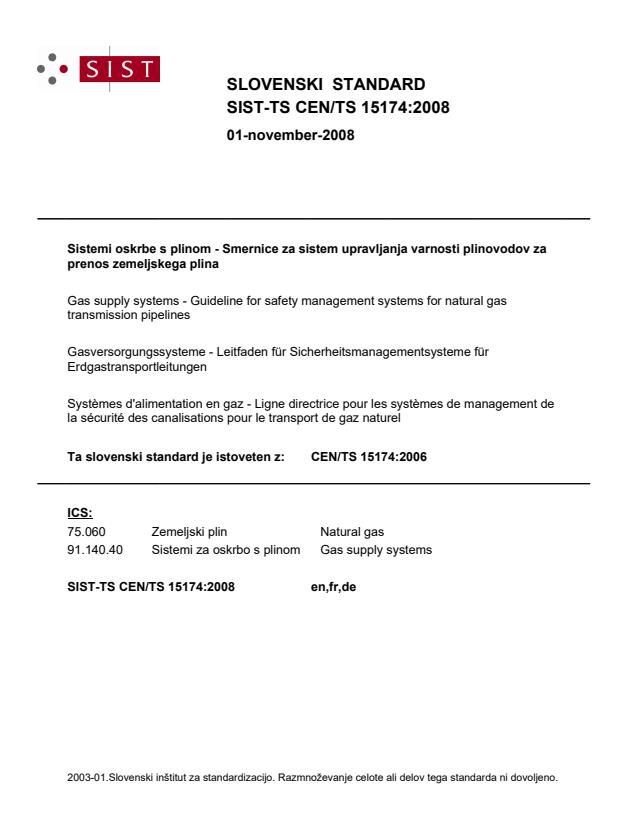
TECHNICAL SPECIFICATION
CEN/TS 15174
SPÉCIFICATION TECHNIQUE
TECHNISCHE SPEZIFIKATION
July 2006
ICS 23.040.01
English Version
Gas supply systems - Guideline for safety management systems
for natural gas transmission pipelines
Systèmes d'alimentation en gaz - Ligne directrice pour les Gasversorgungssysteme - Leitfaden für
systèmes de management de la sécurité des canalisations Sicherheitsmanagementsysteme für
pour le transport de gaz naturel Erdgastransportleitungen
This Technical Specification (CEN/TS) was approved by CEN on 25 June 2005 for provisional application.
The period of validity of this CEN/TS is limited initially to three years. After two years the members of CEN will be requested to submit their
comments, particularly on the question whether the CEN/TS can be converted into a European Standard.
CEN members are required to announce the existence of this CEN/TS in the same way as for an EN and to make the CEN/TS available
promptly at national level in an appropriate form. It is permissible to keep conflicting national standards in force (in parallel to the CEN/TS)
until the final decision about the possible conversion of the CEN/TS into an EN is reached.
CEN members are the national standards bodies of Austria, Belgium, Cyprus, Czech Republic, Denmark, Estonia, Finland, France,
Germany, Greece, Hungary, Iceland, Ireland, Italy, Latvia, Lithuania, Luxembourg, Malta, Netherlands, Norway, Poland, Portugal, Romania,
Slovakia, Slovenia, Spain, Sweden, Switzerland and United Kingdom.
EUROPEAN COMMITTEE FOR STANDARDIZATION
COMITÉ EUROPÉEN DE NORMALISATION
EUROPÄISCHES KOMITEE FÜR NORMUNG
Management Centre: rue de Stassart, 36 B-1050 Brussels
© 2006 CEN All rights of exploitation in any form and by any means reserved Ref. No. CEN/TS 15174:2006: E
worldwide for CEN national Members.
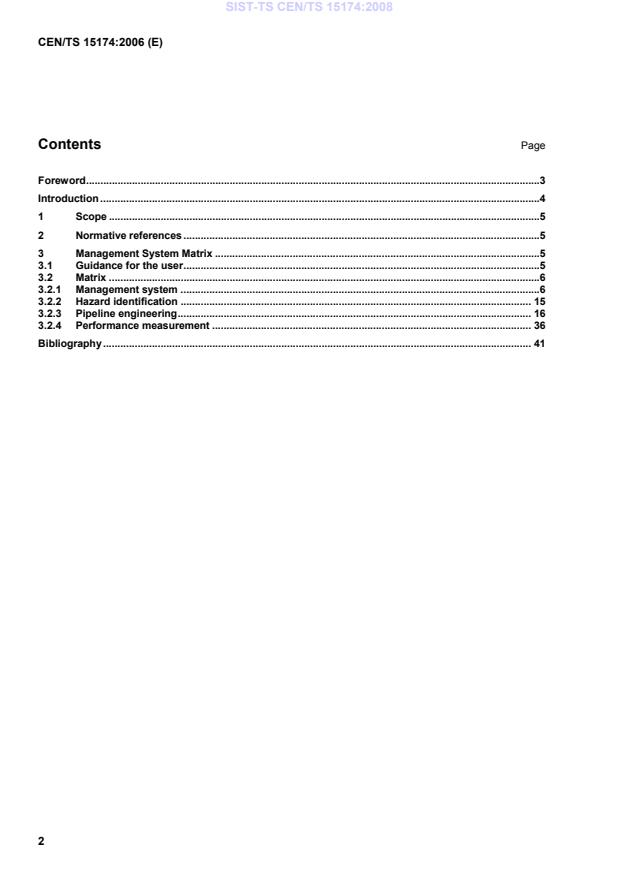
Contents Page
Foreword.3
Introduction.4
1 Scope .5
2 Normative references .5
3 Management System Matrix .5
3.1 Guidance for the user.5
3.2 Matrix .6
3.2.1 Management system .6
3.2.2 Hazard identification . 15
3.2.3 Pipeline engineering. 16
3.2.4 Performance measurement . 36
Bibliography. 41
Foreword
This Technical Specification (CEN/TS 15174:2006) has been prepared by Technical Committee CEN/TC 234
“Gas Supply Systems”, the secretariat of which is held by DIN.
There is a complete suite of functional standards prepared by CEN/TC 234 "Gas Supply" to cover all parts of
the gas supply system from the input of gas to the transmission system up to the inlet connection of the gas
appliances, whether for domestic, commercial or industrial purposes.
In preparing this Technical Specification a basic understanding of Quality Management Systems and gas
supply systems by the user has been assumed.
According to the CEN/CENELEC Internal Regulations, the national standards organizations of the following
countries are bound to announce this Technical Specification: Austria, Belgium, Cyprus, Czech Republic,
Denmark, Estonia, Finland, France, Germany, Greece, Hungary, Iceland, Ireland, Italy, Latvia, Lithuania,
Luxembourg, Malta, Netherlands, Norway, Poland, Portugal, Romania, Slovakia, Slovenia, Spain, Sweden,
Switzerland and the United Kingdom.
Introduction
This Technical Specification describes the management of pipeline systems. It covers design, construction,
commissioning, operation, maintenance and abandonment, all in order to provide a pipeline system for the
safe and secure transmission of gas.
The text of this Technical Specification is based upon the existing documents EN ISO 14001 (Environmental
Management Systems), EN 1594 (Pipelines for maximum operating pressures over 16 bar – Functional
requirements) and CEN/TS 15173 (Frame of reference regarding Pipeline Integrity Management System).
Among the EN ISO standards, EN ISO 14001 appears to be the most appropriate reference for a Safety
Management System for natural gas transmission pipelines no reference is given to EN ISO 9000 series.
Not all the references specifically cover pipeline management. However they give a good overall guide as far
as the topic in question is concerned.
1 Scope
This Technical Specification is applicable to pipelines for the transmission of processed, non-toxic and non-
corrosive natural gas according to ISO 13686 in on land gas supply systems, where:
the pipeline elements are made of unalloyed or low-alloyed carbon steel;
the pipeline elements are joined by welds, flanges or mechanical couplings;
the pipeline is not located within commercial or industrial premises as an integral part of the industrial
process on these premises except for any pipelines and facilities supplying such premises.
This Technical Specification applies both to new and existing pipelines and covers pipelines which begin after
the gas producer's metering station and ends at the boundary of the delivery station on the premises of the
customer. Installations like Under Ground Storage, Compressor stations and LNG plants are excluded from
this scope.
2 Normative references
The following referenced documents are indispensable for the application of this document. For dated
references, only the edition cited applies. For undated references, the latest edition of the referenced
document (including any amendments) applies.
EN 1594:2000, Gas supply systems - Pipelines for maximum operating pressure over 16 bar - Functional
requirements
EN ISO 14001:2004, Environmental management systems – Requirements with guidance for use(ISO
14001:2004)
CEN/TS 15173:2006, Gas supply systems - Frame of reference regarding Pipeline Integrity Management
System (PIMS)
3 Management System Matrix
3.1 Guidance for the user
This clause contains important notes for the user of this Technical Specification. Understanding provisions
below are necessary for the proper interpretation of this Technical Specification.
This Technical Specification is intended for use by individuals who possess a basic appreciation of quality
management, environmental management, pipeline operation, maintenance and integrity issues.
This Technical Specification proposes the topics as given in the matrix in 3.2 to be included in a Safety
Management System.
The structure is a general framework that is meant to cover general needs of pipeline operators with special
emphasis on safety aspects of pipeline management (e.g. public safety, pipeline condition monitoring, etc.).
Where there are preferences over either of the topics included or the structure itself, it is at the user’s
discretion to make the necessary adjustments according to specific needs.
The majority of the 18 topics contain more than one reference. The user may see this as duplication. The aim
of this Technical Specification was not to make a prioritised selection of the “best” references quoted under
each topic, but rather to leave at the user’s discretion to make his own choice.
The text of the references quoted in this Technical Specification is the original text. However to achieve the
required level of consistency between texts from different sources, expressions in brackets help the user in
the proper interpretation of certain phrases.
There may be other existing documents under a single topic not referred to in this Technical Specification that
give more specific guidance for the relevant topic, however the intention of this Technical Specification is to
include widely known, used and available documents.
There are objects and structures referred to under certain topics, which are outside the scope of this Technical
Specification (e.g. compressor stations). The Safety Management System proposed in this Technical
Specification covers only pipelines as defined in the scope. However it is at the user’s discretion to include
other objects and structures in its own management system.
Different approaches used in the wording of texts referred to in this Technical Specification may suggest to the
user that there are references more important than or have precedence over others (e.g. use of shall, should,
must etc). It is at the user’s discretion to interpret these differences properly and apply a uniform approach.
3.2 Matrix
3.2.1 Management system
3.2.1.1 Management system
General requirements (EN ISO 14001:2004, 4.1)
The organization (pipeline operator) shall establish and maintain an environmental management system, the
requirements of which are described in Clause 4 of EN ISO 14001:2004.
Safety and Environment - Principles (CEN/TS 15173:2006, 9.4.1)
(…) natural gas transport operator (pipeline operator) may implement a safety / environmental management
system, following an external frame of reference. Such reference systems have a very wide scope and go
beyond PIMS' requirements. However, the specific safety / environmental activities described below may be
implemented in the PIMS.
Quality systems (EN 1594:2000, Clause 4)
The life of a pipeline for transmission of gas can be divided into three phases:
the design;
the construction and testing;
the operation and maintenance.
A quality system should be applied to the design, construction, testing, operation and maintenance activities in
accordance with this Standard.
Reference may be made to the EN 9000 series of standards or to equivalent quality assurance systems.
After the pipeline has been commissioned, the integrity should be maintained by a precisely defined
programme of operation, maintenance and condition monitoring (a pipeline integrity management system).
Competent personnel capable of assessing the quality of the work within the scope of this standard shall be
employed for in all activities in the design, construction, testing and operating phases.
PIMS – General (CEN/TS 15173:2006, 4.1)
PIMS is defined as Pipeline Integrity Management System. It is a safety management system, whose field is
pipeline integrity. The field does not cover occupational health.
Each natural gas pipeline operator has a system to manage all its resources and activities. This management
system is specific to each operator. It generally integrates all the following activities: storage, compression,
transportation and delivery of natural gas.
PIMS is based on such principles as:
adoption of high technological standards in the construction;
carrying out of proactive measures for ensuring that the pipeline system is maintained fit for purpose;
working out of emergency procedures;
incidents investigation;
training of personnel,
definition of roles and responsibilities of personnel.
It follows the basic principle plan, do, check and act (PDCA) which includes policy, planning, implementation
and operation, inspection and corrective actions, and management review.
In this management system, the PIMS represents all the resources (organisation, equipment, know-how, etc.)
and activities provided by each natural gas pipeline operator to control the hazards associated with its natural
gas transport network. (see boundary of PIMS below)
The goal of the PIMS is to manage:
the safety of the employees and the public;
the protection of urban, natural or industrial environment;
the service life and reliability of industrial equipment (natural gas transport network)
taking technical and economic requirements into account.
NOTE Further in the document, these three items are summarised by the expression “safety and protection of the
environment”
Boundaries of the PIMS (CEN/TS 15173:2006, 4.2)
The structures in the scope of PIMS are on-shore pipelines and related equipment (insulating devices,
disconnecting devices, pre-pressure reduction devices, cathodic protection equipment and simple
interconnections).
The delivery points, "complex" interconnections, storage facilities, terminals and compressor stations are not
included in this scope.
3.2.1.2 Management policy, objectives and targets
Management commitment (CEN/TS 15173:2006, 6.2)
The top management provides visible and active leadership in developing and maintaining a supportive
culture of Environmental and Safety matters.
The top management may define an Environmental and Safety Policy in which overall objectives and a
commitment to maintain or improve environmental and safety performance are clearly stated.
System management process (CEN/TS 15173:2006, 6.1 – last paragraph)
(….) safety / environment policies and objects can be defined. Management then undertakes to develop and
implement a safety / environment management system and continuously maintain, or improve its efficiency, if
necessary.
Policy (EN 1594:2000, 10.1.1)
The pipeline operator is responsible for formulating the policy with regard to pipeline operation and
maintenance (pipeline related) activities. The object of the policy is to ensure that the system carries the gas
safely, economically and without interruption.
The status of the pipeline system can, however, be influenced by the reliability of the individual items of
equipment and/or by the operation and the maintenance of the pipelines. In order to meet good performance
standards, all necessary precautions and provisions shall be taken to:
ensure safe operation of the pipeline system;
monitor its condition;
carry out maintenance safely and effectively;
deal effectively and responsibly with incidents and emergencies.
These precautions and provisions shall be incorporated into the management system.
Environmental (and safety) policy (EN ISO 14001:2004, 4.2)
Top management shall define the organization’s (pipeline operator’s) environmental (and safety) policy and
ensure that it
is appropriate to the nature, scale and environmental and safety impacts of its activities, products or
services;
includes a commitment to continual improvement and prevention of pollution;
includes a commitment to comply with relevant legislation and regulations, and with other requirements to
which the pipeline operator subscribes;
provides the framework for setting and reviewing environmental and safety objectives and targets;
is documented, implemented and maintained and communicated to all employees;
is available to the public.
Safety and environment (EN 1594:2000, 10.1.2)
All operations and maintenance (pipeline related activities) shall be carried out safely, in such a way as to
minimize the impact on the environment as far as reasonably practicable, and shall be consistent with the
requirements of national legislations or relevant rules.
All reasonable precautions shall be taken to ensure the safety of the personnel and the public at large and to
protect property, plant and the environment.
Objectives and targets (No reference)
The organization (pipeline operator) shall establish and maintain documented environmental (and safety)
objectives and targets, at each relevant function and level within the organization.
When establishing and reviewing its objectives, an organization (a pipeline operator) shall consider the legal
and other requirements, its significant environmental (and safety) aspects, its technological options and its
financial, operational and business requirements, and the views of interested parties.
The objectives and targets shall be consistent with the environmental (and safety) policy, including the
commitment to prevention of pollution.
3.2.1.3 Management planning
Environmental (and safety) management programme(s) (No reference)
The organization (pipeline operator) shall establish and maintain (a) programme(s) for achieving its objectives
and targets. It shall include:
designation of responsibility for achieving objectives and targets at each relevant function and level of the
organization;
the means and time-frame by which they are to be achieved.
If a project relates to new developments and new or modified activities, products or services, programme(s)
shall be amended where relevant to ensure that environmental (and safety) management applies to such
projects.
Planning and performance monitoring (CEN/TS 15173:2006, 6.5)
Planning to achieve safety objectives is required with performance indicators to measure and monitor the
implementation of Environmental and Safety Policies on a regular basis.
The (pipeline) operator sets up a Performance Measurement framework in order to demonstrate effective
management of pipeline safety and environmental performance according to:
the incidents that can happen;
the severity of the consequences;
the operational control (i.e. air emission, patrolling, intelligent pigging and so on)
the elements of the Management System (i.e. public awareness, visit to landowners, training courses and
so on).
3.2.1.4 Legal and other requirements
Legal and other requirements (No reference)
The organization (pipeline operator) shall establish and maintain a procedure to identify and have access to
legal and other requirements to which the organization (pipeline operator) subscribes, that are applicable to
the environmental (and safety) aspects of its activities, products or services.
3.2.1.5 Implementation
Structure and responsibility (EN ISO 14001:2004, 4.4.1)
Management shall provide resources essential to the implementation and control of the environmental (and
safety) management system. Resources include human resources and specialized skills, technology and
financial resources.
Roles, responsibility and authorities shall be defined, documented and communicated in order to facilitate
effective environmental (and safety) management.
The organization’s (pipeline operator’s) top management shall appoint (a) specific management
representative(s) who, irrespective of other responsibilities, shall have defined roles, responsibilities and
authority for:
ensuring that environmental (and safety) management system requirements are established,
implemented and maintained in accordance with this International Standard;
reporting on the performance of the environmental (and safety) management system to top management
for review and as a basis for improvement of the environmental (and safety) management system.
Organisation and responsibilities (CEN/TS 15173:2006, 6.3)
The organisation and responsibilities for the management of Environmental and Safety may be defined and
documented.
The role, responsibility, accountability, authority and interrelation of the personnel who manage, perform or
verifies work affecting environmental and safety matters are defined:
in the provision of resources, ensuring staff awareness of relevant hazards and the compliance with the
environmental and safety policy;
in the identification, recording and follow-up of corrective or improvement actions;
in the control of abnormal situations including emergencies;
in the identification of training needs, the provision of training and the evaluation of its effectiveness;
in the implementation of the system.
Organization (EN 1594:2000, 10.2)
One of the primary tasks of maintenance and operating organization (pipeline operator) is to match resources
to the workload. The objective of such matching is to achieve the agreed pipeline performance at optimum
resource costs. This objective can be achieved in many ways and depends on the policy of the pipeline
operator. As regards the organization of operation and maintenance (pipeline related activities) of a pipeline
system, the minimum requirements are:
organization chart:
The pipeline operator shall keep an up-to-date chart of its management and maintenance organization.
responsible persons:
The pipeline operator shall identify the responsible persons and their deputy or deputies for specific fields
of activity including, if applicable, authorization of permits to work.
personnel and training:
The relevant personnel shall be familiarized with and have access to the operating instructions. The
pipeline operator shall provide adequate training for it to ensure the safe pipeline related activities of the
pipeline.
3.2.1.6 Training, awareness and competence
Training, awareness and competence (EN ISO 14001:2004, 4.4.2)
The organization (pipeline operator) shall identify training needs. It shall require that all personnel, whose work
may create a significant impact upon the environment, have received appropriate training.
It shall establish and maintain procedures to make its employees or members at each relevant function and
level aware of:
the importance of conformance with the environmental (and safety) policy and procedures and with the
requirements of the environmental (and safety) management system;
the significant environmental (and safety) impacts, actual or potential, of their work activities and the
benefits of improved personal performance;
their roles and responsibilities in achieving conformance with the environmental (and safety) policy and
procedures and with the requirements of the management system, including emergency preparedness
and response requirements;
the potential consequences of departure from specified operating procedures.
Personnel performing the tasks which can cause significant environmental (and safety) impacts shall be
competent on the basis of appropriate education, training and/or experience.
Training – General (CEN/TS 15173:2006, 9.1.1)
All personnel – (employees of the natural gas transport (pipeline) operator, but also of the subcontractors) are
selected, trained and developed to carry out their respective technical duties in a safe and efficient manner.
In addition, the pipeline operator may define and set up procedures to ensure that its employees working at
each level are aware of:
the importance of conformance to the company policy, and to the requirements of the management
system;
their roles and responsibilities in achieving conformance to the company policy, the procedures and the
requirements of the management system.
For persons employed in the gas sector, completed training qualifying them either as gas fitters, electricians,
measurement and control engineers or a metal-processing trade education may be considered sufficient.
Training on the job (internal training) (CEN/TS 15173:2006, 9.1.2)
When beginning their employment, new employees receive detailed instructions related to the special
circumstances that prevail when working with the substance gas. More specifically, the employees are
informed about what to refrain from doing on grounds of safety, especially in the areas of surface facilities (e.g.
taking along mobile telephones, flammable material, intervention in the system without prior consultation with
the technical officer in charge, etc.).
Only when it can safely be assumed that an employee is familiar both with the local conditions and the
functional tasks of the system, and is able to take all the necessary safety provisions in practice correctly, can
he/she be assigned an unsupervised task.
Training courses (CEN/TS 15173:2006, 9.1.3)
The employees' basic training should comprise the following courses, according to their position and work:
Safety engineering in gas utilities
The aim of this course is to convey basic knowledge with regard to personal protective equipment, noise,
electrical facilities, and operating materials, machine facilities, handling of cranes and elevators, rules
related to pressure tanks and explosion protection. Depending on the assigned area, it may also be
necessary for employees to become familiar with methods of handling gas pressure regulation stations,
gas odorisation, gas compressors, plants, measuring stations and cathodic protection plants.
First Aid:
This course aims at teaching employees the First Aid procedure in case of accidents.
Fire fighting training
The aim of this course is to teach employees what steps can be taken to prevent fire and the procedure
to be followed when extinguishing fires - tailored to meet the individual workplace requirements. It can
include a practical fire fighting exercise in this course.
Hazardous material
This course aims at teaching employees methods of handling hazardous materials encountered at work,
especially as regards their storage and transport. Moreover, the course intends to teach employees about
labelling and the obligation to provide information with regard to such materials.
In order to benefit from one's own mistakes and those committed by others, superiors should schedule
meetings with employees several times a year with the aim of avoiding such mistakes in future. More
specifically, all situations that produce accidents causing personal harm must be carefully analysed and the
conclusions drawn there from disseminated to the involved people.
It is also recommended to document all courses and training including the persons who attended.
Technology (CEN/TS 15173:2006, 9.6.2)
The company (pipeline operator) should undertake actions in order to maintain high technical knowledge and
to introduce them when necessary to the technical development.
Some areas concerning the development of technology are:
Communication;
Cathodic Protection;
Pipeline survey;
Gas measurement;
Pipe coating;
Intelligent pigging;
Construction methodology;
Geographical Information System (GIS).
Sharing of experiences with other pipeline operators, pipeline journal reports and pipeline conferences are
very useful to ensure pipeline operators are up-to date with technology.
3.2.1.7 Communication
Communication (EN ISO 14001:2004, 4.4.3)
With regard to its environmental (and safety) aspects and environmental (and safety) management system,
the organization (pipeline operator) shall establish and maintain procedures for:
internal communication between the various levels and functions of the organization (pipeline operator);
receiving, documenting and responding to relevant communication from external interested parties.
The organization (pipeline operator) shall consider processes for external communication on its significant
aspects and record its decision.
Information management (CEN/TS 15173:2006, 6.6)
Environmental and safety information is controlled to ensure that they are accurate, relevant and readily
available to enable safe operations.
Procedures for ensuring that this information is communicated to and from employees and other interested
parties may be defined.
Communication principles (CEN/TS 15173:2006, 9.3.1)
The company (pipeline operator) should adopt procedures in order to ensure that information on relevant
safety and environmental matters are transmitted to and from employees and others involved parties.
Construction and operation (CEN/TS 15173:2006, 9.3.2)
Sensitisation of local authorities, stakeholders, public & industry about the influence on gas pipeline of the:
vegetables plantation (some trees);
third works nearby the gas pipeline;
throwing chemical products nearby the gas pipeline;
new constructions.
The (pipeline) operator could use prospectus, notices, in house newsletter to transmit the wanted message
(giving the nearest phone number where they could call for emergency).
Maintenance (CEN/TS 15173:2006, 9.3.3)
A top manager appoints a team and assigns functional responsibilities for each member.
Information has to be managed each time that the operation teams monitor and do the ‘’routine’’ maintenance
of the structures (infrastructure)
The reports of the company (pipeline operator) are transmitted to the designated team (Incidents and activities
reports, Potential surveys of structures .).
Emergency (CEN/TS 15173:2006, 9.3.4)
Information and procedures dealing with the hazards prevention and covering emergencies are communicated
throughout the company.
A liaison can be established with appropriate public authorities (fire and police officials).
3.2.1.8 Document control
Environmental (and safety) management system documentation (No reference)
The organization (pipeline operator) shall establish and maintain information, in paper or electronic form,
to:
describe the core elements of the management system and their interaction;
provide direction to related documentation.
Document control (No reference)
The organization (pipeline operator) shall establish and maintain procedures for controlling all documents
required by this International Standard to ensure that:
they can be located;
they are periodically reviewed, revised as necessary and approved for adequacy by authorized
personnel;
the current versions of relevant documents are available at all locations where operations essential to the
effective functioning of the environmental (and safety) management system are performed;
obsolete documents are promptly removed from all points of issue and points of use, or otherwise
assured against unintended use;
any obsolete documents retained for legal and/or knowledge preservation purposes are suitably identified.
Documentation shall be legible, dated (with dates of revision) and readily identifiable, maintained in an orderly
manner and retained for a specified period. Procedures and responsibilities shall be established and
maintained concerning the creation and modification of the various types of document.
Documentation (CEN/TS 15173:2006, 9.5.2, 1st paragraph)
Documents drawn up in the PIMS context must be controlled. Before being circulated, such documents are
reviewed and approved by authorised persons. They are readable, easily identifiable and accessible. Any non
valid or obsolete document is withdrawn or appropriately identified as such.
3.2.2 Hazard identification
Environmental (and safety) aspects (No reference)
The organization (pipeline operator) shall establish and maintain (a) procedure(s) to identify the environmental
(and safety) aspects of its activities, products or services that it can control and over which it can be expected
to have an influence, in order to determine those which have or can have significant impacts on the
environment. The organization (pipeline operator) shall ensure that the aspects related to these significant
impacts are considered in setting its environmental (and safety) objectives. The organization (pipeline
operator) shall keep this information up-to-date.
Hazard identification and control (CEN/TS 15173:2006, 6.4)
Potential hazards for environment and safety from the transport activity may be identified and assessed.
Appropriate controls and systems are implemented to reduce and manage those hazards.
The organization (pipeline operator) may define and set up procedures in order to identify the hazards, assess
their relevance and implement the necessary control measures, both in routine and non-routine activities.
The organization (pipeline operator) includes the assessment results and the effects of the controls in the
company policy when relevant.
Safety analysis (CEN/TS 15173:2006, 9.4.3)
A safety analysis can be carried out during the design of new pipelines to examine and set out the potential
hazards that can affect them.
This analysis defines and justifies the safety measures taken to reduce the probability of occurrence of
accidents and their effects. In particular, it stipulates the safety measures taken during the pipeline building
and operating phase.
It can also indicate the principles to be used in drawing up the emergency plan.
Environmental analysis (CEN/TS 15173:2006, 9.4.4)
The purpose of the impact analysis is to determine the optimum conditions for inserting the projected pipeline
into its environment.
In particular, it can include:
an analysis of the initial condition of the site and its environment,
an analysis of the project’s direct, indirect, temporary or permanent effects on the environment,
environmental measures taken to eliminate, reduce or compensate such impacts.
3.2.3 Pipeline engineering
3.2.3.1 Planning and construction
Land use planning (No reference)
The pipeline route shall be selected so that the effects of a pipeline on the environment and the effects of the
environment on the pipeline is minimal, taking into account the need to prevent major accidents and to limit
their potential consequences. Second aspect of land-use planning is the necessity of ongoing controls on new
developments in the vicinity of pipelines, again taking into account the need to prevent major accidents and to
limit their potential consequences.
Appropriate safety measures (EN 1594:2000, 5.2)
Possible measures to ensure safety in design, construction and operation are listed below. The list is not
intended to be exhaustive nor will it be necessary to incorporate all the measures on each occasion.
When selecting measures, consideration shall be given to the safety and environmental conditions existing at
the time of construction for which firm details are known:
A control zone should be established to control all third-party activities in order to safeguard the pipeline
against interference;
If a system of area classification is used, design factors should be chosen relevant to the classification
levels. This design factor may be increased if additional measures are taken against third-party
interference;
The route of the pipeline should be at an appropriate distance from buildings. The distance should be
fixed by the particular parameters and/or national requirements;
For high-strength pipe steels, appropriate toughness properties for fracture-arrest capability should be
selected;
The minimum depth for the pipeline shall be greater than that of normal agricultural/horticultural activities
expected in the area. The probability of third-party interference to the pipeline will decrease if a depth
greater than the minimum specified in 7.7 (-) is adopted;
Additional forms of mechanical protection can reduce interference by third-party activity. Designers shall
carefully select the forms of the additional protection to minimize any adverse effects on the efficiency of
the cathodic protection;
The route of the pipeline should be identified by a locating system such as markers;
Pipeline safety can further be increased by ensuring an adequate frequency of surveillance.
Surveys (EN 1594:2000, 5.3.2)
An essential prelude to pipeline projects is to acquire from records, maps and physical survey a set of data
that is relevant for the design, construction and safe and reliable operation of the pipeline. The adoption of a
preliminary route shall be preceded by a desk study, making use of all available information.
Before a route is finally adopted for construction, a physical survey shall be made, aided as necessary by
aerial photography, soil surveys, underwater observation and a review of geographical, geotechnical,
topographical and environmental features, as well as safety-related aspects in connection with other activities
along the pipeline route. The route survey shall cover a sufficient width and be sufficiently accurate to identify
features that could adversely influence the installation and operation of the pipeline
rd th
Equipment process – General (CEN/TS 15173:2006, 7.1, 3 /4 paragraph)
Both, the design and the construction, should be carried out in accordance with the principles and the
objectives described in the Environmental and safety Policy.
This clause provides a summary description of the two activities considering in particular the safety and
protection of environment.
Design principles (CEN/TS 15173:2006, 7.2.1)
The management and the control of the design of new plants (infrastructure) and of modifications of the
existing ones (infrastructure) are carried out assuring the fulfilment of the criteria and requirements about
safety, in observance of the relevant national law.
Besides, the decisions and the solutions adopted in the design are in accordance with the Environmental and
Safety Policy of the Company (pipeline operator).
The design of the pipeline shall lead to a safe system for transmission of gas.
Design principles (EN 1594:2000, 7.1.1)
The design of the pipeline shall lead to a safe system for transmission of gas.
The design shall consider all technical issues together with the environmental and safety aspects.
The design shall take into account the controlled release of gas or other materials during construction,
operation or maintenance of the pipeline.
The design principles shall be documented together with procedures in the design report.
Basis of design – Pipeline (EN 1594:2000, 7.1.2.1)
The pipeline shall be leak-tight and shall have the necessary resistance to safely withstand all the forces to
which it is expected to be exposed during construction, testing and operation.
The pipeline consists of pipeline sections (see example 1) and stations (see example 2). During the design
phase these parts of the pipeline can be considered separately, as long as the interaction of forces between
the connected parts is also considered.
EXAMPLE 1 Buried, submerged, above ground, trench less.
EXAMPLE 2 Compression, pressure regulating, metering.
Crossings with railways, major roads and waterways shall be designed in consultation with the owners and/or
authorities.
For crossings with dykes and flood defences extra measures can be required to prevent possible flooding of
the hinterland.
Standards (CEN/TS 15173:2006, 7.2.2)
In the planning, design actions and choices refer to specifications on the basis of prescriptive codes and
procedures that are well documented and recognised both at national and at international level such as
European, international and national standards.
The natural gas transport (pipeline) operator can decide to define and adopt internal company standards
based on the above references, adapted to its own skills and know-how.
The whole set of these standards satisfies the operating conditions in each State and ensures compliance
with its specific legal requirements. It covers the pipeline design matter, like sizing, location, correct selection
of materials and components, construction details, testing and commissioning into services.
Besides, they apply equally to associated plants and their components such as reduction stations, pressure
control stations, metering stations and so on.
Design supervision (CEN/TS 15173:2006, 7.2.3)
The extent and detail of the design of a pipeline is sufficient to demonstrate that the integrity and availability
can be maintained during the design life of the pipeline.
In order to manage the design activity of pipelines and equipment for assuring a high safety level and to
provide solutions for preventing damages, development design plans can be arranged, according to the
importance of the new pipeline or the modification.
These plans are suited for identifying:
scope of the work;
organisation for the execution (people and responsibilities);
design data;
execution activity;
expected document list;
execution program;
planning of surveillance activity and safety aspects auditing;
planning and control of the design.
The design takes into consideration all technical issues together with environmental and safety aspects.
Besides, the controlled release of gas or other materials during the following construction phase may be taken
into account.
Design overview (CEN/TS 15173:2006, 7.2.4)
The (pipeline) operator defines, as a first step, the general design data such as the diameter, the design
pressure, the safety factors, the wall-thickness, the distance from buildings, the grade of the steel, the routing,
the stations, the line systems etc.
Some of the most important aspects for the safety and environmental protection are reported in the following:
Route selection:
The pipeline route is selected with regard to soil characteristics, other pipelines and nearby buildings,
sensitive areas, environment impacts and economical aspects;
In the areas crossed by the pipeline, the (pipeline) operator adopts the necessary safety measures that
have been taken according to legislation or applicable standards.
Wall thickness specifications:
The required pipeline thicknes
...